

Cold Calling in Germany: What's Legal, What Gets You Fined, and What Actually Works
Your legal team sent back a one-line email: "Cold calling is illegal in Germany." They're wrong - mostly. The "cold calling in Germany is illegal" myth is the best thing that ever happened to teams who actually understand the law, because it means fewer competitors are picking up the phone.
The fear is real, though. German threads on r/selbststaendig show founders terrified of an Abmahnung - and confused about what's actually allowed in B2B outreach. But the fear is mostly about cold email and consumer calls. B2B phone prospecting operates under a different standard, one that's strict but workable if you know the rules.
Here's the quick version:
- B2B cold calling in Germany is legal if you can demonstrate "presumed consent" (mutmaßliche Einwilligung) - and you should document your rationale before dialing.
- Consumer cold calling requires express prior consent. Don't confuse the two.
- Your biggest risk isn't the law - it's calling with bad data. Wrong person, wrong company, no presumed consent argument.
The Legal Framework: B2B vs. B2C
Germany's Unfair Competition Act (UWG) §7 draws a hard line between business and consumer cold calls.
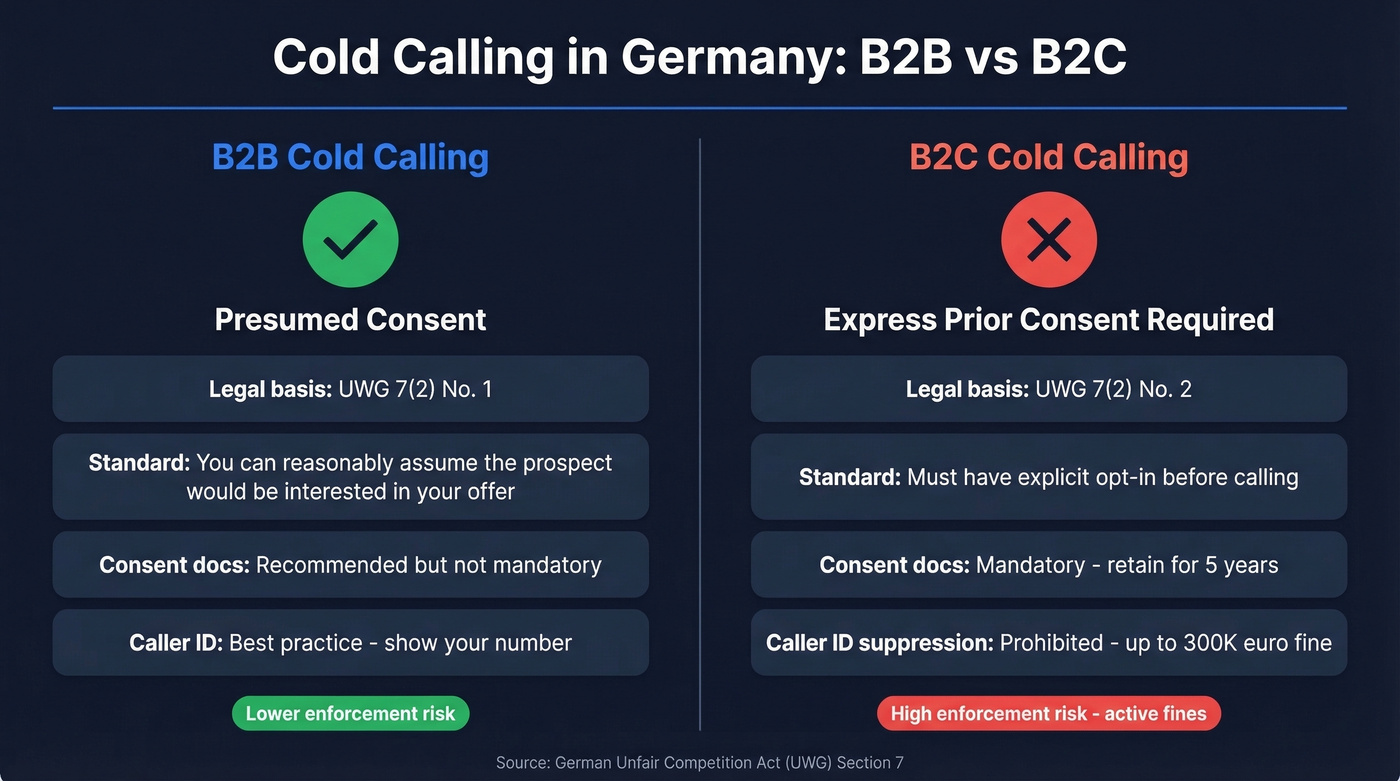
For consumers (B2C): telephone advertising generally requires express prior consent (UWG §7(2) No. 2). No wiggle room. For businesses (B2B): telephone advertising is permitted only if you can assume presumed consent (mutmaßliche Einwilligung) under UWG §7(2) No. 1. In practice, that means you can reasonably assume the person you're calling would have a concrete interest in your offer and would tolerate being contacted by phone about it.
The BGH (Germany's Federal Court of Justice) clarified this in a Feb 5, 2004 judgment (I ZR 87/02), as analyzed by PayTechLaw: B2B telephone advertising must be tolerated only when it corresponds to the company's interests such that the nuisance is acceptable. That's a higher bar than "they're in my TAM" (see addressable market).
One critical nuance: GDPR legitimate interest (Art. 6(1)(f)) doesn't automatically give you permission to cold call. The Saarland OVG held this explicitly in a case where a company collected business phone numbers from public directories and called dental practices about precious metals - listing a phone number publicly isn't presumed consent to receive advertising calls. That case was appealed to the BVerwG, with an oral hearing scheduled for late 2024, but the strict standard is still the safe assumption for outbound teams in 2026.
And if you're eyeing AI voicebots as a shortcut: UWG §7 distinguishes "telephone calls" from "automatic calling machines," and courts haven't clearly classified AI voicebots yet. From August 2, 2026, the EU AI Act (Art. 50) requires disclosing that a caller is AI unless it's obvious. Treat voicebot calls as higher-risk than human calls until case law catches up.
| B2B Cold Calling | B2C Cold Calling | |
|---|---|---|
| Legal standard | Presumed consent (mutmaßliche Einwilligung) | Express prior consent (ausdrückliche Einwilligung) |
| Legal basis | UWG §7(2) No. 1 | UWG §7(2) No. 2 |
| Consent docs | Recommended | Mandatory (5-year retention under §7a UWG) |
| Caller ID | Best practice | Suppression prohibited (up to €300K fine) |
| Enforcement risk | Low if documented | High - active fines |
Fines and Enforcement
The Bundesnetzagentur isn't messing around. In 2023, they imposed €1.435 million in fines for unsolicited marketing calls, with individual fines reaching €285,000. They processed 34,714 complaints about unwanted marketing calls that year.
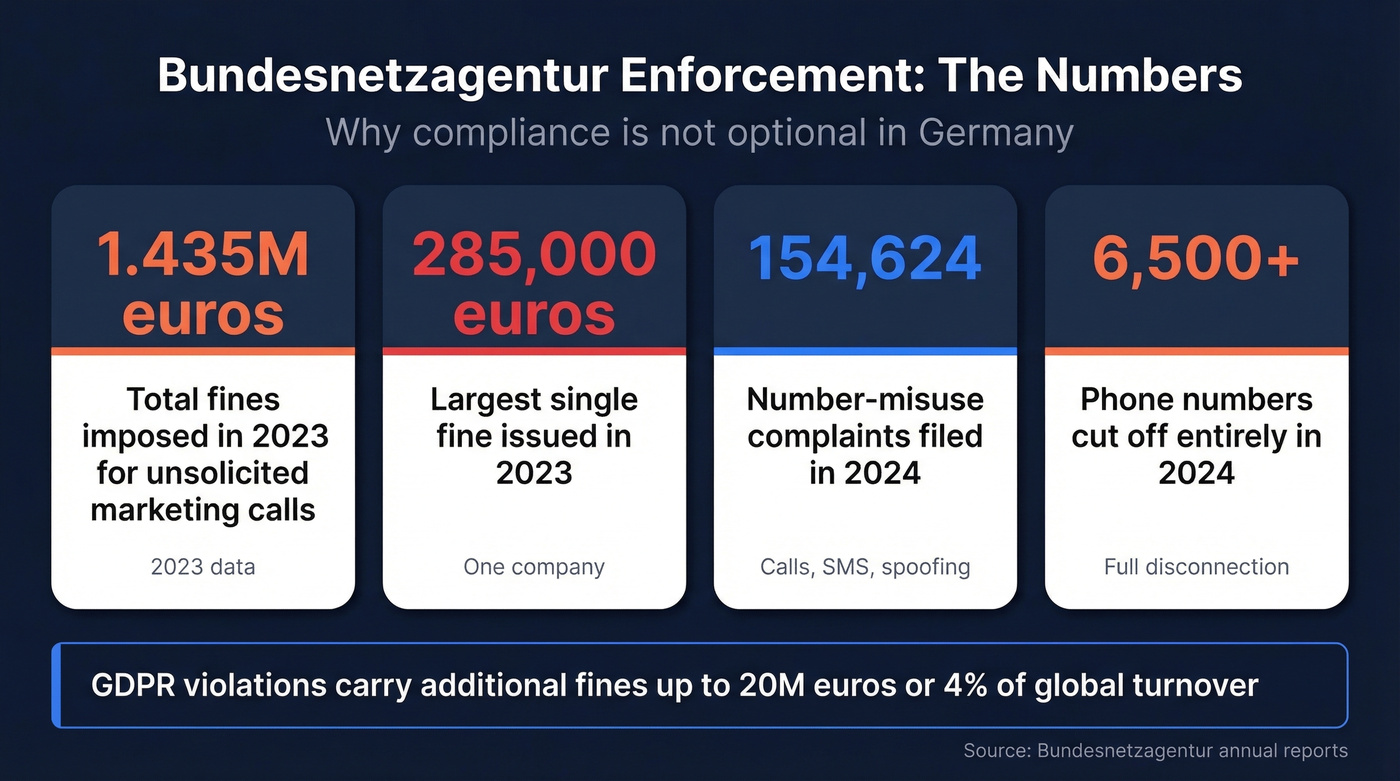
2024 got worse: 154,624 number-misuse complaints covering calls, SMS, spoofing, and more. Roughly 6,500 phone numbers were cut off entirely, and about 1,100 bans on invoicing for unlawful services were issued. On top of that, GDPR violations carry fines up to €20M or 4% of global turnover.
This enforcement is overwhelmingly aimed at consumer marketing abuse - energy supply, prize draws, construction products. In our experience, compliant B2B callers with documented presumed consent aren't the target. But the enforcement climate means German recipients are skeptical of any unsolicited call, which makes your first 10 seconds even more critical.
Pre-Call Compliance Checklist
Before your SDRs touch a dialer, lock down these items:
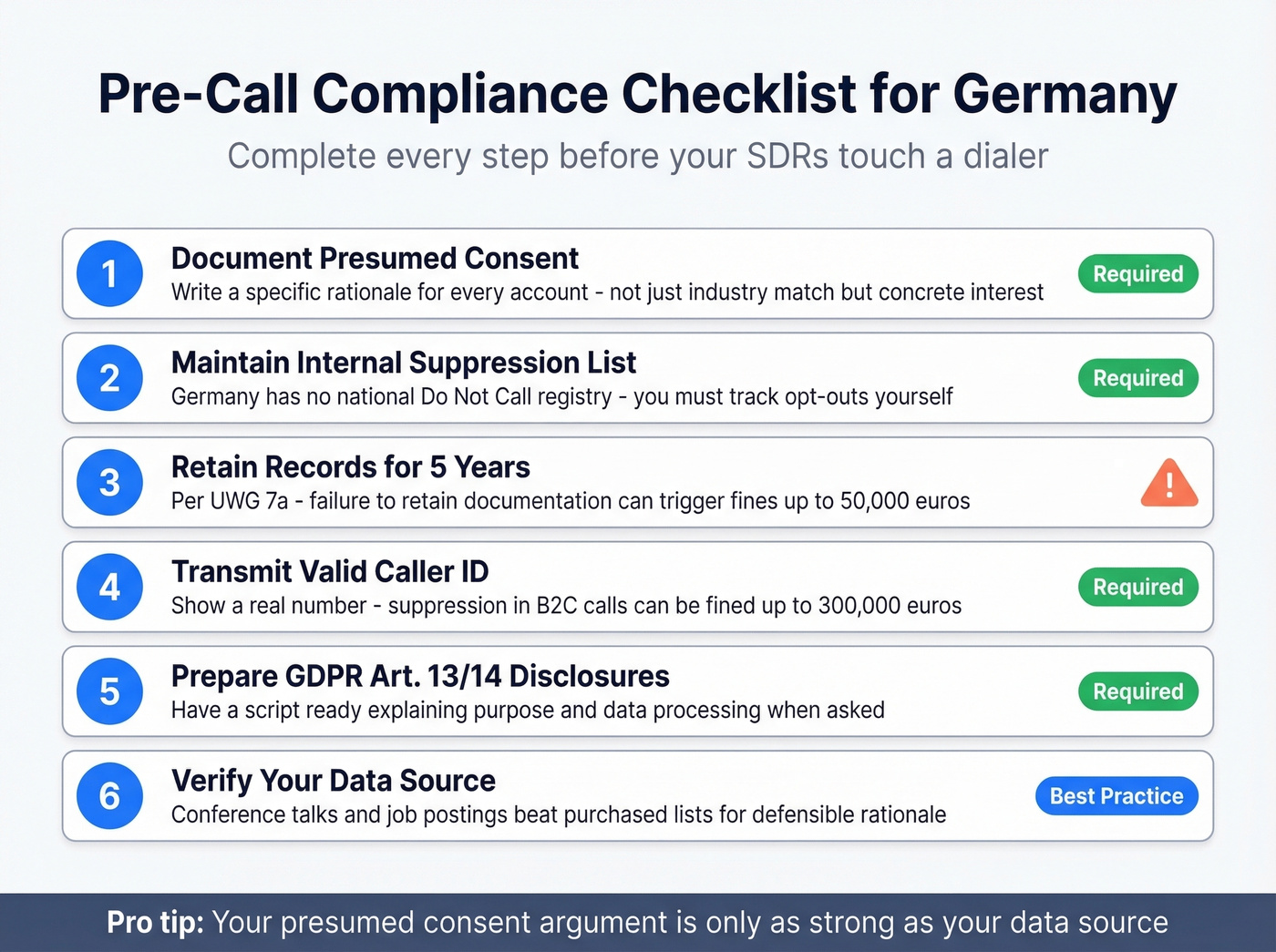
- Document presumed consent rationale for every account before dialing. "They're a SaaS company" isn't enough. "Their job postings mention migrating to Kubernetes, and we sell container security" is. (If you need a repeatable system, start with an ideal customer profile.)
- Maintain an internal suppression list. Germany has no national Do Not Call registry, so you're responsible for tracking opt-outs yourself.
- Retain consent records for 5 years per §7a UWG. Failure to retain documentation can trigger fines up to €50,000.
- Transmit a valid caller ID. For consumer marketing calls, suppressing your number is prohibited and can be fined up to €300,000. For B2B, showing a real number builds trust and signals legitimacy.
- Prepare GDPR Art. 13/14 disclosures. When you process someone's name and number, you owe them information about purpose and processing. Have a script ready.
- Verify your data source is defensible. "We bought a list" is weaker than "we identified this contact through their published conference presentation on supply chain automation." (More on data enrichment if you're standardizing sources.)

Presumed consent in Germany demands you call the right person with a defensible reason. Prospeo's 30+ search filters - including technographics, job postings, and buyer intent - let you build pre-call rationale that holds up. 125M+ verified mobile numbers with a 30% pickup rate mean you reach decision-makers directly, not gatekeepers.
Document your presumed consent with data that's refreshed every 7 days.
Tactics That Actually Convert
Let's be honest: the fact that you need a law degree to figure out whether you can make a sales call in Germany is absurd. But once you've cleared the legal bar, the cultural bar is just as important.
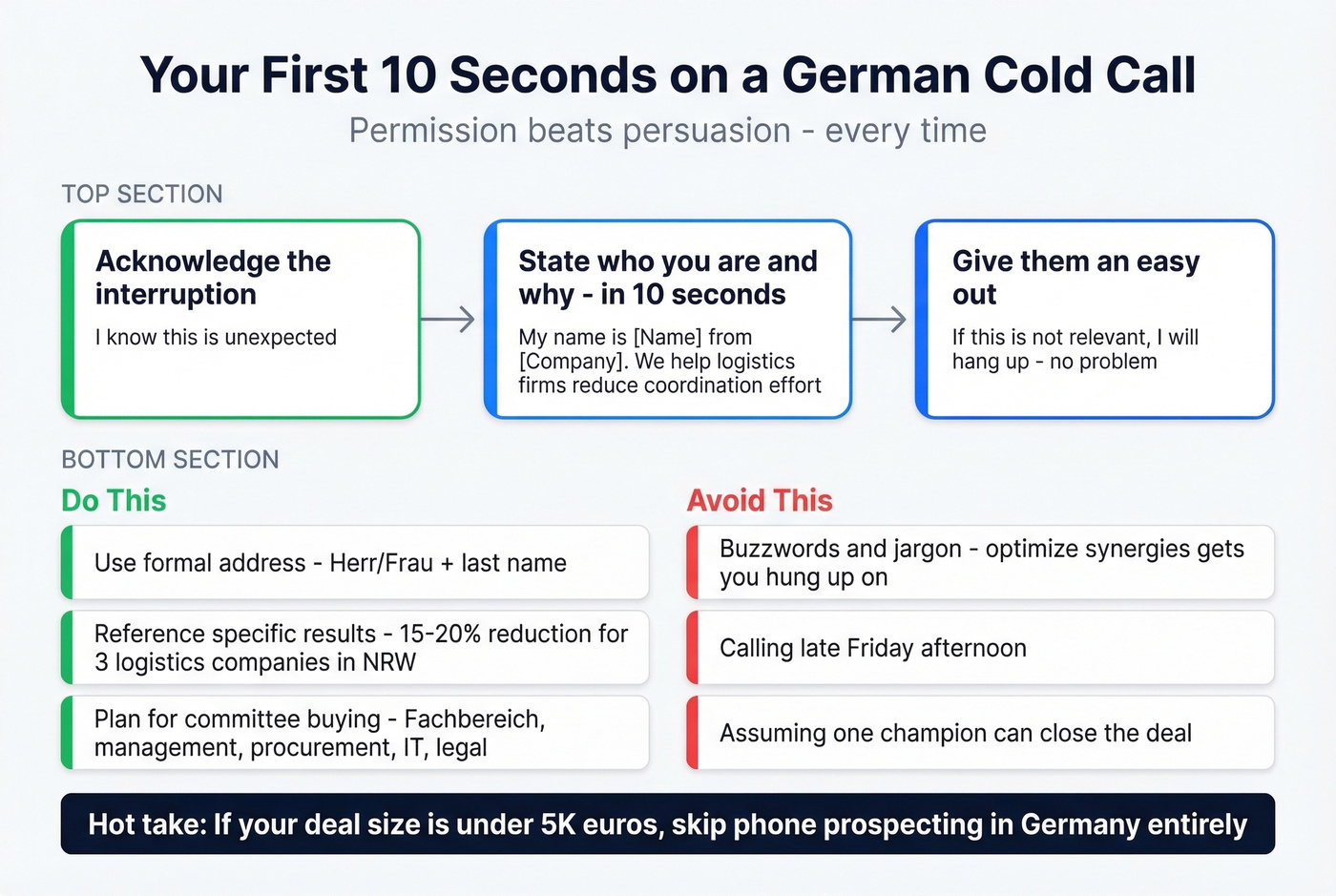
Permission beats persuasion. Germans aren't offended by outreach - they're offended by assumptions. Acknowledge the interruption, state who you are and why you're calling within 10 seconds, and give them an easy out. "If this isn't relevant, I'll hang up - no problem" goes further than any clever hook. (If your team needs more openers, borrow from these sample elevator pitches.)
Use formal address: Herr/Frau + last name until they invite you to switch. Have your Impressum visible on your website - German buyers will check, and so will their colleagues on Xing. Avoid calling late Friday afternoon. And drop the buzzwords entirely. "We help companies optimize synergies" will get you hung up on. "We reduced coordination effort by 15-20% for three logistics companies in NRW" gets you a meeting.
Germany's buying process is committee-driven. The Fachbereich (specialist department), management, procurement, and sometimes IT and legal all weigh in. Don't assume a single champion can push a deal through. Your cold call is the start of a multi-threaded process, not a one-call close, so plan your follow-up sequence to reach multiple stakeholders from the first conversation. (See team selling for how to run multi-threaded deals.)
Hot take: If your deal size is under €5K, skip phone prospecting in Germany entirely. The compliance overhead and multi-stakeholder sales cycle make outbound calls most valuable for mid-market and enterprise deals where a single meeting can justify 200 dials. For low-ACV plays, invest in inbound and partnerships instead. (If you're building the broader motion, use these sales prospecting techniques.)
Benchmarks for German Outbound
Set expectations before you launch. These are global benchmarks - expect the lower end initially when calling German prospects, but higher conversion quality once you break through.
| Metric | Typical Range |
|---|---|
| Meeting booking rate | 2-3% avg, 6-10% top performers |
| WHAM dataset rate | 4.82% |
| Avg successful call length | ~93 seconds |
| Connect rate | 3-10% |
| Follow-ups needed | 80% of sales need 5+ |
The connect rate is where data quality makes or breaks you. We've seen teams triple their connect rates just by switching from switchboard numbers to verified direct dials - the difference between 3% and 10% is almost entirely a data problem, not a skills problem. (If you're building a repeatable motion, start with a cold calling system.)
Sourcing Compliant Phone Data
Your presumed consent argument is only as strong as your data. If you're calling the wrong person at the wrong company because your list is six months stale, you've got no defensible rationale - and you're wasting dials.
This is where most teams trip up. They spend weeks building a compliance framework, then feed it garbage data from a list broker who last verified numbers in Q3 of last year. In a market where every call needs a documented rationale, stale data isn't just a productivity drain - it's a compliance risk.
Prospeo's mobile finder covers 125M+ verified mobile numbers on a 7-day refresh cycle, which directly supports your presumed consent defense. A 30% mobile pickup rate means your reps are actually reaching decision-makers, not voicemail boxes. The free tier gives you 75 credits to test before committing, and the platform is fully GDPR compliant with DPAs available. (If you're comparing sources, start with sales prospecting databases.)
Bad data is your biggest compliance risk in Germany. Wrong contact, wrong company, no presumed consent argument - and you're exposed. Prospeo's 5-step verification delivers 98% email accuracy and verified direct dials, so every call maps to a real person with a defensible reason to dial.
Stop risking Bundesnetzagentur fines on unverified contact lists.
FAQ
Is cold email also legal in Germany?
No. Cold email to businesses requires express prior consent under UWG §7(2) No. 3. Unlike phone outreach, there's no "presumed consent" exception for B2B email. This is the opposite of the US CAN-SPAM model - in Germany, you need opt-in first. That's why the phone is actually your strongest outbound channel here.
Do I need to speak German?
Enterprise and tech decision-makers often speak English fluently, but gatekeepers and mid-market Mittelstand companies strongly prefer German. If you're calling from abroad, hire native-speaking SDRs. Teams consistently report 2-3x higher conversion rates with German-speaking reps versus English-only callers. Skip this step at your own peril.
What about AI voicebot cold calls?
Legally uncertain. UWG §7 distinguishes "telephone calls" from "automatic calling machines," and courts haven't classified AI voicebots yet. From August 2, 2026, the EU AI Act (Art. 50) requires disclosing that a caller is AI. Treat voicebot calls as higher-risk and ensure full transparency until there's clear precedent.
How do I find verified German mobile numbers?
Prospeo's mobile finder includes 125M+ verified numbers refreshed every 7 days, with GDPR-compliant sourcing and DPAs available. Hunter and Lusha also offer German number coverage, but we've found the weekly refresh cycle matters most in compliance-heavy markets where stale data creates real legal exposure.