

How to Build a Cold Calling Pitch That Actually Books Meetings
You've memorized scripts. You've bookmarked guides. You still freeze up two seconds after "Hi, this is [name] from [company]."
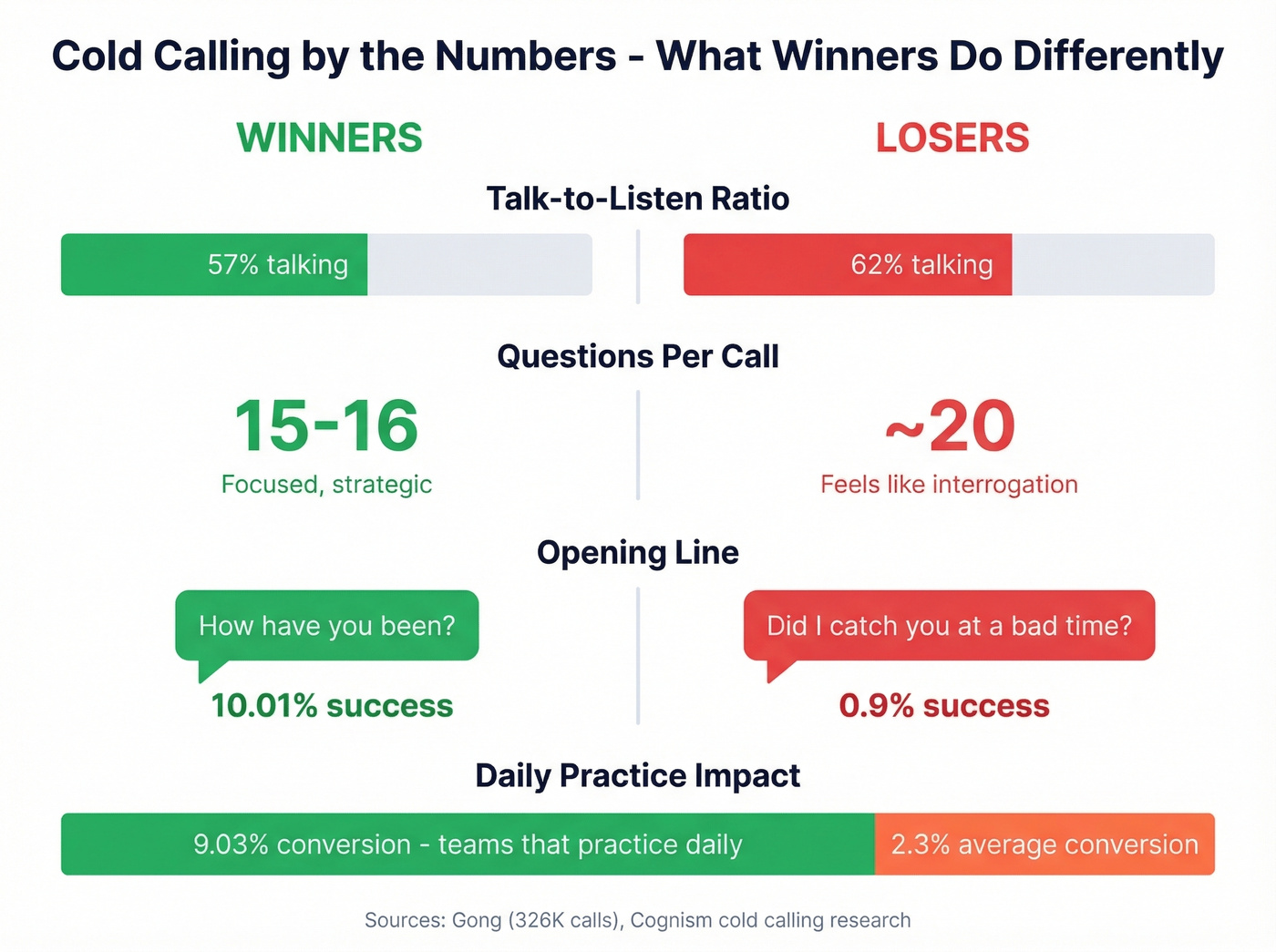
The problem isn't effort - it's focus. Most cold calling advice dumps talk tracks on you like recipes, but nobody isolates the 15-30 second value proposition moment that determines whether the call lives or dies. An analysis of 90,380 cold calls found that asking "Did I catch you at a bad time?" craters your success rate to 0.9%. Reps who opened with "How've you been?" - on a cold call to a stranger - booked meetings at a 10.01% rate. The words matter, but not the way most guides teach them.
And RAIN Group research shows 82% of buyers will take a meeting with a seller who reaches out proactively, if the value is clear. The opportunity is real. Your cold calling pitch just needs to earn it.
The Three Things That Actually Matter
Three things separate reps who book meetings from reps who burn through dial lists:
- Verified data so you actually reach someone. If half your dials go to voicemail or disconnected lines, your pitch never gets heard. (If you’re rebuilding your outbound stack, start with a cold calling system.)
- A 15-second pitch that names their problem. Not your product. Their problem. (If you want examples to model, pull from these sample elevator pitches.)
- A micro-commitment close. You're selling the meeting, not the product. (This maps cleanly to the steps to close a sale framework.)
Everything below unpacks those three elements.
Your Pitch Isn't Your Script
Most cold calling guides conflate two different things. Let's separate them.
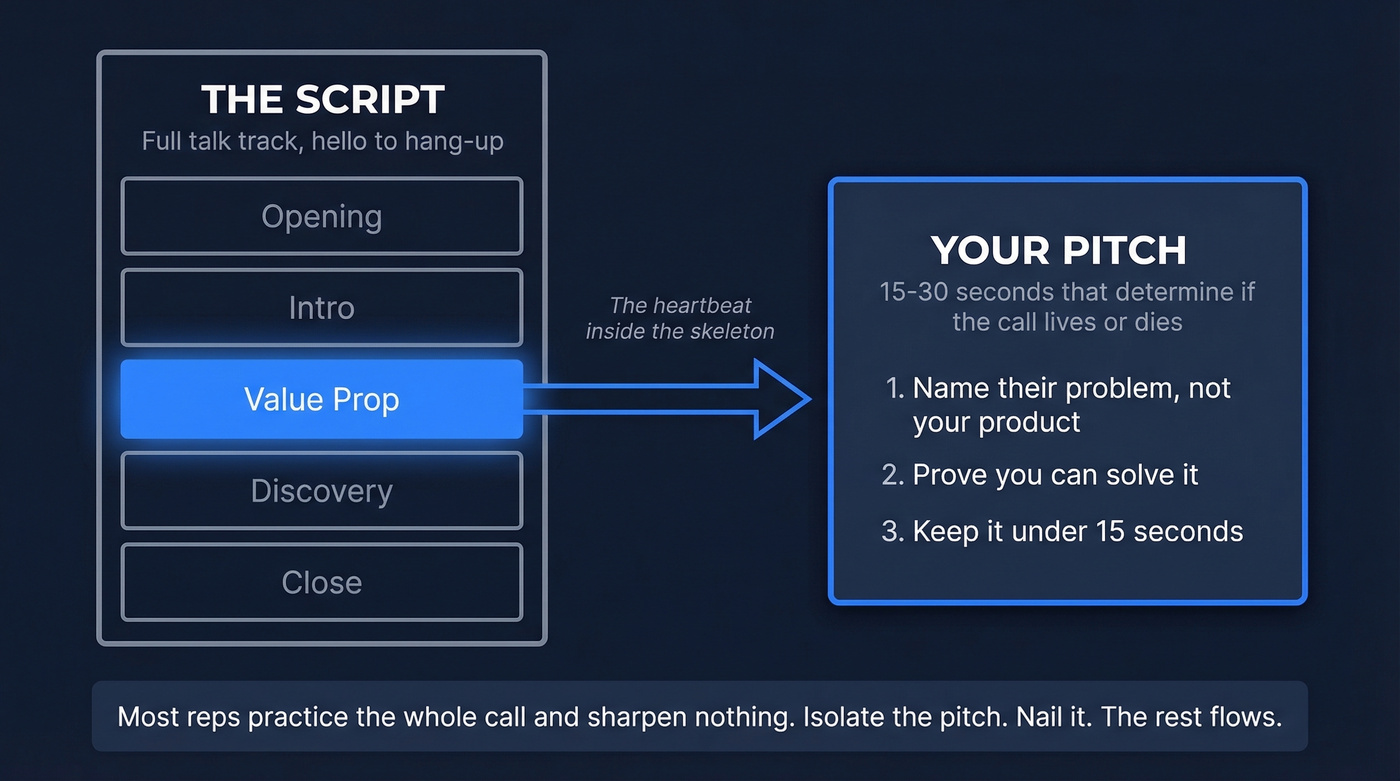
Your script is the full talk track - the structure that guides you from hello to hang-up. Your pitch is the 15-30 second value proposition moment inside that script where you earn the right to keep talking. A script is the skeleton. Your pitch is the heartbeat.
We've watched hundreds of reps freeze up not because their pitch was bad, but because they never isolated it from the script. They practiced the whole call and sharpened nothing. That's backwards. Nail the pitch, and the rest of the call flows naturally.
Anatomy of a Pitch That Converts
Every high-converting cold calling pitch contains five building blocks. The order matters. Skip one, and the whole thing collapses.
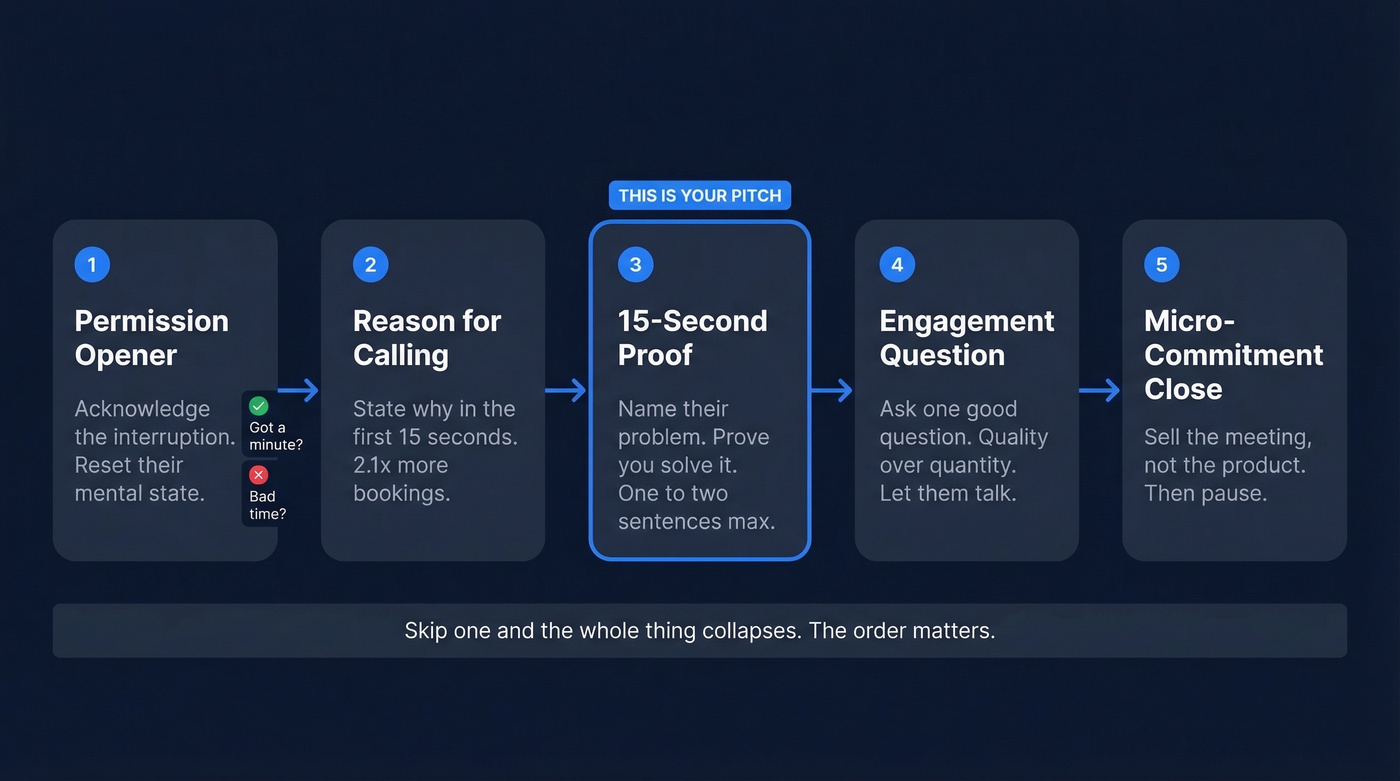
Permission Opener
You interrupted someone's day. Acknowledge it. "Hey [name], caught you out of the blue - got a minute?" This isn't politeness for politeness' sake. It's a pattern interrupt that resets the prospect's mental state from "who is this?" to "okay, I'm choosing to listen."
What you don't say: "Did I catch you at a bad time?" Data from 90K+ cold calls shows that phrase makes you 40% less likely to book a meeting.
Reason for Calling
State why you're calling within the first 15 seconds. Reps who stated the reason early were 2.1x more likely to book a meeting. Don't bury the lead. "The reason I'm calling is..." followed by a problem statement, not a product description. (If you’re struggling to pick the right “problem,” start with an Ideal Customer Profile so your opener matches who you’re calling.)
15-Second Proof Statement
This is the pitch itself - your elevator statement distilled to its most potent form. One or two sentences that name a problem the prospect likely has and prove you can solve it: "We help [type of company] [solve specific problem] - companies like [competitor or peer] are using us to [specific outcome]." Keep it under 15 seconds. Research on 326K+ sales calls shows that lost deals feature longer seller monologues. Shorter wins.
Engagement Question
Don't monologue past your proof statement. Ask a question that invites the prospect to talk. Quality beats quantity here - won deals actually have fewer questions than lost ones, according to Gong's analysis. One good question after your proof statement ("Is that something you're running into?") beats five rapid-fire discovery questions that feel like an interrogation. (For a deeper bank of options, use these discovery questions.)
Micro-Commitment Close
You're not closing a deal. You're closing a meeting. "I'd love 20 minutes to show you how this works - does Thursday afternoon work?" Then pause. Let the silence do the work.
Cold Call Pitch Templates
New Prospect Template
"Hey [name], it's [your name] from [company] - caught you out of the blue. Got a minute?"
[Wait for response]
"The reason I'm calling - we help [industry] companies cut [specific problem] by [specific outcome]. Companies like [peer company] are seeing [result]."
"Is that something your team's dealing with right now?"
[If yes] "Great - I'd love to set aside 20 minutes to walk through how. Does [day/time] work?"
The bolded section is your pitch. Practice it until you can deliver it in under 15 seconds without sounding rushed.
Trigger-Event Pitch
"Hey [name], congrats on the Series B - saw the announcement last week. Quick question: as you scale the team, are you running into [problem that scaling creates]?"
[Wait for response]
"We work with post-funding companies to [solve that specific problem] - [peer company] brought us in right after their raise and [specific result]."
"Worth a 20-minute call to see if it fits?"
Trigger events - funding rounds, leadership changes, hiring surges, product launches - give you a reason to call that isn't "I found you in a database." Spend 2-3 minutes researching before dialing. Layer in firmographic and technographic details: their tech stack, recent headcount growth, or a competitor they just lost a deal to. That specificity is the difference between sounding relevant and sounding generic. (If you want a repeatable way to operationalize this, see how to track sales triggers.)
Referral Pitch
Skip the blockquote format here because the referral does the heavy lifting. Name the mutual connection in your first sentence, state the specific result you delivered for that connection, and ask for 15 minutes. That's it. Don't overcomplicate your highest-conversion template: "Hey [name], [mutual connection] suggested I reach out - we helped their team [specific result], and they thought it'd be relevant for you. Do you have 15 minutes this week?"
"Not Interested" Re-Engagement
"Totally fair - and I appreciate you being direct. Quick question before I let you go: is it the timing that's off, or does the topic just not resonate?"
[If timing] "Makes sense. When would be a better window? I'll put something on the calendar and you can cancel if it doesn't make sense."
[If topic] "Got it. What's actually top of mind for you right now?"
This connects directly to the objection handling framework below.
One delivery tip that matters more than any template: Slow down. Stand up. Smile. The consensus on r/sales is that delivery matters more than word choice - and we'd agree. A mediocre pitch delivered with confidence and warmth beats a perfect script read in monotone. Here's a timing hack from those same threads: Friday afternoons can be gold for reaching VPs and C-suite, because the gatekeepers have already checked out for the weekend.

You just learned that your pitch lives or dies in 15 seconds. But none of that matters if you're dialing dead numbers. Prospeo gives you 125M+ verified mobile numbers with a 30% pickup rate - so your pitch actually reaches a human. At $0.01 per lead, bad data is no longer an excuse.
Stop perfecting a pitch nobody hears. Start dialing numbers that connect.
What the Data Says in 2026
| Metric | Winners | Losers | Source |
|---|---|---|---|
| Talk-to-listen ratio | 57% talk | 62% talk | Gong (326K calls) |
| Questions per call | 15-16 | ~20 | Gong (326K calls) |
| "Bad time?" opener | - | 0.9% success | Gong (90K calls) |
| "How've you been?" | 10.01% success | - | Gong (90K calls) |
| Reason stated early | 2.1x more bookings | - | Gong (90K calls) |
Conversion rates tell a different story depending on what you sell:
| Industry | Conversion Rate | Calls per Sale |
|---|---|---|
| Business services | 2.61% | ~38 |
| Telecommunications | 1.29% | ~78 |
| Technology/software | 0.95% | ~105 |
| Average (all) | 2.35% | ~43 |
The average cold calling success rate dropped from 4.82% in 2024 to roughly 2.3% more recently. That decline makes pitch quality more important than ever. But here's the stat that should change how you allocate your time: teams that practice daily hit a 9.03% conversion rate, according to Cognism's cold calling data. Not weekly, not monthly. Daily. The gap between 2.3% and 9% isn't talent - it's reps. (To systematize practice and coaching, borrow from these sales training tips.)
Here's the thing: if your deal size is under $50K, cold calling is probably your highest-ROI outbound channel. For seven-figure enterprise deals, cold calling alone won't fill your pipeline - but as one channel in a multi-touch sequence, it's irreplaceable.
Pitch Mistakes That Kill Deals
These aren't theoretical. They're the patterns we see kill call performance over and over.
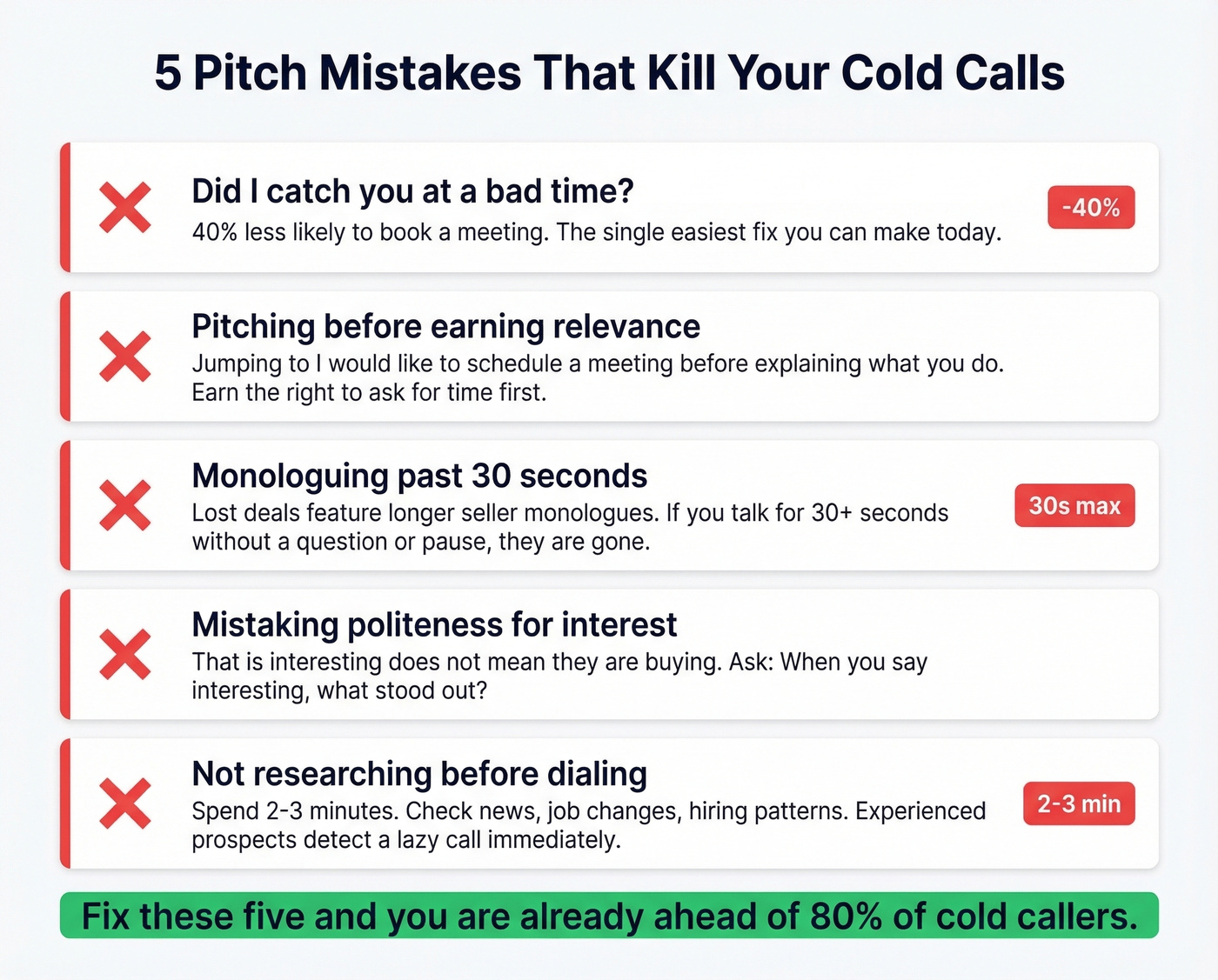
"Did I catch you at a bad time?" makes you 40% less likely to book. Don't say it. Ever. This is the single easiest fix you can make today.
Pitching before earning relevance is the second-biggest killer. One Reddit poster shared a pitch that jumped straight to "I'd like to schedule a meeting to introduce myself." The prospect immediately asked "What do you do?" - and the rep had to improvise an explanation they should've led with. Earn the right to ask for time.
Monologuing past 30 seconds is a death sentence. The data is unambiguous: lost deals feature longer seller monologues. If you're talking for more than 30 seconds without a question or pause, you've lost them.
Mistaking politeness for interest is just as dangerous - a prospect saying "that's interesting" isn't buying. Qualify it: "When you say interesting, what stood out?" These qualifying questions separate polite brush-offs from real engagement. And not researching before dialing? Spend 2-3 minutes. Check for recent news, job changes, hiring patterns. Experienced prospects detect a lazy, unprepared call immediately.
Handling "Not Interested"
"Not interested" accounts for roughly 49% of all cold call objections. It's not a wall - it's a door with a lock you can pick.
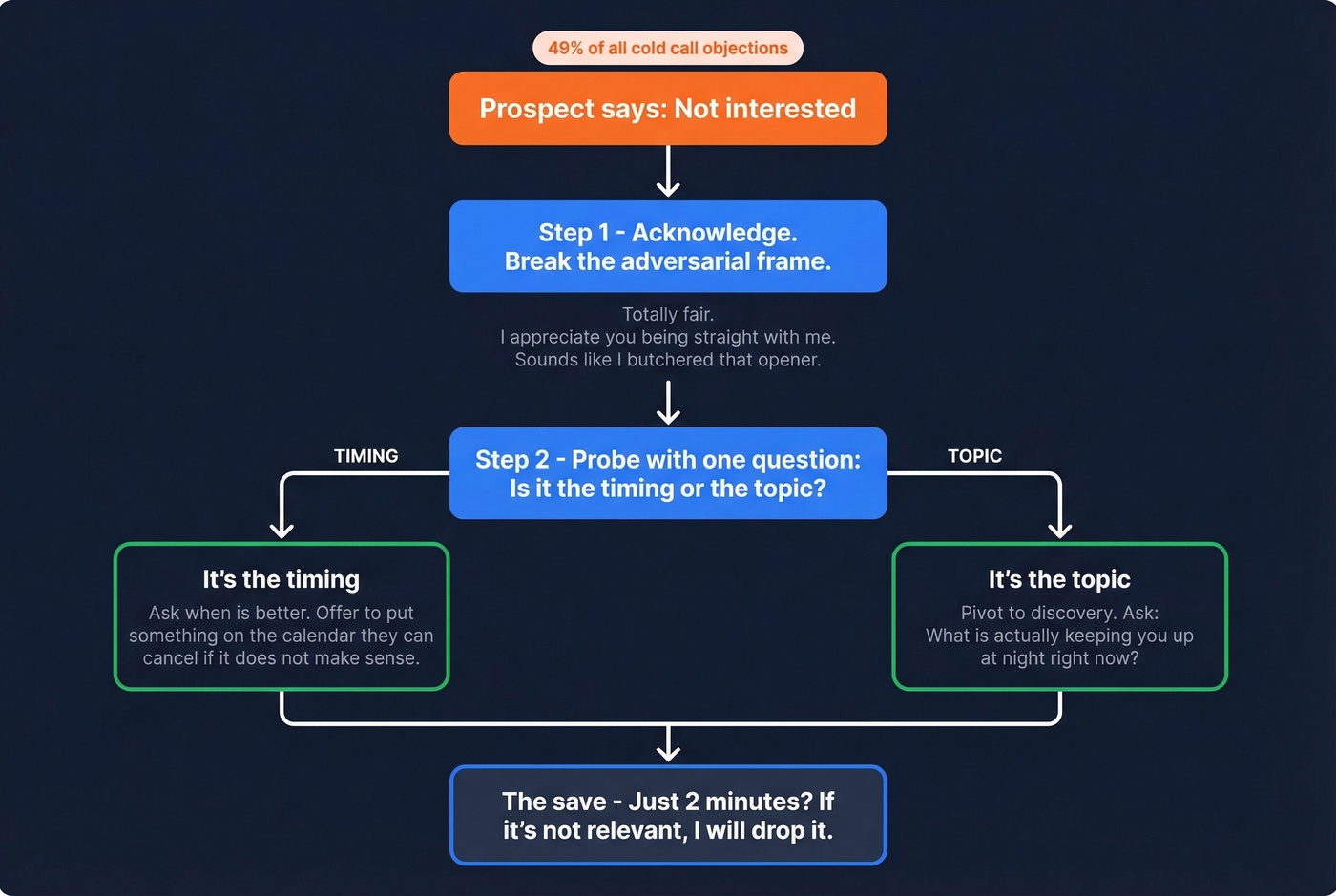
Acknowledge. Don't fight it. "Totally fair" or "I appreciate you being straight with me" or even a pattern interrupt like "Sounds like I butchered that opener." Break the adversarial frame.
Probe. One question: "Is it the timing or the topic?" This forces specificity. "Not interested" is vague. Timing vs. topic is actionable.
Respond to what you learn. If it's timing, ask when's better. If it's the topic, pivot: "What's actually keeping you up at night right now?"
When they say "send me an email" - and they will - don't just comply. Try: "Happy to. So I send you something relevant, what's the biggest challenge you're working on this quarter?" This turns a brush-off into a discovery question and gives you one more shot. The micro-commitment that saves calls: "Just 2 minutes? If it's not relevant, I'll drop it."
Before You Pitch - Fix Your Data
Here's what gets overlooked: even small amounts of bad contact data wreck cold calling. People change jobs, get promoted, switch numbers. If your dial list is stale, your pitch never gets heard - and your reps burn out dialing ghosts. In our experience, reps who nail the pitch but dial bad numbers burn out fastest. No training session or talk track fixes a list full of dead numbers. (If you’re cleaning and upgrading records, look at data enrichment services.)
Prospeo solves this at the source - 125M+ verified mobile numbers with a 30% pickup rate, refreshed every 7 days versus the six-week industry average. Email accuracy sits at 98%. GreyScout cut rep ramp time from 8-10 weeks to 4 weeks after switching. Meritt tripled their connect rate to 20-25%. The pitch matters, but only if a human picks up the phone. (If you’re evaluating providers, compare options in our sales prospecting database guide.)
Trigger-event pitches need fresh data. Prospeo refreshes every 7 days - not the 6-week industry average - so you're calling about last week's funding round with a number that still works. Layer 30+ filters like job changes, headcount growth, and buyer intent to nail the specificity that separates relevant from generic.
Turn trigger events into booked meetings with data that's never stale.
FAQ
How long should a cold calling pitch be?
Your proof statement should be 15-30 seconds. The full call runs under 5 minutes for a successful booking. Successful cold calls are almost twice as long as unsuccessful ones - because the prospect is engaged and talking, not because the rep is monologuing.
What makes a good sales pitch for cold calling?
A strong pitch names the prospect's problem before mentioning your product, delivers a proof statement in under 15 seconds, and closes with a micro-commitment - not a hard sell. It should feel like a conversation, not a presentation. Use the five building blocks: permission, reason, proof, question, close.
What's a good cold call conversion rate?
The average sits around 2.3%, down from 4.82% in 2024. Top performers with daily practice hit 9%+. Business services averages 2.61%, while technology/software sits at 0.95%. If you're above 3%, you're outperforming most teams.
Should I use a word-for-word script?
No. Use a framework - the five building blocks - and practice until delivery sounds natural. Word-for-word scripts sound robotic. Winging it leads to rambling and missed closes. The framework gives you structure with room to adapt. Skip word-for-word memorization if you want to sound like a human, not a recording.