

Cold Calling Strategies for 2026: The Data-Backed Playbook Top Reps Actually Use
Your SDR team made 800 dials last month. They booked two meetings. Morale's in the gutter, the VP of Sales is questioning headcount, and someone floated the idea of going "inbound only." Meanwhile, a team across town made the same 800 dials and booked 18 meetings. Same market, same personas, same economy.
That gap isn't about hustle or talent. Gong analyzed 300M+ cold calls and found the difference is almost entirely systematic - data quality, call structure, and cadence design. This piece covers methodology, operations, and compliance, because you need all three to actually move the number. Let's get into it.
The Playbook in Three Lines
If you're short on time:
- Clean your data first. Verified direct dials are one of the biggest connect-rate levers - not scripts, not tone, not time of day.
- Use the 30MPC framework for your first 15 seconds. Context-first openers, not "How's your day going?" Permission language increases compliance by up to 400%.
- Build a 6-8 touch multichannel cadence capped at 5 call attempts per prospect. 93% of conversations happen by attempt 3, 98.6% by attempt 5. Everything after that is wasted effort.
2026 Benchmarks That Matter
You can't improve what you don't measure. Here's where the industry actually stands, based on the largest datasets available.
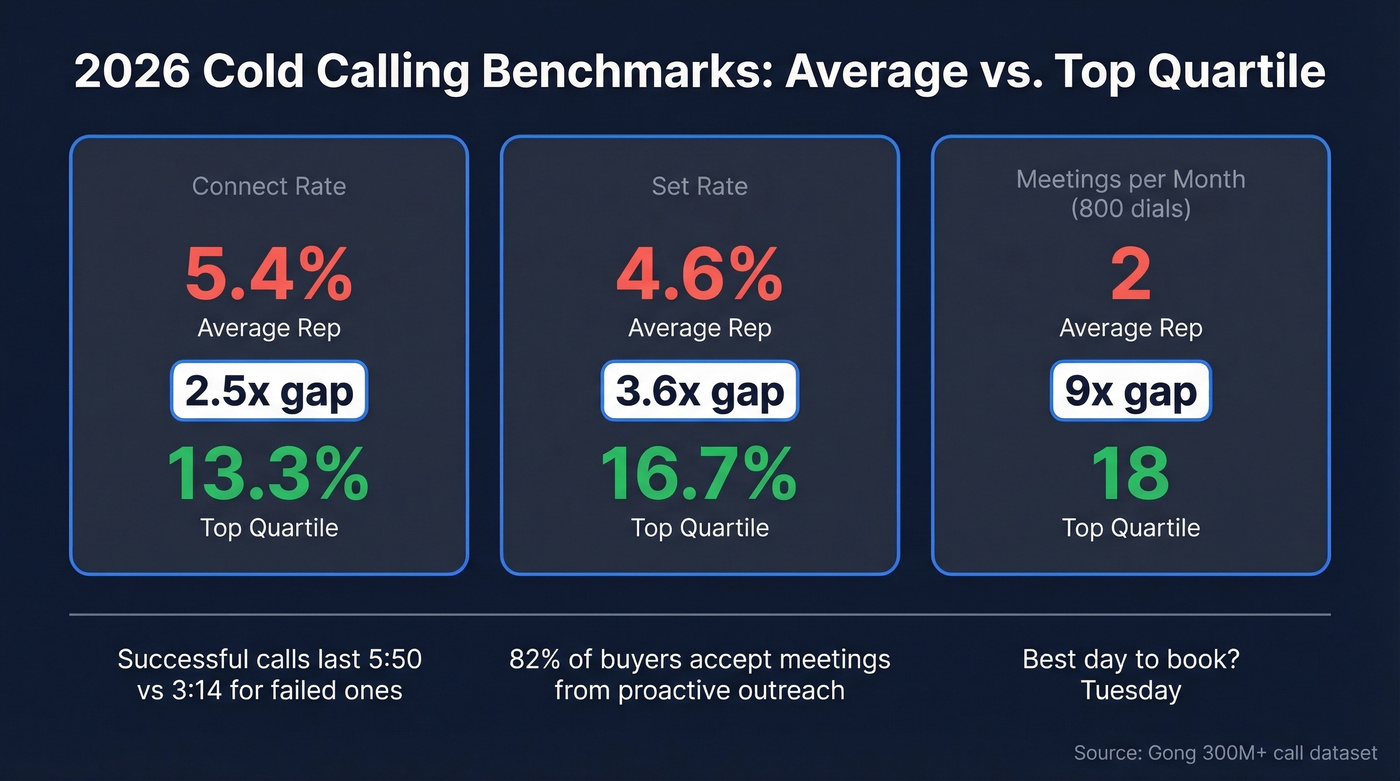
| Metric | Average Rep | Top Quartile | Gap |
|---|---|---|---|
| Connect rate | 5.4% | 13.3% | 2.5x |
| Set rate | 4.6% | 16.7% | 3.6x |
| Meetings/mo (800 dials) | 2 | 18 | 9x |
Those numbers come from Gong's 300M-call dataset. The gap is staggering - and it compounds. A top-quartile rep doesn't just connect more often; they convert conversations to meetings at 3.6x the rate. Two separate multipliers stacking on each other.
A few more benchmarks worth pinning to your wall: successful cold calls last 5:50 on average versus 3:14 for failed ones - roughly 2x longer. 82% of buyers say they'll accept meetings with sellers who proactively reach out, per RAIN Group. The Cognism/WHAM report pegs the baseline success rate (conversation to meeting booked) at 4.82%. Best day for bookings? Tuesday, consistently.
Once you actually reach someone, about 65.6% of conversations convert to a meaningful next step. The bottleneck is always the connect, not the conversation.
Why Data Quality Beats Scripts
Stop optimizing your script. Start optimizing your list.
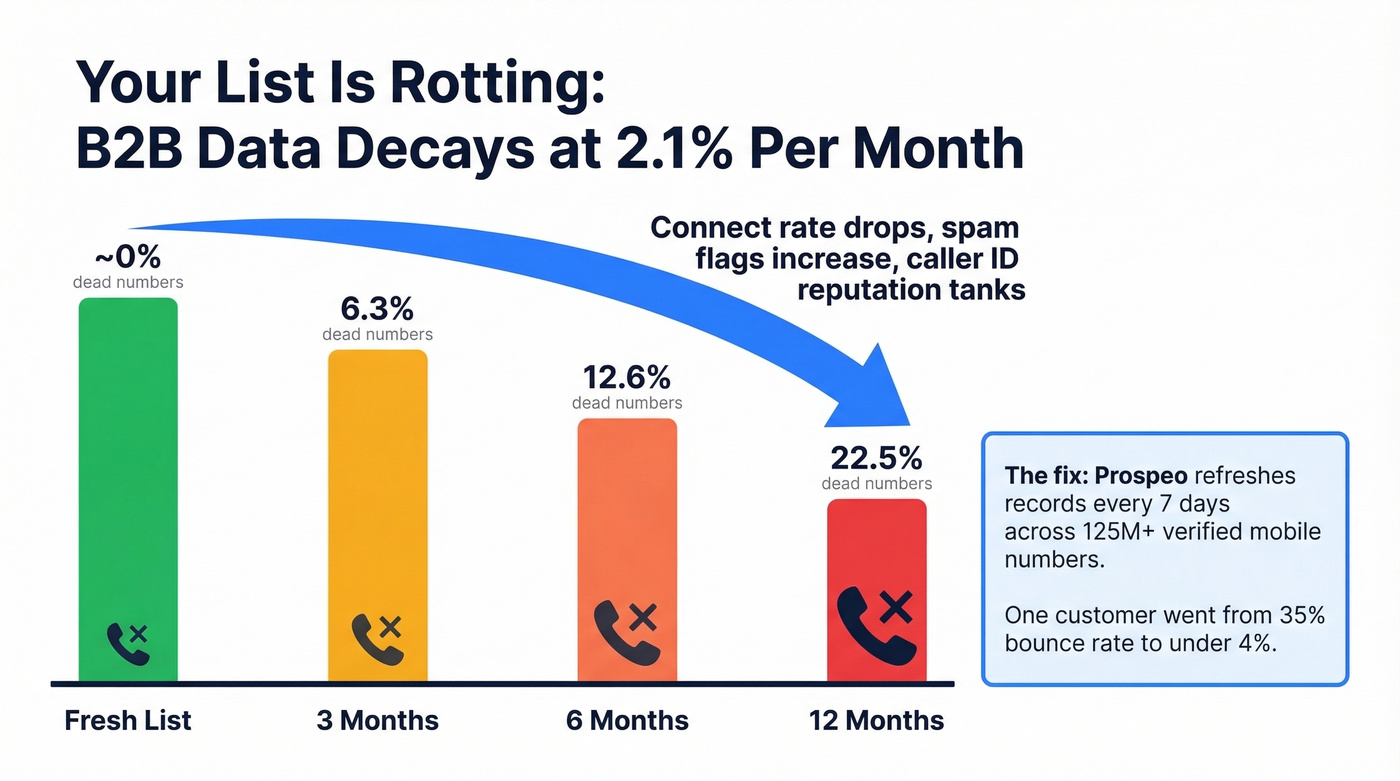
B2B contact data decays at 2.1% per month - that's 22.5% annually. If you're calling a list that's three months old, about 6.3% of numbers are already dead. Six months? You're burning through roughly 12.6% dead numbers, tanking your caller ID reputation in the process.
Gong's data shows top-performing reps don't just make more calls - they prioritize direct dials and actively mark bad numbers so they never re-dial dead lines. That's an operational discipline, not a sales skill. The data also reveals something counterintuitive: cold calling nearly doubles email reply rates even when you don't get a live connect (3.44% versus 1.81%). The voicemail itself creates familiarity that makes the follow-up email land.
This is where your data provider matters more than your script. Prospeo's database covers 300M+ professional profiles, 143M+ verified emails, and 125M+ verified mobile numbers with a 30% pickup rate - roughly 2.5x what most competitors deliver. Records refresh on a 7-day cycle, so you're not burning dials on contacts who changed roles last quarter. One customer, Meritt, saw their connect rate triple to 20-25% after switching, with bounce rates dropping from 35% to under 4%.
We've seen this pattern repeatedly: teams invest in expensive dialers and coaching programs while feeding reps garbage data. Fix the inputs first. Everything downstream gets easier.
The Framework That Works
The 30MPC framework is the best structure we've found for B2B cold calls. It's built on four parts: a context-first opener, a problem proposition, an interest-based CTA, and a redirect method for objections.
Context-First Openers
Your first 15 seconds determine everything. Most reps blow it with some variation of "Hi, this is Jake from Acme, how are you today?" The prospect's guard goes up instantly.
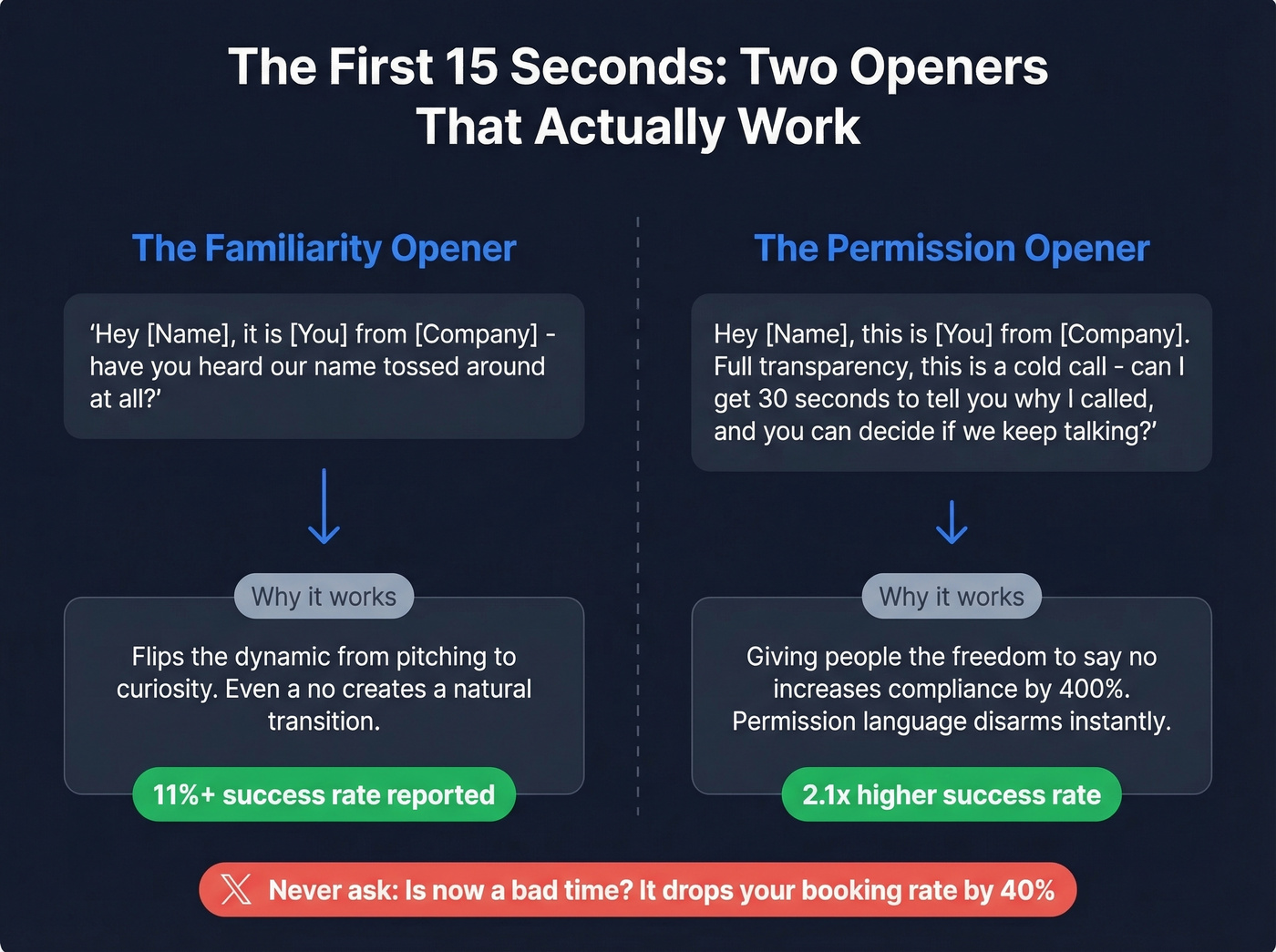
Gong's data shows that stating the reason for your call yields a 2.1x higher success rate - which is exactly why both of the following openers lead with context, not pleasantries.
The familiarity opener: "Hey [Name], it's [You] from [Company] - have you heard our name tossed around at all?" This flips the dynamic. Instead of pitching, you're asking a question that creates curiosity. Even if they say no, you've earned a natural transition into why you're calling. Reps on r/salesdevelopment report 11%+ success rates with this opener - one called the underlying framework "zero fluff, 100+ talk tracks."
The tailored permission opener: "Hey [Name], this is [You] from [Company]. Full transparency, this is a cold call - can I get 30 seconds to tell you why I called, and you can decide if we keep talking?" The behavioral science here is real: adding "you're free to accept or refuse" language increased compliance by 400% in donation studies. Permission language disarms because it gives the prospect control.
What doesn't work? "Is now a bad time?" drops your booking rate by 40%, per Gong. Don't ask it. Ever. (If you want a cleaner alternative, use a permission-based opener instead.)
The Problem Proposition
Once you've earned 30 seconds, you need to describe a problem so specific the prospect thinks you've been sitting in their team meeting. The 30MPC framework calls this "movie-scene specificity" - paint the picture of the exact frustration they're living with.
Bad version: "We help companies improve their sales productivity."
Good version: "What I'm hearing from other VPs of Sales at Series B companies is that their reps are spending two hours a day manually researching prospects instead of actually calling. By the time they've built a list, half the numbers are wrong. We fix that - verified direct dials, refreshed weekly, so reps spend time talking instead of Googling."
Then the interest-based CTA: "Does that sound like something worth exploring, or am I totally off base?" You're validating interest before asking for a meeting. It feels collaborative, not pushy.
Objection Handling: The Redirect
The 30MPC framework uses what they call the "Mr. Miyagi" approach - agree first, then redirect. Fighting objections head-on creates resistance. Agreeing disarms. The Cognism/WHAM report identifies the top four objections:
"Not interested" - "Totally fair - most people aren't until they hear the specific problem we solve. Can I take 20 seconds? If it doesn't resonate, I'll hang up."
"I'm busy" - "I respect that. When's a better 90 seconds?" Don't ask for a meeting - ask for 90 seconds.
"Just email me" - "Happy to. So I don't send you something generic - what's the biggest headache your team's dealing with on [relevant topic] right now?" Turn the brush-off into a qualifying question.
"We already have a solution" - "Good - that tells me you take this seriously. What's the one thing you'd change about your current setup?"

The article says it clearly: data quality beats scripts. Prospeo gives your reps 125M+ verified mobile numbers with a 30% pickup rate - 2.5x the industry average. Records refresh every 7 days, so you stop burning dials on dead lines. Meritt tripled their connect rate to 20-25% after switching.
Stop coaching reps on scripts while feeding them garbage data.
Building a Multichannel Cadence
Cold calling in isolation is a grind. Cold calling inside a multichannel cadence is a system. Multichannel campaigns drive results up to 287% higher than single-channel outreach.
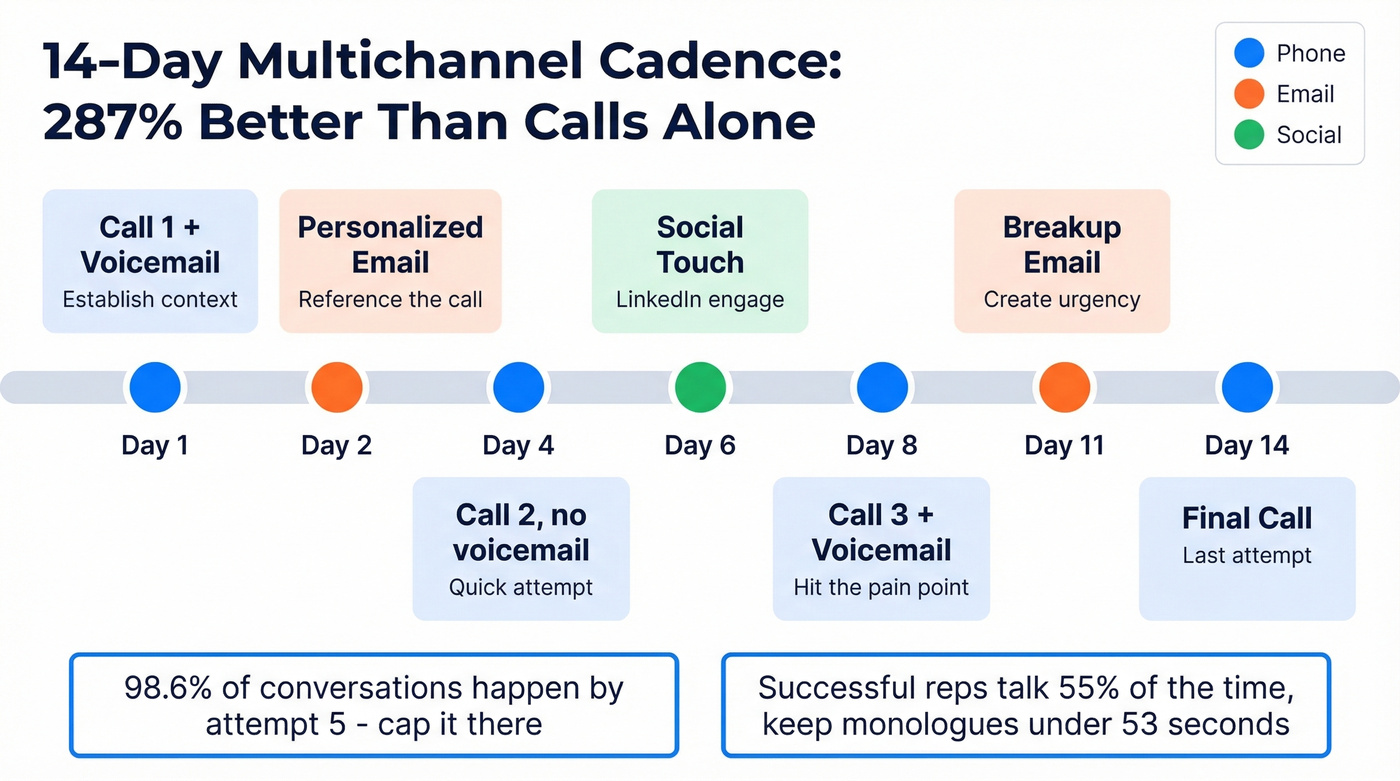
| Day | Touch | Channel |
|---|---|---|
| 1 | Call #1 + voicemail | Phone |
| 2 | Personalized email | |
| 4 | Call #2 (no VM) | Phone |
| 6 | Social touch | Social |
| 8 | Call #3 + voicemail | Phone |
| 11 | Breakup email | |
| 14 | Final call | Phone |
Cap call attempts at five per prospect - 98.6% of conversations happen by then. Beyond five, you're annoying people and burning caller ID reputation with zero upside.
Voicemails aren't about getting callbacks. They're about priming the email. The two-voicemail approach works well: first voicemail establishes context ("Hey, I'm calling because..."), second voicemail hits the pain point. Both help lift reply rates because the prospect recognizes your name when the email arrives. (If you want templates, start with these cold call voicemail scripts.)
On talk-time ratio: Gong's data shows successful reps talk about 55% of the time during a cold call. Keep monologues under 53 seconds before shifting to a question. Longer than that and you've lost them.
Why Your Calls Get Blocked
Here's a scenario we've watched play out dozens of times: a team's connect rate drops from 8% to 4% over a quarter with zero process changes. No new reps, same scripts, same ICP.
Their numbers got flagged as spam.
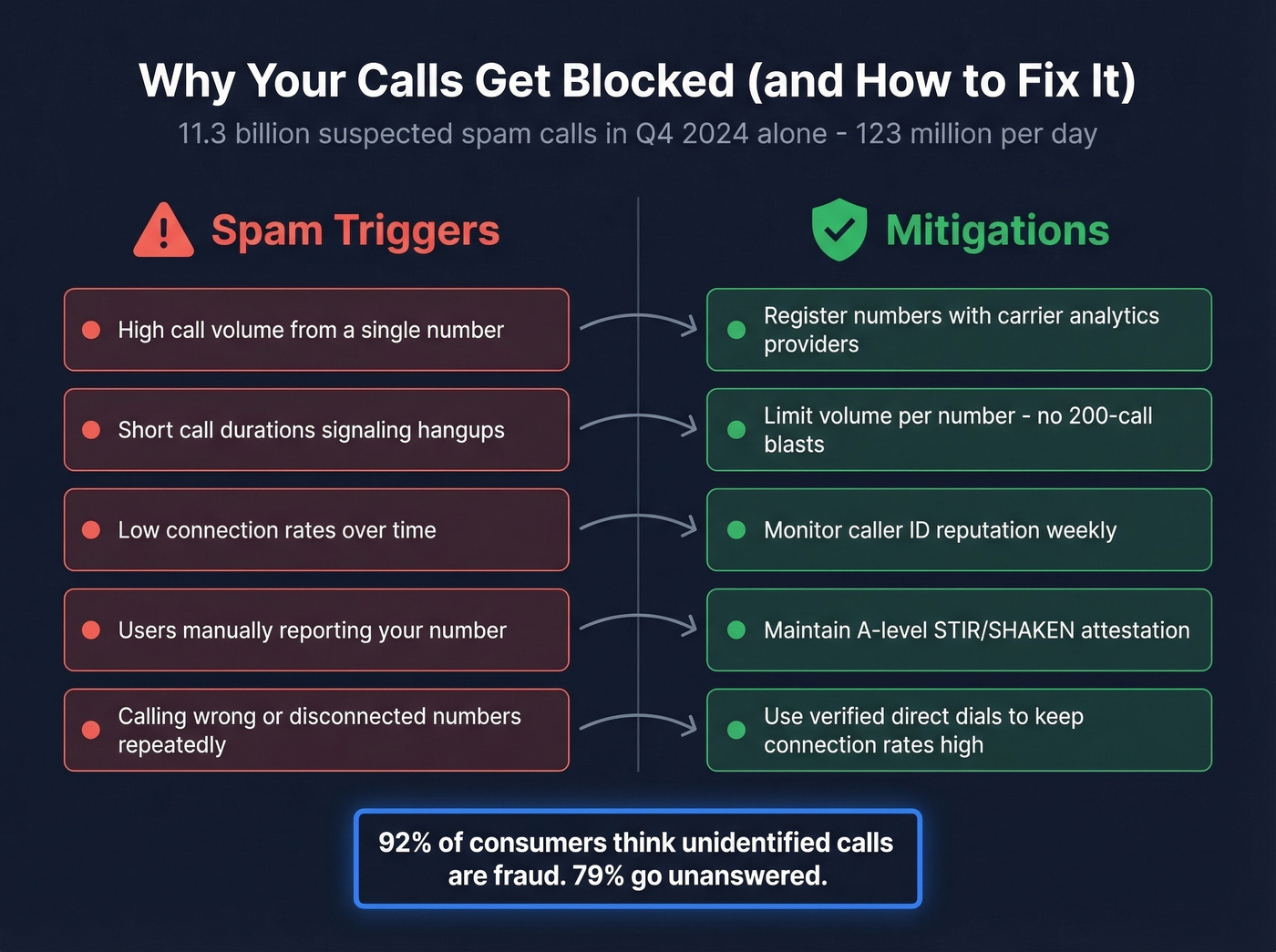
The scale of this problem is massive - Hiya reported 11.3B suspected spam calls in Q4 2024 alone, roughly 123 million per day. 92% of consumers think unidentified calls are fraud, and 79% of those calls go unanswered. STIR/SHAKEN authentication has been mandatory for voice service providers on IP networks since June 30, 2021, assigning attestation levels (A, B, or C) to every call. Level A means the carrier fully verified the caller's identity and right to use the number. Level C means almost nothing was verified. In August 2025, the FCC removed 1,200+ providers from the Robocall Mitigation Database for noncompliance, effectively cutting them off from U.S. networks.
The triggers that get your numbers flagged: high call volume, short call durations indicating hangups, low connection rates, and user reporting. The mitigations require discipline:
- Register your numbers with carrier analytics providers
- Manage volume per number - don't blast 200 calls from one number in a day
- Monitor caller ID reputation weekly
- Maintain A-level attestation by working with a compliant carrier
- Use verified direct dials - calling wrong numbers tanks your connection rate, which triggers spam algorithms (more detail in our caller ID cold calling guide)
The 2026 Tech Stack
AI and parallel dialers aren't optional anymore. They're the baseline. A parallel dialer can 3-5x your live conversations per hour, pushing talk time from 10-15 minutes per hour to 40-50 minutes. 56% of sales pros now use AI tools daily, and they're roughly 2x more likely to exceed quota.
Here's the thing: most teams overspend on dialers and coaching tools while underspending on data. If your average deal size is under $10k, you probably don't need a $300/seat dialer - but you absolutely need accurate phone numbers. The dialer multiplies your output; bad data multiplies your waste.
Parallel/AI dialer - Orum, Nooks, Koncert, or Salesfinity. $100-300/seat/month. If a rep goes from 8 conversations/day to 25, the dialer pays for itself in the first week. (If you're evaluating options, start with predictive dialer software and our roundup of the best sales dialer tools.)
CRM - Salesforce (from ~$25/user/month) or HubSpot (free CRM tier available). Every call gets logged, every outcome tracked. Non-negotiable.
Data and verification - Prospeo covers both contact data and verification in one platform: 98% email accuracy, 125M+ verified mobiles, and native integrations with Salesforce, HubSpot, Smartlead, Instantly, and Lemlist. The free tier gives you enough to test before committing. (If you're comparing vendors, see our list of the best B2B data platforms.)
Call recording and coaching - Gong, Chorus, or your dialer's built-in recording. You can't coach what you can't hear.
Top-quartile reps book 18 meetings from 800 dials because they reach real people at real numbers. Prospeo's 300M+ profiles and weekly data refresh mean your team spends time talking, not Googling. At $0.01 per email and 10 credits per verified mobile, it costs less than a single wasted hour of dead dials.
Turn 800 dials into 18 meetings instead of 2.
Compliance - What Changed
Regulation shifted hard in 2024-2025, and most sales teams haven't caught up.
TCPA lawsuits surged roughly 95% year-over-year, with class actions spiking 285% in September alone. The penalties are real: up to $1,500 per call for willful violations. That's not per campaign - per call.
The biggest change: in February 2024, the FCC clarified that AI-generated voices qualify as "artificial or prerecorded" under the TCPA. Any outbound call using an AI-generated or prerecorded voice requires prior express written consent. If you're experimenting with AI voice agents for outbound, you need explicit opt-in before dialing.
State-level regulation is accelerating too. By fall 2025, 15+ jurisdictions had enacted "mini-TCPA" statutes that go beyond federal law - Texas, Florida, Oklahoma, Indiana, North Dakota, Louisiana, and Washington among them. Check every state you're calling into, not just where your reps sit.
The practical checklist:
- Federal floor: TCPA + Telemarketing Sales Rule (TSR)
- State compliance: verify requirements for every state in your call list
- Consent: prior express written consent required for autodialed or prerecorded calls to mobile numbers, including B2B
- AI voice: written consent mandatory, no exceptions
- DNC scrubbing: federal and state Do Not Call lists, scrubbed before every campaign (use a DNC checker process)
Real talk: the "we're B2B so it doesn't apply" mindset will get you sued. Budget for a compliance review if you haven't done one in the last 12 months.
What Separates Top Reps
For teams looking for B2B cold calling tips that go beyond the basics, here's what separates the top performers we've observed this year from everyone else:
Treat every quarter as a new experiment. The playbooks that worked 18 months ago already need tuning - buyer attention spans are shorter, spam filtering is tighter, and AI tools have raised the bar for personalization. Audit your data monthly, because that 2.1% monthly decay rate means a list you built in January is 12% dead by July.
Record every call and review at least five per week as a team. Pattern recognition across real conversations beats any theoretical training program, and it costs nothing. Track carrier filtering changes and state-level regulation too - these shift faster than most teams realize.
Multichannel cadences and permission-based openers are table stakes now. The new edge is data freshness and compliance rigor. The best cold calling strategies in 2026 combine systematic frameworks, clean data, and airtight compliance into a repeatable engine that compounds over time.
FAQ
What's a good cold calling success rate in 2026?
The Cognism/WHAM dataset puts the baseline at 4.82% - conversations that result in a booked meeting. Top-quartile reps hit a 16.7% set rate per Gong's 300M-call analysis. Above 5% beats average; above 10% is elite territory.
How many times should I call a prospect?
Cap it at five attempts. 93% of conversations happen by attempt three, and 98.6% by attempt five. Beyond that, you're wasting dials and risking spam flags with zero upside.
What's the best day and time to cold call?
Tuesday consistently wins for bookings. Mid-morning (10-11 AM) and mid-afternoon (3-4 PM) in the prospect's time zone tend to perform best. Fridays generate conversations but convert to meetings at a lower rate.
How do I stop my calls from being flagged as spam?
Register your numbers with carrier analytics providers, keep call volume under 50-80 per number per day, and monitor caller ID reputation weekly. Using verified direct dials reduces wrong-number volume, which keeps connection rates high and carrier algorithms happy.
Is cold calling still legal in 2026?
Yes, but the compliance bar is higher than ever. The TCPA and 15+ state mini-TCPAs require careful adherence - especially around AI-generated voices, which now need prior express written consent. Penalties run up to $1,500 per willful violation, per call.