

Cold Calls vs Cold Emails: The Data-Backed Answer for 2026
A practitioner on r/startups ran a clean 1,000-vs-1,000 test - same ICP, same offer, same rep. The calls took three weeks and booked 18 meetings. The emails took one week (mostly automated) and booked 8. That's 2.25x more meetings per touch from calling, but 3x the time investment. The cold calls vs cold emails debate isn't about which channel "wins." It's about which channel wins for your team, your deal size, and your current resources.
30-Second Verdict
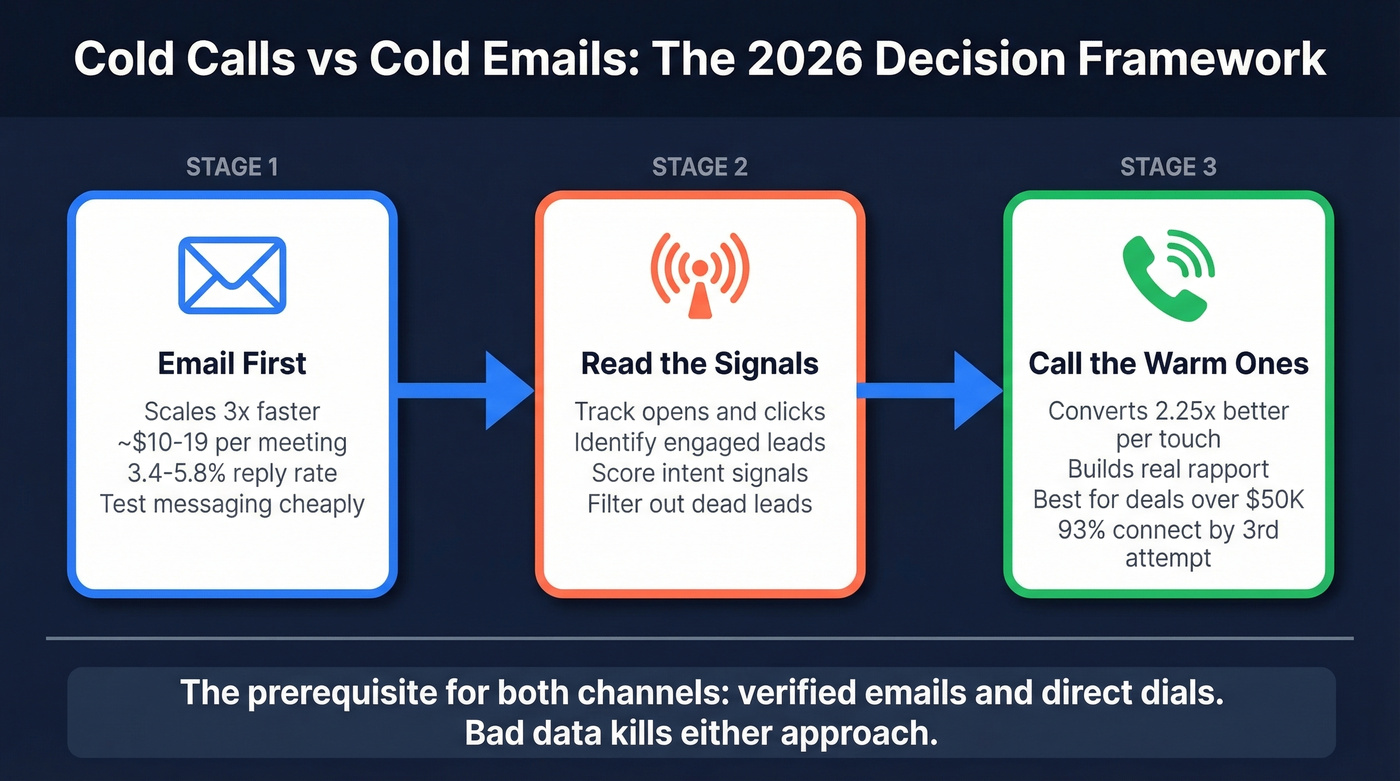
Cold email scales 3x faster. Cold calling converts 2.25x better per touch. The right answer for most B2B teams in 2026: email first to test messaging and generate engagement signals, then call the engaged leads. Neither channel works if your contact data is bad - bounced emails torch your domain reputation, and wrong numbers waste entire call blocks. Verified emails and direct dials are the prerequisite, not the afterthought.
Cold Email Benchmarks in 2026
Instantly's 2026 benchmark report - drawn from billions of cold email interactions - puts the average reply rate at 3.43%. Top quartile senders hit 5.5%+, and the top 10% clear 10.7%. Those top performers aren't lucky. They're disciplined about targeting, copy, and deliverability.
Belkins tells a similar story from a different angle. Across 16.5 million cold emails sent in 2024, they measured a 5.8% average reply rate - down from 6.8% the year before, a roughly 15% YoY decline. The inbox is getting noisier, and every sender is competing for the same sliver of attention.
A few operational details that matter: 58% of all replies come from the first email. The sweet spot for sequence length is 4-7 touchpoints - beyond that, you're burning goodwill. Spam complaint rates climb from 0.5% on the first email to 1.6% by the fourth. Wednesday is the best send day. And the top-performing emails? Under 80 words.
If you want a repeatable structure, start with a proven B2B cold email sequence and iterate from there.
Cold Calling Benchmarks in 2026
Cognism's State of Cold Calling report - based on 204,000+ calls and 27,000+ conversations - pegs the average cold calling success rate at 2.3% in 2026, down sharply from 4.82% the prior year. That's brutal. Caller ID screening is a big reason why. Still, 49% of buyers say they prefer to be contacted through a cold call - the appetite for live conversation hasn't disappeared.
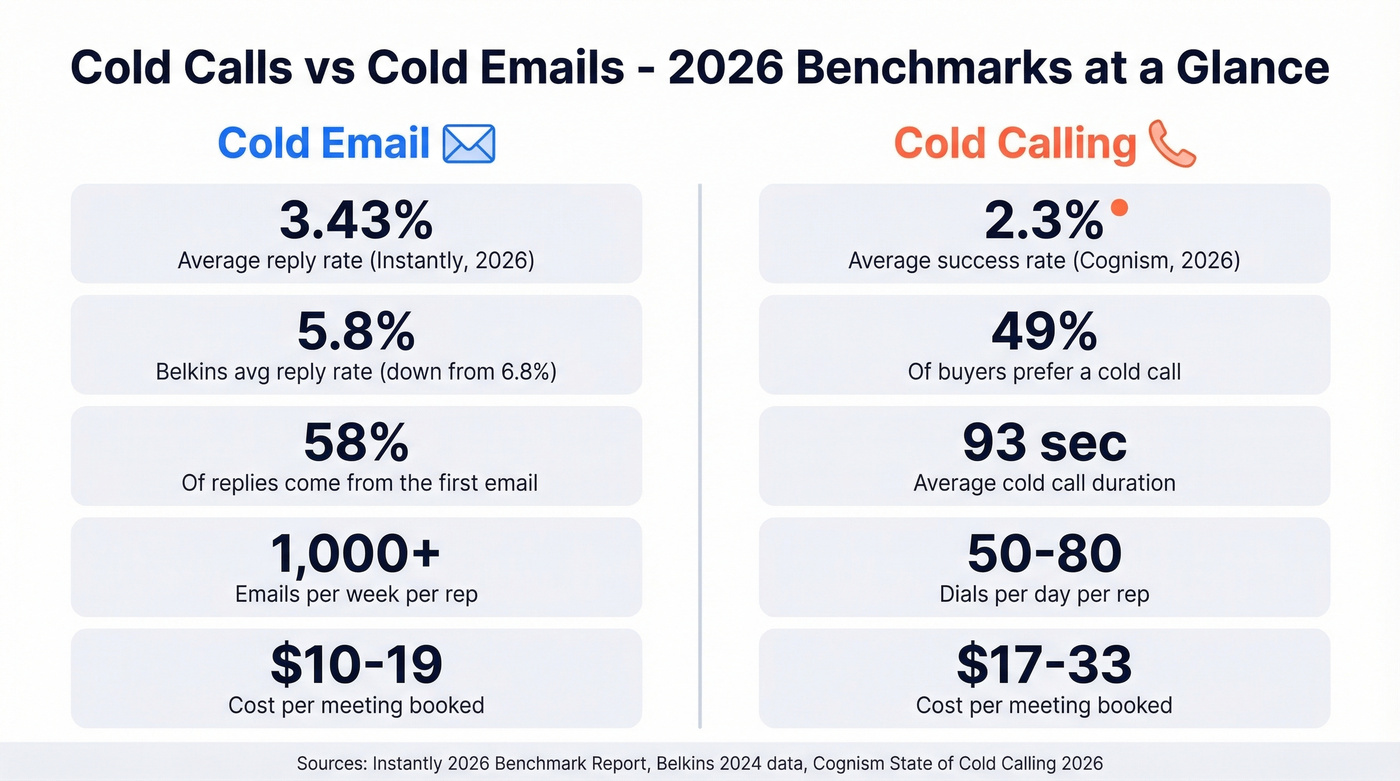
The operational benchmarks are more useful than the headline number. It takes an average of 3 attempts to connect with a prospect, and 93% of all conversations happen by the third call. The average cold call lasts just 93 seconds - barely enough time to deliver a value prop, let alone build rapport. Tuesday is the best day for booking meetings, with 10-11am and 2-3pm as the peak windows. Gong data shows a simple opener - asking how they've been - can push success rates above 10%.
Regional differences are real, too. UK success rates run around 8%, while both Europe and the US sit closer to 6%.
If you're building a repeatable dialing motion, a documented cold calling system matters more than any single script.
Head-to-Head Comparison
| Dimension | Cold Email | Cold Calling |
|---|---|---|
| Scalability | 1,000+/week (1 rep) | 50-80/day (1 rep) |
| Cost per meeting | ~$10-19 | ~$17-33 |
| Conversion per touch | ~3.4-5.8% reply rate | ~2.3% success rate |
| Time investment | Low (automated) | High (manual) |
| Compliance risk | Domain reputation | Per-incident fines |
| Trackability | High (opens, clicks) | Medium (call logs) |
This isn't a debate - it's a math problem. Email wins on efficiency and cost. Calling wins on conversion quality and rapport-building.
One note on a stat you'll see floating around: a "McKinsey study of 40,000 deals" supposedly showing top performers make 82% more cold calls. That claim appears in multiple sales blogs but nobody links to the actual McKinsey publication. We'd treat it as unverified until someone produces the source.

Bounced emails destroy domain reputation. Wrong numbers burn call blocks. Whether you lead with email or calls, bad data is the silent killer of both channels. Prospeo delivers 98% verified emails and 125M+ direct dials - refreshed every 7 days, not every 6 weeks.
Fix the data first. The channel debate is secondary.
Should You Call or Email First?
Here's the thing: email gives you control over messaging and timing; calls give you real-time conversation and objection handling. Use calls for strong asks - book a meeting, get a commitment - and email for weak asks like sharing a resource or starting a conversation. The right first move depends on deal size, your team's bandwidth, and how warm the lead already is.
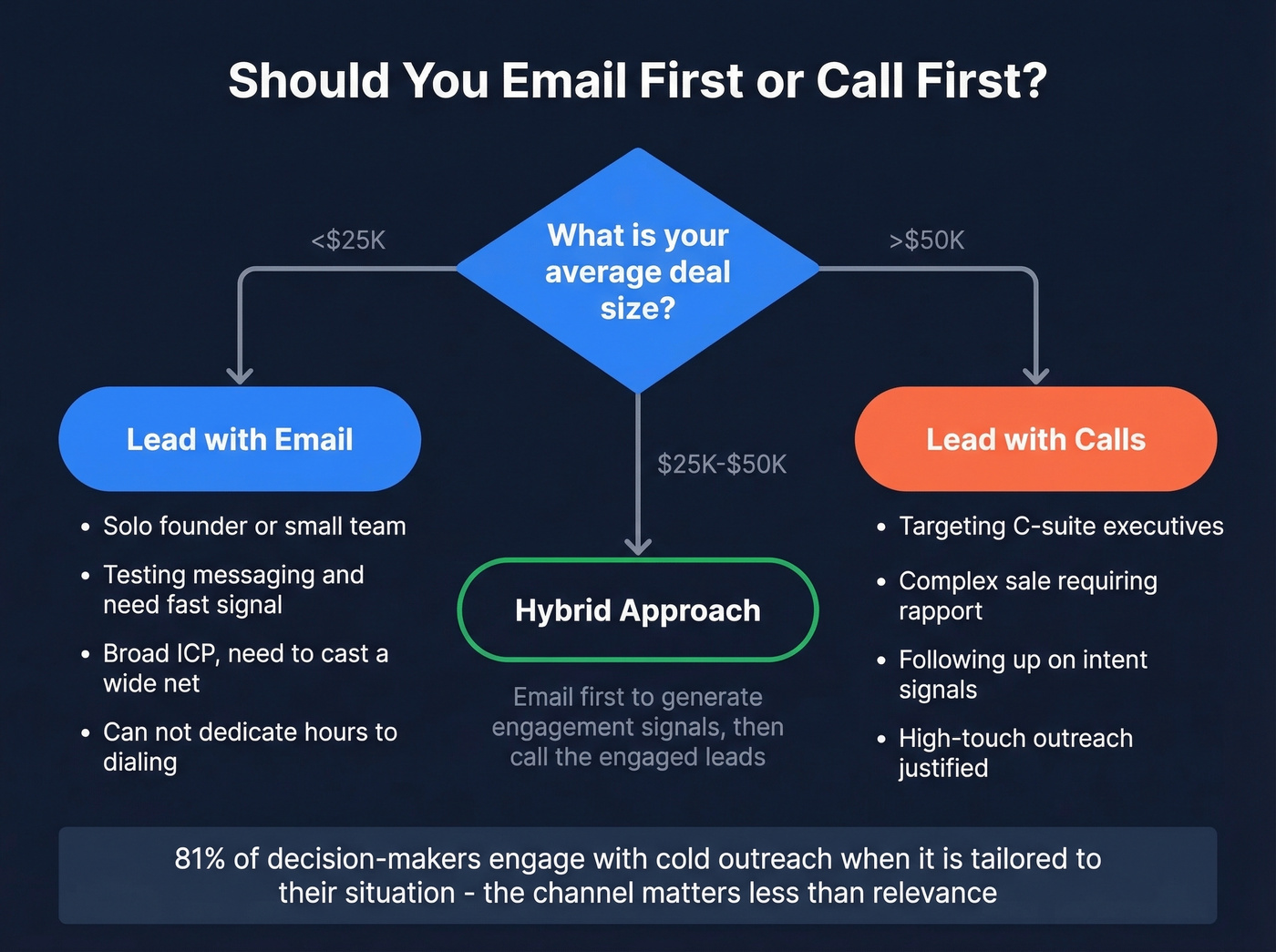
Lead with email when:
- You're a solo founder or small team that can't dedicate hours to dialing
- You're testing messaging and need fast signal on what resonates
- Deal size is under $25K and doesn't justify high-touch outreach
- Your ICP is broad and you need to cast a wide net before narrowing
Lead with calls when:
- Deal size exceeds $50K and warrants the time investment
- You're targeting C-suite executives who ignore cold email
- You're following up on engaged leads - email opens, link clicks, intent signals
- The sale is complex and requires rapport before a demo makes sense
In our experience, deals above $50K almost always require a call somewhere in the sequence. 81% of decision-makers say they'll engage with cold outreach when it's tailored to their situation. The channel matters less than the relevance. A generic email and a generic call both fail. A targeted email followed by a well-timed call? That's where meetings happen.
If you need a tighter way to qualify “engaged” vs “noise,” use a simple lead scoring model tied to opens, clicks, and replies.
Let's be honest about something: if your average contract value sits below $15K, you probably don't need cold calling at all. The math doesn't work. A rep making 60 dials a day at a 2.3% success rate books roughly one meeting per day. At that deal size, the meeting needs to convert at an unrealistic rate to justify the loaded cost. Email-first with selective calling on warm signals will outperform a pure-dial approach every time.
Why Both Channels Got Harder
Cold email reply rates dropped ~15% year-over-year. Cold calling success rates fell from 4.82% to 2.3%. Both channels are under structural pressure.
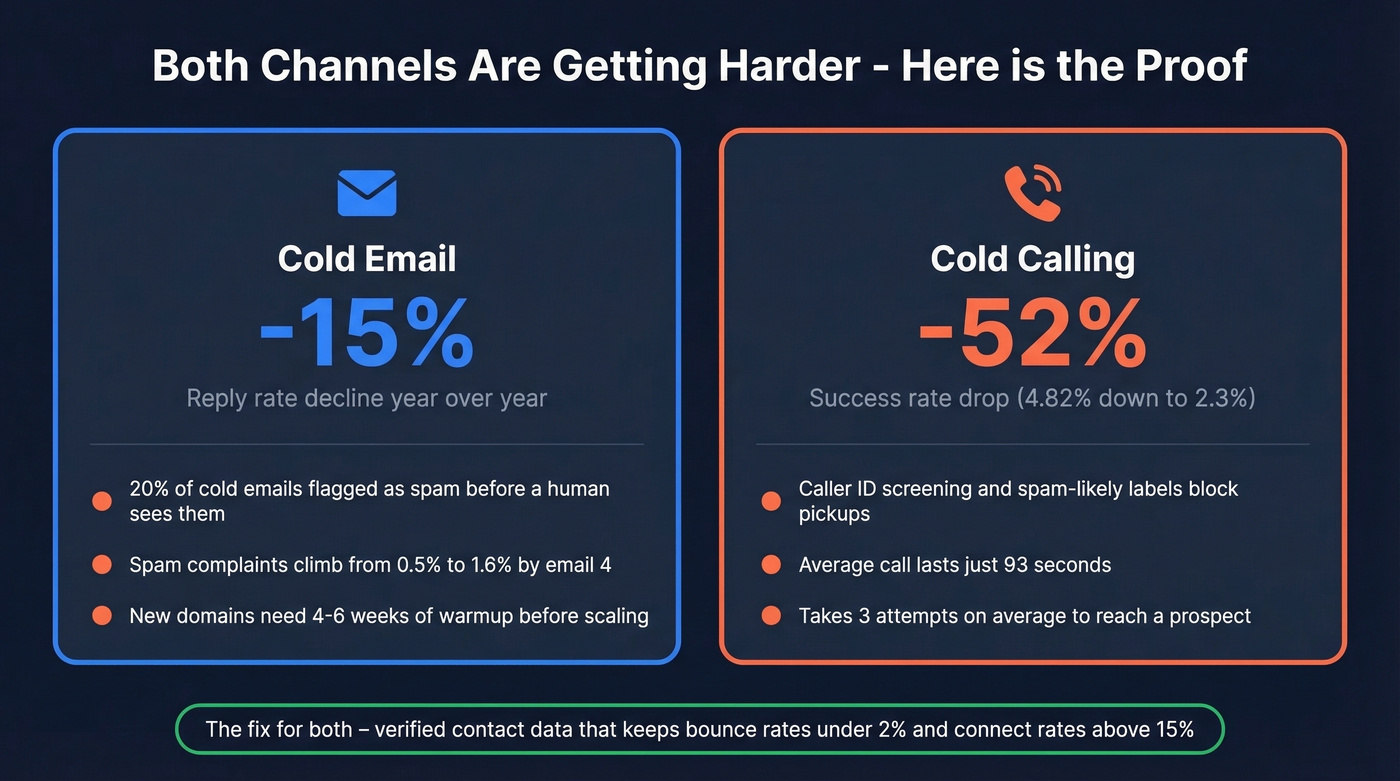
On the email side, Google, Yahoo, and Microsoft now enforce bulk sender rules requiring SPF, DKIM, and DMARC authentication plus one-click unsubscribe headers. Spam complaints must stay under 0.3%, bounces under 2%. New domains need 4-6 weeks of warmup before you can scale. About 20% of cold emails get flagged as spam before a human ever sees them.
If you're troubleshooting bounces and inboxing, start with an email deliverability guide and then work through your email bounce rate by list source.
On the calling side, caller ID screening and spam-likely labels have made it harder to get anyone to pick up. The 93-second average call duration tells you how little patience prospects have even when they do answer.
A bounced email doesn't just miss the prospect - it damages your sender reputation and drags down deliverability for every future email. A wrong phone number doesn't just waste 30 seconds - it eats into a call block that only had 50-80 dials to begin with. Skip this section if your bounce rate is already under 2% and your connect rate is above 15%. For everyone else, keep reading.
The Variable Nobody Talks About: Data Quality
Sales teams obsess over scripts, timing, and subject lines. They rarely address the variable that determines whether either channel works at all: whether the contact information is accurate in the first place.
If your email list bounces above 2%, you're actively destroying your domain reputation. If your phone numbers connect to front desks instead of direct dials, your reps are burning hours on gatekeepers. Most underperformance isn't a messaging problem. It's a data problem.
Prospeo covers 300M+ professional profiles with 98% email accuracy - verified through a proprietary 5-step process that includes catch-all handling, spam-trap removal, and honeypot filtering. The 125M+ verified mobile numbers deliver a 30% pickup rate across all regions, and data refreshes every 7 days versus the 6-week industry average. Snyk's 50-person AE team saw bounce rates drop from 35-40% to under 5% after switching, with AE-sourced pipeline up 180%.
If you're evaluating vendors, compare options across data enrichment services and short-list a few sales prospecting databases before you commit.

The best-performing teams email first, then call engaged leads. That workflow requires two things: deliverable emails that protect your domain, and direct dials that bypass gatekeepers. Prospeo gives you both at $0.01/email with a 30% mobile pickup rate - so your multi-channel cadence actually converts.
Build the email-then-call cadence that books 26% more meetings.
The Multi-Channel Cadence That Actually Works
The cold calls vs cold emails question disappears once you combine both into a single sequence. Here's the cadence we've seen book the most meetings, backed by the benchmark data above.
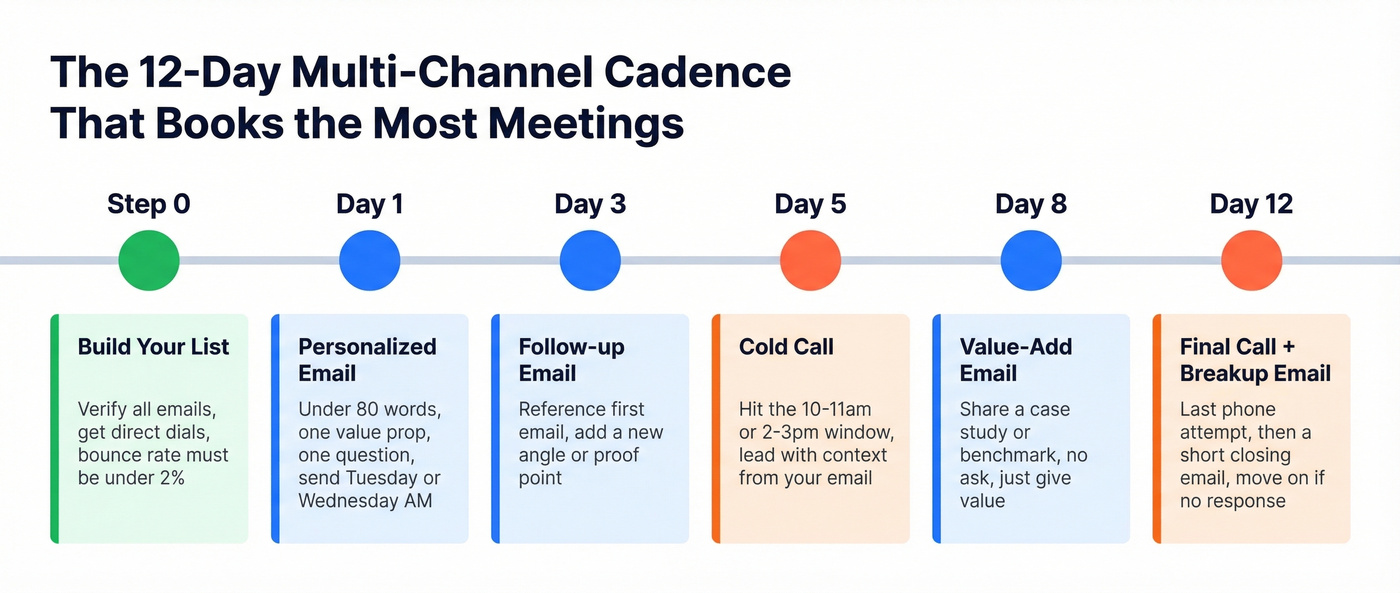
Step 0: Build your list with verified data. Don't start a sequence until your bounce rate is under 2% and you've got direct dials, not switchboard numbers.
Day 1 - Personalized email. Under 80 words. One clear value prop, one question. Send Tuesday or Wednesday morning.
If you need faster iteration on copy, pull from these cold email subject line examples and keep testing.
Day 3 - Follow-up email. Reference the first email. Add a new angle or proof point.
When you run out of angles, use a set of cold email follow-up templates to stay consistent without getting generic.
Day 5 - Cold call. Hit the 10-11am or 2-3pm window. You've got 93 seconds on average, so lead with context: "I sent you an email Tuesday about [specific problem]. Quick question..."
Day 8 - Value-add email. Share a relevant case study, benchmark, or insight. No ask.
Day 12 - Final call + breakup email. One last attempt by phone, followed by a short email that closes the loop. If there's no response after this, move on - your time is better spent on fresh prospects than chasing ghosts.
Compliance Cheat Sheet
| Regulation | Applies To | Max Penalty |
|---|---|---|
| TCPA | Calls/SMS (US) | $500-$1,500/incident |
| CAN-SPAM | Email (US) | Up to $53,088/email |
| GDPR | Both (EU/UK) | 4% global revenue / EUR 20M |
| CCPA | Both (California) | $2,663-$7,988/violation |
Cold calling carries higher per-incident risk - a 1,000-contact TCPA violation can mean $500K-$1.5M in exposure. Cold email carries higher aggregate risk through domain reputation damage that compounds over time. Both require clean lists and documented consent. The fines are large enough to sink a startup, and "I didn't know" isn't a defense.
FAQ
Is cold calling dead in 2026?
No. Success rates dropped from 4.82% to 2.3%, but cold calling still converts 2.25x better per touch than email. 49% of buyers still prefer a phone call as first contact. It's harder, not dead - especially for deals above $50K where live conversation builds trust faster than any inbox message.
What's a good cold email reply rate?
The average sits between 3.4% and 5.8% depending on the dataset. Top 10% of senders hit 10.7%+. If you're below 2%, check your deliverability first - bounces, spam complaints, and domain warmup issues - before blaming your copy.
How many follow-ups should a cold email sequence include?
Four to seven touchpoints is the sweet spot. The first follow-up can lift replies up to 49%, but by the fourth email, spam complaints triple. After seven touches, you're burning your domain for diminishing returns.
What's the best free tool for verified contact data?
Prospeo's free tier includes 75 verified emails and 100 Chrome extension credits per month - no credit card required. At 98% email accuracy, it outperforms most paid plans from competitors on data quality alone.