

Cold Email Examples That Actually Got Replies - With the Data to Prove It
A 34% reply rate from 150 cold emails. Eight paying clients. Roughly EUR12K in revenue - from a single campaign with zero pitch in the first email. That's not a fantasy scenario; it's a real campaign we'll break down below, along with 14 more cold email examples that actually produced replies.
The average person receives 15 cold emails per week. Half never engage. Another 13.7% delete immediately. And 10.3% hit the junk button without reading a word. The templates flooding your inbox from "cold email guru" blogs? They're the reason those numbers look so grim. Everyone's sending the same "Quick question, {firstname}" opener, the same cheery AI compliment, the same ask for 15 minutes. Recipients pattern-match and delete.
You don't need 55 templates. You need 3-4 tested structures, clean contact data, and a value-first approach that breaks the pattern.
What You Need Before Sending
Before you scroll to the templates, internalize three things:
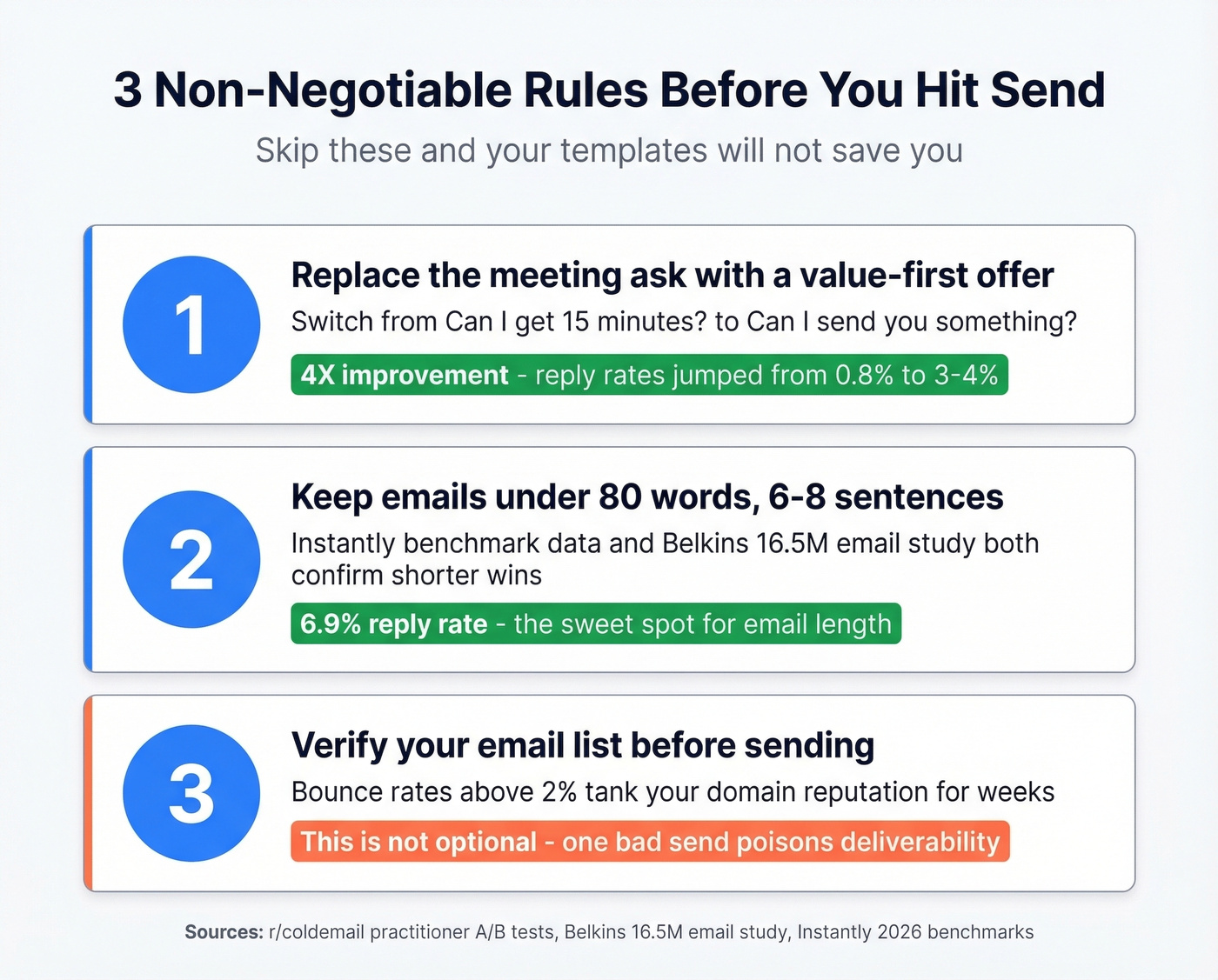
Replace the meeting ask with a value-first offer. Switching from "Can I get 15 minutes?" to "I noticed you're doing X - can I send you something?" moved reply rates from 0.8% to 3-4% in practitioner A/B tests shared on r/coldemail. That's a 4X improvement from changing the CTA alone.
Keep emails under 80 words and aim for 6-8 short sentences. Instantly's benchmark data shows the best-performing campaigns keep emails under 80 words, and the Belkins study of 16.5M emails found 6-8 sentences is the best-performing structure - hitting a 6.9% reply rate.
Verify your list before sending. Bounce rates above 2% tank your domain reputation. One bad send can poison deliverability for weeks. This isn't optional.
What a Good Reply Rate Looks Like
Most teams have no idea whether their reply rate is good, bad, or average. Here's where the numbers stand, pulled from the Instantly 2026 benchmark report and Belkins' 16.5M-email study:
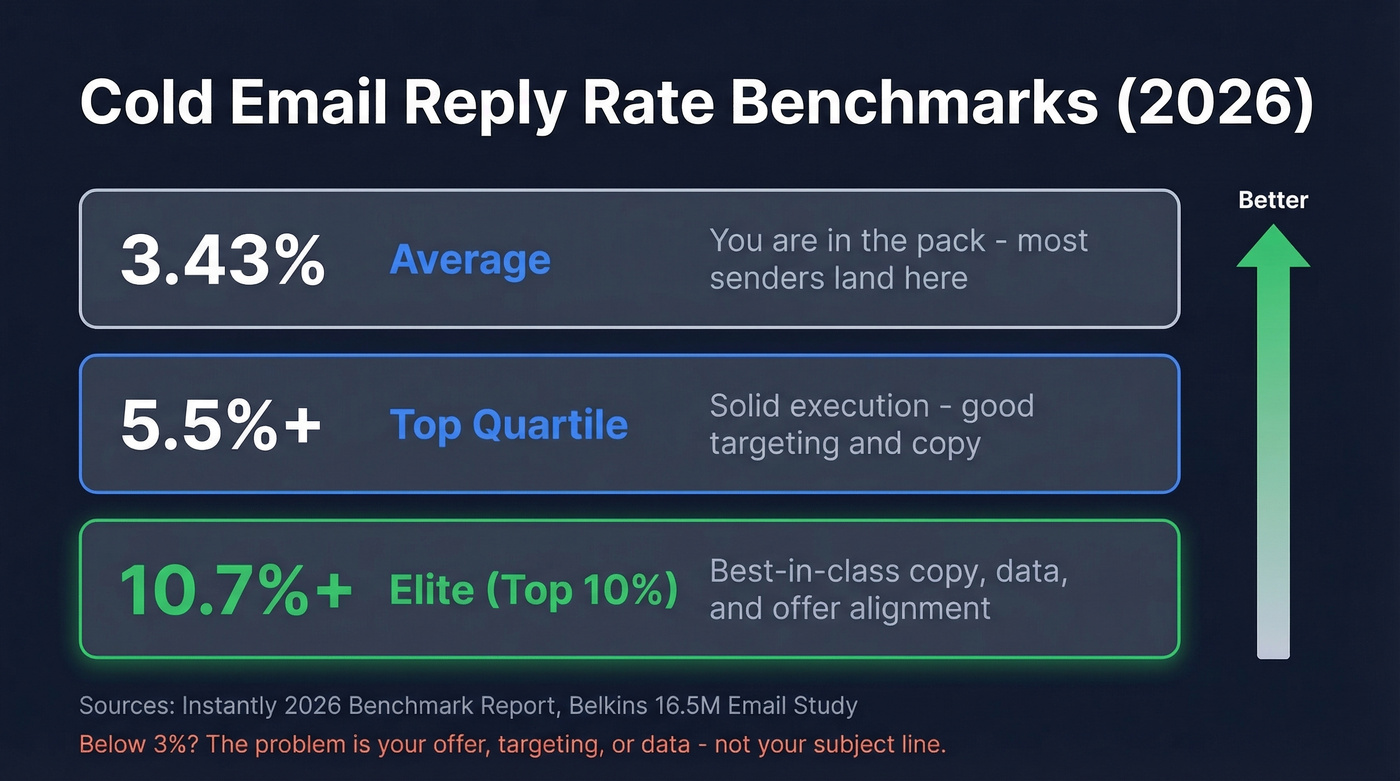
| Tier | Reply Rate | What It Means |
|---|---|---|
| Average | 3.43% | You're in the pack |
| Top Quartile | 5.5%+ | Solid execution |
| Elite (Top 10%) | 10.7%+ | Best-in-class copy + data |
Belkins pegged the overall average at 5.8% across their 2024 dataset - down from 6.8% in 2023. The gap between Belkins' number and Instantly's 3.43% comes down to different sender populations and time periods, but the direction is the same: reply rates are compressing as inboxes get noisier.
A few tactical notes from the data. Tuesday and Wednesday are the highest-performing send days for replies, while Lemlist's data suggests early-morning Monday sends (5-8 AM) can edge out other days for open rates. Emails under 80 words consistently outperform longer ones. Campaigns that A/B test weekly stay in the top quartile - the ones that "set and forget" drift downward. When you test, use a 20/80 split: 20% of your list sees the variant, 80% gets the proven winner.
If you're above 5%, you're doing well. Above 10%, you're elite. Below 3%, the problem is almost certainly your offer, your targeting, or your data - not your subject line.
15 Proven Templates (By Scenario)
Every example below includes the actual email structure, the scenario it fits, and - where available - real performance data. These aren't hypothetical. They're pulled from practitioner campaigns, template libraries with metrics, and community-shared results.

Value-First / Resource Offer
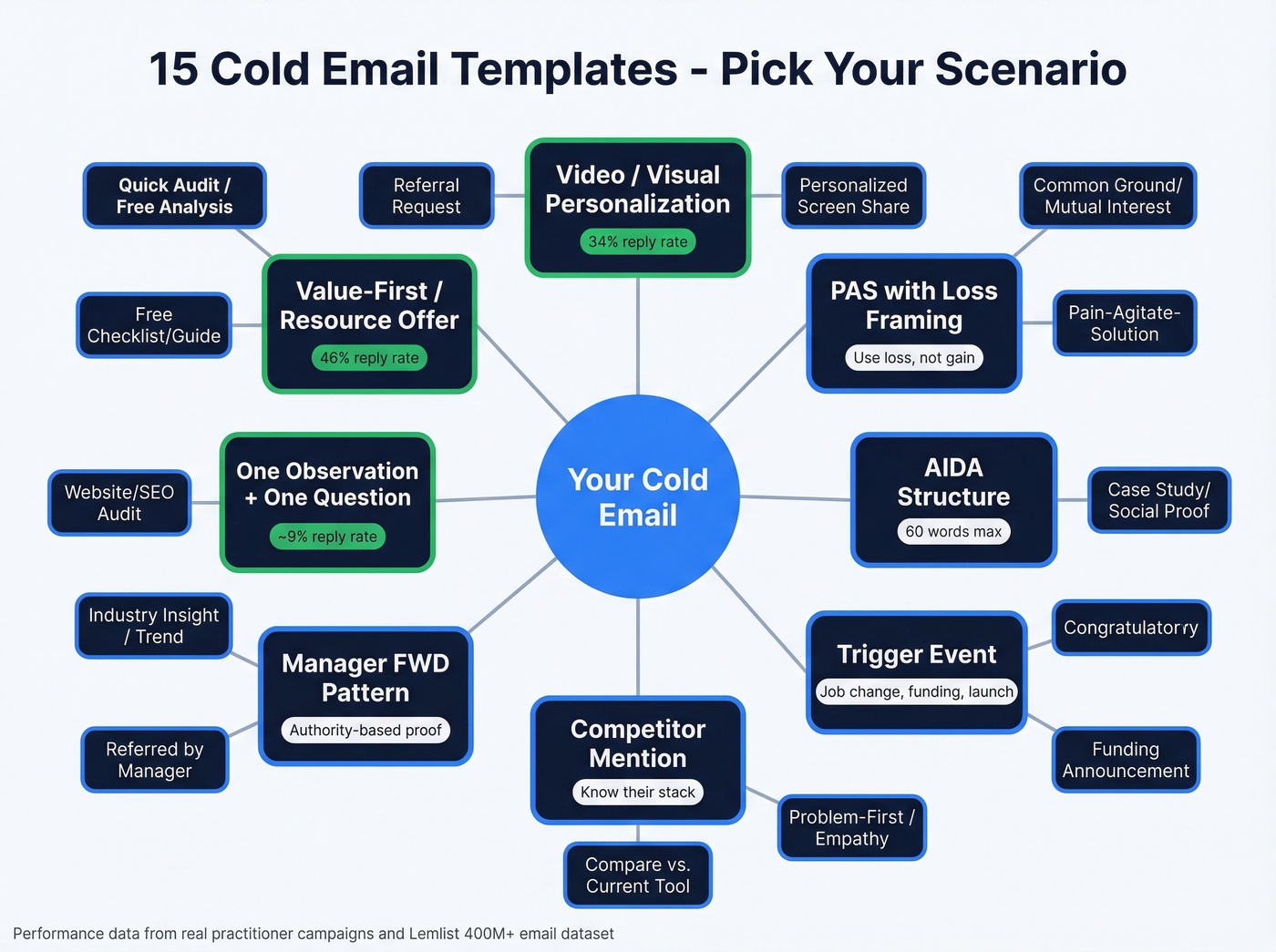
This is the anchor framework. It works because you're giving before asking - and the data from Lemlist's template hub (built on 400M+ emails from 37K+ users) confirms it. A podcast guest outreach template using this structure hit 72% opens and 46% replies. A Head of Sales outreach variant pulled 86% opens and 32% replies. The pattern holds across industries. If you only study one example from this entire guide, make it this one.
Subject: Quick idea for {Company}'s {specific process}
Hi {FirstName},
I noticed {Company} is scaling the SDR team and running paid ads to a new segment. We put together a {resource type - playbook, teardown, benchmark report} on {topic} that might save your team some time.
Want me to send it over?
{Signature}
The CTA is "want me to send it?" - not "can I get 15 minutes?" That shift alone moved reply rates from 0.8% to 3-4% in controlled tests. The prospect's cost of saying "yes" is nearly zero.
Video / Visual Personalization
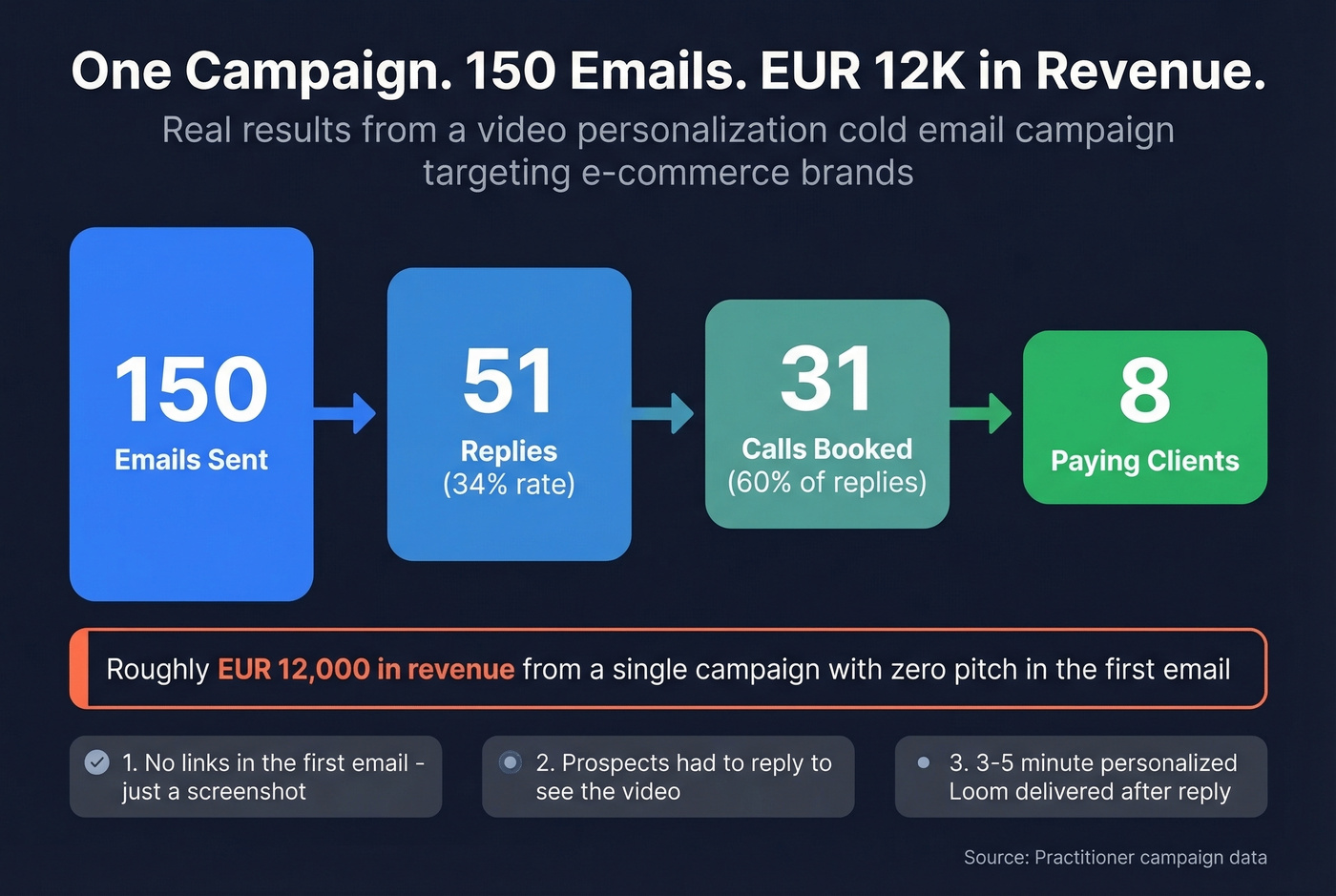
This is the hero example - a cold email that converts. A sender targeting 150 e-commerce brands hit a 34% reply rate: 51 replies, 31 booked calls, 8 paying clients, roughly EUR12K in revenue.
Subject: I recorded a video for you
Hey {FirstName},
I mapped out a quick strategy for {Company}'s {funnel/product page/ad flow} - includes a few things I think you're leaving on the table.
I recorded a short video walking through it. Want me to send it?
{Signature}
The email included a screenshot of the prospect's funnel with annotations. No pitch. No links. When the prospect replied "yes," the sender delivered a 3-5 minute Loom walkthrough.
About 60% of video recipients booked a call. The curiosity gap - having to reply to see the video - is what drives the reply rate. You can't click through; you have to engage. We've seen this pattern replicate across SaaS, agency, and consulting campaigns. If you can invest 5 minutes per prospect in a personalized video, this is the highest-ROI format that exists.
PAS with Loss Framing
Here's the thing most people get wrong: they write PAS emails with gain framing - "we can help you grow X%." Loss framing ("you're losing X%") consistently outperformed gain framing in A/B tests. Here's the version that works:
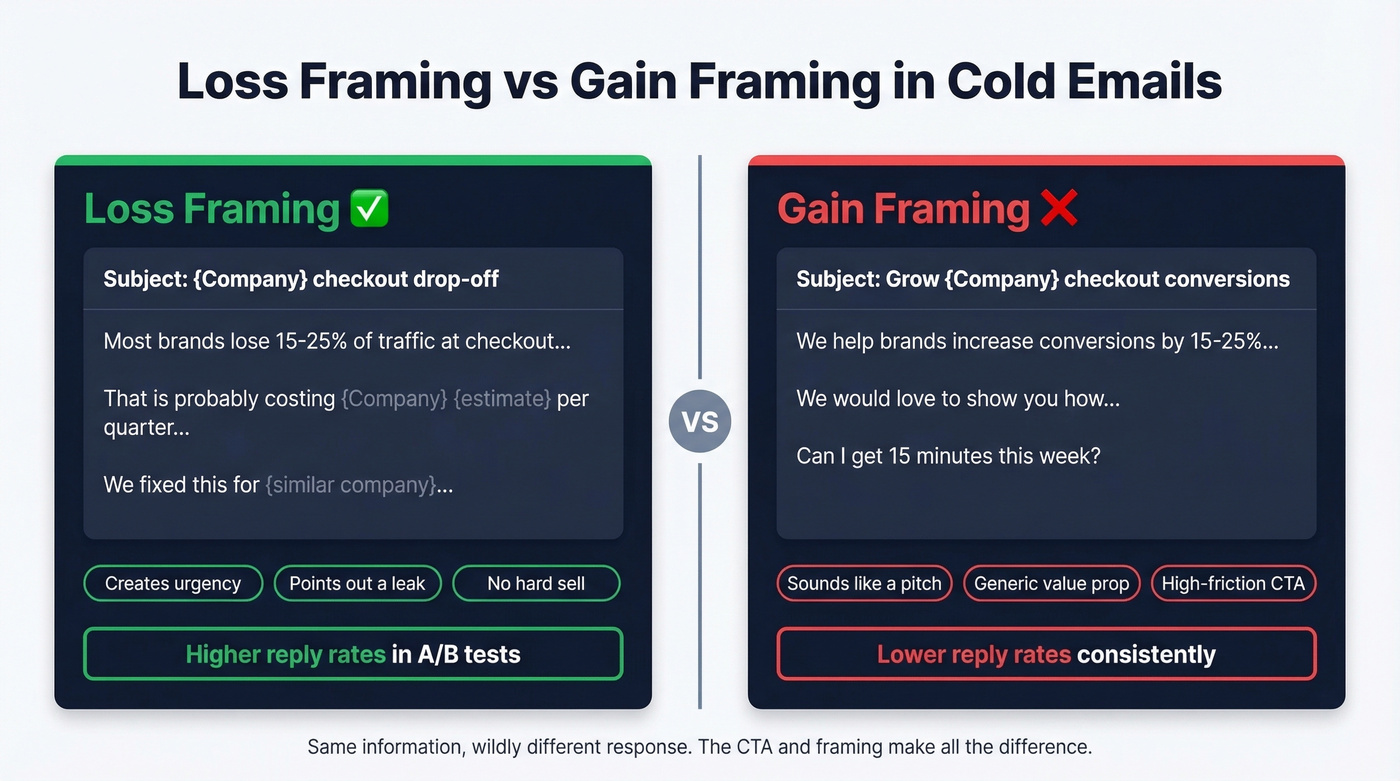
Subject: {Company}'s checkout drop-off
Hi {FirstName},
Most {industry} brands lose 15-25% of qualified traffic at checkout because {specific problem}. Based on your current setup, that's probably costing {Company} {estimate} per quarter.
We fixed this for {similar company} in {timeframe} - happy to share how if it's relevant.
{Signature}
And here's the version that doesn't:
Subject: Grow {Company}'s checkout conversions
Hi {FirstName},
We help {industry} brands increase checkout conversions by 15-25%. We'd love to show you how we did it for {similar company}. Can I get 15 minutes this week?
Same information, wildly different response. The loss frame creates urgency without being pushy. You're not selling - you're pointing out a leak.
AIDA Structure
Attention-Interest-Desire-Action, compressed into 60 words. This format works well for prospects where you have a specific benchmark gap to reference.
Subject: {Company}'s {metric} vs. industry avg
Hi {FirstName},
{Company}'s {metric} is running about {X}% below the {industry} benchmark. {Similar company} closed that gap in 6 weeks by {specific change}.
I've got the breakdown if you want to see it - takes 2 minutes to read.
Worth a look?
{Signature}
Short, specific, and the ask is tiny. "Worth a look?" is lower friction than "Can we schedule a call?" One pronoun tip that makes a subtle difference: aim for a 1:2 ratio of I/my to you/your. The email above does this naturally - it's about their metric, their company, their benchmark. When you flip that ratio and lead with "I" and "we," the email reads like a pitch instead of a conversation.
Trigger Event (Job Change / New Hire)
Timing is everything. A personalized first line referencing a trigger event produced 4X more replies than a generic opener - with the rest of the email identical.
Subject: Congrats on the new role
Hi {FirstName},
Saw you just joined {Company} as {Title} - congrats. New leaders in {function} usually inherit a {common pain point} backlog in the first 90 days.
We helped {similar company} tackle that in their first quarter. Want the case study?
{Signature}
The trigger makes the email feel timely, not random. Job changes, new hires, funding rounds, and product launches all work as triggers. In our experience, job changes within the last 30 days produce the highest reply rates - after 60 days, the "new role" angle loses its punch.
Competitor Mention / Switching Trigger
Risky but effective when you know the prospect's current stack.
Subject: Noticed you're using {Competitor}
Hi {FirstName},
A few {industry} teams have switched from {Competitor} to us this quarter - mostly because {specific pain point with competitor}.
Not sure if that's hitting you too, but if it is, I can show you what they changed in 10 minutes.
{Signature}
This works because it's specific. "Noticed you're using {Competitor}" signals research. The social proof is peer-based, not logo-based - which matters more for mid-market prospects who don't relate to enterprise case studies.
Manager FWD Pattern
The Close.com classic. Authority-based social proof baked into the structure.
Subject: FWD: {Company Name}
Hi {FirstName},
My {VP of Sales / CEO} asked me to reach out - we've been working with a few companies in {industry} on {specific outcome}, and {Company} came up as a fit.
Would a 10-minute call this week make sense to see if there's anything here?
{Signature}
The implied executive endorsement adds weight. It also gives the prospect a reason to respond - someone senior flagged them specifically.
Quick Audit / Free Analysis
Offer something tangible and specific. Not "a consultation" - an actual deliverable.
Subject: Free {audit type} for {Company}
Hi {FirstName},
I ran a quick {SEO audit / ad spend analysis / deliverability check} on {Company}'s {website/campaigns}. Found 3 things that are probably costing you {outcome}.
Want me to send the full breakdown? Takes 5 minutes to review.
{Signature}
The key is that you've already done some of the work. That signals effort and makes the prospect curious about what you found. This template pairs well with the video format - record a 3-minute Loom walking through the audit, and you've combined two of the highest-performing structures.
Referral / Warm Intro Request
Low friction, high redirect rate. Perfect when you're not sure who owns the decision.
Subject: Quick question about {Company}
Hi {FirstName},
Who handles {function - outbound, demand gen, vendor selection} at {Company}? I've got something relevant for that team but don't want to bug the wrong person.
Appreciate the pointer.
{Signature}
This works because it's easy to answer. Even if {FirstName} isn't the buyer, they'll often forward it - and a forwarded email carries implicit endorsement.
One Observation + One Question
The shortest format. One B2B agency reported ~9% reply rates using this approach across ~190 leads. If you need cold emailing examples you can deploy at scale, this is it.
Subject: {Company}'s {specific thing you noticed}
Hi {FirstName},
Noticed {Company} just {observation - launched a new product, opened a new office, posted 5 SDR roles}. Are you handling {related function} in-house or looking at outside help?
{Signature}
Three sentences. The observation proves you did research. The question is easy to answer. No pitch, no fluff.
Data-Driven / Stats-Led Email
Lead with a number the prospect hasn't seen before.
Subject: {Industry} benchmark you might not have
Hi {FirstName},
We just pulled data from {X} {industry} companies - the top 10% are hitting {metric} of {number}. Most teams we talk to are running about {lower number}.
I can send you the full breakdown with the methodology if it's useful. Takes 3 minutes to read.
{Signature}
The stat does the heavy lifting. It positions you as someone with proprietary insight, not just another vendor. If you don't have original data, use a specific stat from a credible source and add your interpretation of what it means for their business.
The "Wrong Contact" Redirect
Skip this template if you already know the decision-maker. But when you're prospecting into a company blind, it's one of the most reliable openers because it's disarming - you're admitting you might be wrong.
Subject: Am I reaching the right person?
Hi {FirstName},
I'm trying to reach whoever handles {function} at {Company}. Based on your role, I thought it might be you - but if not, could you point me in the right direction?
We've been helping {industry} teams with {specific outcome}, and I think there's something relevant for your team.
{Signature}
People are surprisingly willing to redirect you. The humility of "am I reaching the right person?" lowers defenses. And when they do forward your email, it arrives with a built-in endorsement.
Mutual Connection / Shared Community
Shared context - a mutual connection, a community, an event - transforms cold outreach into warm outreach.
Subject: Fellow {community/event} member
Hi {FirstName},
We're both in {community / attended event / connected through mutual contact}. I noticed {Company} is working on {relevant initiative}, and I had a thought on {specific angle}.
Worth a quick conversation, or should I just send over what I had in mind?
{Signature}
The shared context isn't decoration - it's the reason the email gets read. Slack communities, industry events, podcast guest lists, and open-source contributor lists all work as connection points.
Re-Engagement / Breakup-to-Restart
For prospects who went cold after initial engagement. This isn't a follow-up - it's a fresh start with new context.
Subject: Things have changed since we last talked
Hi {FirstName},
We connected back in {month} about {topic}. Since then, we've {new development - shipped a feature, published a case study, worked with a peer company}.
Figured it was worth a fresh ping. Still relevant, or has {Company} already solved {pain point}?
{Signature}
The "things have changed" angle gives you permission to re-enter the conversation without feeling stale. The closing question makes it easy to reply either way.
The Investor / Founder Pitch
Different rules apply when you're pitching investors or reaching out founder-to-founder. Brevity and traction matter more than anything else.
Subject: {Company} - {traction metric}
Hi {FirstName},
{Company} does {one sentence}. We're at {traction metric - revenue, users, growth rate} and {key proof point}.
{Specific reason you're reaching out to this person - portfolio fit, sector expertise, mutual connection}.
Open to a 15-minute call this week?
{Signature}
This is the one template where asking for a call directly is fine. Investors expect it. The traction metric in the subject line does the filtering - if the numbers are interesting, they'll open. If not, no amount of clever copy will help.

That 34% reply rate campaign? It started with verified contact data. Bounce rates above 2% tank your domain reputation and kill deliverability for weeks. Prospeo's 5-step verification delivers 98% email accuracy - so every perfectly crafted cold email actually lands in the inbox.
Fix your data before you fix your copy. Start at $0.01 per verified email.
Real Campaign Case Studies
Two full-funnel campaigns that show how these templates perform in the real world.
Campaign 1: The Video Offer (E-Commerce). 150 sends, 51 replies (34%), 31 booked calls, 8 paying clients, ~EUR12K revenue. The sender used the "I recorded a video for you" template, with a screenshot of each prospect's funnel embedded in the email. When prospects replied "yes," they received a 3-5 minute Loom walkthrough. The 60% video-to-call conversion rate is the standout metric - once someone watches a personalized video, the trust gap closes fast. (If you want to replicate this format, see our Loom walkthrough playbook.)
Campaign 2: The Quality Play (B2B SaaS). 209 sends, 15 replies (7.2%), 7 positive replies, $13K pipeline, 2 closed deals. No blast. No automation tricks. The sender used contextual personalization - referencing each prospect's background, company milestones, and specific achievements. Seven real opportunities from 209 emails is a better ROI than 2,000 sends with a 1% reply rate and zero pipeline.
Both campaigns prove the same point: quality beats quantity. A hundred well-researched, personalized emails will outperform a thousand generic ones every time.
One caveat worth flagging: if your average contract value is under $5K, you probably can't justify the video-per-prospect approach. The math doesn't work. Use the one-observation-one-question template at higher volume instead, and save the video treatment for your top 20% of prospects. Match the effort to the deal size.
Follow-Up Templates That Work
Follow-ups aren't optional. 58% of replies come from the first email, which means 42% come from follow-ups. One agency reported ~70% of their replies landing on touch #2 or #3 across ~190 leads. If you're sending one email and moving on, you're leaving nearly half your replies on the table.
But there's a ceiling. Belkins' data shows spam complaints jump from 0.5% on email #1 to 1.6% by email #4. Unsubscribes climb from 0.1% to 2% over the same span. The sweet spot is 4-7 touchpoints - enough to capture follow-up replies without pushing into obvious diminishing returns. A simple cadence that works: Day 1 / Day 2 / Day 4 / Day 8. (For more options, steal these sales follow-up templates.)
Follow-Up #1 - The "Feels Like a Reply"
Bumping this up - did the {resource / idea / audit} I mentioned make sense for what you're working on?
Short, casual, references the original without restating the whole pitch. Instantly's data shows this style is a top performer for step 2, beating more formal follow-ups by about 30%.
Follow-Up #2 - New Value Add
Hey {FirstName} - saw this {case study / data point / article} and thought of {Company}. {One-sentence summary of the new value.}
Still happy to send over {original offer} if the timing's better now.
Bring something new. Don't just re-send the same ask. A fresh data point or case study gives the prospect a reason to engage that they didn't have before.
Follow-Up #3 - The Breakup
No worries if the timing's off, {FirstName}. I'll leave this here in case {specific pain point} comes up later. Happy to help whenever.
Clean close. No guilt. No passive aggression. The breakup email often gets the highest reply rate of any follow-up because it removes pressure entirely.
Subject Lines That Get Opens
Personalized subject lines are 26% more likely to be opened. But "personalized" doesn't mean "{FirstName}, quick question" - that pattern is burned. Recipients see through it instantly.
Context-tied subjects perform best because they signal relevance before the email is opened. "Intake at {Company Name}?" for law firms, "{Company}'s Q2 pipeline" for sales leaders, "Your {product} launch" for marketing teams. Curiosity gaps are the next tier - "I recorded a video for you" and "Found something on {Company}'s site" both pull strong open rates because the prospect has to open the email to resolve the gap. Specificity rounds out the top three: "{Company} vs. {Competitor} on {metric}" tells the prospect exactly what they'll get.
Patterns to avoid: "Quick q {firstname}" is overused to the point of being an anti-pattern. "Following up" tells the recipient nothing new. Anything with emojis, ALL CAPS, or exclamation marks is a spam filter magnet. Keep subject lines under 6 words. The best-performing ones read like something a colleague would type, not a marketer. (Need more ideas? Swipe these email subject line examples.)
The Technical Foundation
Your copy doesn't matter if your emails land in spam. Google and Yahoo enforce bulk sender rules that make technical setup non-negotiable, and Microsoft has aligned with similar requirements.
Authentication: SPF, DKIM, and DMARC must be configured on every sending domain. One-click unsubscribe (RFC 8058) is required. These aren't best practices - they're table stakes. Fail them and your emails don't reach the inbox. (If you need the technical details, start with DMARC and SPF record examples.)
Thresholds to stay under: Spam complaints below 0.3%. Bounce rate below 2%. Exceed either and mailbox providers throttle or block your domain. (More on email bounce rate benchmarks and fixes.)
Warmup: Start new domains at 5-10 emails per day. Ramp over 4-6 weeks with predictable volumes. The consensus on r/coldemail is clear: max 20 emails per inbox per day, no more than 3 inboxes per domain. Space your sends. Use a dedicated subdomain for cold outreach so your primary domain stays clean. (See email velocity for safe sending limits.)
Content rules: Plain text over HTML. Minimal links - one max. Custom tracking domain to isolate reputation. Turn off open tracking; it adds invisible pixels that spam filters flag. Keep emails between 25-100 words with one clear ask. (If you're troubleshooting, use an email spam checker.)
Verify every email before it enters your sequence. This is where most campaigns silently fail. A 5% bounce rate doesn't just waste sends - it damages your sender reputation for weeks. Prospeo's 5-step verification catches spam traps, honeypots, and catch-all domains before they hit your sequence. Meritt cut their bounce rate from 35% to under 4%. Snyk dropped from 35-40% to under 5% across 50 AEs. The free tier gives you 75 email verifications per month plus 100 Chrome extension credits.
Let's be honest: the best cold email copy in the world won't save you if 8% of your list bounces. Fix the data first. Then worry about the words.
You just found 15 proven cold email templates. Now you need the right people to send them to. Prospeo's 300M+ database with 30+ filters - buyer intent, job changes, technographics - lets you target prospects who actually match your ICP. No more spraying generic lists.
Better targeting beats better copy. Build your list with 98% accurate emails.
FAQ
How many cold emails should I send per day?
Keep it to 20 or fewer per inbox, with a maximum of 3 inboxes per domain - that's 60 emails per domain per day at the absolute ceiling. Exceeding this triggers rate-limiting and deliverability drops. Space sends throughout the day rather than blasting them in batches.
What's a good reply rate for cold emails?
The Instantly 2026 benchmark puts the average at 3.43%, top quartile at 5.5%, and elite campaigns above 10.7%. Consistently above 5% means your targeting and copy are working. Below 3% signals a fundamental problem - usually the offer or list quality, not the subject line.
How many follow-ups should I send?
Four to seven total touchpoints is the sweet spot. Spam complaints jump by email #4, and unsubscribe rates climb from 0.1% to 2% over the same span, per Belkins' 16.5M-email study. Each follow-up should add new value, not just re-ask.
Should I use HTML or plain text?
Plain text. HTML emails with images, fancy formatting, and multiple links look like marketing - and spam filters treat them accordingly. Plain text reads like a real message from a real person, which is exactly what you want in cold outreach.
How do I keep my cold emails from bouncing?
Verify every address before sending. Prospeo catches invalid emails, spam traps, and catch-all domains through a 5-step verification process - keeping your bounce rate under the critical 2% threshold. Never send to an unverified list, even if the data came from a "verified" provider.