

The 9 Best Cold Email Lead Databases for 2026
Most teams don't lose cold email because their copy is bad. They lose because their data is stale, unverified, and full of guessed emails.
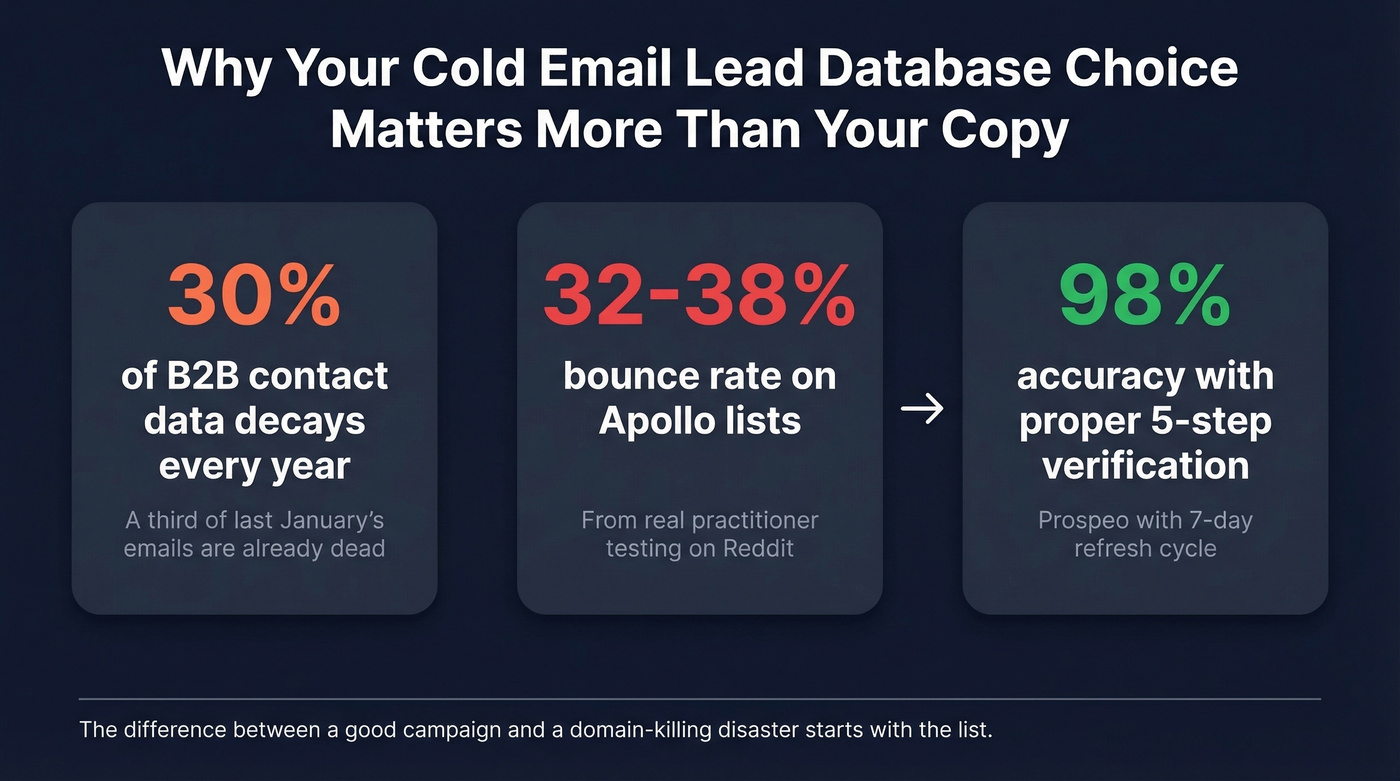
Choosing the right cold email lead database is the single highest-leverage decision in your outbound stack. B2B contact data decays at roughly 30% per year. A third of the emails you pulled last January are already dead. When a practitioner on r/coldemail tested multiple lead sources, their Apollo lists produced 32-38% bounce rates. Hunter and Snov weren't much better at 28-35%. That's what happens when you trust a provider that doesn't verify aggressively.
The difference between a good cold email campaign and a domain-killing disaster starts with the list.
Our Picks (TL;DR)
| Pick | Best For | Starting Price |
|---|---|---|
| Prospeo | Email accuracy & freshness | ~$0.01/lead (free tier) |
| Apollo.io | Free-tier volume & filters | Free / $49/user/mo |
| Instantly | Outreach + database add-on | $37/mo (outreach) + $47/mo (credits) |
How to Evaluate a B2B Lead Database
Database size is the most misleading metric in B2B data. A provider claiming 800M contacts means nothing if half those emails bounce. Five criteria actually matter:
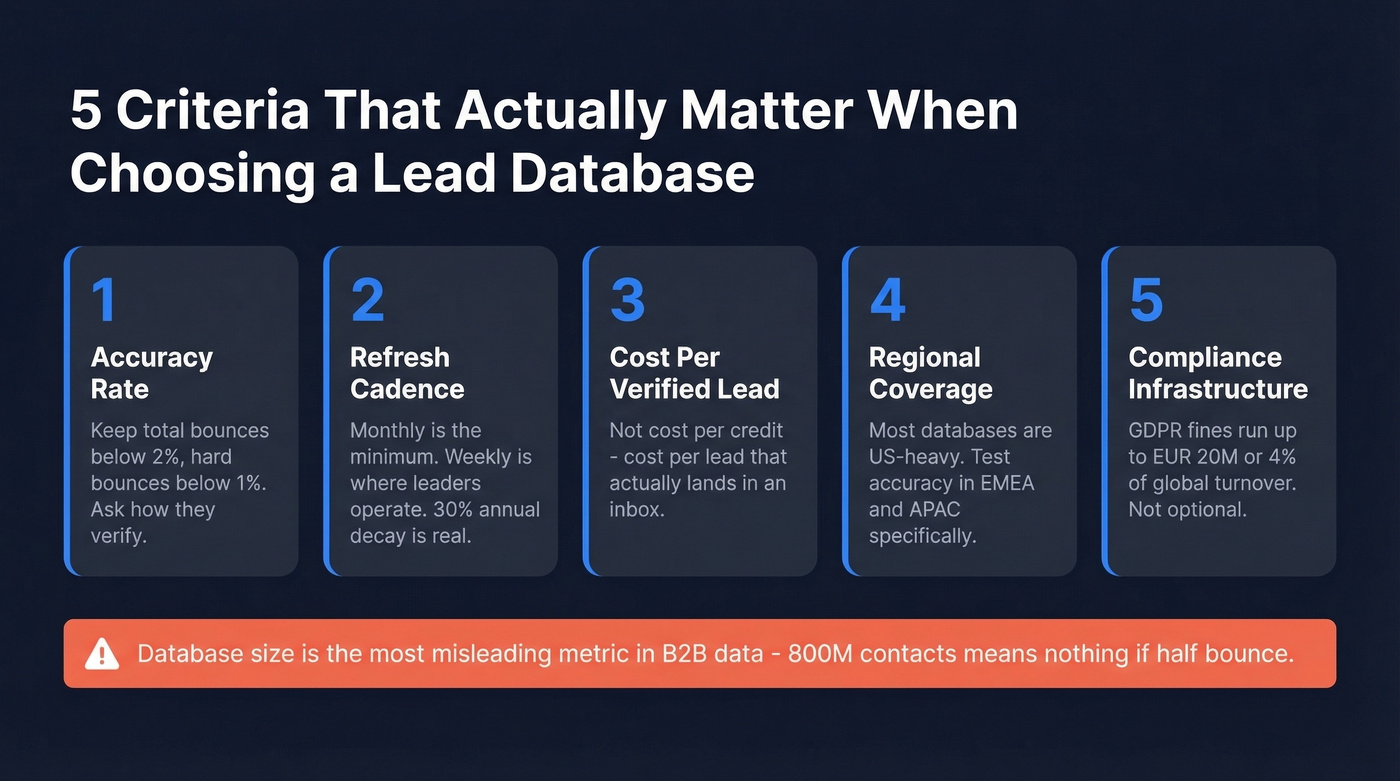
1. Accuracy rate (and how it's measured). The benchmark: keep total bounces below 2%, hard bounces below 1%. Proper email verification can reduce bounce rates from 15-30% down to 2-5%. Any database delivering 10%+ bounces is actively damaging your sender reputation. Ask vendors how they verify - SMTP handshake? Catch-all handling? Or just pattern matching and hoping? (If you want a deeper breakdown of verification options, see our guide to email verification.)
2. Refresh cadence. With 30% annual decay, a database refreshed quarterly is already 7-8% stale by the time you export. Monthly is the minimum. Weekly is where the leaders operate.
3. Cost per verified lead. Not cost per credit - cost per lead that actually lands in an inbox. A $0.03/credit provider with 35% bounce is more expensive than a $0.05/credit provider with 2% bounce. Always do the math after waste. (Related: the benefits of data enrichment compound when your base data is clean.)

4. Regional coverage. Most databases are US-heavy. If you're selling into EMEA or APAC, test accuracy in those regions specifically. We've seen tools perform well in North America and fall apart outside it.
5. Compliance infrastructure. Does the provider offer opt-out enforcement, audit trails, and GDPR-compliant sourcing? Fines run up to EUR 20M or 4% of global turnover. This isn't optional. (More detail: GDPR compliant database requirements and audit checklist.)
The 9 Best Providers for 2026
Prospeo - Best for Email Accuracy
Use this if: You're tired of bounces killing your domain reputation and want the cleanest data available without an enterprise contract.
Skip this if: You need a built-in dialer or full sequencing platform - pair Prospeo with Instantly or Smartlead for sending.
Prospeo's database covers 300M+ professional profiles with 143M+ verified emails and 125M+ verified mobile numbers. The headline number: 98% email accuracy, backed by a proprietary 5-step verification process that includes catch-all handling, spam-trap removal, and honeypot filtering. This isn't a third-party verification layer bolted on - Prospeo built its own email-finding infrastructure from scratch.
The 7-day data refresh cycle is the real differentiator. Industry average sits around 6 weeks, which means most databases are already decaying by the time you export. One customer, Snyk, saw bounce rates drop from 35-40% to under 5% after switching, with AE-sourced pipeline up 180%.

Filters go deep: 30+ options including buyer intent (15,000 Bombora topics), technographics, job changes, headcount growth, funding, and revenue. Native integrations with Instantly, Smartlead, Lemlist, HubSpot, and Salesforce mean you push verified leads directly into your sending tool without CSV exports. (If you're comparing broader options, see our roundup of the best B2B database providers.)
Pricing starts at roughly $0.01 per lead with a free tier of 75 emails/month. No contracts, no sales calls required.
Apollo.io - Best Free Tier for Experimentation
Use this if: You're bootstrapping and need volume to test messaging before investing in a paid database.
Skip this if: You're running high-volume outbound where bounce rates above 5% will torch your domain.
Apollo is the default choice, and that's the problem. Its 275M contacts and 73M companies with 65+ search filters make it the obvious starting point for many SMB teams. The free tier is genuinely useful - database access with limited credits, plus basic sequencing. Paid plans run $49/user/mo (Basic) to $119/user/mo (Organization, minimum 3 seats).
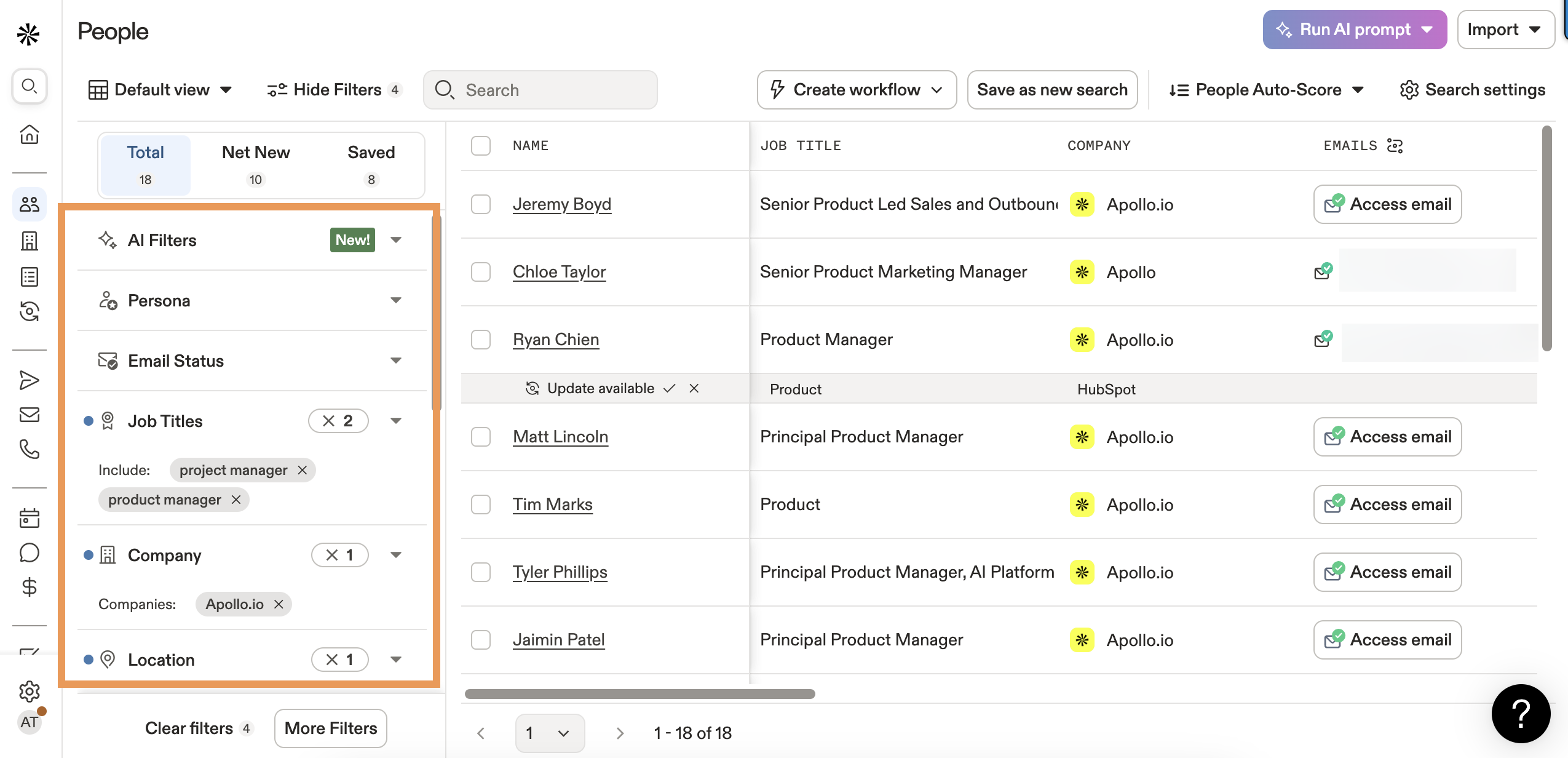
That Reddit practitioner test showed 32-38% bounce on Apollo lists. Outside the US, accuracy often lands around 60-72%. Credits don't roll over and expire each billing cycle, pressuring you to use them whether or not you have good targets. The credit system gets unpredictable at scale, especially when enrichment behavior changes consumption rates.
Apollo is a great place to start. It's a dangerous place to stay if deliverability matters. (If you're building lists specifically for outbound, compare with other B2B list providers.)
Instantly - Best All-in-One Stack
Use this if: You want sending plus a contact database under one roof and don't mind paying for each piece.
Skip this if: You're budget-conscious - the multi-subscription model adds up fast.
Instantly's database covers 450M+ contacts and includes waterfall work email enrichment with 5+ providers. That waterfall approach pulls from multiple sources to fill gaps, which produces better accuracy than any single unverified database. (For more options in this category, see outbound email automation tools.)
The frustrating part: you need separate subscriptions. Outreach starts at $37/mo, database credits start at $47/mo (1,500-2,000 credits/mo), and CRM starts at $47/mo. That's $131/mo minimum for the full stack. For teams already committed to Instantly for sending, adding the database makes sense. For everyone else, you can get better data cheaper and plug it into Instantly's outreach layer.
Saleshandy Lead Finder
The credit math is the first thing you need to understand with Saleshandy. One email lookup costs 1 credit, but email + phone costs 7 credits - which changes the economics dramatically for teams that need direct dials. The database runs 830M+ contacts, and Lead Starter pricing comes in at $59/mo for 2,500 credits ($49/mo annual). The 50% unused credit rollover is a nice touch most competitors don't offer, and invalid emails get refunded automatically. Just know what you're buying before you commit to the phone number tier. (If phone is core to your motion, these phone sales skills matter more than most teams think.)
Lusha - Best for Direct Dials
The real question with Lusha isn't whether the mobile data is good - it is. The question is whether the credit burn makes sense for your volume. Pro starts at ~$22/user/mo with 3,000 annual credits. One credit for an email, five for a direct dial. Those "unlimited" Scale plans come with fair-use caps around 2,000-5,000 contacts per month.
Practitioner tests showed 22-28% bounce on Lusha-sourced emails, so run everything through verification before sending. The phone data is the product here, not the email data.
ZoomInfo - Enterprise-Grade, Enterprise Price
Here's the thing: ZoomInfo is still the most complete B2B data platform on the market. But most teams don't need "most complete." They need accurate emails that land in inboxes.
Professional tier starts around $14,995/year for 5,000 annual credits. Advanced runs ~$24,995, Elite ~$39,995. The fact that ZoomInfo still won't publish pricing on their website tells you everything about their sales motion. If your deal sizes sit below $25k, you almost certainly don't need ZoomInfo-level infrastructure.
UpLead - 95% Accuracy Guarantee
UpLead leads with a promise no one else makes: credits get refunded when emails bounce. That 95% accuracy guarantee is real and auditable. One credit unlocks one contact including email and mobile direct dial.
The catch is volume. 170 credits at $99/mo is thin for high-volume outbound. Annual billing drops Essentials to $74/mo for 2,040 credits, which works for steady, targeted prospecting. Think of UpLead as the mid-range sedan - reliable, no surprises, but you won't win any races.
Cognism - Best for EU/UK Data
If your ICP lives in Europe, Cognism is the conversation you need to have. Diamond Data provides phone-verified mobile numbers across EMEA with a depth that US-focused tools can't match. Accuracy in EU markets sits around 90%, and the GDPR compliance infrastructure is built into the platform rather than bolted on.
Custom pricing runs $1,000-3,000/mo for small teams, with enterprise contracts as the norm. North American coverage doesn't justify the premium - this is a regional specialist, and it's excellent at what it specializes in.
Hunter
Hunter is an email finder, not a full contact database. Free plan gives you 25 searches and 50 verifications; paid starts at $49/mo, Business at $499/mo. Practitioner testing showed 28-35% bounce - too high for serious campaigns without additional verification. It's fine as a supplementary tool, but don't build your outbound motion on it. (If you're evaluating similar tools, see our Hunter alternatives list.)

You just read that Apollo lists bounce at 32-38%. Prospeo's 5-step verification and 7-day refresh cycle deliver 98% email accuracy - Snyk dropped from 35-40% bounces to under 5% and grew AE-sourced pipeline 180%.
Stop paying for leads that bounce. Start at $0.01 per verified email.
Side-by-Side Comparison
Data Quality & Verification
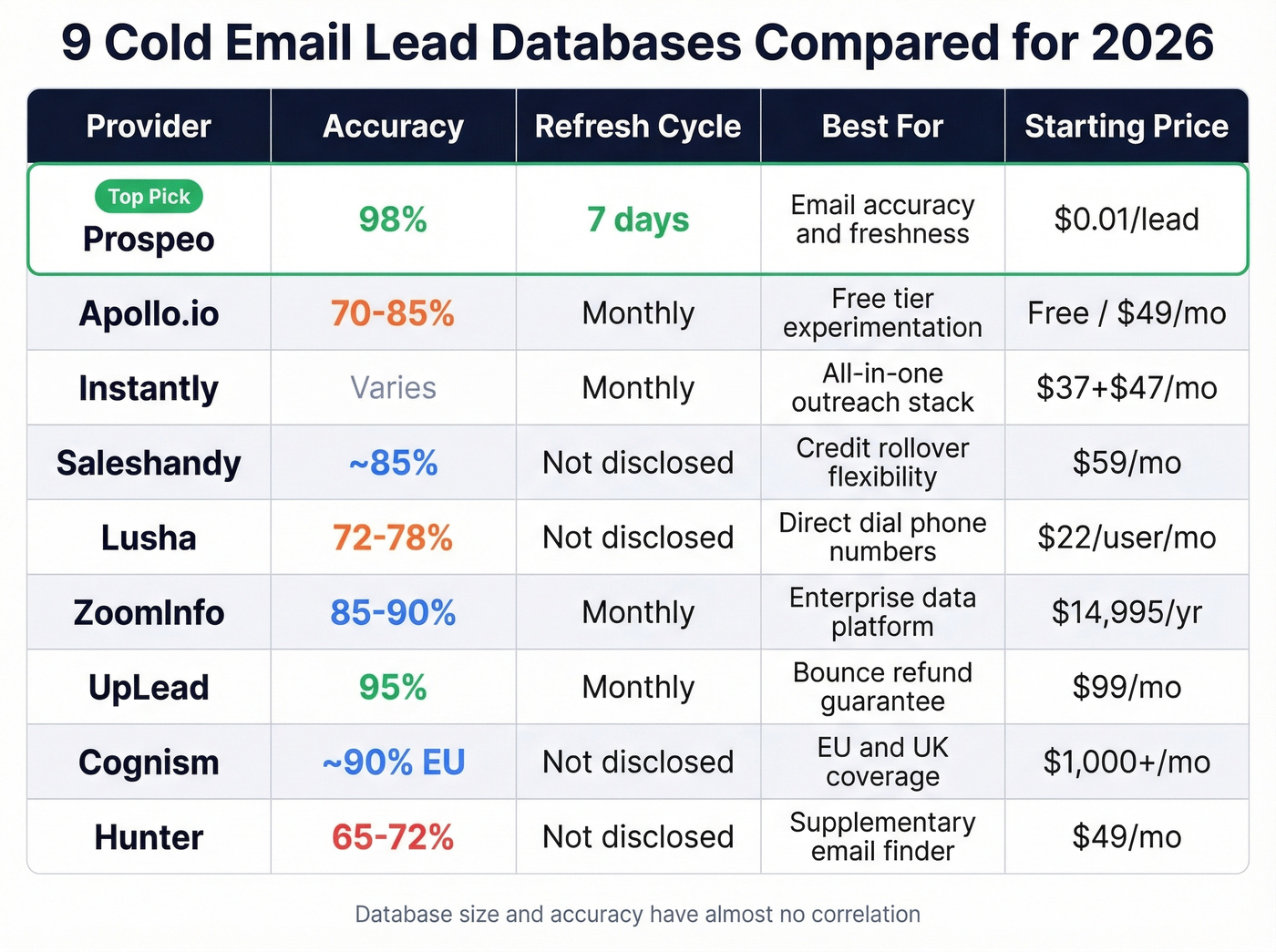
| Tool | Accuracy | Refresh | Verification | Cost/Lead |
|---|---|---|---|---|
| Prospeo | 98% | 7 days | 5-step proprietary | ~$0.01 |
| Apollo | ~70-85% | Monthly | SMTP + pattern | ~$0.05-0.08 |
| Instantly | Varies | Monthly | Waterfall (5+ sources) | ~$0.02-0.03 |
| Saleshandy | ~85% (est.) | Not disclosed | Not disclosed | ~$0.02 |
| Lusha | ~72-78% | Not disclosed | Community + SMTP | ~$0.07 |
| ZoomInfo | ~85-90% | Monthly | Multi-step | ~$1.00 |
| UpLead | 95% | Monthly | Real-time SMTP | ~$0.43 |
| Cognism | ~90% (EU) | Not disclosed | Phone-verified | ~$0.50+ |
| Hunter | ~65-72% | Not disclosed | Pattern + SMTP | ~$0.10+ |
Apollo's cost/lead is based on the $79/mo Pro plan with observed bounce rates. Database size and accuracy have almost no correlation.
The Real Cost Per Verified Lead
Here's where most database comparisons fall apart: they compare sticker price instead of cost per usable lead.
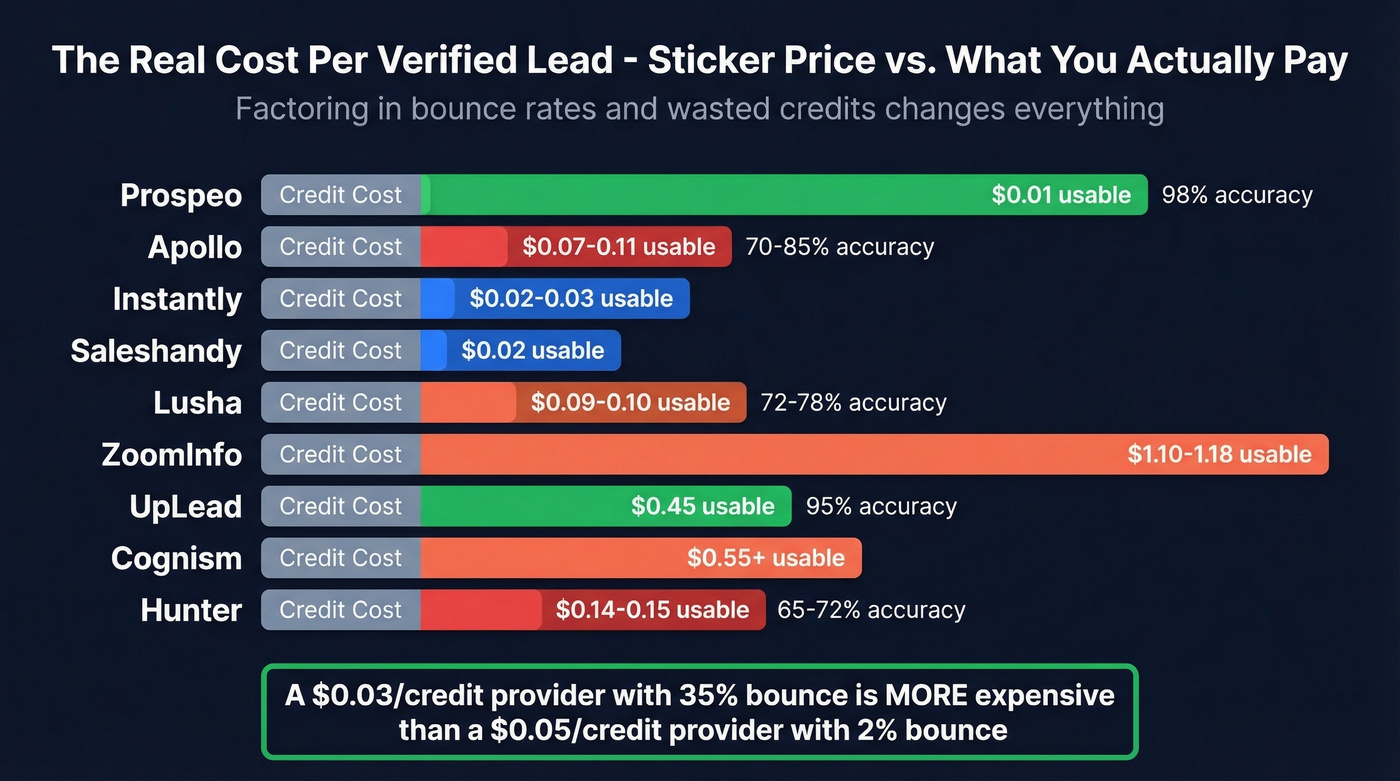
| Database | Credit Cost | Bounce Rate | Usable Cost/Lead |
|---|---|---|---|
| Prospeo | ~$0.01 | ~2% | ~$0.01 |
| Apollo ($79/mo) | ~$0.04 | 32-38% | ~$0.05-0.08 |
| Instantly | ~$0.02-0.03 | 10-20% | ~$0.03-0.04 |
| ZoomInfo | ~$1.00 | ~10-15% | ~$1.10-1.20 |
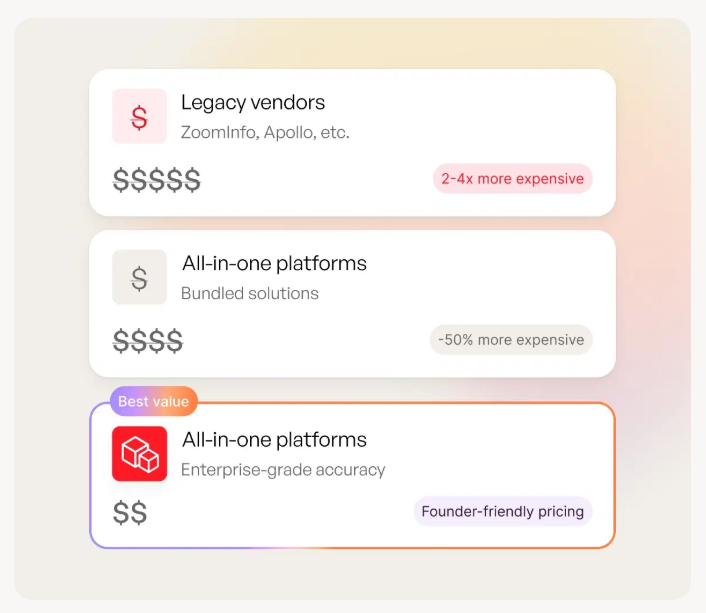
A database with 35% bounce doesn't just waste credits - it damages your sender domain. ESP providers throttle you, your warmup work evaporates, and recovery takes weeks. The "cheap" database becomes the most expensive line item in your stack when you factor in domain rehabilitation and lost pipeline. Third-party verification adds $1.50-$10 per 1,000 emails on top of your database cost, which further erodes the savings from cheaper providers. (If you're troubleshooting deliverability, start with an email reputation check.)
Why One Database Isn't Enough (Sometimes)
The Reddit consensus is clear: stacking multiple data sources through waterfall enrichment produced the lowest bounce rates in practitioner testing - around 10-14% using Clay plus multiple providers. No single database has perfect coverage, so layering sources fills gaps. (If you're considering this approach, see our guide to data enrichment tools.)
But waterfall enrichment introduces complexity. You're managing multiple subscriptions, building Clay tables, debugging enrichment sequences, and still running everything through a separate verification tool. For teams with a dedicated RevOps person, that's fine.
Let's be honest: if you're running fewer than 5,000 contacts per month, a single high-accuracy cold email lead database beats a complex waterfall setup every time. We've watched teams spend more time maintaining their enrichment stack than actually selling. Save the engineering for your product, not your prospecting infrastructure.
Building a Compliant Outreach Database
Cold email is legal in most jurisdictions. But "legal" has conditions.
Under GDPR (EU/UK), B2B cold email works via Article 6(1)(f) legitimate interest if you have a genuine business reason, the outreach is relevant to the recipient's professional role, and you provide a clear opt-out. You also need DSAR readiness and records of where you sourced the data. CAN-SPAM (US) requires clear sender identification and a working opt-out mechanism - no prior consent needed, just don't be deceptive. CASL (Canada) is the strictest: consent is required before sending commercial messages, so don't cold email Canadian prospects without explicit or implied consent.
Across every region: include your real company name and physical address, make unsubscribe one-click and immediate, keep records of data sources for every contact, and honor opt-outs promptly. Choose databases that provide compliance infrastructure - opt-out enforcement, audit trails, and GDPR-compliant sourcing. Saving $50/month on a cheaper provider isn't worth a regulatory headache. (More on this: B2B compliance.)
A cold email lead database refreshed every 6 weeks is already 3-4% decayed on export day. Prospeo refreshes every 7 days across 300M+ profiles, with catch-all handling and spam-trap removal built into every record.
Protect your domain with the freshest B2B data available - 75 free emails to prove it.
FAQ
Is buying a cold email lead database legal?
Yes, in most jurisdictions. B2B cold email is legal under GDPR via legitimate interest (Article 6(1)(f)) and under CAN-SPAM with proper sender identification and opt-out. CASL in Canada requires prior consent. Always include a one-click unsubscribe.
What bounce rate should I expect from a good provider?
Keep total bounces below 2% and hard bounces below 1%. Practitioner tests show unverified databases deliver 22-38% bounce rates. Providers with built-in multi-step verification consistently stay under 5%.
How often should lead data be refreshed?
Monthly refresh is the minimum acceptable standard since B2B data decays at roughly 30% per year. The industry average is 6 weeks. Weekly refresh exists but it's rare - most competitors top out at monthly.
Can I use one database for everything?
You can if accuracy is high enough. Waterfall enrichment - stacking multiple sources - reduces bounce rates to 10-14% in practitioner testing. But for teams under 5,000 contacts/month, a single high-accuracy provider with built-in verification outperforms a complex multi-tool setup and costs less to manage.
What's the best B2B database for cold email in 2026?
It depends on your priorities. For raw accuracy and data freshness, Prospeo leads with 98% accuracy and a 7-day refresh cycle. Apollo wins on free-tier accessibility for bootstrapped teams. Cognism is the strongest option for European markets. Prioritize verified accuracy over raw database size - a 300M-contact database at 98% accuracy outperforms an 800M-contact database at 70%.