

How to Handle Every Cold Email Objection (With Copy-Paste Templates)
Most cold email objection advice is recycled cold-calling content dressed up for inboxes. That's a problem.
Phone scripts assume a live conversation where you can listen, pivot, and recover in real time. Email objections don't work that way. You get one shot per message - three sentences, maybe four - before the prospect decides you're worth replying to or not. That demands a completely different playbook, and the generic "overcome objections with empathy!" posts out there aren't cutting it.
Below: copy-paste reply templates for every objection you'll actually face, backed by data from a ~484K-email test and 2026 benchmarks from Instantly. Five objections, five replies, and the data quality foundation that makes all of it work.
The Short Version
TL;DR - save this box:
- Most objections are preventable. Three opener patterns consistently beat a 2% reply rate in a ~484K-email test. The other 15+ patterns generated the objections you're now trying to handle.
- For objections you do get: use the acknowledge → reframe → one question framework. Three sentences max. Every reply in this article follows that structure.
- If your bounce rate is above 5%, no template saves you. You're emailing dead addresses, wrong people, and spam traps. Fix your data first.
What "Normal" Looks Like in 2026
Let's calibrate expectations before talking tactics. According to Instantly's 2026 benchmark report, which analyzed billions of cold email interactions:
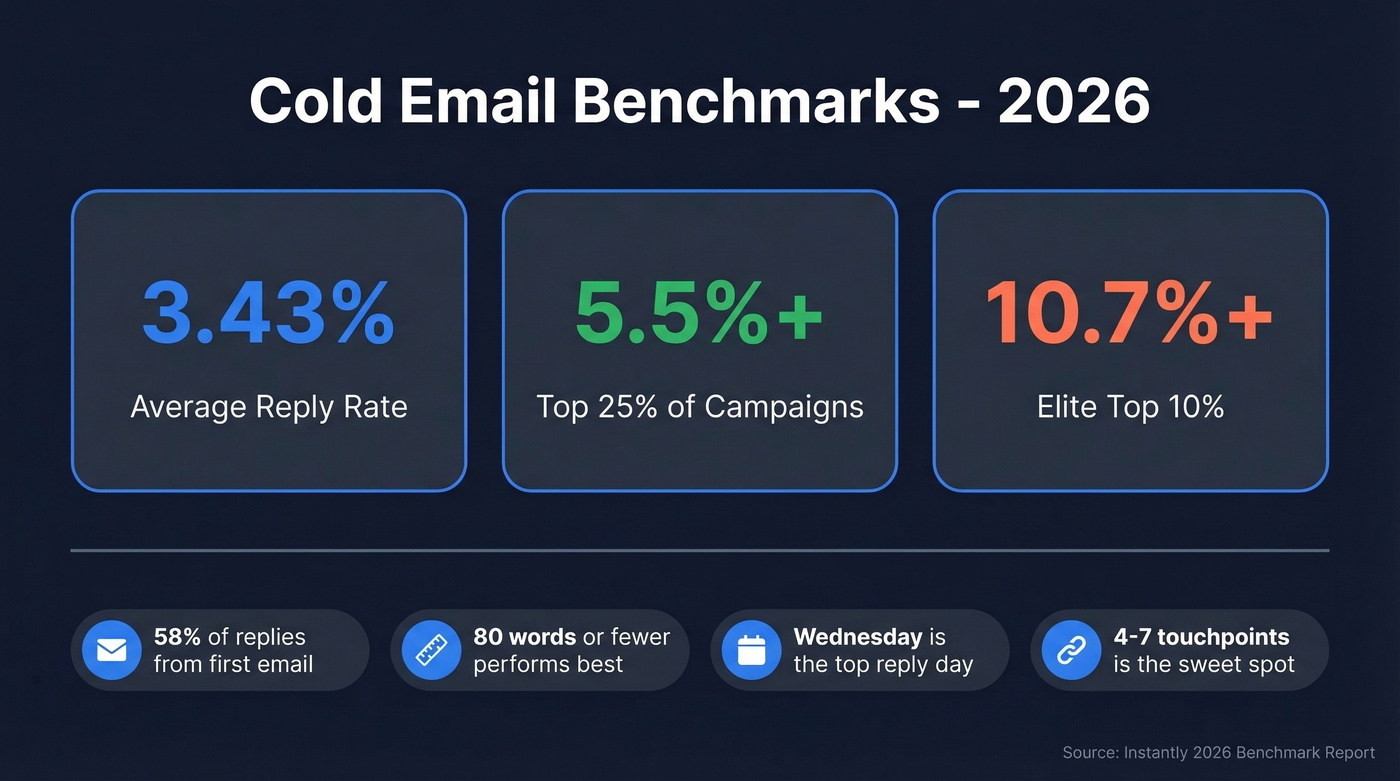
- Average reply rate: 3.43%
- Top quartile: 5.5%+
- Elite (top 10%): 10.7%+
If you're sending 1,000 emails, expect roughly 34 replies. Of those, figure 20-25 are objections or neutral responses. Maybe 5-10 are genuinely positive. That's the math - you need to convert a handful of objections per campaign, not all of them.
Other benchmarks worth knowing: 58% of all replies come from the first email, with 42% from follow-ups. Best-performing campaigns keep emails under 80 words. Wednesday edges out Tuesday for peak reply day. The sweet spot for sequence length is 4-7 touchpoints - fewer leaves money on the table, more starts burning goodwill.
Prevent Objections Before They Happen
The best objection reply is one you never have to send. A practitioner on r/coldemail shared results from testing 18+ opener patterns across ~484K emails over four months - controlling for list quality, infrastructure, and offer. Only 3 patterns consistently beat a 2% reply rate. Everything else landed between 0.8% and 1.8%.
If you're still building your outbound system, start with a solid B2B cold email sequence and then optimize the pieces.
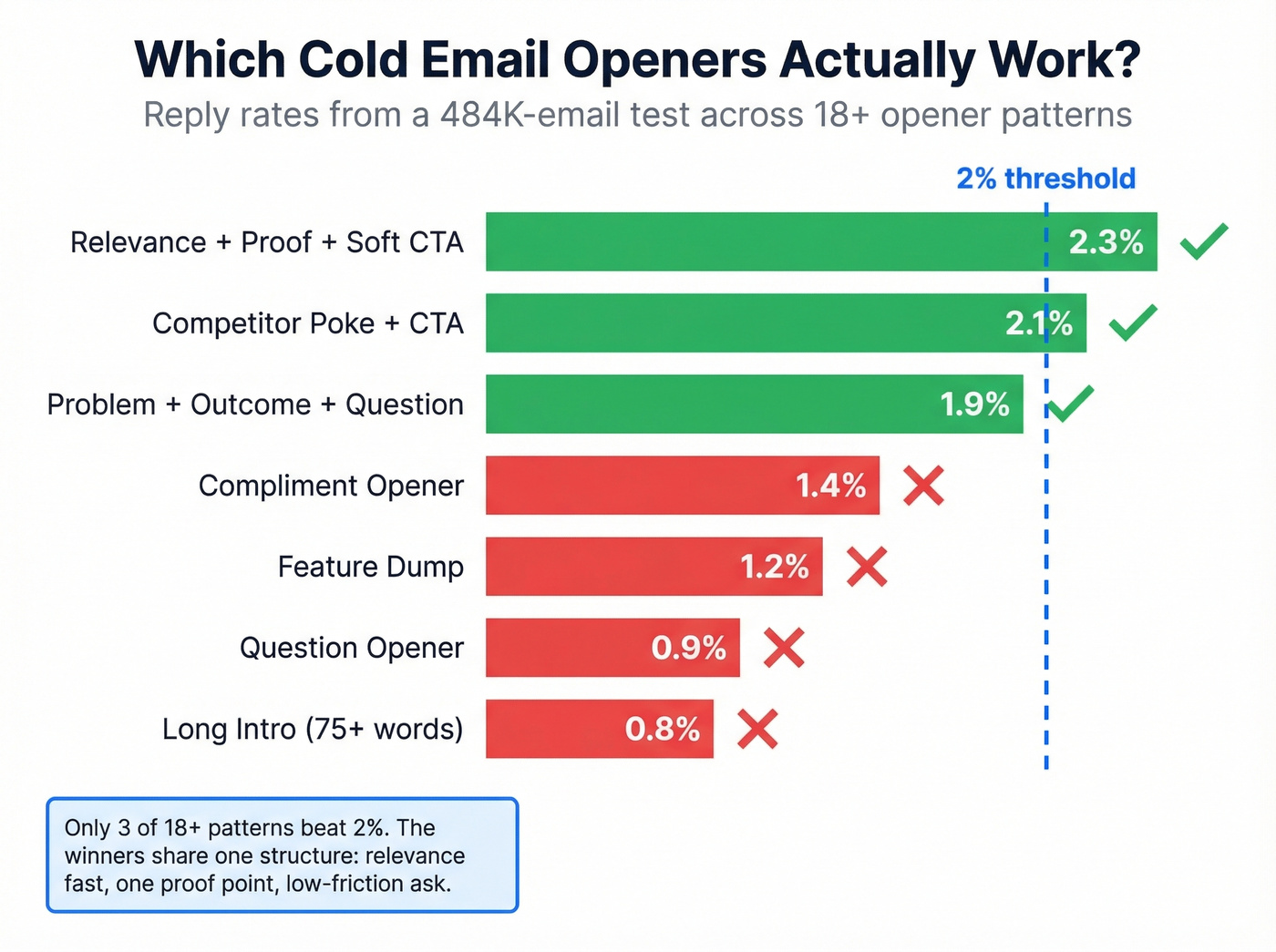
| Opener Pattern | Reply Rate | Verdict |
|---|---|---|
| Relevance + proof + soft CTA | 2.3% | ✅ Use this |
| Competitor poke + CTA | 2.1% | ✅ Use this |
| Problem + outcome + question | 1.9% | ✅ Use this |
| Compliment opener | 1.4% | ❌ Stop using |
| Feature dump | 1.2% | ❌ Stop using |
| Question opener | 0.9% | ❌ Stop using |
| Long intro (>75 words) | 0.8% | ❌ Stop using |
"Love what you're doing at [Company]" - the compliment opener every sales blog recommends - pulled just 1.4%. The consensus on r/coldemail is that compliment openers read as fake at scale, and the data backs that up. The "Are you struggling with...?" question opener? 0.9%. Long intros over 75 words? Dead last.
The winning patterns share a structure: establish relevance fast, offer one proof point, end with a low-friction ask. No flattery, no feature lists, no rhetorical questions. Getting this right is the single best way to reduce your objection rate before replies even start rolling in.
Two more levers worth pulling. First, timeline-based hooks outperform problem hooks - 10.01% average reply rate vs 4.39% (about 2.3x). "We helped [similar company] cut onboarding time by 40% in Q1" beats "Are you struggling with slow onboarding?" every time. Second, segmenting your list into cohorts of 50 or fewer contacts increased reply rates by 2.76x in one analysis.
Here's the thing: heavy personalization ran about $0.15/lead versus $0.02/lead for category-level copy, and the ROI was actually lower for the expensive version. Relevance isn't the same as personalization - you can be relevant without researching every prospect's podcast appearances. Spend that time on list quality instead.
If you're tightening targeting, an ideal customer profile plus basic intent based segmentation will prevent a lot of "not interested" replies.
The 5 Objections You'll Actually Face
Zig Ziglar mapped every sales objection to five basic obstacles: no need, no money, no hurry, no desire, and no trust. In cold email, those translate to five replies you'll see over and over:
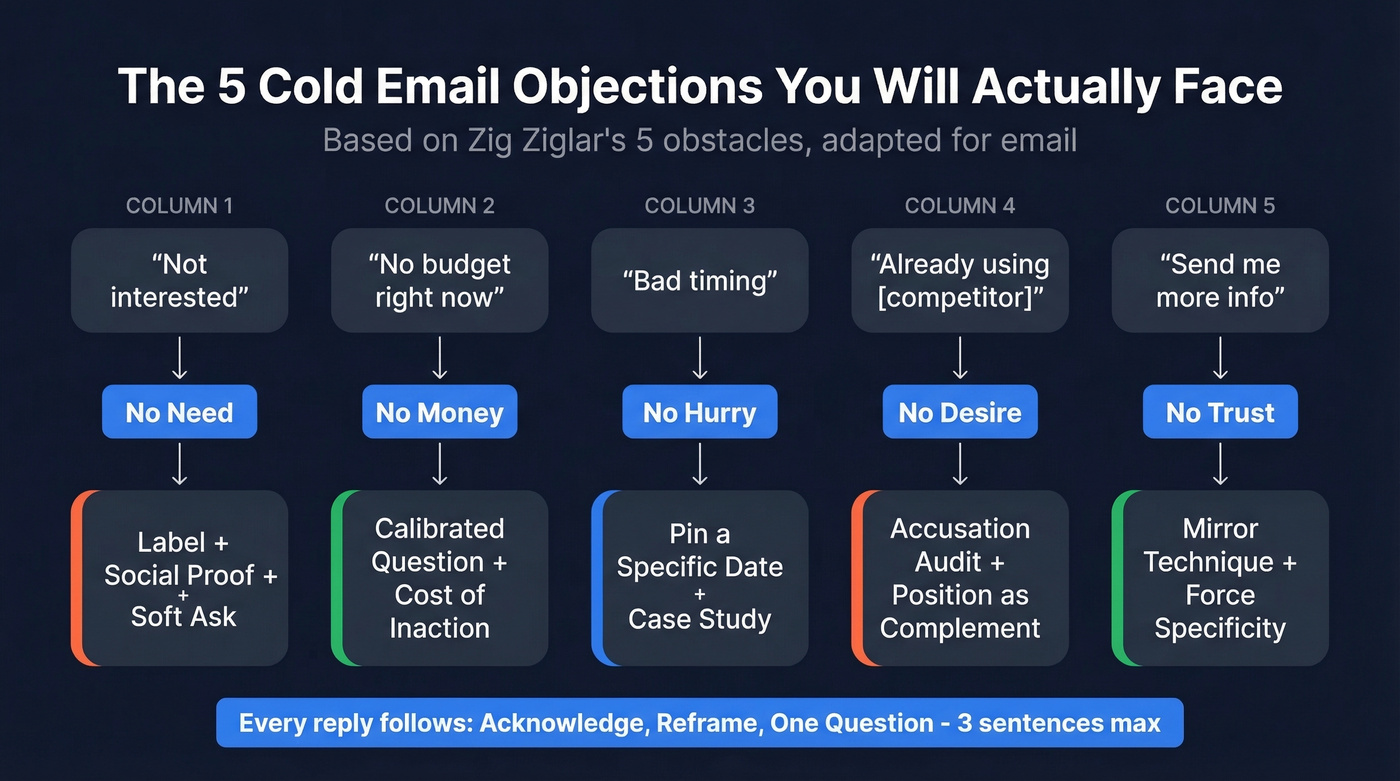
- "Not interested" → No need (or no perceived need)
- "No budget right now" → No money
- "Bad timing" → No hurry
- "Already using [competitor]" → No desire to switch
- "Send me more info" → No trust (yet)
On a sales call, you'd use the LAER framework - Listen, Acknowledge, Explore, Respond - because you're in a live conversation. Email doesn't give you that luxury. Each reply is a standalone pitch. You get three sentences to acknowledge, reframe, and ask one question. That's the budget.
If you're seeing the same pushbacks across channels, it can help to compare with cold call rejection patterns too.

You read it above: if your bounce rate is above 5%, no template saves you. Prospeo's 98% email accuracy and 7-day data refresh mean your replies are actual objections from real people - not bounces from dead addresses.
Stop handling bounces. Start handling real objections.
Copy-Paste Objection Reply Templates
"Not Interested"
What they said: "Thanks, but we're not interested right now."
This is the default rejection. Half the time it means "I didn't read your email carefully enough to form a real objection."
Your reply:
It sounds like the timing caught you off guard - totally fair. [Similar company] said the same thing before they cut their [metric] by [X%] in [timeframe]. If that's even slightly relevant, would a 10-minute call be worth it?
This uses Chris Voss's labeling technique - "It sounds like..." - which acknowledges their position without agreeing with it. The social proof reframes from "why should I care" to "someone like me got results."
Don't say this: "Can I ask why?" It puts them on the defensive and reads like a survey. You'll never hear back.
If they don't respond: Send one follow-up using Voss's ghosting prompt: "Have you given up on improving [metric]?" It's direct, slightly provocative, and pulls a response when nothing else will. Then move to breakup.
"No Budget Right Now"
Sometimes this is true. More often, it means "I don't see enough value to justify finding budget." Your job is to shift the frame from cost to cost-of-inaction.
Totally understand - budget cycles are real. Quick question: what would need to change for this to make sense next quarter? Most teams we work with find that [specific outcome] pays for itself within [timeframe], so I want to make sure I'm sending the right info when timing opens up.
The calibrated question ("What would need to change?") is straight from Voss's playbook - it makes the prospect define their own buying criteria instead of you arguing about price.
Don't say this: "We have flexible pricing options." You've just told them you're negotiable before they even asked.
Follow up in 2-3 weeks with a case study that quantifies ROI. Don't repeat the pitch.
"Bad Timing"
Completely fair - Q3 planning is brutal. When specifically should I circle back? Happy to send over a quick case study on how [similar company] handled [their version of this problem] so you've got context when the time's right.
The key word is "specifically." Vague timing ("next quarter") lets them forget you. A specific date ("first week of September") gives you a legitimate reason to follow up. Set a calendar reminder for whatever date they give, or 6 weeks out if they don't specify.
"Already Using [Competitor]"
What they said: "We're already using [tool/vendor] for this."
They're satisfied - or at least satisfied enough that switching feels like more work than it's worth. You're not going to unseat an incumbent in one email. Don't try.
Your reply:
You're probably thinking "why would I switch when what we have works" - and honestly, most of our customers started in the same spot. We're not asking you to rip anything out. [Specific differentiator] works alongside [competitor] - would it be worth 15 minutes to see if there's a gap we can fill?
This opens with an accusation audit - saying the worst thing they're thinking before they say it. Then you position as complementary, not competitive. This is the hardest objection to overcome via email. One follow-up max, then long-term nurture.
Don't say this: "We're better than [competitor] because..." You've just insulted their judgment for choosing that tool.
"Send Me More Info"
In our experience, this is the most deceptive objection. It feels like progress but almost never is. "Send more info" is the polite way of saying "I want you to stop emailing me without saying no."
Happy to - what specifically would be most useful? I can send a one-pager on [specific use case] or a 2-minute walkthrough. But honestly, the fastest way to see if this fits is a quick 15-minute call - would Thursday or Friday work?
The mirror technique (repeating their request back as a question) forces them to get specific. If they actually want info, you'll learn what matters. If they were brushing you off, the specificity request surfaces that. Send one follow-up with a single, specific resource - not a brochure - then move to breakup.
What to Do After You Reply
The worst thing you can do is follow up 24 hours later with "just checking in." Skip this if you're tempted - everyone hates it, and it signals you have nothing new to say.
If you need alternatives that still feel human, borrow phrasing from how to say just checking in professionally.
For executives, wait at least 3 business days. A fast follow-up reads as desperate. For SMB owners, a 2-day window works because their decision cycles are shorter. When you do follow up, reference the specific objection in one sentence, add a new angle or proof point, and ask one question.
If you want more ready-to-send options, pull from these sales follow-up templates and adapt them to the objection.
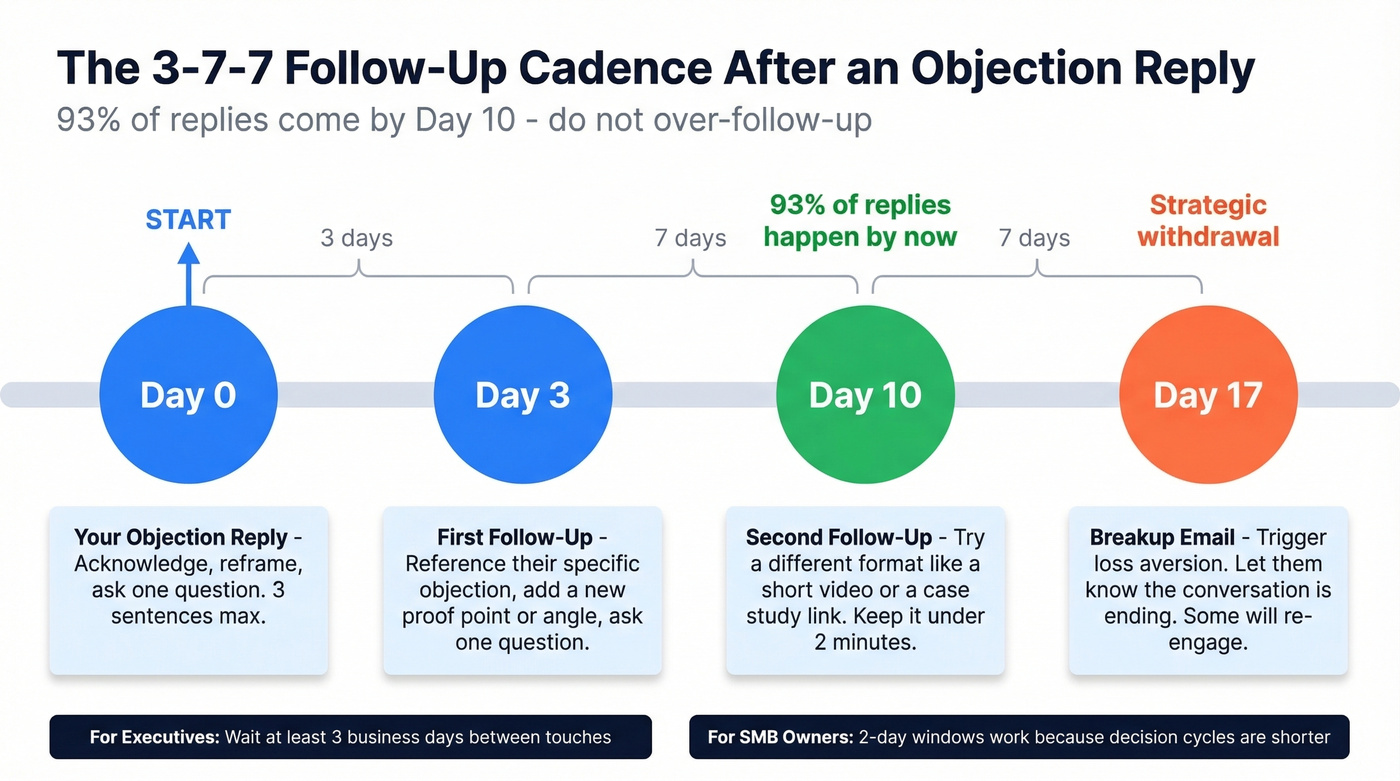
The 3-7-7 cadence model works well: Day 0 (your objection reply) → Day 3 (first follow-up) → Day 10 (second follow-up) → Day 17 (breakup). 93% of replies come by Day 10, so anything beyond that is diminishing returns. One tactic we've seen break through after the 2nd or 3rd email: a short video follow-up. Keep it under 2 minutes, say their name, reference their objection, and embed it directly.
The Breakup Email
After 5+ touchpoints with no response, it's time for strategic withdrawal. Breakup emails work because they trigger loss aversion - the prospect realizes the conversation is ending, and some percentage re-engages. Breakup emails can drive reply rates as high as 76% compared to 5-10% for standard follow-ups. That number won't hold for every campaign, but the pattern is consistent - the final touch outperforms the middle ones.
Template 1: Direct Withdrawal
I've reached out a few times and haven't heard back, so I'll assume the timing isn't right. If [problem you solve] becomes a priority, I'm here. Closing the loop - wishing you a strong Q[X].
Template 2: Feedback Request
Quick question - which best describes your situation? (A) Not relevant right now, (B) Using something else, (C) Interested but buried, (D) Wrong person. A one-letter reply works.
The A/B/C/D format typically outperforms the direct withdrawal because it's easier to answer. Even a "D" reply is valuable - it tells you to ask for a referral. Space your breakup 3-4 days after your last touch. Less than 48 hours signals desperation; more than 5 days and they've lost context.
The Objection No Template Can Fix
The most common "objection" in cold email isn't an objection at all. It's silence.
Silence often means your email never reached a real person. If you're getting auto-replies from people who left the company six months ago, or your bounce rate is creeping above 5%, the problem isn't your copy - it's your data. Every bounced email damages your sender reputation, and enough damage means even your good emails land in spam.
We've watched teams rewrite their templates three or four times before realizing the real issue was a list full of dead addresses. Prospeo runs a 5-step verification process with catch-all handling, spam-trap removal, and honeypot filtering - catching toxic contacts before they tank your domain. Stack Optimize built to $1M ARR using Prospeo with bounce rates under 3% and zero domain flags across all clients. Before you rewrite a single template, verify your list. That's the highest-ROI move in your entire outbound stack.
If you want to diagnose the root cause fast, start with email bounce rate and then work through an email deliverability guide.
The data showed segmented lists of 50 contacts boost replies 2.76x. Prospeo's 30+ filters - intent data, job changes, headcount growth - let you build hyper-relevant micro-lists that prevent objections before they happen.
Build the list that makes 'not interested' rare.
FAQ
What's the best framework for cold email objection handling?
Acknowledge → reframe → one question. Three sentences max. Every objection reply in this article follows that structure, adapted from Chris Voss's negotiation techniques for asynchronous communication where you can't read tone or body language.
How many follow-ups should I send after an objection?
Use the 3-7-7 cadence: reply on Day 0, follow up on Days 3, 10, and 17. The breakup email goes after 5+ total touchpoints. 93% of replies arrive by Day 10, so anything beyond that is diminishing returns.
What's a good reply rate for cold emails in 2026?
Average is 3.43%, top quartile is 5.5%+, and elite senders hit 10.7%+ per Instantly's 2026 benchmarks. Above 5.5% means your messaging is working. Below 3%, revisit opener patterns and list quality.
How do I reduce objections before they happen?
Start with verified contact data - bounce rates above 5% mean you're emailing the wrong people entirely. Then use one of the three winning opener patterns from the ~484K-email test (relevance + proof + soft CTA scored highest at 2.3%). Pair that with list segmentation under 50 contacts per cohort and you'll cut objection volume significantly.
Should I respond to every "not interested" reply?
Yes, once - using the acknowledge → reframe → question framework. No response after that? Move to the breakup email. Multiple replies to someone who said "not interested" crosses the line from persistent to annoying.