

Cold Email Opening Lines That Actually Get Replies
You've got about 6 seconds after someone opens your email - and your cold email opening lines aren't just the first thing they read inside the body. They're the preview text sitting next to your subject line, competing with dozens of other unread messages. Across 14.3B cold emails analyzed, the average reply rate is 3%. Your opening sentence is one of the biggest levers to beat that number.
What Actually Works (Quick Version)
Five opener types consistently outperform everything else: specific observation, loss-framed problem, mutual connection, curiosity gap, and trigger event reference.
But here's the contrarian take most articles won't give you: stop collecting opening lines. Start collecting prospect intelligence. The research behind the line is 80% of the equation. A mediocre intro built on a real insight beats a perfectly crafted line built on nothing every single time.
5 Best Cold Email Openers
1. Specific Observation + Value Offer
"Noticed [Company] just expanded into DACH - we helped [similar company] cut their localization timeline by 40%. Mind if I send the playbook?"
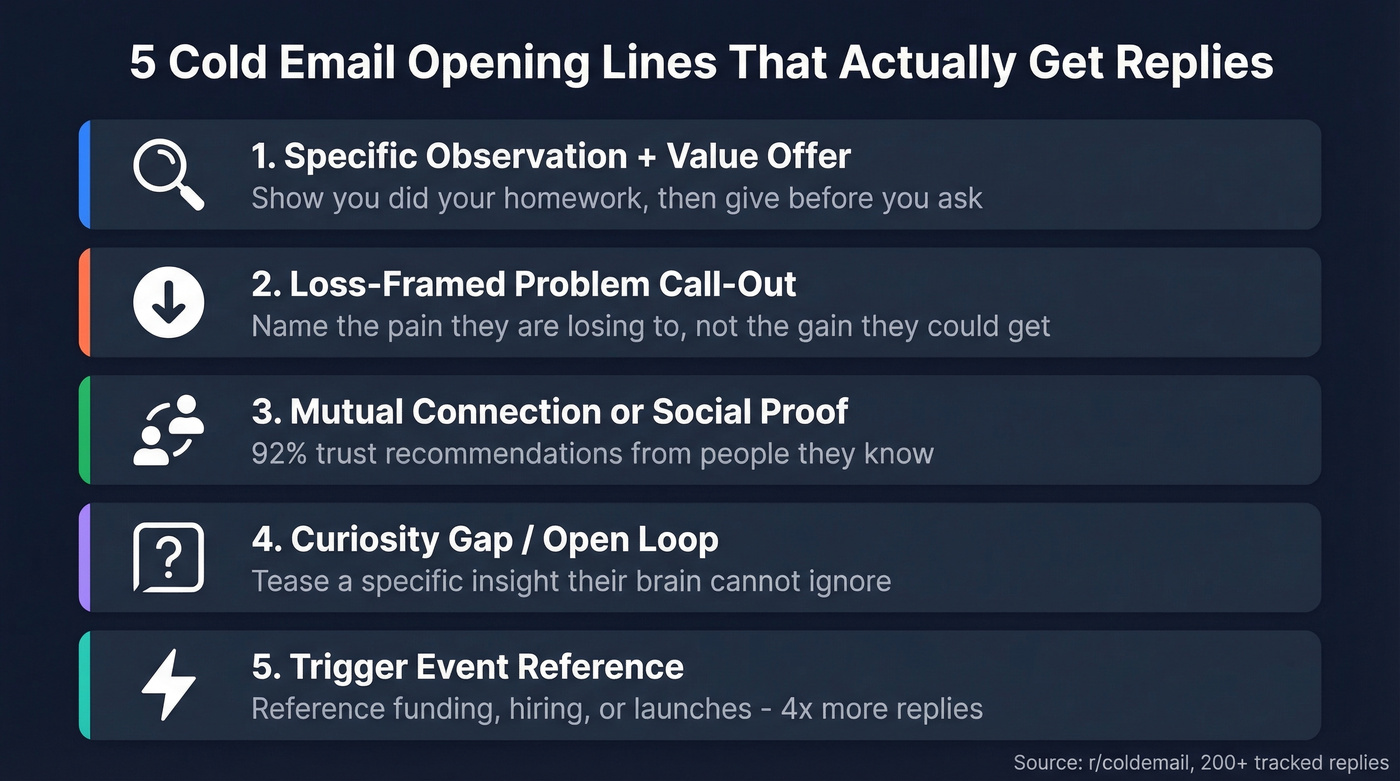
One practitioner who tracked 200+ replies on r/coldemail found that switching from an ask-first opener to a value-first opener lifted reply rates from 0.8% to 3-4%. The mechanism is reciprocity - you're giving before asking, which earns the right to a response.
2. Loss-Framed Problem Call-Out
Most outbound advice focuses on what prospects could gain. That's backwards. Loss aversion is one of the most reliable psychological triggers in sales development - people respond far more to what they're losing than what they could win.
Before: "We can help you route leads 20% faster."
After: "Most Series B SaaS teams are losing 15-20 hours/week on manual lead routing. Is that hitting your team too?"
We've seen loss-framed openers outperform gain-framed ones consistently across every vertical we've tested. The "after" version names a specific, quantified pain. That's what gets replies.
3. Mutual Connection or Social Proof
92% of people trust recommendations from people they know over advertising. A warm reference - even a loose one - immediately separates you from the noise because it borrows trust you haven't earned yet.
"[Name] at [Company] mentioned you're rebuilding your outbound stack - we just helped them cut bounce rates from 12% to under 2%."
If you don't have a direct connection, a shared community or event works too. "Saw your talk at SaaStr" is miles better than "Love what your company is doing."
4. Curiosity Gap / Open Loop
"Most [industry] teams are making one mistake with their outbound sequences that's costing them 30%+ of their pipeline. Happy to share what we're seeing."
This taps the Zeigarnik effect - our brains can't let go of incomplete information. The key is making the gap specific enough to feel real, not so vague it feels like clickbait. "One mistake costing 30% of pipeline" works. "A secret that will change everything" doesn't.
5. Trigger Event Reference
Personalized first lines referencing real events generate 4x more replies than generic openers. It's the cocktail party effect - people pay attention when you say something that's actually about them.
"Saw you just brought on [Name] as VP of Sales - usually means outbound is about to scale fast. We help teams like yours avoid the data quality problems that come with that growth."
Newly funded companies are in a growth mindset, and the first quarter after a funding announcement is prime outreach territory. Hiring signals work the same way. The challenge is finding these signals fast enough to act on them - which is where lead enrichment tools with weekly data refresh cycles earn their keep.
The 3-Sentence Introduction Framework
Sentence 1: Specific observation - something you found in two minutes of research. Sentence 2: Brief credibility signal - what you do, who you've helped. Sentence 3: Small ask - not "15 minutes," something low-friction.
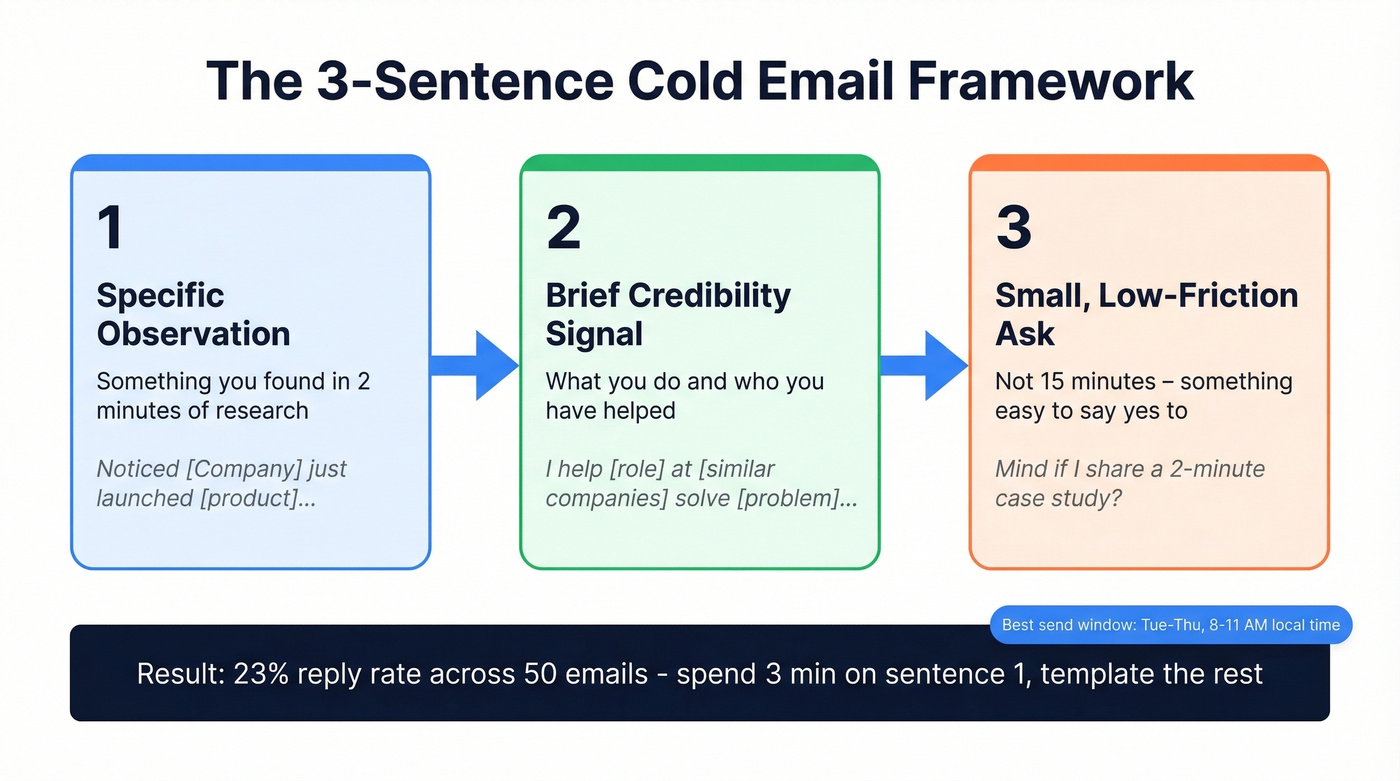
In practice: "Noticed [Company] just launched [product]. I help [role] at [similar companies] solve [problem] - saw a 30% lift with [peer company]. Mind if I share a 2-minute case study?"
One practitioner using this structure reported a 23% reply rate across 50 emails. Top practitioners spend about 3 minutes per email on the first sentence - the rest is templated. When you A/B test openers, run at least 250 contacts per variant and measure positive reply rate, not opens. Send Tue-Thu between 8-11 AM in the recipient's timezone; practitioners report 16% higher open rates versus other windows (more timing data in our best time to send cold emails guide).

Trigger event openers generate 4x more replies - but only if you catch the signal in time. Prospeo refreshes 300M+ profiles every 7 days, surfacing job changes, funding rounds, and hiring spikes before your competitors see them.
Stop writing great openers to stale data. Get signals that are actually fresh.
Intro Lines to Stop Using Immediately
"Quick q {firstname}" - So burned out it's become a spam signal. Prospects see it and immediately know it's automated.
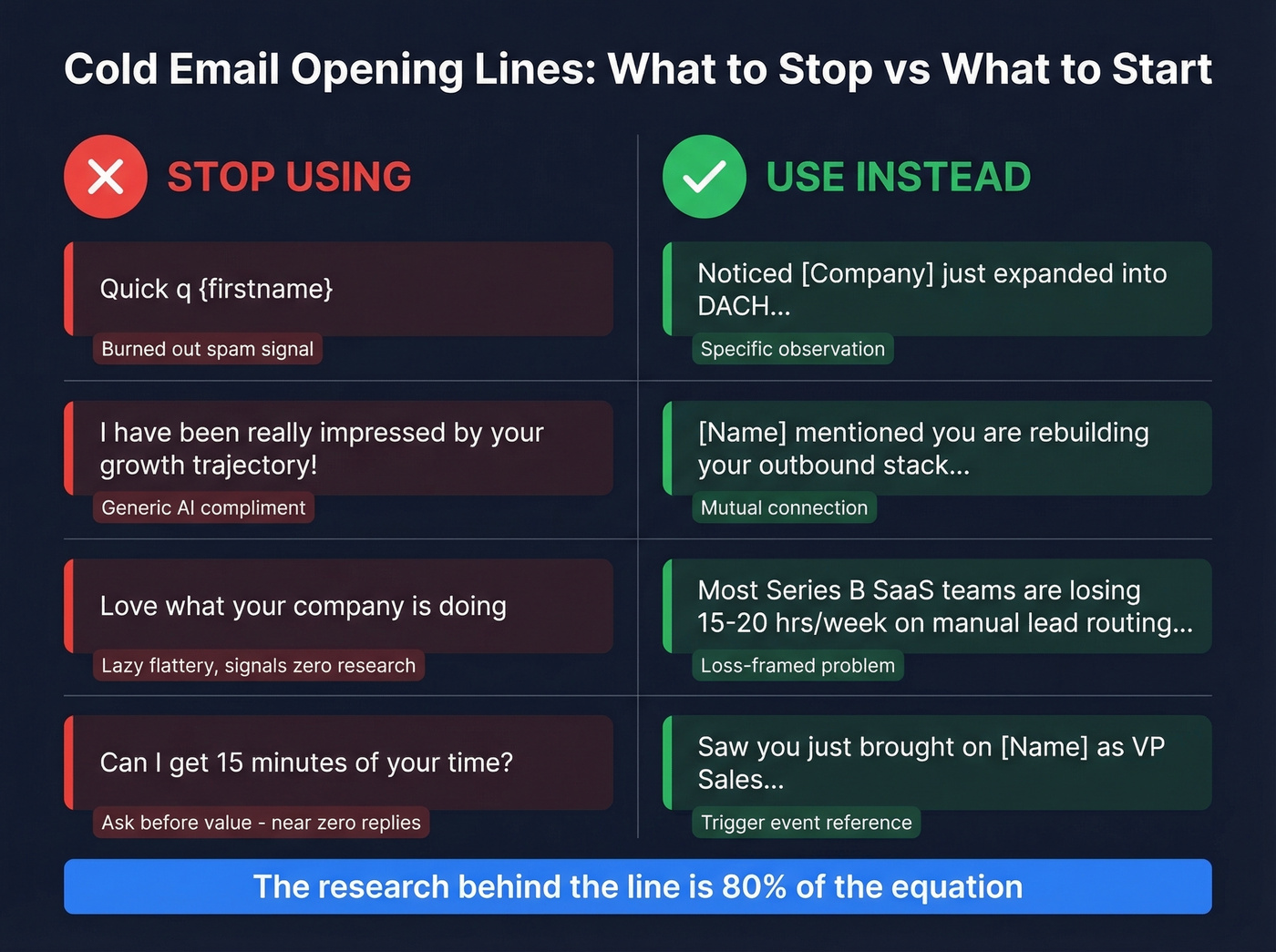
The cheery AI compliment - "I've been really impressed by [Company]'s growth trajectory!" is 2026's version of "Hope this finds you well." Everyone knows GPT wrote it (if you're using AI, follow a real AI cold email outreach workflow).
Generic flattery - "Love what your company is doing" tells the prospect you couldn't be bothered to find out what they're actually doing. It's worse than no opener at all because it signals laziness.
"Can I get 15 minutes?" - Leading with an ask before providing any value produces near-zero reply rates. Earn the right to ask first.
Let's be honest: if you're still using any of these, your reply rate problems aren't about deliverability. They're about copy.
Reply Rate Benchmarks by Industry
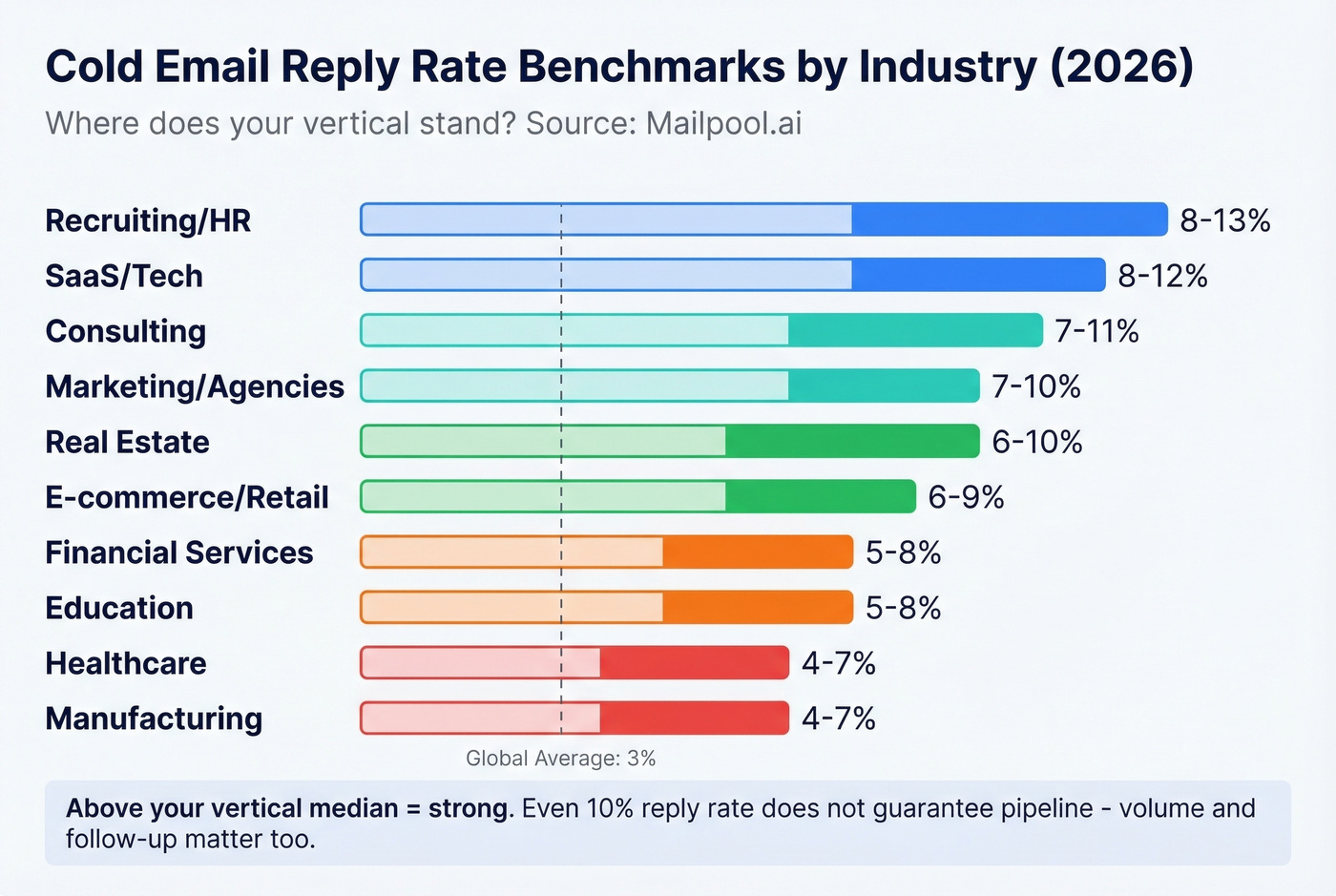
Your first line isn't competing against a universal benchmark - it's competing against your industry's baseline. Here are the numbers by vertical:
| Industry | Reply Rate |
|---|---|
| Recruiting/HR | 8-13% |
| SaaS/Tech | 8-12% |
| Consulting | 7-11% |
| Marketing/Agencies | 7-10% |
| Real Estate | 6-10% |
| E-commerce/Retail | 6-9% |
| Financial Services | 5-8% |
| Education | 5-8% |
| Healthcare | 4-7% |
| Manufacturing | 4-7% |
If you're in SaaS and hitting 4%, you're below average. If you're in healthcare and hitting 5%, you're doing fine. Context matters more than vanity benchmarks.
Fair warning: even a 10% reply rate doesn't guarantee pipeline. Prospects ghost after positive replies more than you'd expect, which is why volume and cold email follow-up templates matter alongside your opener.
How to Personalize Openers at Scale
Here's the thing - personalization and scale aren't opposites. Micro-campaigns of 50 or fewer recipients hit 5.8% response rates versus 2.1% for larger blasts. That's nearly 3x the performance just from tighter segmentation (start with an ideal customer profile that’s actually enforceable).
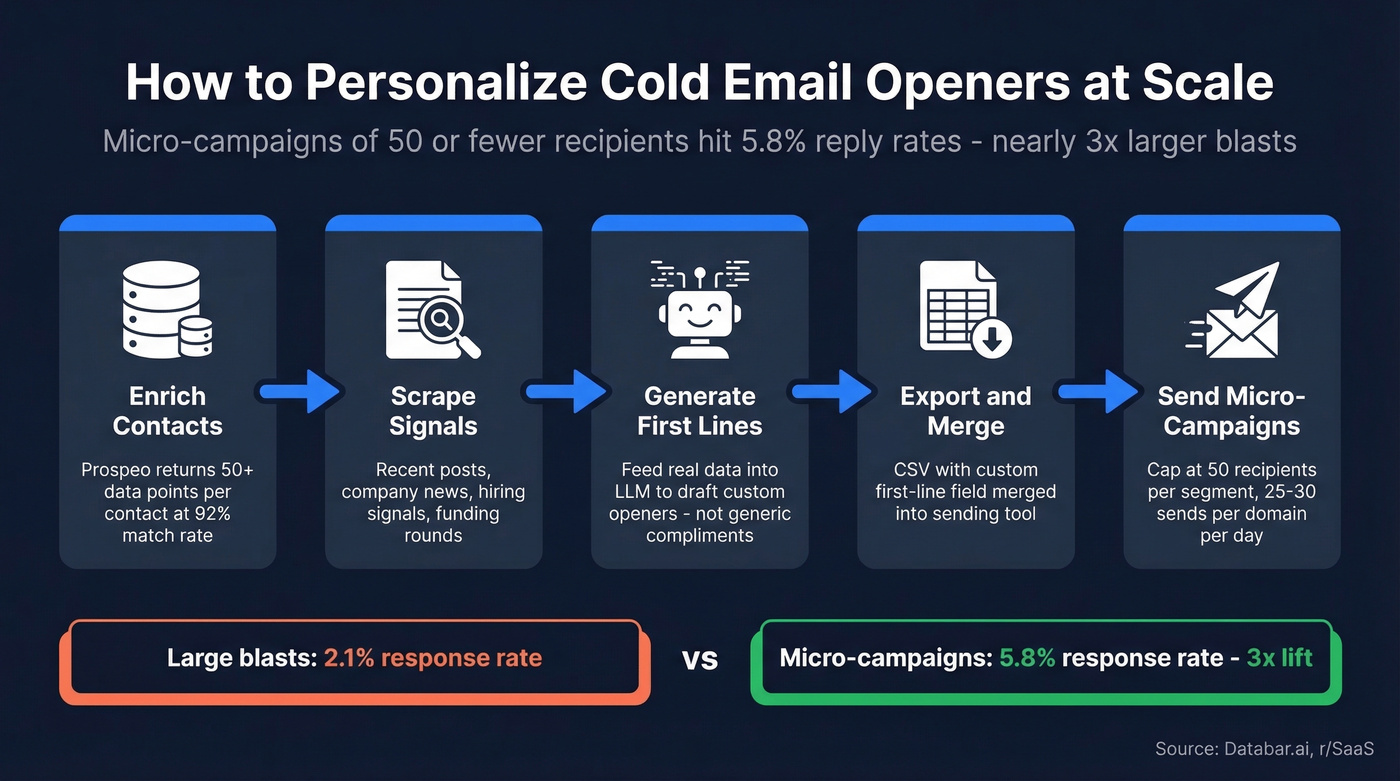
The workflow we've seen work best: scrape prospect data - recent posts, company news, hiring signals - and run it through an LLM to generate a custom first-line field. Export to CSV, merge into your sending tool, send. SDR teams doing this report roughly 3x response lifts versus their old approach.
The bottleneck isn't the AI. It's the data feeding it. Prospeo's enrichment returns 50+ data points per contact at a 92% match rate, which gives you the raw material for genuinely personalized first lines instead of generic compliments scraped from a company's About page (see the best data enrichment services if you’re comparing options).
None of This Matters in Spam
The best cold email opening lines in the world are worthless if they land in the spam folder.
One practitioner rebuilt their entire deliverability stack - scaling from 3 domains to 7, capping at 26 emails per day each - and dropped bounce rates from 11% to under 2%. That alone moved their reply rate from 3% to 6% before they changed a single word of copy. The full stack cost about $420/month and generated 16 qualified leads/month from email alone.
Look, most teams don't have a copywriting problem. They have a data quality problem. I've watched teams agonize over subject line A/B tests while sending to lists with 10%+ bounce rates. Fix the foundation first.
The basics: warm your domains, authenticate with SPF/DKIM/DMARC, and cap sends at 25-30 per domain per day (use an email velocity framework so you don’t guess). Never send from your primary domain - use dedicated sending domains so a flag on one doesn't tank your main sender reputation. Most critically, verify every email before you send (use an email deliverability guide to audit the full stack). Prospeo handles this with 98% email accuracy, real-time verification, and a 7-day data refresh cycle that keeps your list clean even as contacts change jobs. The free tier gives you 75 verified emails per month to start testing.
Personalized micro-campaigns hit 5.8% reply rates - nearly 3x larger blasts. But personalization at scale requires accurate contact data. Prospeo delivers 98% email accuracy at $0.01/email with 30+ filters to build hyper-targeted lists of 50.
Build the tightly segmented lists that make your opening lines actually land.
FAQ
How long should a cold email be?
Keep the full email under 56 words and the opener to one sentence - two at most. Top performers use three short paragraphs max. Your first line doubles as inbox preview text, so every word needs to earn its spot or it's costing you opens.
What's a good reply rate for cold email in 2026?
The global average is 3% across 14.3B emails analyzed. Top performers hit 10-15%. Your industry baseline matters more - recruiting teams average 8-13%, while healthcare sits at 4-7%. Anything above your vertical's median is strong.
Should I use AI to write cold email opening lines?
Yes, but only as a drafting layer on top of real prospect data. AI-generated first lines using scraped enrichment signals can lift response rates roughly 3x. Generic AI compliments without data backfire hard - they're the new "Hope this finds you well." Feed verified contact data into your prompt, then let the AI turn those signals into a relevant opener. Skip this approach entirely if you don't have quality data to feed it; you'll just generate polished-sounding spam.