

How to Write a Cold Email Referral That Actually Gets a Response
You found the perfect prospect. You know someone who knows them. You fire off a quick "Hey, could you introduce me?" and... nothing. No reply. No intro. Just silence.
The problem isn't your network - it's how you're writing the ask.
Referred prospects are 4x more likely to buy, and 92% of people trust referrals from someone they know. Yet only 35% of satisfied clients ever actually make a referral. That gap between willingness and action is where most sellers lose, and the fix isn't asking more people - it's asking the right way, with the right words, at the right moment.
Before You Write a Single Word
Three rules that save you from the delete folder:
- Never ask "Do you know anyone?" Make the ask specific to a named person or a described inner circle.
- Time the ask after a green light moment - gratitude, a compliment, a successful outcome. That's your window.
- Keep the email to 150-200 words, include one CTA, and verify the email address before you send. A bounced referral email is worse than no email at all. (If you want the deliverability checklist, start with our Email Deliverability Guide.)
Why Most Referral Asks Get Ignored
Picture this: you've identified a great role at a target company. You find three employees, send each one a polished "I'd love a referral - here's my resume" message, and all three ignore you.
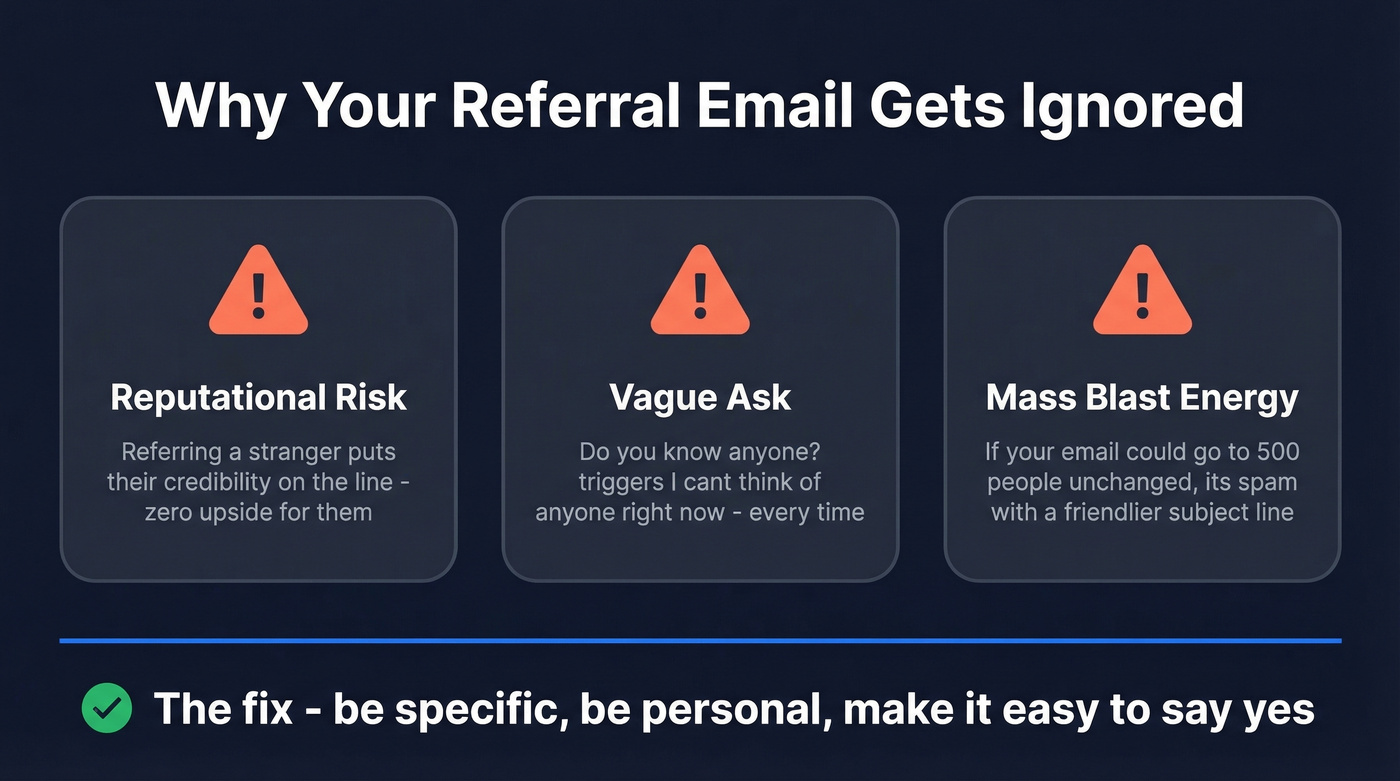
Here's the thing: a referral is a reputational bet. When someone refers you, they're putting their credibility on the line. As one engineer put it on r/ExperiencedDevs, referring an unvetted stranger can damage their standing for future referrals. That's a real cost for zero upside.
We've seen this pattern hundreds of times. The other killer is a vague ask. "Do you know anyone who might be interested?" triggers an immediate "I can't think of anyone right now," even from people who genuinely want to help. The Sandler inner-circle approach nails this: generic questions produce generic non-answers. And here's a useful litmus test - if your email could be sent to 500 people unchanged, it's not a referral request. It's spam with a friendlier subject line. (For more on writing outreach that doesn’t read like a blast, see Personalized Outreach.)
How to Ask for a Referral the Right Way
The Inner Circle Method
Instead of asking "anyone," ask about specific circles. What industry groups do they belong to? Who do they see at conferences? Who's in their regular rotation of professional contacts?
This works because it narrows the cognitive load. You're not asking someone to mentally scan their entire network - you're asking about a specific pocket of people they already think about regularly. Once they name someone, ask why they thought of that person. This gives you personalization context you can't get anywhere else.
Then close with the permission script: "Would it be OK if I tell [Name] that you mentioned them?" Never skip this step. Using someone's name without consent is a trust-killer.
Timing the Ask
The best referral asks don't come out of nowhere. They follow what SBI Growth calls a "green light moment" - any time the other person expresses gratitude, gives you a compliment, or acknowledges a positive outcome.
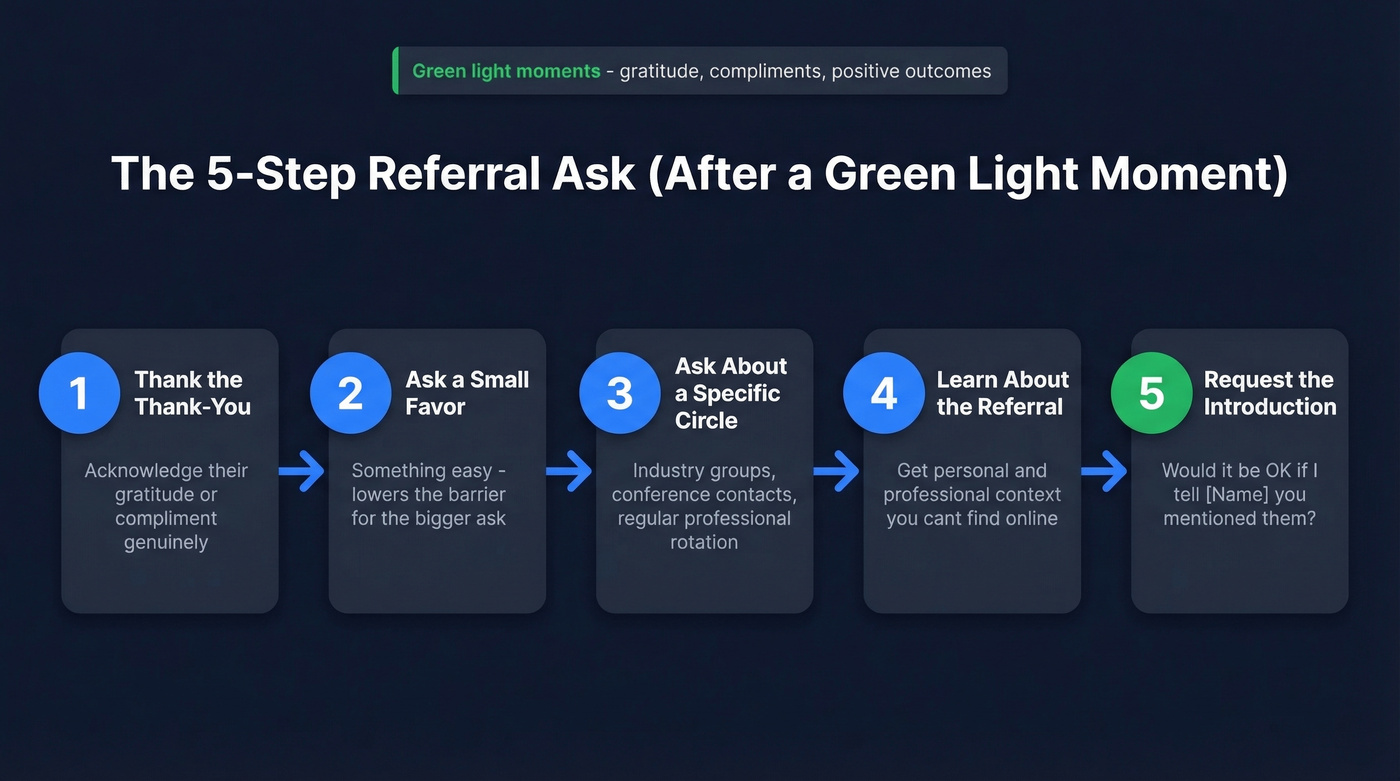
The five-step process looks like this: thank them for the thank-you, ask for a small favor, ask who they know in a specific circle, learn about the referral's personal and professional context, then request the introduction. Frame the entire thing as asking for help, not demanding a favor. Humility converts. People respond to genuine requests for help, not transactional demands. (If you need better asks, borrow a few Email Call to Action patterns.)

You spent social capital getting that referral. Don't waste it on a bounced email. Prospeo verifies emails with 98% accuracy and a 5-step process that catches spam traps, honeypots, and catch-all domains before they torch your sender reputation.
Verify every referral email before you burn the introduction.
3 Referral Email Templates That Work
Keep every template to 150-200 words. Subject lines of 6-10 words tend to earn strong open rates - don't overthink them. (If you want more options, swipe from these Cold Email Subject Line Examples.)
Sales Referral Ask
Subject: Quick question about [Referrer's Name]
Hi [First Name],
[Referrer] mentioned you're dealing with [specific problem] at [Company]. We helped them [specific result] - thought it might be relevant for your team too.
Would a 15-minute call this week make sense? If the timing's off, no worries at all.
Best, [Your Name]
This works because it leads with the referrer's name, which gives you instant credibility. It names a specific problem, proving you did homework, and offers an easy out. The "no worries" line lowers the stakes.
One more thing: use "you/your" twice for every "I/my." Referral emails that center the recipient feel more relevant than self-centered ones. (For more on structure and phrasing, see Email Copywriting.)
Job Referral Ask
Subject: [Role title] - quick intro via [Mutual Contact]
Hi [First Name],
I'm reaching out because [Mutual Contact] suggested I connect with you about the [Role] opening.
Three things that might matter:
- [Relevant accomplishment with a number]
- [Skill that maps to the role's biggest challenge]
- [Why this company specifically, in one sentence]
Would you be open to a quick chat, or could you point me to the right person?
This is the three-bullet format: three bullets, a direct ask, nothing else. Evan Spiegel reportedly responded positively to a short cold email structured this way and helped a high school junior land an internship at Snapchat. Think of it as the ABM mindset applied to your job search - research the company like you'd research a target account, and personalize the message so it could only go to that person. If it reads like a mass blast, it is one.
Mutual Connection / Warm Intro
Subject: Noticed we both know [Name]
Hi [First Name],
I saw that you and [Mutual Connection] both [attended X event / worked at Y / are in Z group]. [Mutual Connection] and I have been talking about [topic], and your work on [specific thing] came up.
Would you be open to a quick intro? Happy to share [resource/insight] either way.
The key here is targeting connection hubs - consultants, event organizers, former employees of target accounts, active community contributors. These people sit at the intersection of multiple networks and are often happy to make introductions if you give them a reason.
For teams sending more than 20 referral emails, A/B test your subject lines. Send two variants to 20% of your list, then use the winner for the remaining 80%. (If you’re building a sequence, use these Cold Email Follow-Up Templates.)
Mistakes That Kill Referral Emails
Do this:
- One specific ask, one CTA, one easy out
- 150-200 words max
- Personalize enough that the email could only go to that person
- Follow up in 3-5 business days, Tuesday through Thursday
- Proofread - 59% of recipients say typos leave a negative impression
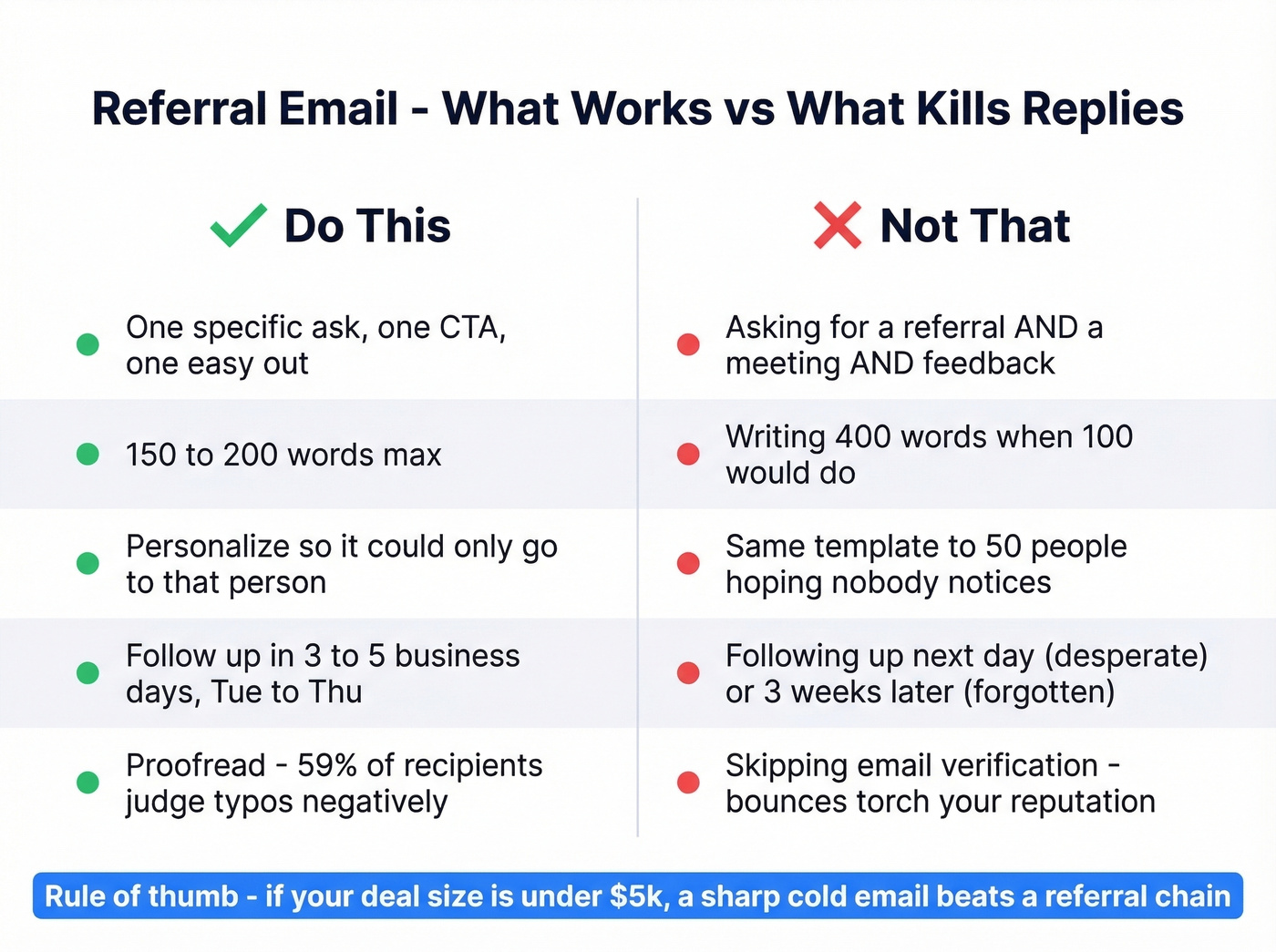
Not that:
- Asking for a referral AND a meeting AND feedback in the same email
- Writing 400 words when 100 would do
- Sending the same template to 50 people and hoping nobody notices
- Following up the next day (reads as desperate) or three weeks later (you're already forgotten)
Let's be honest: if your average deal size is under $5k, you probably don't need a sophisticated referral program. You need a better cold email. Referral campaigns pay off when the relationship equity justifies the effort. For smaller deals, a well-verified cold list and a sharp two-sentence email will outperform a referral chain every time. (If you want more outbound ideas beyond referrals, see Sales Prospecting Techniques.)
Make Sure Your Email Actually Arrives
Your referral template is worthless if it bounces. In our experience, the single biggest reason referral campaigns underperform isn't the copy - it's bad email data.
Don't send from your primary domain. Use secondary domains, set up SPF, DKIM, and DMARC before you send a single email, and warm up new inboxes for at least 14 days (21 is better), running 2-3 inboxes per domain. The average cold email response rate sits around 5.1%. Bad data makes that number worse. (If you’re troubleshooting bounces, start with Email Bounce Rate.)
Verify every email address before you hit send. Prospeo validates emails in real time with 98% accuracy and refreshes data every 7 days, so you're not burning your domain reputation on dead addresses. The free tier covers 75 emails - more than enough to test your referral campaign before scaling. One agency we've worked with, Stack Optimize, built to $1M ARR while keeping client deliverability above 94% and bounce rates under 3%, with zero domain flags across all their accounts. (If you’re tightening your sending practices, read How to Improve Sender Reputation.)

For deals under $5k, skip the referral chain. Prospeo's database gives you 300M+ profiles with 30+ filters - buyer intent, job changes, tech stack - so you can build a verified cold list in minutes instead of chasing warm intros for weeks. At $0.01 per email, it's cheaper than a coffee.
Build a verified prospect list faster than waiting for an intro.
FAQ
How long should a referral email be?
Keep it to 150-200 words max. One specific ask, one CTA, one easy out - nothing more. If your pitch can't fit in a tweet-length summary, it's too complex for initial outreach.
Should I mention the referrer's name without permission?
Never. Always ask "Would it be OK if I mention your name?" first. Using someone's name without consent damages trust and kills any chance of future referrals from that person.
What's a good reply rate for cold email referrals?
A solid cold campaign gets 2-4% replies at scale. Referral emails with a named mutual connection typically hit the higher end of that range - sometimes 5-8% with strong personalization. Verified email data matters more than most people realize: if your message bounces, your reply rate is effectively zero regardless of how good your copy is.
Do I need a different template for every situation?
No. The three templates above - sales, job search, and warm intro - cover the vast majority of scenarios. Pick the one that matches your goal, then customize the specifics for each recipient. A single well-personalized email will always outperform a dozen generic ones.