

Cold Email Success Rate: Every 2026 Benchmark in One Place
Most benchmark posts cherry-pick one dataset and call it universal. We combined six - Instantly, Hunter, Belkins, Backlinko/Pitchbox, Sopro, and Focus Digital - covering 75M+ emails plus platform-scale and touchpoint-scale datasets, then normalized definitions so you can compare cold email success rate data apples to apples.
Let's get the terminology straight first. "Success rate" means different things depending on who's measuring:
- Reply rate = any reply / delivered emails. This is what most tools report.
- Positive reply rate = interested replies / delivered emails. The metric that actually matters.
- Full-funnel success rate = closed deals / emails sent. The only number your CFO cares about.
This article covers all three. When you see "reply rate" below, we mean total replies unless stated otherwise.
The Quick Version
The average cold email reply rate in 2026 is 3-5%. Top performers hit 10%+. If your reply rate sits below 3%, data quality and deliverability are usually the fastest fixes before you touch copy.
The three highest-leverage changes: verify every email (keep bounce under 2%), send fewer emails per account (20-49/day, often 25-30), and keep copy under 80 words.
2026 Benchmarks: Reply Rate + Deal Rate
We synthesized six major datasets to build one consolidated view. The spread is wide because these sources measure different things - sales prospecting, marketing outreach, digital PR, link building. Context matters more than the number itself.
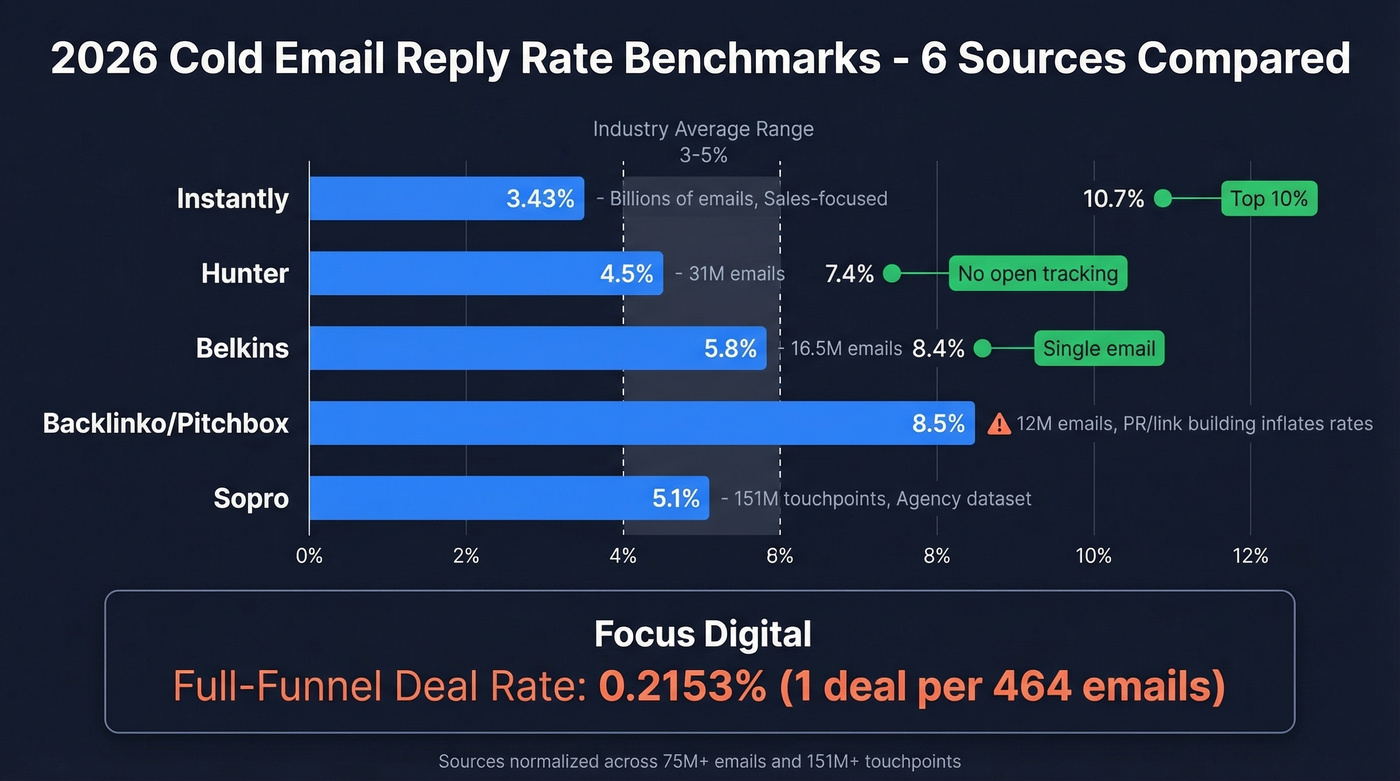
| Source | Dataset Size | Reply Rate | Top Performers | Notes |
|---|---|---|---|---|
| Instantly | Platform-wide (billions) | 3.43% avg | 10.7%+ (top 10%) | Sales-focused |
| Hunter | 31M emails | 4.5% avg | 7.4% (no open tracking) | Mixed use cases |
| Belkins | 16.5M emails | 5.8% avg | 8.4% (single email) | YoY decline vs 2023 |
| Backlinko/Pitchbox | 12M emails | 8.5% avg | N/A | PR/link building inflates rates |
| Sopro | 151M touchpoints | 5.1% avg | >5% "exceptional" | Agency dataset |
| Focus Digital | Industry study | 0.2153% full-funnel | Varies by vertical | Emails to closed deal |
How to Read These Benchmarks
Not all benchmarks are created equal.
Per-sequence vs per-email. Belkins reports reply rates at the campaign/sequence level. Hunter does too, but also breaks out performance by configuration and segmentation. Two similar-looking percentages can reflect completely different counting rules.
Outreach/PR datasets inflate numbers. Backlinko's 8.5% average includes link-building and PR pitches where the recipient has a professional incentive to respond. Don't benchmark your SaaS sales outreach against that number.
Positive reply rate is the real KPI. An 8% reply rate where 6% are "stop emailing me" is worse than a 4% reply rate where 3% are genuine interest. Community benchmarks on r/coldemail put positive reply rate at roughly 2-4% - about half of total replies.
Full-funnel conversion is the only "success" metric. Focus Digital's 0.2153% means 1 deal per 464 emails. That's the number to use when modeling ROI.
Why Reply Rates Keep Dropping
The trend line isn't encouraging. Belkins tracked a decline from 6.8% in 2023 to 5.8% in 2024. Instantly's data shows a steeper drop - 5.1% down to 3.43% in their 2026 report.
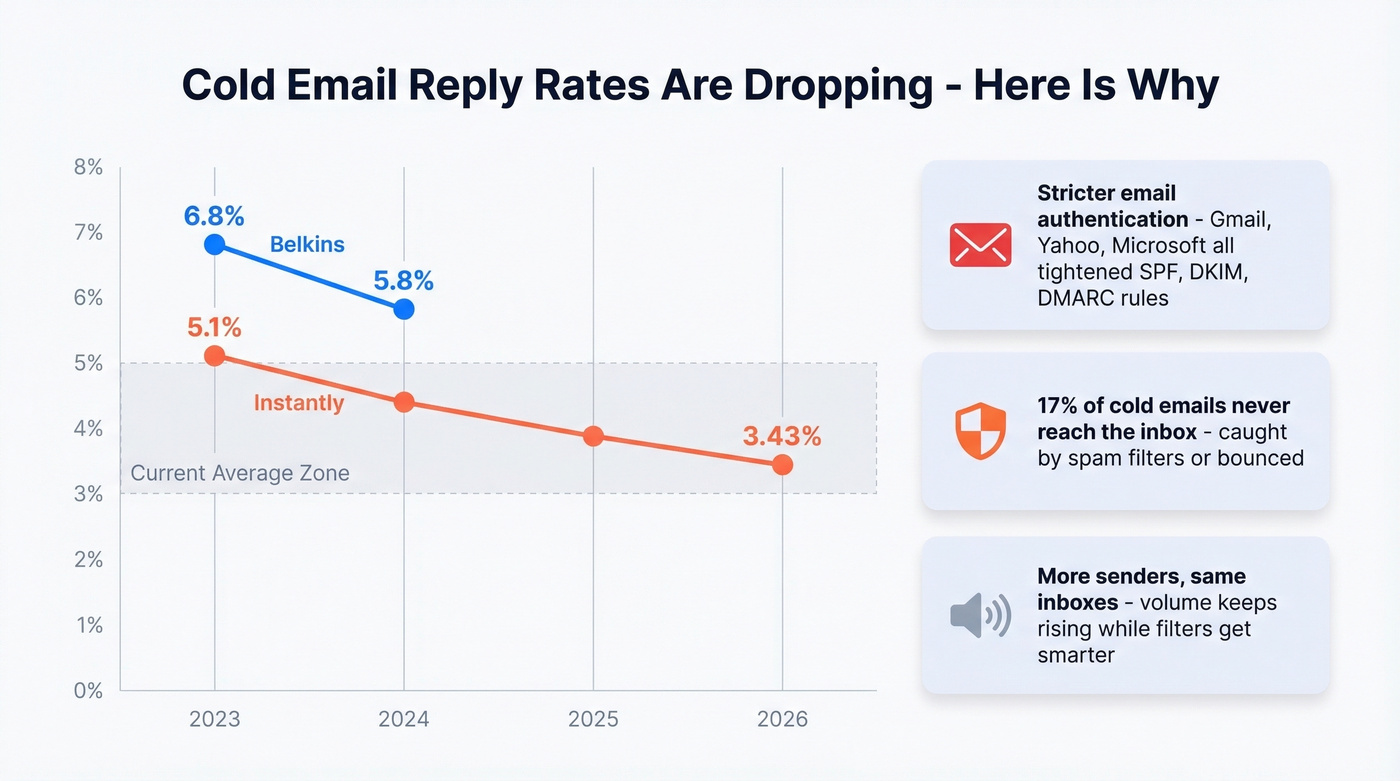
Three forces are compressing reply rates simultaneously.
Gmail and Yahoo enforced stricter SPF/DKIM/DMARC requirements in 2024, and Microsoft tightened filtering in 2025. About 17% of cold emails never reach the inbox - caught by spam filters or bounced before a human ever sees them. Apple's Mail Privacy Protection has made open rates a ghost metric, so teams optimizing for opens are chasing noise. And the volume problem compounds everything: more senders, stricter filters, same number of inboxes.
If you aren't actively managing deliverability, you're losing ground every quarter.
Deliverability Thresholds That Matter
Forget open rates. These are the numbers to watch:
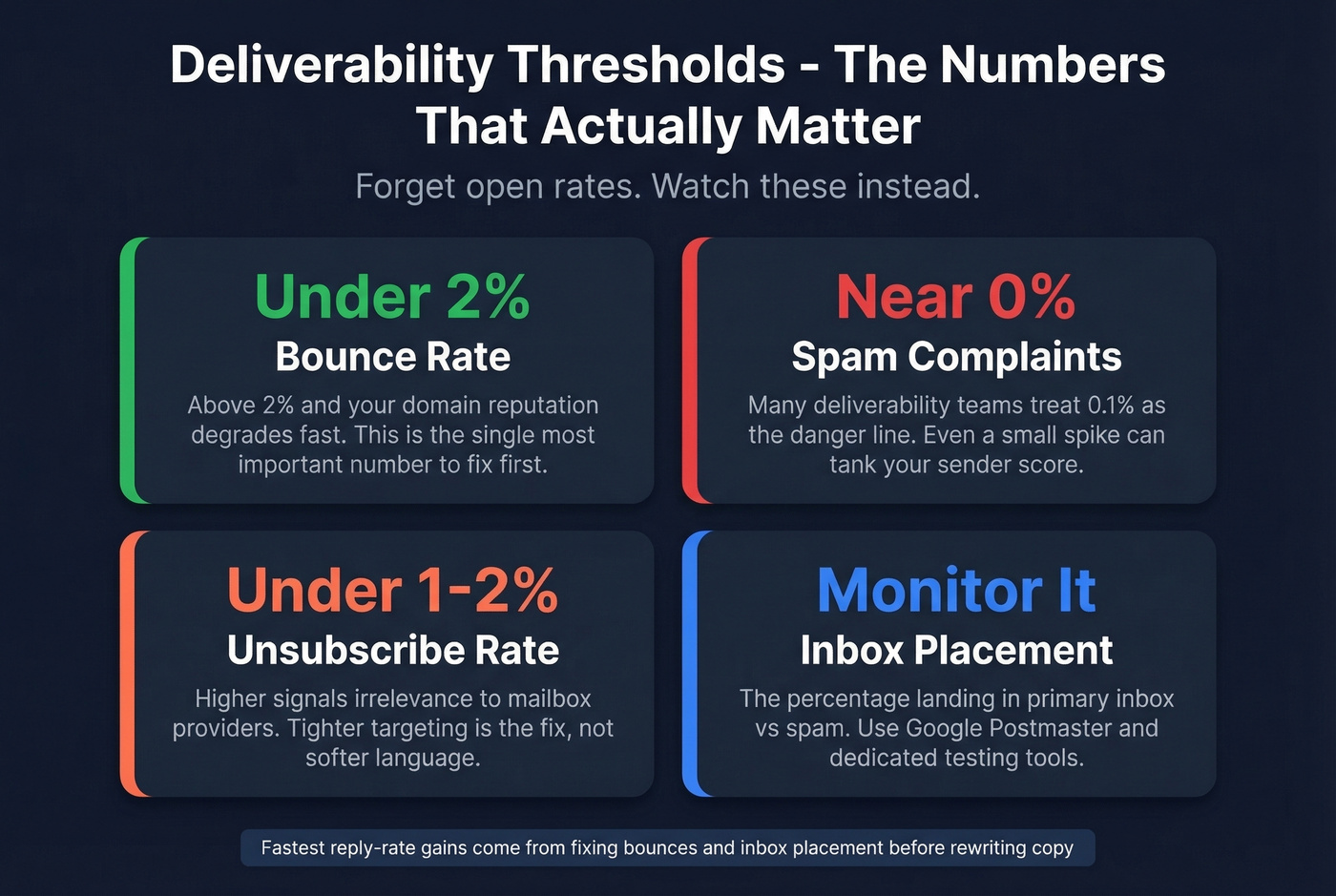
- Bounce rate: Under 2%. Above that, your domain reputation degrades fast. (If you need a deeper breakdown, see email bounce rate.)
- Spam complaints: Keep as close to zero as possible - many deliverability teams treat ~0.1% as the danger line.
- Unsubscribe rate: Under 1-2%. Higher signals irrelevance.
- Inbox placement: The percentage of emails landing in primary inbox vs spam. Google Postmaster helps you monitor domain reputation; inbox placement itself requires dedicated testing tools.
In our audits, the fastest reply-rate gains come from fixing bounces and inbox placement before rewriting a single word of copy.

You just read it: bounce rates above 2% kill reply rates before copy even matters. Prospeo's 5-step email verification delivers 98% accuracy across 143M+ verified emails - refreshed every 7 days, not every 6 weeks. Stack Optimize kept bounce under 3% and hit 94%+ deliverability while scaling to $1M ARR.
Fix the data and watch your cold email success rate climb.
How to Improve Your Cold Email Results
Here's the thing: stop obsessing over subject lines. The biggest levers are infrastructure and targeting - the boring stuff nobody wants to talk about.
Use a Custom Domain
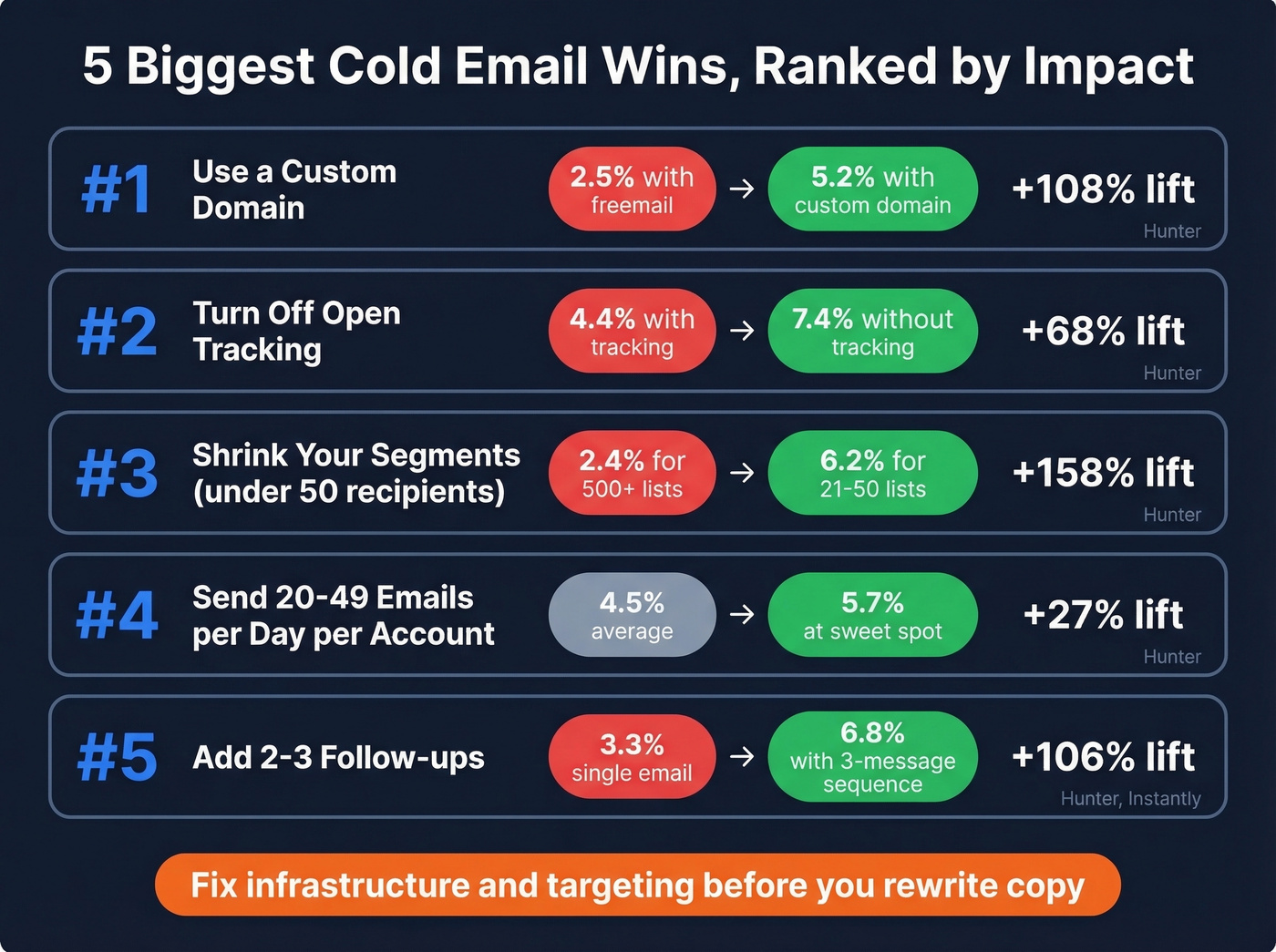
This is the single easiest win. Hunter's data shows sending from a custom domain delivers a 108% lift in reply rates - 5.2% vs 2.5% for freemail. Custom domains signal legitimacy to both spam filters and recipients. If you're still sending from a freemail address, fix this before you touch anything else.
One practitioner expanded from 3 custom domains to 7, capping at 26 emails per day per domain. Combined with proper domain warm-up and authentication, that kind of infrastructure investment pays for itself immediately.
Turn Off Open Tracking
Hunter's data is unambiguous: campaigns without open-tracking pixels hit 7.4% reply rates vs 4.4% with tracking enabled. That's a 68% lift from removing a feature.
Open tracking pixels trigger spam filters. Open rates are inflated by bots and Apple MPP anyway. We've seen teams add 1-2 points of reply rate simply by turning off open tracking and cutting daily volume. No copy changes, no new offers - just cleaner infrastructure. (If you want the technical why, see email tracking pixels.)
Shrink Your Segments
Smaller lists win. Hunter found that campaigns targeting 21-50 recipients averaged 6.2% reply rates vs 2.4% for lists of 500+. Emailing 1-2 contacts per company yields 5.1% vs 3.5% when you blast 3+ people at the same org. The consensus on r/coldemail echoes this - smaller, targeted lists consistently outperform broad blasts.
Fix Your Data First
If your bounce rate is above 2%, your copy doesn't matter yet. Bad contact data is the upstream cause of everything that kills outbound performance: bounces destroy domain reputation, which tanks deliverability, which means your perfectly crafted email never reaches anyone.

Prospeo's 5-step email verification - catch-all handling, spam-trap removal, and honeypot filtering across 143M+ verified emails - delivers 98% accuracy on a 7-day refresh cycle. Stack Optimize used Prospeo to keep client deliverability at 94%+, bounce under 3%, and zero domain flags while scaling to $1M ARR. (If you're comparing vendors, start with data enrichment services.)
Keep Emails Short
Instantly's best performers keep emails under 80 words. Belkins found messages under 200 words outperform longer emails, with 6-8 sentences as the sweet spot in their dataset.
65% of recipients say cold emails fail because they feel too sales-focused, and 61% cite irrelevance. The fix isn't softer language - it's tighter ICP targeting and leading with a specific trigger event, not a generic value prop. If your email could be sent to any company in your TAM, it's too generic. (For frameworks, see email copywriting.)
Mini Case Study: 3% to 6% Reply Rate
One r/Entrepreneur practitioner doubled their reply rate with four infrastructure changes: expanded from 3 domains to 7, capped volume at 26 emails/day/domain, dropped bounce rate from 11% to under 2% with verified data, and cut email length from 141 words to under 56. No new offer. No new ICP. Just cleaner execution.
Send Less, From More Domains
The r/coldemail playbook recommends 4-6 rotating mailboxes at 25-30 sends each. Hunter's data confirms the sweet spot: 20-49 emails per day per account yields 5.7% reply rates vs the 4.5% average. More domains at lower volume beats fewer domains at higher volume every time. (To set safe limits, use an email velocity plan.)
Skip this approach if you're only sending 50 emails a week total - the overhead of managing multiple domains isn't worth it until you're doing real volume.
Follow Up - But Know When to Stop
Instantly found that 42% of replies come from follow-ups, so you absolutely need them. But you need to cap them before complaint risk spikes.
Two to three follow-ups is the sweet spot. Hunter found a 3-message sequence doubles replies vs a single email (6.8% vs 3.3%). But Belkins tracked the dark side: spam complaints escalate from 0.5% on the first email to 1.6% by the fourth. Four emails to uninterested prospects can seriously damage your deliverability, and that damage compounds across every campaign you run afterward. (If you need copy, use these cold email follow-up templates.)
One practitioner on r/coldemail reported iterating from 3.44% to 24.36% reply rates through pain-first messaging, better timing, and clear CTAs. That's the ceiling with tight targeting and manual personalization - not a realistic average, but proof the lever has range.
Time It Right
Wednesday is consistently the best send day across both Instantly and Backlinko's datasets. Tuesday through Thursday mornings are a safe default. Avoid weekends - Sunday significantly underperforms. This won't make or break your campaign, but if you're optimizing at the margins, send your best emails mid-week. (More data here: best time to send cold emails.)
The Full Funnel: Emails to Deals
Reply rate is a vanity metric if it doesn't convert. Here's what the full funnel actually looks like:
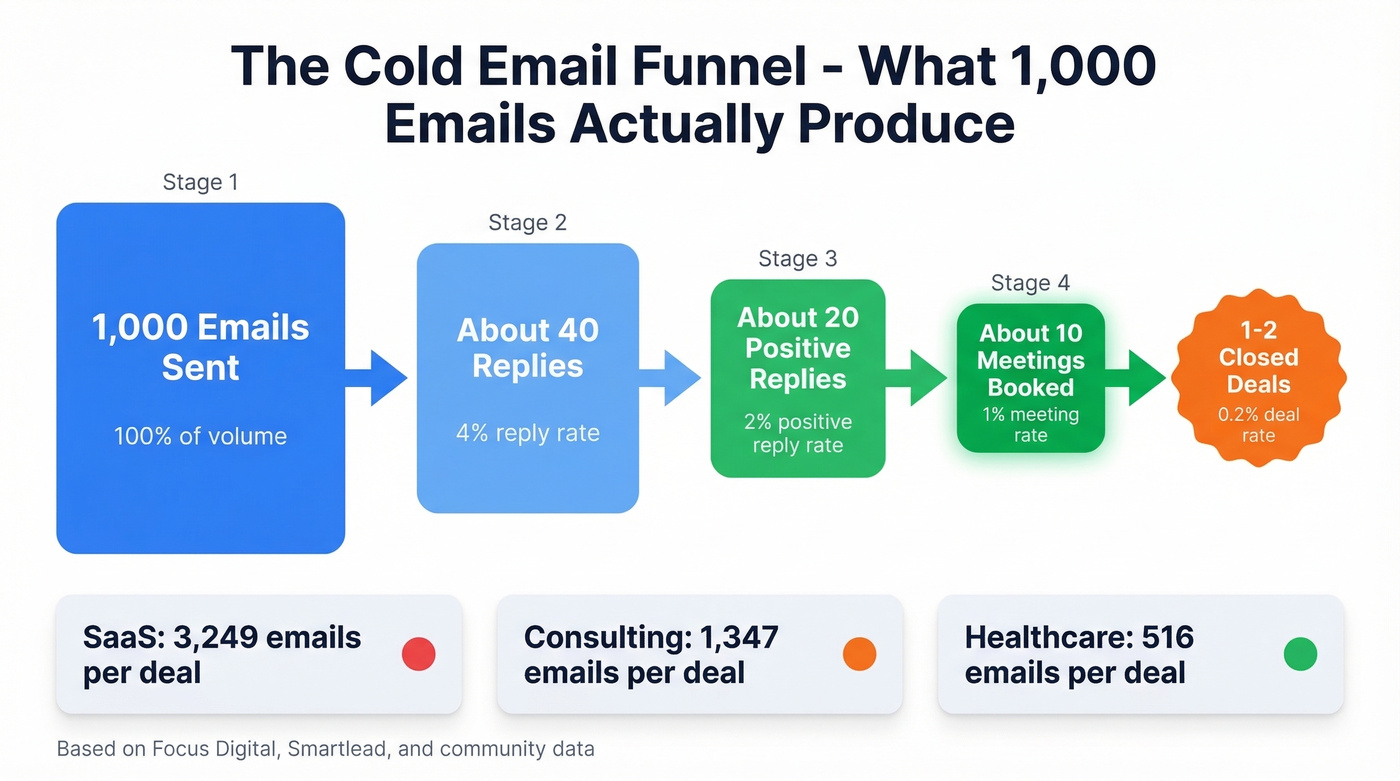
| Stage | Conversion | Per 1,000 Emails |
|---|---|---|
| Replies | ~4% | ~40 |
| Positive replies | ~2% | ~20 |
| Meetings booked | ~1% | ~10 |
| Closed deals | ~0.2% | ~1-2 |
Meeting booking rates align with Smartlead's aggregated data at roughly 1%. Focus Digital's research puts the overall average at 1 deal per 464 emails. But industry variance is massive - SaaS is the hardest at 3,249 emails per deal, while consulting runs closer to 1,347 and healthcare services around 516. For teams in SaaS expecting 1 deal per 500 emails, the math won't work out.
Let's be honest about what these numbers mean in practice. If your average deal size is under $10K, you probably don't need a 0.2% deal rate to make cold email wildly profitable. At $5K ACV and 1 deal per 500 emails, you're generating $10 revenue per email sent. The math works even at "average" performance. The teams who fail at cold email aren't failing because the channel is broken - they're failing because they're sending unverified emails from burned domains to untargeted lists.
Is Cold Email Still Worth It?
Even at a 3% reply rate, cold email remains one of the cheapest controllable outbound channels when infrastructure is right. One Reddit practitioner runs a full cold email stack for ~$420/month and generates 16 qualified leads - roughly $26 per qualified lead. For context, paid search averages $802 per customer acquisition, LinkedIn ads $982, and outbound sales overall $1,980. Even accounting for the lead-to-customer gap, cold email's unit economics are hard to beat.
Cold email isn't dying. It's getting harder for lazy senders and staying profitable for disciplined ones. The teams that verify every email, send from clean infrastructure, and write like humans - not marketers - are still booking meetings at scale. Your cold email success rate is ultimately a function of data quality and sending discipline, not clever copywriting.
Smaller segments. Verified contacts. One or two decision-makers per company. That's the formula this data points to - and it requires contact data you can trust. Prospeo gives you 30+ filters to build hyper-targeted lists at $0.01/email, with 98% accuracy and catch-all handling built in.
Stop blasting 500+ unverified contacts and start booking replies.
FAQ
What is a good cold email success rate?
Above 5% reply rate is good and 10%+ is excellent - the 2026 average across major datasets sits at 3-5%. For full-funnel conversion, the benchmark is about 0.2%, or roughly 1 deal per 464 emails. Consistently hitting 5%+ reply rate with half being positive replies puts you ahead of most teams.
How many emails does it take to book a meeting?
Roughly 80-100 emails per meeting booked, based on a ~1% booking rate from Smartlead's aggregated data. For a closed deal, expect approximately 464 emails on average - though SaaS companies often need 3,000+ emails per deal while consulting and services verticals convert much faster.
Should I track open rates on cold emails?
No. Hunter's data shows disabling open tracking increases reply rates by 68%. Open rates are inflated by bots and Apple Mail Privacy Protection, making them unreliable. Focus on bounce rate instead - keep it under 2% with verified data, and you'll track a metric that actually correlates with results.
What's the best day to send cold emails?
Wednesday, consistently. Both Instantly and Backlinko's datasets show mid-week outperforming other days. Tuesday through Thursday mornings are a safe default. Avoid weekends entirely.
Why do results vary so much across datasets?
Different sources measure different things. Sales prospecting datasets like Instantly report lower numbers because recipients have no prior relationship with the sender. PR and link-building datasets like Backlinko's skew higher because the recipient often benefits from responding. Always compare your numbers against a dataset that matches your use case.