

Cold Email Verification: What Actually Works in 2026
A RevOps lead we know ran an unverified send to 2,000 scraped emails last year. Bounce rate hit 14%. Gmail flagged the domain, and it took six weeks to recover. That's not an edge case - it's what happens when you skip verification and hope for the best.
The bounce-rate cliff is real. Under 2% bounces, nobody notices. Cross 5%, and providers start throttling. Hit 10%, and you're blacklisted. The gap between "fine" and "domain is toast" is narrower than most teams realize.
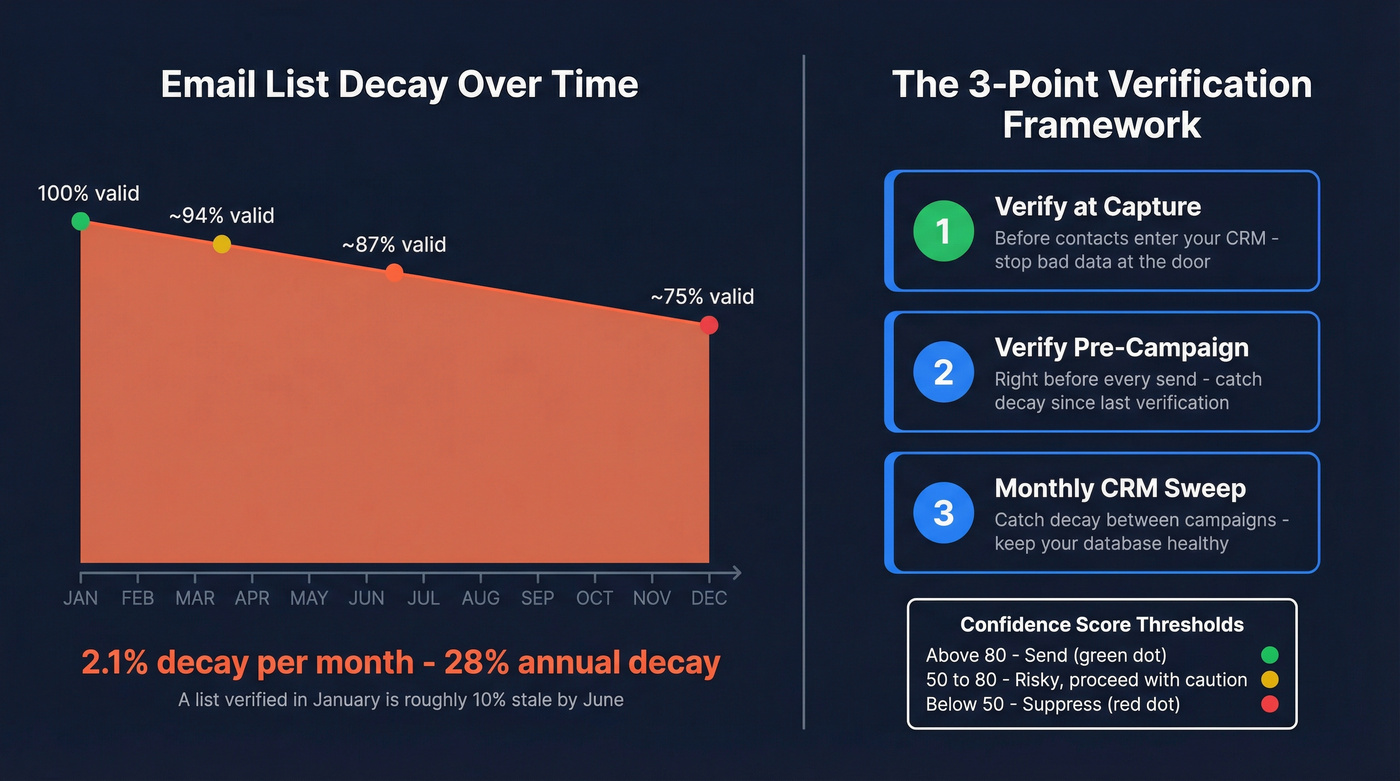
Email lists decay at roughly 2.1% per month. People change jobs, companies shut down mailboxes, IT teams reconfigure domains. A list that was clean in January is about 10% stale by June. Verifying your contacts before every send isn't a nice-to-have - it's the difference between a productive outbound motion and a domain recovery project that eats your quarter.
Three Things to Know First
- Verification isn't optional if you send cold email. One bad campaign can tank months of domain warm-up.
- Catch-all domains are the hidden killer. 38% of B2B domains are catch-all, and they bounce at 27x the rate of verified addresses. Your verifier's catch-all handling matters more than its headline accuracy number.
- Verify at the point of data collection, not after. Cleaning a list you already imported into your sequencer is backwards.
Quick tool picks: Prospeo if you want prospecting and verification in one workflow. MillionVerifier if you need the cheapest bulk cleaning for existing lists. ZeroBounce if you're enterprise and need SOC 2/ISO 27001 compliance documentation.
How Email Verification Actually Works
Every verification tool runs roughly the same pipeline under the hood. The difference is how well each step executes - and whether the tool actually does all of them.
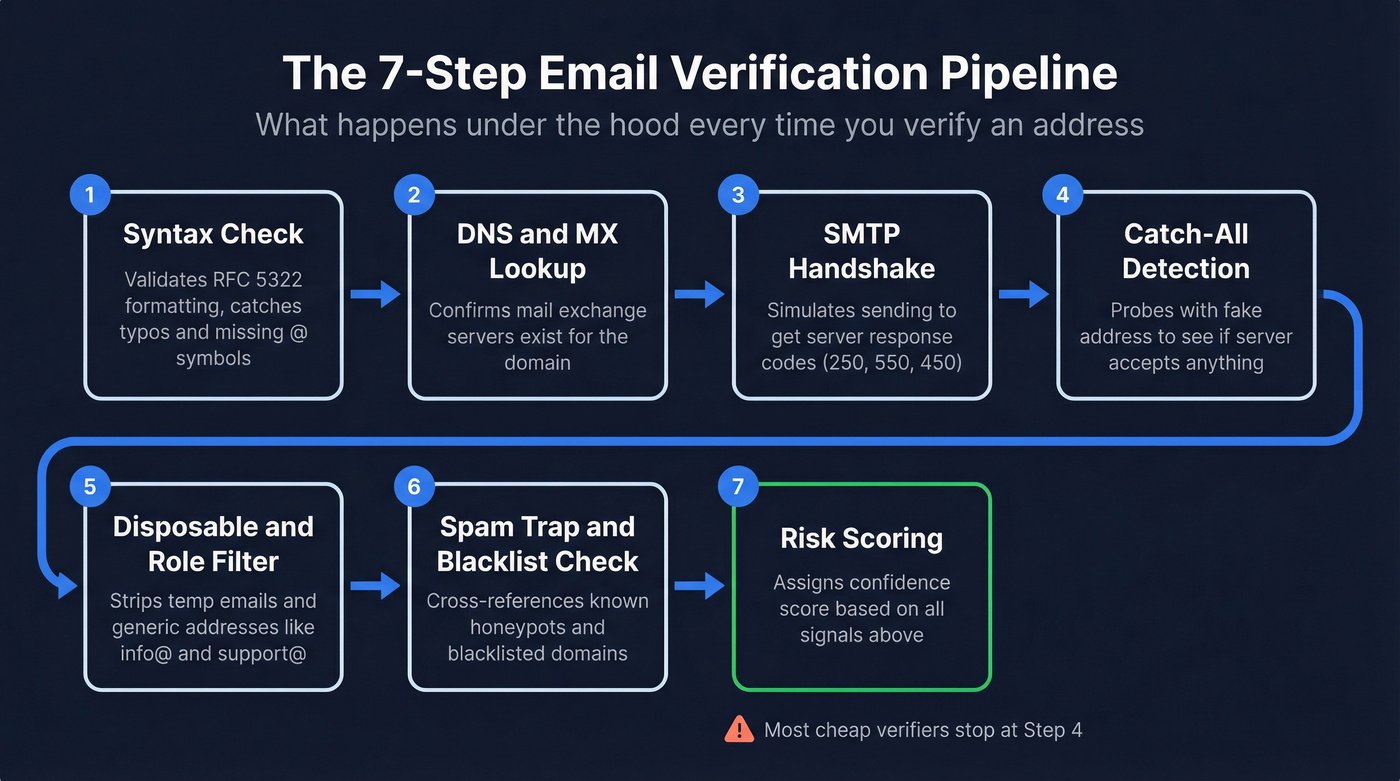
Step 1: Syntax check. Validates the email against RFC 5322 formatting rules. Catches typos, missing @ symbols, illegal characters. Table stakes.
Step 2: DNS and MX lookup. Queries the domain's DNS records to confirm mail exchange servers exist. No MX record means the domain can't receive email. Dead end.
Step 3: SMTP handshake. The tool opens a connection to the mail server and simulates sending without actually delivering a message. The server responds with status codes - 250 means the mailbox exists, 550 means it doesn't, and 450 or 421 means "try again later." This is where the real signal lives.
Step 4: Catch-all detection. The tool probes the server with a random, obviously fake address. If the catch-all domain accepts email, the domain is catch-all - it'll accept mail to any address, whether the mailbox is real or not. Most cheap verifiers stop here and label everything "unknown."
Step 5: Disposable and role-based filtering. Strips out temporary email services and generic role addresses like info@, support@, and sales@ that rarely convert and often trigger spam filters.
Step 6: Spam-trap and blacklist checks. Cross-references against known spam traps, honeypots, and blacklisted domains.
Step 7: Risk scoring. The tool assigns a confidence score based on all the signals above. This final step is what separates serious tools from glorified syntax checkers.
The Catch-All Problem
Here's the thing: catch-all domains are the single biggest threat to cold email deliverability, and most teams don't even know what they are.
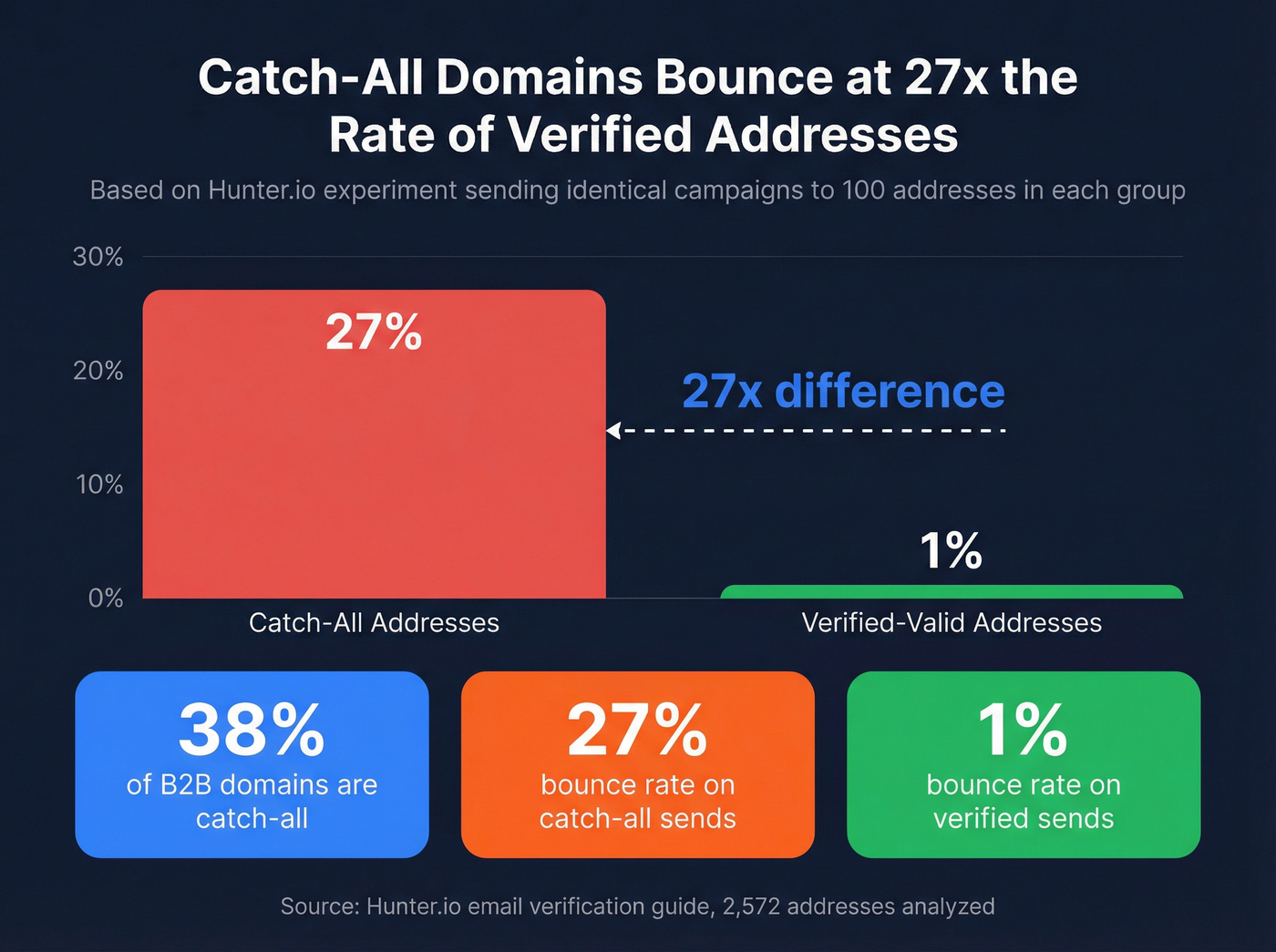
A catch-all domain accepts email sent to any address - real or fake. When a verifier pings john.smith@company.com, the server says "sure, send it over" regardless of whether John Smith actually has a mailbox there. The verifier can't distinguish a real inbox from a black hole.
Hunter analyzed 2,572 email addresses and found 38% of domains were configured as catch-all. In a separate experiment, they sent the same campaign to 100 catch-all addresses and 100 verified-valid addresses. The catch-all group bounced at 27%. The valid group bounced at 1%. That's a 27x difference from a single variable.
If your verifier labels catch-all addresses as "unknown" and leaves the decision to you, it's failing at its job. Different tools handle this differently: DeBounce gives Safe/Risky/Unknown labels, others give binary valid/invalid flags. The best tools assign confidence scores that map directly to send/suppress decisions - clear verdicts, not a shrug.
Most teams obsess over their verifier's headline accuracy number. That number is almost meaningless. What actually determines whether your domain survives is how the tool handles the 38% of addresses sitting on catch-all domains. A verifier with 95% accuracy on standard domains but no catch-all strategy will wreck your sender reputation faster than one with 90% accuracy and strong catch-all scoring.

38% of B2B domains are catch-all - and most verifiers just shrug. Prospeo's 5-step verification includes catch-all scoring, spam-trap removal, and honeypot filtering across 143M+ verified emails. 98% accuracy. $0.01 per email. No black holes.
Verify your next list with the tool that actually handles catch-alls.
Why One-Time Verification Fails
Email data decays at roughly 28% annually. People get promoted, leave companies, switch providers. A list you verified in January has lost about 10% of its valid addresses by June.
We've seen this play out dozens of times. An SDR verifies a prospect list in Q1, loads it into Outreach, and starts sequences. By Q2, they're running the same list for a follow-up campaign. Nobody re-verifies. Bounce rate spikes to 8%. The SDR blames the copy. The real problem was stale data.
The fix is a three-point timing framework:
- Verify at capture - before contacts enter your CRM.
- Verify pre-campaign - right before every send.
- Monthly CRM sweep - catch decay between campaigns.
Use confidence-score thresholds to automate decisions: above 80, send. Between 50 and 80, risky. Below 50, suppress.
Best Verification Tools for Cold Email
Every verification tool claims 99% accuracy. Hunter actually tested 15 of them using 3,000 real business emails. Results ranged from 70% down to 31%. Stop trusting marketing pages. Look at independent benchmarks and your own test results.
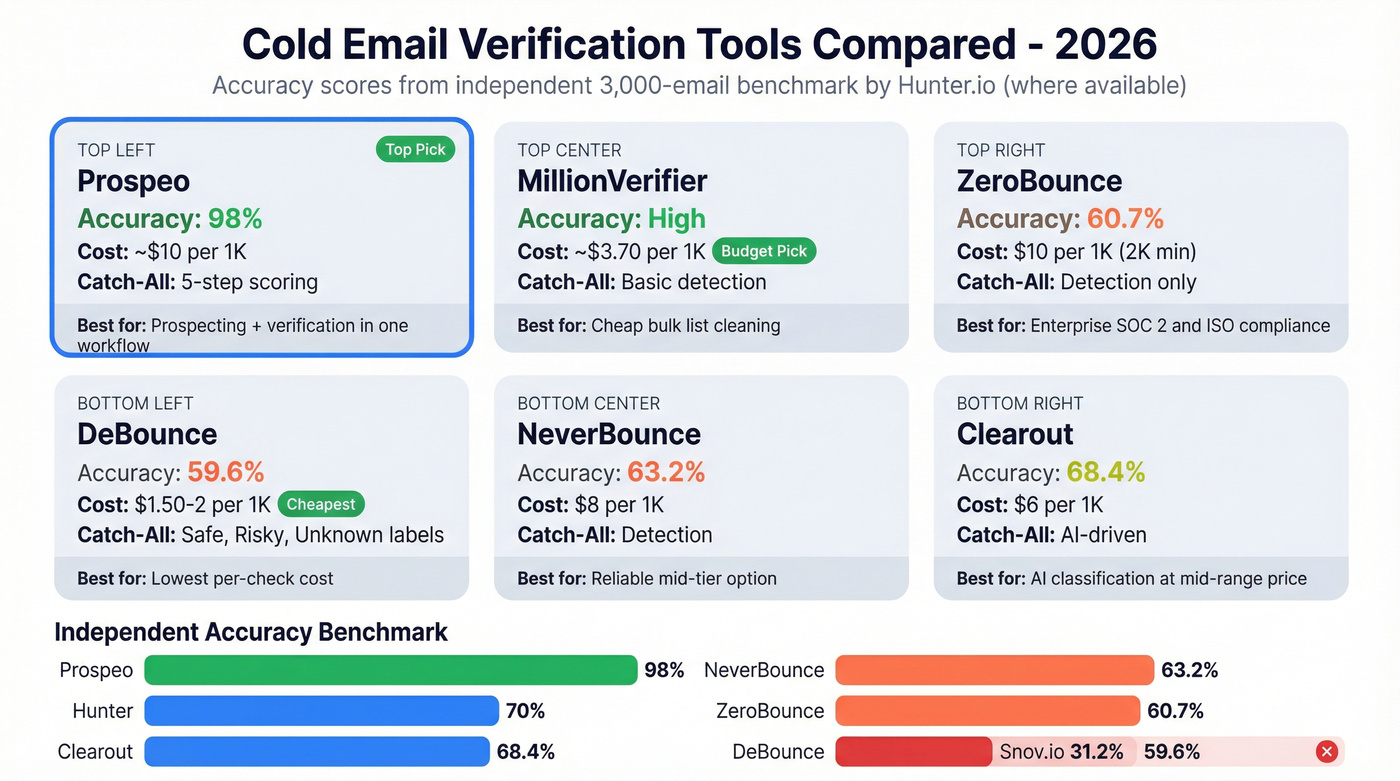
| Tool | Accuracy | Cost/1K | Catch-All | Best For |
|---|---|---|---|---|
| Prospeo | 98% | ~$10 (75 free/mo) | 5-step scoring | Prospecting + verify |
| MillionVerifier | High | ~$3.70 | Basic | Budget bulk cleaning |
| ZeroBounce | 60.7%* | $10 (2K min) | Detection only | Enterprise compliance |
| DeBounce | 59.6%* | ~$1.50-2 | Safe/Risky/Unknown | Cheapest per-check |
| NeverBounce | 63.2%* | $8 | Detection | Mid-tier reliable |
| Bouncer | Good | ~$8 | Detection | Non-expiring credits |
| Instantly | Good | $19-31 | Built-in | All-in-one outreach |
| Clearout | 68.4%* | $6 (100 free) | AI-driven | AI classification |
| Hunter | 70.0%* | ~$24.50 | Detection | Benchmark data |
| Snov.io | 31.2%* | (50 free/mo) | Basic | Avoid for verification |
Asterisked scores are from an independent 3,000-email benchmark. Prospeo accuracy is based on internal testing across 143M+ emails.
Prospeo
Use this if you want verification built into your prospecting workflow - not bolted on after. Prospeo's 5-step verification runs at the point of data collection across 300M+ profiles and 143M+ verified emails. Catch-all handling, spam-trap removal, and honeypot filtering happen automatically before contacts reach your CRM. For teams searching for the best email verifier for cold outreach, this integrated approach eliminates the gap between finding a contact and confirming they're reachable.
At ~$0.01 per email, the cost is competitive with standalone verifiers - except you're also getting the prospecting database, 30+ search filters, and native integrations with Salesforce, HubSpot, Smartlead, Instantly, and Lemlist. Stack Optimize used Prospeo to build from $0 to $1M ARR with 94%+ deliverability and zero domain flags across all clients.
Already invested in a separate prospecting database and only need CSV list cleaning? MillionVerifier will be cheaper for pure bulk jobs.
MillionVerifier
Use this if you're sitting on a massive existing list and need the cheapest way to clean it. At ~$3.70 per 1,000, MillionVerifier is the budget pick by a wide margin. The one-time purchase model means no subscription to forget about.
The tradeoff: it's a bulk cleaning tool, not a prospecting platform. No database, no enrichment. For teams running large-scale list hygiene on a tight budget, that's perfectly fine. Skip it if catch-all handling sophistication matters - its detection is basic compared to multi-step pipelines.
ZeroBounce
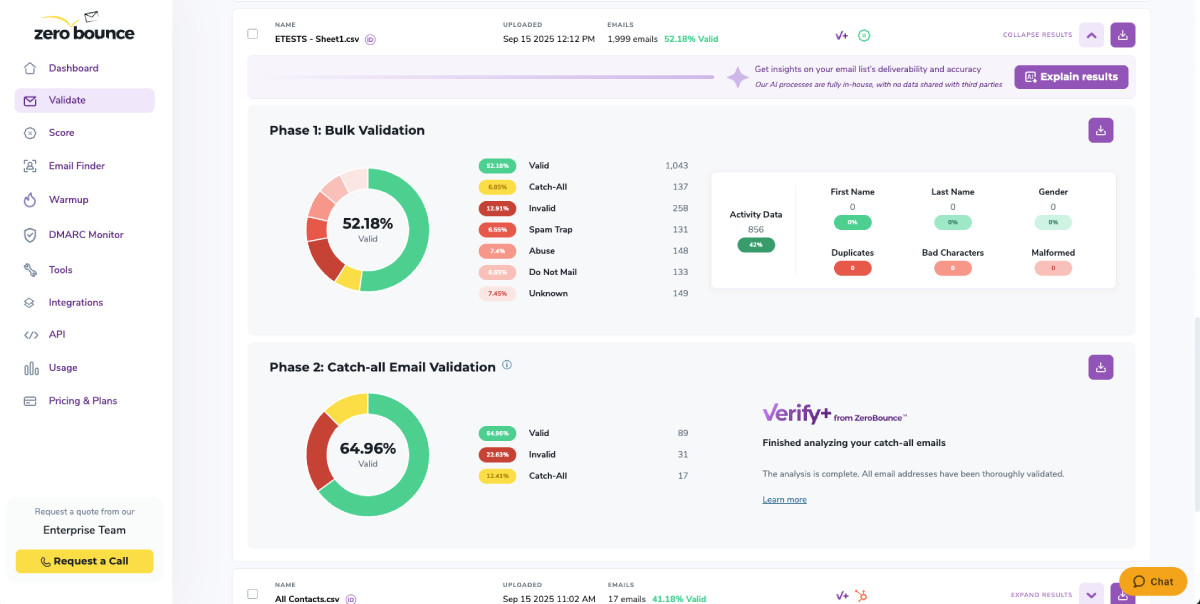
Your compliance team needs SOC 2 Type II and ISO 27001 certifications? ZeroBounce checks both boxes, making it the default for enterprise and regulated industries. Pricing is $10 per 1,000 with a 2,000-credit minimum, plus deliverability monitoring for an extra $49/month.
The catch: ZeroBounce scored 60.70% in independent benchmark testing. We've seen this pattern repeatedly - compliance-first tools invest in certifications and audit trails, sometimes at the expense of raw verification performance. Skip it if accuracy is your primary concern and you don't have a compliance requirement driving the decision.
DeBounce
The absolute cheapest per-verification cost at $1.50-2 per 1,000. Their Safe/Risky/Unknown verdict system for catch-all addresses is more useful than a binary flag, though not as sophisticated as full confidence scoring. A solid budget tool that does one thing well.
NeverBounce
NeverBounce scored 63.17% in independent testing - respectable but not leading. At $8 per 1,000, it sits mid-spectrum with pay-as-you-go and subscription options. It's the safe, boring choice. Sometimes boring is exactly what you need.
Bouncer
Straightforward verifier with non-expiring credits at around $8 per 1,000. Verify contacts in bulk without overcomplicating your stack.
Instantly
Already running Instantly for cold email outreach? The built-in verification saves you a tool switch. The $47/month plan gets 1,500 credits (~$31 per 1,000), while $97/month drops to ~$19 per 1,000 for 5,000 credits. Not the cheapest standalone verifier, but the convenience is real if you're already on the platform.
Clearout
Clearout scored 68.37% in independent testing - fourth overall - at $6 per 1,000 with 100 free credits. Worth testing if you want AI-driven classification at a mid-range price.
Hunter
At ~$24.50 per 1,000, Hunter is expensive for verification-only use. Its real value is the published benchmark data - the most transparent accuracy comparison available. Use it for research, not bulk cleaning.
Snov.io
Snov.io scored 31.20% accuracy in independent testing - dead last among 15 tools. That's not a rounding error; it's a fundamental accuracy problem. Use it for other things.
Email lists decay 2.1% per month. Prospeo refreshes its entire 300M+ contact database every 7 days - not every 6 weeks like competitors. Verify at capture, pre-campaign, and on a rolling basis without switching between a prospecting tool and a separate verifier.
Get prospecting and verification in one workflow - 75 free emails to start.
Beyond Verification: Full Deliverability Stack
A clean list is necessary but not sufficient. Verification is one layer in a deliverability stack that includes several non-negotiable elements.
Authenticate first. SPF, DKIM, and DMARC must be configured correctly before you send a single cold email. Without them, even verified emails land in spam. (If you need a setup walkthrough, start with SPF, DKIM, and DMARC.)
Warm up on clean lists only. Warming up a domain while sending to unverified lists is self-defeating. You're building reputation with one hand and destroying it with the other. (More detail: email warm up.)
Cap volume and avoid spikes. Start at 50 emails per day per inbox during ramp. Jumping from 50 to 500 in a day triggers the same flags as high bounce rates. Keep spam complaints under 0.1%. If you're scaling, follow a volume best-practices ramp plan.
Ditch open-rate tracking pixels. They reduce deliverability and the data is increasingly unreliable. Track replies and engagement instead. (Deep dive: Does open tracking hurt cold email?.)
Cold email verification is the foundation, but it only works when the rest of your deliverability stack is solid. If you're troubleshooting issues end-to-end, use an email deliverability checklist.
FAQ
How often should I verify my email list?
At three points: before contacts enter your CRM, before every campaign launch, and as a monthly sweep. B2B data decays ~2.1% per month, so a three-month-old list has ~6% stale addresses - enough to cross the 5% throttling threshold.
What's an acceptable bounce rate for cold email?
Under 2% is safe. Above 5%, throttling kicks in. Hit 10% and you're blacklisted for weeks. Most disciplined teams target under 1% hard bounces by verifying pre-campaign and suppressing risky addresses.
Can I just use a free email verifier?
Free tiers work for testing workflows - Prospeo offers 75 free verifications per month, ZeroBounce offers 100. But free tools typically lack catch-all handling and spam-trap detection. For anything beyond a small test batch, invest in a full verification pipeline.
What's the difference between email verification and email validation?
Validation checks syntax and formatting - confirming an address is structurally correct. Verification goes further, confirming the mailbox actually exists via SMTP handshake, catch-all detection, and risk scoring. Most modern tools bundle both steps together, so the distinction matters less than it used to.