

Cold Email vs Email Marketing: The Numbers Behind the Debate
Your marketing team is celebrating a 35% open rate on last week's newsletter. Meanwhile, your SDR is staring at an 8% bounce rate on a cold sequence that took two days to build. Same channel, completely different games.
The core difference between cold email and email marketing is simple: cold email targets people who've never heard of you, and email marketing talks to people who already raised their hand. But the strategy, tooling, compliance, and benchmarks diverge so sharply that treating them as variations of the same thing will get you in trouble fast.
Quick Definitions
Cold email is top-of-funnel outreach to people who didn't subscribe, didn't opt in, and don't know your company exists. The goal is to start a conversation - book a meeting, get a reply, open a door.
Email marketing lives in the middle and bottom of the funnel. You're emailing people who signed up, downloaded a lead magnet, or bought something. The goal is nurturing and conversion. The best email marketing reads like helpful content, not a sales pitch, with a direct offer woven in every few sends.
Side-by-Side Comparison
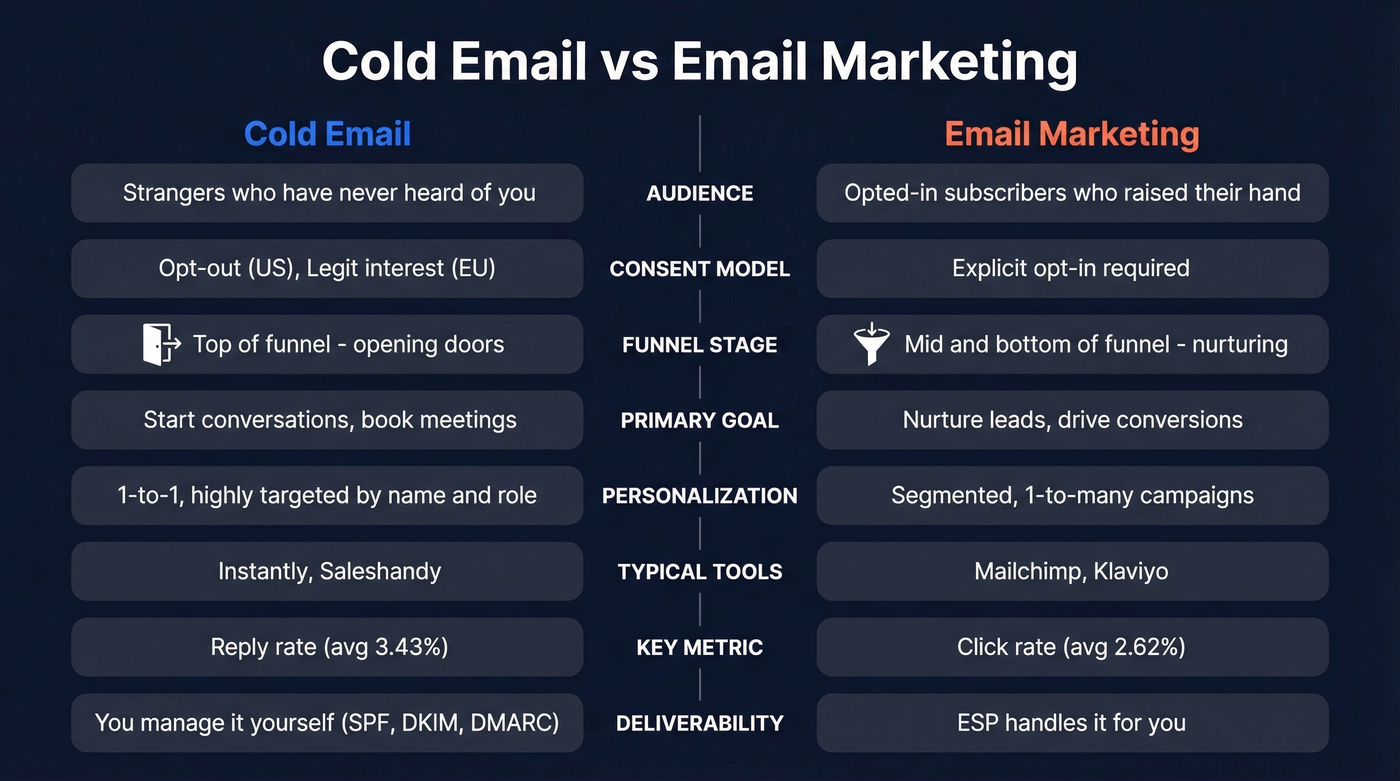
| Dimension | Cold Email | Email Marketing |
|---|---|---|
| Audience | Strangers | Opted-in subscribers |
| Consent | Opt-out (US) | Opt-in |
| Funnel stage | Top | Mid / Bottom |
| Primary goal | Start conversations | Nurture & convert |
| Personalization | 1-to-1, highly targeted | Segmented, 1-to-many |
| Typical tools | Instantly, Saleshandy | Mailchimp, Klaviyo |
| Key metric | Reply rate | Click / conversion rate |
| Deliverability risk | You manage it (SPF/DKIM/DMARC) | ESP handles it |
Benchmarks That Actually Matter
Cold Email Performance
Instantly's 2026 benchmark report analyzed billions of cold email interactions across thousands of active workspaces. The numbers are sobering if you're used to marketing email metrics.
| Metric | Average | Top 25% | Top 10% |
|---|---|---|---|
| Reply rate | 3.43% | 5.5%+ | 10.7%+ |
For a broader view, Martal's compilation pegs cold email open rates around 27.7% and bounce rates around 7-8% - which is why serious outbound teams treat under 3% bounces as a hard operational target.
Here's the thing: 58% of replies come from the first email. The other 42% come from follow-ups, so giving up after one touch leaves nearly half your results on the table. The sweet spot is 4-7 touchpoints. Top campaigns keep emails under 80 words and send Tuesday through Wednesday.
You'll see the "40x more effective than social media" stat floating around. That's about marketing emails to opted-in lists, not cold outreach. Don't let anyone conflate the two.
Email Marketing Performance
Mailchimp's published benchmarks show a 35.63% average open rate and 2.62% click rate, though Apple Mail Privacy Protection inflates open rates - treat them as directional. Industry variation is significant: nonprofits hit 40.04% open rates while e-commerce sits at 29.81%.
Klaviyo's 2026 data across 183,000+ brands reveals a distinction most articles miss. One-off campaigns average a 31% open rate and 1.69% click rate. Fine. But automated flows - welcome sequences, abandoned carts, post-purchase - hit 5.58% click rates and 2.11% conversion rates (placed order rate), with top 10% flows reaching 4.3% conversion.
Permission-based email's real power is in automation, not blasts.


The article says it clearly: bad data is the fastest way to burn a domain you spent weeks warming up. Prospeo's 5-step email verification and 7-day data refresh cycle keep bounce rates under 3% - so your cold outreach actually reaches inboxes. Starting at $0.01 per verified email.
Stop burning domains. Start with data that's verified this week.
Why Cold Outreach Is Harder to Run
Email marketing platforms handle deliverability for you. Cold email makes you the postmaster. Here's what most people underestimate:
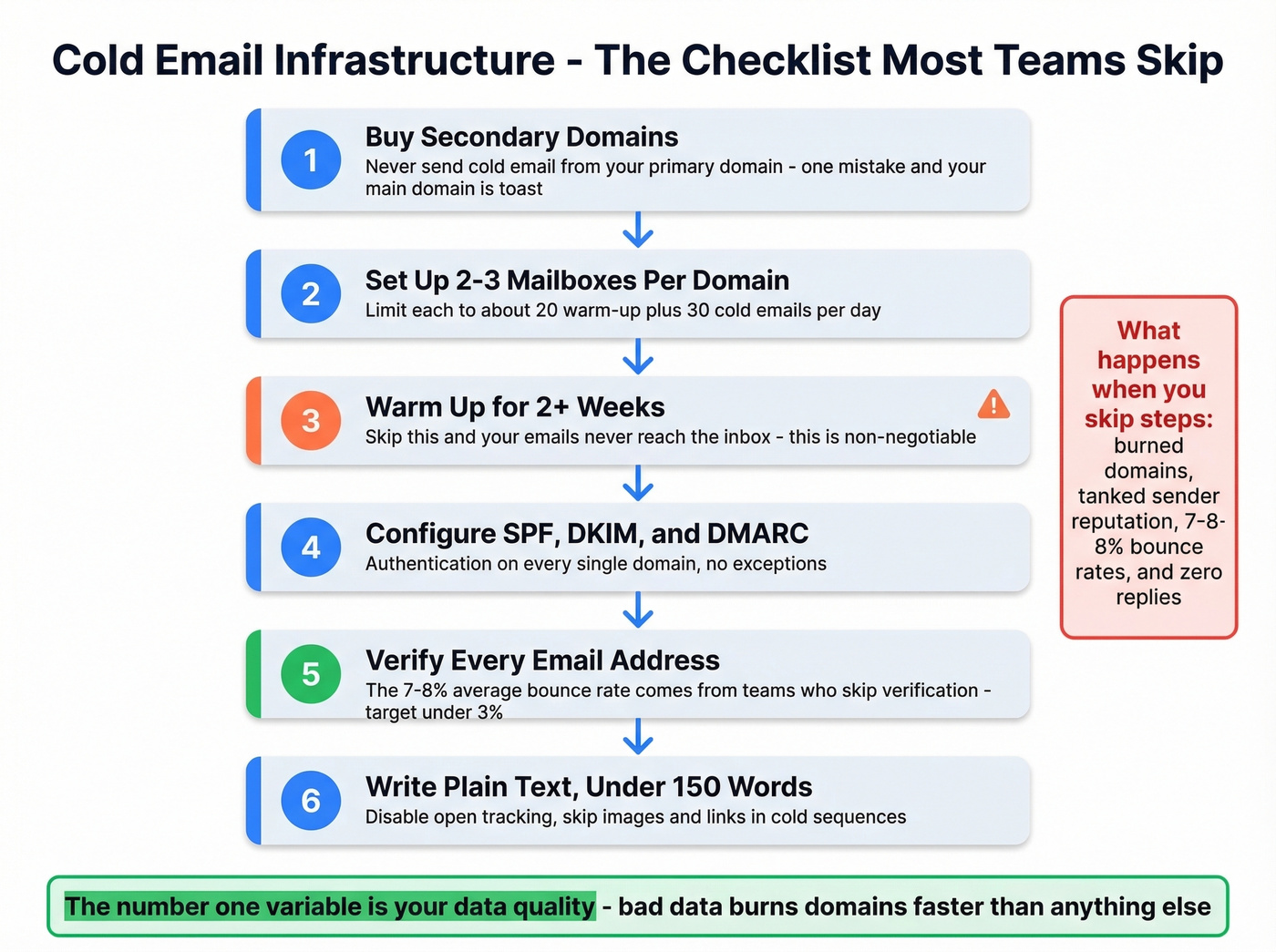
- Secondary domains only - never send from your primary domain
- 2-3 mailboxes per domain, each limited to ~20 warm-up + 30 cold emails/day
- 2-week minimum warm-up before sending a single cold email
- Plain text, under 150 words - disable open tracking, skip images and links
- SPF, DKIM, and DMARC configured on every domain
- Bounce rate under 3% - exceed that and your sender reputation tanks
Skip warm-up on a new domain and your emails never reach the inbox. We've seen teams burn through three domains in a month because they skipped verification.
But the #1 variable isn't your domain setup - it's your data. Cold email bounce rates average 7-8%, and that number comes from teams sending to unverified lists. Prospeo's 5-step verification and 7-day data refresh cycle keep many customer bounce rates under 4-5%. Stack Optimize, an outbound agency using Prospeo, maintains client deliverability above 94% with bounce rates under 3% and zero domain flags across all accounts. Bad data is the fastest way to burn a domain you spent weeks warming up.
If you want to go deeper on the operational side, start with an email deliverability checklist and keep an eye on email velocity as you scale.
Compliance Quick Reference
| Requirement | CAN-SPAM (US) | GDPR (EU/UK) | CASL (Canada) |
|---|---|---|---|
| Consent model | Opt-out | Opt-in / legit interest | Express / implied |
| Unsubscribe | 10 business days | Immediate | 10 business days |
| Max penalty | $50,120 per email | EUR 20M or 4% turnover | $10M CAD |
CAN-SPAM allows cold email with an unsubscribe link, physical address, and honored opt-outs. GDPR requires legitimate interest - you can cold email a VP of Sales about your sales tool, but document why. CASL is the strictest: you need express or implied consent before hitting send.
Which Strategy Wins?
Cold email is the play when you're a B2B team selling to other businesses and need to open doors with people who've never heard of you. Your ICP is specific enough to target by title, industry, and company size. If you’re building sequences, a solid B2B cold email sequence structure matters more than fancy copy.
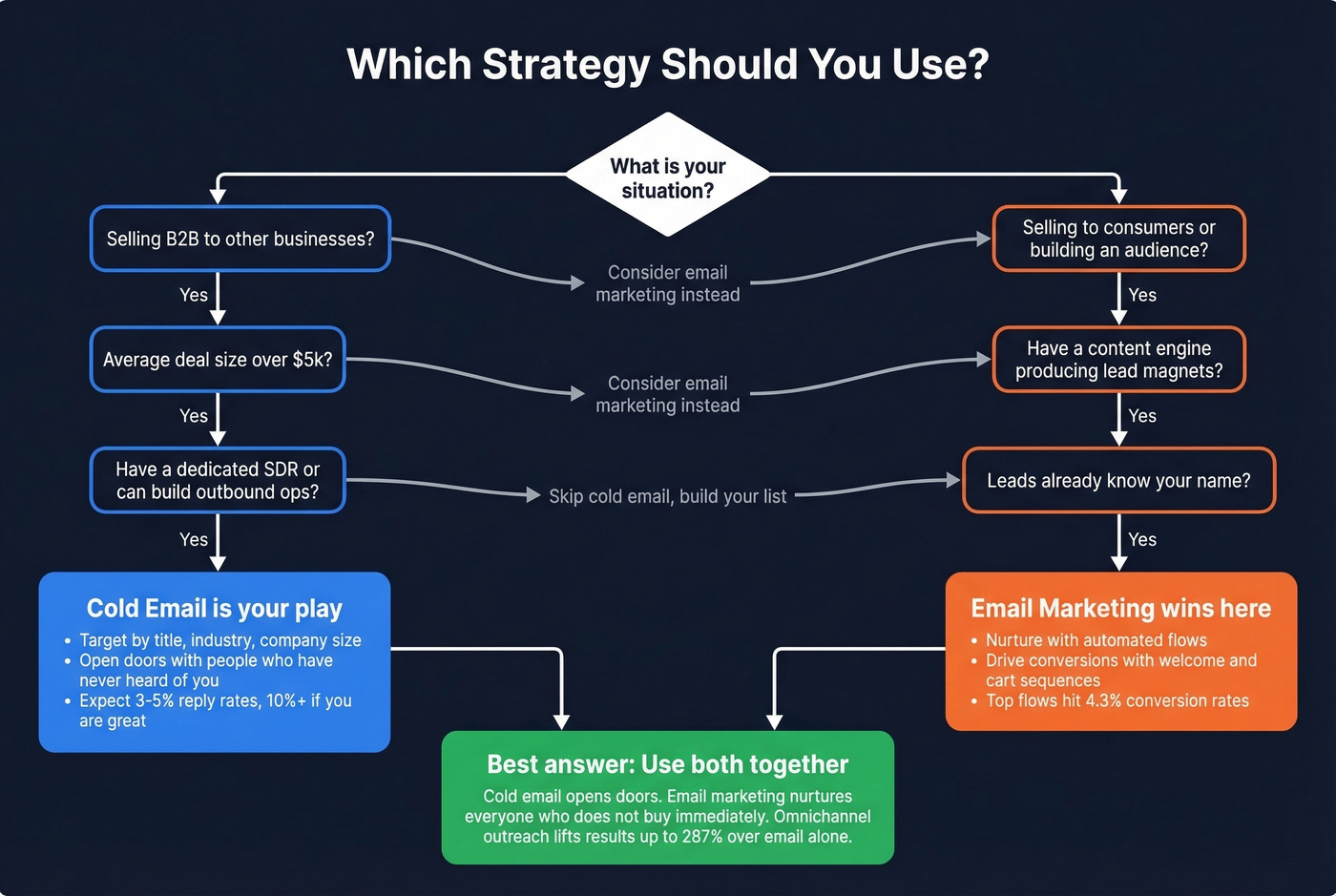
Email marketing wins when you're building an audience, selling to consumers, or nurturing leads who already know your name. You've got a content engine producing lead magnets and newsletters people actually want to read. If you’re optimizing performance, it helps to understand the click rate formula and how it maps to downstream conversion.
Let's be honest though - both channels together is where pipeline compounds. Cold email opens doors. Email marketing nurtures everyone who doesn't buy immediately. In our experience, the handoff between the two is where most B2B teams leave pipeline on the table. And if you're going omnichannel - pairing email with phone and social touches - the lift can reach 287% over email alone.
If your average deal size is under $5k and you don't have a dedicated SDR, skip cold email entirely and invest in content that builds an email list. Cold email's operational overhead only pays off when the deal size justifies it. Understanding the difference between cold outreach and marketing emails early saves you months of wasted effort. For more tactical help, keep a swipe file of email subject lines and use proven sales follow-up templates to increase replies without spamming.
If list quality is your bottleneck, consider data enrichment services and always monitor your email bounce rate as you scale.
Cold email opens doors. But only if your list is clean and your contacts are real. Prospeo gives you 300M+ profiles with 98% email accuracy, 30+ filters to nail your ICP by title, industry, and company size - plus intent data to find buyers who are actively in-market. No contracts, no sales calls.
Build the cold email list that actually converts to meetings.
FAQ
Can I use Mailchimp or HubSpot for cold email?
No. ESPs are built for opt-in lists and will suspend accounts that send to purchased or scraped contacts. Cold email requires dedicated tools like Instantly or Saleshandy with separate domains, mailbox rotation, and warm-up. Using an ESP for cold outreach is the fastest way to get banned - the tooling between cold and marketing email is fundamentally different.
Is cold email legal?
Yes, in most regions with rules. CAN-SPAM allows it with an unsubscribe link and physical address. GDPR requires legitimate interest documentation. CASL requires express or implied consent. None ban cold email outright, but penalties reach $50,120 per violation under CAN-SPAM or EUR 20M under GDPR.
How do I keep bounce rates low on cold campaigns?
Verify every address before sending - the 7-8% average bounce rate comes from teams skipping this step. Use a provider with real-time verification and target under 3% bounces to protect sender reputation. We've found that running lists through a dedicated verification tool before loading them into your sending platform cuts bounce-related domain issues almost entirely.
What metrics should I track for each channel?
Measure cold email by reply rate (3.43% average, 10%+ for top performers) and meetings booked. Measure email marketing by click rate (2.62% average) and conversion rate (up to 4.3% for automated flows). Comparing open rates across the two is misleading - they serve different funnel stages with different KPIs.