

Cold Emails for Sales: A 2026 Playbook Built on Data, Not Templates
You sent 500 cold emails last month. Three replies - two "please remove me" and one wrong person. Before you rewrite your subject lines or buy another template pack, let's diagnose what actually went wrong. If your cold emails for sales aren't getting replies, the problem almost never starts with your copy. It's your list, your deliverability, or your offer - in that order.
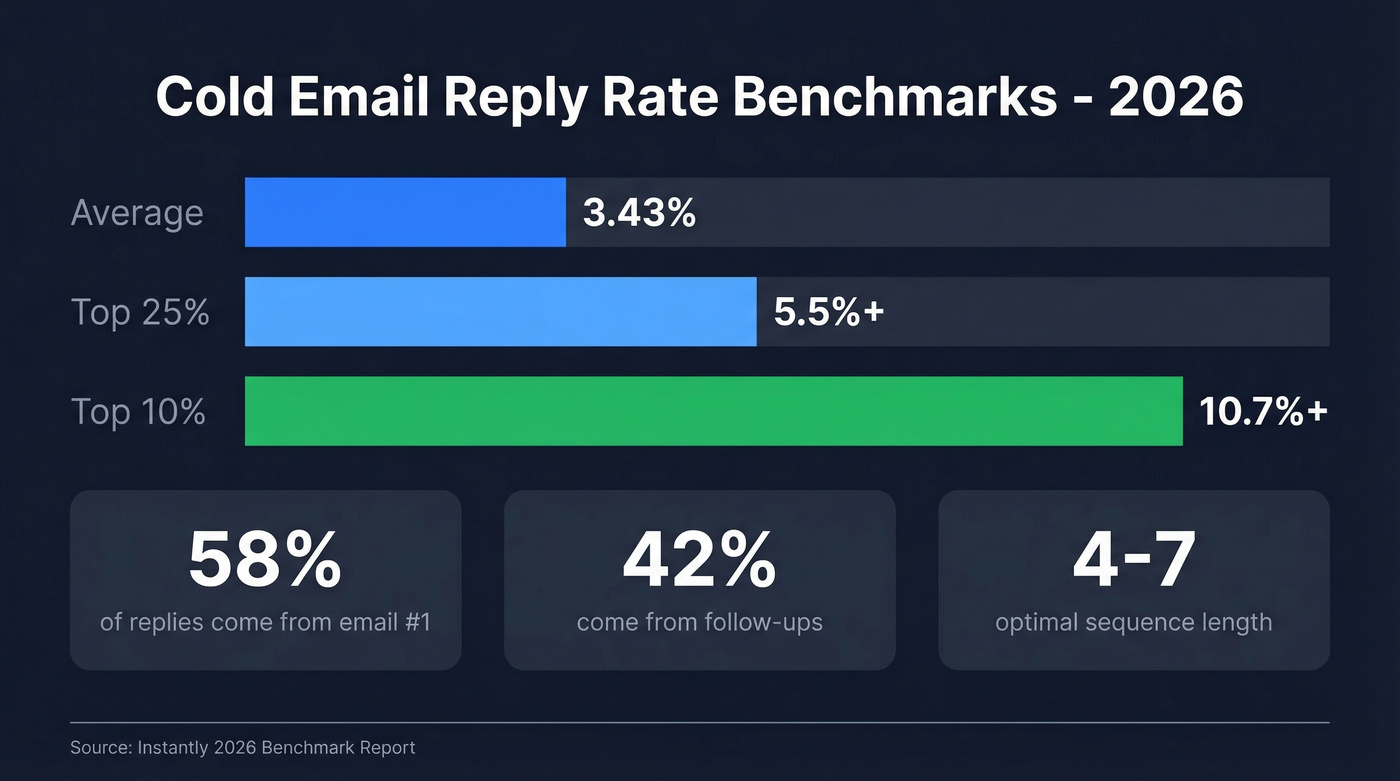
The average cold email reply rate sits at 3.43%. That means even a well-run campaign on a clean list with a strong offer will get silence from 96 out of 100 prospects. The top 10% of campaigns hit 10.7%+. The gap between "good" and "average" is enormous, and it has nothing to do with finding the perfect template.
What You Actually Need
Stop collecting templates. Build one great offer and run it through a sequence. That's the whole game.
- Verified list with bounces under 2%. If your list is dirty, nothing else matters. Bounces above 2% tank your sender reputation and push everything to spam.
- One great offer that's specific, low-friction, and worth something right now. "Free 30-minute call" isn't an offer - it's an ask. "Audit of your top 3 landing pages with a Loom walkthrough" is an offer.
- A 4-7 touch sequence. 58% of replies come from email #1, but 42% come from follow-ups. Most reps stop after one email. Don't be most reps.
Templates decay. The moment a "proven template" hits Reddit, thousands of people copy it and your prospects start seeing the same patterns weekly. Frameworks beat templates every time.
2026 Benchmarks - What "Good" Looks Like
Let's ground this in real numbers. Instantly's 2026 benchmark report analyzed billions of cold email interactions:
| Metric | Average | Top 25% | Top 10% |
|---|---|---|---|
| Reply rate | 3.43% | 5.5%+ | 10.7%+ |
| Replies from email #1 | 58% | - | - |
| Replies from follow-ups | 42% | - | - |
Optimal sequence length is 4-7 touches. Tuesday and Wednesday are the best send days, with Wednesday pulling the highest engagement. Emails under 80 words outperform longer ones.
If you're under 2% reply rate, don't rewrite your emails yet. Check deliverability first - your messages probably aren't reaching inboxes. At 3-4%, your infrastructure is fine and the lever is copy, offer, or targeting. Above 5.5%, you're outperforming most SDR teams and should focus on scaling volume carefully without burning domains.
Deliverability and List Quality Come First
The best outbound email ever written still fails if it lands in spam. Here's the thing: deliverability isn't a nice-to-have. It's the foundation everything else sits on.
DNS Authentication
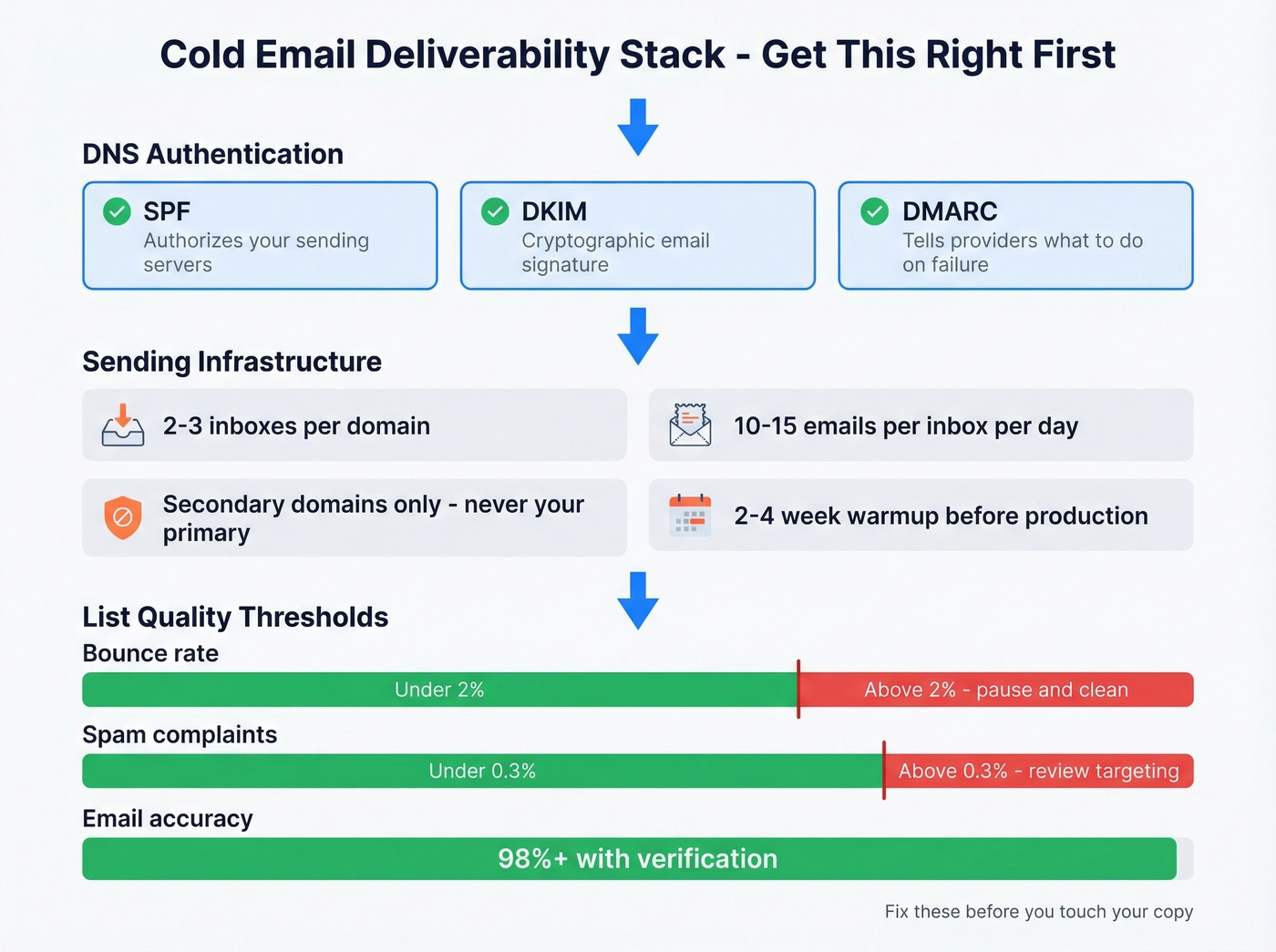
Every sending domain needs three records configured correctly. No exceptions.
SPF tells mailbox providers which servers can send on your domain's behalf. DKIM cryptographically signs your emails so providers verify they weren't tampered with. DMARC tells providers what to do when SPF or DKIM fails. Missing any of these is near-guaranteed spam placement in 2026 - Google and Yahoo enforce them as baseline requirements for bulk senders.
Thresholds That Trigger Spam
| Metric | Target | If Exceeded |
|---|---|---|
| Bounce rate | <2% | Pause sends, clean list |
| Spam complaints | <0.3% | Review targeting, add unsub |
| Warmup period | 2-4 weeks | Full ramp takes 4-6 weeks |
Start at 5-10 emails per day on new domains and ramp gradually. You need an RFC 8058 one-click unsubscribe header, and you should use a custom tracking domain via CNAME.
Domain and Inbox Math
Never send cold outreach from your primary business domain. Use secondary domains - variations like "getacme.com" or "tryacme.io" - so a deliverability hit doesn't torch your main domain's reputation.
Run 2-3 inboxes per domain, 10-15 emails per day per inbox. That gives you roughly 30-45 sends per domain daily. To reach 400 emails per day, you need approximately 10-12 domains on Google Workspace or Microsoft 365.
Build a Clean List First
This is where most outbound campaigns actually fail. We've seen teams spend weeks perfecting copy while sending to a list that bounces 15%+. One agency we worked with was running a 35% bounce rate before switching to verified data - they got it under 4%, and pipeline tripled from $100K to $300K/week.
Prospeo's 5-step verification catches bad addresses before they ever hit your sequence, running 98% email accuracy with spam-trap removal and honeypot filtering on a 7-day refresh cycle. Verify your list before you send a single email. It's the highest-ROI step in the entire workflow.
Compliance in 30 Seconds
Cold emailing prospects is legal in most jurisdictions. But the penalties for getting it wrong are steep enough to care about.
| Rule | Consent | Penalty | Opt-Out Deadline |
|---|---|---|---|
| CAN-SPAM (US) | Not required | $46,517/email | 10 business days |
| GDPR (EU) | Explicit opt-in | EUR20M or 4% revenue | Immediate |
| CASL (Canada) | Express/implied | $10M CAD | Immediate |
Every cold email needs real sender identity, physical mailing address, and a working unsubscribe mechanism. Honor opt-outs fast. Keep consent records if you're emailing into the EU or Canada. SmartReach's compliance guide covers jurisdiction-specific nuances in more detail.

You just read it: bounces above 2% tank your sender reputation and push everything to spam. Prospeo's 5-step verification and 7-day data refresh keep your lists clean before you hit send - 98% email accuracy, spam-trap removal, and honeypot filtering built in. At $0.01 per email, list quality costs less than a single wasted send day.
Stop rewriting subject lines. Fix your list first.
Writing Emails That Get Replies
One idea, about them, easy to say yes to. Aim for 40-60 words - under 80 is the benchmark ceiling, but under 60 is where top performers live. Your prospect doesn't want a pitch. They want to know why they should care, in about 15 seconds of reading.
Here's a hot take: if your deals typically close under five figures, you don't need elaborate personalization. A tight offer sent to a well-targeted list at 50 words will outperform a heavily personalized 200-word email sent to a mediocre list. Every time.
The Offer Ladder
The CTA is where most sales outreach emails die. "Got 30 minutes for a call?" is the hardest possible ask from a stranger. Build an offer ladder instead:
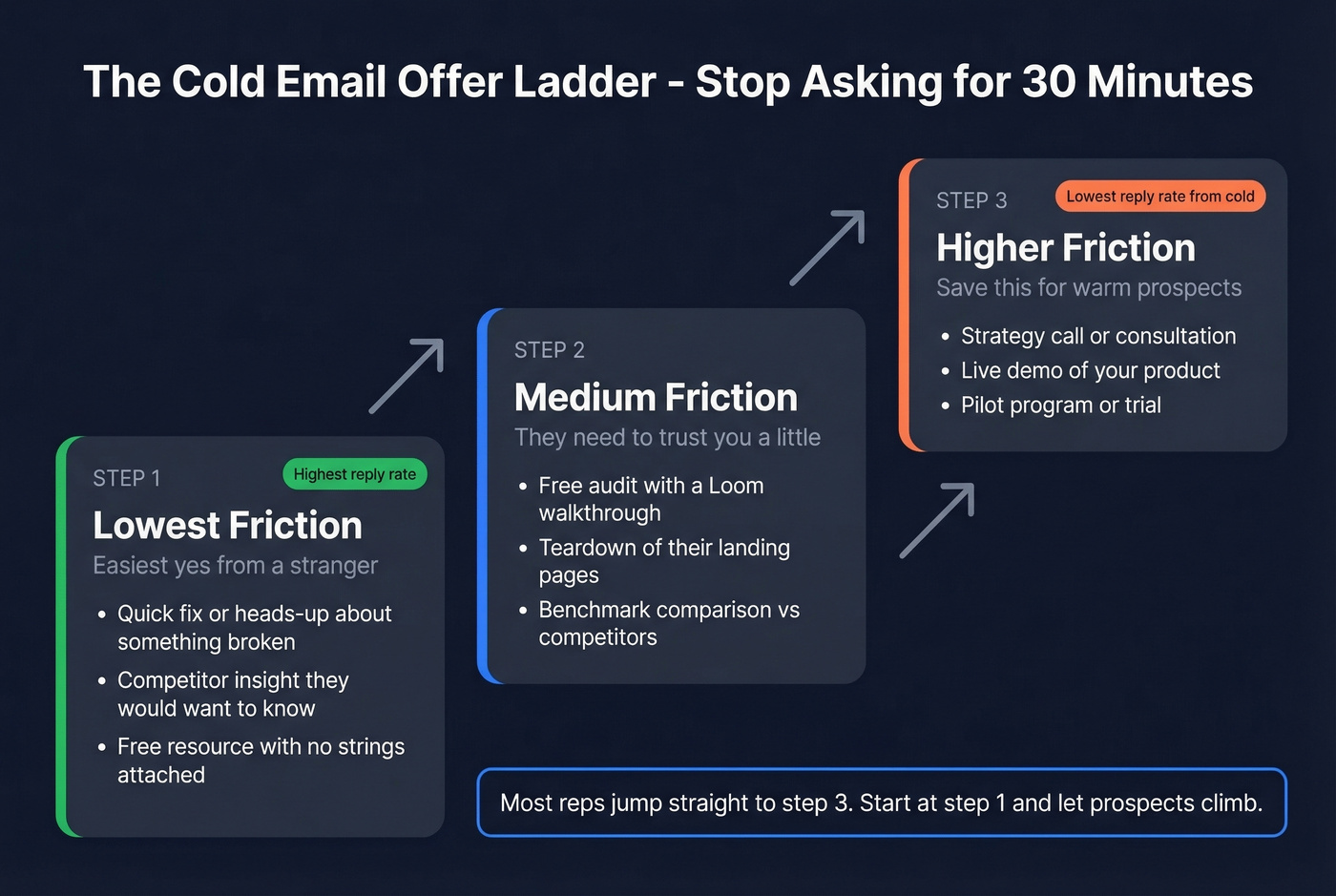
- Lowest friction: Quick fix, heads-up about something broken, competitor insight
- Medium friction: Free audit, teardown, benchmark comparison with a Loom walkthrough
- Higher friction: Strategy call, demo, pilot
The consensus on r/sales and r/coldemail is clear: value-first CTAs are outperforming everything else in 2026. The best-performing emails lead with something useful on the spot - "I looked at your top 3 landing pages and found two conversion issues. Want me to send a Loom?"
One more writing rule: use "you" twice for every "I." Cold emails that center the prospect's world instead of yours pull dramatically higher reply rates. Count your pronouns before you hit send.
PAS Framework - Worked Example
Compare this to the typical cold email: "Hi, I'm reaching out because we help companies like yours improve their sales process. We've worked with hundreds of companies and I'd love to schedule a 30-minute call to discuss how we can help you too." That's 43 words of nothing - no specificity, no value, hard CTA. Now look at PAS done right:
Subject: Quick thought on {{company}} conversions
Hi {{firstName}},
{{company}} is pulling 99.7k visits/month but your demo page converts below the SaaS median. That's roughly $40k/quarter in pipeline you're leaving on the table.
We fixed this exact issue for [similar company] in 3 weeks. Worth a 5-min Loom showing what we'd change?
That's 52 words. The problem is specific and data-backed. The agitation quantifies the cost. The solve is low-friction. The CTA is soft.
Other Frameworks Worth Testing
AIDA works well for product-led pitches. BAB (Before, After, Bridge) is great when you have a strong case study. Quick Question ("Quick question - are you still handling X manually?") works for high-volume campaigns where you can't personalize deeply. Breakup emails ("Last note from me") reliably pull replies from prospects who've gone silent - in our experience, they're the second-highest performing email in any sequence after the opener.
Building a 4-7 Email Sequence
58% of replies come from the first email, but that means 42% come from follow-ups you almost didn't send. The sweet spot is 4-7 touches. Beyond 7, diminishing returns kick in unless each touch adds genuinely new value.
If you want a step-by-step build, use this B2B cold email sequence guide as a reference.
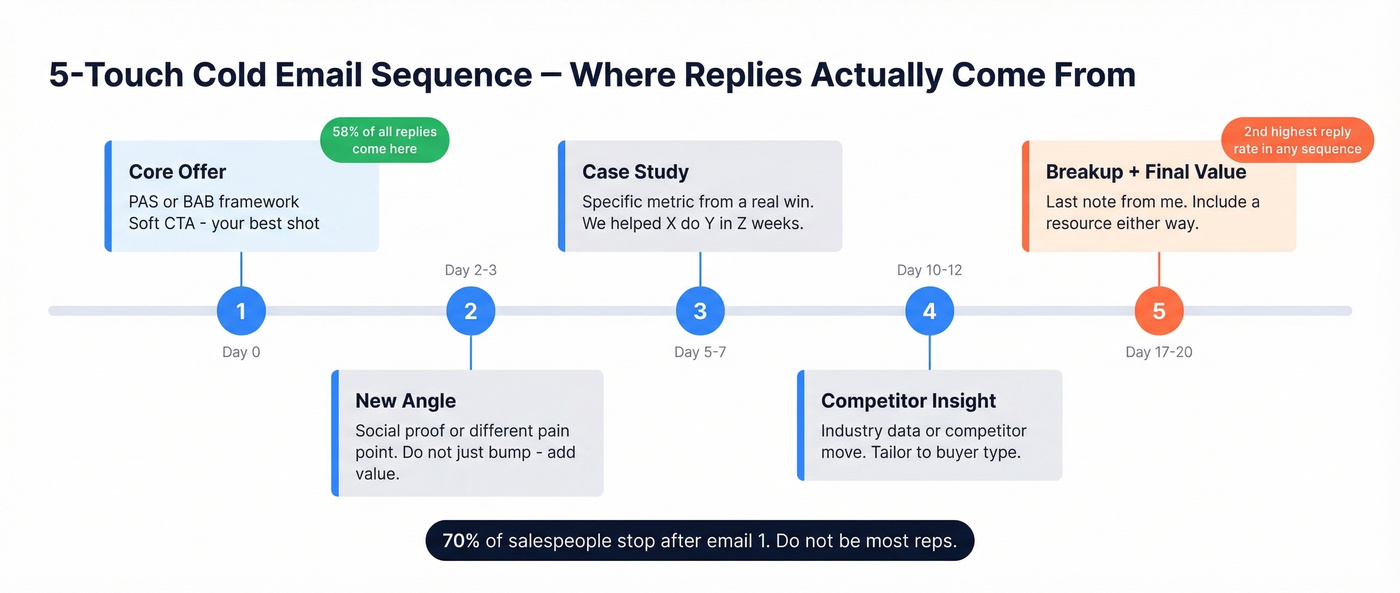
- Email 1 (Day 0): Core offer. PAS or BAB framework. Soft CTA. This is your best shot - make it count.
- Email 2 (Day 2-3): New angle. Social proof or a different pain point. Don't just "bump" - add value.
- Email 3 (Day 5-7): Case study or data point. "We helped [company] do X in Y weeks" with a specific metric.
- Email 4 (Day 10-12): Competitor insight or industry observation. Data-driven buyers respond to metrics here; relationship-first prospects need social proof earlier.
- Email 5 (Day 17-20): Breakup + final value. "Last note from me. Here's a resource either way." This consistently pulls the highest reply rate after email #1.
Reaching executives typically requires ~9 touches vs ~4 for other contacts. For C-suite prospecting, extend your sequence and space later touches 5-7 days apart.
The biggest mistake isn't bad copy in email #3. It's not sending email #3 at all. 70% of salespeople stop after one email.
Subject Lines That Get Opened
Your subject line has one job: get the email opened. It doesn't need to be clever. It needs to be relevant and short.
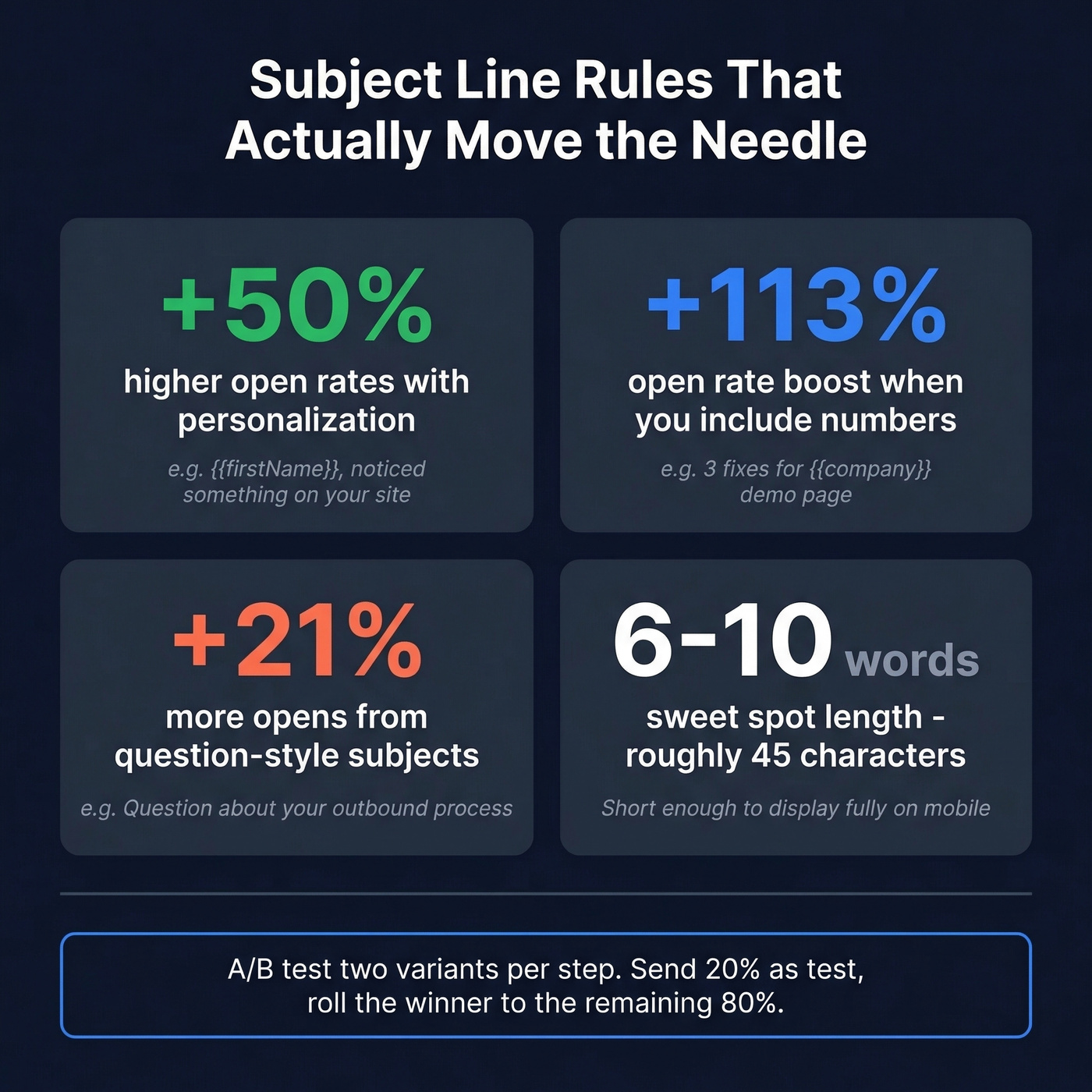
Personalized subject lines get 50% higher open rates. Including numbers can increase opens up to 113%. Questions boost opens by 21%. The sweet spot is 6-10 words, roughly 45 characters - short enough to display fully on mobile.
A/B test two variants per sequence step and let volume pick the winner. Allocate 20% of sends to the test, then roll the winner to the remaining 80%.
If you want more options, pull from these email subject line examples and adapt them to your ICP.
10 subject lines that work across scenarios:
- Quick thought on {{company}}'s pipeline
- {{firstName}}, noticed something on your site
- 3 fixes for {{company}}'s demo page
- Question about your outbound process
- {{competitor}} just changed their pricing
- Idea for {{company}} - 2 min read
- Can I send this over?
- {{company}} vs industry benchmark
- One thing about your {{specific page}}
- Last note from me, {{firstName}}
Mistakes Killing Your Reply Rate
Use this as a self-audit checklist. Fix these before touching your copy:
- Sending from your primary domain. One spam flag and your company email reputation is cooked.
- Skipping warmup. New domains need 2-4 weeks minimum before production sends.
- Not cleaning your list. Bounces above 2% trigger spam filters. Verify before you send.
- Writing long emails. 40-60 words. Not 200. Not 150.
- Multiple CTAs. One email, one ask. Three asks equals zero replies.
- No unsubscribe link. Required by law and by mailbox providers.
- Too many links or HTML. Plain text outperforms designed emails for cold outreach. One or two links max.
- No segmentation. The same email to a VP of Sales and a Marketing Director is a wasted email to both.
- Missing SPF/DKIM/DMARC. Non-negotiable. Check every sending domain.
If you're still stuck, work through these sales prospecting techniques to tighten targeting before you touch copy.
Tools Worth Using in 2026
List Building and Verification
This is where we'd start. The sending tool doesn't matter if your list is bad. Prospeo covers 300M+ professional profiles with 98% email accuracy, verified through a proprietary 5-step process that includes catch-all handling, spam-trap removal, and honeypot filtering. The 7-day data refresh cycle means you're not emailing someone who left the company six weeks ago. Pricing runs ~$0.01 per email with a free tier of 75 verified emails and 100 Chrome extension credits per month, no contracts. You can search by 30+ filters - buyer intent, technographics, job changes, headcount growth - build a targeted list, verify it in bulk, and push it directly to Smartlead, Instantly, or Lemlist through native integrations.
If you're comparing vendors, start with these data enrichment services and then narrow down based on your workflow.

Sending and Sequencing
Apollo is worth considering if you want a combined database and sending platform in one tool. The free plan includes 100 credits per month, paid starts at $59/user/month, and the Organization tier runs $149/user/month with a 3-seat minimum. Skip it if you just need a sequencer - its real value is the all-in-one approach.
Saleshandy ($25/month billed annually, 7-day trial) is the budget pick. No built-in database, but if you're building lists elsewhere and just need reliable sending with basic automation, it does the job without the overhead.
If you're evaluating options, this breakdown of SDR tools can help you pick a stack that fits your volume and team size.
Quick Picks
GMass ($25/mo) lives entirely inside Gmail - dead simple but lacks warmup features. Best for founders sending low volume. Smartlead (~$39/mo) focuses on inbox rotation and deliverability management for high-volume senders. Lemlist (~$59/mo) leans into personalization with dynamic images and landing pages - worth it if visual differentiation is part of your strategy.
If you're sending at scale, keep an eye on email velocity so you don't burn domains.
Scaling to 400 cold emails per day means nothing if you're targeting the wrong people. Prospeo's 300M+ profile database with 30+ filters - buyer intent, technographics, job changes, headcount growth - lets you build the tight, well-targeted lists that top 10% campaigns run on. One agency went from 35% bounce to under 4% and tripled pipeline to $300K/week.
Build lists that hit 5.5%+ reply rates, not spam folders.
FAQ
How many cold emails should I send per day?
Send 10-15 per inbox with 2-3 inboxes per domain. Scale by adding domains, not increasing volume per inbox. You'll need roughly 10-12 domains to hit 400 sends daily without risking deliverability.
What's a good reply rate for sales outreach?
Average is 3.43%, top quartile hits 5.5%+, and top 10% exceeds 10.7%. If you're under 2%, check deliverability and list quality before rewriting any copy - your emails likely aren't reaching inboxes.
Are cold emails for sales legal?
Yes, in most jurisdictions. CAN-SPAM doesn't require prior consent but mandates opt-out mechanisms and sender identification. GDPR requires explicit opt-in for EU contacts. Every email needs a physical address and working unsubscribe link.
How do I keep cold emails out of spam?
Authenticate every sending domain with SPF, DKIM, and DMARC. Keep bounces under 2% and spam complaints under 0.3%. Warm up new inboxes for 2-4 weeks minimum. Verify your entire list before sending - catching invalid addresses, spam traps, and honeypots before they hit your sequence is the single most effective thing you can do for inbox placement.
How do I get verified emails for cold outreach?
Use a B2B data platform with real-time verification. Search by filters like job title, industry, company size, and buyer intent signals, then verify in bulk and export directly to your sending tool. Most platforms offer free tiers so you can test accuracy before committing.