

The Best Cold Outreach Tools in 2026: What Actually Moves the Needle
Your bounce rate just crossed 8%. Reply rates cratered. The domain you spent six months warming is now flagged, and your SDR team is blaming the copy when the real problem is the data feeding their sequences. We've seen this pattern play out dozens of times.
Choosing the right cold outreach tool isn't about finding the fanciest sequencer. Most of these platforms just schedule and send emails - that's table stakes. Sequencing doesn't fix bad data, and bad data is what kills deliverability, reply rates, and ultimately pipeline. The tool that matters most isn't the one sending your emails. It's the one verifying the contacts before they ever hit a sequence.
Here's what separates the tools worth paying for from the ones burning your budget.
Our Top Picks for 2026
Three quick picks before we go deep:
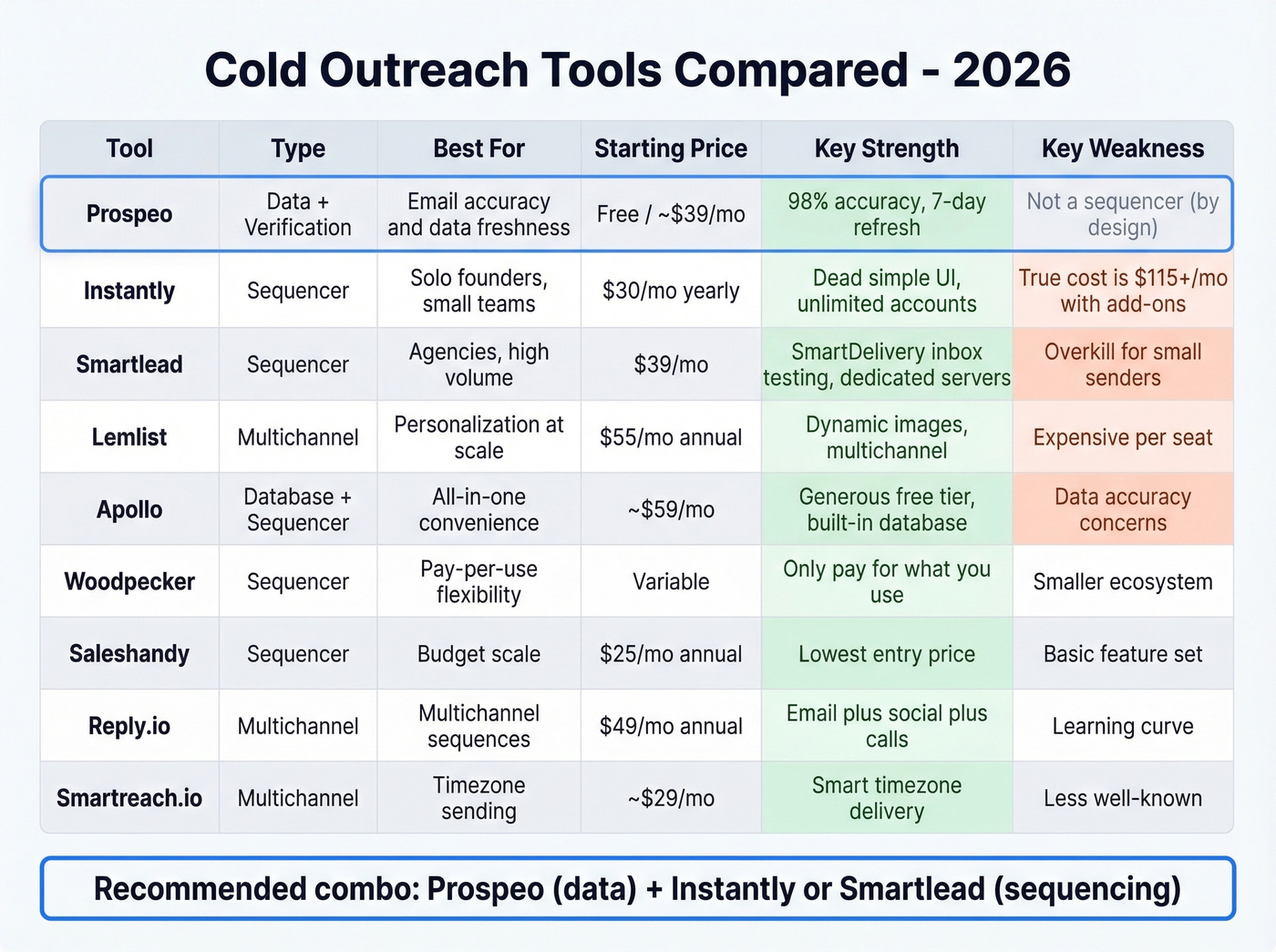
- Prospeo - Best for email accuracy and data freshness. The layer that protects your domain before a single email sends.
- Instantly - Best sequencer for solo founders and small teams. Unlimited accounts, built-in warmup, dead-simple UI.
- Smartlead - Best for agencies and high-volume senders. SmartDelivery inbox testing plus dedicated server infrastructure.
Most teams need two tools - a data/verification source and a sequencer. Our top combo: Prospeo + Smartlead or Prospeo + Instantly.
| Tool | Best For | Starting Price | Type |
|---|---|---|---|
| Prospeo | Email accuracy & data | Free / ~$39/mo | Data + verification |
| Instantly | Small team sequencing | $30/mo (yearly) | Sequencer |
| Smartlead | Agency / high volume | $39/mo | Sequencer |
| Lemlist | Personalization | $55/mo (annual) | Multichannel sequencer |
| Apollo | All-in-one convenience | ~$59/mo | Database + sequencer |
| Woodpecker | Pay-per-use model | Variable | Sequencer |
| Saleshandy | Budget scale | $25/mo (annual) | Sequencer |
| Reply.io | Multichannel | $49/mo (annual) | Multichannel sequencer |
| Smartreach.io | Timezone sending | ~$29/mo | Multichannel sequencer |
Cold Email Benchmarks in 2026
Before picking tools, you need to know what "good" looks like. Instantly's 2026 benchmark report analyzed billions of sends and found an average reply rate of 3.43%. Top quartile performers hit 5.5%+, and the top 10% reach 10.7%+.
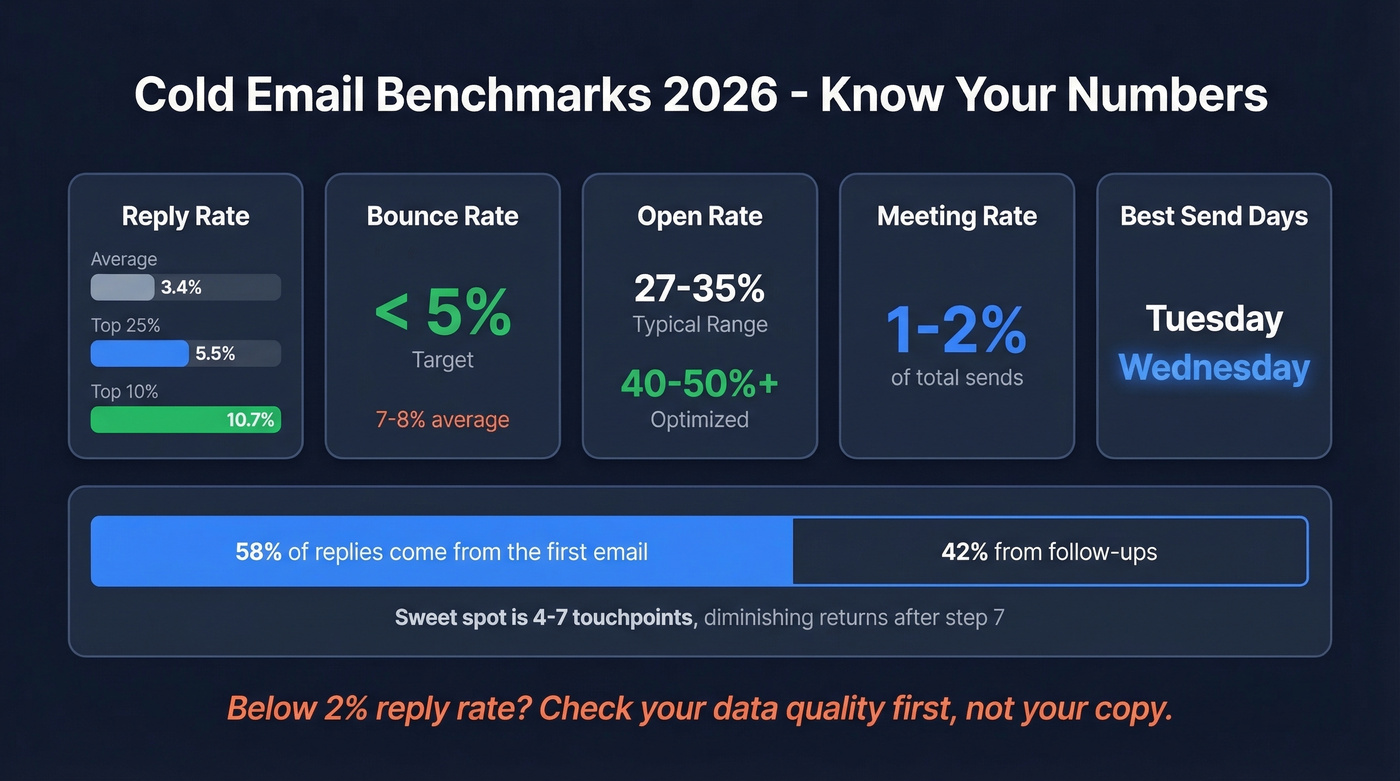
That gap between average and top 10% is enormous - and it's mostly driven by list quality and targeting, not subject lines. Best performers keep first-touch emails under 80 words and A/B test weekly.
Other key findings: 58% of replies come from the first email. Follow-ups contribute the remaining 42%, with diminishing returns after step 7. The sweet spot is 4-7 touchpoints, and Tuesday and Wednesday are peak send days, with Wednesday edging ahead slightly.
Reddit practitioners paint a similar picture:
- Bounce rate: 7-8% is a common average, but keep it under 5% for healthy deliverability.
- Open rate: 27-35% is typical. Optimized campaigns push 40-50%+.
- Reply rate: 5-6% is strong overall; positive reply rate around 2-4% is solid.
- Meeting booking: 1-2% of total sends. Higher if your ICP is tight.
If you're below a 2% reply rate, don't rewrite your copy first. Check your data quality and targeting. The copy is rarely the bottleneck.
What "Cold Outreach Tool" Actually Means
The phrase gets thrown around like it's one thing. It's not. A proper cold outreach stack has four layers, and most tools only cover one or two.
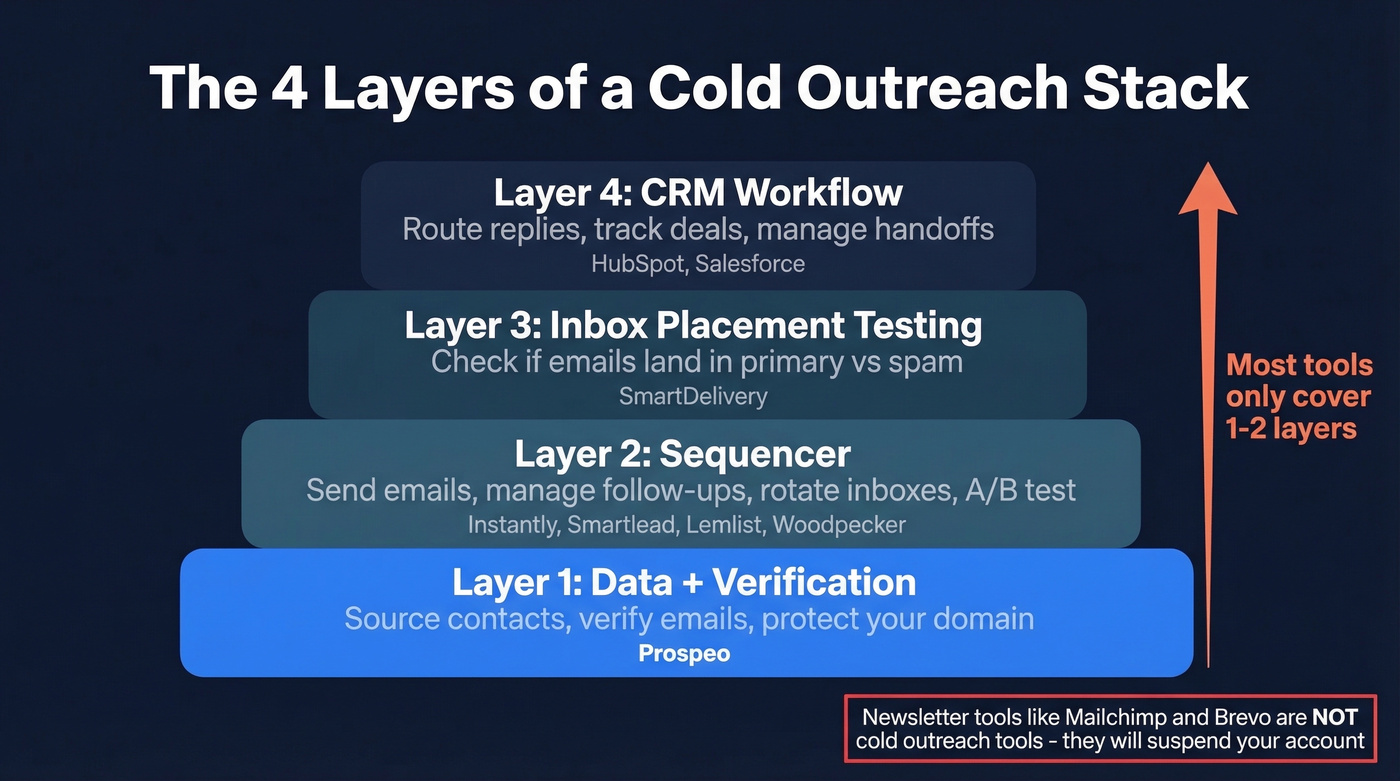
Data + Verification is the foundation - where you source contacts and verify they're real before sending. This is the layer that protects your domain. Without it, every other tool in your stack is working with a handicap.
The Sequencer is the engine that sends emails, manages follow-ups, rotates inboxes, and handles A/B testing. Instantly, Smartlead, Lemlist, and Woodpecker all live here. Most roundups only cover this layer.
Inbox Placement Testing checks whether your emails actually land in the primary inbox vs. spam. Smartlead's SmartDelivery is the standout option here. Without this, you're flying blind on deliverability.
CRM Workflow is where replies get routed, deals get tracked, and handoffs happen - HubSpot, Salesforce, or even Instantly's own CRM module.
One critical clarification: Mailchimp, Brevo, and other newsletter platforms aren't outreach tools built for cold sending. They lack warmup, inbox rotation, and throttling. They'll suspend your account for cold sends. Don't learn this the hard way.
The consensus on r/coldemail is that timezone sending, multichannel drips, and the ability to manage domains and inboxes inside the tool ecosystem are the criteria that actually matter when evaluating cold outreach platforms.
For a deeper look at what belongs in a modern outbound stack, see our guide to SDR team tooling.

Most cold outreach fails at the data layer, not the sequencer. Prospeo delivers 98% email accuracy on a 7-day refresh cycle - while the industry average sits at 6 weeks. Teams like Meritt dropped bounce rates from 35% to under 4% and tripled pipeline. Native integrations with Instantly, Smartlead, and Lemlist mean verified contacts flow straight into your sequences.
Stop blaming your copy when the real problem is stale data.
Best Cold Outreach Software for Sales Teams
Prospeo - Best for Data Accuracy
Every sequencer in this list sends emails. None of them can fix a bad list. Prospeo is the data layer that makes everything downstream work.
The database covers 300M+ professional profiles with 143M+ verified emails and 125M+ verified mobile numbers that carry a 30% pickup rate - useful for teams running call sequences alongside email. The 98% email accuracy rate is backed by real outcomes: Meritt dropped from a 35% bounce rate to under 4% after switching, and Stack Optimize maintains 94%+ deliverability across all client campaigns with zero domain flags.
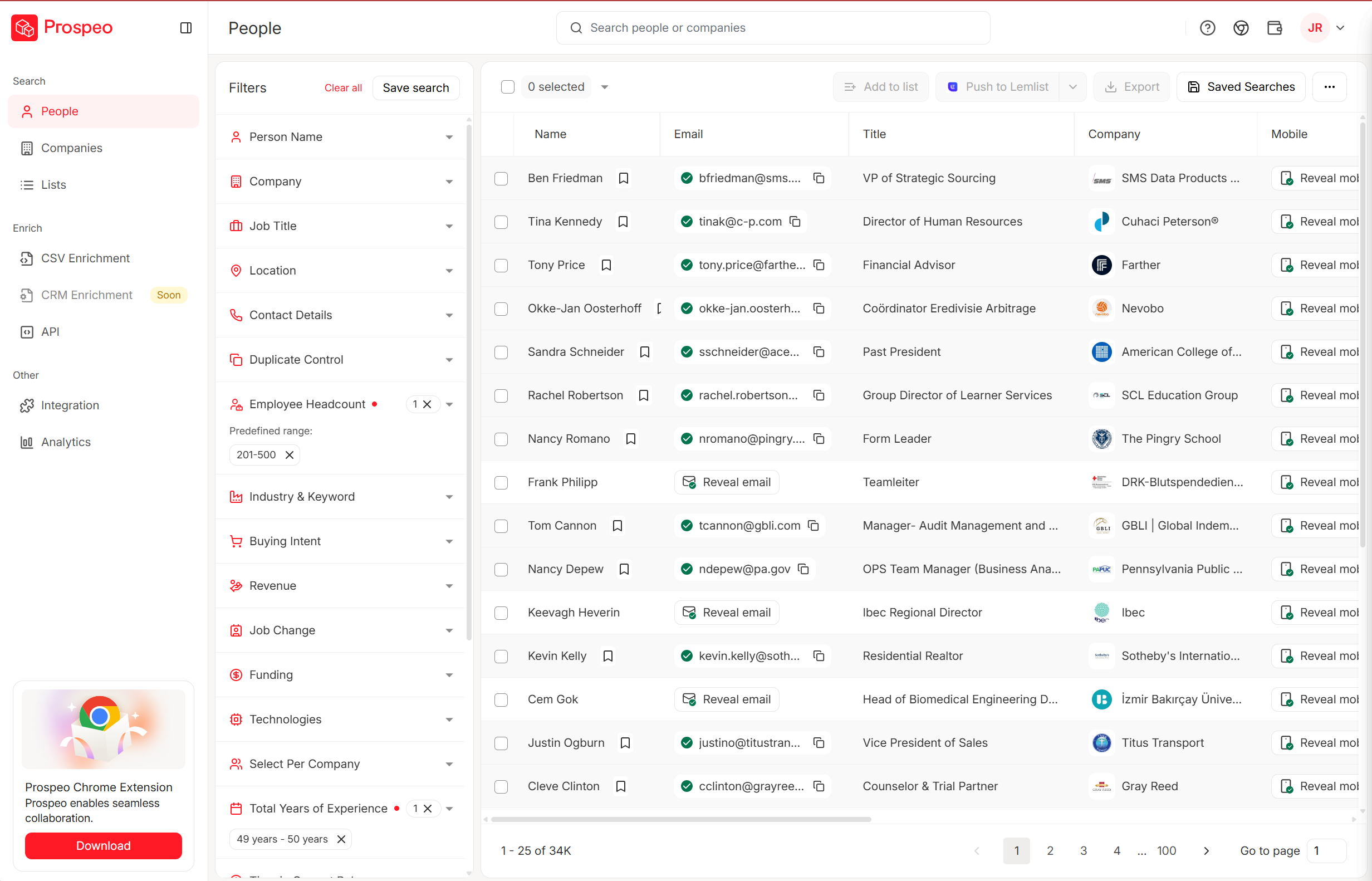
What makes Prospeo different from other data providers is the 7-day refresh cycle. The industry average is six weeks. In cold outreach, a six-week-old email list is already decaying - people change jobs, companies restructure, inboxes get deactivated. Weekly refresh means your data stays current. The platform also layers intent data across 15,000 topics powered by Bombora, so you can prioritize prospects actively researching your category.
Native integrations with Smartlead, Instantly, and Lemlist mean verified contacts flow directly into your sequencer without CSV gymnastics. The Chrome extension lets you pull verified emails from any website or professional profile in one click - 40,000+ users rely on it daily.
Pricing runs on credits at roughly $0.01 per email. The free tier gives you 75 verified emails and 100 extension credits per month, enough to test accuracy before committing. No contracts, no sales calls.
If you’re comparing vendors, start with our breakdown of data enrichment services and how they impact downstream performance.
Use Prospeo if: You're running outbound at any scale and need verified data that won't torch your domain. Especially valuable for agencies managing multiple client domains where one bad list can cascade into reputation damage across every account.
Instantly - Best Sequencer for Small Teams
Instantly is the sequencer that took over the cold email world by being dead simple. Connect unlimited email accounts, warm them all up automatically, build sequences, and send. That's the pitch, and it delivers.
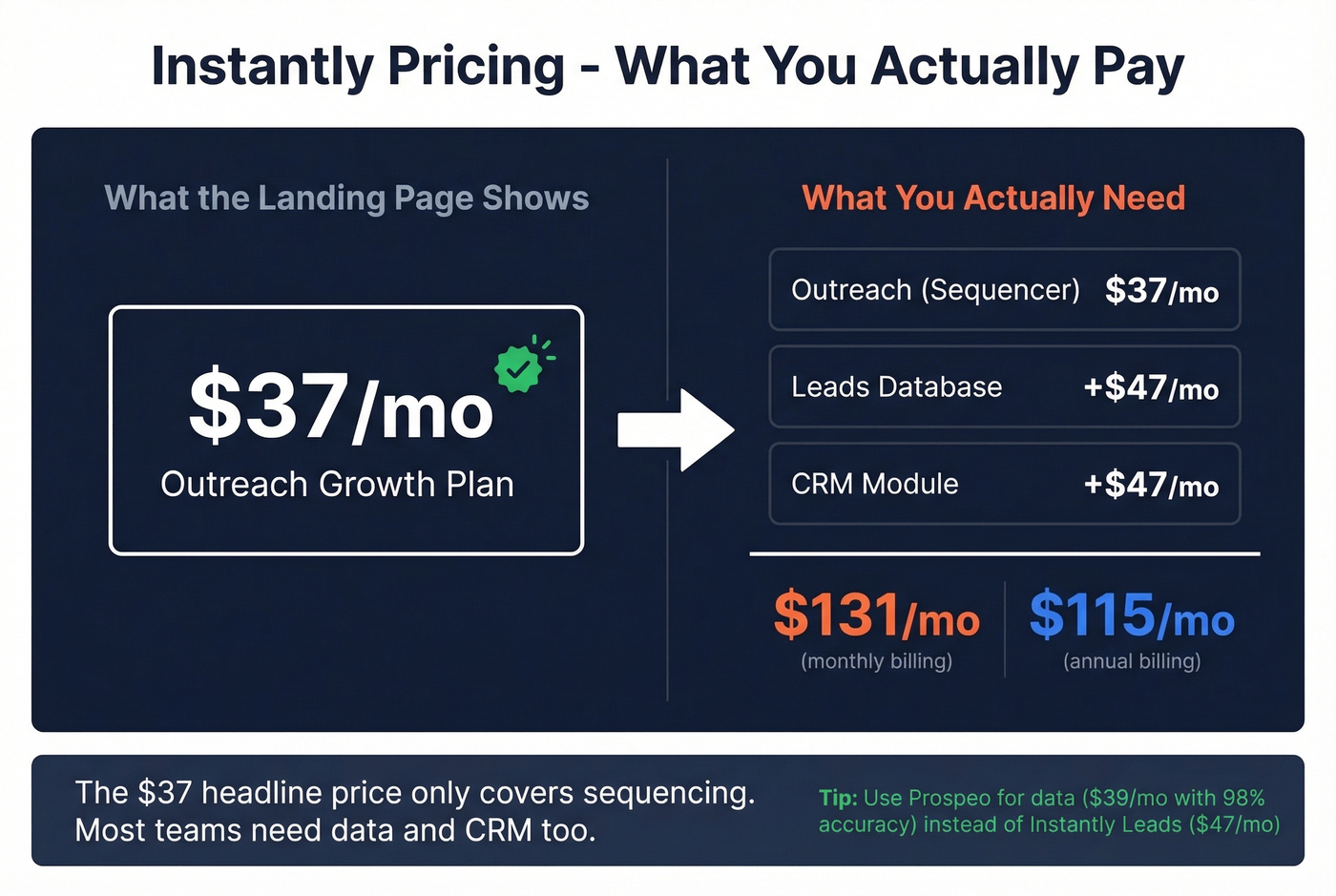
The Outreach Growth plan runs $37/mo monthly or $30/mo on annual billing. You get 1,000 uploaded contacts, 5,000 emails per month, and unlimited email accounts with warmup. Hypergrowth bumps to $97/mo monthly or $77.60/mo yearly for 25,000 contacts and 100,000 emails. G2 ratings sit at 4.8/5 across 4,040 reviews with a 9.4 Ease of Use score.
Here's the thing though: Instantly's headline price is misleading. The Leads database costs an additional $47/mo. The CRM module is another $47/mo monthly or $37.90/mo on annual billing. So a team that wants prospecting + sequencing + CRM is looking at $37 + $47 + $47 = $131/mo minimum on monthly billing - not the $37 you saw on the landing page. On yearly billing, the stack runs ~$115/mo. Reddit users consistently flag this stacking.
If you want to tighten the actual sequence mechanics, use this B2B cold email sequence framework as your baseline.
Use Instantly if: You're a solo founder or small team that already has a verified data source and just needs a reliable, easy sequencer with solid warmup.
Skip Instantly if: You need multichannel beyond email, or you're an agency needing white-label client management.
Smartlead - Best for Agencies & High Volume
Where Instantly optimizes for simplicity, Smartlead optimizes for control. Agencies love it for that reason.
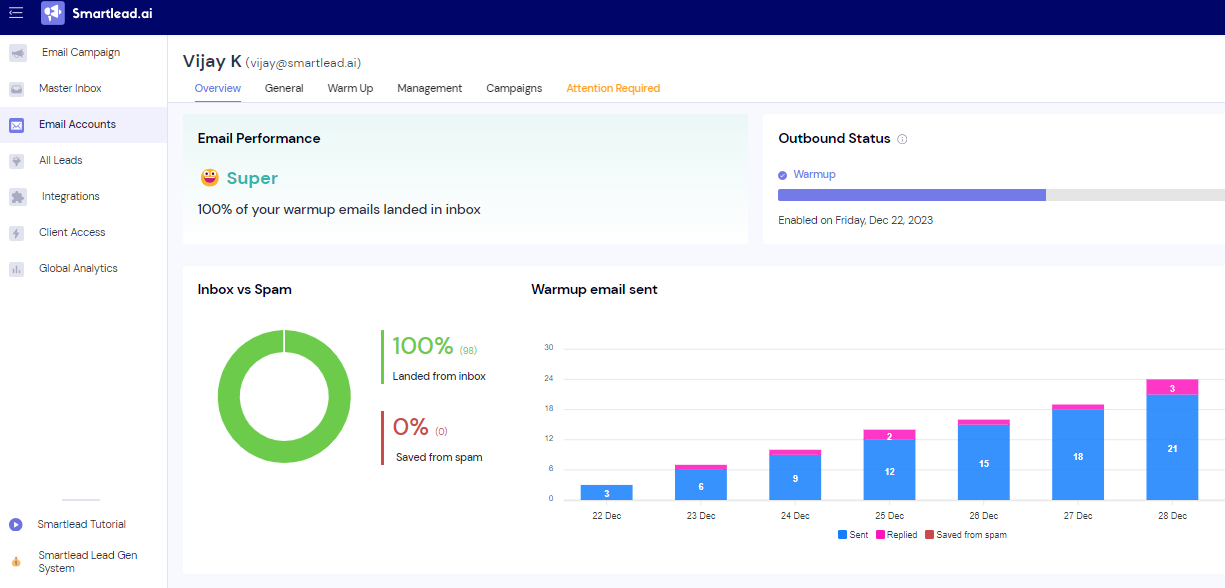
Core plans start at $39/mo for 2,000 contacts and 6,000 sends, scaling up to Prime at $379/mo for unlimited contacts and 500,000 sends. Every tier includes unlimited email accounts and warmup.
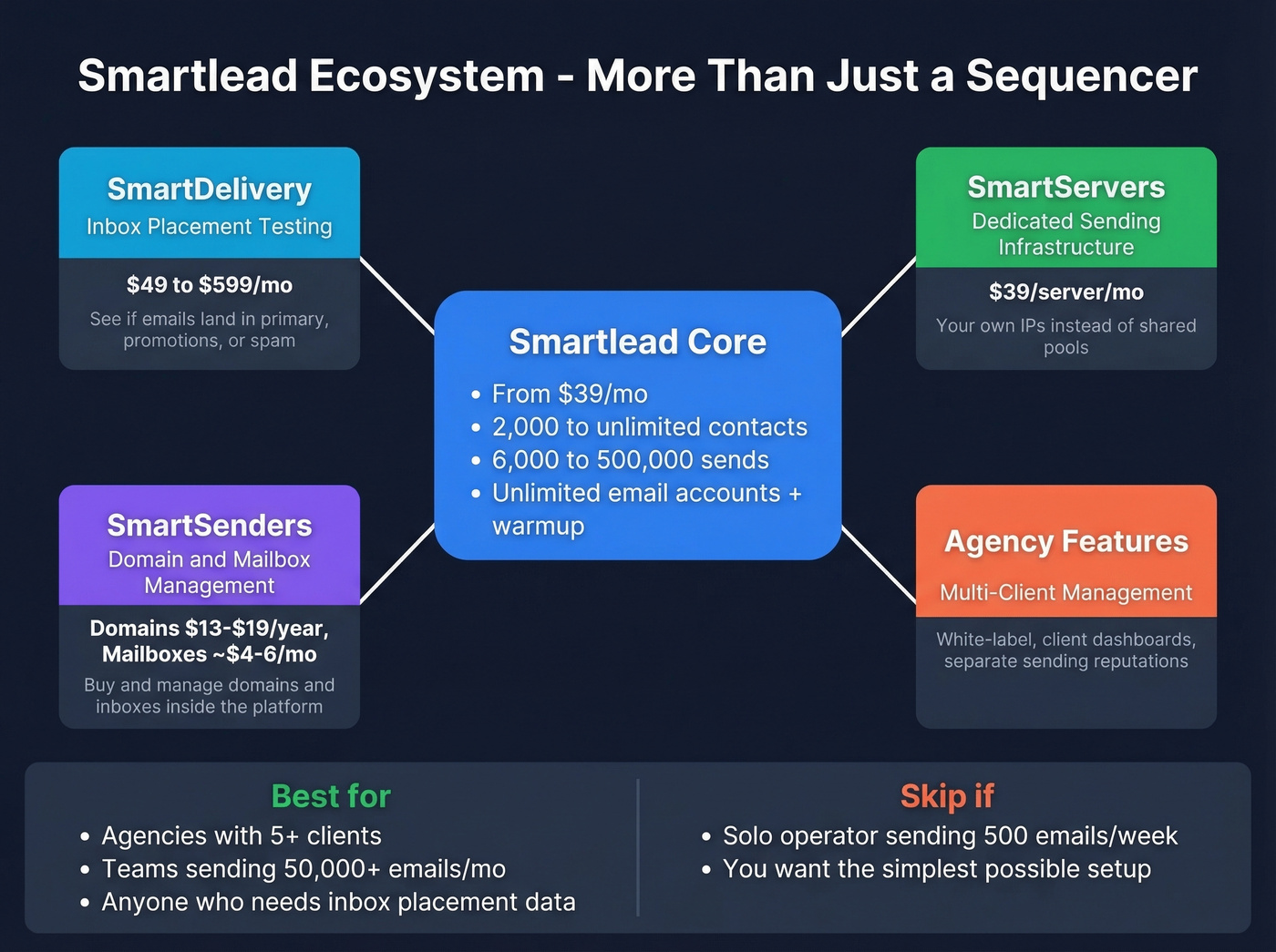
The real differentiators are the add-ons. Smartlead's SmartDelivery ($49-$599/mo) lets you run inbox placement tests - actually seeing whether your emails land in primary, promotions, or spam. SmartServers ($39/server/mo) give you dedicated sending infrastructure instead of shared IPs. SmartSenders lets you buy domains ($13-$19/year) and mailboxes (~$4-6/mo) directly inside the platform, a feature Reddit practitioners specifically call out as a massive time-saver for teams managing dozens of sending accounts.
If you’re troubleshooting deliverability, start with bounce mechanics and codes in our email bounce rate guide.
Use Smartlead if: You're an agency managing 5+ client accounts, you send 50,000+ emails per month, or you want granular control over sending infrastructure and inbox placement.
Skip Smartlead if: You're a solo operator who just wants to send 500 emails a week. Instantly's simpler UX will get you moving faster.
Lemlist - Personalization That Earns Its Premium
Most sequencers stop at {{first_name}} merge tags. Lemlist goes further with dynamic images, custom landing pages, and multichannel sequences blending email with calls and social touches. G2 gives it 4.6/5 across 1,333 reviews, with personalization and multichannel consistently cited as top strengths.
Entry pricing is $55/mo on annual billing and $79/mo for multichannel, making it one of the pricier sequencers here. The "Expensive" tag shows up on both G2 and Reddit threads. That said, if personalization at scale is your competitive edge, Lemlist earns its premium.
For personalization that doesn’t tank clarity, pull from these email subject line examples and iterate from there.
Use Lemlist if: Your outreach strategy depends on heavy personalization and multichannel cadences. Skip it if: You're optimizing for cost per send.
Apollo - The All-in-One Trade-Off
Apollo is the Swiss Army knife - database, sequencer, dialer, and basic CRM in one platform. It's the most-reviewed tool in this space on G2 (4.7/5, 9,478 reviews), and the free tier is genuinely generous. Paid plans start around $59/mo.
The trade-off is data accuracy. "Inaccurate Data" is a recurring con tag on G2, and Reddit practitioners note that deliverability isn't always strong and domain setup control is limited. In our experience, teams using dedicated verification providers book 35% more meetings compared to Apollo's built-in data - the convenience of all-in-one comes at the cost of depth in any single layer.
If you’re evaluating the “one login” approach, it helps to understand examples of a CRM and what’s actually included.
Use Apollo if: You want one login for everything and can tolerate some data quality variance. Skip it if: Deliverability is your top priority.
Woodpecker - Pay for What You Use
Woodpecker's pricing model is genuinely unique: you pay per "contacted prospect" rather than per seat or per email. Contact the same person multiple times in one campaign and it counts once. Contact them in two separate campaigns and it counts twice.
Every plan includes 4 free warmups, catch-all verification via Bouncer, 400 Lead Finder credits, unlimited team members, and unlimited email accounts. Add-ons are transparent: LinkedIn automation at $29/mo per account, agency panel at $27/mo per client, and additional email addresses at $4-6/mo each.
If you’re building a follow-up system around this model, keep a swipe file of cold email follow-up templates handy.
Use Woodpecker if: You have a defined prospect list and want predictable costs. Skip it if: You're doing high-volume sends - the per-prospect model gets expensive fast.
Saleshandy, Reply.io & Smartreach.io
Saleshandy is the budget play for teams that need volume. Plans start at $25/mo on annual billing or around $36/mo monthly, and it handles the basics - sequences, warmup, inbox rotation. Deliverability features aren't as advanced as Instantly or Smartlead, but for teams watching every dollar, it gets the job done.
Reply.io occupies similar territory to Lemlist - multichannel sequences across email, calls, and social touches - with entry pricing starting around $49/mo on annual plans and common Email Volume plans at $59/mo. A solid choice if Lemlist's pricing feels steep, though the personalization depth isn't quite as strong.
Smartreach.io is the Reddit practitioner's sleeper pick. At ~$29/mo entry, it's often highlighted for timezone sending and multichannel drips. One r/coldemail poster specifically called it their top lean for the feature-to-price ratio. We haven't tested it deeply enough to recommend it over the Tier 1 picks, but it's on our radar.
Honorable mentions: You'll see Snov.io, Klenty, GMass, and Mailshake in other roundups. They're functional tools, but none offer a clear advantage over the picks above in deliverability, pricing, or feature depth.
Pricing Models Explained
Here's where finance asks why your "$37/mo tool" actually costs $200/mo. The pricing models across cold outreach software are wildly different, and the headline number almost never tells the full story.
| Tool | Pricing Model | Entry Price | Cost Jump Trigger |
|---|---|---|---|
| Prospeo | Per credit (~$0.01/email) | Free / ~$39/mo | Volume of verified contacts |
| Instantly | Per module (stacked) | $30/mo (yearly) | Adding Leads + CRM modules |
| Smartlead | Per tier + add-ons | $39/mo | SmartDelivery + SmartServers |
| Lemlist | Per seat | $55/mo (annual) | Adding seats + channels |
| Apollo | Per seat + credits | ~$59/mo | Credit overages + seats |
| Woodpecker | Per contacted prospect | Variable | Prospect volume + add-ons |
| Saleshandy | Per tier | $25/mo (annual) | Contact volume |
| Reply.io | Per seat | $49/mo (annual) | Seats + channels |
| Smartreach.io | Per tier | ~$29/mo | Contact volume |
Let's break this down with real numbers. Instantly's Growth plan at $37/mo looks great until you add the Leads database at $47/mo and CRM at $47/mo - that's $131/mo for what many teams consider baseline functionality. Smartlead's $39/mo base plan becomes $127/mo once you add SmartDelivery at $49/mo and a dedicated server at $39/mo. Woodpecker's per-prospect model is elegant in theory, but add LinkedIn automation at $29/mo per account and an agency panel at $27/mo per client, and the add-ons stack fast.
If your deals average under $8k, you probably don't need a $130+/mo outreach platform. A credit-based data provider plus a $30/mo sequencer will outperform an overbuilt stack you're only using 40% of.
Recommended Tool Stacks
Stop shopping for 12 tools. Pick two layers - data/verification and sequencer - and commit for 90 days. Here are three proven combos.
Budget Stack (~$70-80/mo): Prospeo's free tier plus Instantly Growth at $30/mo yearly. This gets a solo founder or early-stage SDR sending verified sequences within an hour. Upgrade the data plan as volume grows.
Agency / High-Volume Stack (~$175-300/mo): A paid data/verification plan plus Smartlead Pro at $94/mo plus SmartDelivery at $49/mo. This gives you verified data flowing into a sequencer with inbox placement testing and dedicated infrastructure. Agencies managing multiple client domains need this level of control - one bad list on a shared domain can cascade across every client account.
RevOps / API Stack (~$150-400/mo): An enrichment API with a 92% match rate and 50+ data points per contact, integrated into Salesforce or HubSpot, feeding the sequencer of your choice. This is for teams that want enrichment running automatically - new leads get verified and enriched before they ever touch a sequence.
If you’re still building your list engine, start with these sales prospecting techniques before you add more tools.
The common thread across all three: separate your data layer from your sending layer. Treating them as separate concerns gives you better results than any all-in-one.
Bad data doesn't just kill reply rates - it flags your domain and tanks every campaign after it. Prospeo's 5-step verification with catch-all handling, spam-trap removal, and honeypot filtering keeps bounce rates under 4%. At $0.01 per email, it costs less than one wasted send from a dirty list.
Protect every domain in your stack for a penny per verified email.
How to Pick the Right Tool
Look, most "tested and ranked" roundups don't publish inbox placement results. Deliverability is mostly about your list, your authentication setup, and your sending behavior - not which sequencer logo is on the dashboard. Here's what actually matters when choosing.
Deliverability protection. Does the tool support warmup, throttling, and inbox rotation? More importantly, are you feeding it verified data? A sequencer can't fix a 15% bounce rate.
Personalization depth. If your ICP responds to personalized outreach - most do - you need more than {{first_name}}. Lemlist leads here. For volume plays, basic merge fields are fine.
Inbox rotation and timezone sending. Sending from a single inbox at 3 AM the recipient's time is a deliverability and reply-rate killer. Every serious tool on this list supports rotation. Timezone sending is less universal - Smartreach.io and Smartlead handle it well.
Reporting and analytics. You need open rates, reply rates, bounce rates, and sequence-level performance at minimum. The gap is in inbox placement testing - knowing whether your emails actually land in primary. Smartlead's SmartDelivery is one of the few tools that lets you test this directly.
Integrations. Your sequencer needs to talk to your CRM and your data source. Check native integrations before committing - Zapier workarounds break more often than you'd think. If you want a step-by-step, use this guide to connect outreach tool to CRM.
FAQ
Which cold outreach tool has the best deliverability?
No controlled bake-off with inbox placement data exists across these tools. Deliverability depends far more on list quality, email authentication (SPF/DKIM/DMARC), and sending behavior than the sequencer itself. Start with verified data from a dedicated provider, then run inbox placement tests using SmartDelivery to diagnose issues.
How many follow-ups should a cold email sequence have?
The sweet spot is 4-7 touchpoints. 58% of replies come from the first email, but follow-ups contribute 42% of total replies. Diminishing returns kick in hard after step 7. Keep first-touch emails under 80 words and A/B test weekly.
What's a good reply rate for cold email in 2026?
The average reply rate is 3.43% per Instantly's benchmark data. Top quartile performers hit 5.5%+, and the top 10% reach 10.7%+. If you're below 2%, check your data quality and ICP targeting before rewriting copy.
Can I use Mailchimp or Brevo for cold outreach?
No. Newsletter platforms aren't built for cold sending. They lack warmup, inbox rotation, throttling, and bounce management. They'll suspend your account - it violates their terms of service. Use a dedicated cold outreach tool instead.
How do I keep bounce rate under 5%?
Use a data provider with real-time verification and frequent refresh cycles. A 98% accuracy rate with a 7-day refresh cycle keeps bounce rates consistently under 5%. Meritt dropped from 35% to under 4% after switching to verified data, and Stack Optimize maintains under 3% bounce across all client campaigns.