

The Cold Sales Email Playbook for 2026: From Infrastructure to Inbox
Your SDR sent 500 cold sales emails last week and booked zero meetings. Before you rewrite the copy for the fourth time, consider this: the emails probably never reached anyone's inbox. The average reply rate for cold email in 2026 is 3.43%, and that's only for emails that actually land. Belkins' study of 16.5M cold emails shows reply rates dropped from 6.8% to 5.8% year-over-year. As one practitioner on r/coldemail put it: cold email feels broken in 2026. But the teams rebuilding their infrastructure are the ones recovering.
Here's the thing: cold email in 2026 is an infrastructure problem disguised as a copywriting problem. Most teams obsess over subject lines while sending to lists with ~11% bounce rates. Fix the pipes first.
What You Actually Need
Three things, in this order:
- Verified data so your emails don't bounce and torch your domain reputation.
- Properly authenticated domains so messages hit the inbox, not spam.
- Short, specific emails with a soft CTA - not another 200-word pitch about your platform.
Realistic expectations: 3.43% average reply rate, 5.5%+ for top-quartile campaigns, and 10.7%+ for elite performers. If you're below 2%, your problem is almost certainly infrastructure or data, not copy.
Outbound Email Benchmarks
| Metric | Average | Top Quartile | Elite (Top 10%) |
|---|---|---|---|
| Reply rate | 3.43% | 5.5%+ | 10.7%+ |
| First email share of replies | 58% | - | - |
| Optimal sequence length | 4-7 touches | - | - |
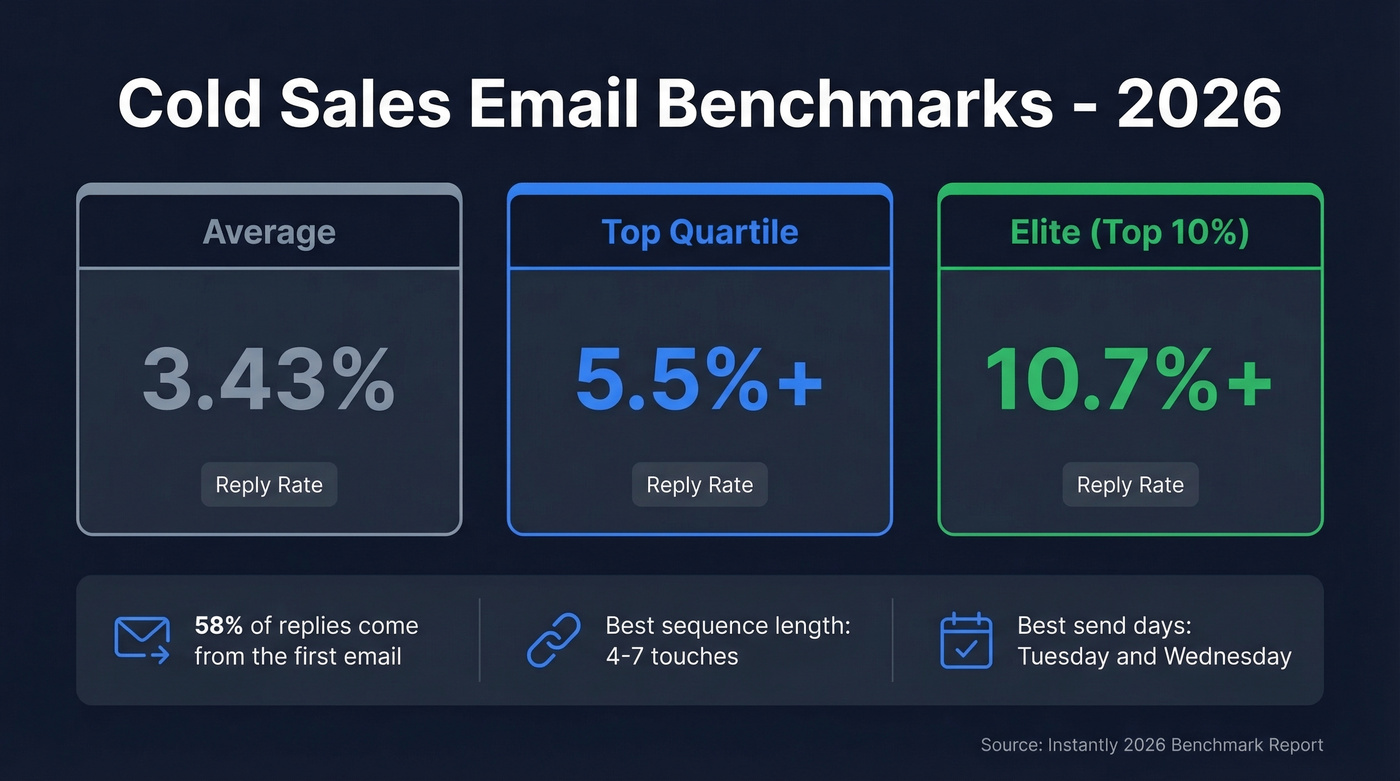
58% of all replies come from the first email. Your opener carries most of the weight - follow-ups help, but they can't rescue a bad first touch.
The trend line isn't encouraging. Belkins measured a 15% year-over-year decline in reply rates. Open rates spiked early in 2024 (up to 46%) before stabilizing around 31-32%. Tuesday and Wednesday are the highest-performing send days, with Wednesday edging ahead slightly.
Fix Your Data First
One in six B2B emails never reaches a visible inbox - global deliverability sits at just 83.1%. You can write the perfect prospecting message and it won't matter if your list is dirty.
One founder on r/Entrepreneur reported an 11% bounce rate before rebuilding their list hygiene. After switching to manual verification and cleaning their data, bounces dropped under 2% and reply rates doubled from 3% to 6%. We've seen the same pattern across dozens of campaigns we've audited - bad data is almost always the root cause when reply rates crater.
Skip this step if you enjoy watching your domain reputation burn. Seriously - trusting "verified" data from six weeks ago is asking for trouble. People change jobs, companies shut down inboxes, and a stale email is a bounce waiting to happen.
Deliverability Infrastructure
Authentication isn't optional in 2026. If you send outbound email at scale, inbox providers expect proper authentication and easy unsubscribes. For Gmail specifically: all senders need SPF or DKIM, and bulk senders (over 5,000/day to Gmail) need SPF + DKIM + DMARC plus one-click unsubscribe.
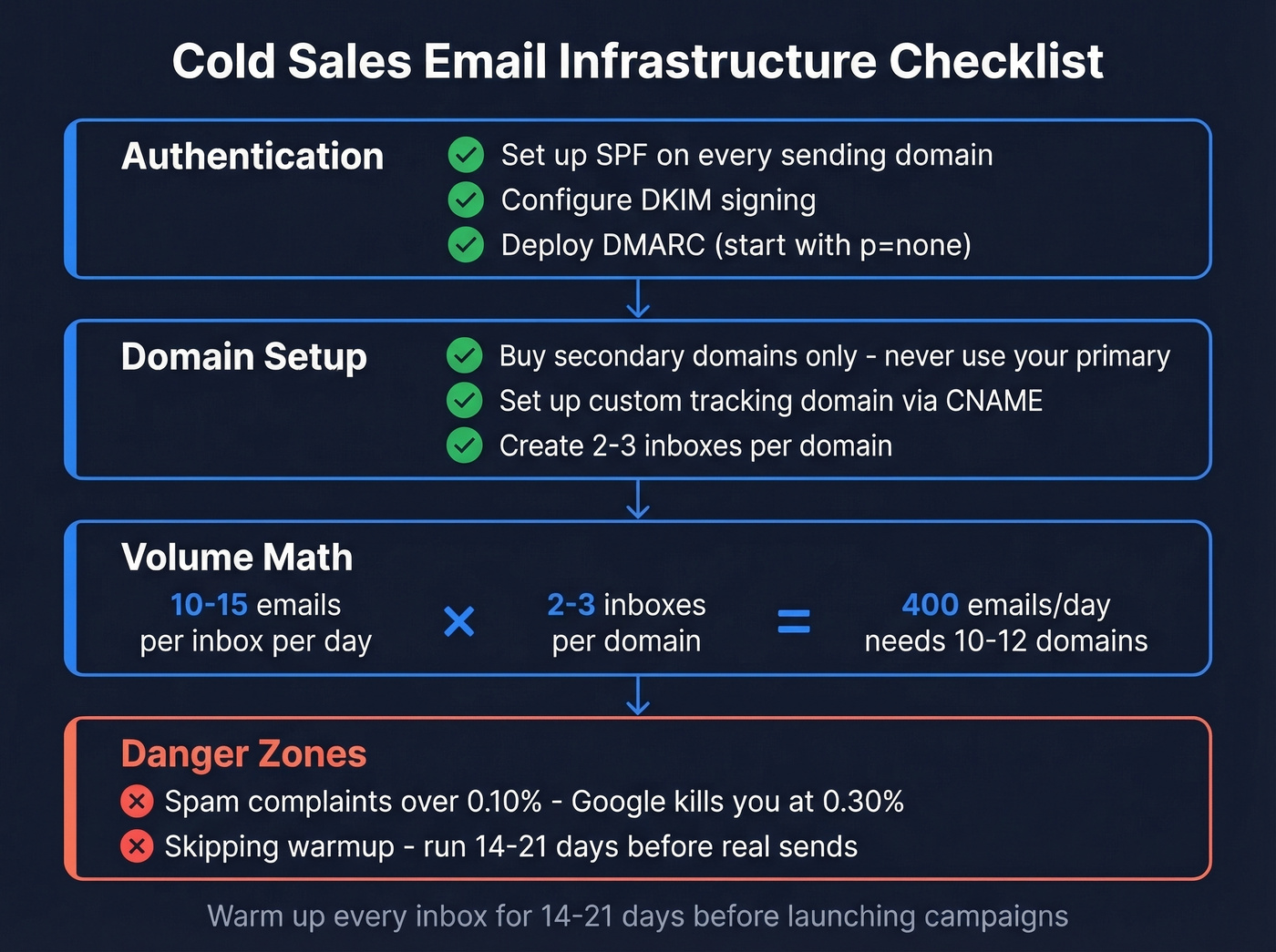
Set up SPF + DKIM + DMARC on every sending domain. Watch the SPF 10-DNS-lookup limit - exceeding it causes SPF to silently fail. Set up a custom tracking domain (CNAME) so your link tracking doesn't piggyback on a shared domain that other senders have already burned.
Use secondary domains only. Never send cold prospecting email from your primary domain. Buy domains that look similar to your brand (e.g., tryacme.com if you're acme.com). We've seen companies tank deliverability for their entire organization's email because someone ran outbound from the main domain. Don't be that team.
Volume math: each inbox handles 10-15 emails/day. Run 2-3 inboxes per domain. To send 400/day, you need roughly 10-12 domains. Warm up for 14-21 days before sending real campaigns, and keep warmup running after launch. Keep spam complaints under 0.10% - Google's threshold is 0.30%, but you want a wide margin.
For marketing-style emails and bulk senders, use one-click unsubscribe headers (RFC 8058). Even for pure sales outreach, including an easy opt-out protects your sender reputation.
Roll out DMARC in phases - don't skip straight to p=reject or you'll block legitimate emails you forgot about:
| Phase | DMARC Policy | Duration | Purpose |
|---|---|---|---|
| 1 | p=none | 2-3 weeks | Monitor, collect reports |
| 2 | p=quarantine (pct=25) | 2 weeks | Partial enforcement |
| 3 | p=quarantine (pct=100) | 2 weeks | Full quarantine |
| 4 | p=reject | Ongoing | Full protection |
How to Write Emails That Get Replies
Subject Lines
Belkins analyzed 5.5M emails and the findings are clear. Personalized subject lines hit 46% open rates versus 35% without - reply rates more than doubled (7% vs 3%). The sweet spot is 2-4 words. Performance drops steadily past 7.
Question-format subjects performed best at 46% opens. Urgency words ("ASAP," "urgent") actually hurt, pushing open rates below 36%. One founder tested this directly: "Quick question" pulled 39% opens, a company-name subject got 33%, and "Partnership opportunity" cratered below 19%.
If you want more options to test, pull from a swipe file of subject lines and adapt them to your ICP.
Body Structure and Length
The consensus on r/copywriting is that ultra-short prospecting emails - 40-60 words - are what's working now. Instantly's benchmark data points in the same direction: best-performing campaigns keep emails under 80 words. That same founder who doubled their reply rate cut email length from 141 words to under 56.
If you're still dialing in structure, this pairs well with a broader guide to email copywriting for outbound.
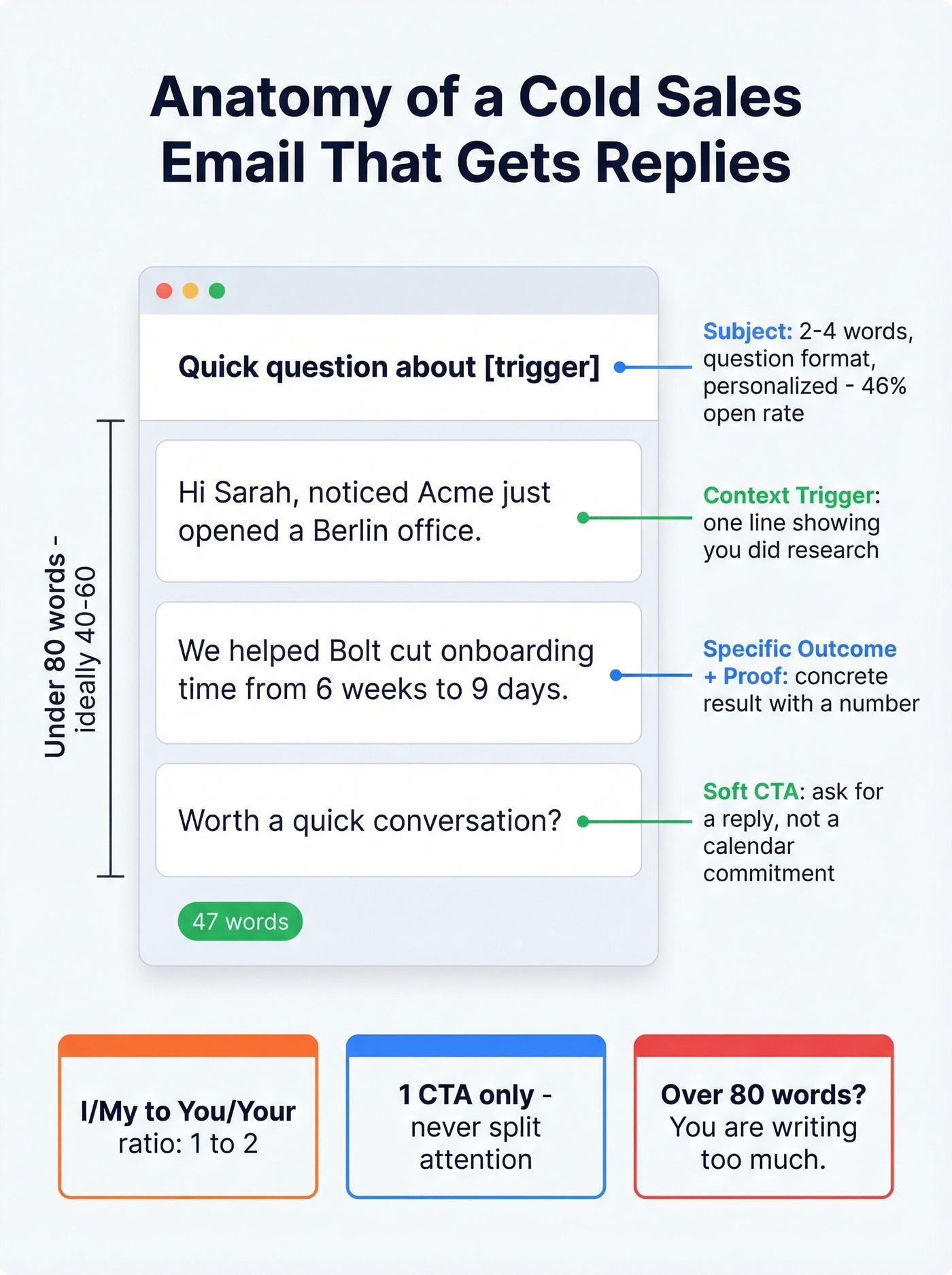
Start with a context trigger - one line showing you did research. Then a specific outcome: what you can do for them, concretely. Add one piece of small proof, like a result, a number, or a client name. Close with a soft ask like "Worth a conversation?" not "Book 30 minutes here." Throughout, aim for a 1:2 ratio of I/my to you/your. The email should be about them, not you.
If you're past 80 words, you're writing too much.
The CTA
Soft CTAs outperform hard meeting requests. "Worth a conversation?" or "Interested?" beats "Let's schedule a 30-minute call this Thursday." The difference is friction - you're asking for a reply, not a calendar commitment. One CTA per email. Multiple CTAs split attention and tank response rates.
For deals north of $50K ACV, consider a personalized lead magnet as your CTA - a custom Loom video or a one-page audit of their current setup. It takes more effort but dramatically outperforms generic asks when the deal size justifies it. (If you want a playbook for that, see Loom video outreach.)

You just read that 11% bounce rates destroy cold email campaigns. Prospeo's 5-step verification delivers 98% email accuracy on a 7-day refresh cycle - not the 6-week-old stale data that's torching your domain reputation. Teams using Prospeo cut bounce rates under 4% and book 35% more meetings than Apollo users.
Stop rewriting copy when your real problem is dirty data.
5 Prospecting Templates for 2026
The Ultra-Short (47 Words)
This is the format top performers are running. Under 50 words, specific trigger, concrete proof, soft CTA.
Hi {{first_name}}, noticed {{company}} just {{trigger event}}. We helped {{similar company}} {{specific result}} in {{timeframe}}. Worth a quick conversation?
The Trigger Event
Use this when your prospect's company just made a public move - new hire, funding round, office expansion, product launch. Timing intelligence makes a cold reach-out feel like a response to their situation, not a mass blast.
{{first_name}} - saw {{company}} opened a new {{office/role/market}}. When {{similar company}} did the same, they ran into {{specific problem}}. We helped them {{outcome}}. Relevant to what you're building?
The Pain Point
Hi {{first_name}}, most {{role}} at {{company stage}} companies tell us {{specific pain}} is eating 10+ hours a week. We cut that to {{reduced number}} for {{client}}. Open to seeing how?
Names the pain before pitching the solution. The "most {{role}} tell us" framing normalizes the problem.
The Social Proof Lead
Most outbound emails bury social proof in the third follow-up. Lead with it instead.
Before (generic): "We help companies like yours grow revenue."
After (specific): "{{known company in their space}} used us to {{result with number}}. Their setup was similar to {{company}} - {{1-2 similarities}}. Happy to share what worked for them if useful."
The second version offers value rather than asking for time.
The Breakup Email
Hi {{first_name}}, I've reached out a couple times - no worries if the timing's off. If {{pain point}} becomes a priority, here's a {{resource link}} that might help either way. All the best.
Follow-Up Strategy
The first follow-up lifts replies by up to 49%. After that, returns drop fast.
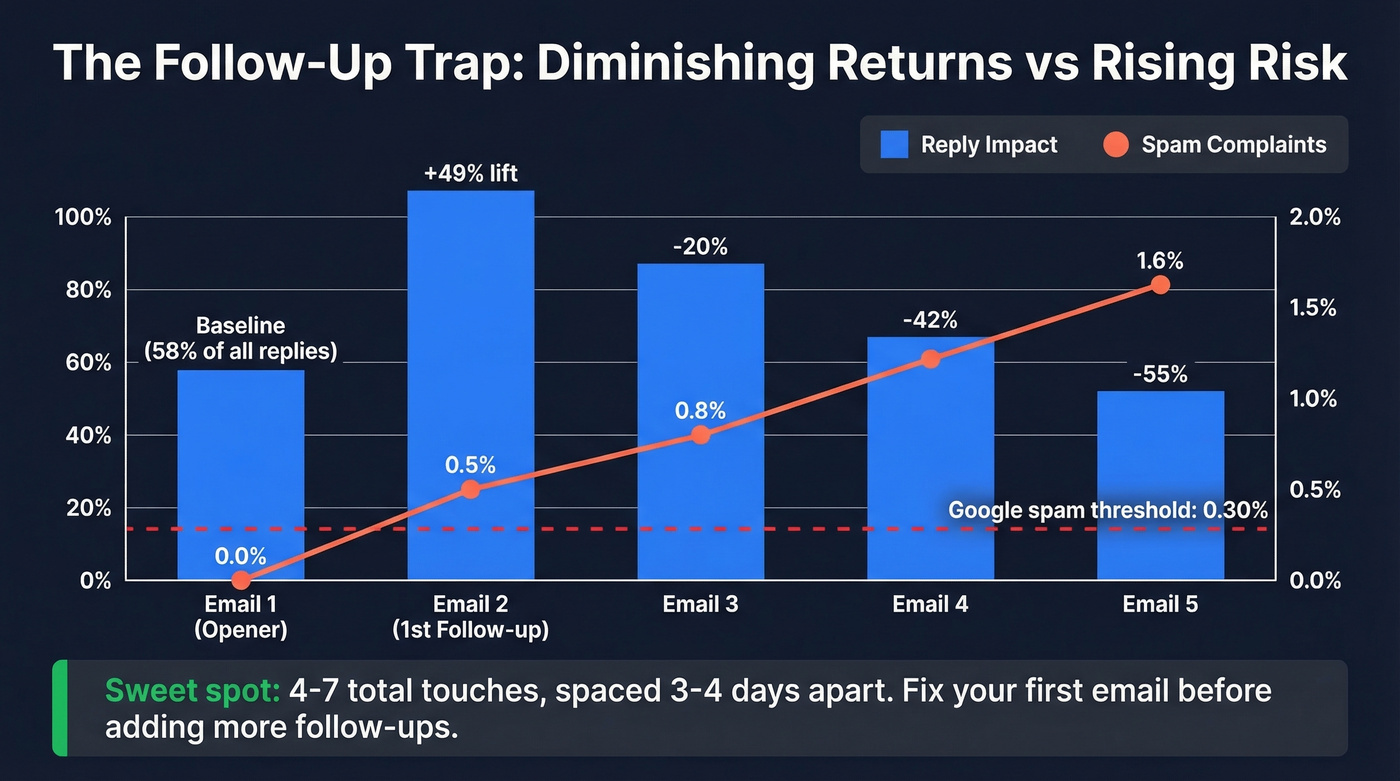
| Follow-Up # | Reply Impact | Spam Complaints | Unsub Rate |
|---|---|---|---|
| 1st (email 2) | +49% lift | 0.5% | 0.1% |
| 2nd (email 3) | -20% | ~0.8% | 0.05% |
| 3rd (email 4) | -40% | ~1.2% | 0.8% |
| 4th (email 5) | -55% | 1.6% | 2.0% |
The sweet spot is 4-7 total touches, spaced 3-4 days apart. Look at the spam complaint escalation - it triples by the fourth email. That's not just annoying prospects; it's actively damaging your sender score and your sales pipeline.
If you need copy for the rest of the sequence, use these cold email follow-up templates to keep touches tight and relevant.
58% of replies come from the first email. If your opener isn't working, adding more follow-ups won't fix it. Fix the first email, then build the sequence around it.
AI Personalization at Scale
Manual personalization takes 10-15 minutes per prospect. That doesn't scale past 20 emails a day. Teams reporting 3x response lifts use three layers of personalization: company intelligence (funding, hiring, tech stack), person intelligence (role, recent content, career moves), and timing intelligence (trigger events that make outreach relevant right now).
The practical workflow: scrape prospect signals from public sources, feed them to an LLM to generate custom opening lines, then map those into your sending tool as merge fields. The key is feeding your LLM specific, recent data. "Saw you're hiring" is table stakes. "Noticed you posted three backend engineering roles in Berlin last week - sounds like the EU expansion is real" is what gets replies.
If you're building this into your outbound motion, it helps to start from a solid AI cold email outreach workflow and iterate from there.
What a Cold Email Stack Costs
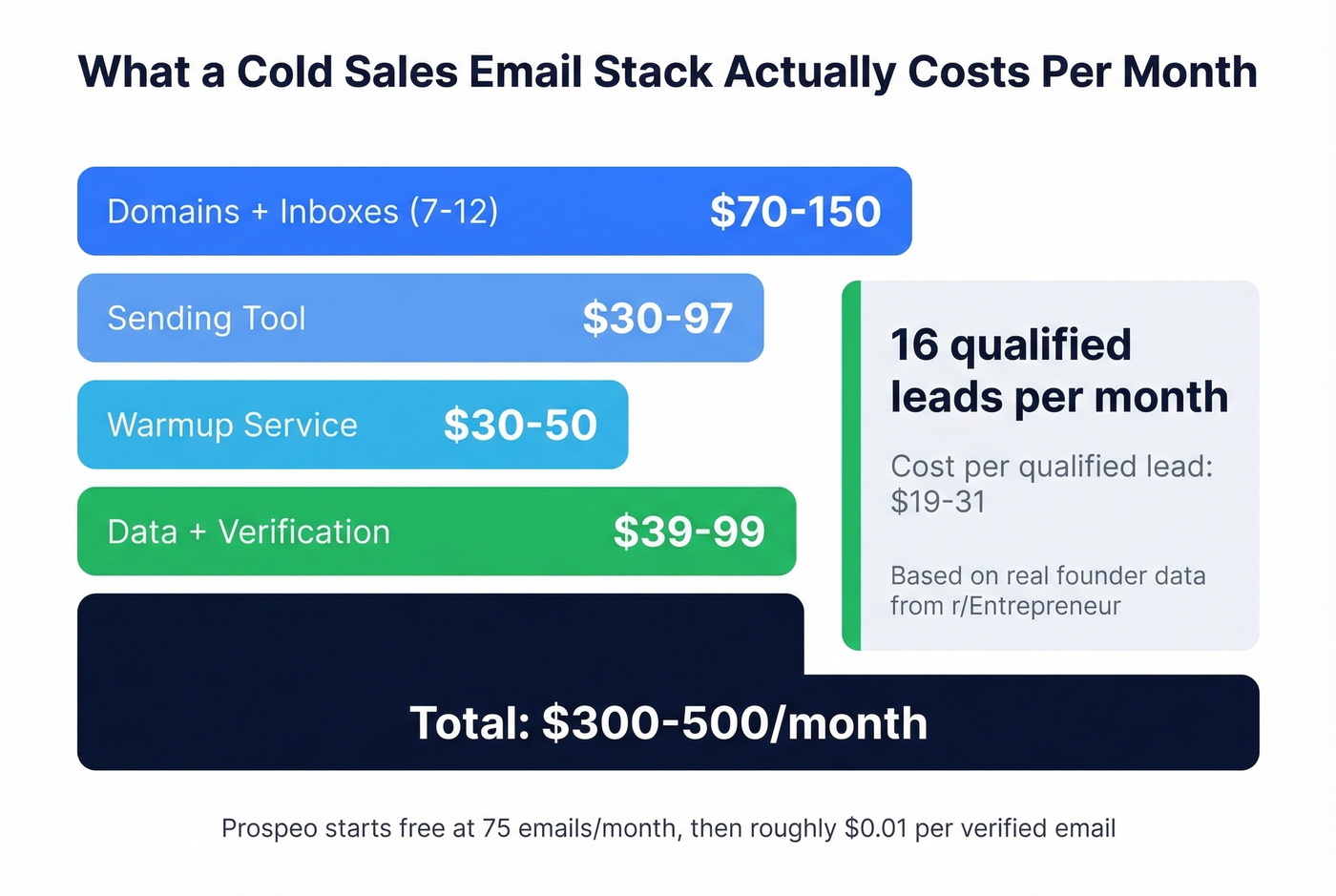
One founder documented their full stack at $420/month generating 16 qualified leads:
If you're comparing tools, this list of SDR tools is a good starting point for 2026 stacks.
| Category | Monthly Cost |
|---|---|
| Domains + inboxes (7-12) | $70-150 |
| Sending tool | $30-97 |
| Warmup service | $30-50 |
| Data + verification | $39-99 |
| Total | $300-500 |
For verified contact data, Prospeo starts free (75 emails/month) and scales at roughly $0.01 per verified email. Even at the paid tier, verification is the cheapest line item in your stack and the one with the highest ROI - bad data is the single fastest way to burn domains and waste every other dollar you're spending.
If you're evaluating vendors beyond verification, compare options across data enrichment services and email list providers to avoid paying twice for the same coverage.
Compliance Checklist
| CAN-SPAM (US) | GDPR (EU) | CASL (Canada) | |
|---|---|---|---|
| Consent needed | No | Legitimate interest | Yes |
| Opt-out deadline | 30 days | Prompt | 10 business days |
| Max penalty | $53,088/email | EUR 20M or 4% revenue | $10M CAD |
CAN-SPAM is the most permissive - no prior consent required, but you need a physical address, truthful subject lines, and opt-out honored within 30 days. GDPR allows B2B cold contact under Article 6(1)(f) legitimate interest, but document a Legitimate Interest Assessment before you start. CASL is the strictest - express or implied consent required. Every jurisdiction requires an unsubscribe mechanism.
FAQ
Does cold email still work in 2026?
Yes, but benchmarks are lower than 2023. The average reply rate sits at 3.43%, and top performers hit 10.7%+. Teams that treat outreach as a systems problem - infrastructure, data quality, deliverability - consistently outperform those who only tweak copy. It's still one of the most cost-effective B2B pipeline channels when the foundation is solid.
How long should a cold sales email be?
Aim for 40-80 words. Practitioners pushing 40-60 words see the best results, and benchmark data confirms campaigns under 80 words outperform longer messages. One founder cut from 141 to 56 words and doubled their reply rate from 3% to 6%.
How do I keep prospecting emails out of spam?
Authenticate every domain (SPF, DKIM, DMARC), keep bounce rates under 2%, use secondary domains, warm up for 14-21 days, and verify your list before sending. Prospeo's 5-step verification with 98% accuracy catches bad addresses before they damage your sender reputation.
What's the best day to send cold outreach?
Tuesday and Wednesday consistently outperform other days, with Wednesday edging ahead slightly. Avoid Mondays (inbox overload) and Fridays (early checkout). Send between 8-10 AM in the prospect's local time zone for highest open rates.
Let's be honest: the teams that see the fastest improvement are the ones that stop tweaking subject lines and start auditing their infrastructure. Fix your data, authenticate your domains, then write short emails with soft CTAs. Every cold sales email in your sequence depends on the same foundation - and the channel works, but only if the messages actually arrive.
If you want to go deeper on sequencing, build a B2B cold email sequence that matches your market and ACV.
Those 47-word cold sales emails only work when they land in real inboxes. Prospeo gives you 143M+ verified emails across 300M+ profiles - refreshed every 7 days, not weeks. One agency built to $1M ARR with sub-3% bounce rates and zero domain flags using Prospeo data.
Fix the pipes first. Start with data that actually connects.