


Common Room Pricing, Reviews & Pros/Cons: What You'll Actually Pay in 2026
Your community Slack is blowing up with product questions, your GitHub stars are climbing, and three prospects just joined your Discord. Your SDRs have no idea who any of these people are.
That's the problem Common Room solves - a signal intelligence platform that aggregates buying signals from community, product, and web activity into a unified view so GTM teams can act on them. But when you dig into the actual pricing, real user reviews, and the tradeoffs, the picture gets more nuanced. At $1,000/month billed annually to start, it's not a casual purchase.
Common Room Pricing Breakdown
Here's what Common Room's pricing page shows:
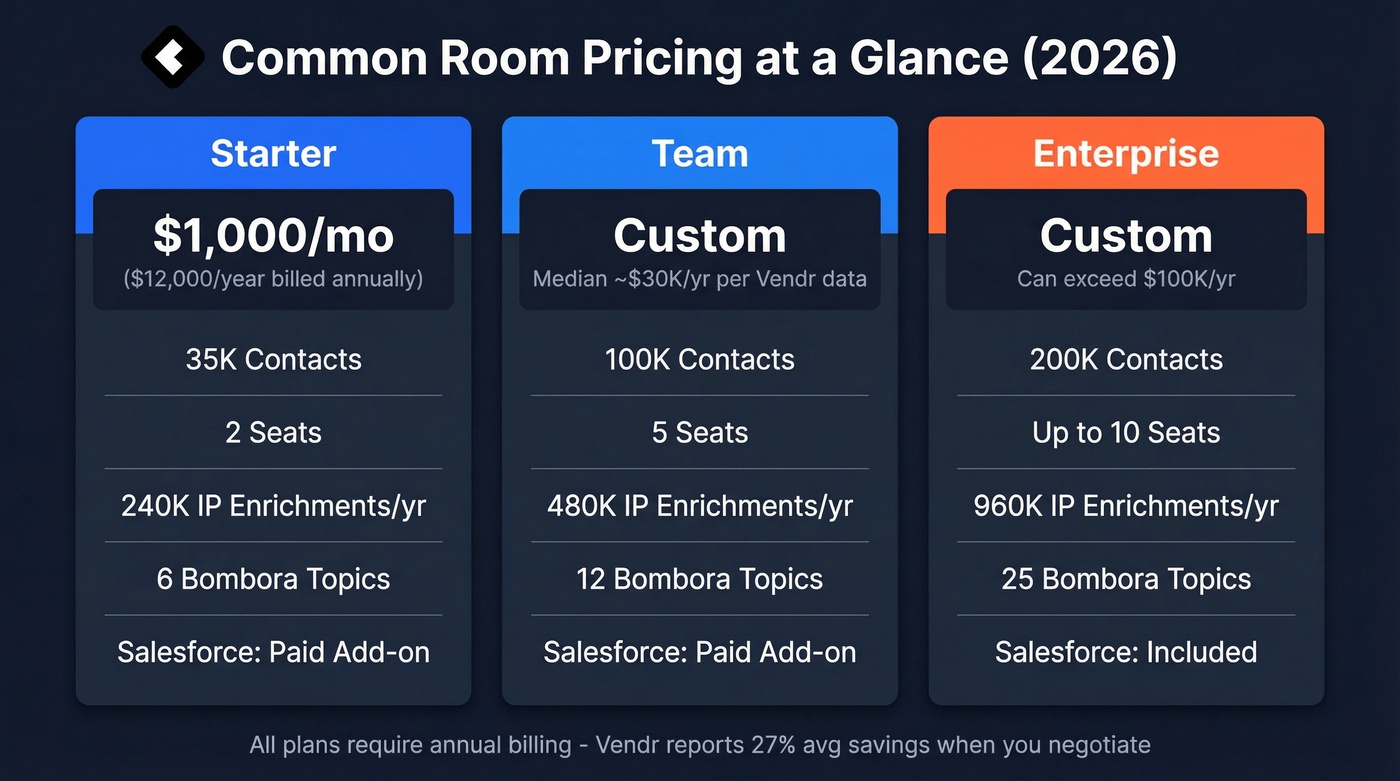
| Starter | Team | Enterprise | |
|---|---|---|---|
| Price | $1,000/mo | Custom | Custom |
| Contacts | 35K | 100K | 200K |
| Seats | 2 | 5 | Up to 10 |
| IP enrichments/yr | 240K | 480K | 960K |
| Bombora topics | 6 | 12 | 25 |
| Billing | Annual | Annual | Annual |
Team is sometimes quoted at $2,500/mo ($30K/year) by third-party sources, but the official pricing page lists both Team and Enterprise as Custom. Starter at $1,000/mo billed annually ($12,000/year) is the only confirmed list price. Add-ons include Premium Phone Number Enrichment from FullEnrich, and Salesforce integration is included on Enterprise but sold as an add-on for Starter and Team.
What You'll Actually Pay
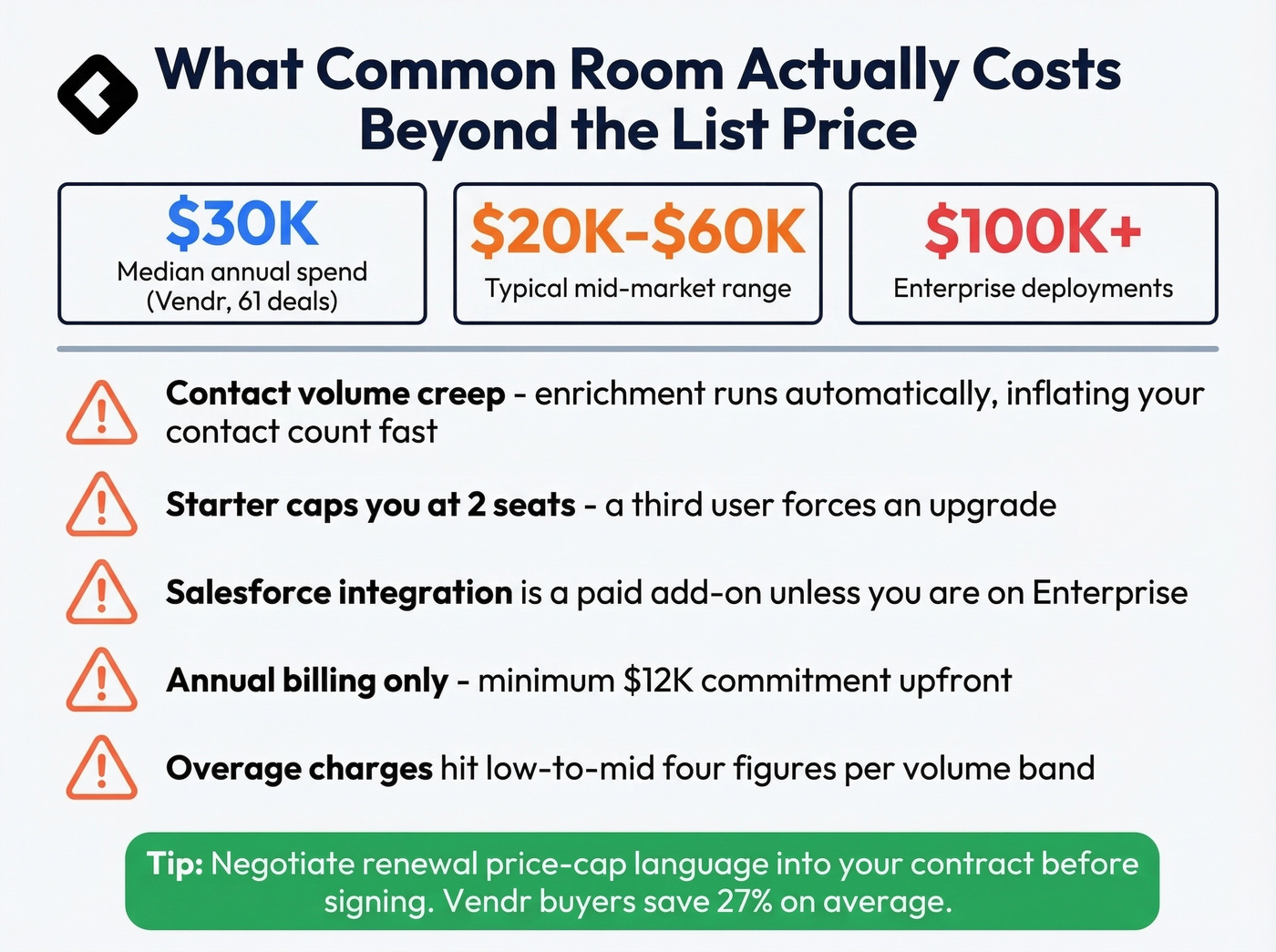
The list price tells half the story. Vendr's benchmark data from 61 actual purchases puts the median buyer at $30,000/year. Mid-market contracts with 10-25 seats typically land in the $20K-$60K range annually, and enterprise deployments push past $100K.
Vendr reports 27% average savings for buyers who negotiate, so push back hard. If you want a negotiation framework, start with an anchor and define your walk away point before procurement gets involved. As one Reddit user in r/CommunityManager put it, Common Room is "veryyy expensive" - and that was just reacting to the Starter price.
Hidden Cost Drivers
- Contact volume creep - enrichment runs as signals fire, inflating your contact count even if reps aren't actively prospecting. We've seen teams underestimate how fast this adds up.
- Starter's 2-seat cap - forces an upgrade the moment a third person needs access.
- Salesforce integration - included on Enterprise, paid add-on otherwise. Budget for it.
- Annual billing - you're committing at least $12K upfront for Starter.
- Overage billing - once you exceed contact or enrichment caps, expect additional charges in the low-to-mid four figures per volume band. Negotiate renewal price-cap language into your contract before signing.
Pros: Where Common Room Delivers
Common Room earns a 4.5/5 on G2 across 106 reviews, with 70% giving it five stars. Here's where the praise clusters:
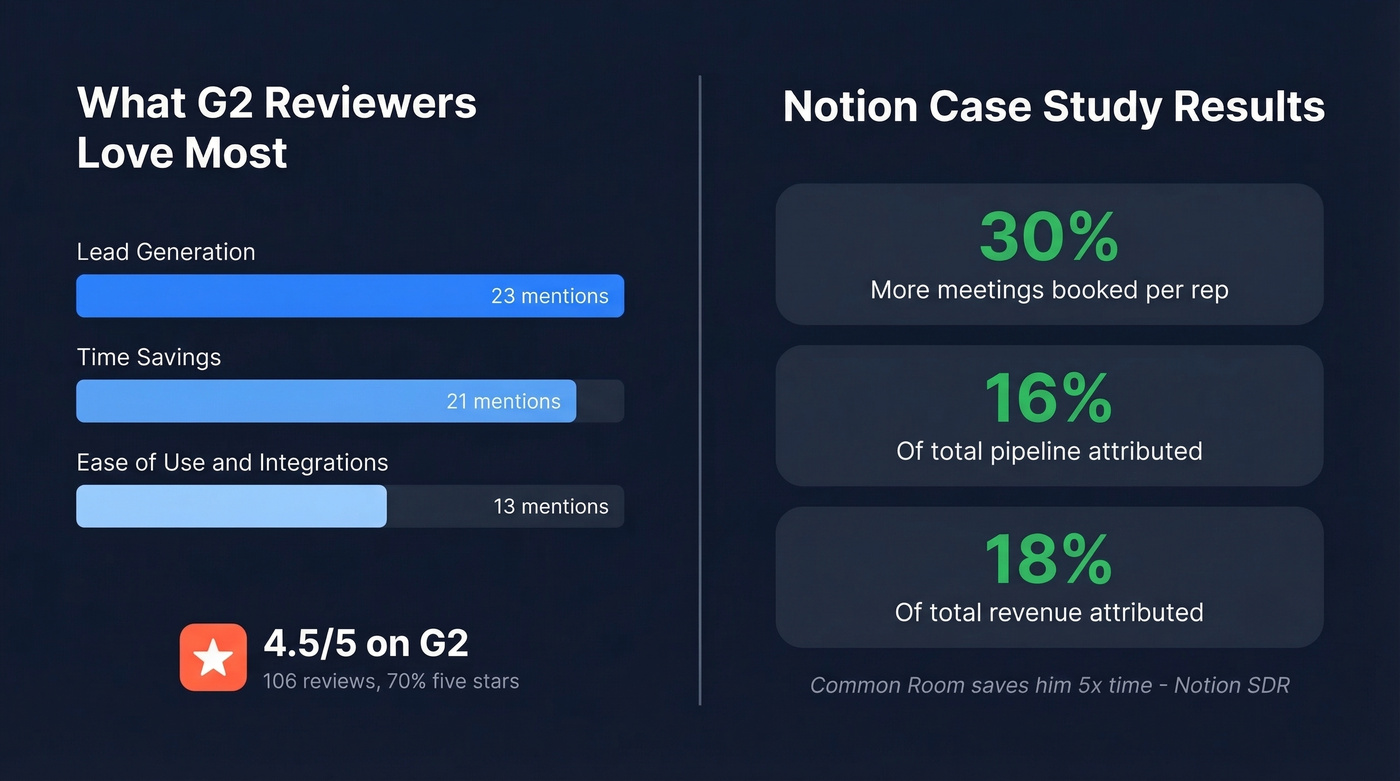
Lead generation (23 mentions) is the standout. The signal aggregation is genuinely best-in-class for community-led GTM. One reviewer called it "the first one that truly addresses all of my needs in a single place." That's a bold claim, but the review volume backs it up - this isn't one enthusiastic early adopter talking. If you're building a repeatable motion, these sales prospecting techniques help you turn signals into pipeline.
Time savings (21 mentions) come up almost as often. One of Notion's SDRs said Common Room "saves him 5x time," which tracks with what we've seen across mid-market teams using the platform. Notion's team also reported 30% more meetings booked per rep, 16% of total pipeline, and 18% of total revenue attributed to Common Room. Those are serious numbers for a signal tool.
Ease of use and integrations (13 mentions) round out the top themes. The platform includes Roomie AI, an AI agent that automates signal-to-action workflows, which cuts the manual routing work that bogs down most RevOps teams. If you're evaluating the broader stack, compare it against other SDR tools and map the handoffs to your sales activities.

Common Room surfaces buying signals but leaves you without reliable contact data. Prospeo fills that gap with 143M+ verified emails at 98% accuracy and 125M+ mobile numbers - refreshed every 7 days, not every 6 weeks. At ~$0.01 per email, you close the loop from 'interested' to 'contacted' without adding another $30K tool.
Turn Common Room signals into booked meetings for a fraction of the cost.
Cons: Where It Falls Short
The G2 cons cluster around predictable themes, and they're worth taking seriously:
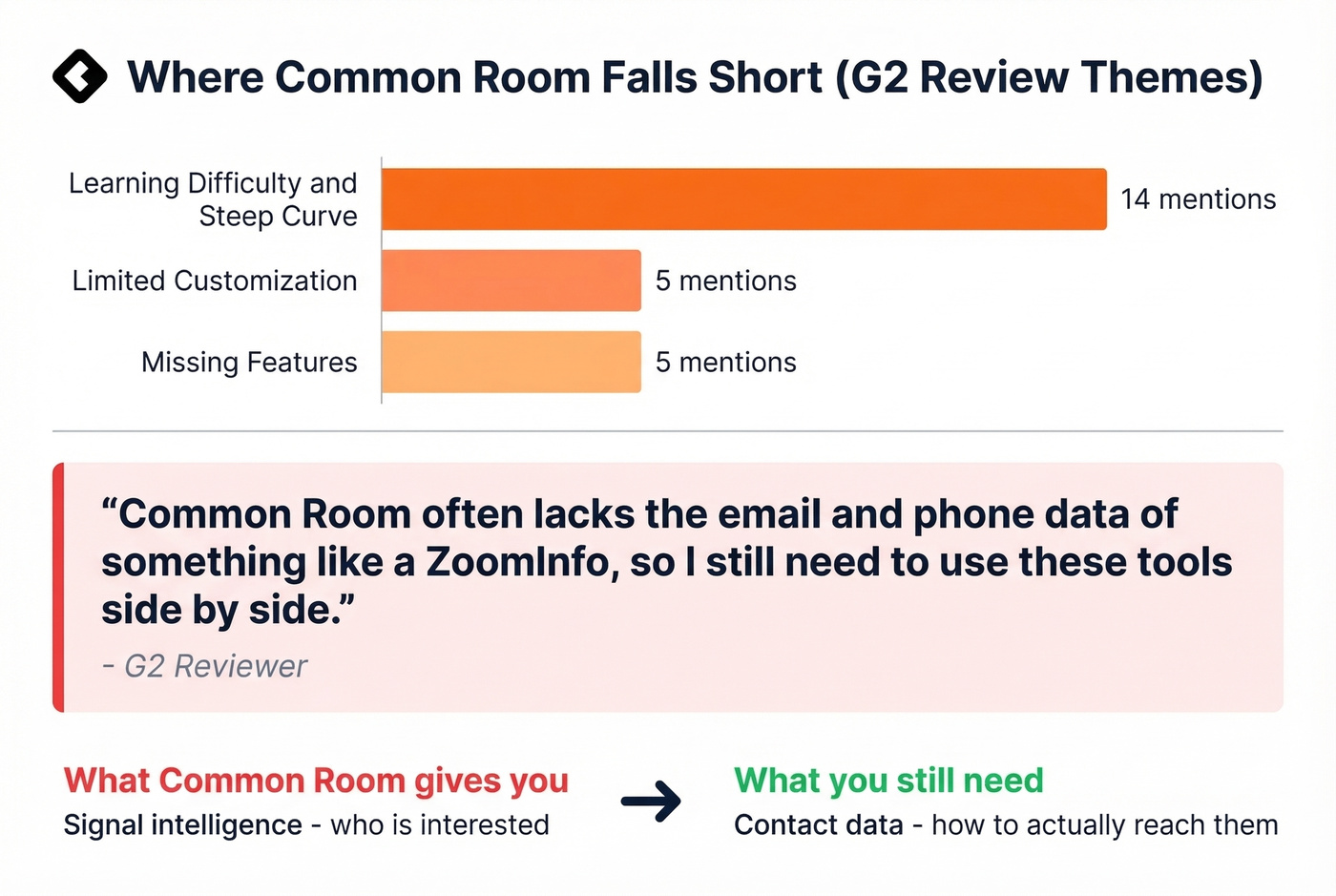
Learning difficulty and steep curve (14 combined mentions) top the list. Most mid-market teams take 2-6 weeks to fully wire integrations, scoring, and routing. That's not trivial onboarding, and if you don't have a dedicated ops person driving the setup, expect it to take longer. If you're formalizing the function, a dedicated RevOps owner usually pays for itself here.
Limited customization (5 mentions) frustrates power users who want more flexibility in scoring models and dashboards. Missing features (5 mentions) come up too - teams want better syncing, ownership visibility, and broader signal coverage.
But here's the con that actually matters for buyers: the contact data gap. As one G2 reviewer put it directly, Common Room "often lacks the email and phone data of something like a ZoomInfo, so I still need to use these tools side by side." Common Room shows you who's interested. It doesn't reliably give you how to reach them.
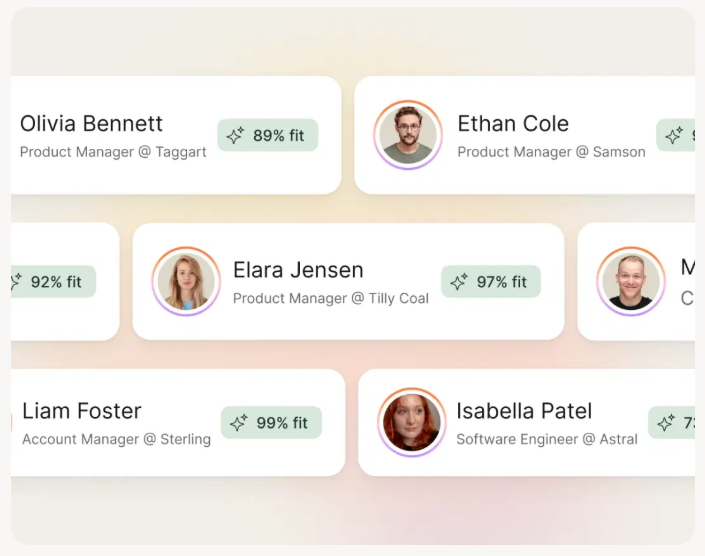
That's where pairing it with a dedicated contact data platform makes sense. Prospeo covers 143M+ verified emails at 98% accuracy and 125M+ verified mobile numbers, refreshed every 7 days - closing the data gap Common Room leaves open at roughly $0.01 per email. If you're comparing vendors, start with data enrichment services and a shortlist of B2B company data providers.
Is Common Room Worth It?
Let's be honest: Common Room is the best signal aggregation platform on the market right now. But most teams buying it don't actually need signal aggregation - they need contact data with some intent layered on top. Know which one you are before you sign a $30K check.
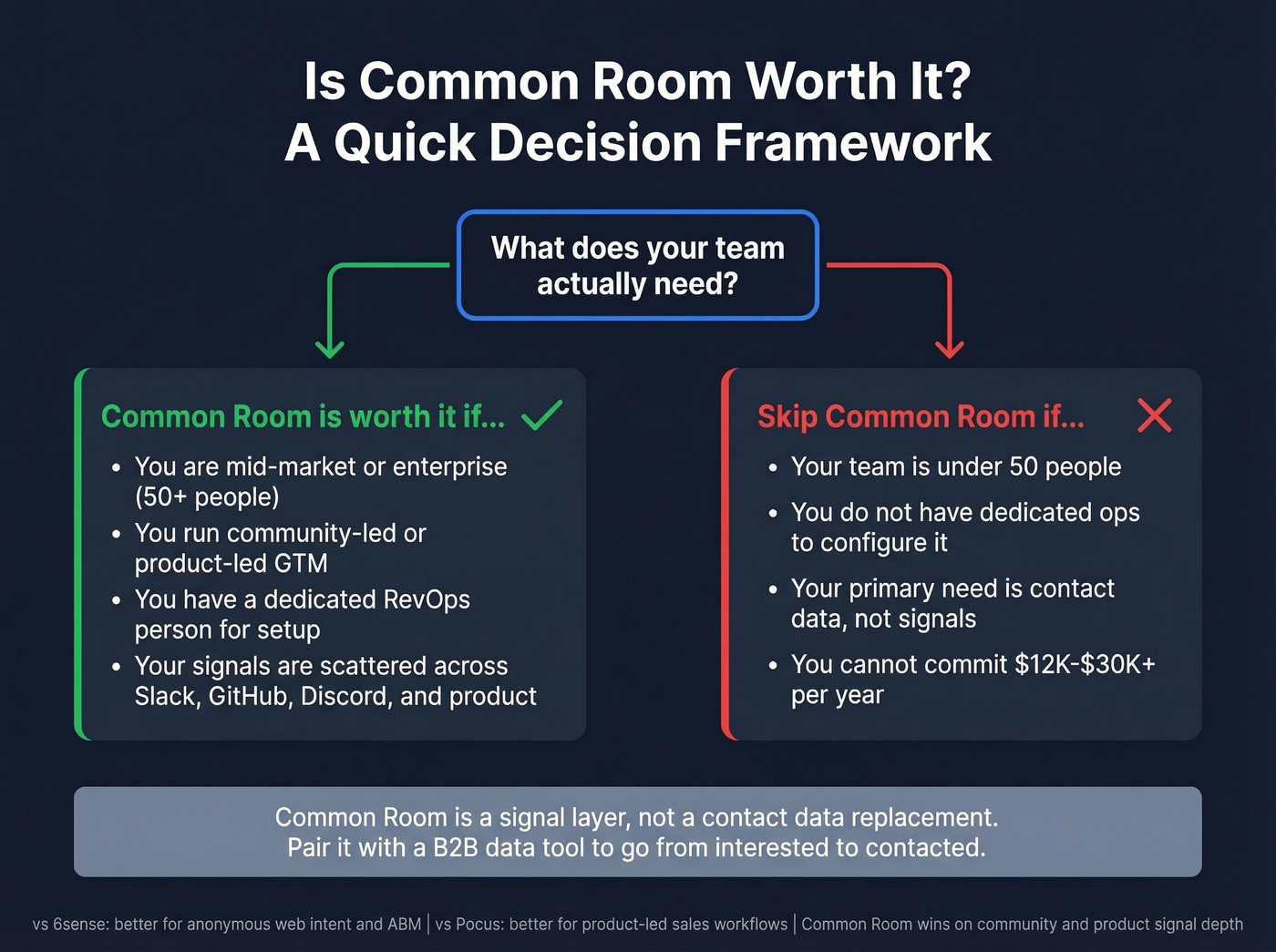
Worth it for: Mid-market and enterprise teams running community-led or product-led GTM with a dedicated RevOps function. If you've got signals scattered across Slack, GitHub, Discord, and your product, and you need to turn that noise into prioritized pipeline, this is the tool. Comparing against 6sense or Pocus? Common Room's edge is community and product signal depth. To operationalize it, build a clear lead scoring model and track the right lead generation metrics.
Skip it if: You're a team under 50 people, you don't have dedicated ops to configure and maintain it, or your primary need is contact data rather than signals. A thread in r/SalesOperations asking whether intent tools like Common Room deliver enough ROI to justify the cost went unanswered - which tells you something about how new this category still is. Common Room isn't a ZoomInfo replacement. It's a signal layer. Pair it with a dedicated contact data tool to close the loop from "interested" to "contacted."
G2 reviewers say it themselves: Common Room 'often lacks the email and phone data' you need to actually reach prospects. Prospeo delivers 98% email accuracy and a 30% mobile pickup rate across 125M+ verified numbers - no annual contract, no sales call required.
Stop paying $30K/year for signals you can't act on without contact data.
FAQ
Does Common Room offer a free plan?
No. Starter begins at $1,000/month on annual billing - $12,000/year minimum. Some older sources reference a limited free option, but it no longer appears on the pricing page. Request a demo before committing.
What integrations does Common Room support?
Common Room integrates with Salesforce, HubSpot, Slack, Discord, GitHub, Snowflake, and Outreach, among others. Salesforce integration is included on Enterprise but is a paid add-on for Starter and Team - factor that into your total cost.
Can Common Room replace my contact data provider?
No. It identifies buying signals and aggregates community activity but doesn't provide verified emails or direct dials at scale. Most teams run it alongside a dedicated B2B data platform for the contact information needed to actually reach the prospects Common Room surfaces.
How does Common Room compare to 6sense or Pocus?
Common Room's strength is community and product signal depth - Slack, Discord, GitHub, and open-source activity. 6sense focuses on anonymous web intent and ABM orchestration. Pocus leans toward product-led sales workflows. Choose based on where your highest-value buying signals originate.