

Company Data APIs: The Buyer's Guide With Real Pricing
B2B contact data decays at roughly 2.1% per month - and in tech, turnover pushes that closer to 40% annually. That's not a minor inconvenience. It's the reason your sequences bounce and your pipeline forecasts lie.
The data enrichment market is projected to hit $16.7B by 2034, up from $2.9B in 2025, because every revenue team is trying to solve this problem with a reliable company data API. Here's how to pick the right one without overpaying.
Our Picks (Quick Version)
You probably don't need a $30,000/year API. Here's where to start based on what you actually need:
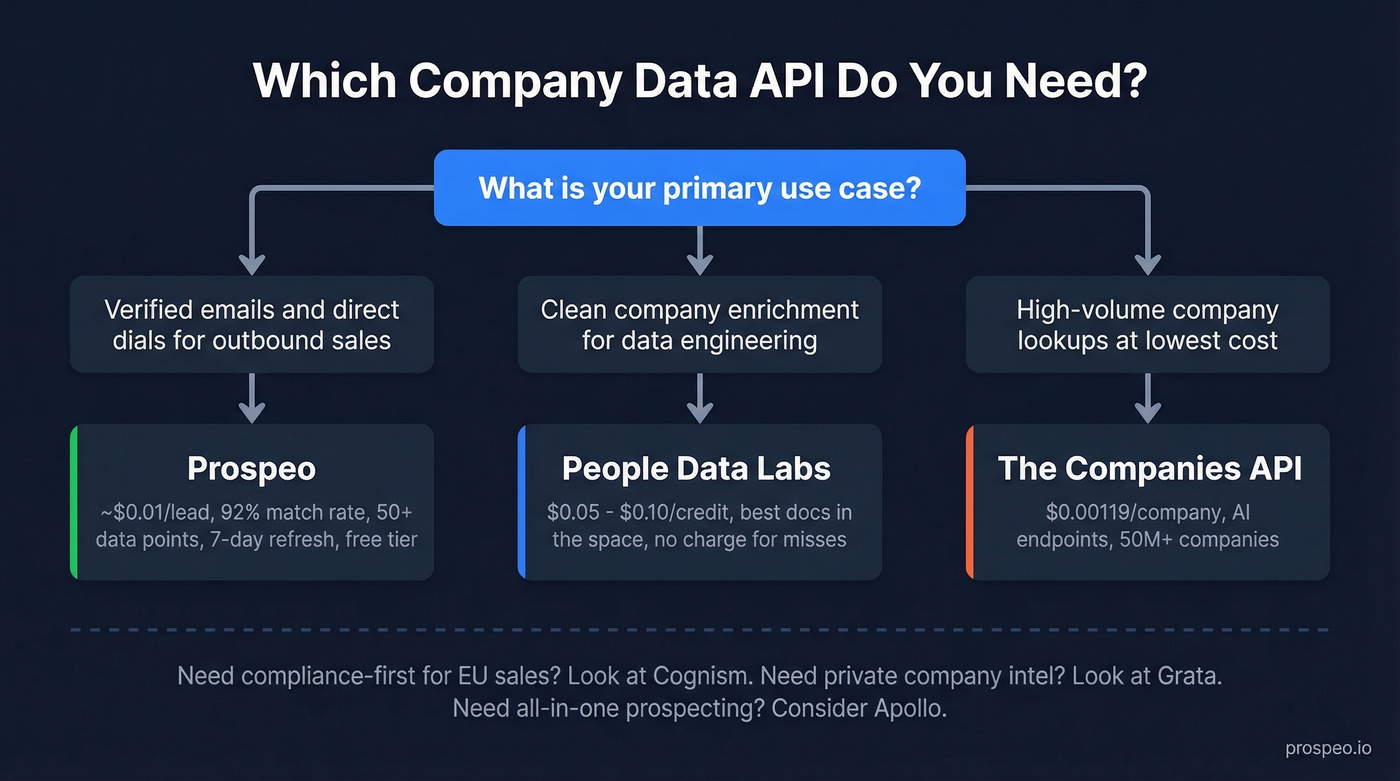
- Verified contact data + enrichment: Prospeo - ~$0.01/lead, 92% API match rate, 50+ data points per enrichment, self-serve with a free tier.
- Developer-friendly company enrichment: People Data Labs - $0.10 down to $0.05/credit depending on volume, transparent tiered pricing, clean documentation.
- Cheapest per-company lookup: The Companies API - $0.00119/company, plus AI endpoints for prompt-based workflows if you're building something custom.
For 90% of teams, the answer is somewhere in that list. If none of those fit, keep reading.
What to Evaluate Before You Choose
Six criteria separate the best business data APIs from ones that'll cost you months of cleanup.
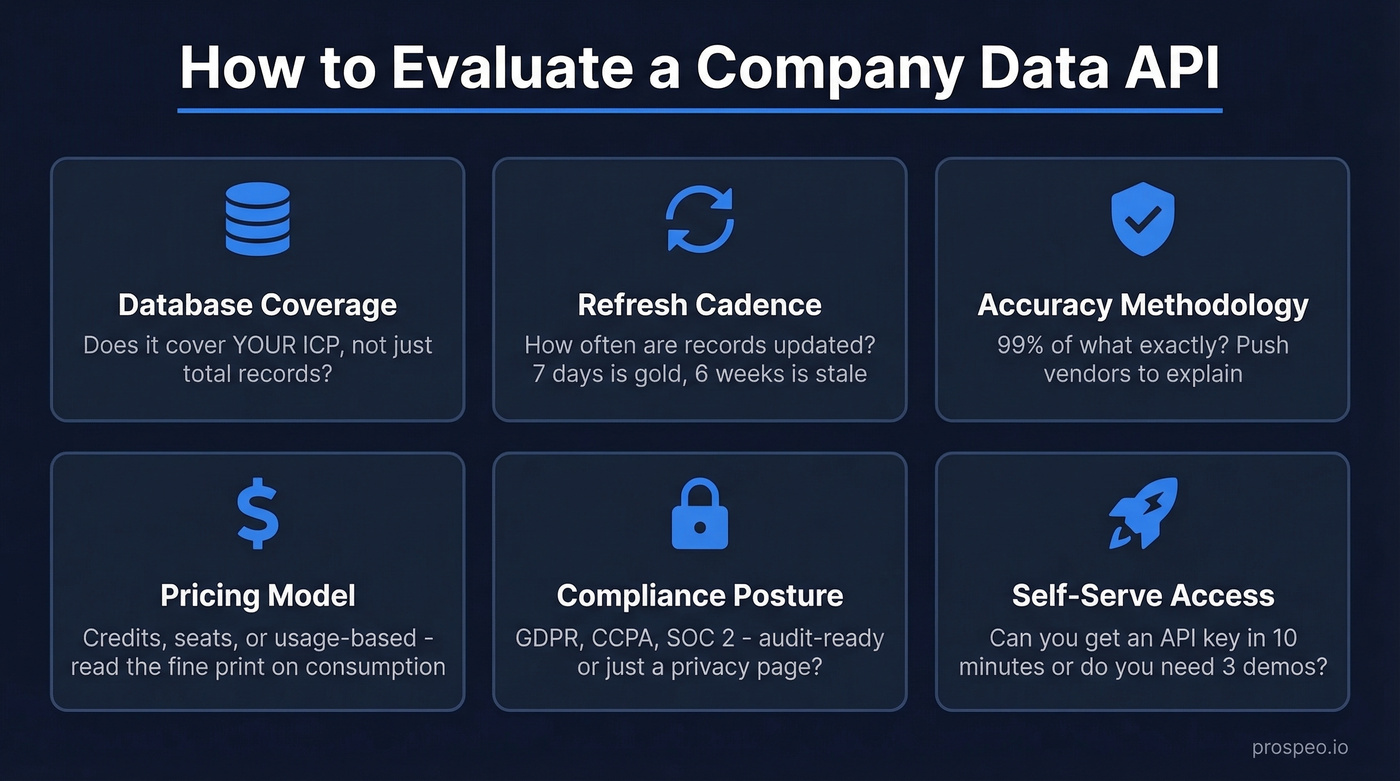
Database size and coverage. Raw numbers matter less than coverage in your target market. 300M profiles means nothing if your ICP is mid-market European SaaS and the database skews US enterprise. (If you need a broader benchmark, start with our B2B databases ranking.)
Refresh cadence. This is the most underrated criterion. If a vendor won't publish how often records are refreshed, treat that as a red flag. A 7-day refresh cycle keeps pace with job changes and company moves. Most vendors run on 4-6 week cycles, which means your data is already stale by the time you use it.
Accuracy methodology. Every vendor claims "99% accuracy." The question is: 99% of what? Of records they return? Of records in their database? Of the records they cherry-picked for measurement? Push vendors on this. If they can't explain their verification methodology, the number is marketing. (Related: benefits of data enrichment when it’s done right.)
Pricing model. Credits, seats, flat monthly, usage-based - every API prices differently. Credits sound cheap until you realize bulk enrichment requests can consume 100 credits per call, or auto-enrichment defaults burn through your allocation overnight. We've seen teams get hit with surprise invoices because they didn't read the fine print on credit consumption. (If you prefer flexible spend, compare pay-as-you-go B2B data options.)
Compliance posture. GDPR, CCPA, SOC 2 - these aren't checkboxes. If you're selling into the EU or handling data for enterprise clients, you need audit-ready metadata and consent trails, not just a privacy policy page. (More detail in our B2B compliance guide.)
Self-serve vs. sales gate. Can you sign up, get an API key, and start testing in 10 minutes? Or do you need three demos and a procurement cycle? For most teams, self-serve access with transparent pricing is a massive advantage.
Pricing Comparison for 2026
Let's be honest: when a vendor hides pricing behind "talk to sales," they're optimizing their sales process, not your buying experience. Here's what these APIs actually cost.
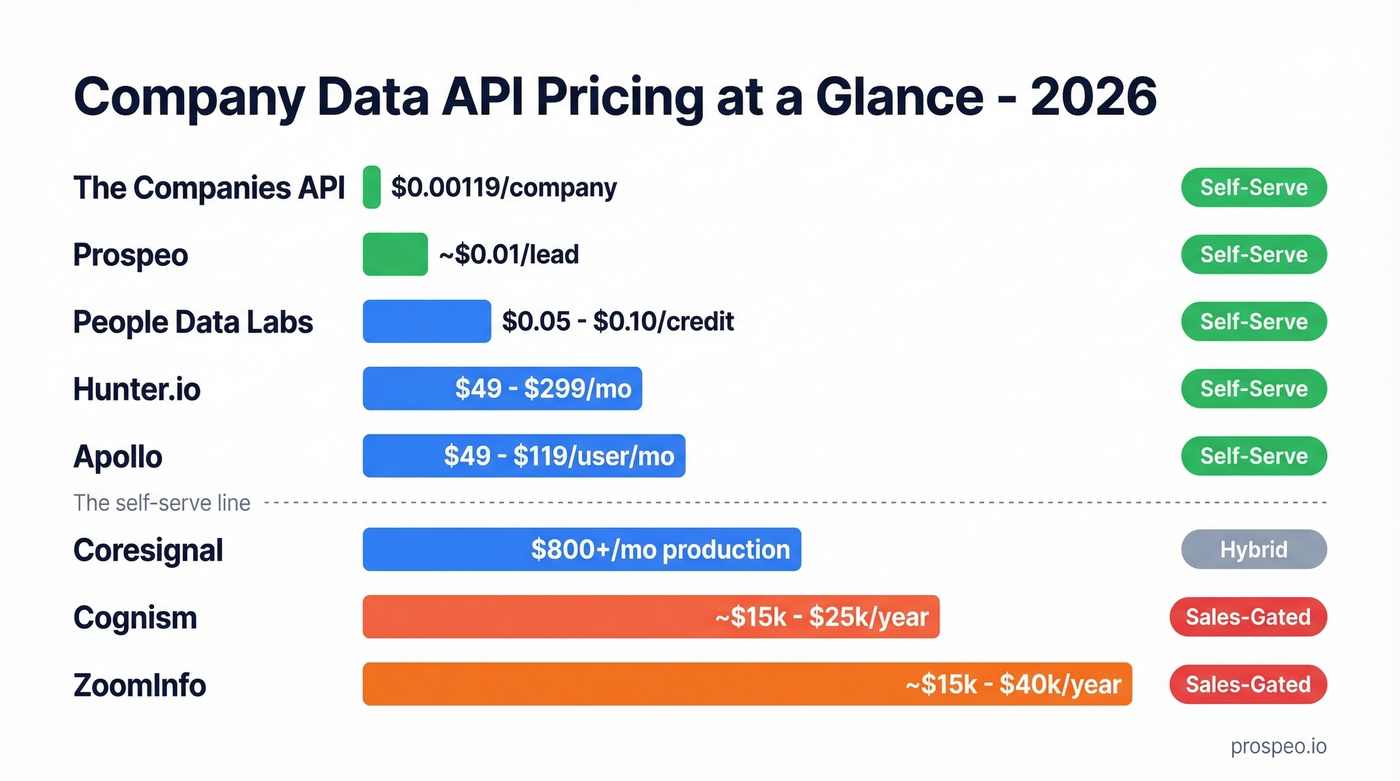
| Provider | Database Size | Starting Price | Self-Serve | Refresh |
|---|---|---|---|---|
| People Data Labs | Not public | $0.10/credit (monthly Tier 1) | Yes (up to 100k credits) | Varies |
| The Companies API | 50M+ companies | $95/mo (50k credits) | Yes | Not public |
| Apollo | 275M+ contacts | $49/user/mo (annual) | Yes | Not public |
| Coresignal | 67M+ company profiles | ~$49/mo test; $800+/mo prod | Yes | Daily updates available |
| Cognism | Not public | ~$15k-$25k/yr | No | Not public |
| Hunter.io | Email-focused | $49/mo (1k credits) | Yes | Not public |
| Grata | Private companies | ~$30k-$60k/yr | No | Not public |
| ZoomInfo | 260M+ profiles | ~$15k-$40k/yr | No | Not public |
| Bold Data | 303M+ companies | From EUR 425 | Quote | Real-time |
| OpenCorporates | Open registry data | Free (share-alike attribution) | Yes | Varies |

You just read that data decays at 2.1% per month. Prospeo's enrichment API refreshes every 7 days - not every 6 weeks like most providers on this list. At $0.01/lead with a 92% match rate and 50+ data points per enrichment, it's the company data API that doesn't make you choose between accuracy and budget.
Get your API key in 2 minutes. No sales call required.
The Best Company Data APIs Reviewed
Prospeo
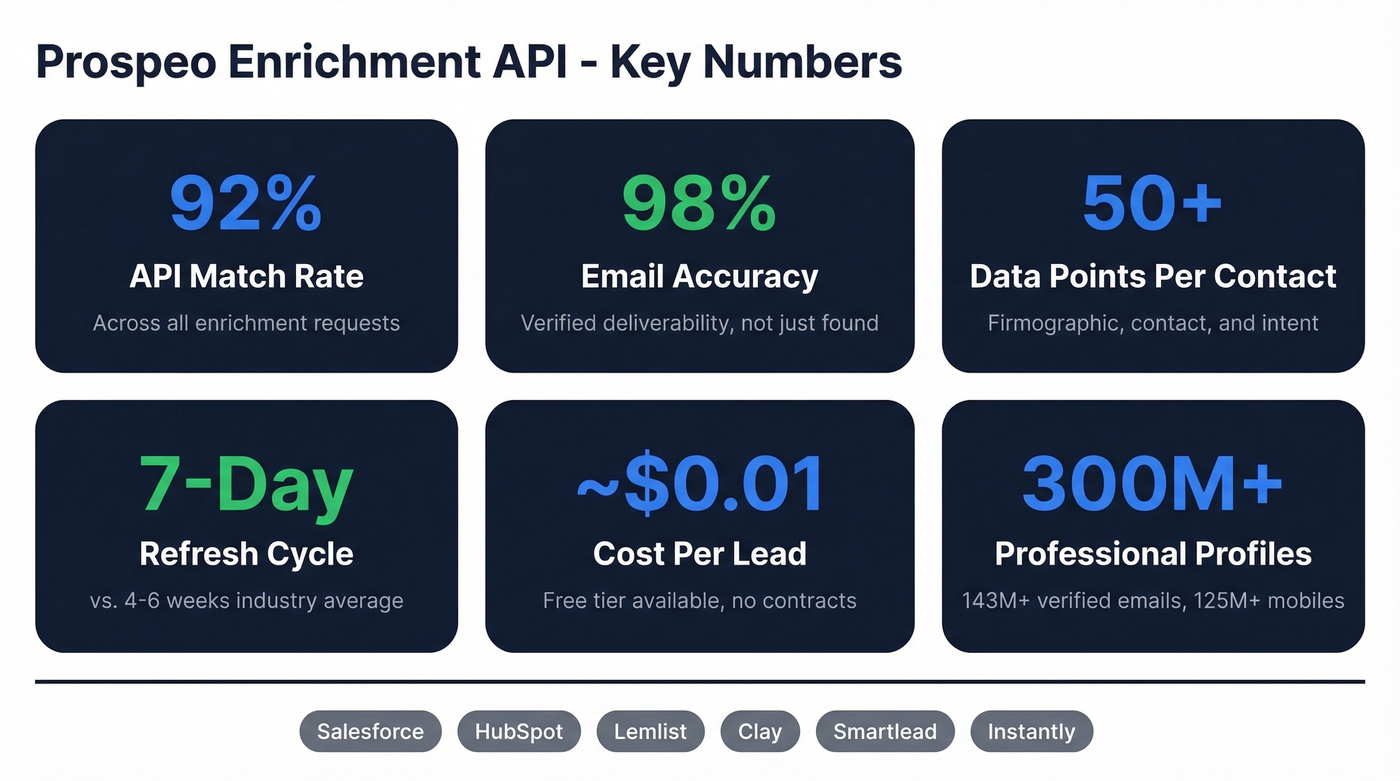
Most company enrichment APIs return firmographics but treat contact data as an afterthought. Prospeo fills that gap - its enrichment API returns 50+ data points per contact with 98% email accuracy and a 92% match rate.
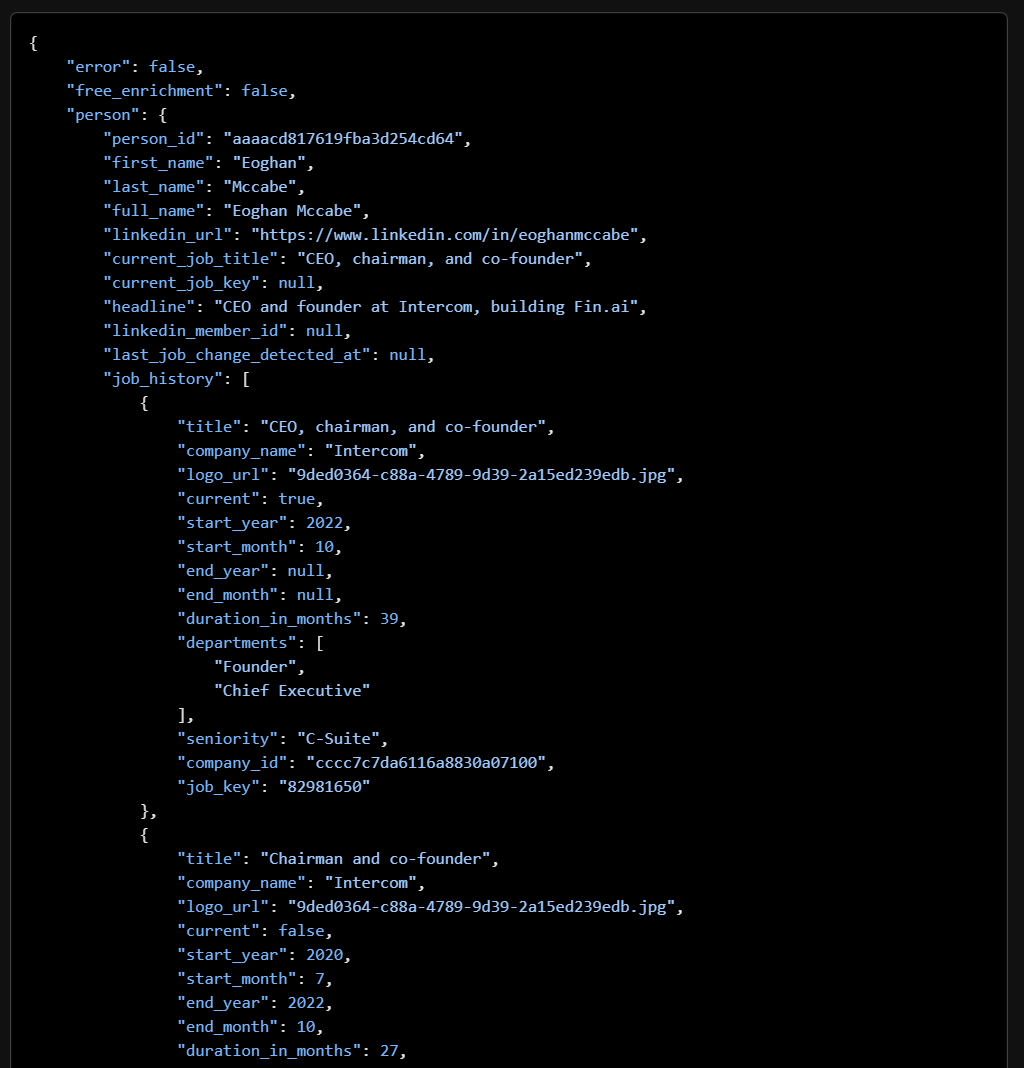
The database covers 300M+ professional profiles, 143M+ verified emails, and 125M+ verified mobile numbers, all on a 7-day refresh cycle. That refresh cadence alone puts it ahead of most competitors running on 4-6 week schedules. Intent data covers 15,000 topics via Bombora, so you can layer buying signals on top of firmographic and contact enrichment in a single API call. (If intent is core to your workflow, see contact-level intent data.)
Real results back this up: a 50-person sales team using Prospeo's enrichment API dropped bounce rates from 35-40% to under 5% and generated 200+ new opportunities per month. Another team built from $0 to $1M ARR with client deliverability consistently above 94% and zero domain flags. (If bounce is a recurring issue, start with check bounce.)
Pricing runs about $0.01/lead with a free tier (75 emails/month) and no contracts. Native integrations push data straight into Salesforce, HubSpot, Lemlist, Smartlead, Instantly, and Clay - making it straightforward to plug into existing sales stacks. (If you’re building lists in Clay, see Clay list building.) The proprietary email-finding infrastructure doesn't rely on third-party providers, which is why the accuracy numbers hold up under real-world testing rather than just in marketing decks.
Use this if: You need verified emails and direct dials alongside company data, not just firmographics. Sales and outbound teams get the most value here. (Also compare verified contact databases if you’re shopping broadly.)
Skip this if: You're building a pure data engineering pipeline that only needs company-level attributes without contact information.
People Data Labs
PDL is the strongest option for developers who want a company profile API with fully transparent pricing. Entry tier runs $0.10/credit on monthly plans, dropping to $0.075 above 10k credits and $0.065 above 25k. Annual plans range from $0.08 down to $0.05/credit at scale. One credit per successful match - you don't pay for misses.
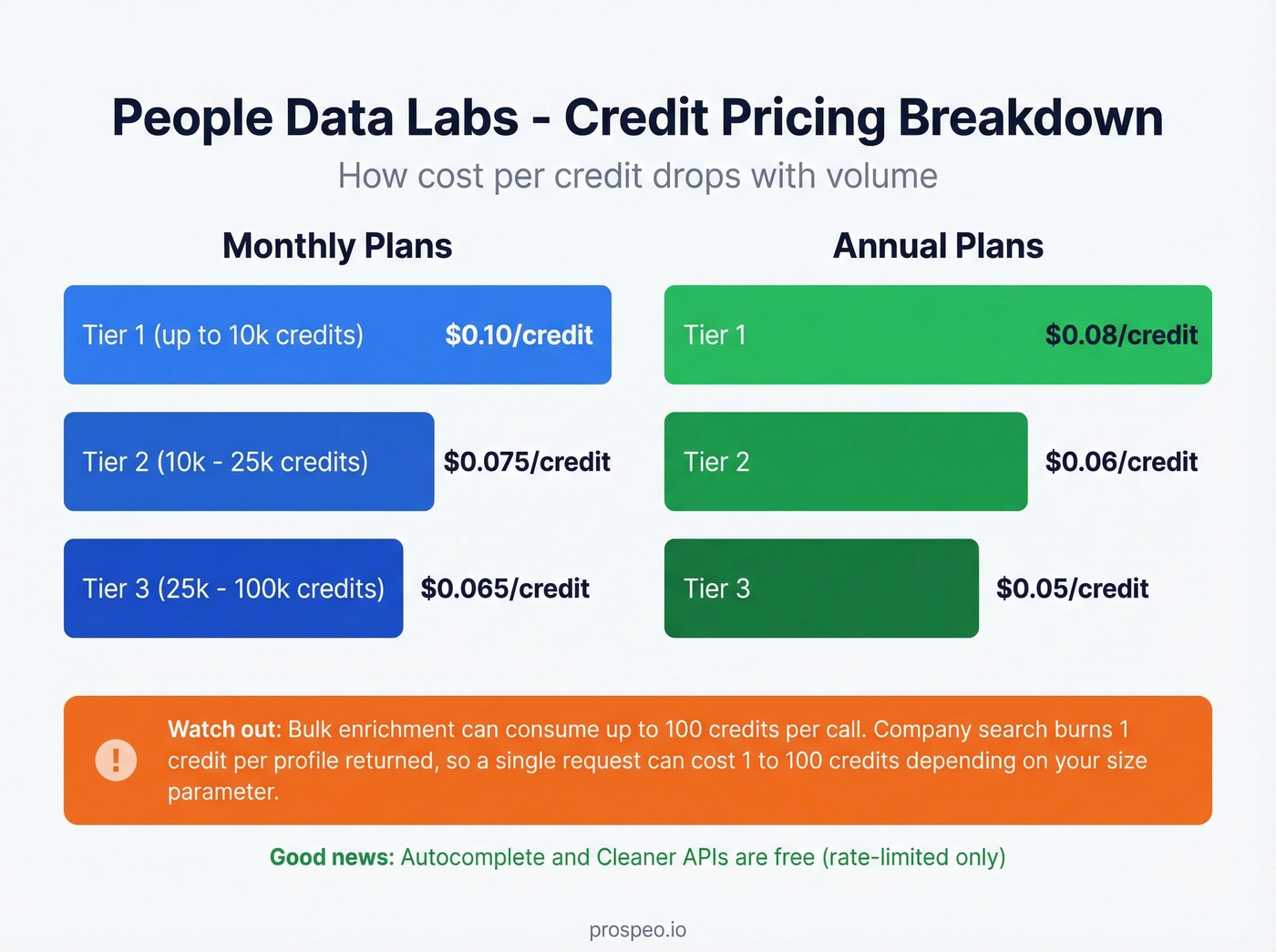
The nuances matter, though. Bulk enrichment requests can consume up to 100 credits per call. Their company search API queries consume 1 credit per profile returned, so a single request can burn 1-100 credits depending on your size parameter. On the upside, Autocomplete and Cleaner APIs don't consume credits at all - they're rate-limited instead.
For anything over 100k credits, you're talking to their enterprise sales team. Below that threshold, it's genuinely self-serve. The documentation is some of the best in the space - clean schemas, clear examples, predictable response formats.
Use this if: You're a data engineering team that wants clean schemas, predictable pricing, and solid documentation.
Skip this if: You need deliverability-verified outreach data. PDL's strength is company and person enrichment, not verification-first outbound.
The Companies API
At $0.00119 per company, this is the cheapest per-lookup option in the market. The database covers 50M+ companies with plans ranging from $95/month (50k credits) to $595/month (500k credits). There's a free tier with 500 credits to test.
What makes it interesting: AI endpoints, including prompt-based endpoints, for teams building workflows that need a flexible company lookup API at scale. The tradeoff is that it's firmographics-focused. Don't expect verified contact data or intent signals.
Use this if: You need high-volume company lookups at the lowest possible cost, especially for prompt-based or AI-assisted workflows.
Skip this if: You need contact-level data or buying intent signals alongside company firmographics.
Apollo.io
Apollo bundles prospecting, enrichment, and sequencing into one platform - 275M+ contacts, a generous free tier of 100 credits/month, and G2 ratings of 4.7/5 across 8,800+ reviews. Paid plans break down as Basic ($49/user/month, 2,500 credits), Professional ($79, 4,000 credits), and Organization ($119, 6,000 credits, minimum 3 users). All annual billing.
Here's the thing about Apollo: the all-in-one pitch is compelling, but the credit system is genuinely confusing. Different actions consume different credit amounts, and it's easy to burn through allocations without realizing it. We've seen "verified" emails bounce at 15-20% rates on certain segments, and Trustpilot sits at 2.3/5 with recurring complaints about billing surprises and support responsiveness.
Apollo works for teams that want prospecting and sequencing in one tool and can tolerate some data quality variance. It's not the right choice if email deliverability is your top priority.
Coresignal
Coresignal occupies a different lane entirely. It's a data-as-a-service platform for teams that want raw or cleaned datasets, not just an enrichment endpoint. The company information API covers large-scale company profiles with 300+ data points, delivered via Elasticsearch Query DSL in JSON, JSONL, CSV, or Parquet formats. Over 700 clients use the platform, though a Proxyway review notes the user experience can feel unpolished compared to more sales-focused tools.
Pricing starts at ~$49/month for testing, but production usage runs $800+/month. If you're building analytics, investment models, or competitive intelligence tools and need bulk datasets with flexible querying, Coresignal is built for that. If you're an SDR looking for a simple enrichment API, look elsewhere.
Cognism
Cognism is the compliance play. SOC 2 Type II, ISO 27001, GDPR/CCPA/PECR consent trails, and audit-ready metadata make it the default choice for teams selling into regulated industries or European markets where consent documentation matters as much as the data itself. Data delivery happens via API plus flat file options through Snowflake, S3, and Google Cloud.
The catch: no self-serve access, no transparent pricing, and an annual commitment. Expect bespoke pricing in the ~$15k-$25k/year range for a 10-15 rep team. If you're a startup that needs to test before you buy, Cognism isn't set up for that workflow.
Hunter.io
Hunter does one thing well: email finding and verification. Starter plan runs $49/month for 1,000 credits, scaling to $299/month for 10,000 credits, with roughly 30% annual discounts. The API is clean and well-documented.
But that's the entire product. No phone numbers, no company firmographics, no intent data. Credits burn fast on bulk lookups, so moderate-volume email-only use cases are the sweet spot. For anything broader, you'll need to pair Hunter with another tool.
Grata
Grata occupies a niche most sales tools ignore: private company intelligence. It includes conference intelligence and deep firmographic data on private companies, plus hard-to-find executive contact information. Custom pricing runs mid-five-figures annually. This is purpose-built for PE firms, M&A teams, and corporate development groups that need to find and evaluate private companies at scale. If that's not you, move on.
Bold Data, OpenCorporates, FactSet, Bright Data
Bold Data covers 303M+ companies and 287M contacts with real-time updates. Pricing starts from EUR 425 depending on datasets - you'll need a quote for anything serious.
OpenCorporates is the open-data option. It provides corporate registry data with share-alike attribution requirements. Great for supplementing commercial APIs with official filing data, but don't expect enriched contact information.
FactSet offers a private company API geared toward financial services and investment research. Pricing is enterprise-level and quote-based - expect $20k-$50k/year depending on data modules. Worth evaluating alongside Grata if you're in PE or M&A.
Bright Data isn't a traditional business data API - it's a proxy and web scraping platform with 72M+ residential IPs. If you want to build your own data collection pipeline rather than buying pre-structured data, this is the infrastructure layer. Residential proxy pricing starts around $8-$15/GB, and meaningful data collection volumes run $500+/month.
The Clearbit Cautionary Tale
If you're evaluating company data APIs in 2026, you need to know what happened to Clearbit. HubSpot acquired the company in December 2023 and folded it into Breeze Intelligence. Clearbit's standalone free tools ended April 30, 2025. The Logo API followed on December 1, 2025.
Teams that had built workflows around Clearbit's enrichment API faced a choice: migrate into HubSpot's ecosystem or find a new provider entirely. One team discovered $11,000 in unexpected charges after auto-enrichment was enabled by default during the transition.
The lesson isn't "don't use HubSpot." It's that platform lock-in with opaque credit systems creates real financial risk. When your enrichment provider gets acquired, your data pipeline becomes someone else's upsell opportunity. Self-serve access, transparent pricing, and no annual lock-in aren't just nice-to-haves - they're insurance.
Common Pitfalls to Avoid
Credit system gotchas. Auto-enrichment defaults, bulk request multipliers, and unclear credit consumption rules are how vendors turn a $500/month plan into a $2,000 invoice. Read the fine print on what consumes credits - and what doesn't. The consensus on r/sales is that surprise overages are the single most common complaint about data tools, and it's almost always a credit-system issue.
Ignoring data decay. At 2.1% monthly decay, about a quarter of your database goes stale every year. In tech, it's worse. If a provider dodges refresh cadence questions, that tells you everything you need to know.
Accuracy claims without methodology. "99% accuracy" is meaningless without context. Is that 99% of emails that exist in their database? 99% of records that match your query? 99% of the records they chose to measure? Always ask: verified how, against what, and when?
Shallow taxonomy. A practitioner on Reddit flagged that Alpha Vantage classifies Amazon as "TRADE & SERVICES." If your use case depends on granular industry classification, test the taxonomy depth before you commit. Most company information APIs are weaker here than their marketing suggests.
Which API Should You Pick?
For data engineering pipelines, People Data Labs or Coresignal give you the bulk access, clean schemas, and query flexibility that engineering teams need. PDL for structured enrichment, Coresignal for raw datasets.
For PE, M&A, and corporate development, Grata or FactSet. Private company data is a fundamentally different problem, and general-purpose APIs won't cut it.
For budget-conscious startups, The Companies API at $0.00119/company for firmographics, or OpenCorporates for registry data. Layer a verification-focused tool on top for contact information. (If you’re building outbound lists, use a cold email lead list building workflow.)
For compliance-sensitive organizations, Cognism's audit-ready metadata and consent trails are worth the premium if you're selling into regulated European markets.
Here's our hot take: 90% of company data API use cases are solved at $50-$300/month. The $30k+ platforms exist for enterprise teams with complex multi-tool GTM stacks and procurement departments that need to justify their own existence. If your average deal size is under $15k, you almost certainly don't need ZoomInfo-level data - and the money you save buys a lot of pipeline elsewhere. (If you’re tightening ops, map it to a lean RevOps tech stack.)
Snyk's 50-person sales team plugged Prospeo's API into their stack and cut bounce rates from 35-40% to under 5% - generating 200+ new opportunities per month. That's what happens when your company data API returns 98%-accurate emails and verified direct dials, not stale firmographics from a 6-week-old refresh.
Stop paying enterprise prices for data that's already decayed.
FAQ
Is there a free company data API?
OpenCorporates provides corporate registry data under share-alike attribution. The Companies API gives 500 free credits, Apollo offers 100 monthly, and Prospeo includes 75 free verified emails per month. None are unlimited, but all are enough to validate a workflow before committing budget.
Company data API vs. web scraping - which is better?
APIs deliver structured, refreshed, compliance-ready data with zero maintenance overhead. Web scraping offers flexibility but requires engineering resources, proxy infrastructure, and ongoing legal review. For most teams, a structured API is the right starting point - add scraping only when you need data no provider covers.
How often should records be refreshed?
Monthly is the minimum acceptable cadence given 2.1% monthly data decay. A 7-day refresh cycle is ideal, especially for outbound teams where a stale email means a bounced sequence and potential domain reputation damage. If a vendor won't disclose their refresh schedule, that's a red flag.
Do I need separate APIs for company and contact data?
Most company enrichment APIs return firmographics - revenue, headcount, industry, tech stack - but included contact information is often unverified. Prospeo combines both, returning 50+ data points per contact with 98% email accuracy. Otherwise, you'll want to layer a verification tool on top of your firmographics provider.
What's the cheapest option for startups?
The Companies API at $0.00119/company is the lowest-cost firmographics source. For verified contacts, free tiers from Prospeo (75 emails/month) and Apollo (100 credits/month) let you start prospecting at zero cost. Combine a firmographics API with a verification tool and you're under $100/month total.