

Company Data Sources: A Practical Guide for 2026
B2B contact data decays roughly 70% every year. The average sales team now uses 2.7 data providers simultaneously just to keep lists usable. On r/LeadGeneration, a recent thread summed it up nicely: the OP had tried Apollo plus Crunchbase and "haven't been too impressed" with freshness. The era of relying on a single company data source is over.
What You Actually Need
For sales and outbound: a verified contact source with weekly refresh, plus intent signals from Bombora or 6sense. For investor research: Crunchbase or PitchBook for funding histories. For marketing and ABM: layer firmographic filters with technographic and intent data.
Don't try to find one tool that does everything. Two to three purpose-built sources will outperform any "all-in-one" platform every time.
Four Types of Company Data
| Type | What It Covers | Example Sources |
|---|---|---|
| Firmographic | Industry, revenue, headcount, HQ location | ZoomInfo, D&B, Census Bureau |
| Technographic | Tech stack - CRM, marketing tools, infrastructure | Wappalyzer, BuiltWith, HG Insights |
| Intent | Behavioral signals showing purchase interest | Bombora, 6sense, Demandbase |
| Financial | Revenue, funding, ownership, filings | PitchBook, Bloomberg, SEC EDGAR |
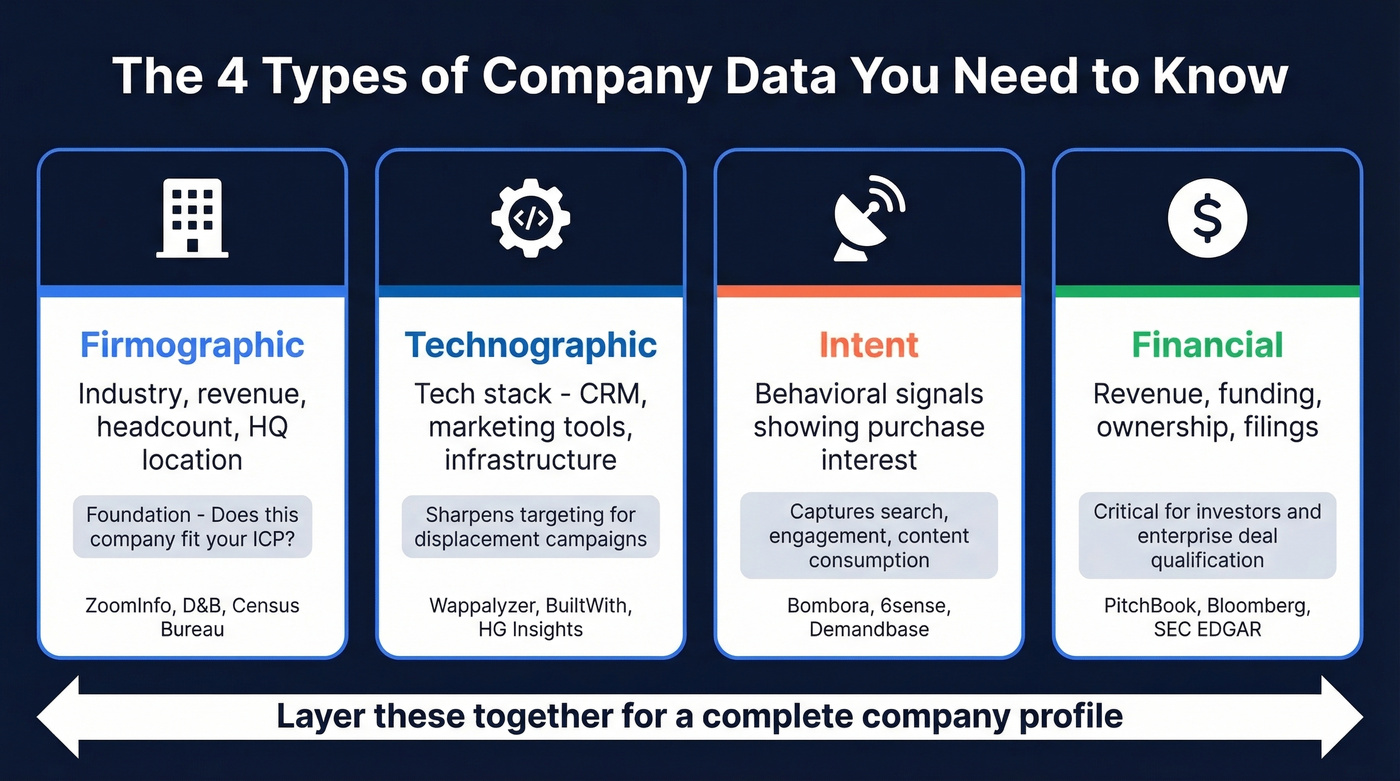
Firmographic data is the foundation. It tells you whether a company fits your ICP at all. Technographic data sharpens targeting by revealing what tools a prospect already runs, which is critical for displacement campaigns where you need to know exactly what you're replacing. Intent data captures behavioral signals across search, engagement, and content consumption patterns - Gartner groups these alongside firmographic and technographic dimensions. Financial data matters most for investor workflows and enterprise deal qualification.
A quick note: "company data sources" also covers academic research datasets and master data management contexts. This guide focuses on B2B sales and investment workflows, the use cases where source quality directly impacts revenue.
Seven Categories Worth Knowing
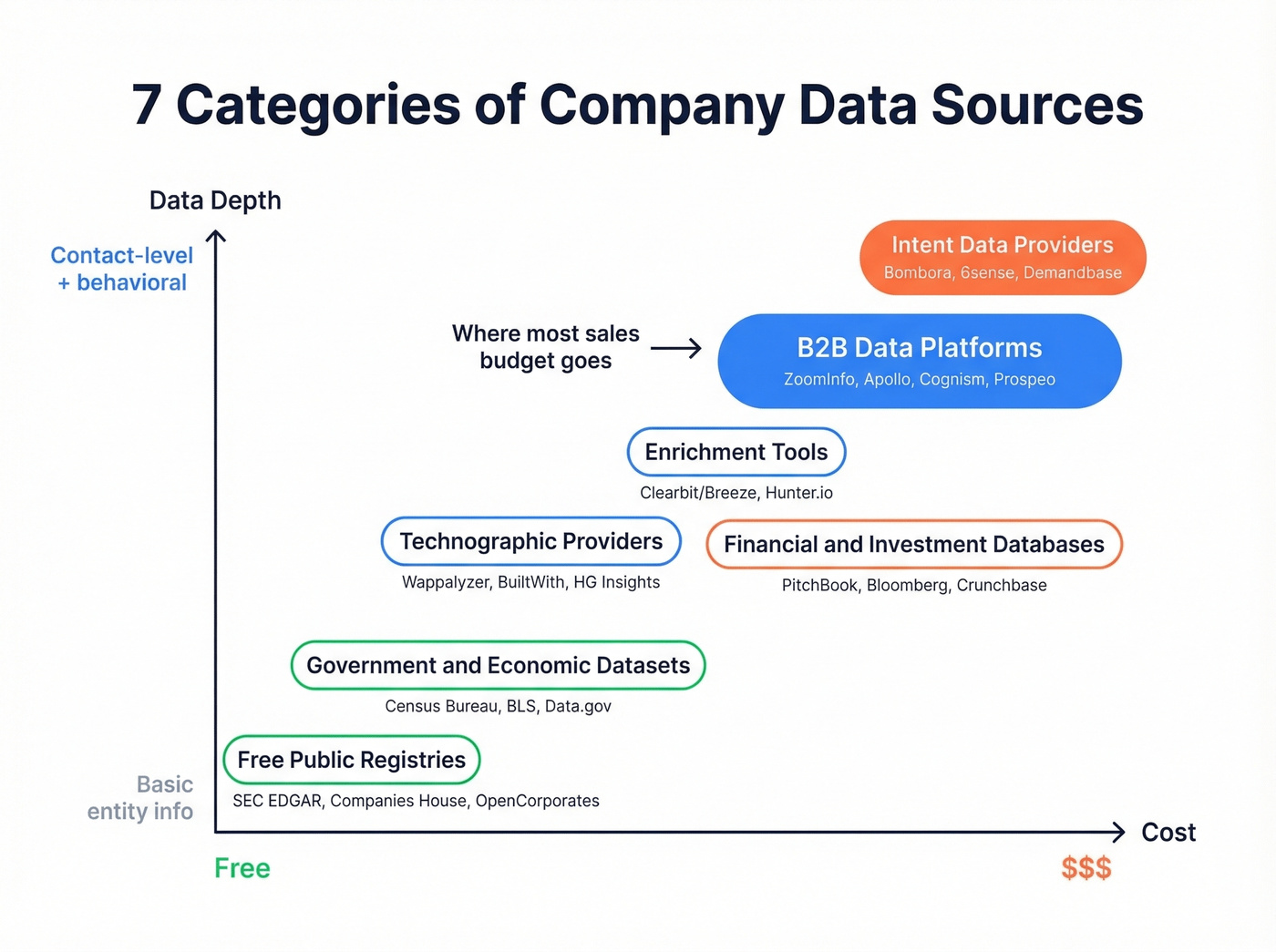
The distinction that matters most is registries of legal entities versus platforms that compile data from multiple origins. Registries are free and authoritative for what they cover. Multi-source platforms cost money but deliver the contact-level, behavioral, and technographic depth that registries can't.
Free Public Registries
SEC EDGAR, Companies House (UK), and OpenCorporates are widely used for incorporation details and filings. The companydata.com project publishes a CC0-licensed dataset with millions of company records, free to use. Great for entity research, useless for outreach.
Government & Economic Datasets
The Census Bureau's SUSB data, Bureau of Labor Statistics, and Data.gov provide macro-level industry and employment statistics. These serve as useful employee data sources for market sizing and headcount benchmarking, but they're not built for prospect lists.
Financial & Investment Databases
PitchBook covers 3M+ private and 55K+ public companies and typically costs $20K+/year, often $20K-$50K+ depending on seats and modules. Bloomberg Terminal runs around $24K/year. S&P Capital IQ lands in the $15K-$40K+ range. Crunchbase is the accessible entry point - free tier for basic lookups, with Pro starting around $49/month. Tracxn tracks 10M+ companies and CB Insights covers roughly 300K, primarily startups.
B2B Data Platforms
This is where most sales and RevOps teams spend their budget, and where we've spent the most time testing. If you're comparing vendors, start with a ranked list of the Best B2B Databases by accuracy.

ZoomInfo's database runs 500M contacts across 100M companies with 200M+ verified business emails and 135M+ verified phone numbers. Pricing typically lands at $15K-$40K+/year. Apollo covers 270M+ contacts and 70M companies at $49-$149/user/month - more accessible, but email accuracy is closer to 79% in our testing. Cognism runs roughly $1K-$3K/month for small teams, with strong coverage for EMEA-focused selling. D&B remains a major vendor, though users on Reddit describe their offerings as "very complicated" to navigate. LinkedIn Sales Navigator at $99.99/mo is widely used but locked to its own ecosystem.
Enrichment Tools
Clearbit is now sold as Breeze Intelligence inside the HubSpot ecosystem and handles firmographic and technographic API enrichment. Hunter.io focuses on domain-level email search. Default starts at $500/month for CRM enrichment workflows.
Here's the thing: relying on a single enrichment source leaves 40-60% of qualified prospects unreachable. Waterfall enrichment - querying multiple providers sequentially - is how serious teams solve this. If you're building that workflow, compare the best data enrichment tools and the benefits of data enrichment before you commit.
Technographic Providers
Wappalyzer, BuiltWith, and HG Insights specialize in identifying a company's tech stack. Essential for displacement campaigns. Most B2B platforms now bundle basic technographic filters, but dedicated providers go deeper on historical adoption data and market share breakdowns. For a deeper vendor shortlist, see our guide to technographic data tools and the full breakdown of Technographics.
Intent Data Providers
Bombora, 6sense, and Demandbase track buying signals across content consumption, search behavior, and engagement patterns. Enterprise pricing commonly runs $30K-$100K+/year for 6sense and Demandbase. That's a serious commitment, so make sure your sales process can actually act on intent signals before signing a contract that size - especially if you're aiming for contact-level intent data.

The article says it: teams use 2.7 data providers just to keep lists usable. Prospeo combines 300M+ profiles, 30+ search filters (intent, technographics, headcount growth, funding), and 98% verified email accuracy - all on a 7-day refresh cycle. At $0.01/email, you replace the multi-vendor stack, not add to it.
One company data source that actually replaces the other two.
Pricing at a Glance
| Tool | Starting Price | Database Size | Email Accuracy |
|---|---|---|---|
| Prospeo | Free (75 emails/mo) | 300M+ profiles | 98% |
| ZoomInfo | ~$15K/yr | 500M contacts | Not public |
| Apollo | $49/user/mo | 270M+ contacts | Not public |
| Cognism | ~$1K/mo | Not disclosed | Not public |
| Kaspr | $49/mo | Not disclosed | Not public |
| LinkedIn Sales Nav | $99.99/mo | LinkedIn network | N/A |
| Datanyze | $21/mo (annual) | Not disclosed | Not public |
| Crunchbase | Free / ~$49/mo Pro | Not disclosed | N/A |
| PitchBook | ~$20K+/yr | 3M+ private cos | N/A |
| Bloomberg | ~$24K/yr | 85K+ companies | N/A |
Let's be honest: a 10-seat ZoomInfo deal with intent data can run $40-$60K/year. Most teams closing deals under $15K don't need that level of spend. They need accurate emails and a fast refresh cycle, not a platform they'll use 20% of. If you're shopping for list sources specifically, start with these B2B list providers.
How to Evaluate Your Sources
In our testing across dozens of providers, five criteria separate the ones worth paying for from the ones that waste budget.
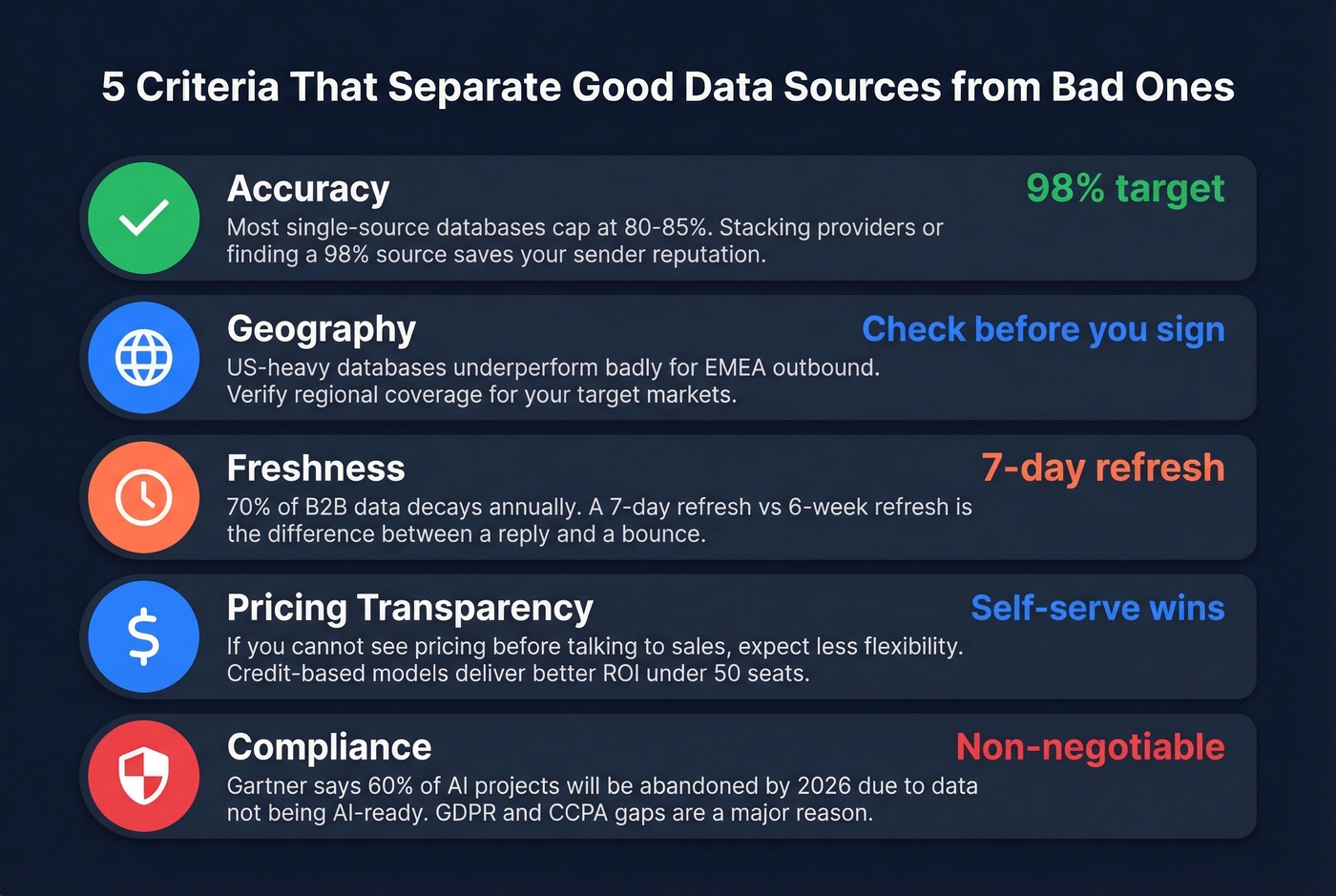
Accuracy is non-negotiable. Most single-source databases structurally cap email accuracy around 80-85% on their own, which is why teams stack providers. If you can find a source that hits 98% verified accuracy on its own, you skip the complexity of building a multi-vendor waterfall just to keep bounce rates manageable. If deliverability is a priority, pair your data evaluation with an email verifier benchmark.
Geography matters. US-heavy databases underperform badly for EMEA outbound. Check whether a source covers your target regions and company sizes before signing anything.
Freshness compounds fast. When 70% of your data decays annually, the difference between a 7-day refresh and a 6-week refresh is the difference between a live prospect and a bounced email. I've watched teams burn through sender reputation in a single campaign because their "fresh" list was already two months old.
Pricing transparency tells you a lot. Can you see pricing before talking to sales? If not, expect a longer buying cycle and less flexibility. Self-serve models with clear credit-based pricing tend to deliver better ROI for teams under 50 seats.
Compliance isn't optional. Through 2026, Gartner projects that organizations will abandon 60% of AI projects due to data that isn't AI-ready - and compliance gaps under GDPR and CCPA are a major contributor. Skip this if you want to learn the hard way. If you're building a process around this, use a GDPR compliant database checklist and a broader B2B compliance framework.
Build Your Stack by Use Case
| Use Case | Recommended Stack |
|---|---|
| Sales / Outbound | Verified contact source + Bombora intent + your sequencer |
| Investor / Analyst | PitchBook or Crunchbase + Bloomberg + SEC EDGAR |
| Marketing / ABM | 6sense or Demandbase + Clearbit enrichment + CRM |
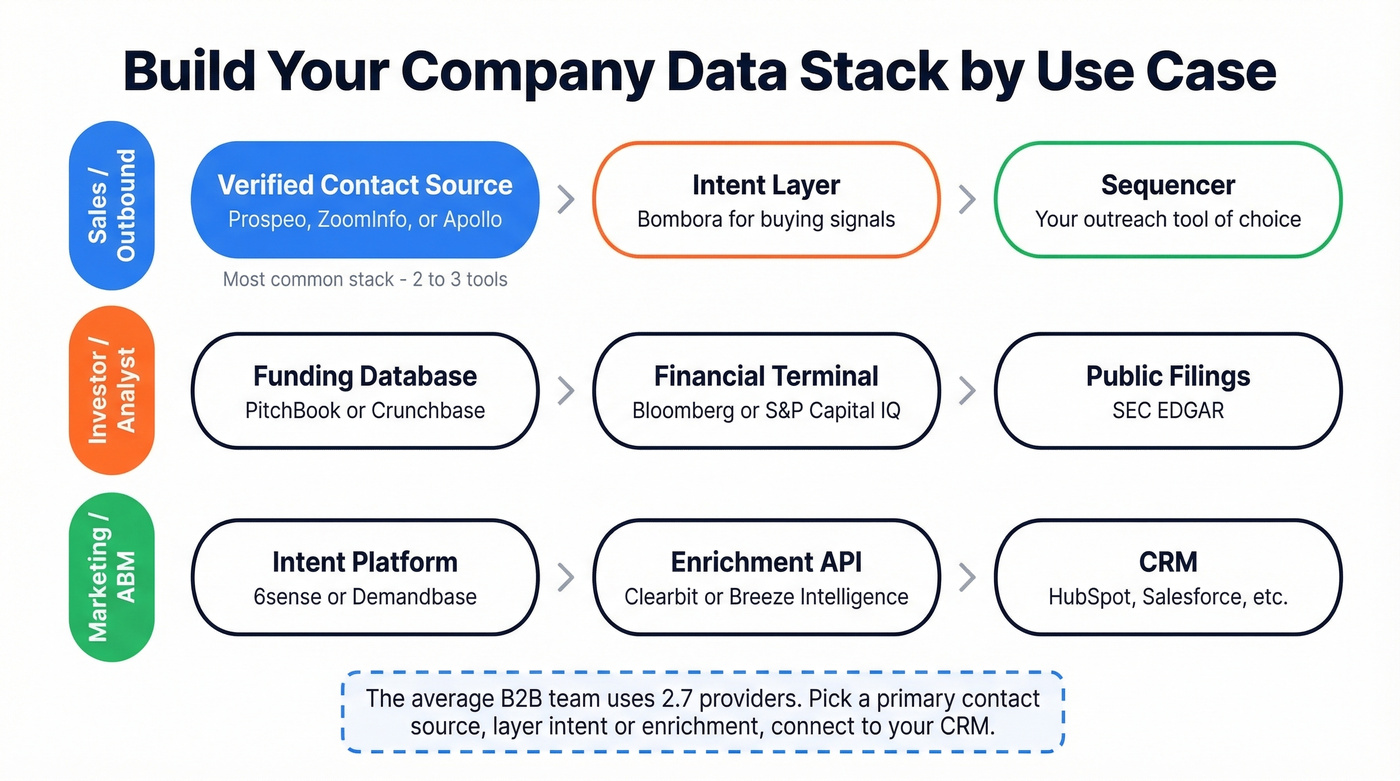
The 2.7-provider average exists for a reason. No single tool covers firmographic depth, verified contacts, intent signals, and technographic data equally well. Pick a primary contact source, layer in intent or enrichment, and connect everything to your CRM. For teams that want to keep things simple, a verified email source with built-in intent filtering - like Prospeo's Bombora-powered intent data across 15,000 topics - can collapse two line items into one.
Waterfall enrichment exists because single-source databases cap out at 80-85% accuracy. Prospeo's proprietary 5-step verification hits 98% on its own - with an 83% enrichment match rate returning 50+ data points per contact. Firmographic, technographic, and intent filters built in. No $40K contracts required.
Skip the waterfall. Get accurate company data from one source at $0.01 per lead.
FAQ
What's the most accurate company data source?
Most single-source databases cap out around 80-85% email accuracy. Waterfall enrichment across providers improves coverage, but Prospeo's 98% verified email accuracy is the simplest way to keep deliverability high without stacking multiple tools.
Are free company data sources reliable?
Government registries like SEC EDGAR and Companies House are reliable for legal entity data - incorporation records, officer filings, annual reports. They lack contacts, technographics, and intent signals entirely, so they won't support outbound or ABM workflows on their own.
How often does company data go stale?
B2B contact data decays roughly 70% per year, meaning a list built in January is half-wrong by July. Look for providers with weekly refresh cycles to keep bounce rates under control. The industry average sits around 6 weeks, which is already too slow for high-volume outbound.
How many data providers should a sales team use?
The average B2B team uses 2.7 providers. A practical minimum is two: one primary contact source for verified emails and direct dials, plus one intent or enrichment layer. Teams with complex ICPs or multi-region targets often need three.