

How to Turn Content Marketing Into a B2B Lead Generation Engine
You've spent months building a content engine, your MQL numbers look great, and then sales tells you half the leads have bad emails. Sound familiar? Marketing Week found 37.7% of B2B marketers are pressured to deliver MQLs regardless of quality, and 26.7% say leads are their only metric of success. The disconnect between content marketing and actual B2B lead generation pipeline is the defining problem of B2B marketing right now, and most teams are solving it wrong.
The Gap Between "Effective" and Everyone Else
Only 12% of B2B marketers rate their content marketing as highly effective, per CMI's 2026 report surveying 1,015 marketers. The gap between that 12% and everyone else comes down to three things: obsessing over content quality instead of content volume, measuring pipeline contribution instead of MQL counts, and verifying lead data before it ever touches a CRM. Nail those three and you're ahead of roughly 88% of B2B content programs.
Why Content Generates Leads for B2B
B2B buyers self-educate before they ever talk to sales. Around 42% consult 4-6 sources before engaging a vendor - your content is either one of those sources or it isn't. There's no middle ground.
The cost argument is strong, too - content-driven lead generation costs roughly 62% less per lead than traditional marketing approaches. But cost efficiency isn't the real story. Among effective teams in the 2026 CMI report, the single biggest needle-mover was content relevance and quality, cited by 65% of respondents. Not more content. Not better tools. Not AI. Quality.
That's a useful corrective for teams drowning in "publish more" mandates.
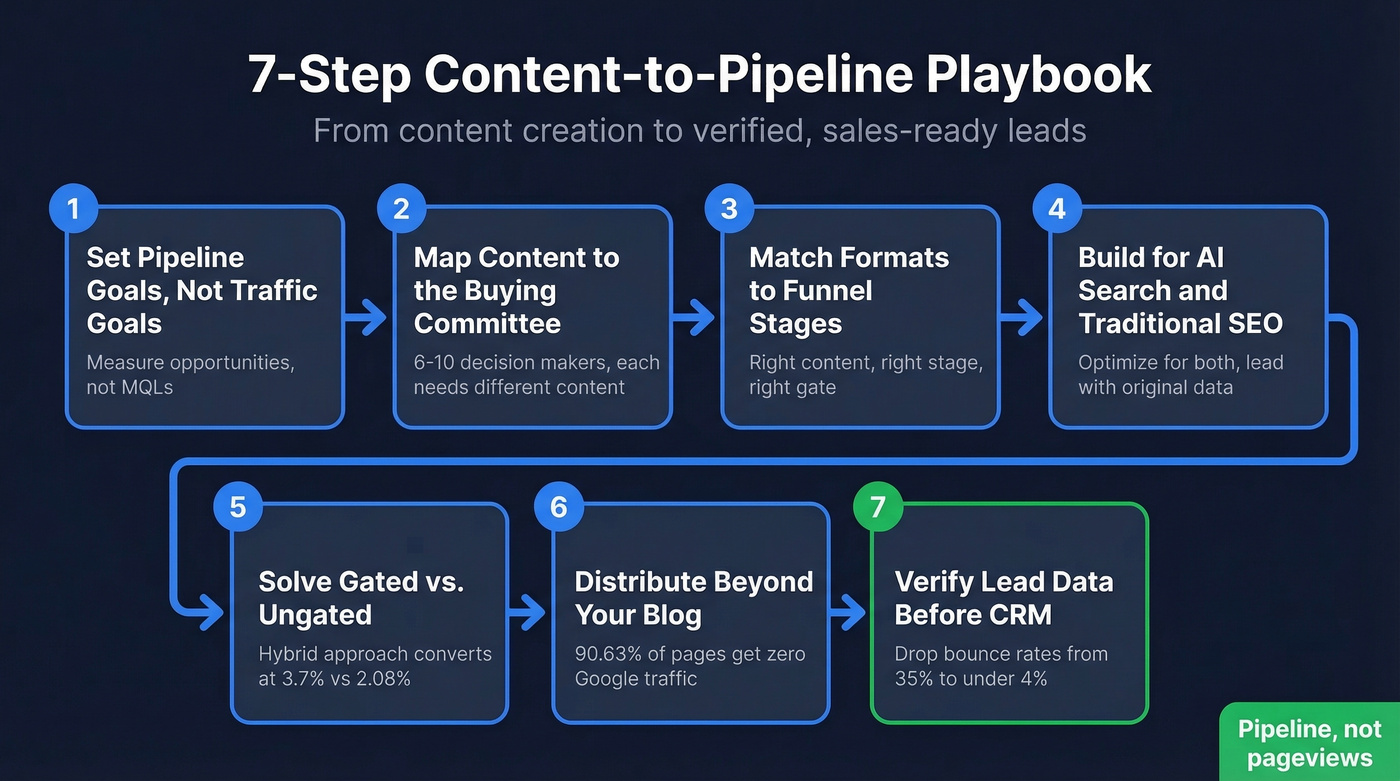
The 7-Step Content-to-Pipeline Playbook
1. Set Pipeline Goals, Not Traffic Goals
Among B2B marketers who rate their lead generation strategy as moderately effective or worse, 42% cite lack of clear goals as the primary reason, and 35% say their approach isn't data-driven enough. That's not a strategy problem - it's a measurement problem disguised as one.
If your content team's KPI is "blog traffic" or "MQL volume," you're incentivizing the wrong behavior. Set goals tied to pipeline: qualified opportunities sourced, influenced revenue, sales-accepted leads. Everything else is vanity.
If you need a tighter definition of what to track, align your KPIs to core funnel metrics instead of channel vanity stats.
2. Map Content to the Buying Committee
Stop writing for "personas." B2B purchases involve 6-10 decision-makers, and each one cares about different things. The VP of Engineering wants technical depth. The CFO wants ROI and risk mitigation. The end user wants implementation ease. Map your content to committee roles and buying stages, not to a fictional "Marketing Mary" persona you built in a workshop three years ago.
If you're struggling to operationalize this, start with an Ideal Customer Profile and then map committee roles inside that ICP.
3. Match Content Types to Funnel Stages
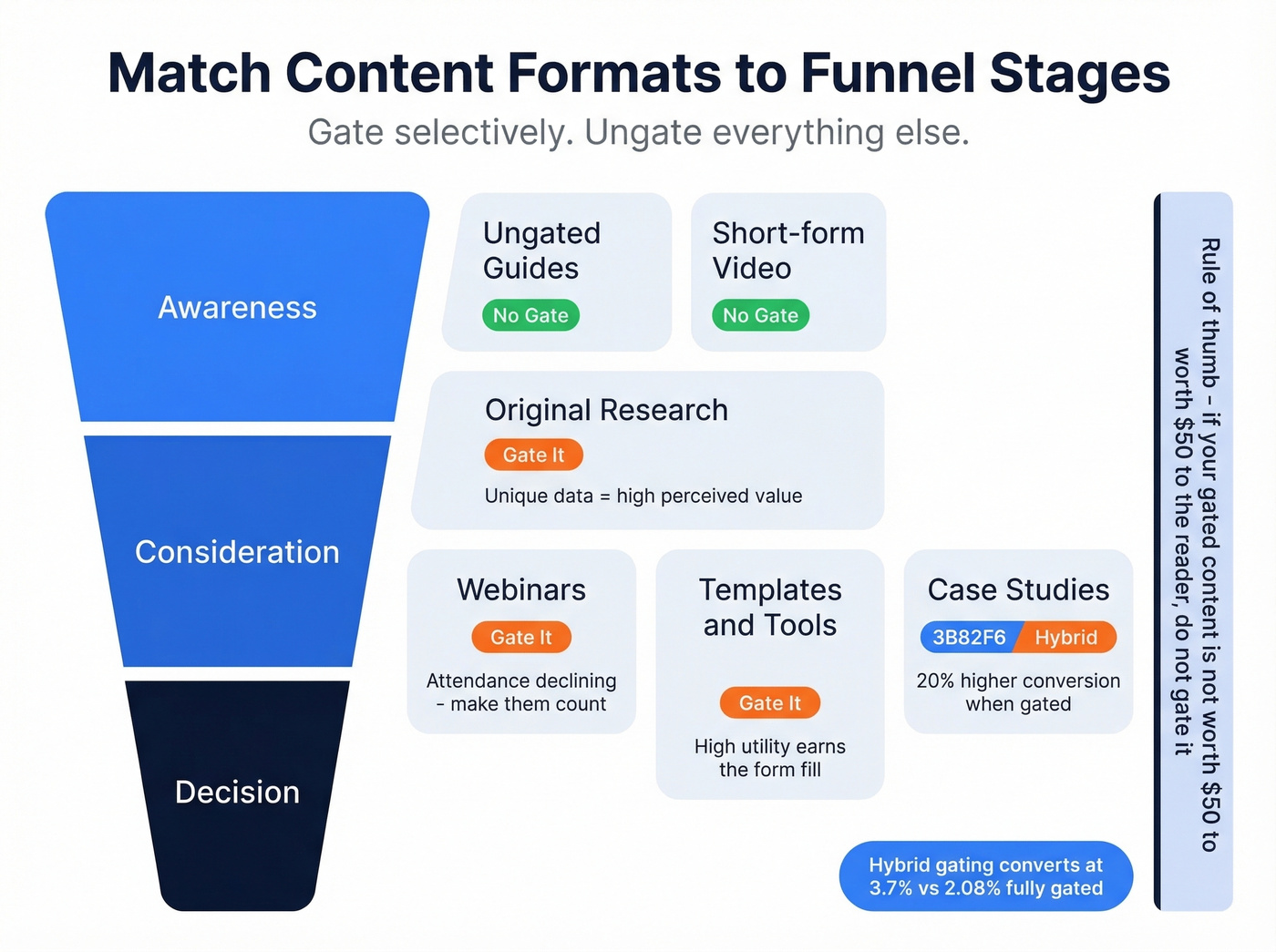
Blog posts were used by 38% of marketers in recent surveys, and the format mix has diversified for good reason - different formats work at different stages. The key principle: awareness-stage content should educate without a gate, consideration-stage assets earn the form fill, and decision-stage sales content should remove objections.
Mismatching format to stage is one of the most common reasons content generates traffic but not pipeline.
If you want a simple framework for stage-by-stage messaging, the AIDA sales funnel is still a useful mental model.
4. Build for AI Search and Traditional SEO
Here's the thing: roughly 30% of marketers reported decreased search traffic as buyers shift to AI tools for research. That's not a reason to abandon SEO - it's a reason to adapt. Some 92% of marketers are already optimizing for both traditional and AI-powered search engines.
Structure content for direct answers - AI search rewards clear, authoritative responses. Build topical authority through content clusters. Then create content formats that AI can't easily replicate: original research, proprietary data, expert interviews. AI can accelerate your production, but the data is clear - quality and relevance drive results, not volume. Use AI to draft faster, not to publish more.
If SEO is a primary acquisition channel for you, it helps to treat it as a pipeline motion - see SEO sales leads for a practical approach.
5. Solve the Gated vs. Ungated Question
The "gate everything" playbook from 2018 is dead. But gated content isn't.
Webinar registrations are down 42% at the median company, and ebook downloads have dipped about 5%. Meanwhile, demo requests are up 9.5%. Buyers are skipping the top-of-funnel gate and going straight to high-intent actions. The consensus on r/sales and r/marketing leans the same way - people hate filling out forms for a recycled PDF.
But here's the counterpoint: a LeadSpot analysis found that gated case studies produced a 20% higher lead conversion rate than ungated ones. And a hybrid approach - partially ungated with a gate on the deepest content - converted at 3.7% versus 2.08% for fully gated. We've tested both approaches across multiple campaigns, and hybrid wins every time. Gate selectively: original research, ROI calculators, templates, detailed case studies. Ungate everything else. This is the best way to capture leads without alienating buyers who aren't ready to hand over their information.
6. Distribute Beyond Your Blog
90.63% of web pages get zero organic traffic. Creating content without a distribution plan is building a store in the desert.
Your distribution stack should include:
- Email nurture sequences - design each email to stand alone, linking to a self-contained resource rather than depending on the previous message
- Professional social and community engagement - thought leadership that starts conversations, not just broadcasts links
- Content syndication through platforms like NetLine, which reaches 125M unique monthly visitors and generates 700K first-party leads per month across 15K publisher properties
- Systematic repurposing - turn a whitepaper into a webinar, a webinar into short-form clips, clips into social posts
One tactical note: segment your email sequences by buying stage and committee role. Personalized nurture drives significantly higher engagement than generic blasts, and the teams that treat each send as an independent value exchange - not just a drip sequence placeholder - see the best results.
If you want to systematize the handoff from nurture to SDR, keep a set of sales follow-up templates ready for each stage.
7. Verify Lead Data Before It Hits Sales
This is the step every other guide skips, and it determines whether your pipeline numbers are real or fiction.
Content did its job - someone filled out a form, downloaded a resource, registered for a webinar. But we've seen customers come to us with 35-40% bounce rates on form-fill data. When that data hits your CRM unverified, your SDRs waste cycles on bounced emails and dead-end phone numbers. Let's be honest: nothing kills sales trust in marketing faster than a list full of invalid contacts.
Prospeo closes this gap. Upload your captured leads for bulk verification - emails are verified at 98% accuracy with a 7-day refresh cycle, and each contact gets enriched with 50+ data points. One customer, Meritt, saw their bounce rate drop from 35% to under 4% after switching to verified contact data. That's the difference between a content program that generates pipeline and one that generates complaints from sales.
In our experience, the teams that verify lead data before CRM import see dramatically better sales follow-up rates - and far fewer "your leads are garbage" conversations.
If you’re diagnosing bounces, it helps to understand email bounce rate benchmarks and root causes.

Your content did the hard work - someone engaged, filled out a form, showed intent. Don't let bad data waste it. Prospeo verifies emails at 98% accuracy and enriches every lead with 50+ data points, so sales gets contacts they can actually reach.
Stop sending sales leads that bounce. Verify them first.
Formats That Generate Pipeline
Here's how the major formats map to funnel stages, gating strategy, and actual conversion behavior:
| Format | Funnel Stage | Gate It? | Why It Works |
|---|---|---|---|
| Ungated guides | Awareness | No | Builds trust, earns SEO traffic |
| Original research | Awareness-Consideration | Yes | Unique data = high perceived value |
| Case studies | Consideration-Decision | Yes or hybrid | 20% higher conversion gated |
| Webinars | Consideration | Yes (attendance declining) | High engagement when done well |
| Templates/tools | Consideration | Yes | High utility earns the form fill |
| Short-form video | Awareness | No | Drives engagement, hard to gate |
Formats that deliver unique, high-utility value still earn the form fill. Generic ebooks and recycled "ultimate guides" don't. My rule of thumb: if your gated content wouldn't be worth $50 to the reader, it shouldn't be gated.
The best results come from leading with ungated content that demonstrates expertise, then gating the asset that helps the buyer build an internal business case - the ROI calculator, the vendor comparison template, the implementation checklist.
Measuring Content's Impact on Pipeline
The biggest measurement mistake in B2B content programs is defaulting to last-touch attribution. The predictable result: over-investing in last-click channels while starving the awareness content that created the opportunity in the first place.
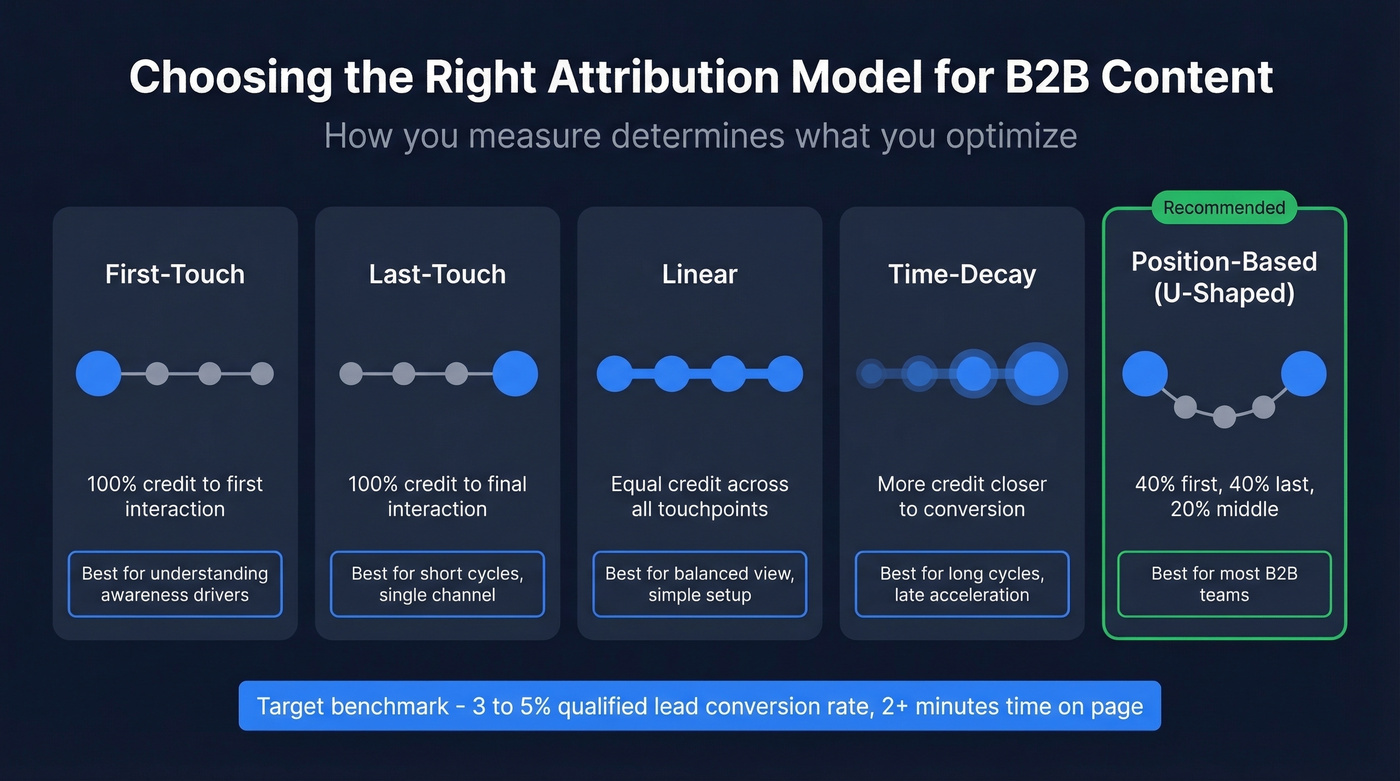
| Model | How It Works | Best For | |---|---|---|---| | First-touch | 100% credit to first interaction | Understanding awareness drivers | | Last-touch | 100% credit to final interaction | Short cycles, single channel | | Linear | Equal credit across all touchpoints | Balanced view, simple setup | | Time-decay | More credit closer to conversion | Long cycles, late acceleration | | Position-based (U-shaped) | 40% first, 40% last, 20% middle | Most B2B teams |
For most B2B teams, position-based attribution is the right starting point. It acknowledges that the blog post introducing a buyer to your brand matters, and so does the case study that closed the deal.
As for benchmarks: First Page Sage suggests a 3-5% qualified lead conversion rate as a strong target. If average time on page is under 20 seconds, the content isn't resonating - aim for 2+ minutes of engagement before expecting meaningful conversions. And track content-influenced pipeline, not just content-sourced pipeline. Most B2B content touches a deal somewhere in the middle, not at the very beginning.
If you need a deeper benchmark set, compare against the average B2B lead conversion rate by channel and stage.
Two Case Studies With Real Numbers
SAP: EUR 924M Pipeline From a Content Mix
SAP's "Inspire the Future" campaign combined podcasts, industry videos, and social content into a multi-format content engine. The results: EUR 924.4M in pipeline generated, with projected revenue of EUR 266.15M. Their podcast hit 22,000+ listeners (top 2% benchmark is 18,000), industry videos crossed 10,000 YouTube views within 30 days, and social content drove 48% higher engagement than other SAP campaigns.
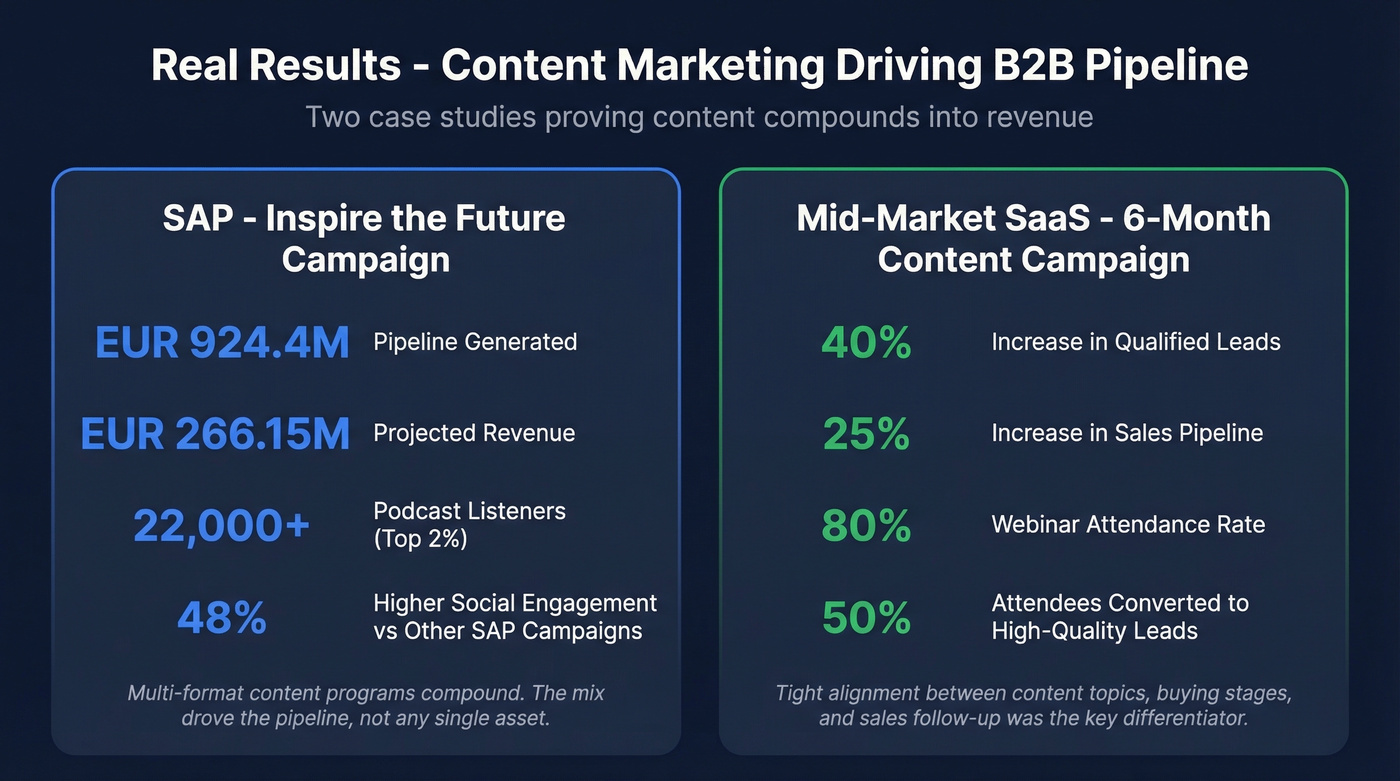
The takeaway isn't "be SAP." It's that multi-format content programs compound. No single asset drove that pipeline. The mix did.
SaaS Campaign: Turning Content Into Leads at Scale
A mid-market SaaS company ran a focused campaign combining whitepapers, webinars, and email nurture sequences. In six months: a 40% increase in qualified leads, a 20% improvement in lead-to-customer conversion, a 25% increase in sales pipeline, and 15% year-over-year revenue growth. Their webinars hit an 80% attendance rate, with 50% of attendees converting to high-quality leads.
The key differentiator wasn't the content itself - it was tight alignment between content topics, buying committee roles, and sales follow-up timing. Every piece mapped to a specific stage and audience, and sales knew exactly when and how to follow up on each content interaction.
If you’re building the ops layer behind this, a defined lead generation workflow prevents leaks between stages.
Mistakes That Kill Pipeline Conversion
Hot take: if your average deal size is under $15K, you probably don't need a 7-step content engine. A focused outbound motion with verified data will outperform a half-resourced content program every time. Skip the content playbook and invest in direct outreach instead. But if you're going all-in on content, here are the mistakes that'll sink you.
No documented strategy or pipeline-tied goals. Without pipeline goals, content becomes reactive. You end up measuring traffic screenshots instead of revenue contribution. Tie every content initiative to a pipeline number before production starts.
Thought leadership without decision-support content. B2B thought leadership gets engagement but fails during evaluation on its own. Buyers need comparisons, ROI ranges, implementation steps, and risk assessments to build an internal business case. If your content library is all "big ideas" and no "how to buy," you'll lose deals at the consideration stage.
We see this constantly: a team publishes three thought leadership pieces a week, gets great social engagement, and then wonders why pipeline is flat. The missing piece is always decision-support content - the comparison page, the ROI calculator, the implementation guide that the economic buyer needs to get budget approved.
Writing for "everyone" instead of the buying committee. Content that targets "everyone" resonates with no one. Map every piece to a specific committee role and buying stage. This is where the 39% of underperformers who cite "not tied to customer journey" are failing.
If you need a practical way to separate roles, use the lens of technical buyer vs economic buyer.
Creating content but ignoring distribution. Remember: 90%+ of pages get zero organic traffic. If you're not distributing through email, social, syndication, and repurposing, you're relying entirely on SEO - and with AI search eating into organic traffic, that's a shrinking bet.
Meritt cut their bounce rate from 35% to under 4% and tripled pipeline from $100K to $300K per week. The difference wasn't more content - it was verifying every lead before it touched their CRM. At $0.01 per email with a 7-day data refresh cycle, Prospeo turns your content leads into real pipeline.
Turn content-captured leads into pipeline that sales actually closes.
FAQ
How long does content marketing take for B2B lead generation?
Most programs need 6-12 months to build real momentum. The SaaS case study above saw a 40% qualified lead increase in six months with tight funnel-stage mapping and consistent distribution from day one. Consistency and strategic alignment matter far more than publishing volume.
Is gated content still effective in 2026?
Gated case studies still convert 20% better than ungated ones, but webinar registrations are down 42% at the median company. Gate only assets worth the exchange - original research, ROI calculators, templates. Ungate everything else to build trust and earn organic traffic.
What's a good conversion rate for B2B content?
A 3-5% qualified lead conversion rate is a strong benchmark. If average time on page is under 20 seconds, the content isn't resonating - aim for 2+ minutes of engagement before expecting meaningful conversion activity.
How do I make sure content leads have accurate data?
Run every form-fill through email verification before CRM import. Tools like Prospeo verify at 98% accuracy and enrich contacts with 50+ data points - one customer cut bounce rates from 35% to under 4%. Without verification, up to 40% of your content-captured leads may have invalid emails, which tanks your sender reputation and wastes SDR time.