

Content Syndication for Lead Generation: What Actually Works (and What Doesn't)
A B2B SaaS head of growth shared on Reddit that his syndication campaign delivered 4,000 leads - all "great fit" by the vendor's firmographic filters. The result? Three to four meetings. A ~0.075%-0.1% lead-to-meeting rate. Sales called the leads garbage. Marketing blamed the SDRs. The vendor blamed the content. Everyone was partially right and completely missing the real problem: they treated content syndication for lead generation like a pipeline channel instead of a list-building one.
Here's the short version: syndication works for mid-to-upper-funnel list building, not immediate pipeline. Expect $60-$110 CPL for mid-market, 6-12 months to see real opportunity and pipeline impact, and plan to spend more time on post-capture nurture than on vendor selection. If your SDRs are calling syndicated leads the next day, stop. You're burning money.
What Content Syndication Actually Is
You take gated content - whitepapers, ebooks, webinar recordings, research reports - and distribute it through third-party publisher networks. Someone on a publisher's site downloads your asset, fills out a form, and that contact record gets passed to you as a lead. You pay per lead, per impression, or on a flat retainer.
The mechanism is simple. The execution is where teams lose money.
What It Costs in 2026
Pricing swings wildly depending on targeting precision and qualification level.
CPL by Lead Type
| Lead Type | CPL Range |
|---|---|
| Basic leads | $25-$50 |
| MQLs (verified) | $50-$120 |
| SQLs (intent signals) | $100-$250+ |
| Enterprise/niche | $200-$400+ |
CPL by Audience Segment
| Segment | CPL Range |
|---|---|
| Broad B2B (manager+) | $35-$75 |
| Mid-market (500-5K emp) | $60-$110 |
| Enterprise (5K+) | $90-$160 |
| C-suite/VP | $120-$220 |
| Specialized verticals | $150-$300 |
CPM models run $15-$100+ depending on audience seniority. CPL dominates, though, and it's what you should benchmark against.
The Funnel Math
Here's a worked example with 1,000 syndicated leads at $80 CPL ($80,000 spend):
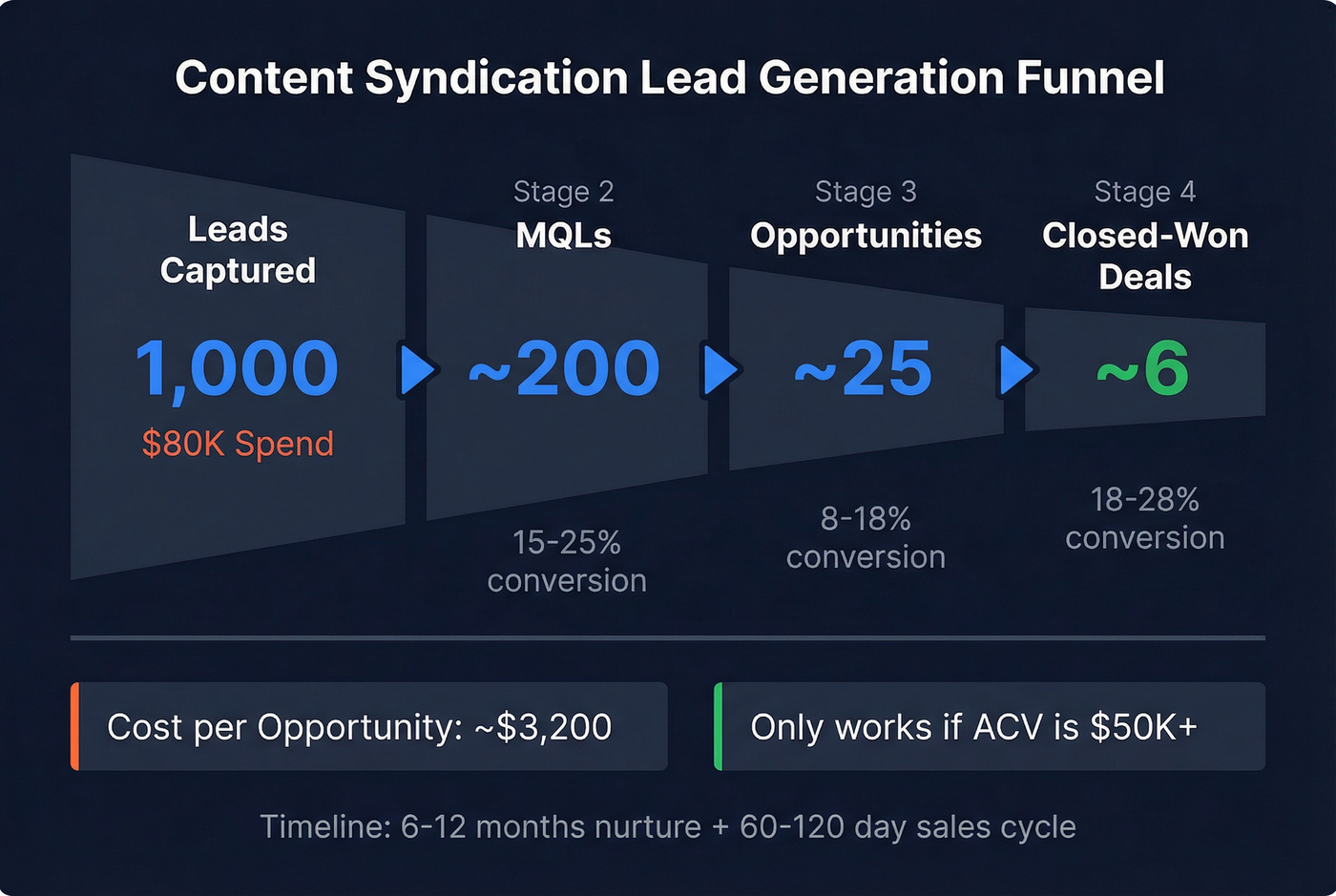
| Stage | Rate | Count |
|---|---|---|
| Leads captured | - | 1,000 |
| Lead to MQL | 15-25% | ~200 |
| MQL to Opportunity | 8-18% | ~25 |
| Opp to Closed-won | 18-28% | ~6 |
Six deals from $80K in spend, plus a 60-120 day sales cycle on top of 6-12 months of nurture before those opps materialize. That math only works if your average deal size justifies it. For teams selling $50K+ contracts, syndication can be a strong channel. For deals under $15K, the unit economics get brutal fast.
Measure CPO (cost per opportunity), not CPL. A $40 CPL that produces zero meetings is infinitely more expensive than a $110 CPL that converts.

You just spent $60-$110 per syndicated lead. A 15-20% bounce rate means thousands of dollars wasted and your sender reputation destroyed before nurture even starts. Prospeo's bulk verification catches invalid emails, spam traps, and catch-all domains at 98% accuracy - for ~$0.01 per email. That's less than 1% of what you paid to acquire the lead.
Protect every dollar of your syndication spend before you hit send.
Why Most Campaigns Fail
48% of B2B marketers say lead quality - not quantity - is their top challenge with syndication. And 35% have dropped the channel entirely because of poor quality. We've watched teams make the same five mistakes over and over, and they're all fixable.
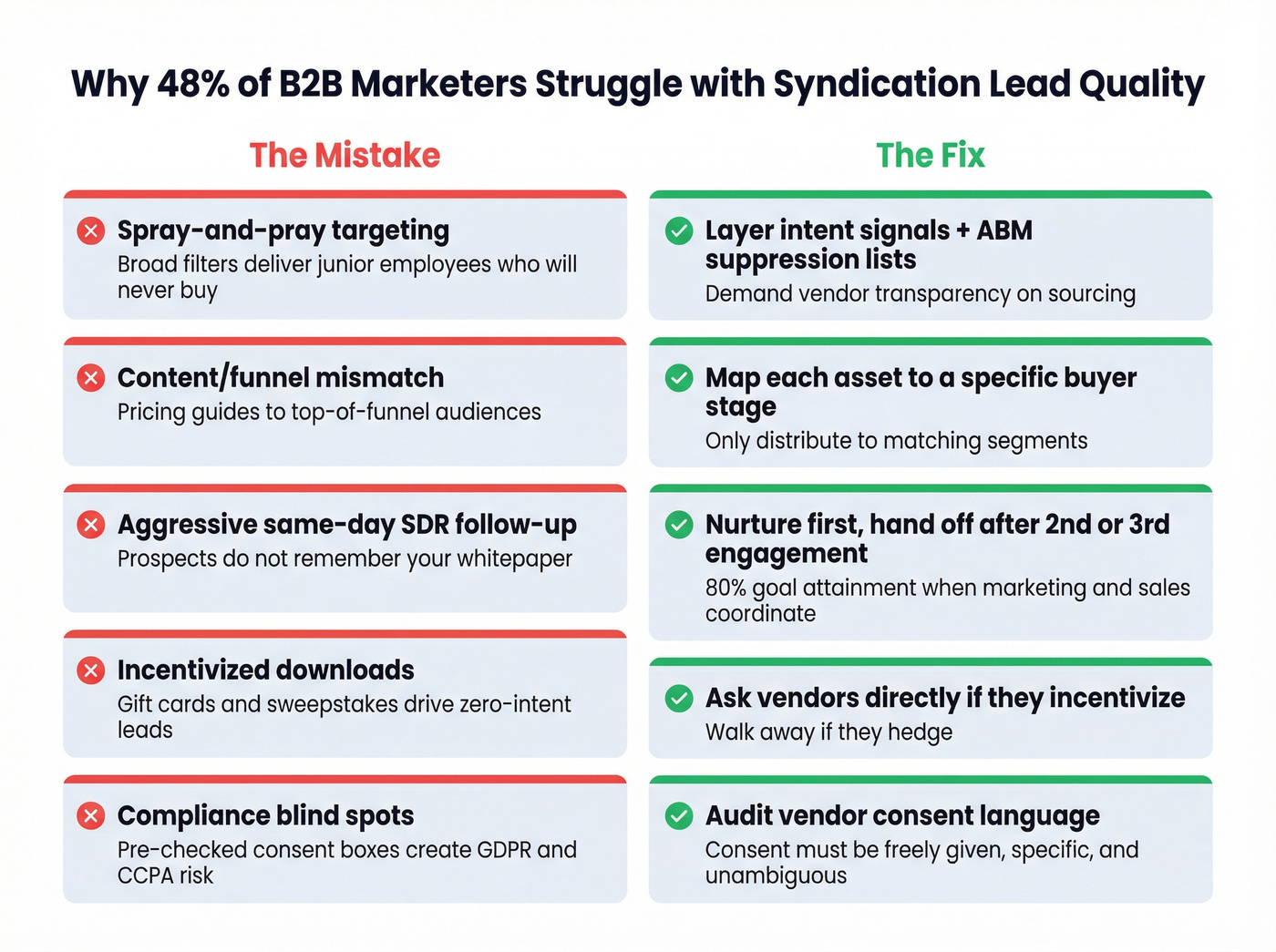
Spray-and-pray targeting. Broad firmographic filters deliver junior employees who'll never buy. Layer buyer intent signals and ABM suppression lists. Demand vendor transparency on how leads are sourced - if they can't explain their publisher network in detail, that's a red flag.
Content/funnel mismatch. Syndicating a pricing comparison guide to top-of-funnel audiences, or a trends report to bottom-funnel buyers. Map each asset to a specific buyer stage and only distribute it to matching segments.
Immediate aggressive SDR follow-up. This is the big one. Prospects don't remember downloading your whitepaper. They filled out a form on a publisher site two weeks ago while researching something tangential. A cold call the next morning feels like spam. Nurture first, hand off after a 2nd or 3rd engagement signal. In our experience, teams hit 80% of goals when marketing and sales coordinate on follow-up timing - versus 50% when marketing acts alone. (If you need copy, use these follow-up timing benchmarks.)
Incentivized downloads. Some publishers use gift cards or sweepstakes to drive form fills. The leads are real people with real job titles and zero buying intent. Ask vendors directly whether they incentivize. Walk away if they hedge.
Compliance blind spots. Pre-checked consent boxes and bundled opt-ins create GDPR and CCPA risk. Audit your vendor's consent language - GDPR requires consent that's freely given, specific, informed, and unambiguous. Skip this step and you're not just risking fines; you're risking your domain reputation.
The Post-Capture Playbook
Syndicated leads tend to generate opportunities 6-12 months after entering your system. Teams that build structured nurture workflows around this timeline generate 67% more SQLs than those that don't. Your post-capture workflow matters more than your vendor selection.
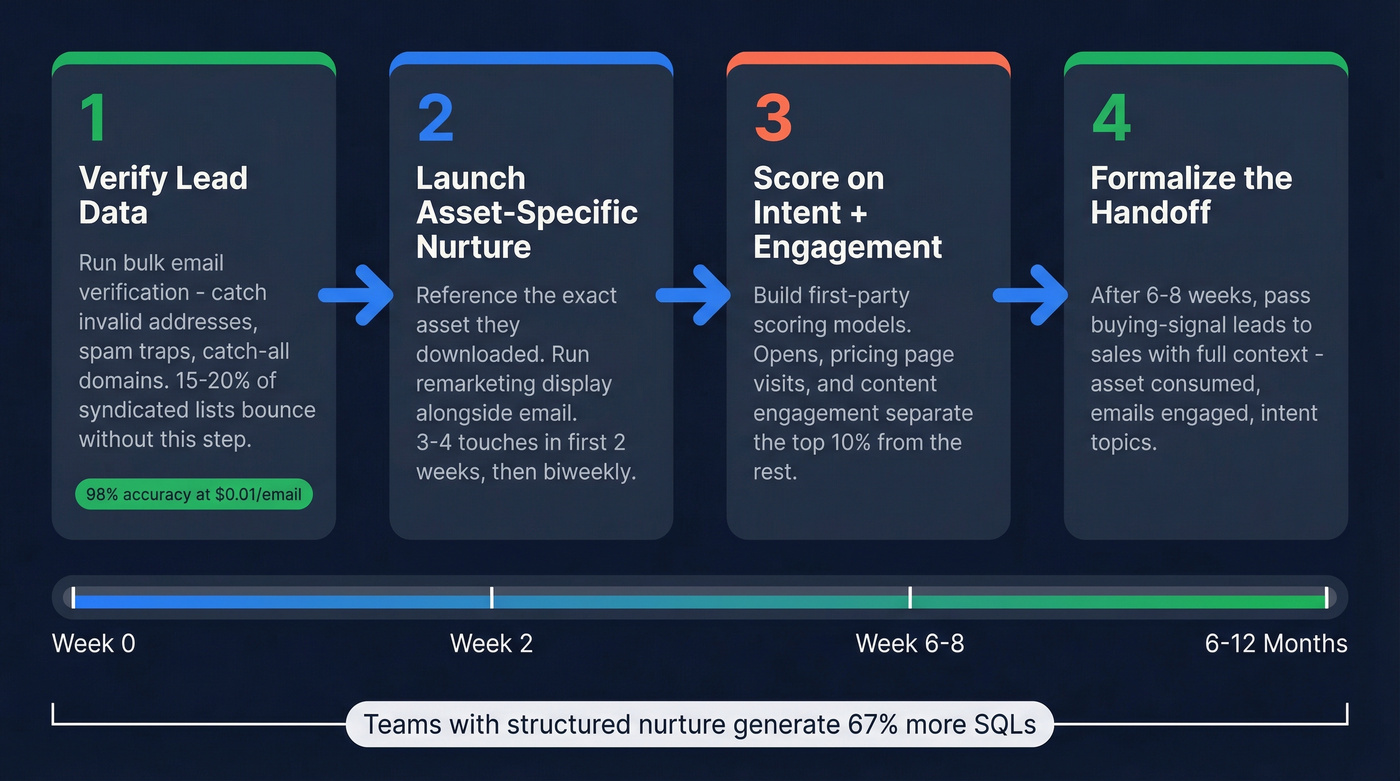
Step 1: Verify Lead Data First
By the time a vendor delivers a batch, some contacts are already invalid. We've seen bounce rates as high as 15-20% on unverified syndicated lists, which tanks your sender reputation for every other campaign in your instance. Run the list through Prospeo's bulk verification - it catches invalid addresses, spam traps, and catch-all domains with 98% accuracy at ~$0.01/email. That's a fraction of the $60-$110 CPL you paid for each contact. (If you're tracking this, start with email bounce rate benchmarks.)
Step 2: Launch Asset-Specific Nurture
"Thanks for downloading [Whitepaper Title]" - not a generic "thanks for your interest." Specificity builds recognition. Run remarketing display alongside email to build the brand familiarity that makes your nurture feel expected rather than intrusive. Three to four touches over the first two weeks, then taper to biweekly. Tighten the copy with proven email subject lines and email copywriting patterns.
Step 3: Score on Intent + Engagement
A lead who downloaded your asset, opened three nurture emails, and visited your pricing page is fundamentally different from one who hasn't engaged since capture. Build first-party data scoring models that reflect this. Don't treat all 1,000 leads the same - the top 10% are doing 90% of the buying. Use a real lead scoring framework and document your identifying buying signals.
Step 4: Formalize the Handoff
After 6-8 weeks, leads showing buying signals get passed to sales with talk tracks and context - what asset they consumed, what emails they engaged with, what buyer intent topics they're researching. SDRs who call with context convert. SDRs who call cold don't. Standardize the process with a handoff email template.
Syndication vs. Paid Ads
| Channel | CPL Range | Best For |
|---|---|---|
| Syndication (mid-market) | $60-$110 | Mid-funnel list building at scale |
| Google (category search) | $80-$250 | High-intent bottom-funnel capture |
| LinkedIn lead gen | $80-$200 | ABM targeting by title/company |
| LinkedIn message ads | $40-$100 | Direct outreach (watch inbox fatigue) |
| Meta B2B | $30-$90 | Broad awareness, retargeting |
| Display/programmatic | $15-$60 | Cheap reach (high fraud risk) |
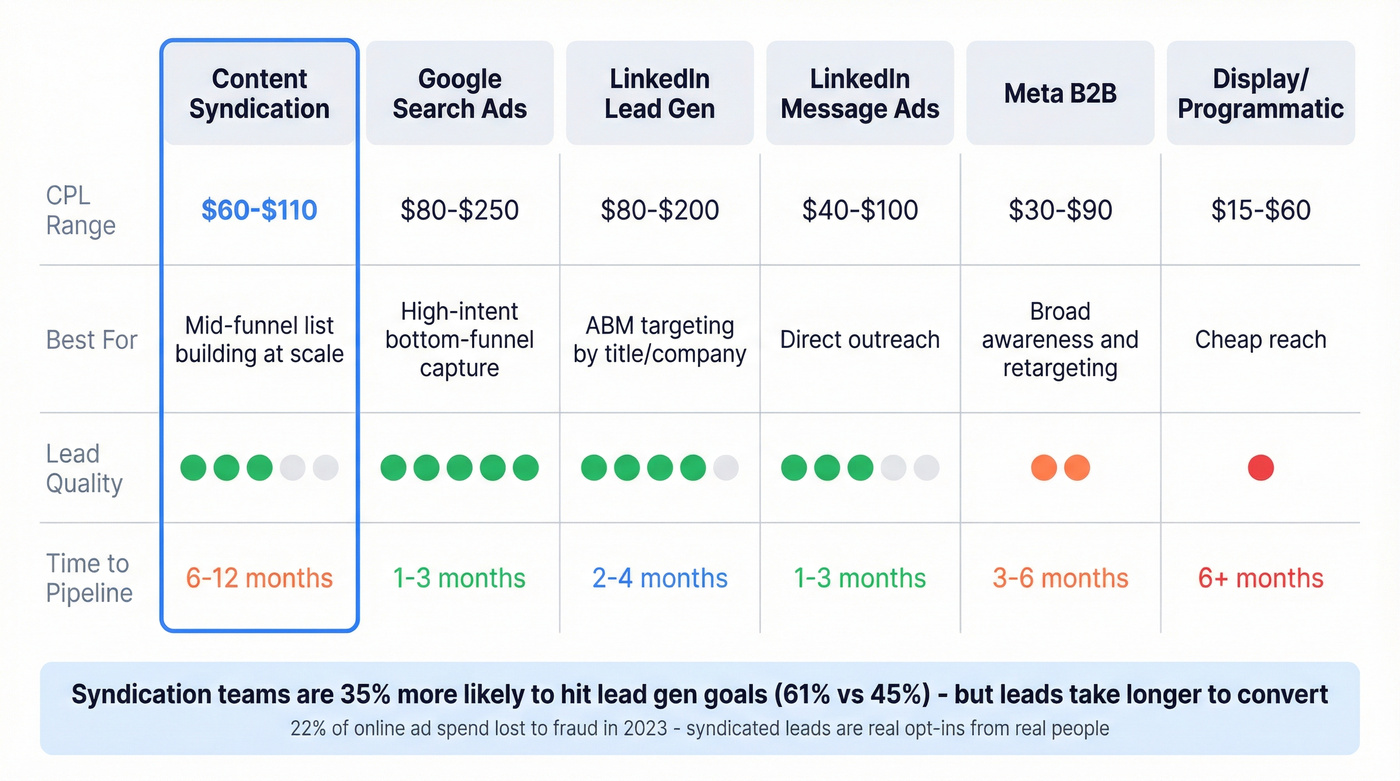
In 2023, an estimated 22% of online ad spend was lost to fraud - roughly $84B. Syndicated leads are real opt-ins from real people who filled out real forms. That's a genuine advantage. Teams using content syndication are 35% more likely to hit lead gen goals (61% vs 45%) compared to paid-ads-only strategies. The leads take longer to convert, but they're human.
Let's be honest: if your average contract value is under $25K, you probably don't need syndication at all. The 6-12 month nurture cycle and $60-$110 CPL only pencil out when closed-won deals are large enough to absorb the cost. For lower deal sizes, LinkedIn ads with tight targeting will get you to pipeline faster.
How to Choose a Syndication Vendor
Most guides on this topic are written by syndication vendors selling their own platform. We don't sell syndication, so here's what actually matters.
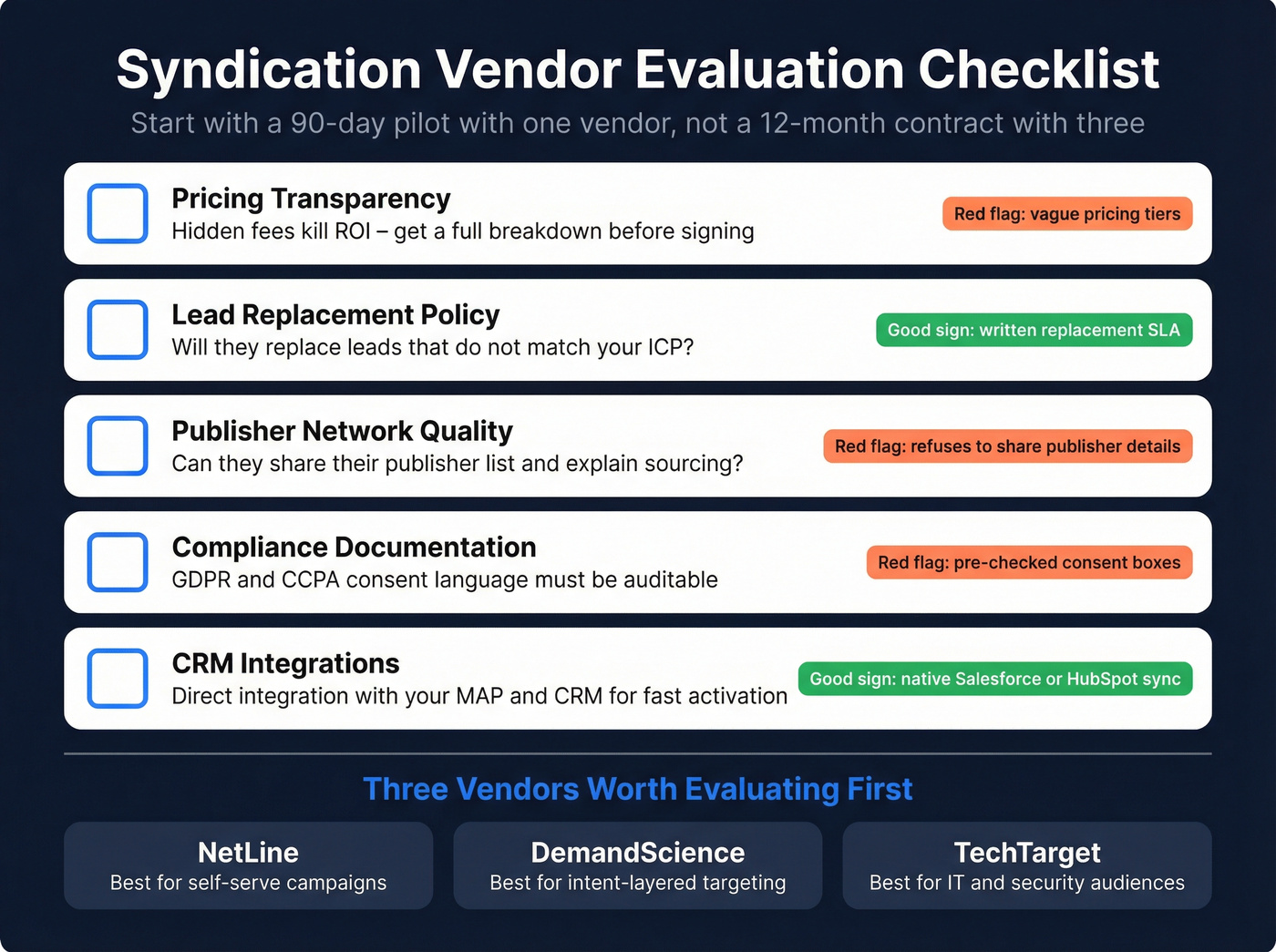
Start with a 90-day pilot with one vendor, not a 12-month contract with three. Evaluate on five criteria: pricing transparency (hidden fees kill ROI), lead replacement policy (will they replace leads that don't match your ICP?), publisher network quality, compliance documentation, and CRM integrations. If a vendor won't share their publisher list or explain their lead sourcing methodology, walk. There are too many good options to waste time on opaque ones. (If your ICP isn't tight, fix it first with an Ideal Customer Profile Template.)
Three vendors worth evaluating first: NetLine, DemandScience, and TechTarget. Each has different strengths depending on your vertical and deal size - NetLine tends to be strongest for self-serve campaigns, DemandScience for intent-layered targeting, and TechTarget for IT and security audiences specifically.
Syndicated leads convert 6-12 months after capture - but only if your contact data is still valid. Prospeo refreshes 300M+ profiles every 7 days, so when your scored leads finally hit the handoff threshold, your SDRs reach real buyers with verified emails and direct dials, not dead inboxes.
Stop handing sales stale data from leads you already paid $80 to acquire.
FAQ
Is content syndication worth the cost?
Yes - if you measure cost per opportunity, not cost per lead, and you're prepared to nurture for 6-12 months. Teams using syndication are 35% more likely to hit lead gen goals than those relying solely on paid ads. It's a mid-funnel list-building channel, not a pipeline shortcut. Skip it if your average deal size is under $25K.
What's a good CPL for B2B syndication?
$60-$110 per lead is standard for mid-market B2B. Below $40, ask hard questions about how leads are sourced - incentivized downloads and recycled lists are common at the low end. Enterprise and C-suite targeting runs $120-$300+, which is reasonable given the deal sizes those contacts represent.
How do you improve syndicated lead quality?
Layer buyer intent data on your targeting criteria and verify emails before loading leads into nurture. Require 2nd or 3rd engagement signals before handing leads to sales, and enforce lead replacement policies with your vendors. The consensus on r/b2bmarketing is that post-capture nurture does more for quality than vendor selection - and we'd agree.