

Corporate Email Structure: How to Write Emails That Actually Get Read
You sent a detailed project update to your VP last Tuesday. Three paragraphs of context, a timeline, two open questions. The reply came back in under a minute: "What do you need from me?" That's not a rude executive - that's a person drowning in 121 emails per day who gave yours about 15 seconds. The problem wasn't your content. It was your corporate email structure.
What You Need (Quick Version)
Every corporate email has seven structural components - not five, which is what most guides teach. The two they skip (bracket-tagged subject lines and disclaimer footers) are the ones that matter most in a real corporate environment.
- 7 components: subject line, greeting, body, CTA, closing, signature, disclaimer footer
- BLUF principle: put your ask, the owner, and the deadline in the opening sentence
- Length target: 80-100 words for routine emails; longer messages need an executive summary up top
- Attention window: your email gets somewhere between 9 and 15 seconds of attention depending on the study, and the first ~140 characters do most of the work in determining whether the reader keeps going or moves on
The 7 Components Every Business Email Needs
Subject Line
For internal comms, subject lines in the 21-40 character range hit a sweet spot, and open rates drop once you pass 80+ characters. Most inboxes only display 40-50 characters anyway, so put the keywords first. If you want swipeable options, keep a running bank of subject lines you can reuse.
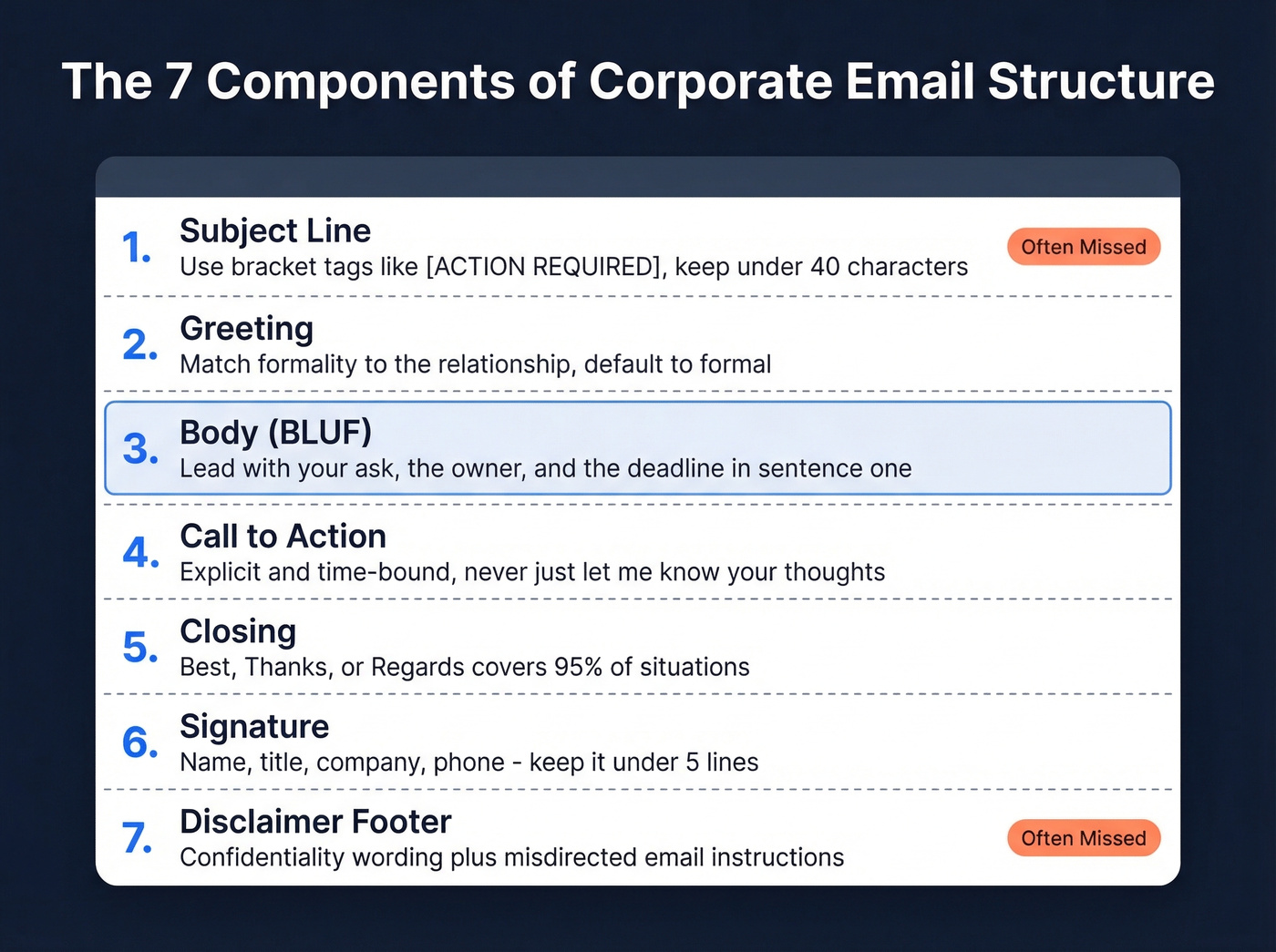
Use bracket tags to signal intent: [ACTION REQUIRED], [FYI], [DECISION NEEDED]. These aren't optional flair - they're triage tools. A VP scanning 30 unread messages will prioritize "[DECISION NEEDED] Q3 budget reallocation" over "Quick Question" every single time. Stop using "Quick Question" as a subject line. It tells the reader nothing and gets buried.
Greeting
For external emails and first-touch messages, use the recipient's name. "Hi Sarah" works in most American contexts. "Dear Dr. Muller" is safer for European executives you haven't met. The rule: default to formal and let the other person set the tone downward. If the CFO signs off as "Tom," you can call him Tom.
Don't know someone's preferred title? Skip gendered honorifics entirely. "Dear Alex Kim" is safer than guessing wrong. Mirror how recipients refer to themselves in their own signature or profile.
Body
This is where most corporate emails fall apart. Lead with BLUF - Bottom Line Up Front. Your opening sentence should contain the ask, who owns it, and when it's due. "I need your approval on the revised vendor contract by Friday COB" tells the reader everything in one line.
Keep routine emails to 80-100 words. Use short paragraphs (2-3 sentences max) and bullets for anything with multiple items. Roughly 50-60% of emails are opened on mobile, so walls of text are especially punishing on a 6-inch screen. If you're writing outreach, strong email copywriting matters as much as structure.
Call to Action
Make it explicit and time-bound. "Let me know your thoughts" isn't a CTA - it's a suggestion that'll sit in someone's inbox for a week. "Please confirm the revised timeline by Thursday at noon" is a CTA. The deadline does the heavy lifting. If you want more examples, see email call to action.
Closing
Stop agonizing over this. Nobody has ever lost a deal over "Best regards" vs. "Sincerely." Pick one that matches the formality of the conversation and move on. "Best," "Thanks," and "Regards" cover 95% of professional situations.
One thing that does matter: warmth markers. A bare "Regards" can read as cold. "Thanks for the quick turnaround" or "Appreciate the help" costs you three seconds and changes the tone entirely.
Signature
Name, title, company, phone number, relevant links. That's it. No artsy fonts, no inspirational quotes, no emoji strings. Your signature is a business card, not a personality test. Keep it under five lines so it doesn't overwhelm the actual message on mobile.
Disclaimer Footer
Most guides skip this entirely, and we'll cover it in depth below. The short version: disclaimers aren't legally required in the U.S., yet they're standard practice in regulated industries. If your company has one, it goes at the very bottom - after the signature, in smaller text.
BLUF and SCRAP - Frameworks That Work
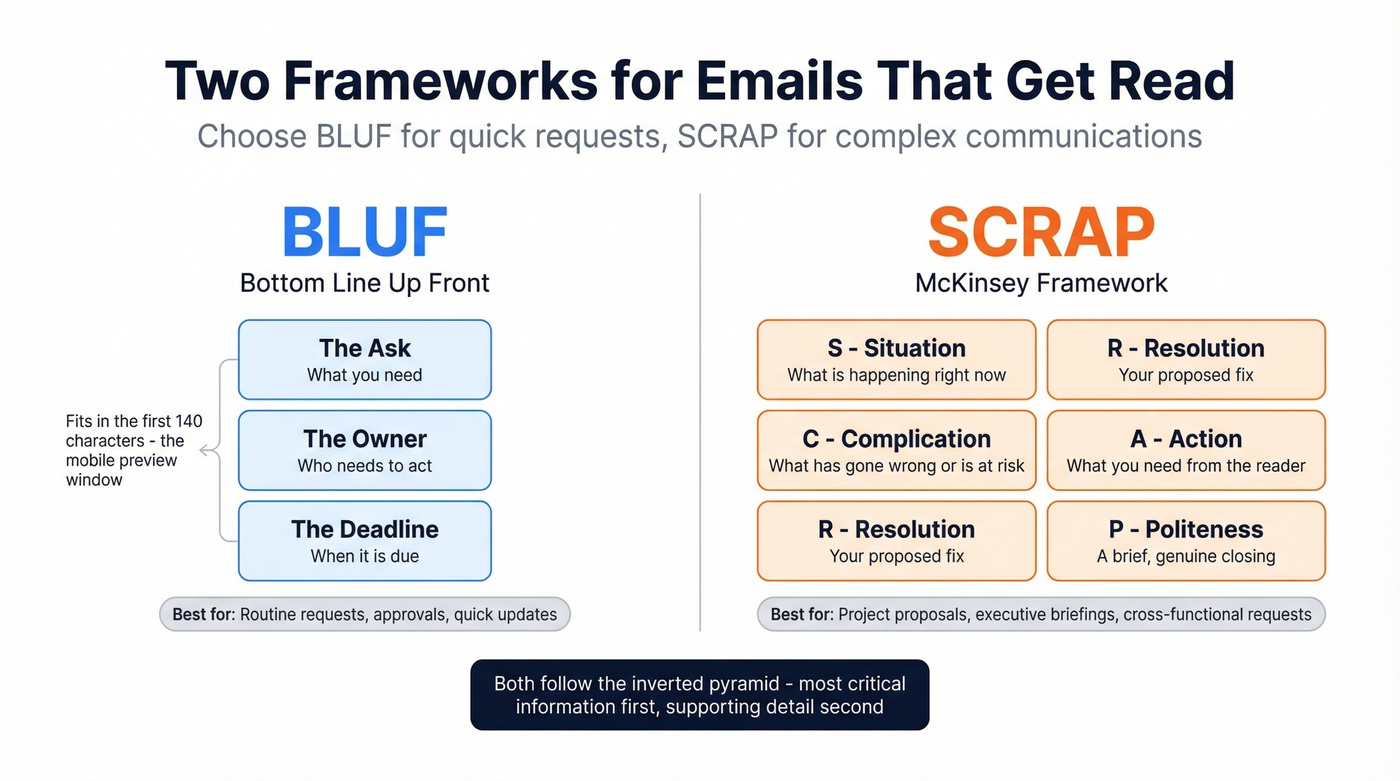
BLUF isn't just military jargon repurposed for corporate life - it's the single most effective structural change you can make. The first ~140 characters of your email are what show up in mobile previews and often in AI-generated summaries. If your ask lives in paragraph four, it won't surface early, and neither will the reader's attention.
Here's the thing: if your email requires scrolling before the reader finds the ask, you've already lost.
For more complex communications - project proposals, cross-functional requests, executive briefings - McKinsey's SCRAP framework gives you a repeatable structure:
- Situation: what's happening right now
- Complication: what's gone wrong or what's at risk
- Resolution: your proposed fix
- Action: what you need from the reader, specifically
- Politeness: a brief, genuine closing
Both frameworks follow the inverted pyramid principle: most critical information first, supporting detail second. The reader who stops after two sentences should still understand what you need.
Internal vs. External Emails
External emails get the full treatment every time - proper greeting, structured body, professional closing, complete signature. There's no shortcut here because you're representing your company to someone who's forming a first impression. If you're doing outbound, a clean B2B cold email sequence helps you stay consistent across touches.
Internal emails are different. A common frustration on r/work: people reply with just the body - no greeting, no closing - leaving others unsure what's "professional." The unwritten rule in most workplaces is that greetings and closings get dropped after the first message in a thread. Nobody says "Dear Michael" in the fourth reply of a Slack-era email chain. But when a new person gets added to the thread, reset the formality. It's a small courtesy that prevents confusion.
CC/BCC etiquette matters more than people think. CC means "this person needs visibility." BCC is for mass distribution where you're protecting recipient privacy - never use it to secretly loop someone in on a contentious thread. That's a trust-destroyer.
A practical tip we swear by: draft your entire email before adding recipients. It prevents the accidental half-written send that haunts your dreams at 2 AM.
What doesn't change internally is clarity. In regulated industries - finance, healthcare, government - every email is a discoverable record. A recap email after a meeting documenting decisions and next steps isn't just good practice; it's a compliance safeguard. Write internal emails as if legal will read them someday, because in some industries, they will. (If you're sending at scale, keep an eye on email deliverability too.)

You just learned how to structure corporate emails that get read. Now make sure they actually land. Prospeo's 98% verified email accuracy and 5-step verification mean your perfectly crafted BLUF message reaches the right inbox - not a bounce folder.
Stop perfecting emails that never arrive. Verify first.
Internal Email Benchmarks
Workshop analyzed 107+ million internal emails, and the benchmarks are worth knowing:
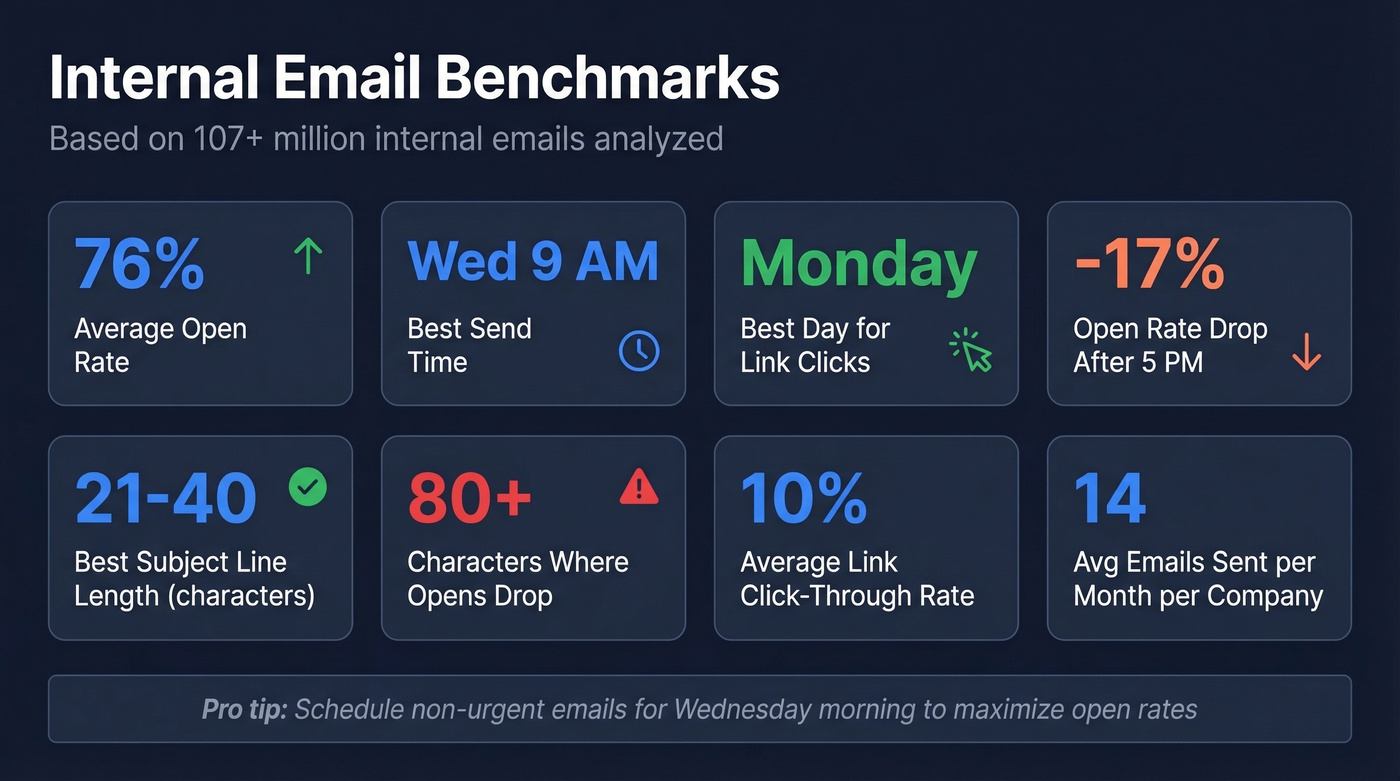
| Metric | Benchmark |
|---|---|
| Average open rate | 76% |
| Best send time | Wednesday, 9 AM |
| Best day for link clicks | Monday |
| Open-rate drop after 5 PM | 17% |
| Best subject line length | 21-40 characters |
| Open-rate drop threshold | 80+ character subjects |
| Average internal sends | 14 emails/month per company |
| Average link click-through rate | 10% |
The Wednesday 9 AM finding is particularly useful for internal comms teams. The Monday click-through peak makes sense too - people are in planning mode and more likely to act on links. And that 17% drop after 5 PM confirms what everyone suspects: emails sent at 6:30 PM get buried under the next morning's avalanche. If it's not urgent, schedule it for morning. (For outbound, timing is different - see best time to send cold emails.)
How Email Format Changes by Region
American directness doesn't translate everywhere.
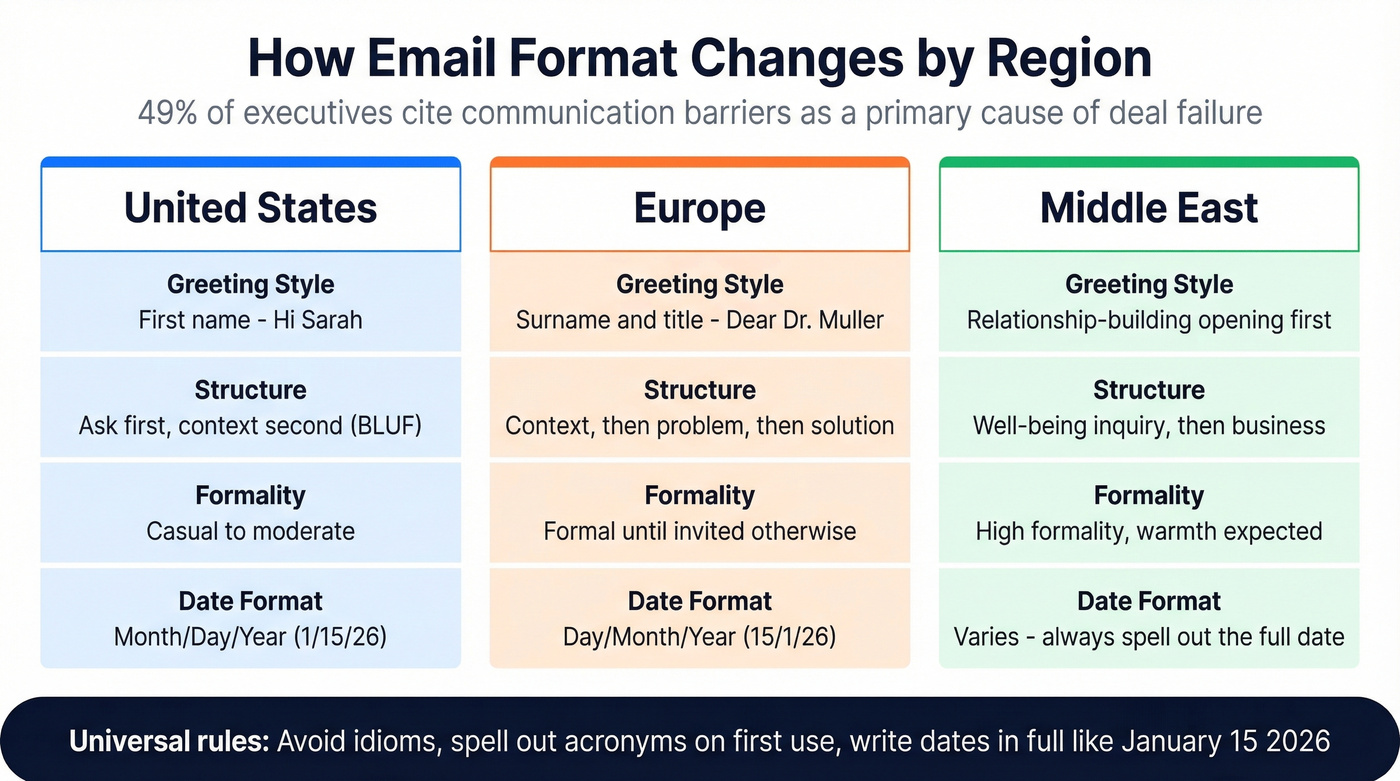
In the U.S., putting your ask in the first two sentences and using first-name greetings is standard. In much of Europe, you use surnames and titles until explicitly invited to do otherwise, and the email follows a logical "context then problem then solution" arc. In the Middle East, a relationship-building opening - asking about well-being before business - isn't just polite, it's expected.
This isn't cultural trivia. An Economist Intelligence Unit study found that 49% of executives cite communication barriers as a primary cause of deal failure. That's nearly half of all cross-border deals at risk because someone didn't adapt their message structure.
A few practical rules: avoid idioms (nobody outside the U.S. knows what "circle back" means intuitively), spell out acronyms on first use, and write dates in full - January 15, 2026, not 1/15/26, which reads as November 15 in most of Europe. When in doubt, match or exceed the formality of the most senior person in the thread.
Email Disclaimers and Compliance
No U.S. federal or state law mandates a general disclaimer on business emails. So why does every corporate email have one?
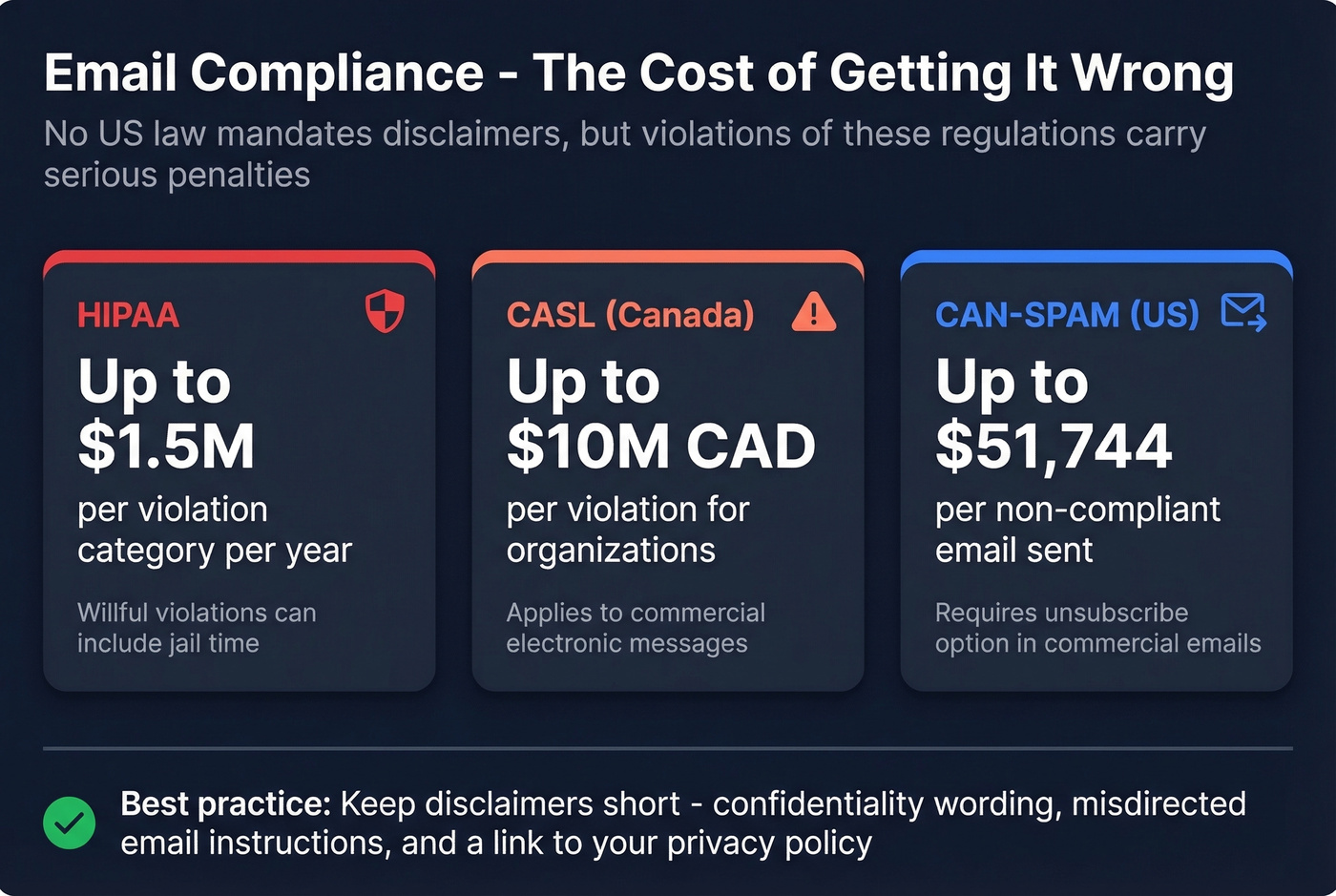
Risk reduction and governance. In regulated industries, disclaimers support confidentiality protocols and guide misdirected recipients on what to do. They don't replace actual compliance measures - a confidentiality disclaimer alone doesn't make an email HIPAA-compliant - but they're part of the framework. The stakes for violations are real: HIPAA willful violations can result in fines up to $1.5M and jail time, Canada's CASL carries fines up to 10M CAD, and CAN-SPAM requires unsubscribe options for commercial emails.
Keep disclaimers short: confidentiality wording, misdirected-email instructions, and a link to your privacy policy. Nobody reads a 200-word legal block.
Corporate Email Templates
Introduction Email
When to use: First contact with a new colleague, vendor, or partner.
Subject: [INTRO] Sarah Chen - New Marketing Ops Lead
Hi David,
I'm Sarah Chen, the new Marketing Ops lead starting this week. I'll be your primary contact for campaign analytics and attribution reporting. I'd love 20 minutes this week to align on priorities - does Thursday at 2 PM work?
Best, Sarah Chen
Escalation Email
This is the template you'll reach for when an issue has stalled and needs higher-level intervention. The key is specificity - name the blocker, quantify the impact, and give a clear deadline. Vague escalations get vague responses.
Subject: [ACTION REQUIRED] Vendor onboarding blocked - need approval by Friday
Hi Maria,
The Acme vendor onboarding has been stalled for two weeks. I've followed up with procurement three times (last on Jan 12) without resolution. The delay is pushing our Q1 launch at risk by 10 days. Could you approve the expedited review by Friday COB so we can stay on track?
Thanks, James Park
Executive Update
When to use: Briefing a senior leader who needs the bottom line fast.
Subject: [FYI] Q1 pipeline - 12% above target
Hi Tom,
Q1 pipeline is at $4.2M, 12% above our $3.75M target. Two enterprise deals ($800K combined) are in final negotiation. One risk: the EMEA team is 8% behind - I'm meeting with their lead Thursday to course-correct. No action needed from you unless the EMEA gap concerns you.
Best, Rachel Nguyen
Cross-Cultural Outreach
Skip this template if all your contacts are domestic. But if you're reaching out to formal European or international recipients for the first time, the structure shift matters - context before ask, title before first name, and a softer close.
Subject: Partnership inquiry - Meridian Solutions and Weber GmbH
Dear Dr. Weber,
I hope this message finds you well. I'm writing to explore a potential partnership between our organizations in the data compliance space. I've reviewed Weber GmbH's recent work on EU data governance and believe there's meaningful alignment. Would you be available for a 30-minute call the week of January 20?
With kind regards, Daniel Torres
Of course, structure only matters if the email reaches the right person. Before sending cold outreach, we've found it's worth verifying the address first - Prospeo checks emails in real time with 98% accuracy so your carefully structured message doesn't bounce. If you're building lists from names, name to email workflows can speed things up.
Finding the right corporate email format is half the battle. Finding the actual verified email address is the other half. Prospeo gives you 143M+ verified business emails at $0.01 each - with catch-all handling and spam-trap removal built in.
Great structure deserves a real inbox. Find any corporate email in seconds.
Five Mistakes That Kill Readability
1. Vague subject lines. "Quick Question" and "Following Up" tell the reader nothing. They get buried behind emails with actual context in the subject. Be specific: what, for whom, by when. If you need inspiration, pull from email subject line examples.
2. Wall-of-text body. Your reader scans in under 15 seconds. A single unbroken paragraph of 200 words doesn't get read - it gets skimmed, misunderstood, or ignored entirely. Break it up.
3. Burying the ask. If your request lives in paragraph four, most readers never reach it. BLUF exists for a reason.
4. Wrong formality level. Too casual with a C-suite executive reads as careless. Too formal with a peer you Slack with daily reads as weird. Match the audience.
5. Missing signature. No name, no title, no phone number. It looks unprofessional and forces the recipient to hunt for context. Research from Power Writing suggests people think their emails are understood 90% of the time - but nearly half are actually misinterpreted. A complete signature at least eliminates the "who is this person?" confusion.
Let's be honest about the through-line across all five: respect the reader's time. Every structural choice in a business email either saves them seconds or wastes them. The emails that get read, answered, and acted on are the ones that make the reader's job easier.
FAQ
How long should a corporate email be?
Keep routine emails to 80-100 words - roughly 5-7 sentences covering your purpose, essential context, and a clear CTA. For longer messages, add an executive summary in the first two sentences so the reader gets the bottom line immediately. Workshop's data shows 21-40 character subject lines perform best, so apply the same brevity principle throughout.
What's the difference between BLUF and SCRAP?
BLUF puts your ask in the first sentence - ideal for routine requests under 100 words. SCRAP (Situation, Complication, Resolution, Action, Politeness) adds narrative structure for complex communications like executive briefings or cross-functional proposals. Use BLUF for daily emails; switch to SCRAP when context is essential for the reader to approve or act.
Do corporate emails legally require a disclaimer footer?
No U.S. federal or state law mandates a general disclaimer on business emails. Disclaimers are standard practice in regulated industries like finance and healthcare, where they support confidentiality protocols. HIPAA violations carry fines up to $1.5M, so disclaimers serve as one layer of a broader compliance framework - not a legal shield on their own.