

CRM Opportunity Management: Templates, Benchmarks & the Process Most Teams Get Wrong
It's Monday morning. The forecast call starts in 20 minutes, and your VP of Sales is scrolling through a pipeline that hasn't been updated since last Thursday. Three deals show "Verbal Commit" with close dates from two months ago. The CFO wants a number. The number is fiction.
Over 50% of revenue leaders missed a forecast at least twice in the past year - and the root cause isn't bad luck. It's broken CRM opportunity management: stale stages, missing fields, and deals that exist only in a rep's imagination.
The Short Version
Build pipeline stages with objective, buyer-validated exit criteria. If a rep can advance a deal without proving the buyer did something, your pipeline is a wish list. Operationalize MEDDIC inside your CRM fields - not in reps' heads, not in a Google Doc, not in tribal knowledge. And fix the data layer, because your opportunities are only as useful as the contact data behind them. One contact per deal means you're single-threaded and blind to the buying committee.
What Is Opportunity Management in a CRM?
Opportunity management is the discipline of tracking qualified deals through your sales pipeline from first qualification to close. It's the engine behind every deal management workflow your team runs.
The distinction that trips people up: lead management tracks people and accounts. Opportunity management tracks deals with dollar values. A lead becomes an opportunity when there's a qualified reason to believe money will change hands and you can attach a number to it. The lifecycle flows from prospect identification through qualification, follow-up, proposal, contract, and into post-sale expansion. That last piece matters more than most teams realize - expansion revenue lives inside the same discipline, not a separate process.
Why Most Teams Get It Wrong
Your CRM isn't the problem. Your process is.
Stale opportunities that never die. Deals sit in "Discovery" or "Proposal Sent" for months with zero activity. Nobody closes them out because reps don't want to shrink their pipeline number, and managers don't enforce hygiene. We've seen pipelines where 40% of open opportunities had no logged activity in 60+ days.
Managers manually chasing reps for updates. If your forecast process involves Slacking each rep to ask "what's happening with the Acme deal?", you've built a system that scales with headcount, not with process. That's expensive and fragile.
Standard stages that don't fit the actual sales motion. Long enterprise and consulting cycles often need stages for RFP response and operational verification. Teams force-fit deals into generic stages, and forecasting breaks down because the map doesn't match the territory.
All three problems share the same fix: objective stage gates, mandatory fields, and clean data.
Pipeline Stage Template with Exit Criteria
Below is a practical 9-stage template inspired by Avoma's pipeline model and stage-gate principles designed to prevent forecast chaos.
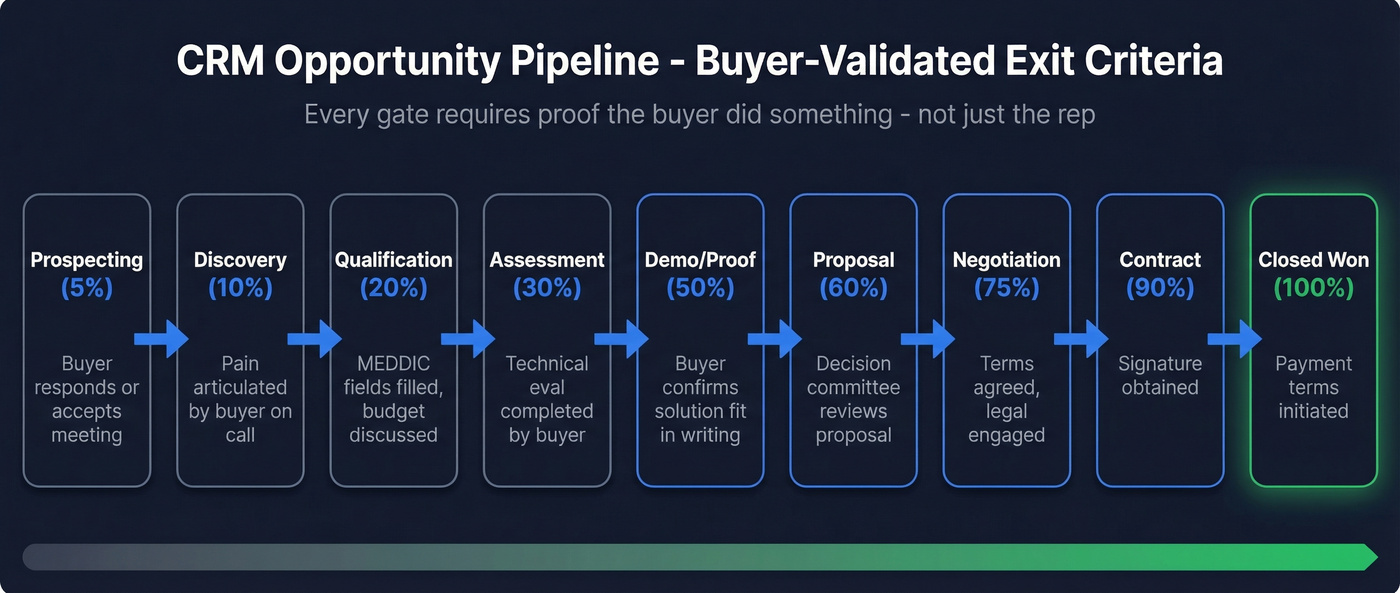
Three rules for every exit criterion: it must be objective and binary (yes or no, not "seems interested"), buyer-validated (the buyer did something, not just the rep), and evidence-based (a documented activity, artifact, or commitment). Evidence comes in three forms - activity evidence like a call that happened, artifact evidence like a document that was shared, and commitment evidence where the buyer agreed to something specific.
| Stage | Entry Criteria | Exit Criteria (Buyer-Validated) | Probability |
|---|---|---|---|
| Prospecting | ICP match confirmed | Buyer responds or accepts meeting | 5% |
| Discovery | Meeting scheduled | Pain articulated by buyer on call | 10% |
| Qualification | Pain confirmed | MEDDIC fields filled; budget discussed | 20% |
| Assessment | Buyer shares requirements | Technical eval completed by buyer | 30% |
| Demo/Proof | Requirements documented | Buyer confirms solution fit in writing | 50% |
| Proposal | Solution fit confirmed | Decision committee reviews proposal | 60% |
| Negotiation | Proposal accepted in principle | Terms agreed; legal engaged | 75% |
| Contract | Redlines exchanged | Signature obtained | 90% |
| Closed Won | Signed contract | Payment terms initiated | 100% |
If your reps can advance a deal to "Proposal Sent" without confirming the economic buyer, your pipeline is fiction.
For enterprise cycles, add stages for RFP response and operational verification between Assessment and Demo. Velocity sales motions with sub-30-day cycles can collapse Qualification and Assessment into a single stage. The framework flexes - the discipline of buyer-validated gates doesn't.
MEDDIC Mapped to CRM Fields
MEDDIC is the qualification framework that separates pipeline theater from pipeline reality. The six components: Metrics, Economic Buyer, Decision Criteria, Decision Process, Identify Pain, and Champion. Teams selling into enterprise should add Paper Process and Competition for MEDDPICC - worth it when legal review and procurement kill more deals than competitors do.
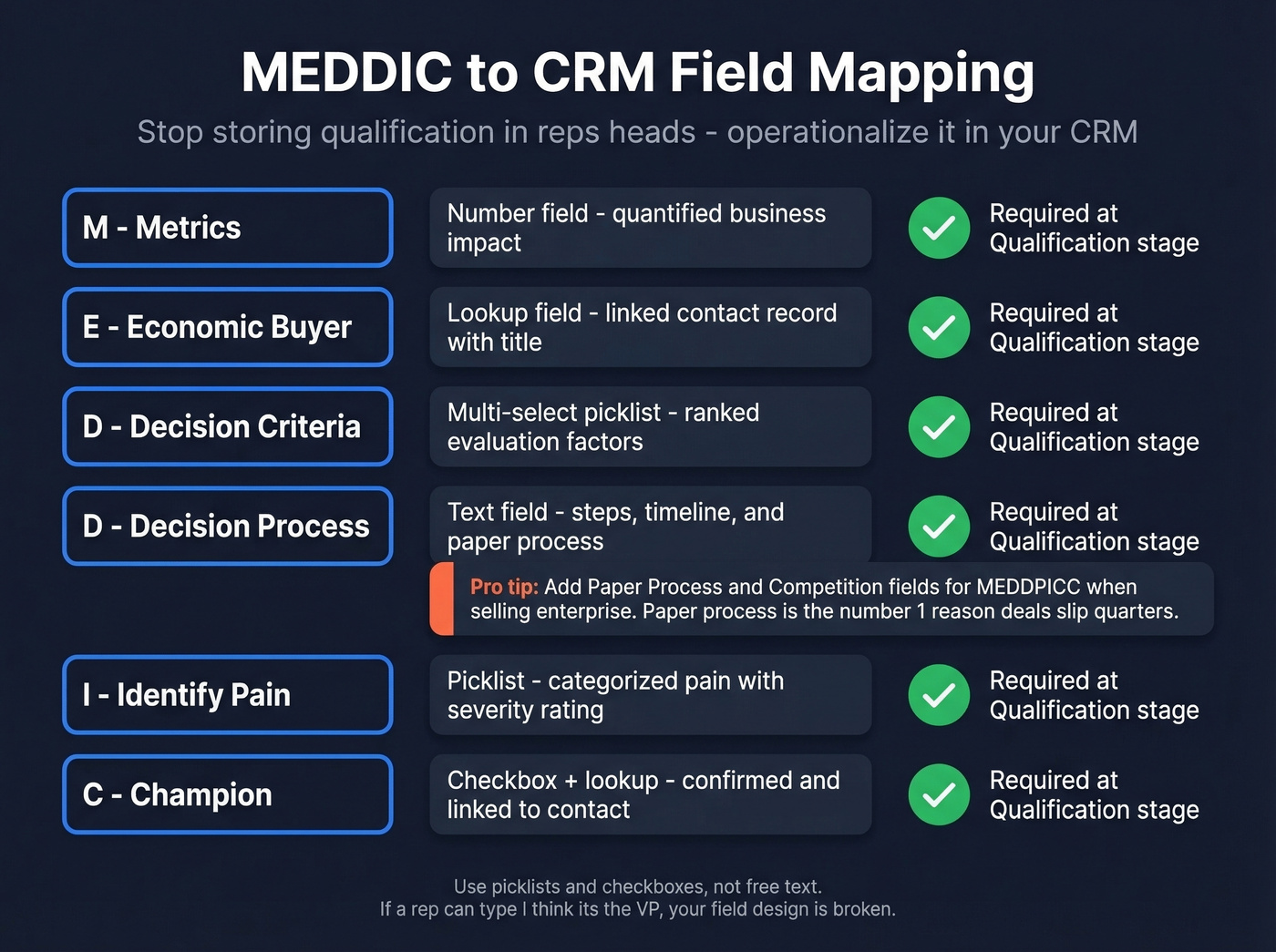
Paper process is the #1 reason contracts get postponed and deals slip out of a quarter. If you haven't mapped procurement, legal review, and signature authority into your Decision Process field, you're guessing at your close date.
Here's how to operationalize it:
Audit your current qualification flow. What fields exist? What's actually filled in? Most teams find that reps routinely skip qualification fields because nothing enforces completion. In our experience, the gap between "fields that exist" and "fields that get used" is enormous.
Create MEDDIC-aligned custom fields on the opportunity object. Not free-text - use picklists and required fields. "Economic Buyer Identified" should be a checkbox, not a notes field where someone types "I think it's the VP." (If you need help finding the right stakeholders, start with technical buyer vs economic buyer.)
Embed MEDDIC in every deal review. If your weekly pipeline call doesn't walk through Champion strength and Decision Process status, it's just a status update meeting. One benchmark worth pinning to the wall: top-closing B2B reps speak 43% of the time on discovery calls versus 65% for average performers. If your reps are talking more than listening during qualification, they're not uncovering pain - they're pitching.

Your MEDDIC fields are useless if you're single-threaded on one contact per deal. Prospeo maps the full buying committee with 300M+ profiles, 30+ filters for job role, seniority, and department - so every opportunity has multi-threaded coverage. 98% email accuracy means your outreach actually lands.
Stop managing opportunities against contacts that bounce.
Benchmarks: What Good Looks Like
Numbers give you something to manage against. Without them, "we're doing fine" is just vibes.
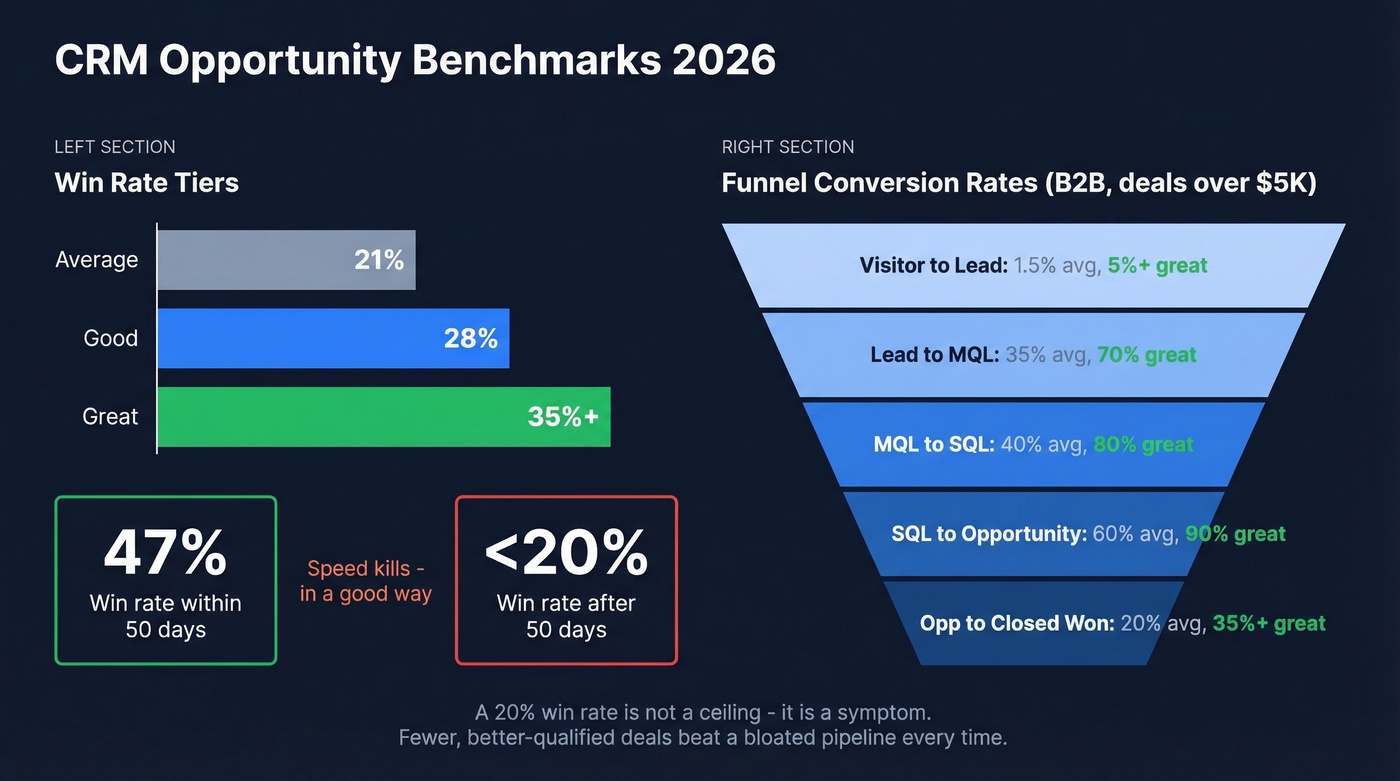
Win Rate & Cycle Length
| Metric | Benchmark |
|---|---|
| Win rate (avg) | 21% |
| Win rate (good) | 28% |
| Win rate (great) | 35%+ |
| Win rate within 50 days | 47% |
| Win rate after 50 days | <20% |
| Cycle length increase since 2021 | +32% |
| Teams with 1-2 quarter avg cycle | 34% |
Funnel Conversion Rates (B2B, deals over $5K)
| Stage | Average | Good | Great |
|---|---|---|---|
| Visitor to Lead | 1.5% | 3% | 5%+ |
| Lead to MQL | 35% | 50% | 70% |
| MQL to SQL | 40% | 60% | 80% |
| SQL to Opportunity | 60% | 75% | 90% |
| Opp to Closed Won | 20% | 28% | 35%+ |
A 20% win rate isn't a ceiling - it's a symptom. One Gradient Works customer reduced rep book sizes and saw win rates climb from 13% to over 20% in under a year. The lesson: fewer, better-qualified deals beat a bloated pipeline every time. (If you want more baselines, compare against broader sales pipeline benchmarks.)
Pipeline Hygiene Playbook
Clean pipelines don't happen by accident. They happen because someone builds the rules and enforces them. When hygiene breaks down, you get three forecast failure modes: premature progression where deals move forward without real buyer commitment, stagnant deals that should be closed-lost but linger for months, and stage inflation where reps park deals at higher stages to hit pipeline targets. (This is one of the most common sales pipeline challenges we see.)
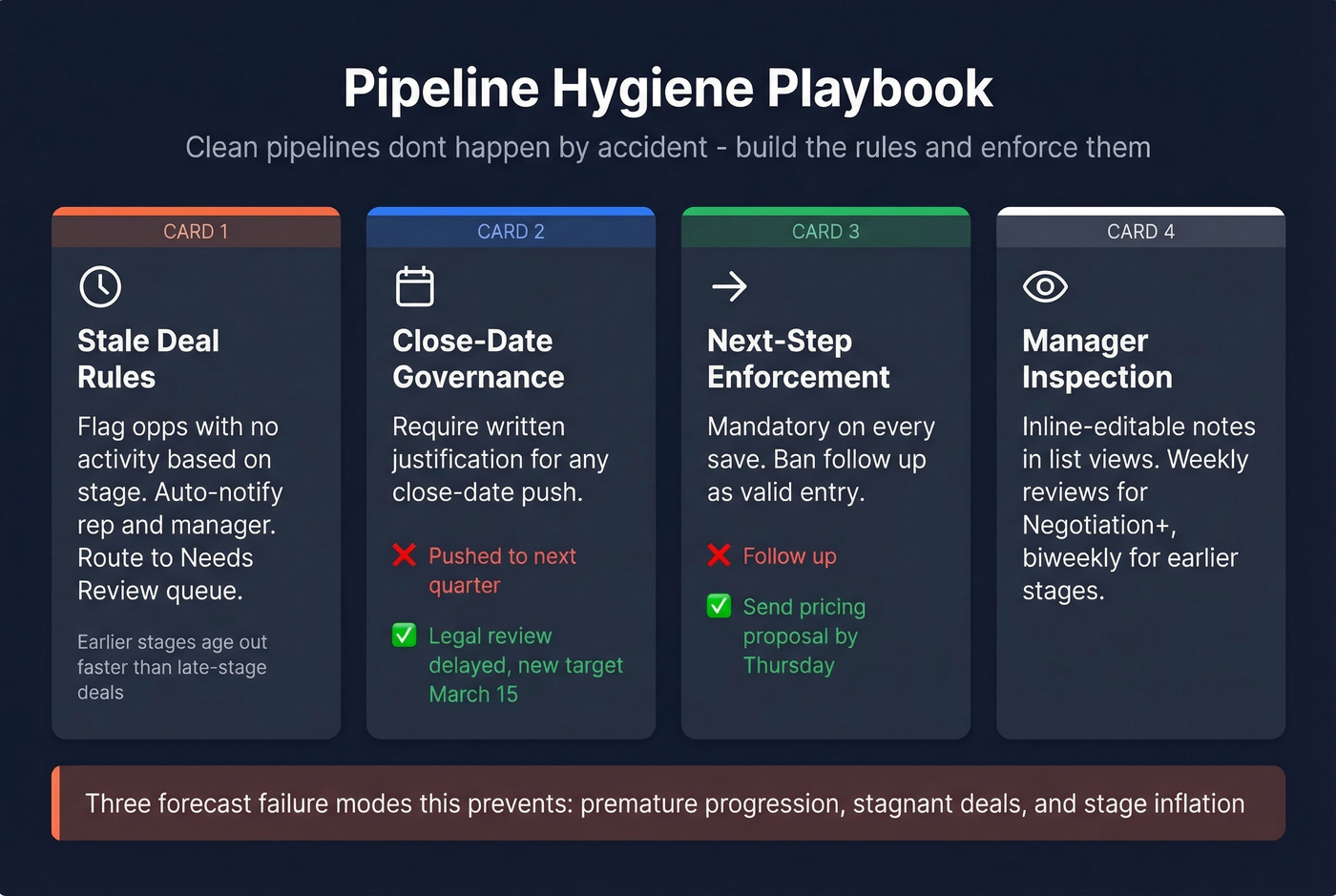
Stale deal rules. Flag opportunities with no recent activity based on stage - earlier stages should age out faster than late-stage deals. Auto-notify the rep and manager. In Salesforce, use automation to flag opportunities sitting too long without logged activity and route them to a "Needs Review" queue.
Close-date governance. Require a written justification for any close-date push. "Pushed to next quarter" isn't a justification. "Legal review delayed; new signature target March 15" is.
Next-step enforcement. Make the "Next Step" field mandatory on every save. Ban "follow up" as a valid entry. A next step is specific: "Send pricing proposal by Thursday" or "Schedule technical review with IT lead." The r/sales community consistently flags vague next steps as the single biggest pipeline hygiene failure, and we agree - if you can't articulate the next action, you don't have a deal. (If you need language, keep a set of sales follow-up templates handy.)
Manager inspection workflows. Build inline-editable notes in list views so managers can review and annotate deals without chasing reps on Slack. Structured update cadences - weekly for deals in Negotiation+, biweekly for earlier stages - replace ad-hoc conversations.
Let's be honest: if your pipeline review is a 90-minute meeting where reps read deal updates off sticky notes, you don't have a process. You have a performance.
Deal Tracking Automation
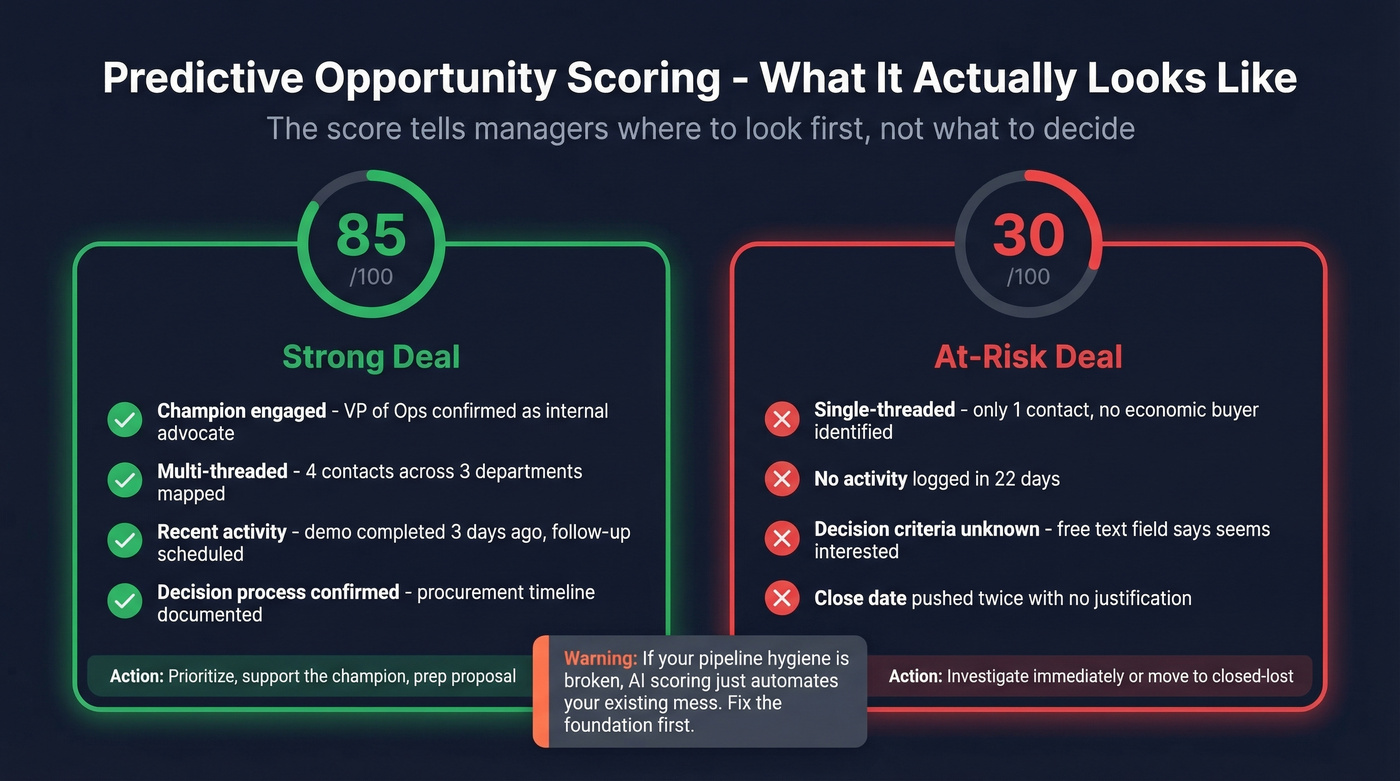
Predictive opportunity scoring uses machine learning to assign a likelihood-to-close score to every deal. It typically requires two years of CRM history plus conversation and meeting data to build a reliable model. Skip this if you don't have that data foundation - you'll just be scoring noise. (If you're evaluating options, start with sales forecasting solutions.)
Beyond scoring, deal tracking automation handles the repetitive work that erodes rep selling time: auto-advancing stages when exit criteria are met, triggering alerts when deals stall past stage-specific thresholds, and syncing activity data from email and calendar so the opportunity record stays current without manual logging.
In practice, a deal with strong champion engagement, recent activity, and a confirmed decision process scores 85/100, while a deal with a single contact and no activity in three weeks scores 30/100. The score doesn't replace judgment - it tells managers where to look first.
Here's the thing: predictive scoring is powerful, but if your pipeline hygiene is broken, AI scoring just automates your existing mess. Garbage stages, stale close dates, and missing fields produce garbage scores. Fix the foundation first, then layer on AI.
The Data Quality Gap
Here's the gap most guides on CRM opportunity management skip entirely: your opportunity records are only as useful as the contact data attached to them.
If your opp has one contact - the person who attended the demo - and you haven't mapped the economic buyer, the champion, or the legal approver, you're single-threaded and flying blind. Speaking to the wrong stakeholders is a recurring deal-killer, which is exactly what happens when your opportunity record has one contact and no buying committee map. 97% of leaders say better data improves forecast accuracy, and they're right - you can't forecast a deal you can't see.
Multi-threading requires accurate contact data for every stakeholder on the buying committee. Prospeo fills this gap by enriching opportunity contacts directly inside Salesforce and HubSpot, returning 50+ data points per contact at a 98% email accuracy rate with a 7-day data refresh cycle. Snyk's sales team runs this workflow: 50 AEs prospecting with Prospeo, generating 200+ new opportunities per month, with bounce rates dropping from 35-40% to under 5%. (If you're comparing vendors, see our roundup of data enrichment services.)
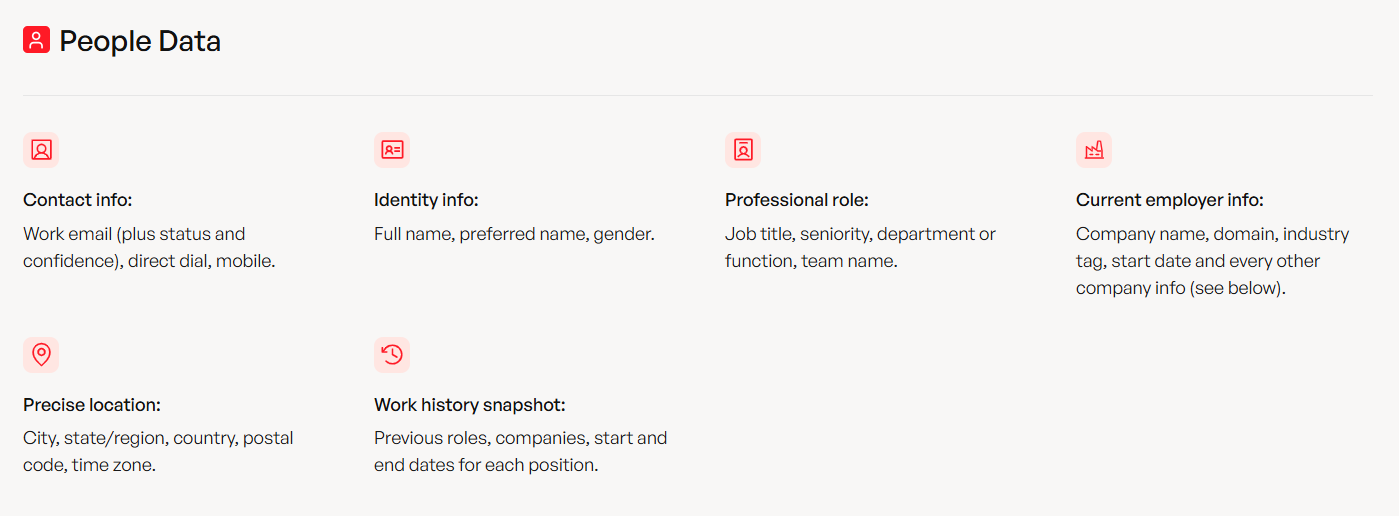
Stale CRM data is why 50% of revenue leaders miss forecast. Prospeo refreshes every record on a 7-day cycle - not the 6-week industry average. Enrich your CRM opportunities with 50+ data points per contact at 92% match rate, so every deal review is grounded in reality, not tribal knowledge.
Enrich your pipeline with data that's never more than a week old.
Best CRMs for Deal Management
The CRM you pick matters less than how you configure it. That said, here's how the major platforms stack up for opportunity management specifically. (If you want more options, browse these examples of a CRM.)
| CRM | Best For | Opp Mgmt Highlights | Pricing |
|---|---|---|---|
| Salesforce | Enterprise teams | Forecast categories, field history tracking, contact roles | Starts at $25/user/mo |
| HubSpot Sales Hub | Teams under 50 reps | Fast setup, free tier, deal pipelines | Free tier; paid from ~$20/user/mo |
| Zoho CRM | Customization-heavy orgs | Deep customization, Zia AI | Free tier; paid from ~$20/user/mo |
| Pipedrive | SMBs wanting simplicity | Visual pipeline, activity-based selling | Starts at $14/seat/mo |
| Dynamics 365 | Microsoft-ecosystem orgs | AI insights, Microsoft 365 integration | ~$65-$135/user/mo |
| Freshsales | Budget-conscious teams | Built-in phone, AI scoring | Free tier; paid from ~$10/user/mo |
Salesforce is the default for enterprise - the forecast categories, field history tracking, and contact roles give you the deepest toolkit. HubSpot is the fastest to set up for mid-market teams and the free tier is genuinely usable for small squads. Pipedrive wins on simplicity and price for SMBs who want a visual pipeline without configuration overhead. For teams already deep in the Microsoft ecosystem, Dynamics 365 removes integration friction, but the learning curve is steeper than HubSpot or Pipedrive.
FAQ
What's the difference between lead management and opportunity management?
Lead management tracks people and accounts before qualification - capturing, scoring, and routing. Opportunity management picks up after qualification, tracking deals with dollar values through pipeline stages to close. The handoff happens when a lead becomes a qualified deal with an estimated value and a close date.
How many pipeline stages should a CRM have?
Most B2B teams perform best with 5-9 stages. Velocity sales motions with sub-30-day cycles work well at 5-6. Enterprise cycles involving RFPs, legal reviews, and procurement need 7-9. The number matters less than exit criteria quality - every stage needs an objective, buyer-validated gate.
What's a good win rate for B2B sales?
The average sits around 20-21%. Good teams hit 28%, and top performers exceed 35%. Deals closed within 50 days win at 47%, while those dragging past that threshold drop below 20%. Speed and qualification quality are directly linked.
How do you keep opportunity data clean?
Enforce mandatory next-step fields, flag stale deals automatically based on stage-specific inactivity thresholds, and require written justification for any close-date push. For contact data, use enrichment tools to keep stakeholder records verified so your buying committee map stays current - bounce rates above 5% are a red flag that your data layer needs attention.
What is MEDDIC in sales?
MEDDIC is a six-component qualification framework: Metrics, Economic Buyer, Decision Criteria, Decision Process, Identify Pain, and Champion. It maps directly to CRM fields so qualification lives in the system, not in reps' heads. Teams running MEDDPICC add Paper Process and Competition - critical for enterprise deals where procurement and legal kill more deals than competitors do.