

CRM for Sales and Marketing: Why Most Teams Get It Wrong (and How to Fix It)
You just bought a CRM for sales and marketing alignment. Six months later, marketing says they're generating plenty of leads. Sales says those leads are garbage. Nobody can prove who's right because the data lives in two different systems and attribution is a black hole.
Sound familiar? Let's fix it.
The Alignment Gap Nobody Talks About
A recurring thread on r/marketing nails this perfectly. A practitioner running HubSpot for marketing automation and Salesforce for CRM describes a "black hole between MQL and closed-won" where nobody knows what happened to a lead after handoff. Attribution is a mess. Teams blame each other instead of fixing the process.
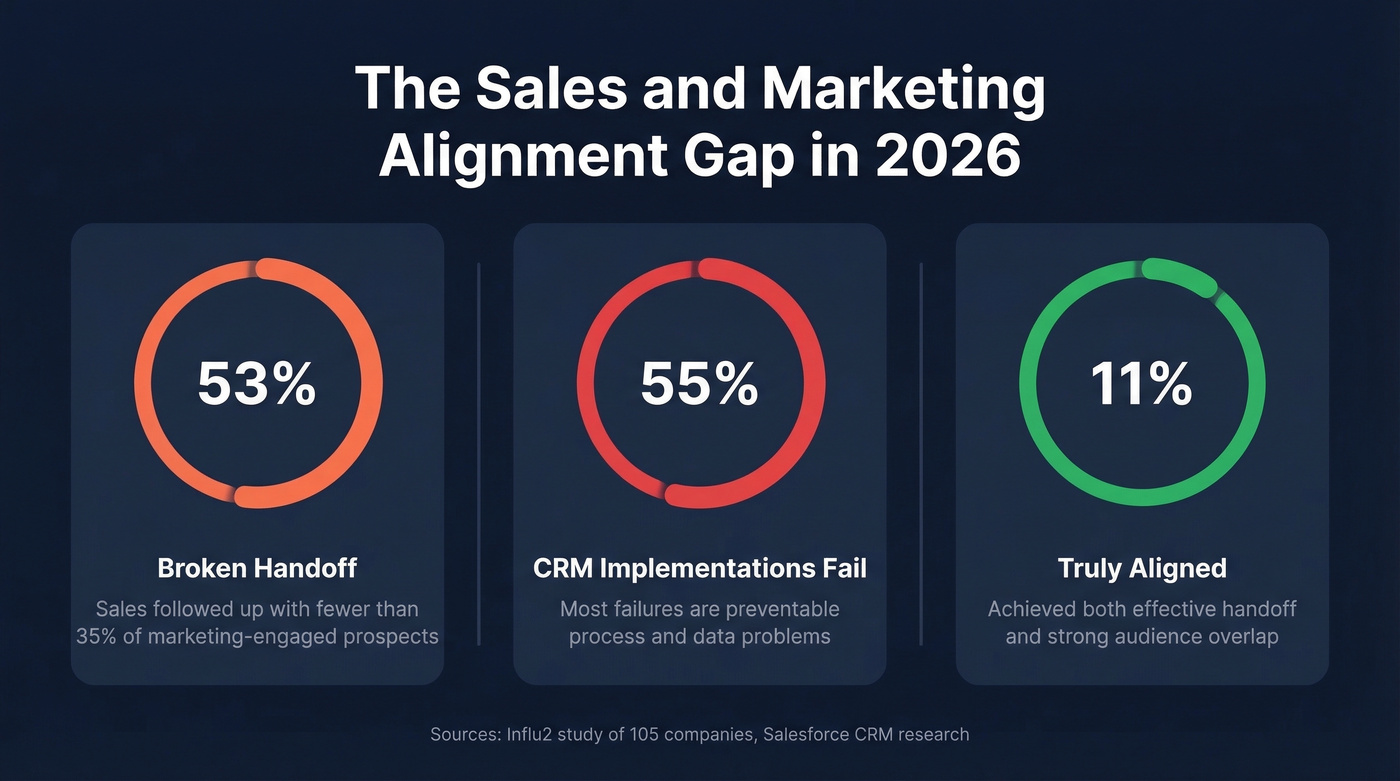
That's the norm, not the exception. An Influ2 study of 105 companies found that 53% had a broken handoff - sales followed up with fewer than 35% of marketing-engaged prospects. Only 11% achieved both effective handoff and strong audience overlap. The gap isn't a technology problem. It's a data and process problem that technology rarely solves out of the box.
What a Unified CRM Actually Means
The CRM market hit $112.91B in 2025 and is projected to reach $320.99B by 2034. But "CRM" means different things to different teams. A sales CRM manages pipeline, deals, and forecasting. A marketing CRM handles segmentation, campaigns, and lead nurturing. Unified platforms like HubSpot try to do both under one roof, while suites like Zoho One bundle CRM and marketing apps together.
Under a RevOps model, the traditional marketing-to-sales handoff is disappearing. Both teams share revenue responsibility, and the CRM is the connective tissue. For most teams under 200 people, a unified platform that combines pipeline management and marketing automation in a single workspace is the right call. Running separate systems creates exactly the black hole described above.
Why Most CRM Implementations Fail
Here's a stat that should make you uncomfortable: 55% of CRM implementations fail - and most of those failures are preventable. We've seen the same four problems kill rollouts over and over again.
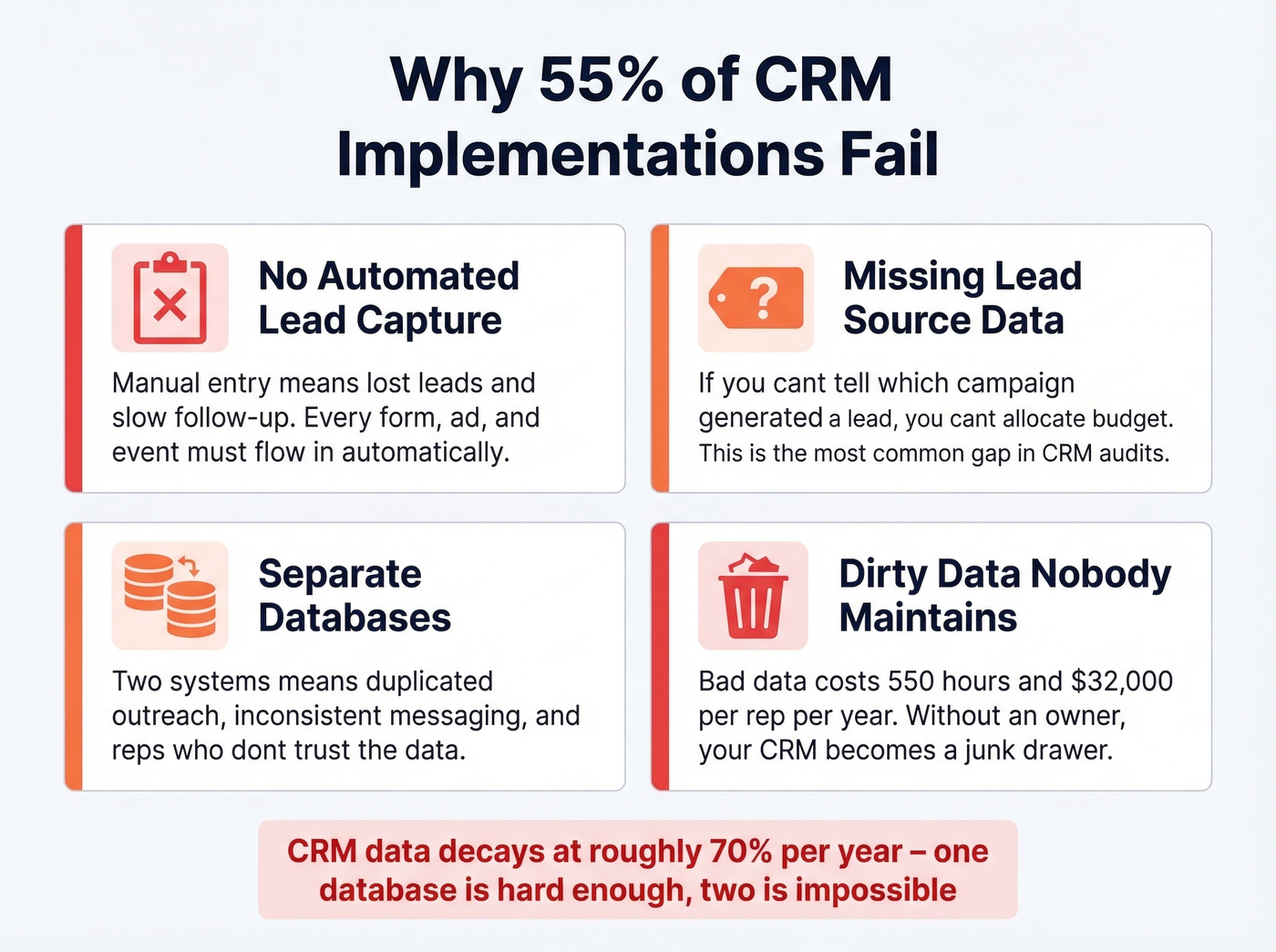
No automated lead capture. If any lead source requires manual entry, you're losing leads and slowing follow-up. Every form, ad, and event needs to flow into the CRM automatically. No exceptions. (If you're rebuilding your top-of-funnel, start with these free lead generation tools.)
Missing lead source data. If you can't tell which campaign generated a lead, you can't allocate budget. In our experience, this is the single most common gap in CRM audits - and it's a setup problem, not a software limitation. Track the right lead generation metrics so attribution isn't guesswork.
Separate databases for sales and marketing. Two systems means duplicated outreach, inconsistent messaging, and reps who don't trust the data. CRM data decays at roughly 70% per year. Maintaining one database is hard enough. If you're evaluating systems, compare a few examples of a CRM before you commit.
Dirty data nobody maintains. Bad data costs roughly 550 hours and $32,000 per sales rep per year in wasted time. If nobody owns data hygiene, the CRM becomes a junk drawer within months. We've audited CRMs where over half the email addresses bounced - at that point, your "database" is fiction. (This is exactly what data enrichment services are built to prevent.)

Dirty CRM data costs reps 550 hours and $32K per year. Prospeo's CRM enrichment returns 50+ verified data points per contact at a 92% match rate - with a 7-day refresh cycle that keeps your database accurate while competitors let theirs rot for 6 weeks.
Fix your CRM data before it kills another quarter.
What to Look For in 2026
As one SMB operator put it on r/CRM, they wanted a system that "really ties marketing and sales together" - lead scoring, behavior-triggered follow-ups, and campaign-to-revenue reporting in one place. That's the right checklist. Add multichannel support across email, social, ads, and phone, plus security that passes procurement review.
Look, 67% of teams already use AI-enabled tools for pipeline and campaign management, but 52% struggle with effective utilization. Don't buy AI features you won't configure. Buy the fundamentals first, get adoption right, then layer on intelligence.
Best CRM Platforms for Sales and Marketing in 2026
| Tool | Best For | From (per user/mo) | Key Strength |
|---|---|---|---|
| HubSpot | SMBs wanting fast setup | Free; $9-$15 | Free tier + native marketing |
| Salesforce | Complex sales orgs | $25-$550 | Deepest customization |
| Zoho CRM | Budget-conscious teams | Free; $14-$20 | Strong features, low cost |
| Pipedrive | Sales-first teams | $14 | Cleanest pipeline UX |
| ActiveCampaign | Marketing-first teams | $19 | Best-in-class automation |
| monday CRM | Visual workflow teams | Free; $12 | Board-based UI |
| Freshmarketer | Lifecycle automation | Free; $18 | Strong automation + journeys |
| Brevo | Email-heavy SMBs | Free; $9 | Cheapest paid tier |
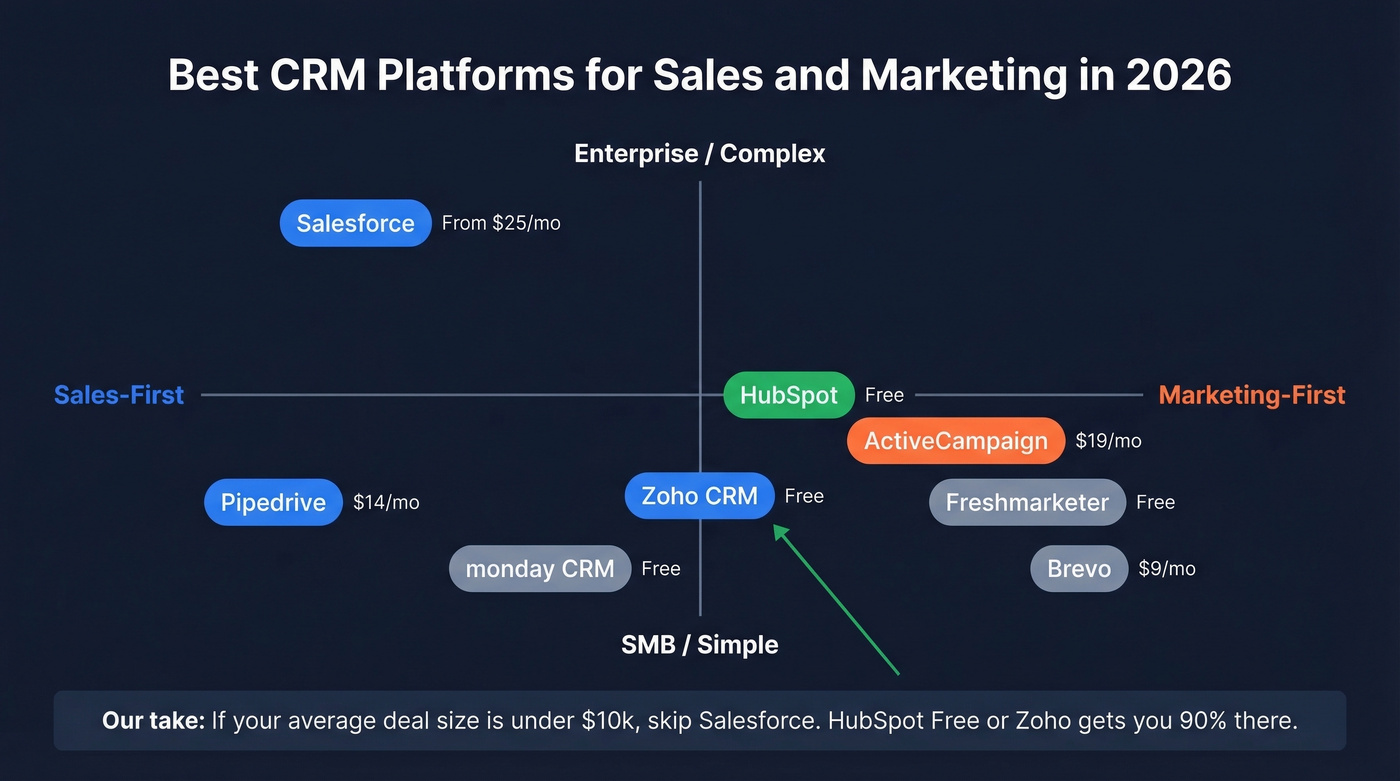
HubSpot is the fastest path to a working setup for SMBs. You can launch in days, and the free tier includes unlimited contacts and email tracking. G2 reviewers consistently praise the onboarding experience, and for good reason - it's genuinely intuitive in a way most CRMs aren't.
Salesforce is the right choice for complex orgs that need deep customization, but expect 8-12 weeks of implementation and a dedicated admin. Skip it if your team is under 50 people and your deal sizes are under $10k. Zoho CRM is a strong value play, especially for teams that want solid capabilities without enterprise-level overhead or pricing.
ActiveCampaign wins for marketing-first teams that want automation depth before pipeline management. Pipedrive is the opposite: sales-first teams that want the cleanest deal-tracking UX on the market. For micro-teams under 5 people, look at Bigin by Zoho CRM or Less Annoying CRM.
Our take: if your average deal size is under $10k, you don't need Salesforce. HubSpot's free tier or Zoho will get you 90% of the way there at a fraction of the cost and complexity.
The Data Layer Most Teams Forget
Your CRM is only as good as the data inside it. Contact data decays at roughly 70% per year - people change jobs, get promoted, switch emails. If you don't actively maintain data quality, your CRM degrades fast, and your reps stop trusting it entirely.
This is where most teams underinvest. Prospeo addresses this at the infrastructure level with 98% email accuracy, a 7-day data refresh cycle versus the 6-week industry average, and native HubSpot and Salesforce integrations. Each enrichment returns 50+ data points per contact at a 92% API match rate. One customer, Meritt, saw bounce rates drop from 35% to under 4% after adding this enrichment layer - that's the difference between a CRM your reps trust and one they ignore. (If you're diagnosing deliverability, start with email bounce rate benchmarks and fixes.)
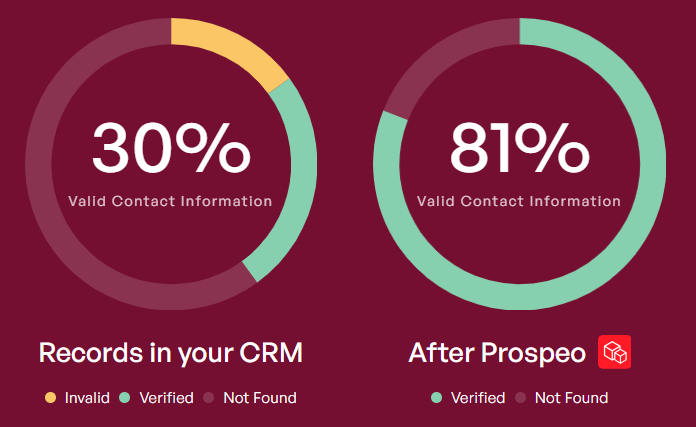
Your CRM comparison doesn't matter if the data inside is garbage. Prospeo plugs directly into HubSpot and Salesforce to verify emails at 98% accuracy, enrich contacts with 50+ data points, and keep records fresh every 7 days - all at ~$0.01 per email.
Start free, no contracts - clean data in minutes, not months.
Quick-Start Playbook
SMBs can be live in 1-4 weeks, mid-market teams in 4-12 weeks, and enterprise rollouts often take 3-6+ months. These three steps prevent the most common failures:
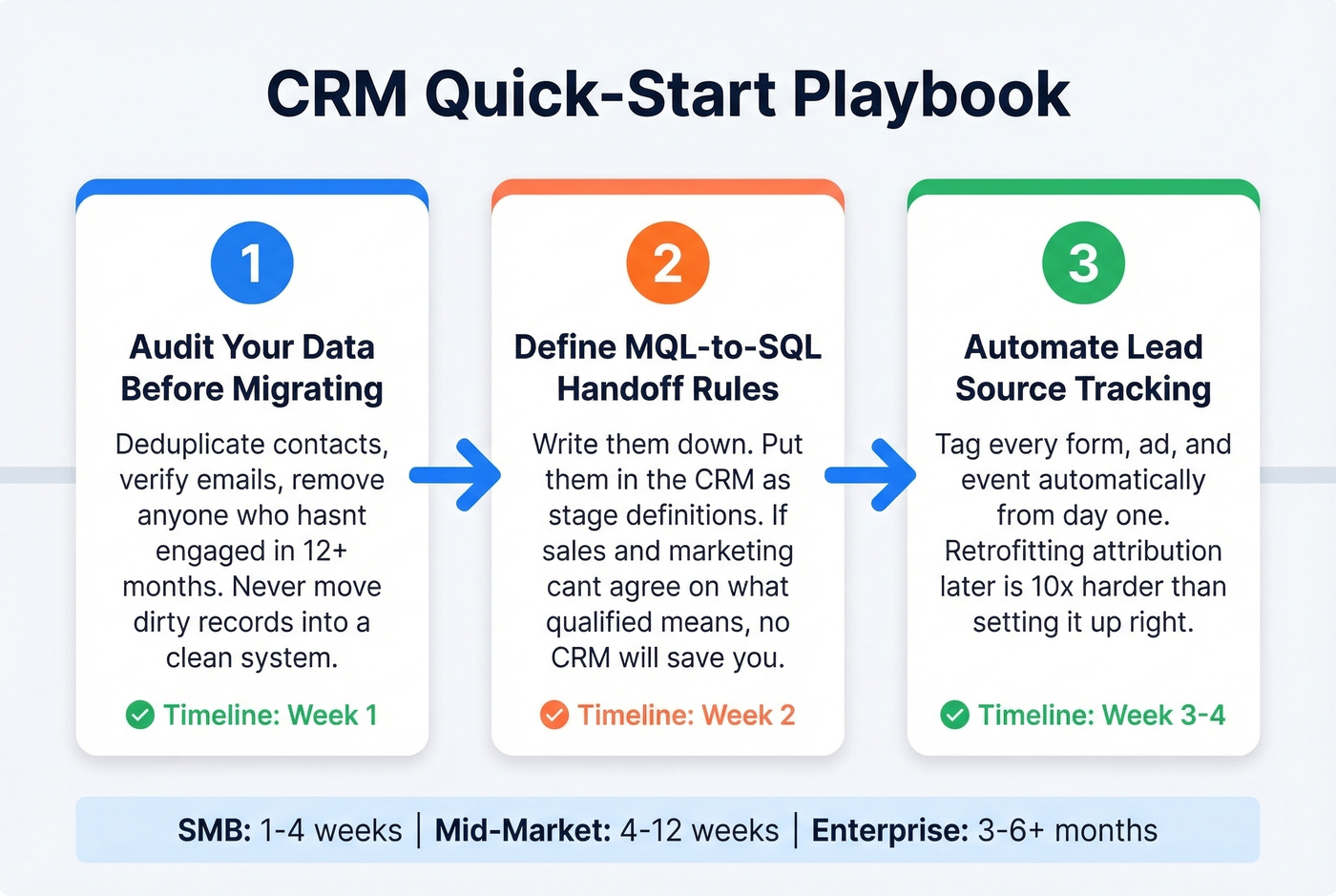
Audit your data before migrating. Deduplicate, verify emails, and remove contacts that haven't engaged in 12+ months. Don't move dirty records into a clean system - you're just relocating the mess.
Define MQL-to-SQL handoff rules both teams agree on. Write them down. Put them in the CRM as stage definitions. If sales and marketing can't agree on what a qualified lead looks like, no CRM will save you. This is the conversation most teams skip, and it's the one that matters most. (If you need a concrete framework, use a clear lead status taxonomy.)
Automate lead source tracking from day one. Every form, every ad, every event - tagged automatically. Retrofitting attribution is ten times harder than setting it up correctly, and we've watched teams spend months trying to backfill data they should have captured from the start.
FAQ
What should a CRM for sales and marketing include?
Lead scoring both teams can see, behavior-triggered workflows, campaign-to-revenue attribution, and multichannel support. Unified platforms like HubSpot or Zoho deliver this out of the box for most teams under 200 people.
How do I keep CRM data accurate over time?
CRM data decays roughly 70% per year, so run regular deduplication, enforce data entry standards, and use an enrichment tool to re-verify contacts on a recurring cycle. Without active maintenance, your database becomes unreliable within months.
What's the difference between a sales CRM and a marketing CRM?
A sales CRM tracks pipeline, deals, and forecasting. A marketing CRM handles segmentation, campaigns, and nurture sequences. Modern platforms like HubSpot and Salesforce increasingly combine both, adding engagement tools like sequencing and real-time buyer signals.
How long does CRM implementation take?
SMBs: 1-4 weeks. Mid-market: 4-12 weeks. Enterprise deployments with Salesforce often take 3-6+ months. Budget twice as much time for change management as you do for technical setup - adoption kills more rollouts than configuration does.