

Cross Selling Strategies: The Data-Driven Playbook for 2026
74% of businesses have tried cross selling. Up to 90% of those programs failed. That's not a typo - it's a Mageworx summary of Gartner research, and it should make you question everything you think you know about selling additional products to existing customers. The gap between "we should cross sell" and "we cross sell profitably" is enormous, and it's almost always a data problem, not a sales problem.
The Short Version
Fix your data first. Stale CRM records kill cross sells before they start. If your contact data is outdated, you're pitching blind.
Use triggered sequences, not batch blasts. Automated emails see 152% higher click rates than regular campaigns. Timing beats volume every time.
Measure with real formulas. If you can't calculate your cross-sell rate right now, you can't improve it. The exact formulas are below.
What Is Cross Selling?
Cross selling means recommending complementary products or services to an existing customer. You bought a phone - here's a case. You signed up for CRM software - here's the email automation add-on. It's distinct from upselling, which pushes a higher-tier version of the same product.
The reason this matters comes down to one stat: companies are 60-70% likely to sell to an existing customer versus just 5-20% for a new prospect. That's a massive efficiency gap most teams leave on the table.
| Cross Selling | Upselling | |
|---|---|---|
| Definition | Complementary product | Higher-tier version |
| Example | Phone -> phone case | 64GB -> 128GB phone |
| Goal | Expand product adoption | Increase deal value |
| Timing | Post-purchase or in-cart | During purchase decision |
Why Cross Selling Drives Revenue
McKinsey's research shows cross selling increases sales by 20% and profits by 30%. For a $10M business, that's $2M in new revenue from customers you've already acquired.
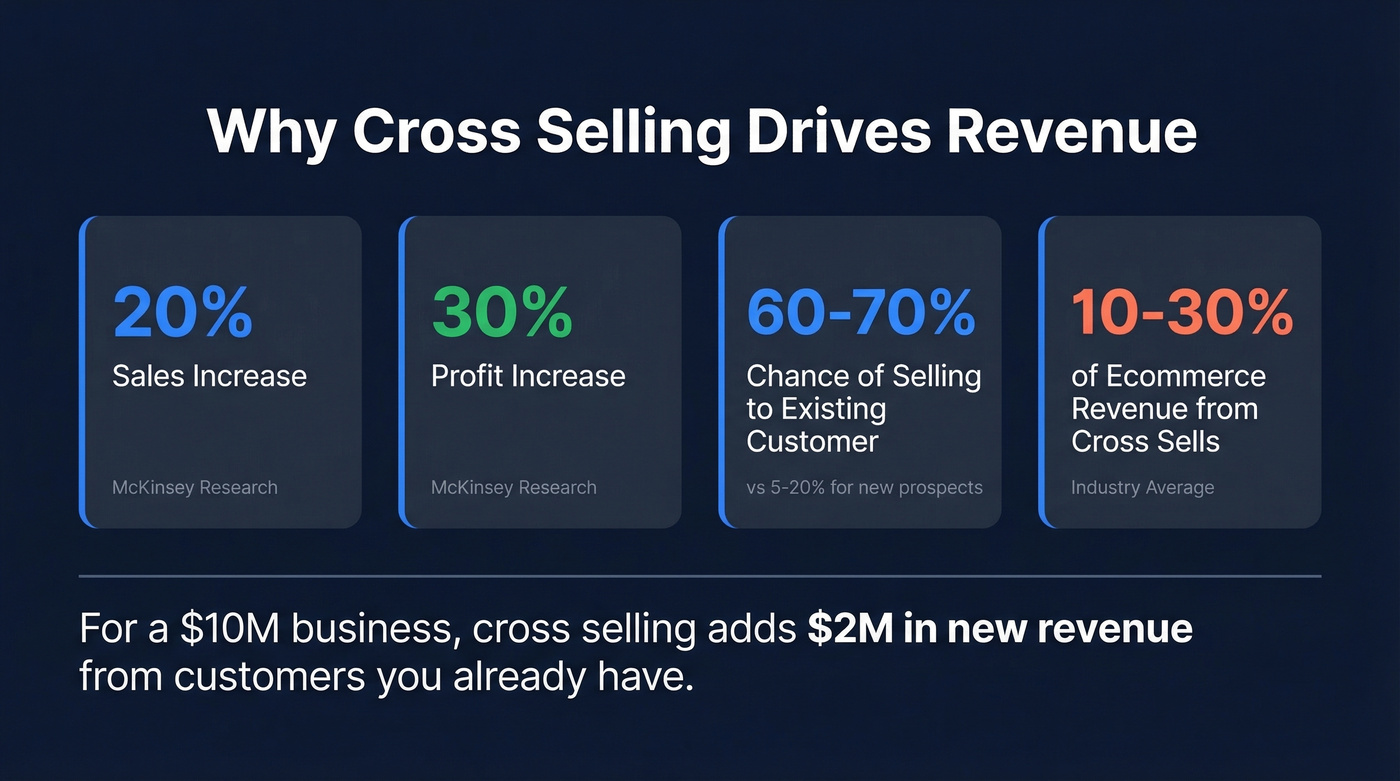
Cross selling contributes 10-30% of ecommerce revenues on average. In B2B, the math is even more compelling because acquisition costs are brutal - new B2B customer acquisition runs $1,000 to $20,000+ depending on your market. Selling additional products to an existing account costs a fraction of that.
Then there's the retention angle. Customers using multiple products churn at significantly lower rates. Every additional product creates switching costs, deepens the relationship, and makes competitors less attractive.
The Data Foundation Most Teams Skip
Here's the thing: most cross selling programs fail before a single offer gets made. The problem isn't the pitch - it's the data underneath it.
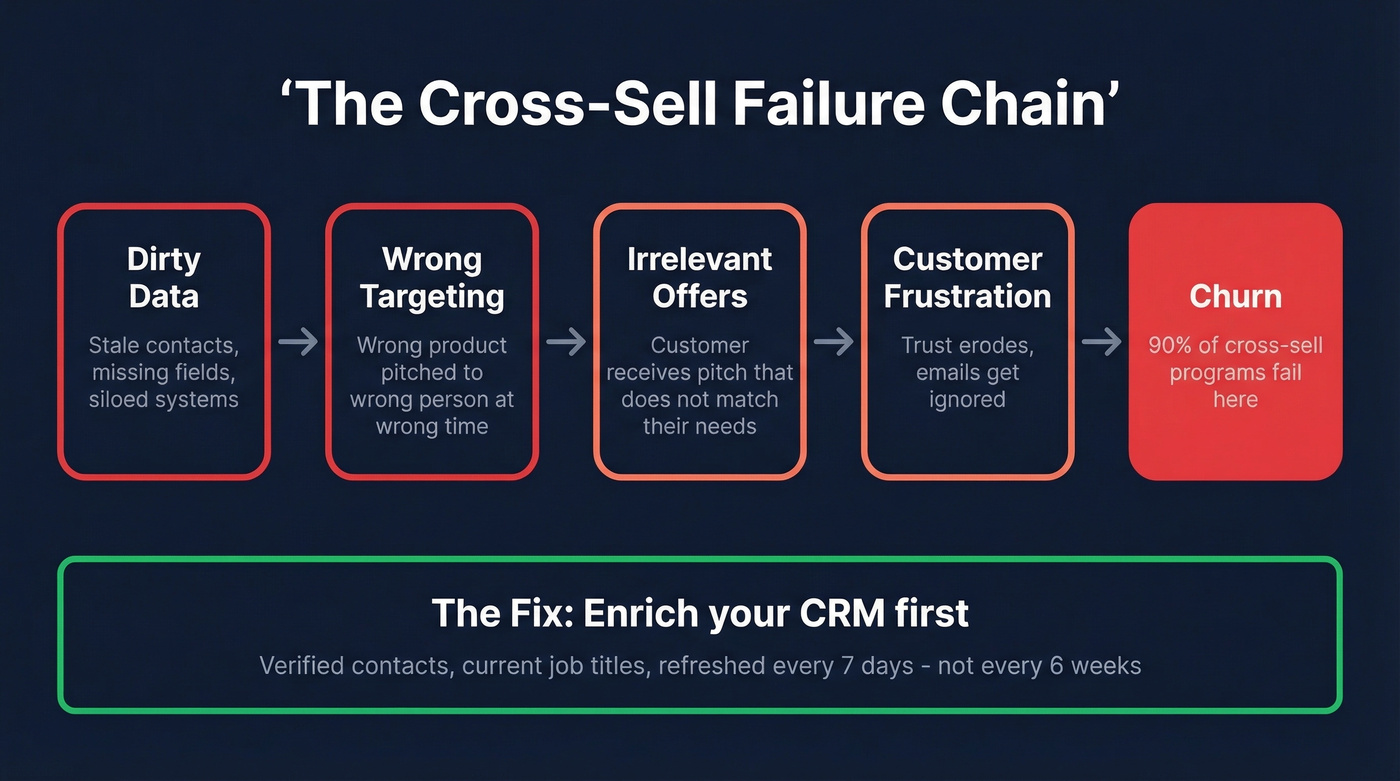
Customer data sits siloed across CRM, ERP, accounting, and marketing systems. Records are incomplete, duplicated, and stale. When your reps work off gut feel instead of actual purchase history and behavioral signals, they pitch the wrong products to the wrong contacts at the wrong time. That chain - dirty data, irrelevant offers, customer frustration, churn - is the #1 cross-sell killer.
People change roles, companies restructure, buying committees shift. If you're building cross-sell campaigns on outdated contacts, you're burning trust with every irrelevant email. We've watched teams pour months into cross-sell playbooks only to realize their CRM hadn't been enriched in over a year. Before you build a single cross-sell workflow, enrich your CRM. Prospeo's enrichment returns 50+ data points per contact at an 83% match rate, refreshed on a 7-day cycle versus the 6-week industry average - so your reps see current job titles, verified emails, and verified mobile numbers instead of ghost records.
Run through this data audit before launching any cross-sell program:
- Are contact records refreshed within the last 30 days?
- Do you have multi-threaded contacts (3+ per account)?
- Is purchase history linked to individual contacts, not just accounts?
- Can you segment by product usage, not just product ownership?
- Can you feed intent signals into your cross-sell triggers?
If you answered "no" to three or more, skip the campaign planning and fix your data layer first. Everything else is downstream.

Your cross-sell campaigns are only as good as the contacts behind them. Prospeo enriches your CRM with 50+ data points per contact at an 83% match rate - job titles, verified emails, and direct dials refreshed every 7 days, not every 6 weeks.
Stop pitching ghost records. Enrich your CRM before your next cross-sell campaign.
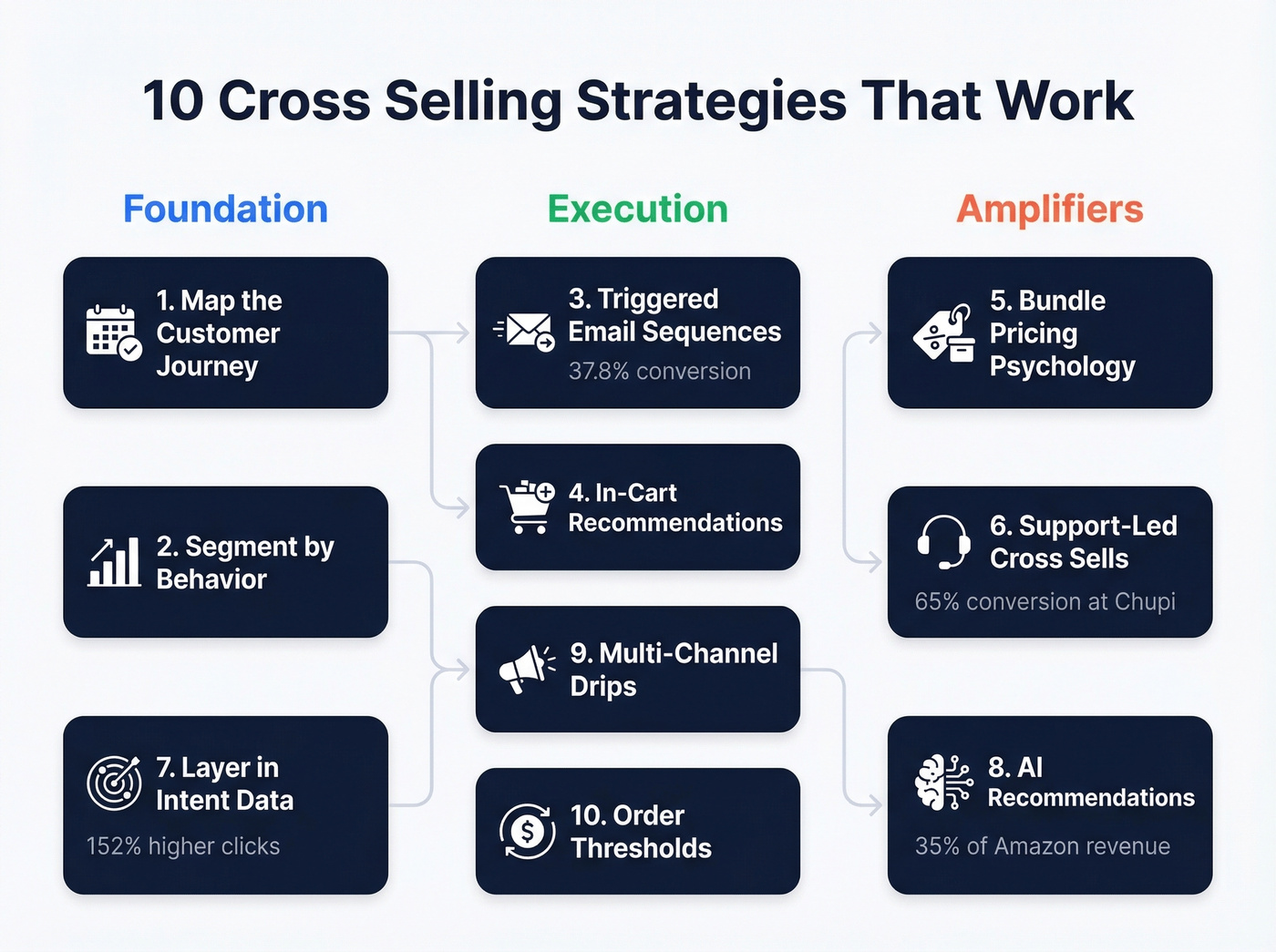
10 Cross Selling Strategies That Work
1. Map the Customer Journey First
Every product has natural cross-sell moments - onboarding, first value milestone, renewal, and support resolution. Map these before you build a single campaign. A customer who just resolved a support ticket about scaling issues is primed for your enterprise add-on. A customer in week one of onboarding isn't ready for anything except getting the first product working.
For B2B teams running ABM, cross-sell signals should feed directly into your account scoring model so the highest-potential accounts surface first.
2. Segment by Behavior, Not Demographics
Job title and industry tell you almost nothing about cross-sell readiness. Purchase history and usage patterns tell you everything.
Personalized recommendations based on actual behavior are 2.2x more effective than generic "best-selling" suggestions. Segment your customer base by what they've bought, how they use it, and what they haven't activated yet. The difference between a 5% and a 25% cross-sell rate often comes down to whether you're segmenting on firmographics or on real product engagement data.
3. Use Triggered Email Sequences
Automated emails outperform batch campaigns by a wide margin - 15% higher opens and 152% higher clicks. The key is timing. Send within 24-72 hours of a trigger event: a purchase, a feature activation, a support resolution. Calendar-based "it's been 30 days" emails feel generic because they are generic.
If you need a starting point, use proven sales follow-up templates and adapt them to post-purchase triggers.
4. Add In-Cart Recommendations
This is the lowest-friction cross sell you can run. One furniture retailer added a conditioning kit recommendation in-cart and saw AOV jump 4.6% (about $55), generating an extra $180,000 in monthly revenue in just 41 days. Order bumps convert at 37.8% on average - nearly 4 in 10 customers saying yes to a complementary product at the moment of highest purchase intent.
Limit suggestions to one or two options. Analysis paralysis kills conversion rates faster than irrelevance.
5. Bundle With Pricing Psychology
Bundles work when the discount feels like a bonus, not a bait-and-switch. Keep the add-on price within roughly 25% of the primary product's price to avoid sticker shock. Frame it as "you're getting X included" rather than "save 15% on X."
The value-add framing consistently outperforms the discount framing because it positions the complementary product as something worth having, not something you're trying to offload.
6. Let Support Lead the Cross Sell
Your support team sees the customer's actual pain in real time. That's intelligence your sales team rarely sees firsthand. Chupi, a jewelry brand, achieved a 65% conversion rate on support-led cross sells by training agents to recommend complementary pieces during service interactions. The key is equipping support with product knowledge and light incentives - not turning them into quota-carrying reps.
7. Layer in Intent Data
Calendar-based cross selling is a guess. Intent-based cross selling is a signal.
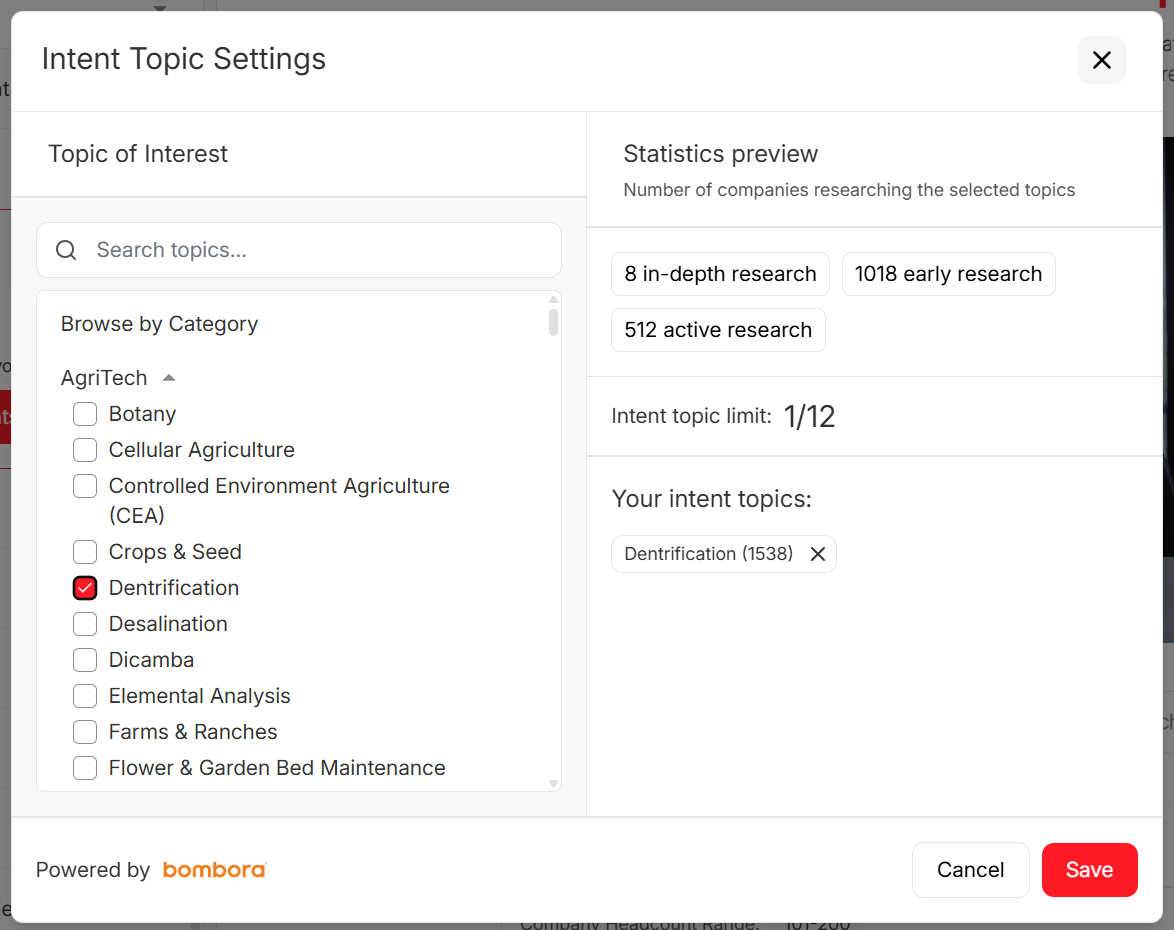
When a customer starts researching a problem your adjacent product solves, that's your window. Intent data across 15,000+ topics lets you layer buying signals into your cross-sell triggers so you're reaching out when the customer is actively looking, not when your campaign calendar says it's time. In our experience, intent-triggered cross-sell sequences outperform calendar-based ones by 3-4x on reply rates.
If you want to operationalize this, start with a simple framework for identifying buying signals.
8. Deploy AI-Powered Recommendations
Amazon attributes 35% of its total revenue to AI-driven product recommendations. You don't need Amazon's infrastructure to get started. Modern recommendation engines analyze purchase patterns, browsing behavior, and similar-customer data to surface cross-sell opportunities that static rules miss. AI-powered chat converts at 12.3% versus 3.1% for unassisted browsing - a 4x lift just from intelligent product suggestions.
To make this measurable, align your tests to core funnel metrics (not just clicks).
9. Build Multi-Channel Drip Campaigns
Email alone isn't enough. SMS cross-sell revenue grew 104% year-over-year, with SMS conversion rates up 47% YoY. Build multi-channel drip sequences that combine email and SMS, triggered by purchase events.
The first touch should deliver value - usage tips, setup guides, quick wins. The cross-sell offer comes after the customer has experienced value from the initial purchase.
10. Set Order Thresholds With Complementary Offers
"Spend $25 more to unlock free shipping + a complementary accessory" drives AOV and introduces adjacent products simultaneously. Post-purchase upsells using threshold mechanics convert at 14.6% on average. The psychology is simple: the customer is already in buying mode, and a small incremental spend feels trivial compared to the value they're already getting.
Measuring Cross-Sell Performance
You can't improve what you can't measure, and most teams measure cross selling wrong - or don't measure it at all.
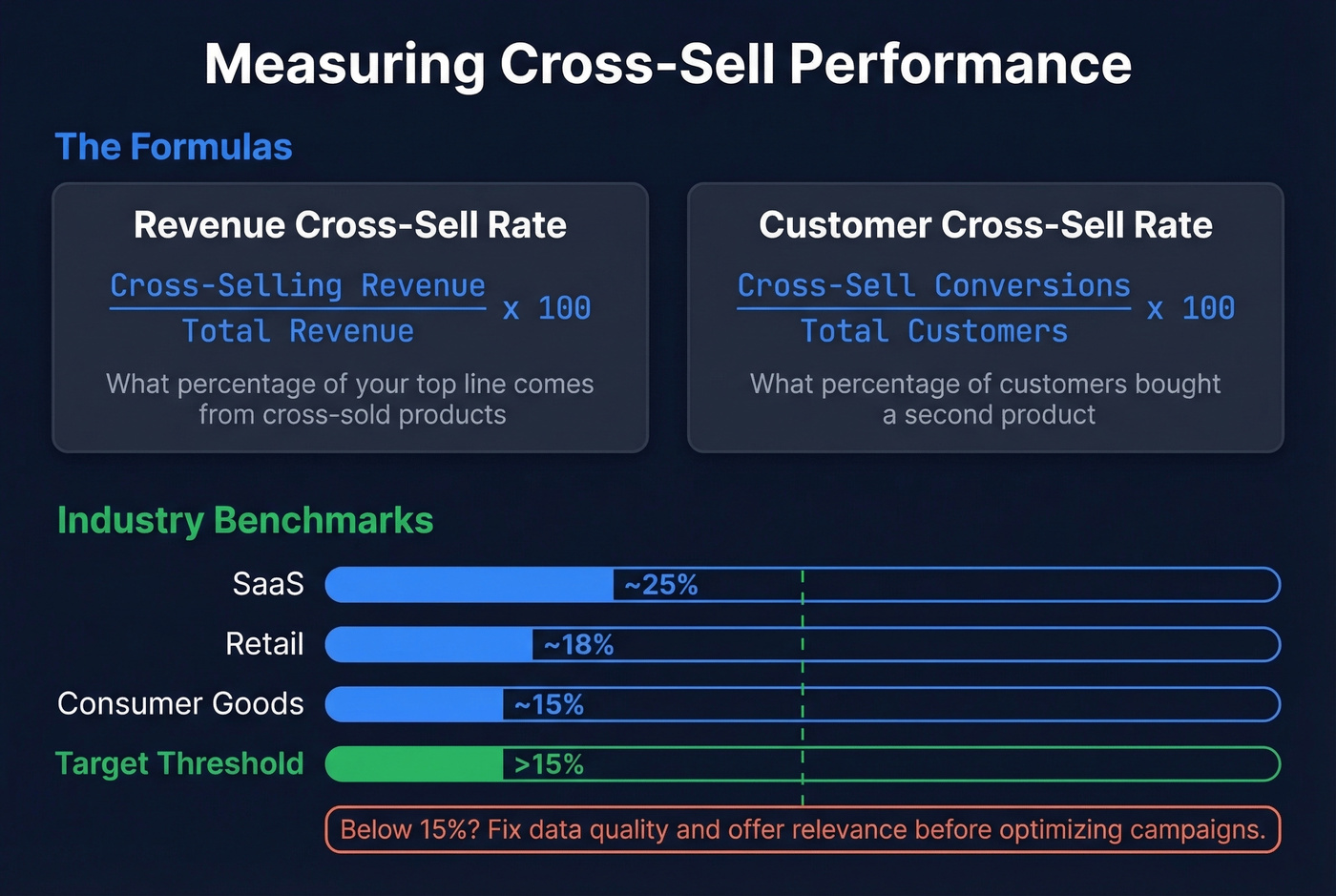
Revenue cross-sell rate: Cross-selling revenue / Total revenue. This tells you what percentage of your top line comes from cross-sold products.
Customer cross-sell rate: Cross-sell conversions / Total customers. This tells you what percentage of your customer base has purchased a second product.
As Wall Street Prep notes, simply counting transactions with multiple items is an inaccurate proxy. You need customer-level attribution to understand what's actually working.
If you're tightening your reporting, pair this with a clean sales conversion rate definition so teams don’t argue over math.
| Industry | Avg Cross-Sell Rate | Context |
|---|---|---|
| SaaS | ~25% | Benchmark heuristic |
| Retail | ~18% | Benchmark heuristic |
| Consumer Goods | ~15% | Benchmark heuristic |
| Target threshold | >15% | KPI target |
If your cross-sell rate is below 15%, you likely have structural issues - start with data quality and offer relevance before optimizing campaigns. Beyond the headline rate, track AOV trend, attach rate per product pair, incremental revenue from cross-sold items, and repeat purchase rate. The combination tells you whether your program is actually profitable or just inflating vanity metrics.
Why Cross Selling Strategies Fail
Irrelevant Offers
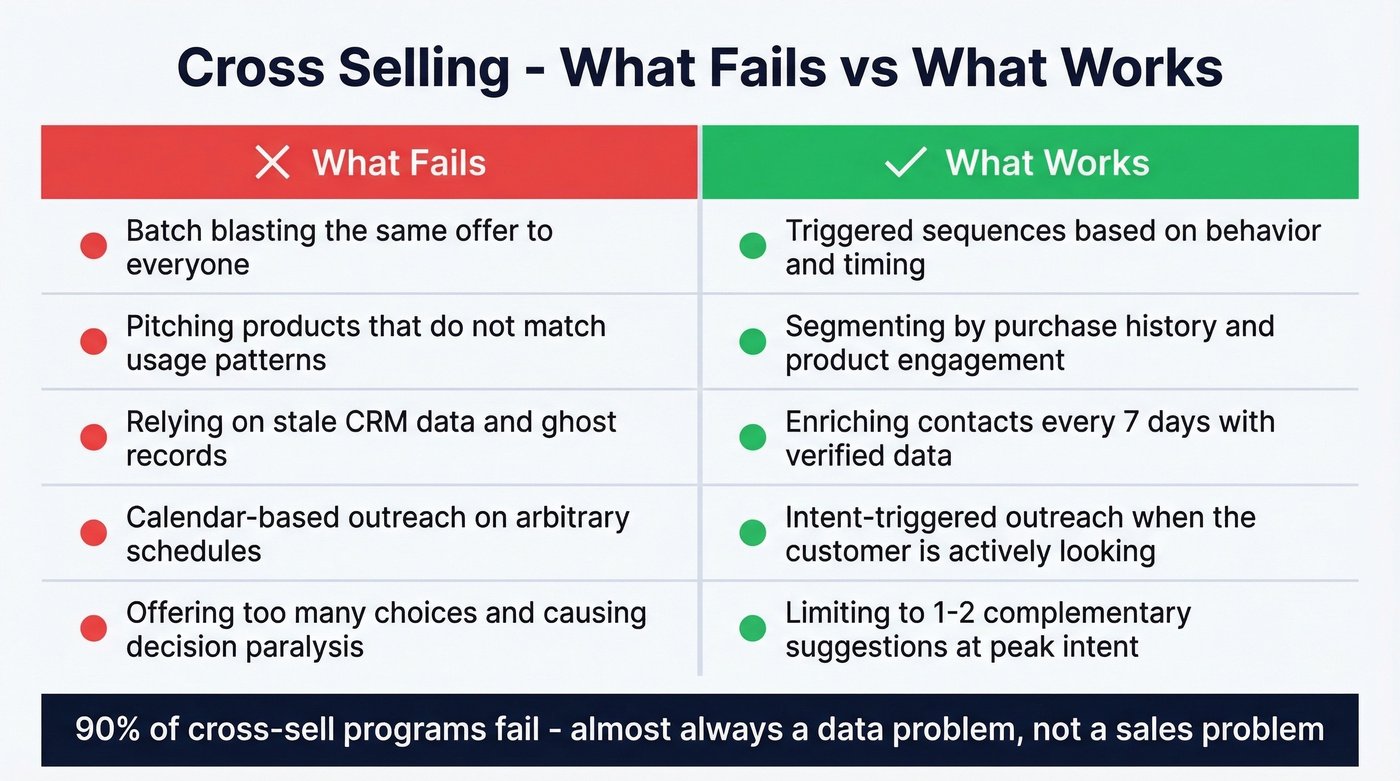
The #1 killer. Pitching products that don't match the customer's actual needs or usage patterns doesn't just fail to convert - it actively erodes trust. Every irrelevant cross-sell email trains the customer to ignore you. Ask any account manager on r/sales about cross selling, and the same complaint surfaces: "I was told to pitch product X to every account, regardless of fit." That's not a strategy. It's spam with a quota attached.
Wrong Timing
Cross selling before the customer has realized value from their initial purchase is the B2B equivalent of proposing on a first date. They haven't even onboarded yet, and you're pitching the premium add-on. Wait for the value milestone.
No Measurement Framework
We've seen teams run cross-sell campaigns for quarters without calculating a single cross-sell rate. If you can't diagnose what's broken, you can't fix it. The formulas above take five minutes to implement. There's no excuse.
Misaligned GTM and Missing Discovery
This one hits B2B teams hardest. Your cross-sell product has a different buyer persona, a different value prop, and often a different buying committee than your core product - but the GTM motion stays identical. Reps skip discovery because they assume the existing relationship means they already understand the account. They don't.
If your team needs a reset, rebuild your qualification around better discovery questions and treat cross-sells like real deals.
Let's be honest: treating every cross-sell like a new deal with a warmer starting point, rather than a guaranteed close, is the single biggest mindset shift most teams need. Build cross-sell training into your enablement program and review cross-sell pipeline in its own cadence, separate from new business.
Unprofitable Buyer Types
Here's a stat that should change how you think about cross selling: HBR found that 1 in 5 cross-buyers is actually unprofitable. They identified four types - service demanders who consume disproportionate support resources, revenue reversers who return products at high rates, promotion maximizers who cost an average of $300 per year in margin erosion, and spending limiters who buy the cheapest add-on and never expand.
Not every customer should be cross-sold. Segment ruthlessly.
The Wells Fargo Warning
The most infamous cross-selling failure in modern business. Wells Fargo's aggressive cross-sell quotas led employees to open 2 million+ fraudulent accounts, resulting in a $185 million fine and $2.8 million in customer refunds. The reputational damage was incalculable. If your cross-sell incentive structure rewards volume over relevance, you're building a smaller version of the same problem.
Our take: Most cross-sell programs fail not because the strategy is wrong, but because leadership treats cross selling as a campaign instead of a capability. Campaigns end. Capabilities compound. If your cross-sell "program" has a launch date and a wrap-up meeting, it's already dead.
Building an AI-Powered Approach for 2026
The AI-based personalization market hit $461.9 billion in 2023 and is projected to surpass $700 billion by 2032. That growth is driven by one reality: AI-powered recommendations dramatically outperform static rules. The 2.2x effectiveness gap between personalized and generic recommendations only widens as models improve at predicting purchase intent from behavioral data.
Early AI adopters outperform laggards by up to 40% on revenue metrics. Practical implementation doesn't require a data science team - start with a product recommendation engine that analyzes purchase patterns across your customer base, then A/B test AI-driven suggestions against your current static cross-sell offers. Measure incremental revenue, not just click-through rates.
The tools have matured enough that a mid-market ecommerce team or a B2B SaaS company with a few hundred customers can deploy meaningful AI-powered cross selling without a six-figure infrastructure investment. If you're still running rules-based recommendations in 2026, skip this section and go test one AI recommendation tool this quarter. The performance gap is too large to ignore.
If you’re building the stack, it helps to understand data-driven selling so your models don’t run on bad inputs.
Multi-threading is the backbone of effective cross selling - you need 3+ verified contacts per account to reach the right buyer at the right moment. Prospeo gives you 300M+ profiles with 98% email accuracy at $0.01 per email, so you can map entire buying committees without blowing your budget.
Build complete account maps and cross sell to the people who actually decide.
FAQ
What's the difference between cross selling and upselling?
Cross selling recommends complementary products - a phone case with a phone. Upselling encourages a higher-tier version of the same product, like upgrading from 64GB to 128GB storage. Both increase order value, but cross selling expands adoption across your catalog while upselling deepens it within a single product line.
When is the best time to cross sell?
The highest-converting windows are in-cart (order bumps convert at 37.8%) and 24-72 hours post-purchase via triggered email. Avoid cross selling before the customer has experienced value from their initial purchase - premature offers feel pushy and damage trust.
What's a good cross-sell rate?
SaaS companies typically land around 25%, retail around 18%. If your rate is below 15%, your program likely has structural issues - start with data quality and offer relevance before optimizing campaign mechanics.
How do I enrich CRM data for better cross-sell targeting?
Use a data enrichment platform that refreshes records automatically and appends verified contact details. Look for tools that return 50+ data points per contact with high match rates and short refresh cycles, plus intent signals that tell you when accounts are actively researching topics related to your cross-sell products.
Can cross selling hurt customer relationships?
Absolutely. Irrelevant or aggressive cross sells erode trust fast. HBR found 1 in 5 cross-buyers is actually unprofitable. The fix: segment carefully, time offers around value realization, and never prioritize quotas over customer needs. Wells Fargo's $185 million fine is the cautionary tale every cross-sell program should study.