

Crunchbase vs ZoomInfo: They're Not Really Competitors
Crunchbase pricing is easy to find on a public plan page. ZoomInfo pricing hides behind a "Request Demo" gate. That single difference tells you almost everything about who these tools serve.
But here's the thing most comparison posts won't say outright: these platforms don't do the same job. One is company intelligence. The other is contact infrastructure. And the growing consensus on r/sales is that big databases are broken anyway - overused contacts, inflated bounce rates, and contracts that feel like hostage situations.
30-Second Verdict
Choose Crunchbase if you need company and funding intelligence - market research, timing signals, startup discovery. It's a research tool, not a contact database.
Choose ZoomInfo if you need enterprise-scale outbound with 500M+ contacts, intent data, and workflow automation, and you've got $15K+/year to spend.
Skip both if you need verified contact data without an enterprise contract or annual lock-in.
Side-by-Side Comparison
These tools target different buyers solving different problems. The table makes that obvious fast.
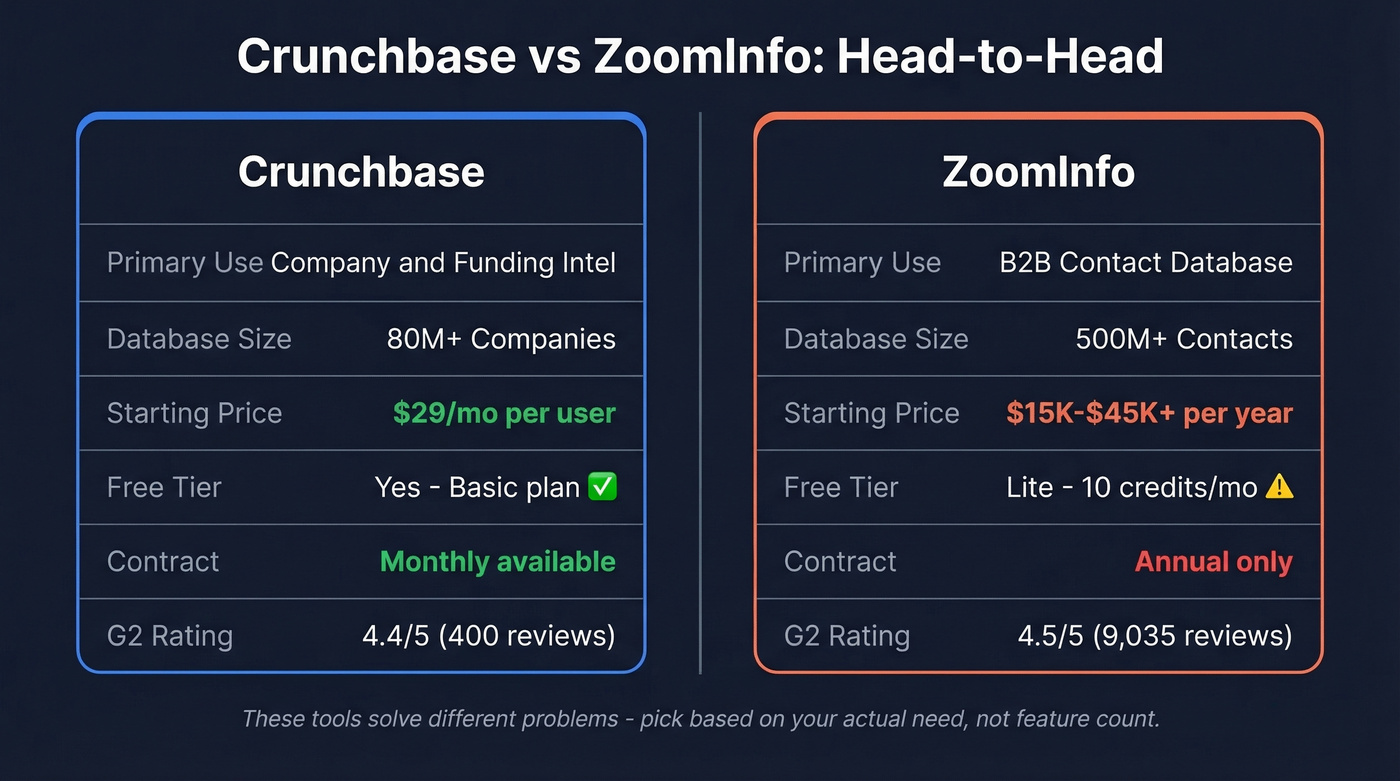
| Dimension | Crunchbase | ZoomInfo | Edge |
|---|---|---|---|
| Primary use | Company/funding intel | B2B contact database | ZoomInfo (for sales) |
| Database size | 80M+ companies | 500M+ contacts | ZoomInfo |
| Pricing | Free-$49/mo/user | ~$15K-$45K+/yr | Crunchbase |
| Free tier | Yes (Basic) | Lite (10 credits/mo) | Crunchbase |
| Contract | Monthly available | Annual only | Crunchbase |
| G2 rating | 4.4/5 (400 reviews) | 4.5/5 (9,035 reviews) | ZoomInfo (volume) |
| Best for | VC/PE, market mapping | Enterprise outbound | Tie - different jobs |
What Crunchbase Actually Does
Crunchbase is a funding and company intelligence platform. It tracks which companies just raised money, who's hiring, and who the competitors are in a given market. For sales teams, the play is timing signals.

Use the Last Funding Date filter (last 90-180 days) to find companies with fresh capital. Expect to qualify about 15-20 leads per hour this way, with a 20-30% "zombie rate" - funded companies that are inactive or have frozen hiring. Funding data also lags 1-3 months behind the actual close, so you're never working with perfectly current information.
Pricing tiers run Basic (free), Starter ($29/mo/user), Pro ($49/mo/user), and custom Enterprise plans. On G2, the Pro Monthly tier shows at $99/user/month.
Skip Crunchbase if you need verified emails and phone numbers. G2 reviewers flag missing contact information (17 mentions) and outdated data for mid-market and non-US companies (15 mentions). On TrustRadius, only 55% of respondents said they'd buy it again. That's a rough number for a paid tool.
If you're building lists for outbound, pair company intel with sales prospecting techniques that prioritize timing signals over volume.

Crunchbase gives you company intel but no contacts. ZoomInfo gives you contacts but charges $15K+ and refreshes data every 6 weeks. Prospeo gives you 300M+ profiles with 98% email accuracy on a 7-day refresh cycle - at roughly $0.01 per email, no annual contract required.
Get ZoomInfo-level data without the ZoomInfo-level invoice.
What ZoomInfo Actually Costs
ZoomInfo's database is genuinely massive - 500M+ professional contacts, 200M+ verified business email addresses, 120M+ direct-dial phone numbers. The product works. The question is whether the price matches your usage.
If you're evaluating tools for reps, it helps to compare the broader category of SDR tools alongside data providers.
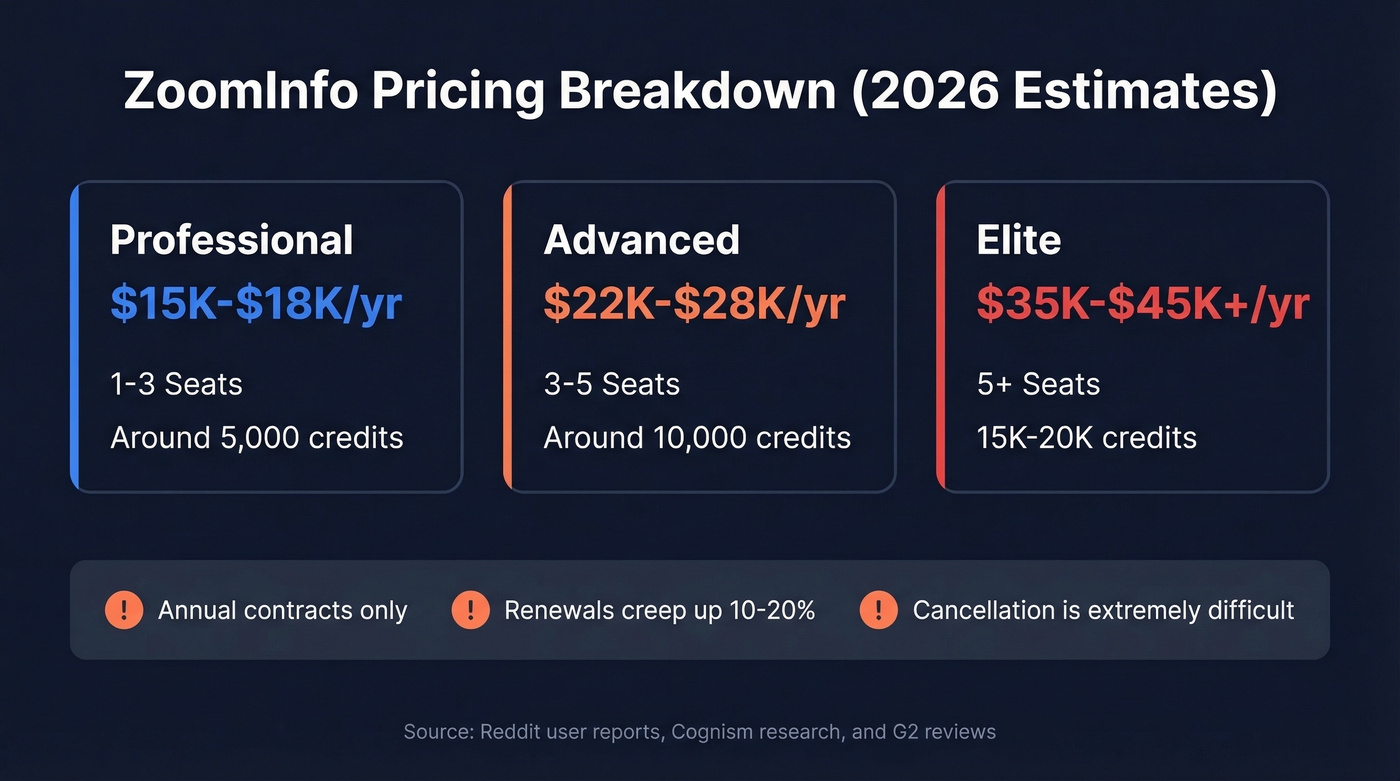
Typical annual contracts break down roughly like this:
| Tier | Annual cost | Seats | Credits |
|---|---|---|---|
| Professional | $15K-$18K | 1-3 | ~5,000 |
| Advanced | $22K-$28K | 3-5 | ~10,000 |
| Elite | $35K-$45K+ | 5+ | 15K-20K |
Beyond SalesOS, ZoomInfo also offers MarketingOS and OperationsOS, but most buyers are evaluating the sales product, so that's what we'll focus on.
One Reddit user reported being quoted ~$24K for just 2 seats. That's the core tension: you pay for the whole buffet even if you only want the salad bar. Contracts are annual only, and renewals often creep up 10-20%. Cancellation? One user tried to terminate while their company was shutting down and was told the $23K contract couldn't be cancelled. ZoomInfo's TrustRadius "would buy again" score sits at 93% - strong, but weighted toward enterprise teams with the budget to absorb the cost.
Data Quality Head-to-Head
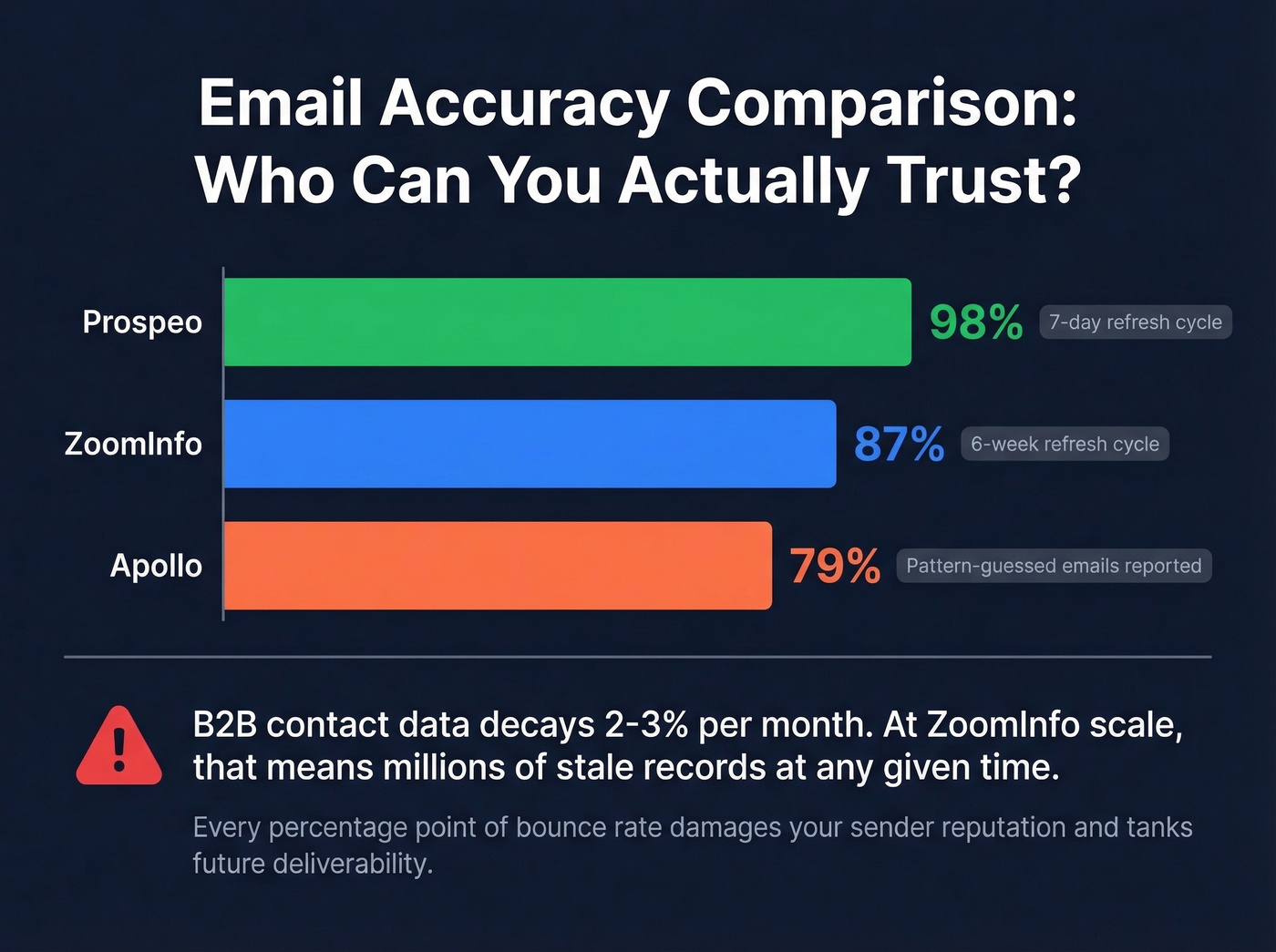
Big databases have a big problem: decay. B2B contact data degrades at roughly 2-3% per month. At ZoomInfo's scale, that's millions of stale records at any given time.

G2 reviewers flag "Inaccurate Data" and "Outdated Data" as cons - each with 232 mentions. That's not a fringe complaint. In our testing, bounce rates from large databases consistently run higher than advertised. One cold email practitioner on r/coldemail reported 15-18% bounce rates from ZoomInfo and Apollo emails that turned out to be pattern-guessed rather than verified. Crunchbase has the opposite issue: decent company data, but contact information that's often missing entirely.
If deliverability is a priority, start with email bounce rate benchmarks and a proper email deliverability guide before you scale volume.
Let's be honest - ZoomInfo is still the most feature-rich all-in-one outbound platform. But most teams don't need all-in-one. They need accurate data. And accuracy is where the big databases consistently fall short.
Other tools in this space include Apollo (free tier available, paid plans from $49/mo) and Lusha (from $29/mo), both of which trade data depth for lower price points. If you're shopping the category, compare options in our guide to sales prospecting databases.
When to Pick Which
Choose Crunchbase If...
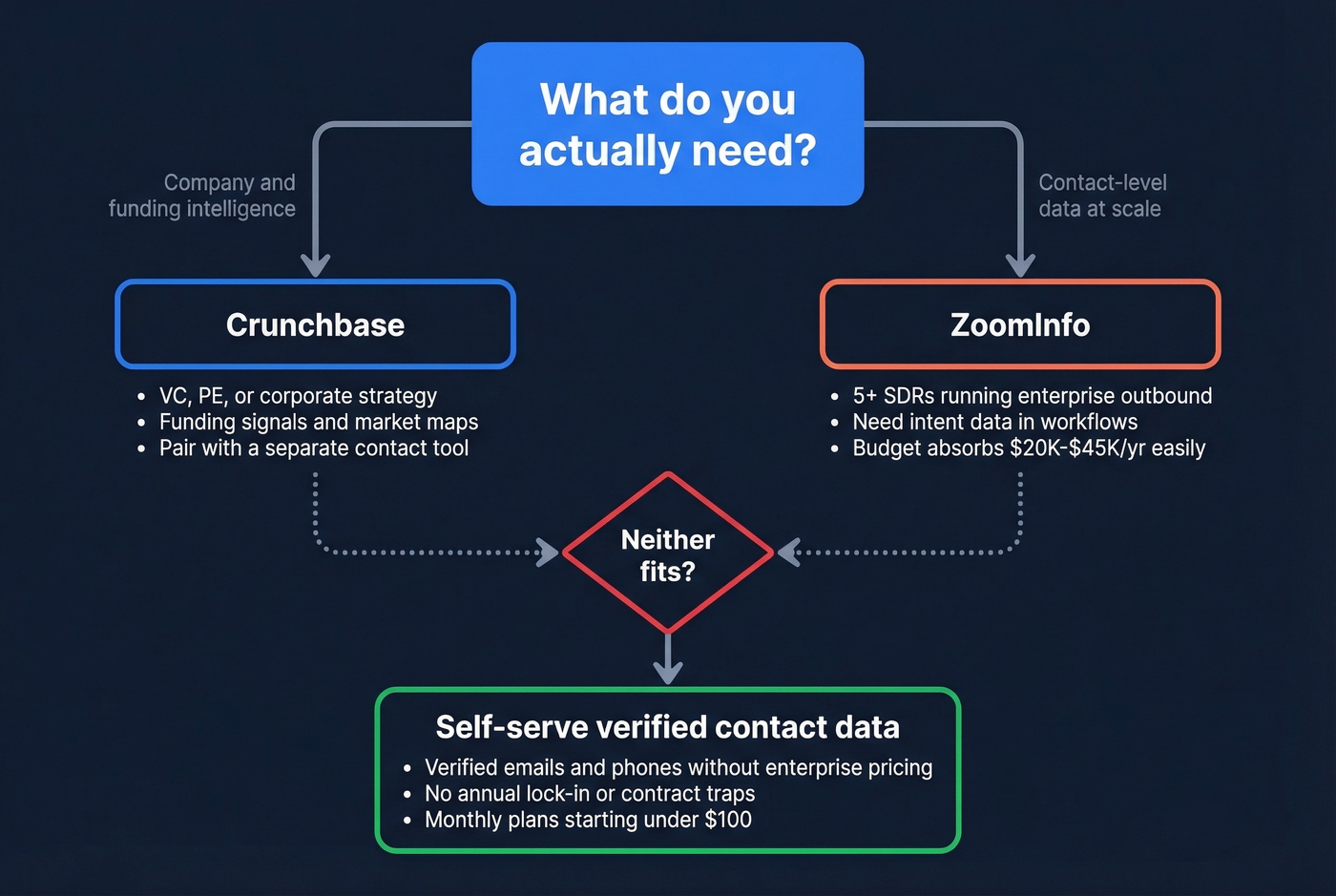
You're in venture capital, private equity, or corporate strategy. You need funding signals, market maps, and company-level intelligence. You don't need a contact database - you need a research platform. Pair it with a separate tool for verified emails and phones.
To operationalize this, build an ideal customer profile and use firmographic filters to keep your research lists tight.
Choose ZoomInfo If...
You're running enterprise outbound at scale with 5+ SDRs, you need intent data baked into your workflow, and your budget can absorb $20K-$45K/year without flinching. We've seen it work well for teams that actually use the full platform - the problem is most teams don't. If your average deal size is under five figures, you almost certainly don't need ZoomInfo-level infrastructure.
If you're selling into larger orgs, align your process with an enterprise B2B sales motion.
When Neither Fits
Most teams weighing Crunchbase vs ZoomInfo actually need something in between: verified contact data without the enterprise price tag or annual lock-in. Prospeo's B2B database covers 300M+ professional profiles with 143M+ verified emails and 125M+ verified mobile numbers on a 7-day refresh cycle, with 30+ search filters including buyer intent, technographics, job changes, and funding signals.
If you also need to enrich what you already have, look at data enrichment services and a structured lead enrichment workflow.

If bounce rates from big databases are killing your deliverability, the problem isn't your copy - it's your data. Prospeo's 5-step verification and 7-day refresh cycle keep bounce rates under 4%, with 143M+ verified emails and 125M+ verified mobiles ready to search with 30+ filters including funding signals and buyer intent.
Stop paying enterprise prices for stale data.
FAQ
Can Crunchbase replace ZoomInfo for sales prospecting?
No. Crunchbase is company intelligence - funding rounds, market signals, competitive analysis. It doesn't function as a contact database. Think of it as the "when to reach out" layer, not the "who to reach out to" layer.
What's the main difference between Crunchbase and ZoomInfo?
Crunchbase tracks companies and funding events. ZoomInfo stores contact-level data - emails, phone numbers, org charts. They solve different problems, and most teams comparing them actually need a dedicated contact data tool.
Is ZoomInfo worth $15K+/year for a small team?
Rarely. Most teams with 2-3 reps use a fraction of ZoomInfo's features. Self-serve tools deliver verified contacts at a fraction of the cost with no contract - roughly 90% cheaper per lead.
What's the most accurate B2B email database in 2026?
Prospeo leads with 98% verified email accuracy on a 7-day refresh cycle. ZoomInfo and Apollo trail at roughly 87% and 79% respectively. Every percentage point of bounce rate damages your sender reputation and tanks deliverability for future campaigns, so this gap matters more than most people realize.