

Customer-Centric Selling: The 2026 Practitioner's Guide
Your rep just bombed a discovery call. Three questions, surface-level answers, then straight into a demo. The prospect went dark within 48 hours. That's not a pipeline problem - it's a customer-centric selling problem. 52% of customers will switch to a competitor after a single negative impression, and a lazy discovery call absolutely counts as one. The fix isn't more activity. It's better conversations that start from the buyer's world.
The Short Version
Customer-centric selling boils down to three things: ask better questions than your competitors, qualify around the buyer's challenges instead of your quota, and walk away when there's no real fit. The rest of this guide gives you the actual questions, the qualification framework, and the implementation steps that the original book and every other guide leave out.
What Is CCS?
Michael Bosworth, along with co-authors John Holland and Frank Visgatis, codified this methodology across two book editions, including the 2009 second edition. The core idea is straightforward: stop presenting and start conversing. Stop pitching features and start solving problems.
For anyone still asking what customer-centric selling actually is - it's a methodology built on buyer-led conversations, not a vague philosophy about "being nice."
The methodology rests on eight principles that hold up remarkably well, even if the book's cultural references feel dated (a fair complaint you'll find across r/sales):
| Principle | What It Means in Practice |
|---|---|
| Conversations, not presentations | Lead with questions, not slides |
| Questions, not opinions | Ask what matters to them |
| Solutions, not products | Tie everything to their problem |
| Target decision-makers | Stop selling to end-users who can't sign |
| Usage, not technology | Show outcomes, not features |
| Relationships, not volume | Fewer, deeper deals win |
| Buyer's timeline, not yours | Align your cycle to their process |
| Help them buy, don't push | Enable the purchase; don't force it |
Here's the part most guides skip: Bosworth's walk-away criteria. Every deal must end in one of three outcomes - a goal achieved, a problem solved, or a need satisfied. If none of those are on the table, you walk away. That's not soft advice. It's the methodology's backbone, and it's what separates this approach from "just be nice to prospects."
The Reddit criticism is real - the book can be a slog. But the framework underneath is sound. We've seen teams take these eight principles, modernize the language, and build genuinely effective buyer-led sales motions around them.
Why Buyer-Centricity Matters More in 2026
Here's the dynamic that makes this approach more relevant now than when Bosworth wrote it: 67% of customers prefer self-service over speaking to a rep. Buyers are doing their own research, building shortlists, and forming opinions before they ever pick up the phone. So when they do engage with a salesperson, that interaction has to be worth their time.
The numbers back this up. 41% of customer-obsessed companies achieved at least 10% revenue growth, compared to just 10% of less mature companies. Customer-centric organizations are 4-8% more profitable than those that don't prioritize the buyer experience.
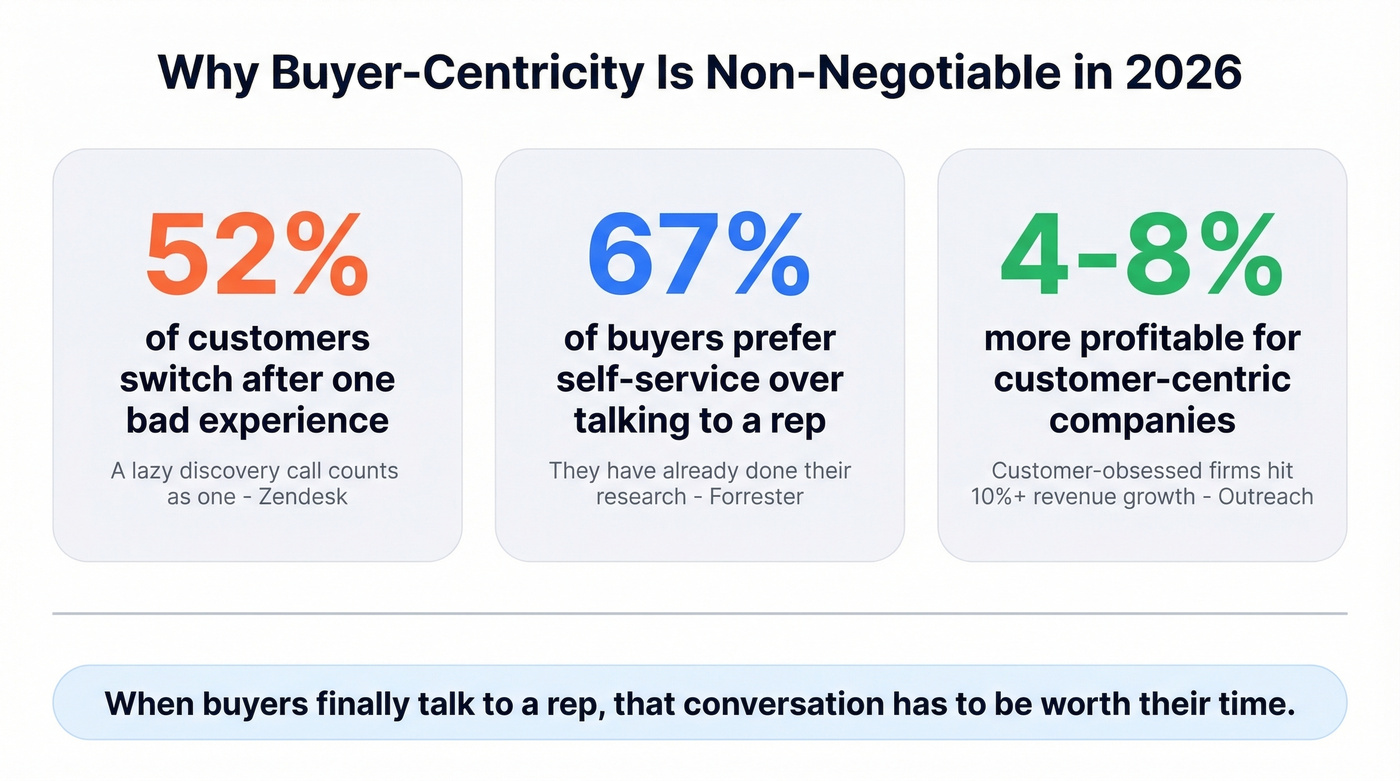
The takeaway is blunt: buyers have more power than ever. Reps who show up unprepared, pitch too early, or ignore the buyer's context don't get second chances.
CCS vs. Other Methodologies
The consensus on r/sales is that all methodologies basically converge on the same fundamentals - need, budget, stakeholders, timeline. One commenter put it well: "They're all saying the same thing in different fonts." That's not a flaw. It's the point. The difference is where each methodology puts the emphasis and which selling motion it fits best.
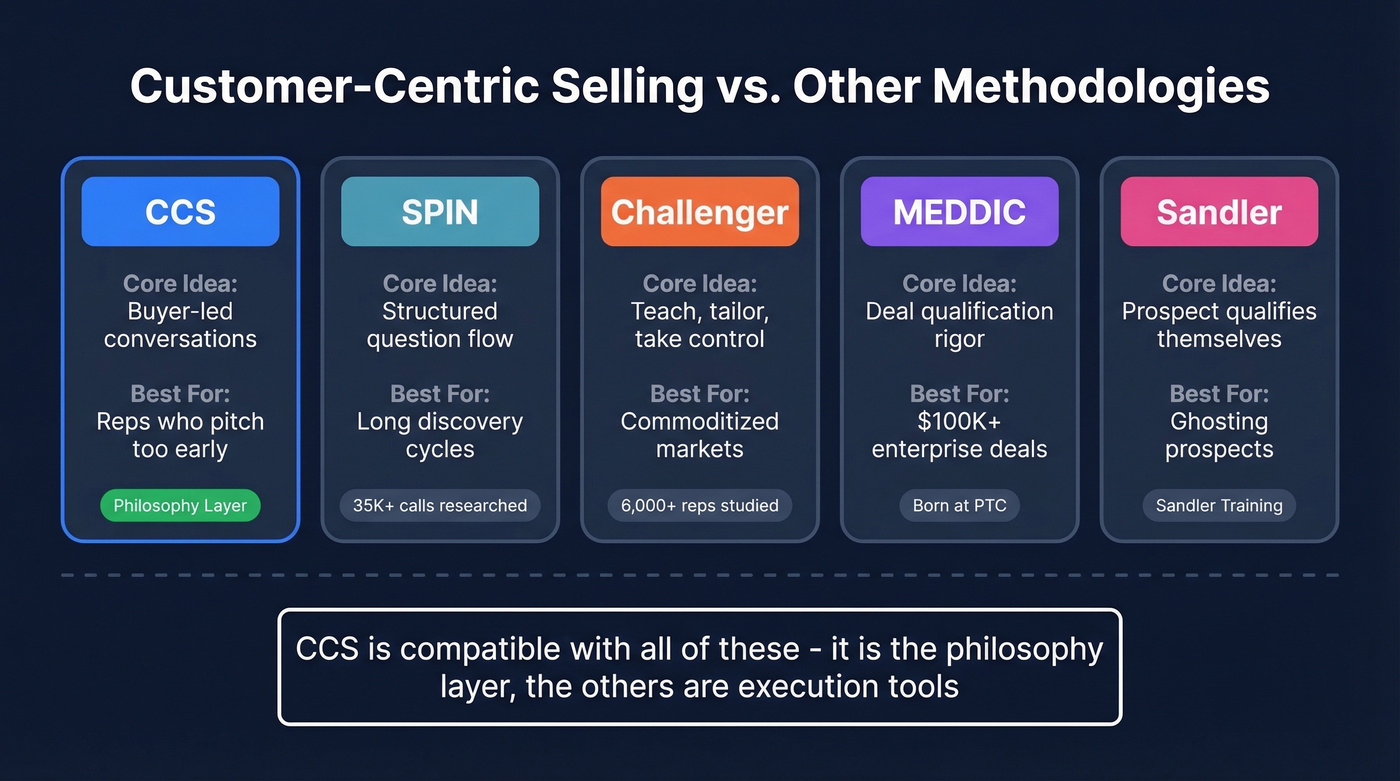
| Methodology | Core Idea | Best For | Origin |
|---|---|---|---|
| CCS | Buyer-led conversations | Reps who pitch too early | Bosworth; 2009 second edition |
| SPIN | Structured question flow | Long discovery cycles | 35K calls, 20+ countries, 12 years |
| Challenger | Teach, tailor, take control | Commoditized markets | 6,000+ reps, CEB |
| MEDDIC | Deal qualification rigor | $100K+ enterprise deals | PTC |
| Sandler | Prospect qualifies themselves | Ghosting prospects | Sandler Training |
SPIN has one of the deepest research foundations - Neil Rackham's team analyzed 35,000+ sales calls across more than 20 countries over 12 years. Hard to argue with that. Challenger has the flashiest outcome data: Xerox saw a 17% increase in sales and $65M in contract value after implementation.
Here's the thing: CCS isn't competing with these methodologies. It's compatible with them. You can run MEDDIC qualification inside a customer-centric selling motion. You can use SPIN's question structure during CCS discovery calls. The eight principles are a philosophy layer; the other frameworks are execution tools.
If your average contract value is under $15K, you probably don't need MEDDIC-level rigor. CCS principles plus solid discovery questions will get you 80% of the way there. Save the heavyweight frameworks for deals that justify the overhead.
Let's be honest about sequencing, too. If your team's biggest problem is reps jumping to demos before understanding the buyer's world, start with CCS. If discovery is fine but deals stall in committee, layer in MEDDIC. We've watched teams try to run pure Challenger without discovery fundamentals - it doesn't work. You can't teach and tailor if you haven't listened first.

You can't run buyer-led discovery on stale data. Prospeo refreshes 300M+ profiles every 7 days - role, tech stack, funding, headcount growth - so your reps walk into every call with current context. At $0.01 per email with 98% accuracy, your first touchpoint actually reaches the decision-maker.
Stop pitching blind. Start every conversation with real buyer intelligence.
How to Implement CCS
Knowing the principles is easy. Changing behavior is hard. Here's a six-step implementation path that actually works.
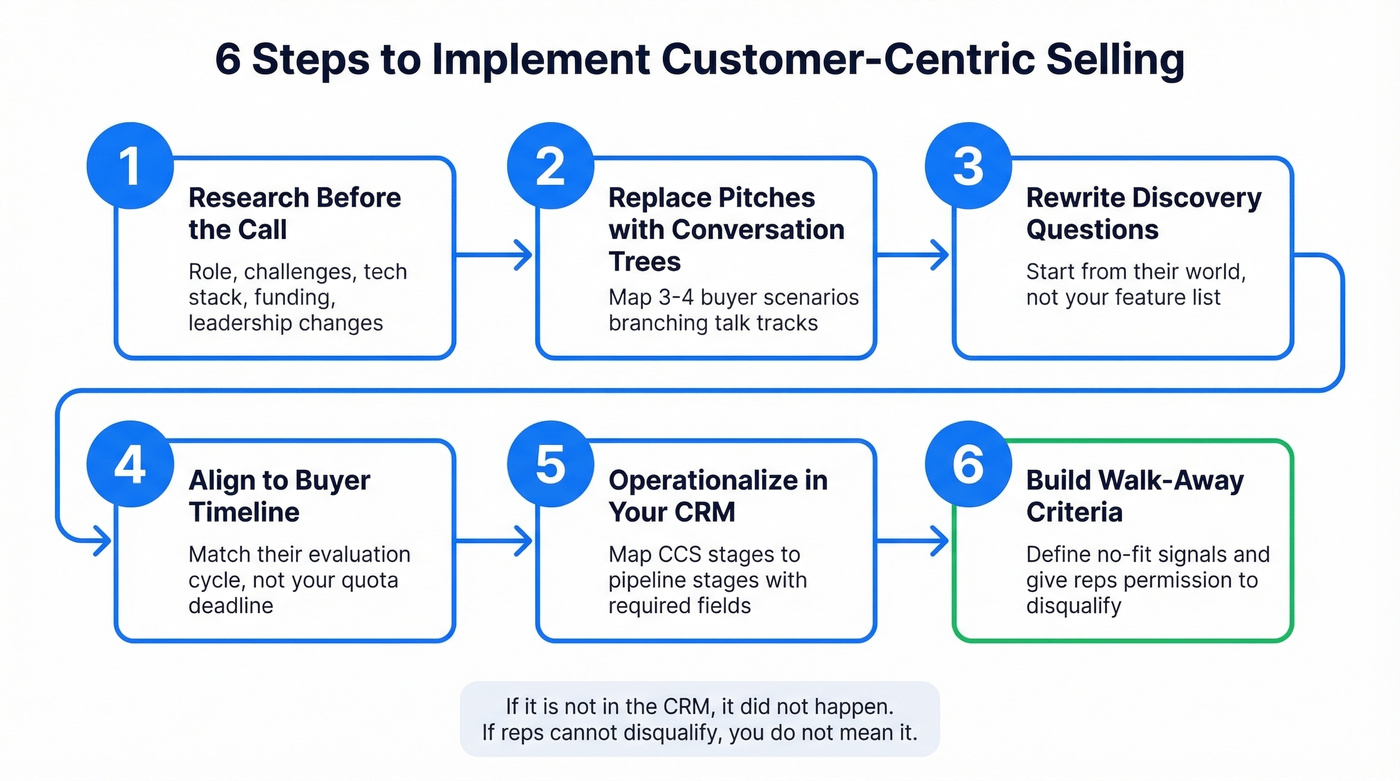
1. Research Before the First Call
Role, company challenges, tech stack, recent leadership changes, funding rounds - all of it. You can't target decision-makers if your data has the wrong person in the wrong role. Tools like Prospeo surface 50+ data points per contact - role, tech stack, company size, recent funding - refreshed every 7 days, so your pre-call research is current and your first touchpoint reaches the actual decision-maker.

2. Replace Pitches with Conversation Trees
Map out the three to four most common buyer scenarios and build branching talk tracks for each. The goal is a structured conversation, not a monologue. We keep ours in a shared doc that reps can pull up mid-call - it's not a script, it's a safety net. (If you need examples, steal a few talk tracks and adapt them to your ICP.)
3. Rewrite Discovery Around Buyer Challenges
Every question should start from their world, not your feature list. "What's the biggest bottleneck in your current process?" beats "Have you seen our new dashboard?" every time. If you want a deeper bank, pull from these discovery questions and tailor them to the role.
4. Align to the Buyer's Timeline
If they're evaluating in Q3 but you're pushing for a Q2 close, you're not being customer-centric. You're being quota-centric. This sounds obvious, but watch how many reps default to end-of-quarter urgency that exists only in their own pipeline review.
5. Operationalize in Your CRM
Map CCS stages to pipeline stages in Salesforce or HubSpot. Create required fields for discovery outcomes - what problem was identified, what goal was confirmed, who the decision-maker is. If it's not in the CRM, it didn't happen. (If your stages are messy, this sales process optimization guide helps.)
6. Build Walk-Away Criteria
Define what "no fit" looks like and give reps permission to disqualify. In our experience, this is where most teams stall. Sales leaders preach buyer-centricity but panic when reps disqualify pipeline. You have to mean it. If you want a clean way to set boundaries, use a walk away point framework.
Discovery Questions That Work
Discovery calls aren't about pitching or closing. They're about understanding. Copy these into your CRM or call prep doc and use them as starting points - not scripts to read verbatim.
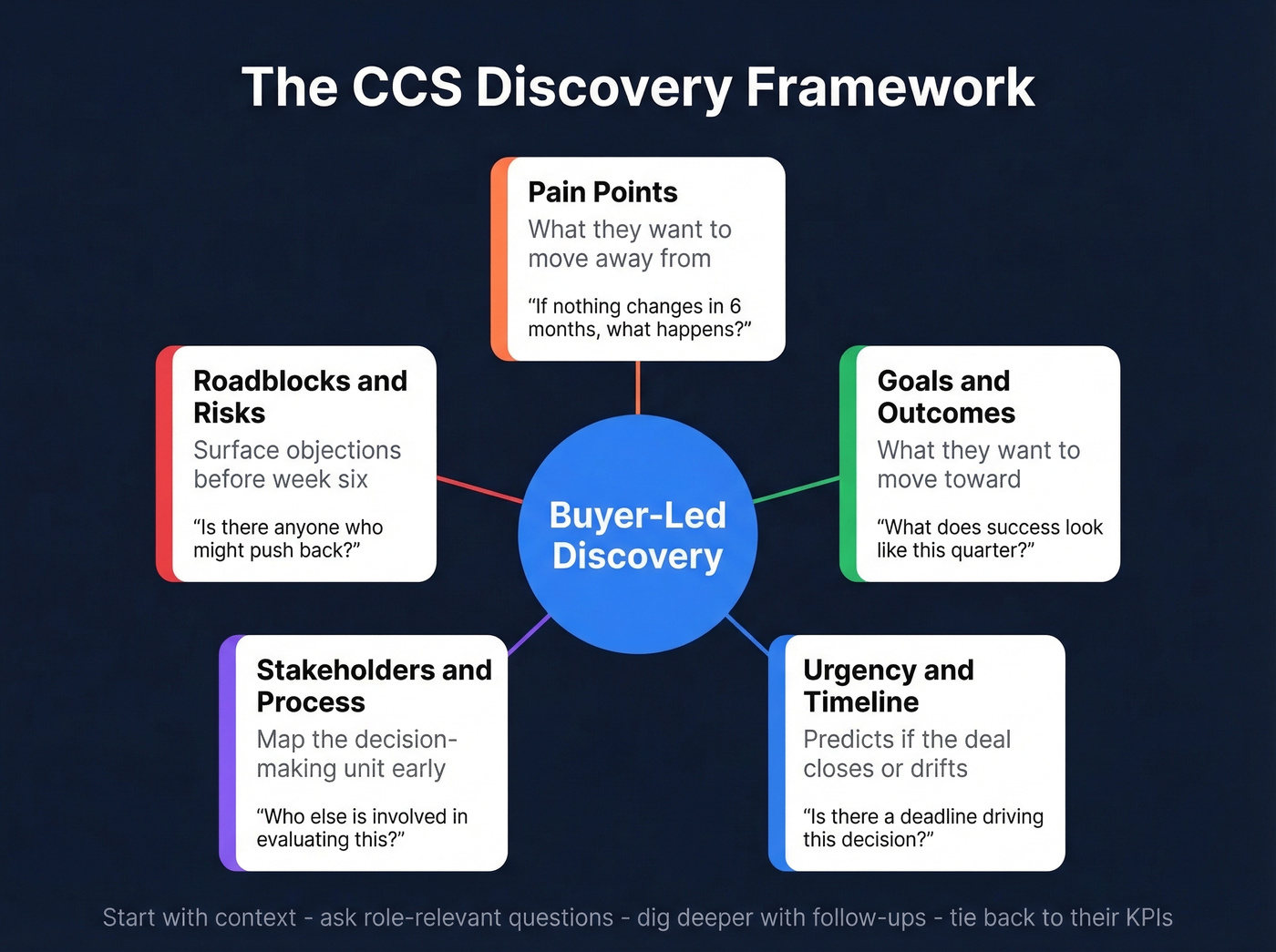
The structure matters: start with context about their situation, craft role-relevant questions, dig deeper with follow-ups, and tie everything back to their KPIs. This is where customer-centric sales teams separate themselves from reps who just run through a feature checklist.
Pain Points
Most reps ask one pain question and move on. That's a mistake. Pain is layered - the surface complaint usually masks a deeper operational or strategic problem. Stay here longer than feels comfortable.
- "What's the biggest challenge your team is facing right now in [their function]?"
- "How long has this been a problem? What's changed recently that made it urgent?"
- "What does this problem cost you - in time, revenue, or team bandwidth?"
- "What have you already tried to fix it?"
- "If nothing changes in the next 6 months, what happens?"
Goals & Outcomes
Goals tell you what the prospect wants to move toward. Pain tells you what they want to move away from. You need both to build a compelling case, because different stakeholders respond to different framing.
- "What does success look like for you this quarter?"
- "If we could solve this perfectly, what would your team's day-to-day look like?"
- "Which KPIs are you personally measured on?"
- "How does this initiative connect to your company's broader goals?"
Urgency & Timeline
These questions predict whether a deal closes this quarter or drifts into the graveyard. If there's no forcing function - a deadline, a board meeting, a contract renewal - you're probably looking at a stall.
- "Is there a specific event or deadline driving this decision?"
- "Where does this rank against your other priorities right now?"
- "What would need to happen for you to move forward this quarter?"
- "Have you set aside budget for this, or is that still in progress?"
Stakeholders & Decision Process
Deals don't die in discovery. They die in committee, three weeks later, when someone you never talked to vetoes the project. Map the decision-making unit early or pay for it later.
- "Who else is involved in evaluating this? What do they care about most?"
- "Walk me through how your team typically makes a decision like this."
- "Is there anyone who might push back on changing the current approach?"
- "What happened the last time your team evaluated a tool like this?"
Roadblocks & Risks
Skip these and you'll be blindsided in week six. The best reps surface objections early, when they can still address them, rather than discovering them in a "we've decided to go another direction" email.
- "What's the biggest risk you see in making a change right now?"
- "What would make you walk away from this evaluation?"
- "Are there internal constraints - technical, political, or budgetary - that could slow this down?"
- "What would your team need to see in a pilot to feel confident moving forward?"
Five Questions That Separate Great Reps
These come from Cerebral Selling's problem-centric framework, and they're the questions that surface root causes instead of symptoms. If your reps are already solid at discovery, these are the level-up.
"What problem are you trying to solve?" Then ask "Why is that important?" repeatedly until you hit the real business impact. Most reps stop one layer too early.
"How do you know you have that problem?" This forces the prospect to cite evidence - metrics, complaints, lost deals. If they can't quantify it, the problem might not be real enough to drive a purchase.
"Why hasn't this been solved yet?" The answer reveals internal blockers: politics, failed past attempts, competing priorities. Gold for understanding the deal dynamics.
"We could solve this if ____." Ask the prospect to fill in the blank. It forces them to articulate the single biggest lever, which tells you exactly what to build your proposal around.
"Does your team actually want to solve this?" This is the uncomfortable question most reps skip. It surfaces internal resistance and political dynamics that'll kill your deal in week six if you don't address them in week one.
Qualify Deals the Buyer-Centric Way
If you're running a buyer-led methodology, BANT is the wrong qualification framework. BANT starts with Budget - which is your concern, not the buyer's. CHAMP flips the order: Challenges, Authority, Money, Prioritization.
Challenges: "What's broken? What's the impact?" Start here because it mirrors how buyers think. They don't wake up thinking about budget - they wake up thinking about problems.
Authority: "Who needs to sign off? Who can block this?" Map the decision-making unit early so you're not surprised in month three. (This is also where understanding the economic buyer matters.)
Money: "Is there budget allocated, or do we need to build a business case?" Notice this comes third, not first.
Prioritization: "Where does this rank against everything else on your plate?" This is the question that predicts whether deals close or stall.
Early adopters report 25% increases in qualified opportunities after switching from BANT to CHAMP. For customer-centric sales teams, CHAMP is the obvious choice - it keeps the buyer's problems front and center through the entire qualification process.
Six Mistakes That Kill the Approach
The first five come from The Customer Centricity Playbook, published by Wharton Digital Press. They're research-backed, and every one of them shows up in real sales orgs.
1. Fixating on deal size instead of customer lifetime value. CLV is forward-looking and predictive - it should drive your segmentation and prioritization, not just first-year revenue. Teams that optimize around initial deal size leave expansion revenue on the table and chase logos that churn in year two.
2. Relying on demographics instead of behavioral value. "Enterprise companies in financial services" isn't a customer-centric segment. Behavioral signals - engagement patterns, product usage, expansion likelihood - are what actually predict value. Segment on behavior or you're just doing firmographic targeting with a buyer-centric label. (If you need a starting point, build an ideal customer profile and score accounts consistently.)
3. Ignoring branding's role in buyer-centricity. This methodology doesn't just happen on calls. Your brand promise, your content, your website experience - all of it shapes how buyers perceive whether you actually care about their problems or just say you do. If your marketing screams "buy now" while your reps ask thoughtful discovery questions, the dissonance kills trust.
4. Treating "The Customer" as one person. Customers are heterogeneous. One-size-fits-all is product-centric thinking disguised as buyer-centricity. Segment or you're just performing the methodology without practicing it.
5. Not identifying customers consistently in your CRM. If your definition of "customer" changes between reports, you can't measure anything meaningful. Lock down a consistent definition, track at the granular level, then roll up to the account.
6. Bad prospect data undermining the entire approach. Look, customer-centric selling is impossible if you can't even reach the right person. You pulled 500 "decision-makers." 40% of emails bounced. The ones that landed went to people who changed roles six months ago. Your "buyer-centric" sequence is now spam. We ran into this exact problem before switching to a data provider with real verification - Prospeo's 5-step process and 7-day refresh cycle dropped our bounce rate from the mid-30s to under 4%. (If you're seeing this, start by tracking and fixing your email bounce rate.)
CCS Principle #4 says target decision-makers, not end-users who can't sign. Prospeo's 30+ search filters - including job title, department headcount, and buyer intent across 15,000 topics - let you skip the gatekeepers and build lists of actual economic buyers.
Reach the right person before your competitor's rep even books a discovery call.
FAQ
What's the difference between customer-centric selling and consultative selling?
Customer-centric selling is a specific methodology codified by Michael Bosworth with eight defined principles and explicit walk-away criteria. Consultative selling is a broader philosophy - any approach that prioritizes understanding the buyer's needs over pushing product. CCS is one structured implementation of the consultative approach.
Is CCS still relevant in 2026?
More than ever. With 67% of buyers preferring self-service, the moments when they do engage a rep carry enormous weight. Bosworth's framework for high-value, buyer-led conversations is more relevant now than when he wrote it. The book feels dated; the principles don't.
How long does implementation take?
Most teams see meaningful behavioral change in 60-90 days with consistent coaching. The methodology itself can be taught in one to two days - the habit change takes longer. Expect the first quarter to feel awkward as reps unlearn pitch-first instincts.
What's the best qualification framework for customer-centric teams?
CHAMP. It starts with Challenges instead of Budget, keeping the buyer's problems front and center through the entire qualification process. BANT works fine for transactional sales, but CHAMP aligns naturally with buyer-led selling principles.
How do you prepare for a buyer-led discovery call?
Research the prospect's role, company challenges, tech stack, and recent changes before dialing. Build three to five hypothesis questions based on what you find, and lead with those instead of a generic opener. The difference between a good discovery call and a great one is almost always the 15 minutes of prep that happened beforehand.