

Customer Outreach Meaning: Definition, Benchmarks, and Strategy for 2026
A founder on r/Entrepreneur shared their outreach results: 50 Twitter DMs sent, zero responses. LinkedIn brought a trickle. Reddit DMs actually worked - until they got temporarily banned for spam. That's the reality when you don't understand what customer outreach actually means in 2026. The channels are everywhere, the noise is deafening, and the gap between teams that book meetings and teams that burn their domain reputation comes down to three things: clean contact data, the right channels, and disciplined follow-up.
The Short Answer
Customer outreach is proactively contacting prospects or existing customers to build relationships, close deals, and retain accounts. It spans sales, marketing, and customer success - not just cold email.
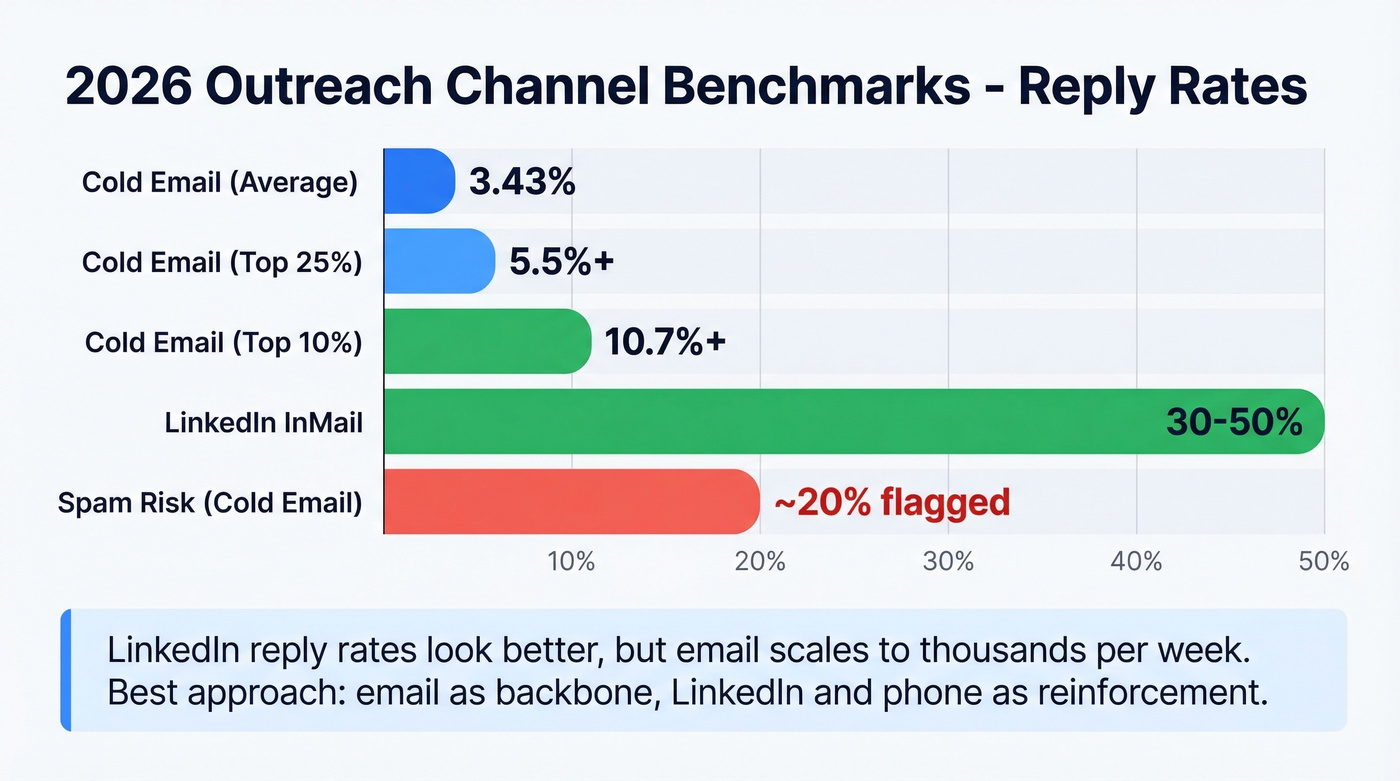
Three things determine whether outreach works: verified contact data, two or three well-chosen channels, and a follow-up cadence of 4-7 touchpoints. The average cold email reply rate in 2026 is 3.43%, with top quartile performers hitting 5.5%+ and the top 10% clearing 10.7%. The gap between those numbers is almost entirely execution - starting with whether your emails actually reach an inbox.
What Is Customer Outreach?
Customer outreach is proactively reaching out to prospects or existing customers through email, phone, social media, direct mail, or events. The key word is proactive. This isn't customer support waiting for a ticket. It's your team initiating contact to start a conversation, close a deal, gather feedback, or prevent churn.
The scope is broader than most people think. Outreach covers the SDR sending a cold email sequence, the CS manager checking in on a renewal, and the marketing team running a re-engagement campaign. Unlike inbound marketing - where leads come to you through content and SEO - outreach is outbound by definition. Your team starts the conversation.
Outreach vs. Prospecting vs. Outreach Marketing
These terms get used interchangeably, but they aren't the same. Prospecting is building a list of potential clients that match your ICP. Outreach is initiating contact with those leads. Outreach marketing is the broader effort to stay visible where your buyers spend time.
| Prospecting | Sales Outreach | Outreach Marketing | |
|---|---|---|---|
| Goal | Build a target list | Start conversations | Stay visible to buyers |
| Owner | SDRs / RevOps | SDRs / AEs | Marketing |
| Output | Qualified lead list | Replies, meetings | Awareness, inbound |
| Channels | Databases, filters | Email, phone, social | Content, ads, events |
Types of Customer Outreach
Outreach isn't a sales-only activity. It shows up across four functions.
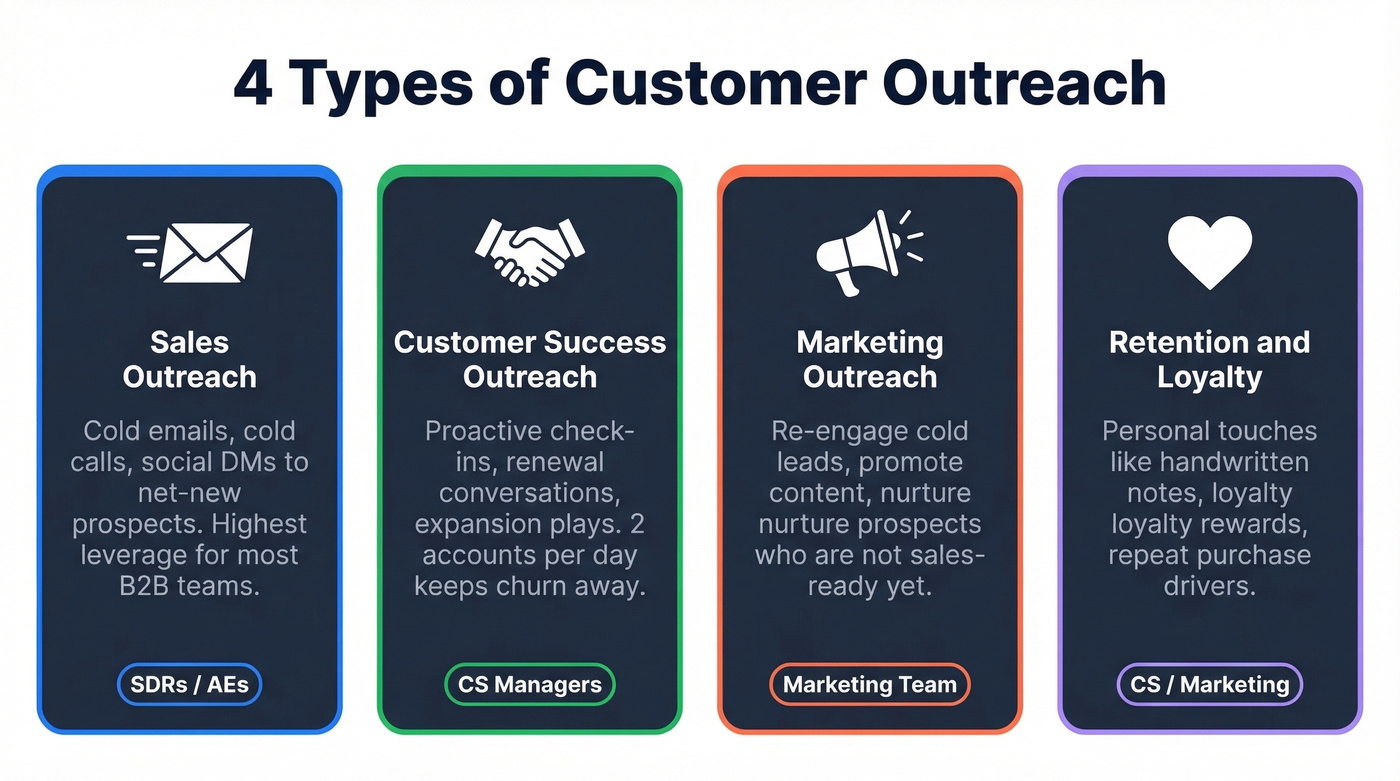
Sales outreach is the classic: cold emails, cold calls, social DMs to net-new prospects. Still the highest-leverage channel for most B2B teams. Customer success outreach covers proactive check-ins on adoption, renewal conversations, and expansion plays. A simple way to operationalize this is to set a contact frequency per account and distribute touches across working days - 40 accounts contacted monthly over 20 working days means 2 accounts per day.
Marketing outreach includes campaigns to re-engage cold leads, promote content, or nurture prospects who aren't sales-ready yet. Retention and loyalty outreach is the personal touch. Shopify highlights an ecommerce example where a founder includes a handwritten thank-you card in every package. That drives repeat purchases without a single line of code.

The article says it clearly: the gap between 3.43% and 10.7% reply rates is execution - starting with whether your emails reach an inbox. Prospeo's 5-step verification delivers 98% email accuracy, and teams like Meritt cut bounce rates from 35% to under 4% after switching. Clean data isn't optional for outreach that books meetings.
Stop burning your domain. Start every outreach campaign with verified contacts.
Channels and 2026 Benchmarks
Not all channels perform equally. Here's what the data shows:
| Channel | Key Benchmark | Source |
|---|---|---|
| Cold email | 3.43% avg reply rate | Instantly 2026 |
| Cold email (top quartile) | 5.5%+ reply rate | Instantly 2026 |
| Cold email (top 10%) | 10.7%+ reply rate | Instantly 2026 |
| 30-50% reply rate | LeadLoft | |
| Cold email spam risk | ~20% flagged as spam | Sopro |
LinkedIn's reply rates look dramatically better than email, but there's context. LinkedIn is harder to scale, more manual, and connection requests cap your volume. Email lets you reach thousands per week. The right move for most teams is a multi-channel approach - email as the backbone, LinkedIn and phone as reinforcement.
Here's the thing: that ~20% spam flag rate isn't a channel problem. It's a data problem. If a big chunk of your list has bad addresses, you're training inbox providers to treat your domain as junk.
How to Build an Outreach Strategy
Six steps, in order.
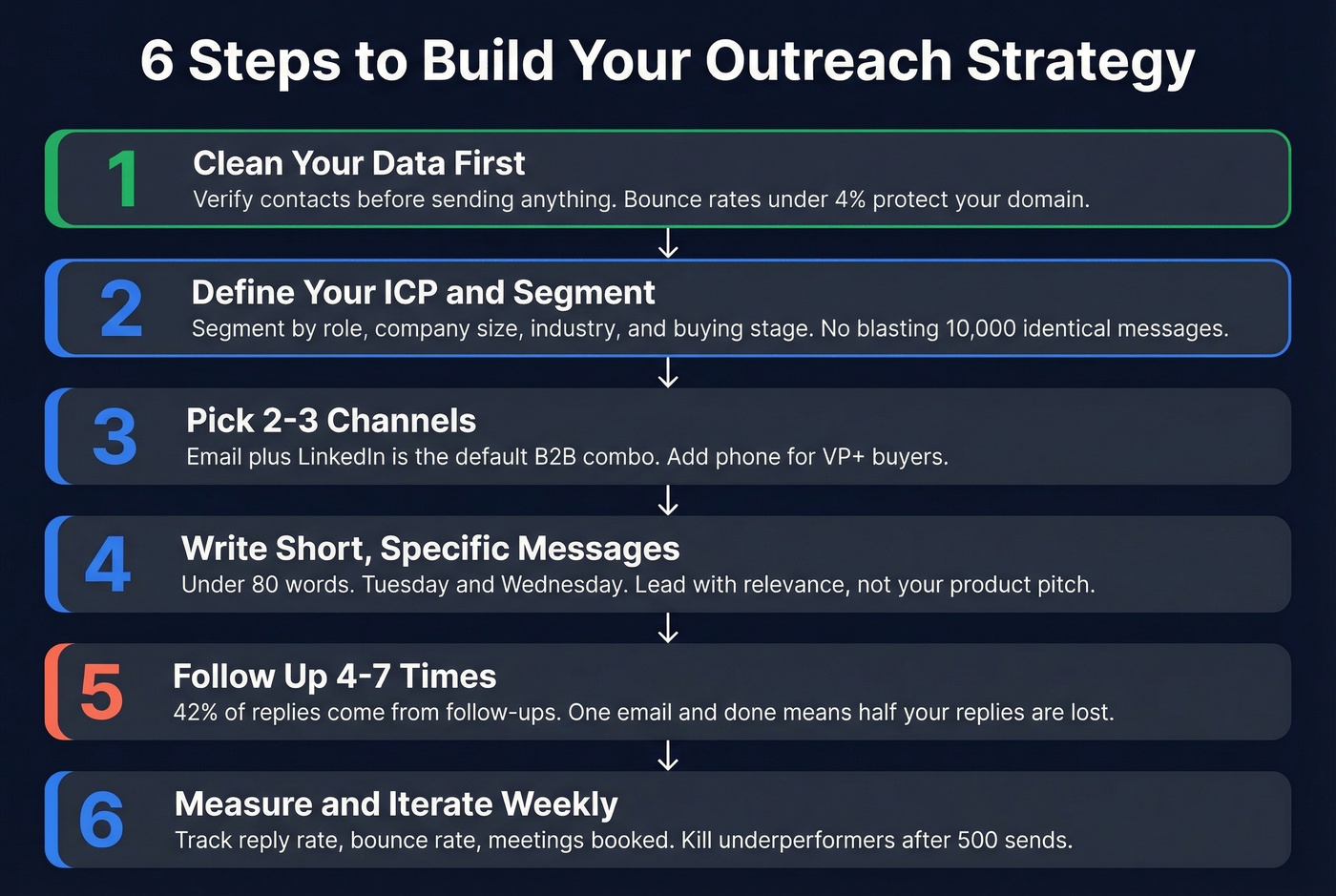
1. Clean your data first. This is the step everyone skips, and it's the one that matters most. Verify your contact list before sending anything. We've seen this pattern repeatedly - Meritt cut bounce rates from 35% to under 4% and tripled pipeline to $300K/week after switching to verified data through Prospeo. That kind of jump doesn't come from better copy. It comes from emails actually reaching inboxes. (If you want the deeper mechanics, start with an email deliverability audit.)

2. Define your ICP and segment. Don't blast the same message to 10,000 people. Segment by role, company size, industry, and buying stage. Tools with granular filters - buyer intent, technographics, headcount growth - let you build hyper-targeted lists without manual research. A simple way to standardize this is an Ideal Customer Profile scorecard.
3. Pick two or three channels. Email plus LinkedIn is the default B2B combination. Add phone if you're selling to VP+ buyers. Don't try to be everywhere. If calling is part of your mix, build a repeatable cold calling system.
4. Write short, specific messages. Best-performing cold emails are under 80 words. Tuesday and Wednesday see the highest reply rates. 81% of decision-makers engage with cold outreach when it's tailored to their company and context - so lead with relevance, not your product pitch. If you're stuck, borrow proven cold email subject line examples and adapt them to your triggers.
5. Follow up 4-7 times. 42% of cold email replies come from follow-ups, not the first message. Executives sometimes need 9+ touches; junior contacts often respond in 4. If you're sending one email and moving on, you're leaving almost half your potential replies on the table. Use a consistent sequence management process so reps don't freestyle cadence.
6. Measure and iterate weekly. Track reply rate, bounce rate, meetings booked, and pipeline generated. We kill sequences that underperform after roughly 500 sends - there's no point optimizing copy on a sample that small. Keep an eye on email bounce rate as an early warning signal.
Templates That Work
We've tested dozens of cadence structures. The best-performing campaigns follow a pattern: short subject line, one personalized sentence, one value prop, one clear ask.
Cold email:
Subject: Quick question about [Company]'s [specific initiative]
Hi [First Name], noticed [Company] just [trigger event]. We help similar teams [specific outcome] - would a 15-min call this week make sense?
Follow-up (3-5 days later):
Subject: Re: Quick question about [Company]'s [specific initiative]
Hi [First Name], circling back. [One-sentence proof point]. Worth a quick chat?
For reference, Siege Media reports 81% open rate, 24% CTR, and 13% reply rate on their best outreach templates. That's what good looks like when personalization and targeting are dialed in. If you need more variations, start with these sales follow-up templates.
Measuring Outreach ROI
The formula is straightforward:
ROI = (Value generated - Cost of outreach) / Cost of outreach x 100
Value includes pipeline generated, deals closed, and retention revenue saved. Cost includes tooling, headcount time, and data spend. A 5% increase in customer retention can boost profits by 25-95% - so don't ignore retention outreach when calculating ROI.
One thing to keep in mind: CX-driven outreach improvements take 18 months or more to show full ROI. Don't kill a program after 90 days. If retention is a core motion, run a proper churn analysis alongside outreach metrics.
Mistakes That Kill Outreach
| Do This | Not That |
|---|---|
| Verify your list before sending | Send to unverified data and watch deliverability drop |
| Research the prospect for 30 seconds | Blast generic "Dear Decision Maker" templates |
| Send on Tuesday-Wednesday | Send at random and wonder why nobody replies |
| Write honest subject lines | Use clickbait subjects that get flagged as spam |
| Stop at 7 touchpoints | Send 12 follow-ups and get marked as spam |
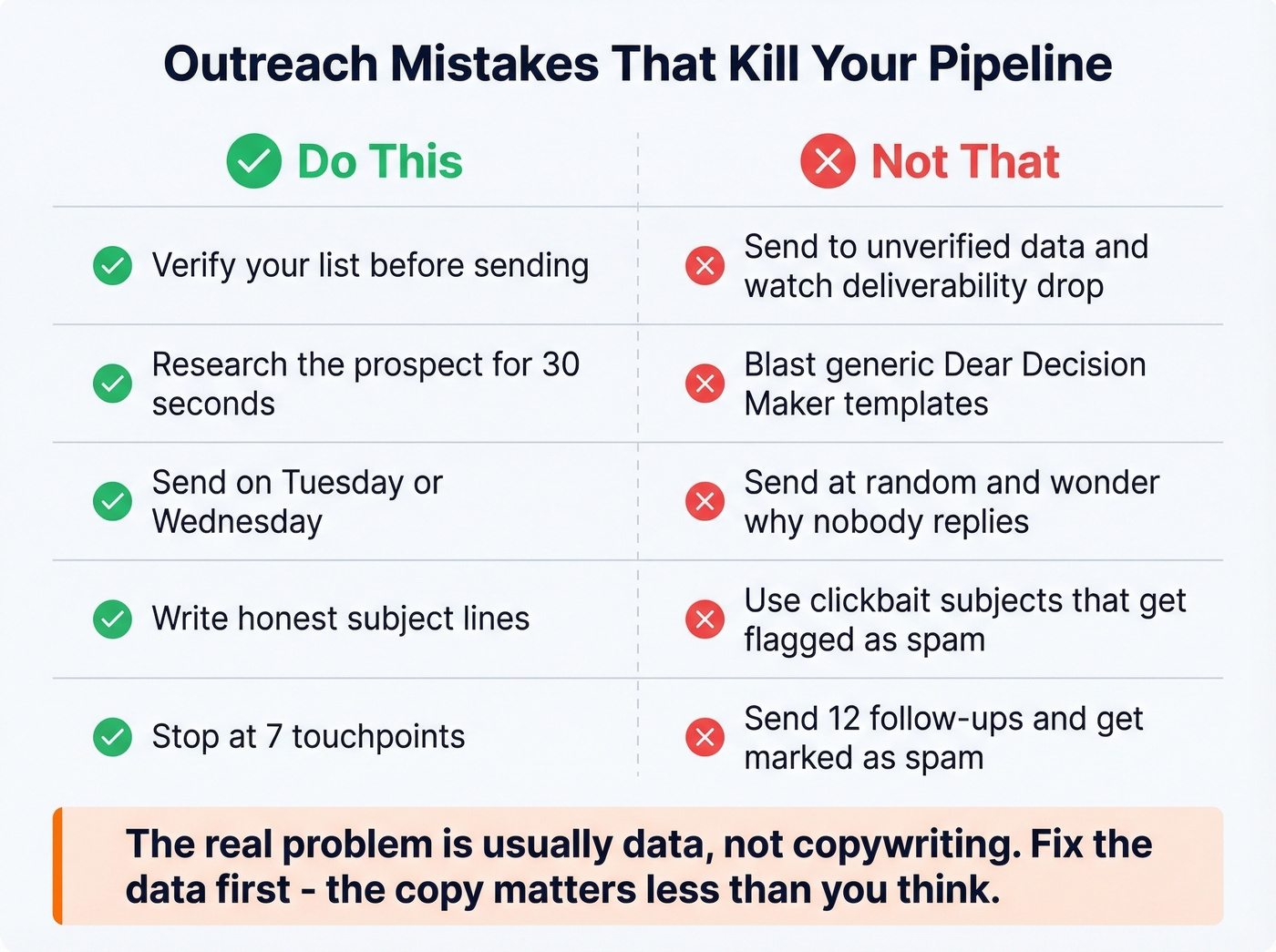
Look - most teams obsess over copywriting when their real problem is data. You can write the perfect email, but if your list quality is bad, your domain reputation tanks and even the good addresses stop seeing your messages. Fix the data first. The copy matters less than you think. (If you're already in trouble, focus on improve sender reputation before scaling volume.)
You just read that 81% of decision-makers engage with outreach tailored to their context. Prospeo's 30+ search filters - buyer intent, technographics, headcount growth, funding - let you segment precisely so every message lands with relevance. At $0.01 per email, building hyper-targeted lists costs less than a single bad send.
Define your ICP, filter by intent signals, and export verified contacts in minutes.
What is customer outreach in simple terms?
Customer outreach means proactively contacting prospects or existing customers to build relationships, close deals, or gather feedback. It's the opposite of waiting for people to come to you - any time your team initiates the conversation across sales, marketing, or customer success, that's outreach.
How many follow-ups should you send?
Send 4-7 touchpoints per sequence. 42% of cold email replies come from follow-ups, not the first message. Stopping after one or two emails means you're abandoning nearly half your potential responses before they happen.
How do you keep outreach emails out of spam?
Verify your contact list before sending to keep bounce rates under 4% and protect your domain reputation. Beyond verification, warm up new sending domains gradually and keep email volume consistent week over week. Skip this and you'll spend months rebuilding sender reputation that took days to destroy.
Is cold calling still effective outreach?
Yes. Cold calling still works for reaching VP+ buyers who ignore email. Connect rates hover around 2-3%, but the conversations you do get tend to be higher quality than email replies. Most teams pair cold calls with email and social touches in a multi-channel sequence for the best results.