

7 Customer Profiling Methods That Go Beyond the Basics
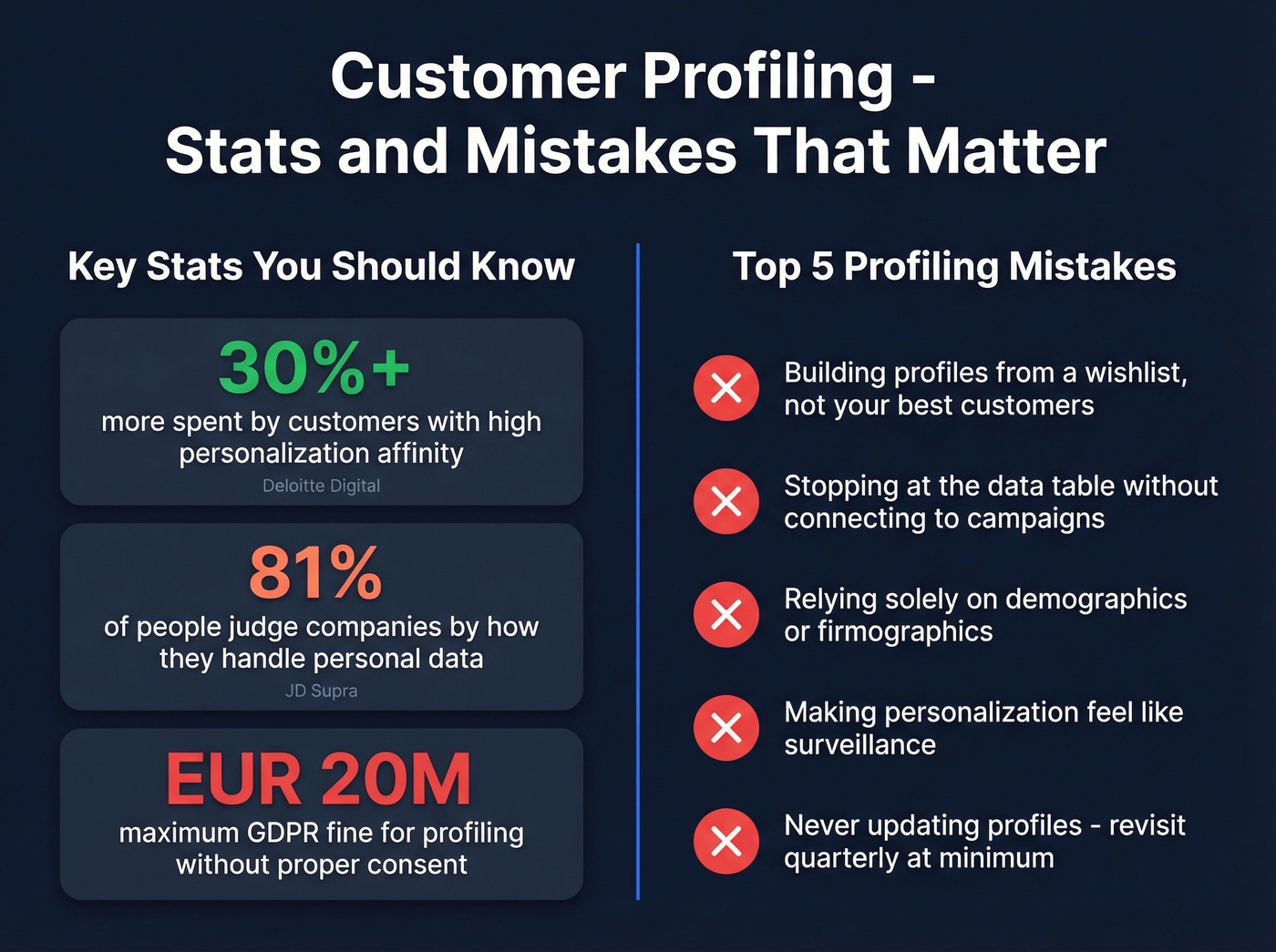
Your marketing team built "Startup Steve" - a 32-year-old product manager who drinks oat milk and listens to podcasts. Meanwhile, your best customers are 45-year-old operations directors buying in bulk every quarter. The persona didn't match reality because it was never built on real data. That's the core failure of most customer profiling methods: customers with the highest personalization affinity spend 30%+ more. You can't personalize against a fictional character.
Most profiling guides rehash three approaches from 2015. The ones that actually move revenue - RFM analysis, Jobs-to-Be-Done, technographic profiling - get ignored. We're covering all seven here, then showing you what to do after you build the dataset.
What Customer Profiling Actually Is
A customer profile is a data-driven record of who your best customers are, what they buy, and how they behave. It's built from transaction history, enrichment data, and behavioral signals - not a brainstorming session. Whether you're building profiles for marketing campaigns or sales outreach, the foundation is the same: real data from real buyers.
The distinction that matters: a profile is quantitative and actionable. A buyer persona is a semi-fictional narrative. An ICP defines the company you're targeting; a profile defines the person. An ICP defines the company you're targeting, then add personas later if your team needs a storytelling layer. Start with profiles, then add personas later if your team needs a storytelling layer.
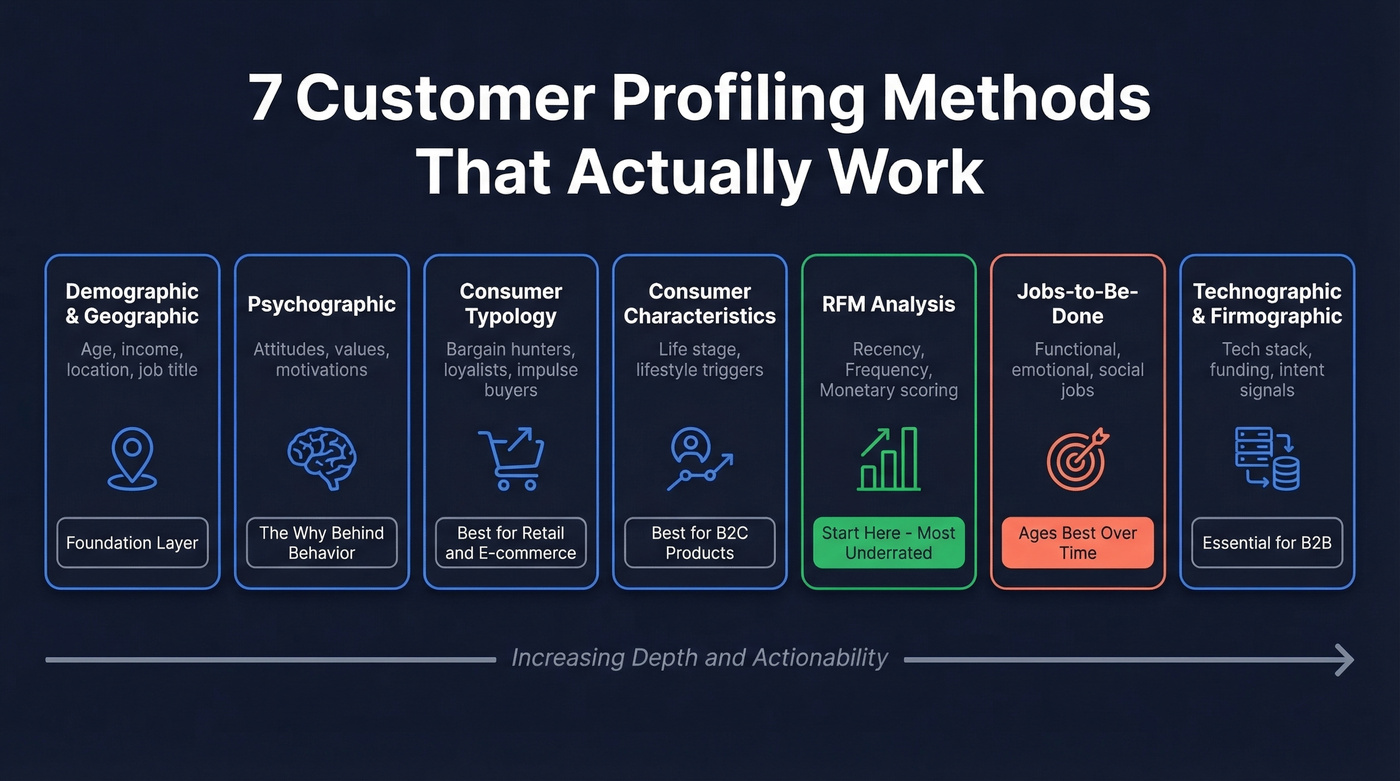
7 Profiling Approaches Worth Using
Demographic & Geographic
Table stakes. Age, income, location, job title - you need these as a foundation, but they're not enough on their own. Relying solely on demographics is one of the most common ICP mistakes teams make. Think of demographics as the skeleton. The next six methods add muscle.
Psychographic Profiling
Psychographics capture attitudes, values, and motivations - the why behind purchase behavior. The modern approach isn't surveys and focus groups. NLP-based sentiment analysis extracts psychographic signals at scale from product reviews, support tickets, and social data. We've seen teams paste structured feedback into LLMs to surface contradictions between what customers say and what they do - scrappy, effective, and impossible with demographic data alone.
This is where profiles built for marketing start to diverge from generic demographic snapshots.
Consumer Typology
Behavioral archetypes group customers by how they interact with your product, not who they are:
- Bargain hunters - price-driven, coupon-responsive, high churn risk
- Brand loyalists - repeat buyers, low price sensitivity, high LTV
- Impulse buyers - respond to urgency and scarcity triggers
- Need-based buyers - research-heavy, comparison shoppers, slow to convert
Useful for retail and e-commerce. If you're selling software, skip to RFM or JTBD.
Consumer Characteristics
Lifestyle and life-stage grouping: new parents, empty nesters, recent movers, career changers. This layers well on top of demographics when you're marketing consumer products with clear life-stage triggers. For B2B, it's rarely the right lens.
RFM Analysis
This is the most underrated quantitative profiling technique, and it's where we'd tell any team to start. RFM stands for Recency (when they last bought), Frequency (how often), and Monetary (how much). You score each dimension, then cluster customers into segments.
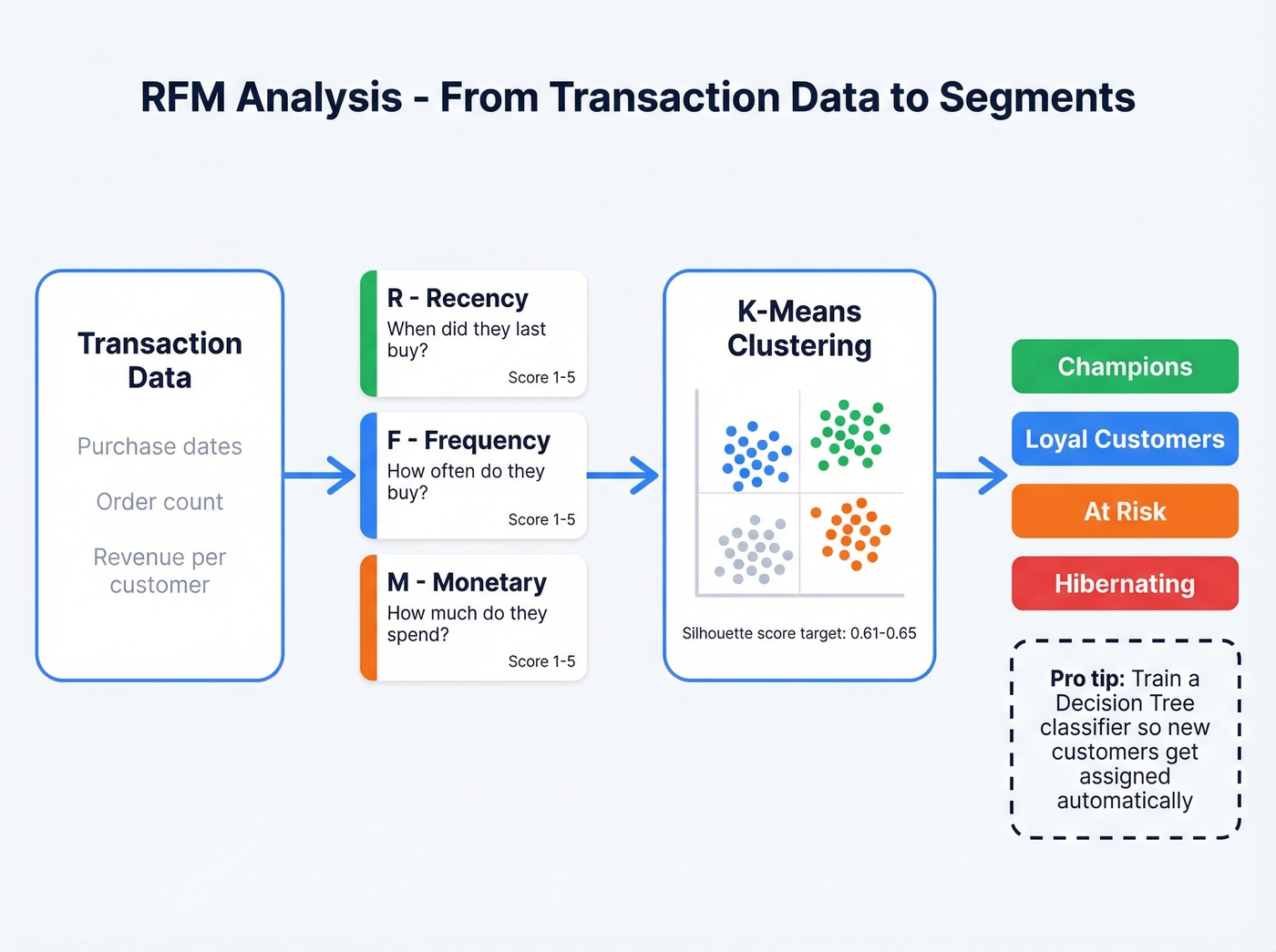
The workflow: calculate RFM metrics from transaction data, score each customer, then apply K-Means clustering. In published benchmarks, K-Means on RFM data produces silhouette scores around 0.61, while DBSCAN hits ~0.65 with better outlier handling. You can start in a spreadsheet; clustering is easiest in Python or R. Use the clusters to inform strategy - teams that let predictive models run campaigns autonomously consistently get burned.
For small business teams with limited budgets, RFM is especially practical because it requires no expensive tooling and the math is straightforward enough that a single analyst can own the whole process end to end.
Jobs-to-Be-Done (JTBD)
Let's be honest: JTBD is the single most underused profiling method in marketing, and it's the one that ages best. Where RFM tells you what customers do, JTBD explains why they buy. Customers "hire" products to accomplish a job with functional, emotional, and social dimensions.
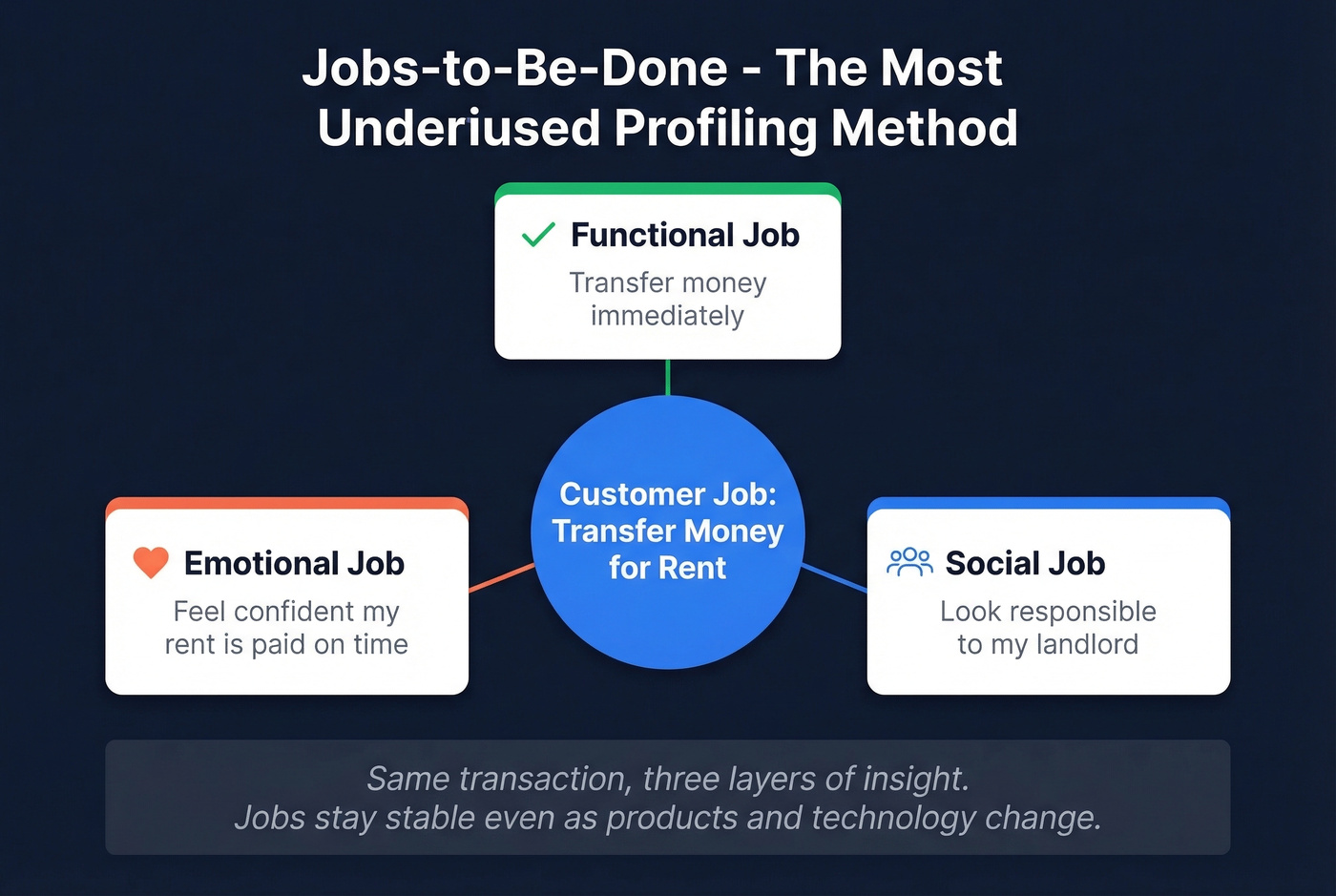
A functional job might be "transfer money immediately." The emotional job is "feel confident my rent is paid on time." The social job is "look responsible to my landlord." Same transaction, three layers of insight. Jobs stay stable even as products and technology change, making JTBD segments more durable than demographic ones. Discovery often happens through in-depth interviews and mobile ethnography - more effort than RFM, but the segments explain behavior that transaction data alone can't.
Technographic & Firmographic (B2B)
For B2B teams, profiling means combining tech stack signals, company attributes, and buyer intent data. What CRM does the prospect use? Are they hiring for a role that signals budget? Did they just raise a Series B?
Profiling for sales teams lives and dies by the accuracy of these signals. Stale firmographic data means wasted outreach, bounced emails, and reps chasing ghosts.
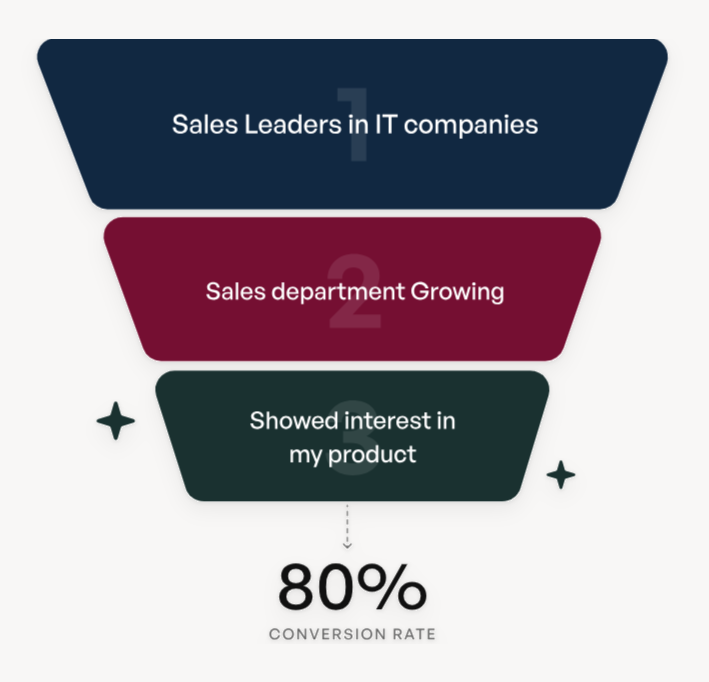
Building these profiles requires accurate, current contact and company data. Prospeo enriches CRM records with 50+ data points per contact - verified emails, direct dials, company size, tech stack, and buyer intent signals across 15,000 topics - with data refreshed every 7 days. That freshness matters when the industry average refresh cycle is six weeks.
From Data to Action
Here's the thing: most teams build the dataset and then stall. A practitioner on r/analytics described it perfectly - they'd built a customer-level table with RFM features, housing data, estimated income, and hit a wall. We've seen this pattern dozens of times in our own conversations with sales and RevOps teams.
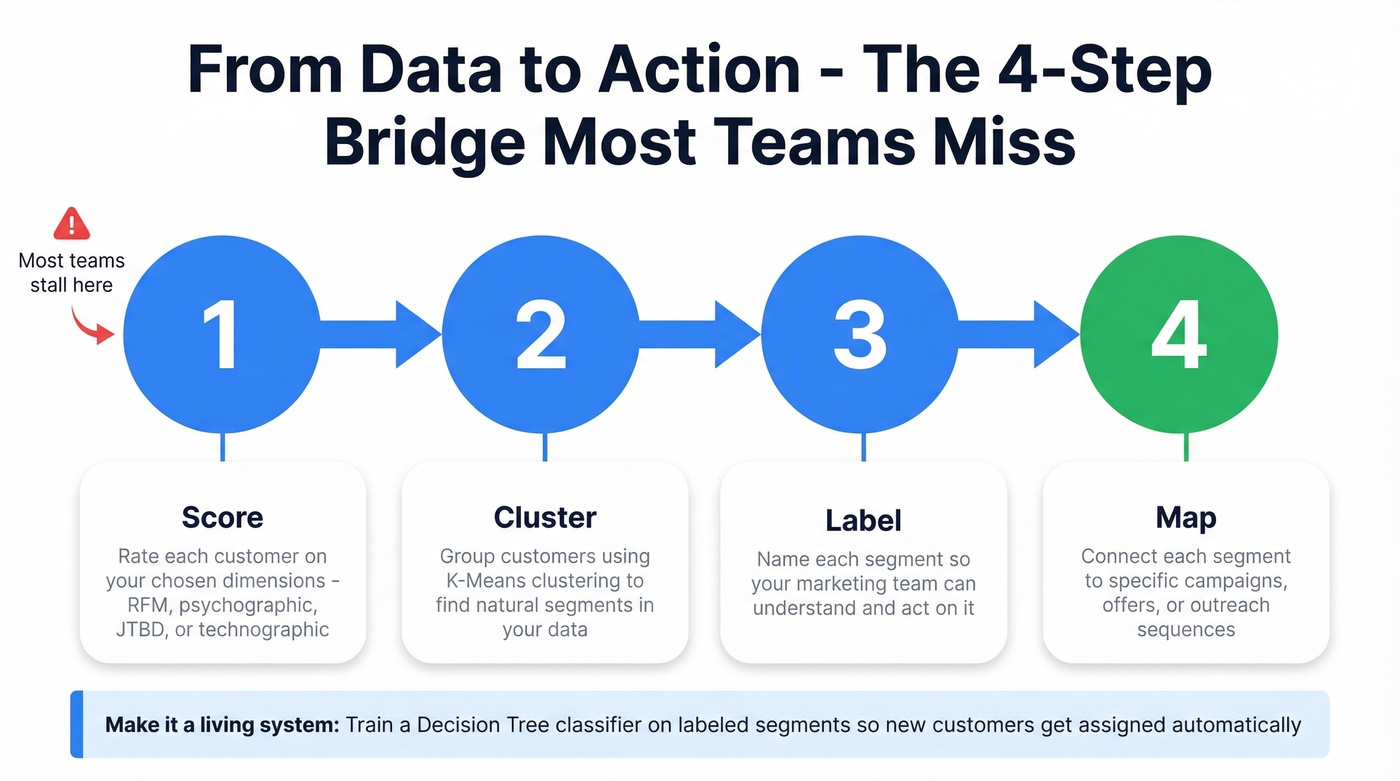
The bridge is a four-step sequence:
- Score each customer on your chosen dimensions
- Cluster them into groups with K-Means
- Label each segment with a name your marketing team can act on
- Map each segment to specific campaigns or offers
For ongoing operations, train a Decision Tree classifier on your labeled segments so new customers get assigned automatically. That turns a one-time analysis into a living system.

Technographic and firmographic profiling falls apart when your data is stale. Prospeo enriches every contact with 50+ data points - verified emails, direct dials, tech stack, funding, and intent signals across 15,000 topics - on a 7-day refresh cycle. That's 6x faster than the industry average.
Stop profiling against outdated records. Start with data you can trust.
Common Profiling Mistakes
- Building profiles from a wishlist, not your best customers. Your ICP should reflect who actually buys and renews - not who you wish would buy. (If you need a scoring rubric, use an ideal customer profile template.)
- Stopping at the data table. A profile that doesn't connect to a campaign is just an expensive spreadsheet.
- Relying solely on demographics or firmographics. Layer in behavioral, psychographic, or intent signals.
- Making personalization feel like surveillance. 81% of people judge companies by how they handle personal data. Profiling based on stereotypical assumptions creates measurable service failures - it's not just bad marketing, it's discrimination.
- Never updating profiles. Job titles change, companies restructure, buying committees shift. Revisit quarterly at minimum.
Privacy Essentials
Profiling without consent infrastructure isn't just risky - it's a EUR 20M fine waiting to happen. GDPR requires freely given, specific, informed consent with clear affirmative action. CCPA/CPRA operates on an opt-out model with penalties up to $7,500 per intentional violation. Over 170 countries now have data privacy regulations on the books.
Collect only what you need, be transparent about how you use it, and build opt-in/opt-out infrastructure before you scale profiling. Not after.
Do You Need a CDP?
Probably not. CDPs are overkill for 80% of teams.
Mid-market CDPs run $1,000-5,000/month; enterprise deployments hit $50K-250K+/year. Segment offers a free tier and paid plans from ~$120/month, but that's just the entry point. I've watched teams burn $50K+ on CDP implementations they didn't need - six months of integration work for a dashboard nobody opened. For B2B, a CRM paired with data enrichment services covers what most mid-market teams need without a six-figure contract. Save the CDP budget for when you're genuinely unifying 10+ touchpoints with real-time identity resolution.
You just built the segments. Now you need verified contact data to actually reach them. Prospeo delivers 98% email accuracy, 125M+ verified mobiles, and 30+ filters - buyer intent, job changes, headcount growth - so your profiles connect to real campaigns, not dead ends.
Turn your customer profiles into pipeline at $0.01 per verified email.
FAQ
What's the difference between a customer profile and a buyer persona?
A customer profile is built from real transaction, behavioral, and enrichment data - quantitative and actionable. A buyer persona is a semi-fictional archetype used for narrative alignment. Start with profiles grounded in purchase history, then layer personas on top later for storytelling context across your marketing team.
What's the fastest profiling method to implement?
RFM analysis. If you have transaction data, you can calculate recency, frequency, and monetary scores in a spreadsheet and cluster customers in an afternoon. No special tools or vendor contracts required.
How often should customer profiles be updated?
Quarterly at minimum, though B2B profiles decay faster than most teams expect - job titles change, emails go stale, companies restructure. Automated enrichment that refreshes on a weekly cycle keeps profiles current between manual reviews so outreach doesn't bounce.
What tools help with B2B customer profiling?
For technographic and firmographic profiling, you need accurate contact and company data. Prospeo provides 300M+ professional profiles with 30+ search filters - including buyer intent, tech stack, and headcount growth - starting with a free tier of 75 email credits per month. Pair it with your CRM for a lightweight profiling stack that skips the CDP overhead.