

Customer Segmentation: How to Build Segments That Actually Drive Revenue
A marketer on r/MarketingAutomation shared a story that'll sound familiar: built what they called a "killer campaign," sent it to every contact on their list, and got zilch. No clicks, no conversions, nothing. The fix wasn't a better subject line or a flashier design - it was customer segmentation, splitting that list by interests and past purchases so the message actually matched the person reading it.
Most segmentation guides stop at definitions. This one doesn't.
The Cheat Sheet
Before you read another long guide, here's the short version:
- Limit yourself to 3-8 segments. Fewer than 3 and you're still blasting generically. More than 8 and your team can't create tailored campaigns for each group.
- Start with behavioral data, not demographics alone. What people do predicts what they'll do next far better than who they are.
- Use RFM analysis if you have transactional data. It's the single most underused framework in marketing.
- Refresh quarterly at minimum. Segments built on last year's purchase patterns target last year's customers.
- Clean your contact data first. Flawed data produces flawed segments - no framework fixes garbage inputs.
What Is Customer Segmentation?
Customer segmentation is the process of dividing your customer base into distinct groups that share meaningful characteristics - behaviors, needs, value, or traits - so you can tailor your marketing, product, and sales strategies to each group.
It's not market segmentation. Market segmentation carves up an entire addressable market, including people who've never bought from you, to identify opportunities. Customer segmentation focuses on people who've already interacted with your business. The classic STP model - Segmentation, Targeting, Positioning - treats this practice as the foundation everything else builds on.
Companies with segmentation data are 130% more likely to understand their customers' motivations and 60% more likely to understand their concerns. That's the gap between guessing and knowing.
7 Types of Segmentation
Here's the thing: demographics alone are a terrible segmentation strategy. They're a starting point, not a destination. Knowing someone is a 35-year-old male in Chicago tells you almost nothing about whether they'll buy your product next month. Understanding the different types - and when to use each - is what separates useful segments from vanity exercises.
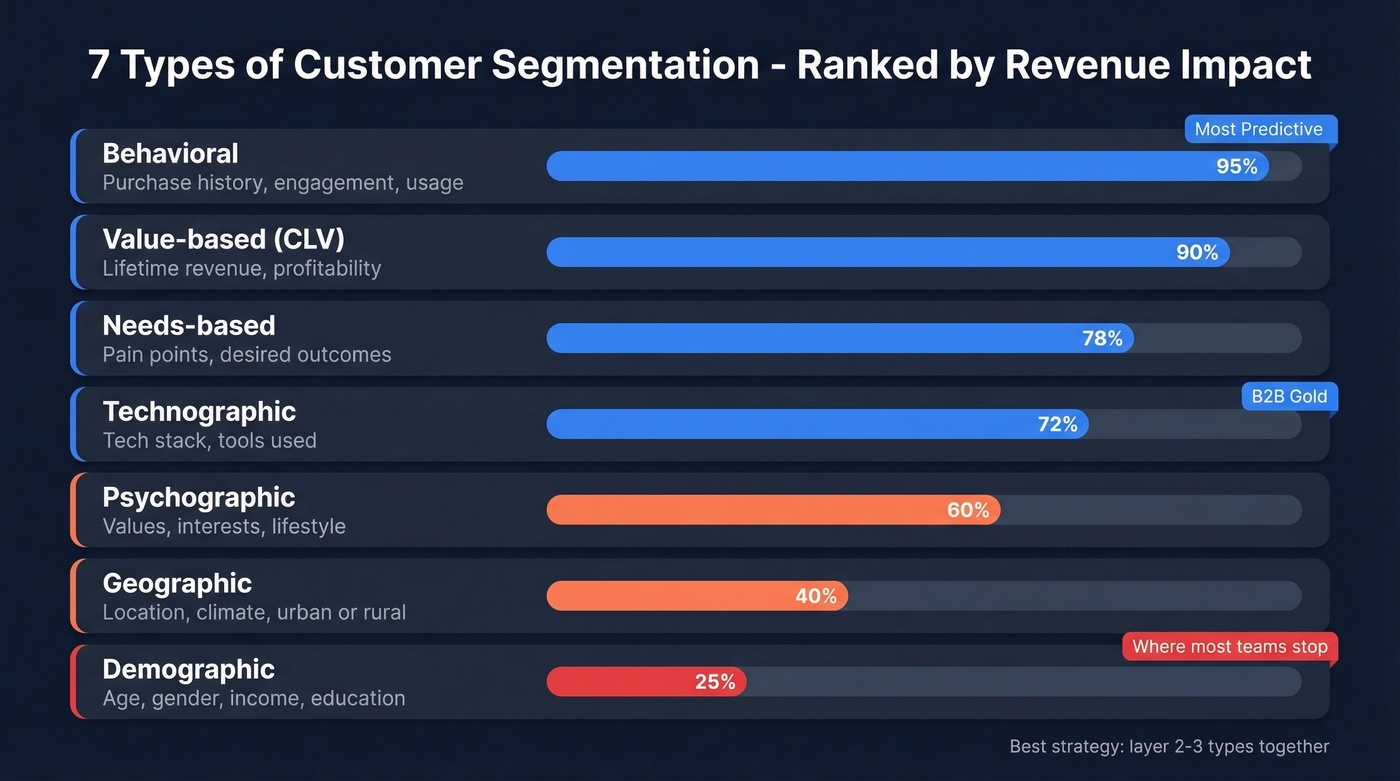
| Type | What It Measures | Best For | Example |
|---|---|---|---|
| Demographic | Age, gender, income, education | Broad targeting | Luxury brand targets HHI $150K+ |
| Geographic | Location, climate, urban/rural | Regional campaigns | Snow gear retailer targets mountain states |
| Behavioral segmentation | Purchase history, engagement, usage | Retention + upsell | SaaS targets users who hit feature X 5+ times |
| Psychographic segmentation | Values, interests, lifestyle | Brand messaging | Eco-brand targets sustainability-conscious buyers |
| Needs-based | Pain points, desired outcomes | Product development | CRM vendor segments by "need reporting" vs "need automation" |
| Technographic | Tech stack, tools used | B2B sales + product | Targets companies using Salesforce but not a CPQ tool |
| Value-based (CLV) | Lifetime revenue, profitability | Resource allocation | Top 10% of customers get dedicated account managers |
Demographic segmentation is where most teams start and, unfortunately, where many stop. It's useful for sizing markets and basic ad targeting, but it doesn't tell you intent.
Behavioral segmentation does the heavy lifting. Purchase frequency, feature usage, email engagement, cart abandonment - these signals predict future action. If you're only going to add one layer beyond demographics, make it behavioral. Among all the types listed above, it's the most predictive for revenue outcomes.
Psychographic segmentation captures the "why" behind purchases. It's harder to collect through surveys and social listening, but it's powerful for messaging and brand positioning. Technographic segmentation is a B2B staple - knowing a prospect runs HubSpot but doesn't have a data enrichment tool tells you exactly what to pitch and how.
Value-based segmentation sorts customers by what they're actually worth. Your top decile often generates the majority of revenue. Treat them accordingly.
The best strategies layer 2-3 types together. Behavioral + value-based is a potent combination for retention. Firmographic + technographic + intent is the B2B gold standard.
How to Build Actionable Segments
Building segments that hold up in production - not just in a slide deck - follows a repeatable process. We've seen teams nail the theory and completely botch the execution, so let's break this down step by step.
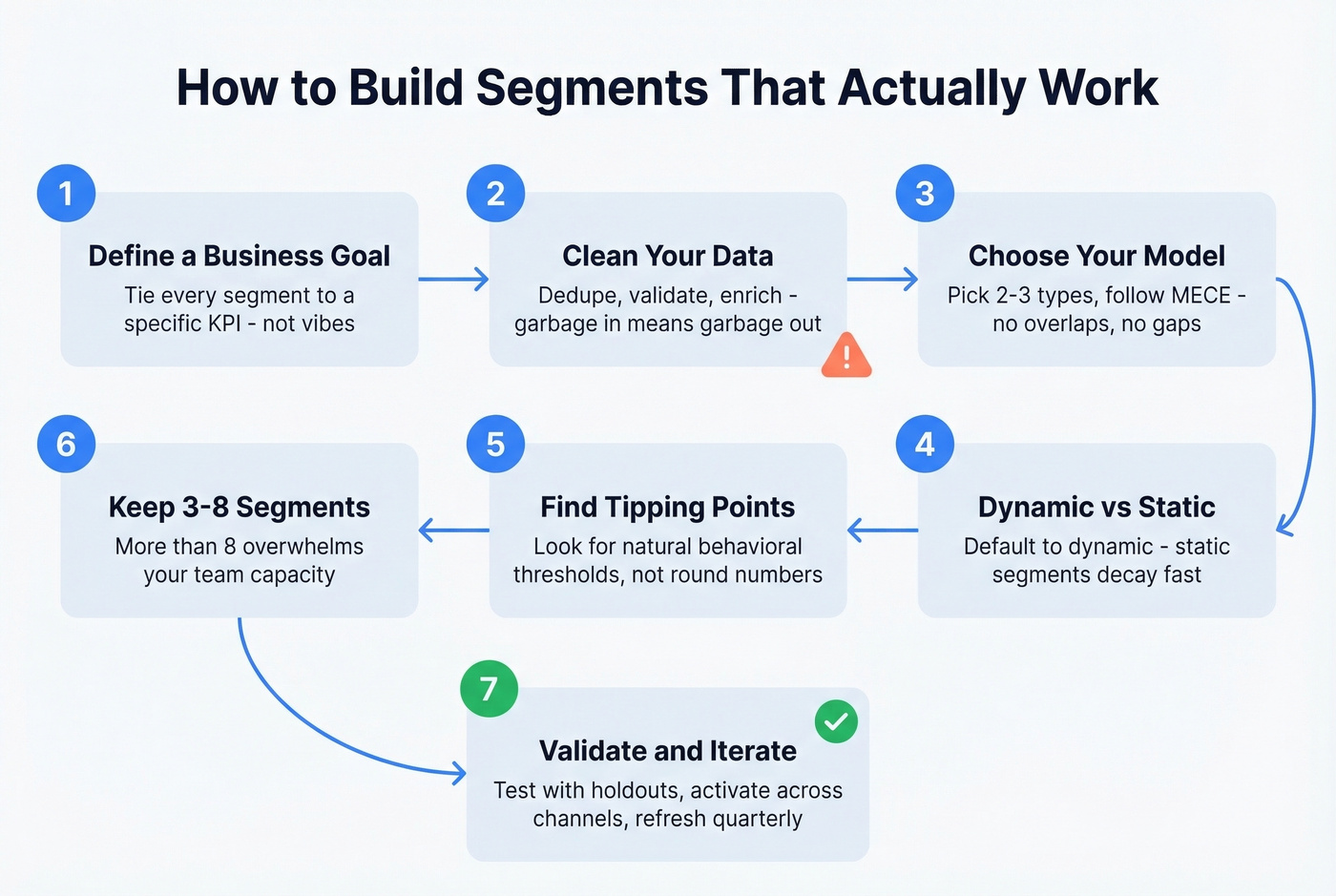
1. Define a clear business goal tied to a KPI. "Understand our customers better" isn't a goal. "Reduce churn among mid-tier accounts by 15% in Q3" is. Every segment should exist to move a specific metric. If you can't tie a segment to a KPI, you don't need that segment.
2. Collect and clean your data. This is where most segmentation projects quietly die. Duplicate records, outdated emails, missing fields - all of it produces segments that look clean in your analytics tool but fall apart the moment you activate them. Validate, dedupe, and enrich before you segment. If you're adding enrichment, compare options in our guide to data enrichment services.
3. Choose your model and variables. Pick 2-3 segmentation types from the table above. Make sure your segments follow the MECE principle: mutually exclusive, so no customer belongs to two segments, and collectively exhaustive, so every customer belongs to one. Overlapping segments create conflicting campaigns. Gaps mean you're ignoring revenue.
4. Choose dynamic or static segmentation deliberately. Static segments are snapshots - useful for one-off campaigns but they decay fast. Dynamic segments update automatically as customer behavior changes, which is better for ongoing programs like lifecycle marketing. Default to dynamic.
5. Look for behavioral tipping points. Don't draw arbitrary lines. Look for thresholds where behavior meaningfully changes - the purchase frequency where retention jumps, the engagement score where conversion doubles. These natural breakpoints make better segment boundaries than round numbers.
6. Keep it to 3-8 segments. More than 8 overwhelms your team's capacity to produce differentiated campaigns for each group.
7. Validate, activate, and iterate. Test your segments against holdout groups. Push them into your marketing automation, CRM, and ad platforms - not just one channel. Then revisit quarterly.
RFM Analysis - The Framework Most Guides Skip
If you only learn one segmentation framework, make it RFM. It works on transactional data most companies already have, and it produces immediately actionable segments.
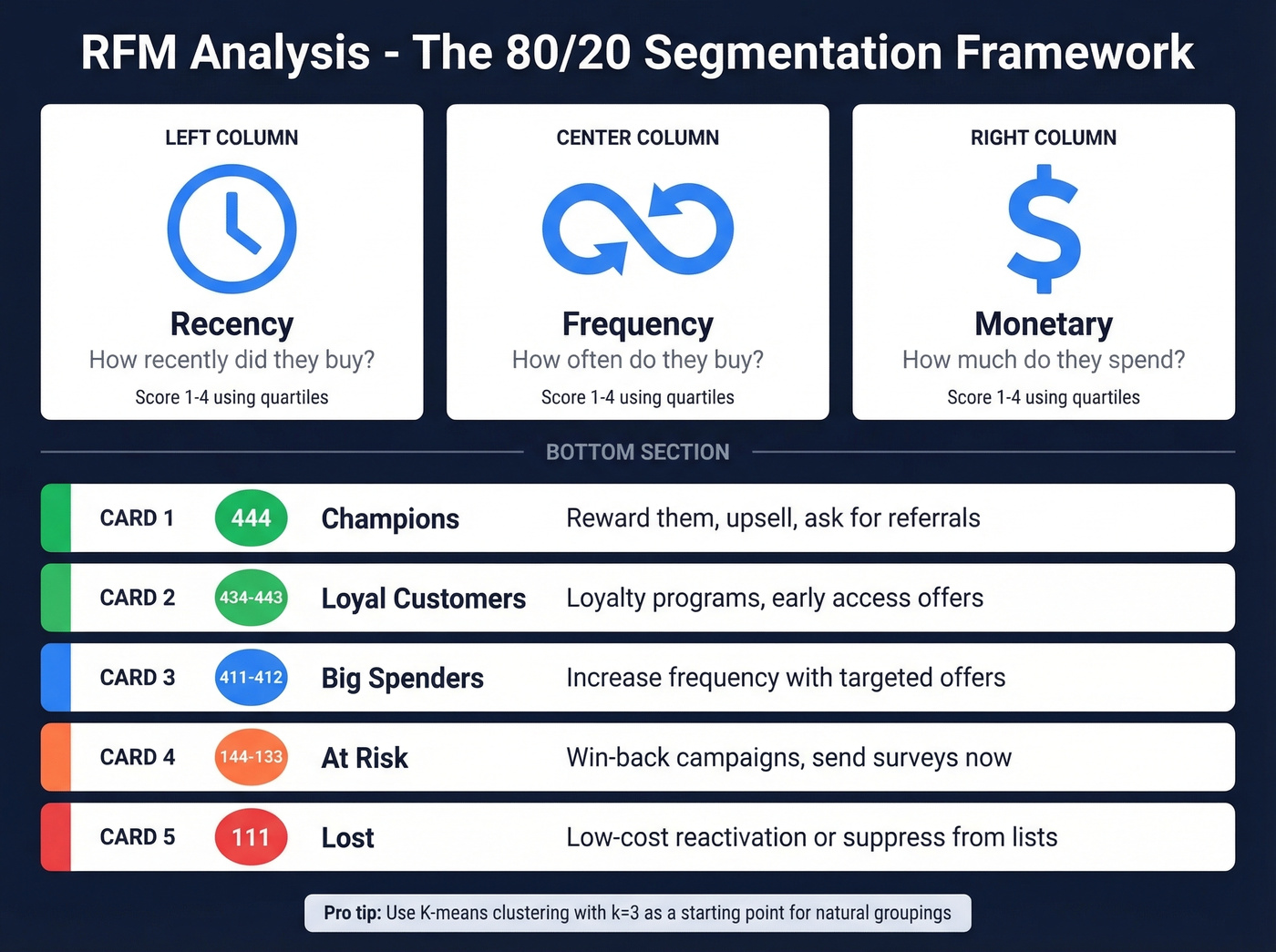
RFM stands for Recency (how recently a customer purchased), Frequency (how often they purchase), and Monetary (how much they spend). Together, these three variables capture the core of customer value without requiring surveys, psychographic inference, or complex ML pipelines.
Take your transaction data and calculate three values per customer: days since last purchase, total number of orders, and total spend. Score each dimension using quartiles - split customers into four equal groups per variable. A customer in the top quartile for all three gets a "444." Someone in the bottom across the board gets "111."
| RFM Score | Label | Action |
|---|---|---|
| 444 | Champions | Reward, upsell, ask for referrals |
| 434, 443 | Loyal | Loyalty programs, early access |
| 411, 412 | Big spenders | Increase frequency with targeted offers |
| 144, 133 | At risk | Win-back campaigns, surveys |
| 111 | Lost | Low-cost reactivation or suppress |
For teams that want more precision, K-means clustering on standardized RFM features finds natural groupings without manually defining thresholds. Use silhouette scoring to choose the right number of clusters - in many RFM datasets, k=3 is a strong starting point.
RFM won't replace a full segmentation strategy. But it'll get you 80% of the value in 20% of the time, especially for e-commerce and subscription businesses.

Great segmentation starts with clean, enriched data. Prospeo returns 50+ data points per contact at a 92% match rate - including technographics, buyer intent across 15,000 topics, and firmographic signals. Layer behavioral, value-based, and intent data without stitching together five tools.
Stop segmenting on stale data. Enrich your CRM in minutes.
B2B Customer Segmentation
B2C segmentation frameworks break down fast in B2B. You're not selling to individuals - you're selling to buying committees with multiple stakeholders across finance, IT, operations, and the C-suite. A single demographic or behavioral model can't capture that complexity.
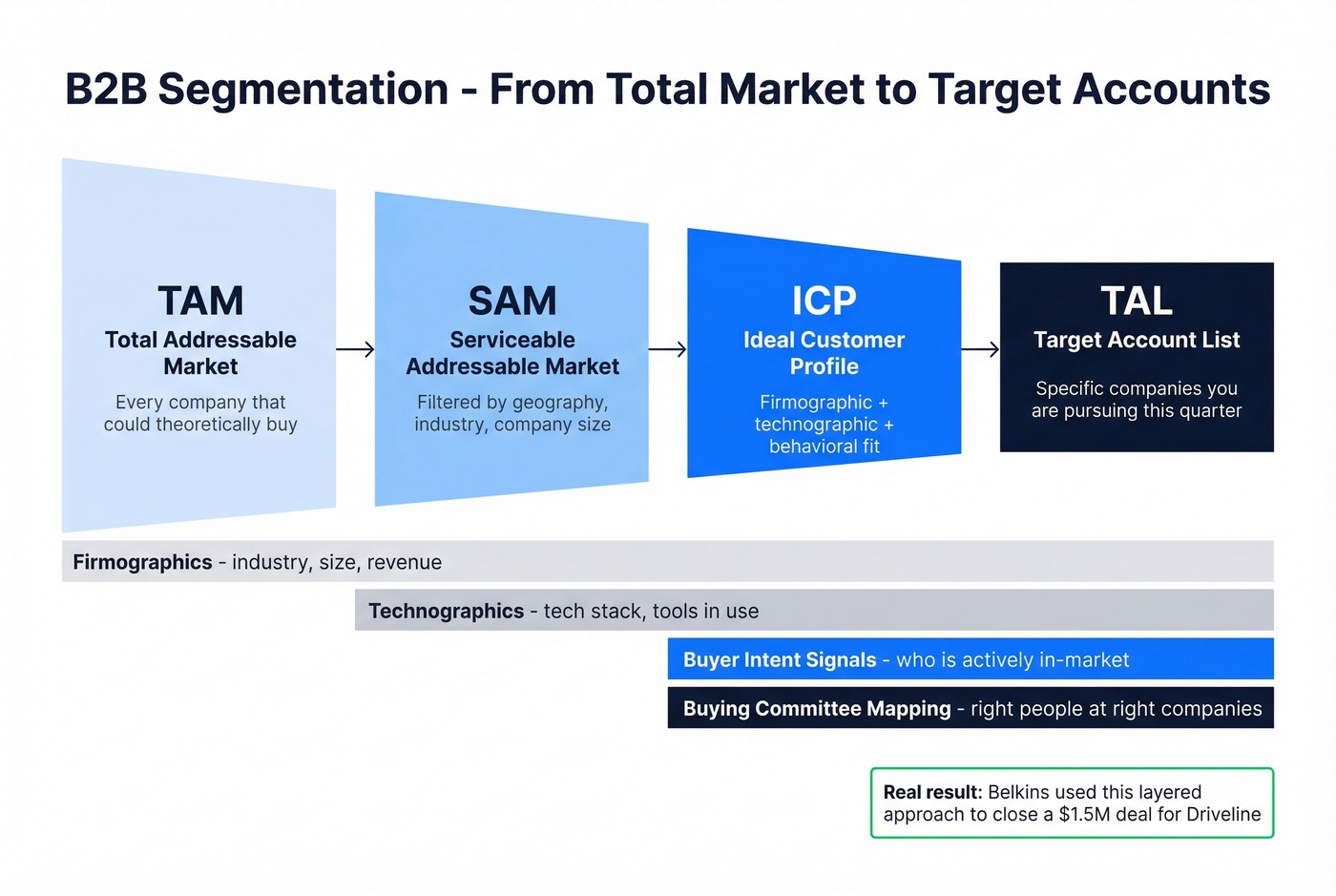
The framework that works: start broad and narrow systematically. Define your Total Addressable Market (TAM), then your Serviceable Addressable Market (SAM) based on geography, industry, and company size. From there, build your Ideal Customer Profile (ICP) using firmographic, technographic, and behavioral criteria. Finally, create a Target Account List (TAL) - the specific companies you're going after this quarter. (If you need a refresher on sizing, see our guide to the addressable market.)
The segmentation variables that matter in B2B stack in layers. Firmographics form the base. Technographics add targeting precision. Buyer intent signals tell you who's actively in-market. And buying committee mapping ensures you're reaching the right people within each account, not just the easiest-to-find contact. For a practical implementation, use an Ideal Customer Profile (ICP) scoring rubric and add intent based segmentation once your basics are solid.
This approach produces real results. Belkins used layered segmentation for Driveline, splitting their ICP into retailers vs. brands, then previous vs. new clients. The customized messaging that followed closed a $1.5M deal.

5 Segmentation Mistakes That Kill ROI
The reason your segmentation isn't working probably isn't your strategy - it's your data. Or your execution. Or both. A common refrain on marketing subreddits: teams build segments once and never touch them again. Here are the five mistakes we see repeatedly.
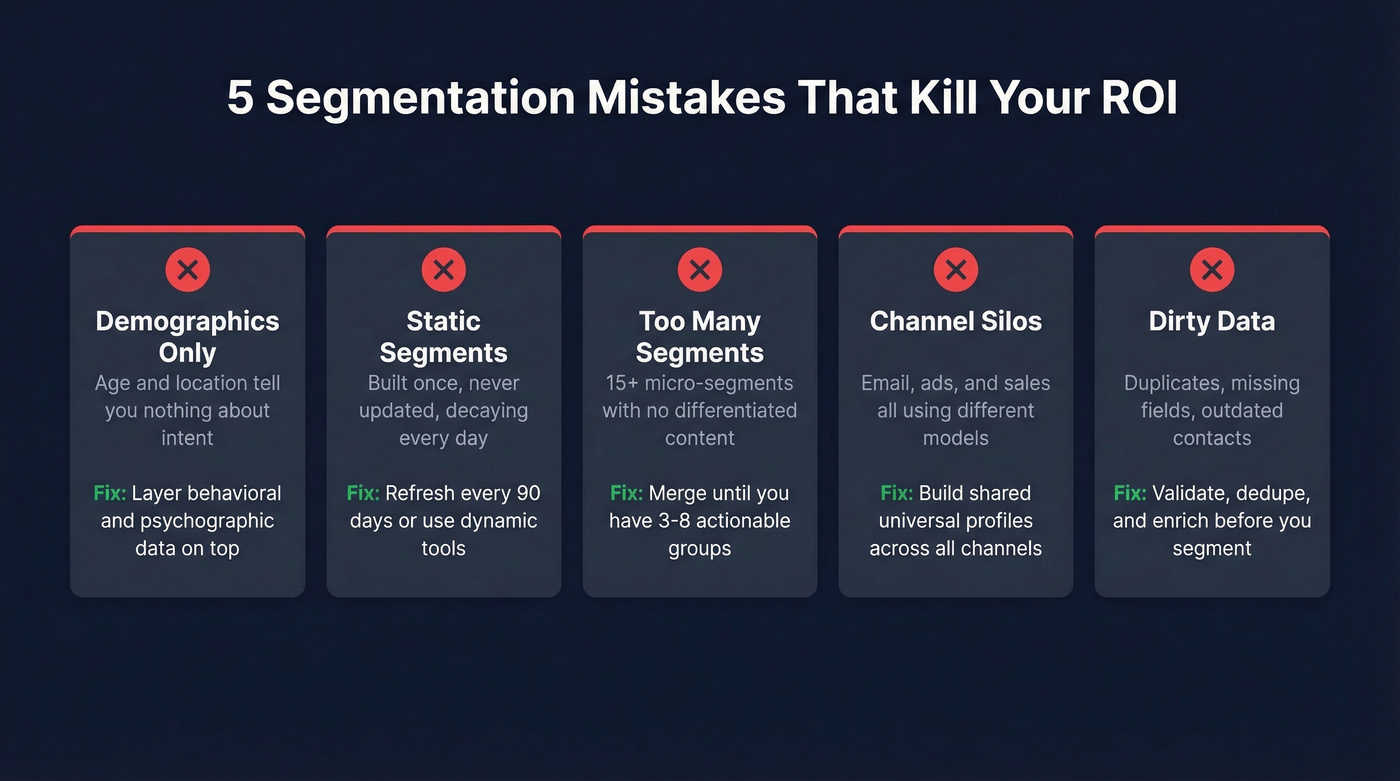
1. The demographics-only trap. Segmenting by age, gender, and location feels productive but produces generic groups. Layer behavioral and psychographic data on top. What customers do and why they do it matters more than who they are.
2. Static segments that rot. Building segments once and running them for a year is a recipe for irrelevance. Customer behavior shifts quarterly - your segments should too. Set a calendar reminder to refresh every 90 days, or use dynamic segmentation tools that update automatically.
3. Too many segments. We've seen teams create 15+ micro-segments and then struggle to produce differentiated content for each one. Merge similar segments until you're in the 3-8 range. If you can't articulate how two segments should be treated differently, they're the same segment.
4. Channel silos. Your email team uses one segmentation model, paid media uses another, and sales uses a third. The customer gets a fragmented experience. Build shared universal profiles that feed every channel from the same logic.
5. No feedback loops. Segments should evolve based on performance data and customer feedback. If your "high-value" segment isn't converting, the segment definition is wrong - not the campaign. Track segment-level KPIs monthly and run customer surveys to validate your assumptions before drift tanks performance. If churn is the KPI you're fighting, pair segmentation with a proper churn analysis.
Privacy-First Segmentation
Look, most segmentation guides don't mention privacy compliance, which is genuinely irresponsible. Every segmentation strategy depends on customer data, and mishandling it carries real consequences.
GDPR fines reach up to EUR20M or 4% of global annual turnover - whichever is higher. Consent must be freely given, specific, informed, and unambiguous. Pre-checked boxes don't count. Bundled consent doesn't count. CCPA and CPRA take a different approach with opt-out mechanisms. If you're sharing segmentation data with ad platforms or partners, you need a visible "Do Not Sell or Share" mechanism and must honor Global Privacy Control browser signals.
Here's why this matters beyond fines: 81% of consumers believe how an organization treats personal data reflects how it respects them as customers. Privacy isn't just compliance - it's trust.
The practical implication: lean hard into first-party data. With third-party cookies continuing to deprecate, the data your customers give you directly - purchase history, preferences, on-site behavior, survey responses - becomes your most valuable segmentation asset. Document your lawful basis for processing, enforce purpose limitation, apply data minimization, set retention limits, and make opt-out frictionless.
Use Cases That Drive Revenue
Segmentation theory is nice. Numbers are better.
Black Diamond targeted lapsed customers with segmented campaigns and saw a 50% reduction in CPA, 2x ROAS, and a 1,101% increase in revenue per email. That last number isn't a typo. When you stop emailing people who don't care and start re-engaging people who used to, the math changes dramatically.
Wondercide applied segmentation to direct mail - a channel most teams treat as a mass blast. By segmenting by customer status, they achieved 600% overall ROI. Even their opted-out email segment returned 310% ROI through carefully targeted physical mail. (If you're testing offline channels, see our guide to direct mail for lead generation.)
Mountain Khakis discovered through segmentation that their female customer segment was massively underserved. Targeted campaigns produced a 7.1x increase in sales and 5x ROAS from female customers specifically.
Brand Collective restructured their paid media around customer segments and saw a 220% increase in ROAS with 2x new customer acquisition. The campaigns didn't change - the targeting did.
Hot take: if your deals typically close under $15K, you probably don't need enterprise-grade segmentation software. RFM analysis in a spreadsheet plus a decent email tool will outperform a $50K CDP that nobody on your team knows how to configure. Sophistication without execution is just overhead.
Best Segmentation Tools in 2026
| Tool | Best For | Starting Price | Free Tier? |
|---|---|---|---|
| Prospeo | B2B segment activation | ~$0.01/email | Yes (75 emails/mo) |
| HubSpot Marketing Hub | CRM + email segmentation | $20/mo (Starter, 1K contacts) | Yes (CRM) |
| Klaviyo | E-commerce email + SMS | $20/mo | Free up to 250 contacts |
| Amplitude | Product-led behavioral | $49/mo (300K MTUs) | Yes |
| Twilio Segment | CDP / data unification | $120/mo (10K MTUs) | Yes (limited) |
| Mixpanel | Event-based analytics | $0.28/1K events | Yes |
| Hotjar | On-site behavioral | $49/mo (7K sessions) | Yes |
| Kissmetrics | Advanced marketing analytics | $299/mo (annual) | No |
| Insightly | CRM segmentation for SMBs | $29/user/mo (annual) | Yes |
Start with Klaviyo or HubSpot if you're email-first. Amplitude or Mixpanel if you're product-led and need event-based behavioral segmentation. Twilio Segment makes sense when you need to unify data across multiple platforms before you can segment at all.
Skip Kissmetrics unless you're doing advanced attribution modeling - it's overkill for basic segmentation and the $299/mo floor is steep for what most teams actually use.
Pricing escalates fast as your contact list or event volume grows. HubSpot jumps from $20/mo at Starter to $890/mo at Professional. Amplitude and Segment get expensive at scale. Budget for growth, not just your current list size.
If segmentation is feeding outbound, make sure your stack can support it end-to-end: list building, enrichment, and outreach. Start with these free lead generation tools and then standardize your sales prospecting techniques so segments actually turn into pipeline.
The article says it: firmographic + technographic + intent is the B2B segmentation gold standard. Prospeo's 30+ search filters let you build segments by tech stack, headcount growth, department size, funding stage, and real-time buying intent - all refreshed every 7 days, not every 6 weeks.
Build revenue-driving segments with data that's actually current.
FAQ
How many customer segments should I have?
Three to eight is the practical sweet spot. Fewer than three means you're still blasting generic messages; more than eight overwhelms your team's capacity to produce differentiated campaigns. Start with three, then split segments only when you can clearly articulate how each new group should be treated differently.
What's the difference between segmentation and personalization?
Segmentation groups customers by shared traits; personalization tailors the experience to individuals within those groups. You need segments first - they provide the framework that makes one-to-one personalization scalable rather than random.
How often should I update my segments?
Quarterly at minimum. Customer behavior shifts fast enough that six-month-old segments target people who no longer match. Dynamic segmentation tools that recalculate automatically are ideal, but even a manual 90-day review catches the worst decay before it tanks campaign performance.
What's a good free tool for B2B segmentation?
Prospeo's free tier (75 verified emails/month) paired with HubSpot's free CRM covers basic B2B segmentation without any spend. Prospeo handles segment-specific list building with 30+ filters, while HubSpot manages contact records and campaign activation.
Is customer segmentation worth it for small businesses?
Absolutely - even splitting your list into 3-4 behavioral groups lifts email revenue by double-digit percentages. Tools like Klaviyo and HubSpot offer free tiers, so the barrier to entry is essentially zero. Start with RFM in a spreadsheet if you have transaction data.