

Customer Segmentation vs Customer Profiling: What's the Difference and Which Comes First?
Your CMO asks for "a segmentation strategy." You pull CRM data, sort accounts by industry and company size, build five tidy buckets, and launch campaigns against each one. Open rates look fine. Pipeline doesn't move.
Here's the thing: the problem usually isn't the segments. It's that nobody did the unglamorous work of profiling the people inside them, so every message lands generic and every "personalized" campaign feels like a mail merge.
That confusion is everywhere. A practitioner thread on r/marketing asks the same question we hear on calls all the time: does target market work happen before segments, before personas, or after? A UX research thread makes the gap even clearer: behavioral segments built from internal data still "don't tell us why" customers act the way they do. Let's break this down without the jargon.
The Short Answer
Segmentation groups customers by shared traits so you can target at scale. Profiling builds detailed portraits of individuals or ideal accounts so you understand why they buy and how they decide.
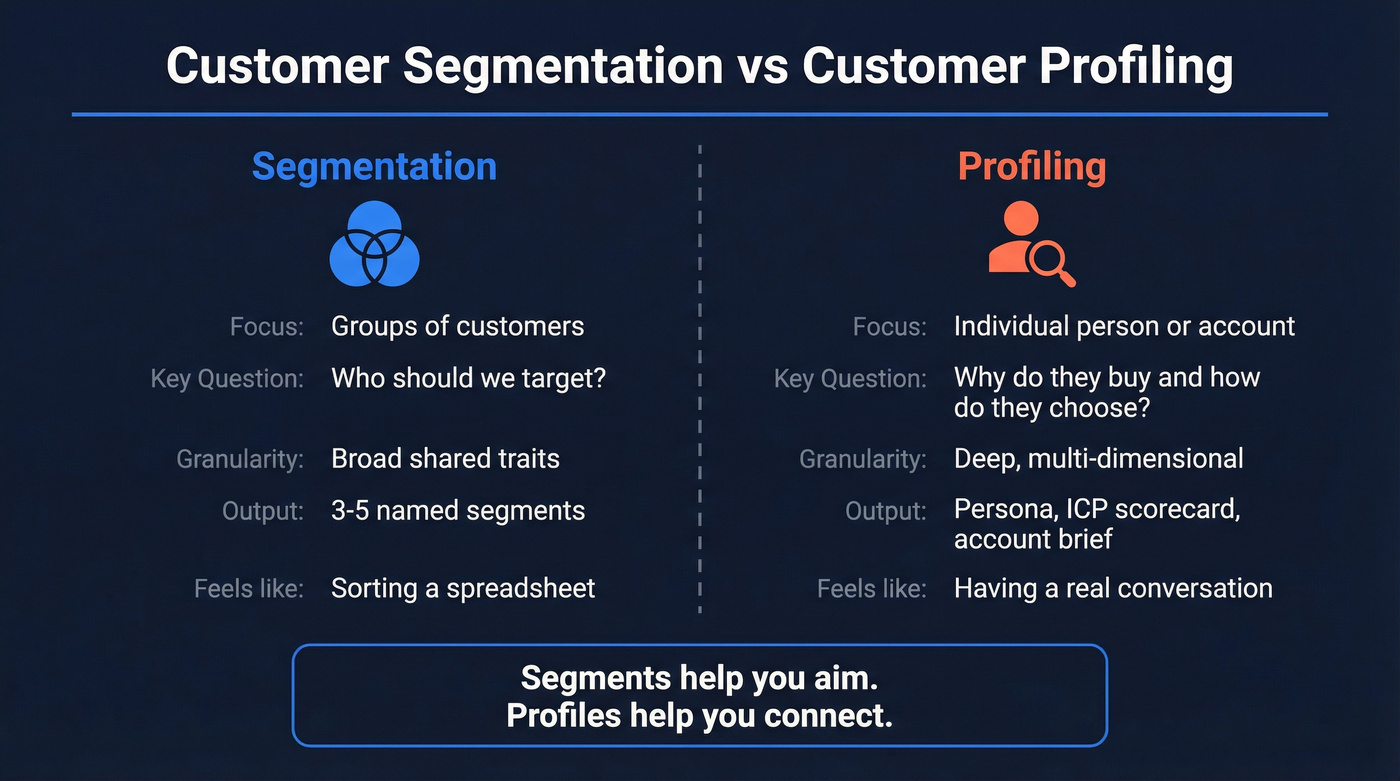
In practice, you segment first, then profile within your best segments. Segments help you aim. Profiles help you connect.
Segmentation vs Profiling at a Glance
| Dimension | Segmentation | Profiling |
|---|---|---|
| Scope | Groups of customers | Individual person or ideal account |
| Granularity | Broad shared traits | Deep, multi-dimensional |
| Key question | "Who should we target?" | "Why do they buy and how do they choose?" |
| Output | 3-5 named segments | Persona, ICP scorecard, or account profile |
| Data sources | CRM, analytics, transactions, product usage | Interviews, surveys, support logs, enrichment |
| Update cadence | Quarterly or continuous | Quarterly and whenever messaging/GTM changes |
| Owned by | Marketing / RevOps | Marketing / Product / Sales |
| Example | "High-value repeat buyers, 25-40, urban" | "Emma, 32, researches via YouTube, price-sensitive, values sustainability" |
What Is Customer Segmentation?
Customer segmentation divides your market into distinct groups that share meaningful characteristics. The point is operational: decide where to spend money, how to route leads, what to prioritize in lifecycle messaging, and which accounts get human sales time.
The classic four types are demographic, behavioral, psychographic, and geographic. In B2B, you'll also see:
- Firmographics: industry, revenue, headcount
- Technographics: what tools they run
- Intent signals: accounts actively researching your category
- Growth and trigger signals: hiring spikes, funding, leadership changes
A concrete example: a SaaS company selling project management software might segment into "Series A startups with 10-50 employees using Jira" and "mid-market companies with 200+ employees running legacy tools." Same product, totally different sales motion. Segmentation tells you where to point the campaign. It doesn't tell you what to say when you get there.
What Is Customer Profiling?
Profiling answers the question segmentation leaves open: why does this person buy, and how do they decide?
A customer profile (B2C persona, B2B ICP scorecard, or account brief) goes beyond surface traits. The fields that actually move revenue are the ones your sales team hears every day:
- Goals and motivations
- Pain points and constraints
- Buying triggers
- Objections and risk concerns
- Decision criteria and "must-haves"
- Preferred channels and content formats
- Who else is involved in the decision
When profiling is done well, it turns generic campaigns into conversations that feel one-to-one. And yes, it's slower than slicing a spreadsheet. That's the point.
In B2B, the most common form of profiling is an ICP scorecard. It's not "companies with 50-200 employees in fintech." It's a scored rubric that weights fit (industry, size, stack), signals (site behavior, intent), and timing (triggers). That extra detail is what turns a segment from a targeting bucket into something you can route, prioritize, and message against consistently.

Your ICP scorecards are only as good as the data behind them. Prospeo enriches every contact with 50+ data points - firmographics, technographics, intent signals across 15,000 topics, and hiring triggers - so your segments aren't just tidy buckets, they're actionable profiles that drive pipeline.
Stop profiling with stale data. Enrich your segments with 98% accurate contacts.
Why You Need Both (and Why Teams Get This Wrong)
McKinsey has put numbers behind the obvious: people expect personalization, and they get annoyed when they don't. Their research reports 71% of consumers expect personalized interactions and 76% get frustrated when they don't. They also cite targeted promotions as a top reason people purchase, and they share a retailer pilot that drove about a 3% boost in annualized margins within three months.
We've seen the same pattern in B2B, just with different metrics. When segmentation is clean but profiling is thin, you get "relevant" targeting paired with bland messaging. When profiling is rich but segmentation is fuzzy, you get beautiful personas that nobody can map to lists, routing rules, or budgets. Both failures look like "marketing isn't working," and both are fixable.
Segmentation without profiling is lazy targeting. Profiling without segmentation is storytelling without strategy.
Which Comes First? The Real Sequence
Most teams don't need a philosophical answer. They need an order of operations they can run next week.
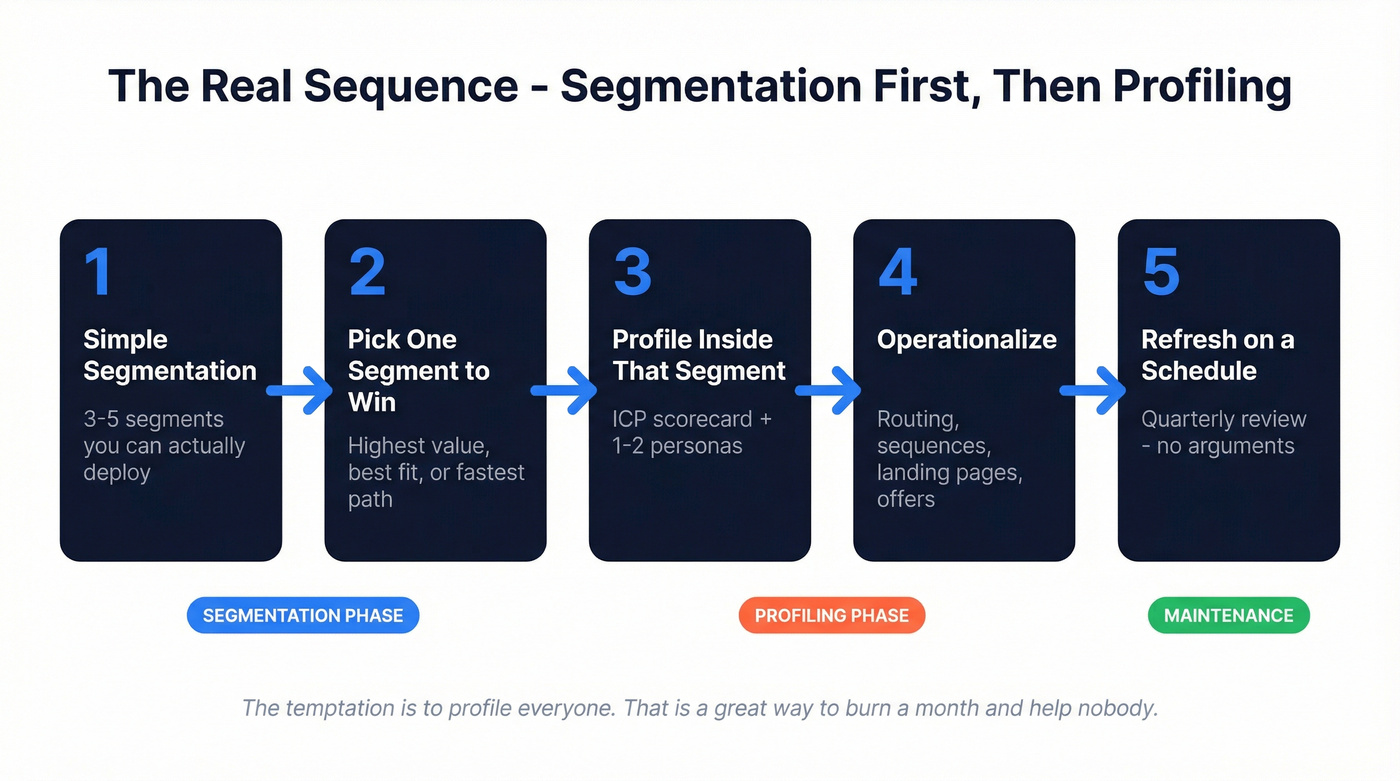
Here's the sequence we've found works in the real world:
- Start with a simple segmentation model you can actually deploy (3-5 segments).
- Pick one segment to win first (highest value, best fit, or fastest path to pipeline).
- Profile inside that segment (ICP scorecard + 1-2 personas).
- Operationalize: routing, sequences, landing pages, offers, onboarding, retention plays.
- Refresh on a schedule (and don't argue about it every quarter).
Look, the temptation is to "profile everyone" because it feels customer-centric. It's also a great way to burn a month and end up with generic personas that describe your entire market and help nobody.
How to Do Both (Without Over-Engineering It)
1) Start with RFM Segmentation (Fast, Practical)
If you're not sure where to begin, RFM scoring is the cleanest starting point for B2C and many PLG motions: Recency (how recently someone engaged), Frequency (how often), and Monetary (how much they've spent).
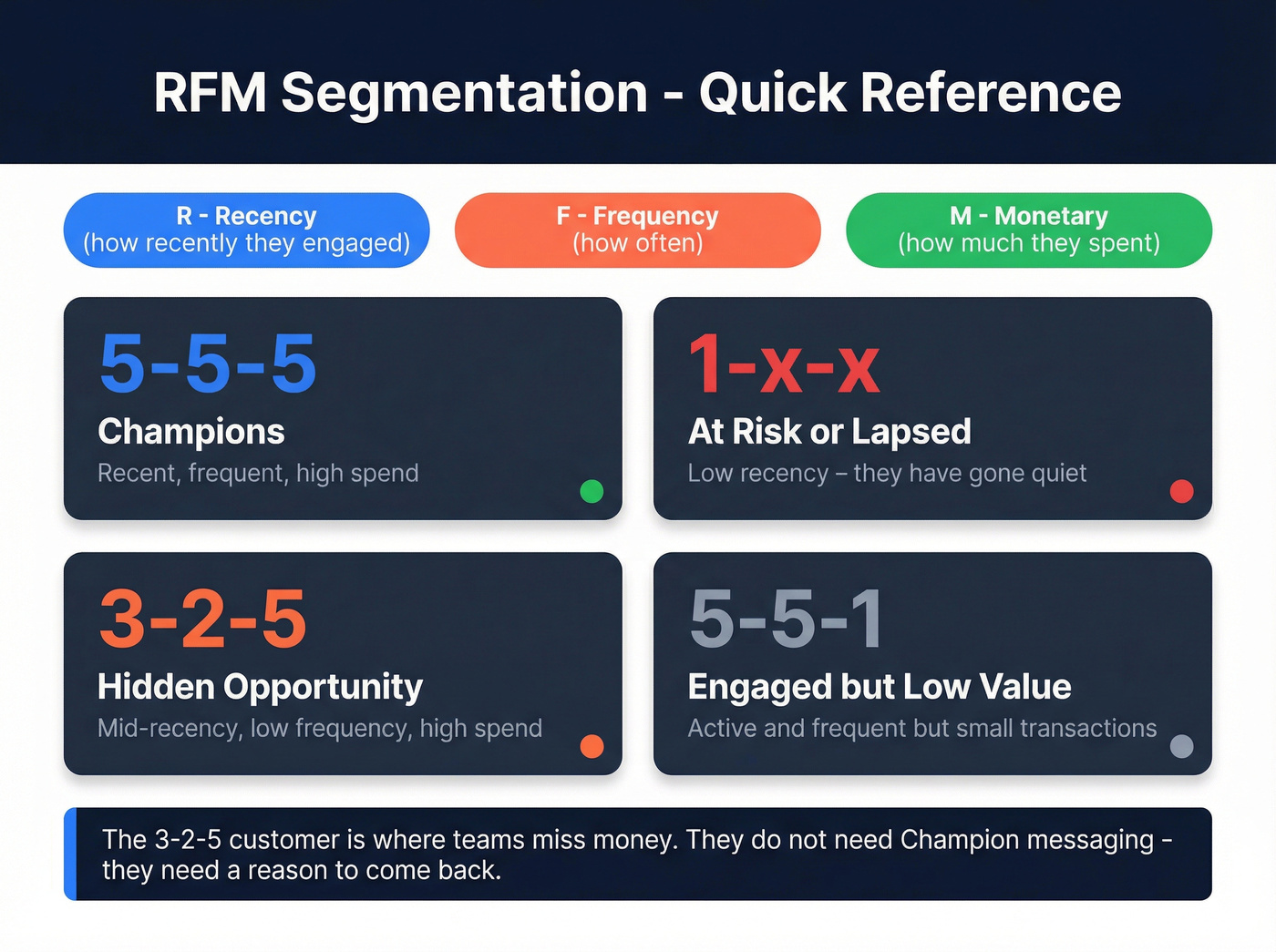
Rank customers on each dimension, split into quintiles, and assign scores from 1 to 5. The combinations create natural segment labels:
- 5-5-5 = Champions (recent, frequent, high spend)
- 1-x-x = At-risk or lapsed (low recency)
- 3-2-5 = the interesting edge case: mid-recency, low-frequency, high-spend
That last one is where teams often miss money. A 3-2-5 customer doesn't need the same messaging as a Champion. They usually need a reason to come back, a reminder of value, or a nudge toward a repeatable use case.
One strong opinion: you need 3-5 segments, max. We've watched teams build 12-segment taxonomies that look smart in a deck and die the moment they hit the CRM. If your SDRs can't remember which segment gets which sequence, you've built a spreadsheet, not a go-to-market system.
2) Then Build ICP Scorecards and Personas (Deep Where It Pays)
Once you've identified your highest-value segments, profile the people inside them. This is where segmentation and profiling meet: segments tell you which groups matter, and profiles tell you what to say, what to offer, and what to expect in the deal cycle.
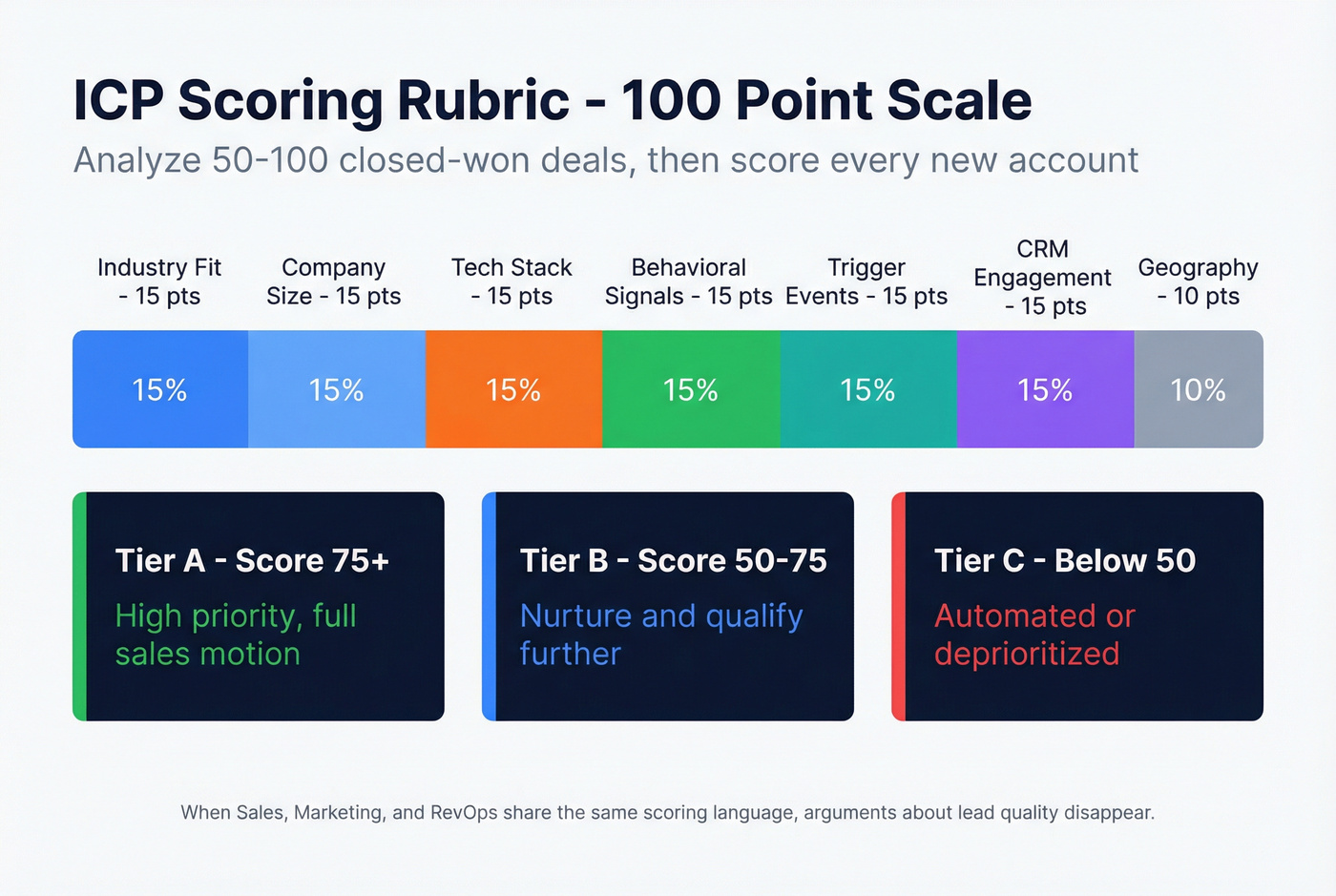
For B2B: build a quantitative ICP scoring rubric. We typically start by analyzing 50-100 closed-won deals, then assign points on a 100-point scale. A simple allocation might look like this:
- Industry fit (15)
- Company size (15)
- Tech stack compatibility (15)
- Geography (10)
- Behavioral signals like pricing page visits (15)
- Trigger events like new funding or leadership changes (15)
- CRM engagement history (15)
Set thresholds so the whole company speaks the same language: Tier A above 75, Tier B 50-75, Tier C below 50. Now Sales, Marketing, and RevOps can stop arguing about "lead quality" and start tuning the model together.
For B2C: build personas with buying context, not trivia. "Emma, 32, likes fitness" is useless. A usable profile sounds more like: Emma researches gear via YouTube reviews, she's price-sensitive but pays more for sustainability, she buys in seasonal cycles, and her biggest objection is shipping cost. That profile tells you what content to produce, what offer to test, and what objections your checkout flow needs to handle.
A quick scenario from our own work: one team had a "mid-market SaaS" segment that looked great on paper, but their win rates were all over the place. Once we profiled the buyers, it turned out two totally different jobs-to-be-done were hiding inside one segment: one group bought to reduce tool sprawl, the other bought to pass compliance audits. Same firmographics, opposite messaging. Fixing that was worth more than any new ad channel.
3) Fix the Data Before You Overthink the Model
This is the part that frustrates people because it's not "strategy." It's plumbing.
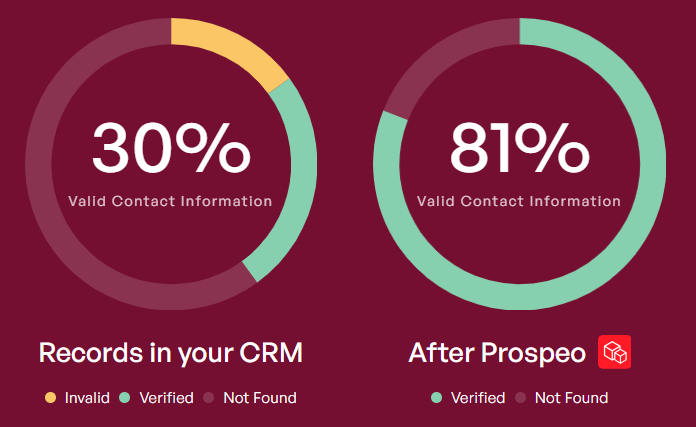
Profiles are only as good as the data underneath them. If your CRM is missing job titles, seniority, tech stack, or clean company size, your ICP scores are built on gaps. And if your emails and phones aren't verified, your "segment performance" is partly deliverability noise.
Prospeo is built for this exact layer: it enriches CRM records with 50+ data points per contact, returns an 83% enrichment match rate, and refreshes records every 7 days. It also verifies emails at 98% accuracy, which matters more than most teams want to admit because bad data quietly wrecks your experiments before you ever get to "messaging." (If you want to go deeper on vendors, see our roundup of data enrichment services.)
4) Validate, Then Refresh (Because Markets Move)
A lot of companies segment once and never touch it again. That's not segmentation. That's a snapshot from 18 months ago that you're still pretending is true.
Dynamic segmentation, where segments update automatically as new behavioral and firmographic data flows in, should be the default. Even without fancy ML, the minimum standard is a quarterly review with two outputs: what changed, and what you're doing about it.
And don't ignore the qualitative layer. Quant data shows what happened. Support tickets, call notes, surveys, and community chatter tell you why it happened. Skip that, and your profiles will be technically accurate but emotionally flat, which is a polite way of saying your copy won't land.
Five Mistakes That Kill Results
1) Demographics-only segmentation
Fix: Add behavioral and psychographic inputs: purchase patterns, content engagement, and product usage signals. Two customers can look identical on demographics and behave completely differently once you see how they evaluate, what they fear, and what they consider "proof."
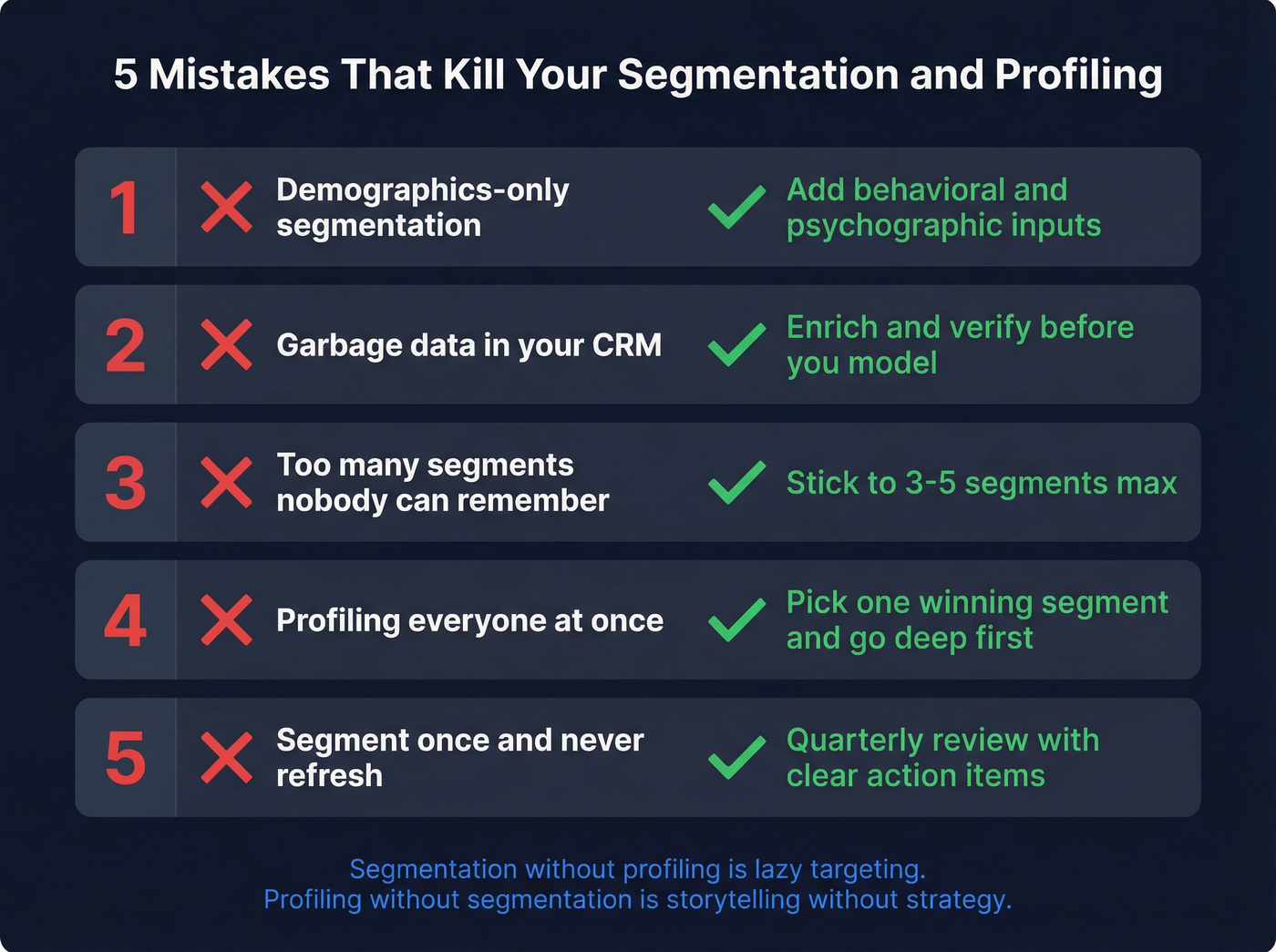
2) Garbage data in the CRM
Fix: Enrich and verify before you segment. If your records are stale, your segments are unstable and your tests lie to you. That's why we treat verification and refresh as table stakes, not a nice-to-have. (If deliverability is part of the problem, start with an email deliverability guide and then track your email bounce rate.)
3) Too many segments
Fix: Cap at 3-5 and go deeper. If you've got 12 segments and a five-person marketing team, you don't have segments. You have a backlog you won't execute.
4) Static segments
Fix: Put a refresh cycle on the calendar and automate what you can. Customers change behavior. Accounts grow, shrink, or switch tools. Your "high-value" segment quietly fills with churn risks if you don't keep it current.
5) Ignoring customer feedback
Fix: Build a simple loop: pull themes from sales calls and support tickets, then update your profiles and objection handling. Reddit threads and community posts are especially useful here because people complain in plain language, which is exactly what your ads and landing pages should mirror.
One more "skip this if" recommendation: skip persona workshops that start with a blank template and end with a cute name and stock photo. If you don't anchor profiles in real deal data and real customer language, you'll get something that looks finished and performs like fiction.
You just mapped the sequence: segment first, then profile your best-fit accounts. Now you need the data to actually do it. Prospeo's 300M+ profiles with 30+ search filters - buyer intent, headcount growth, tech stack, funding - let you build scored ICP lists in minutes, not months. At $0.01 per email, you can profile every segment without blowing your budget.
Turn your segmentation framework into pipeline this week.
Where This Is Heading in 2026
Segmentation used to be a marketing tactic. Now it's creeping into everything: pricing, packaging, onboarding, retention, even product roadmaps. Teams that treat it as a quarterly marketing exercise will get outpaced by teams running living models that feed revenue decisions week to week.
The shift is already visible. Demographics-only targeting is fading in favor of multi-dimensional models that blend behavioral, psychographic, technographic, and intent signals. Manual quarterly reviews are being replaced by continuous refresh. And customer profiling analytics is getting more practical: enrichment data plus behavioral tracking plus scoring means profiles can update as reality changes, not once a year when someone remembers to run a survey.
The distinction between segmentation and profiling isn't going away. The gap between them is shrinking because data is faster, and expectations are higher.
FAQ
Which comes first - segmentation or profiling?
Segmentation comes first. Group customers by shared traits, then build detailed profiles inside your highest-value segments. Profiling everyone before segmenting burns time and usually produces generic outputs that don't map to targeting, routing, or budgets.
Is customer profiling the same as creating buyer personas?
A buyer persona is one type of customer profile. Profiling also includes quantitative approaches like ICP scorecards that assign numerical fit scores to accounts, which is the dominant method in B2B.
How often should you update segments and profiles?
At minimum, quarterly. Ideally, segments refresh dynamically as new behavioral data flows in. Profiles should be reviewed whenever your product, market, or customer base changes in a way that affects messaging, objections, or deal cycles.
What's the best free tool for enriching customer profiles?
If you need verified contact data and enrichment to make profiles and ICP scoring usable, Prospeo has a free tier with 75 email credits per month and returns 50+ data points per enriched contact. That's enough to validate your top segment and build a scoring model before you spend on bigger infrastructure.