

D7 Lead Finder vs LeadRocks: Honest Comparison (2026)
D7 Lead Finder and LeadRocks get compared a lot, but they're barely the same category of tool. D7 is a local business scraper - you punch in a keyword and a city, and it pulls plumber listings and restaurant contacts. LeadRocks is a B2B contact database filtered by job title and industry. Choosing between them comes down to what kind of leads you actually need.
30-Second Verdict
D7 Lead Finder - Pick this if you're an agency scraping local business leads by keyword and location. It's purpose-built for that.
LeadRocks - Pick this if you want a cheap B2B contact database, especially with the AppSumo lifetime deal at $79 one-time.
What Each Tool Actually Does
D7 Lead Finder
D7 is a keyword-plus-location scraper with a 65M+ leads database. Type "dentist" and "Chicago," and it returns up to 1,200 results per search - business names, business emails, websites, and postal addresses, all exportable to CSV, Excel, or PDF. It also includes agency-style signals like review scores, ad/pixel detection, and website tech checks for things like mobile-friendliness and WordPress usage.
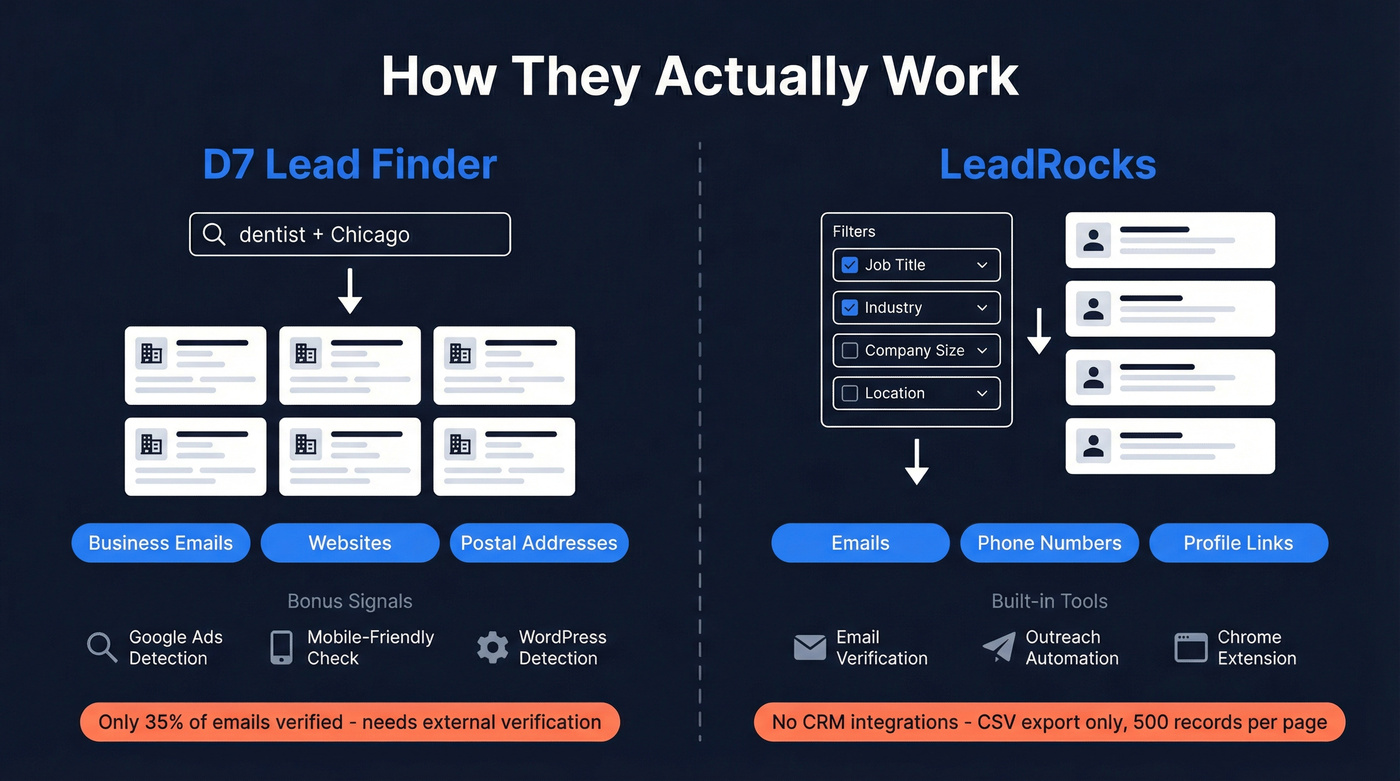
Those enrichment signals are genuinely useful for agencies: you can see whether a prospect runs Google Ads, has a mobile-friendly site, or uses WordPress. The catch? D7's built-in checks aren't full mailbox-level deliverability verification. Third-party analysis suggests only about 35% of D7 emails are verified and roughly 15% are decision-maker contacts. That means you'll want an external verification tool before sending anything, adding $0.003-$0.005 per email to your real cost. (If you're building a repeatable process, it helps to understand the full lead generation workflow end-to-end.)
LeadRocks
LeadRocks positions itself as a B2B contact database with 100M+ records spanning emails, phone numbers, and professional profile links. You filter by company name, job title, location, industry, and team size - a fundamentally different search model than D7's keyword approach.
It includes built-in email verification, email outreach automation, and a Chrome extension for enriching professional profiles. The weak spots: no CRM integrations beyond CSV export, no data export API, and the manual export process caps at 500 records per page. For teams running any kind of automated workflow, those gaps add up fast (especially if you're relying on outbound lead generation tools to scale).
Feature Comparison
| Feature | D7 Lead Finder | LeadRocks | Winner |
|---|---|---|---|
| Search model | Keyword + location | Job title + industry | Tie (different use cases) |
| Database size | 65M+ leads | 100M+ records | LeadRocks |
| Filters | Keyword, city | Company, title, industry, size | LeadRocks |
| Email verification | Basic checks only | Built-in (basic) | LeadRocks |
| CRM integrations | Exports + API | None (CSV only) | Tie (both limited) |
| Export formats | CSV, Excel, PDF | CSV | D7 |
| API access | Yes | Verification API only | D7 |
| Chrome extension | No | Yes | LeadRocks |
The real question isn't which tool wins on features. It's whether you need local business data or B2B contact data. They don't compete - they serve different buyers.

D7's 35% verification rate and LeadRocks' location mismatches both point to the same problem: unverified data wrecks outreach. Prospeo's 5-step verification delivers 98% email accuracy across 300M+ profiles - refreshed every 7 days, not quarterly.
Stop bolting verification onto bad data. Start with data that's already verified.
Pricing Breakdown
D7 Lead Finder:
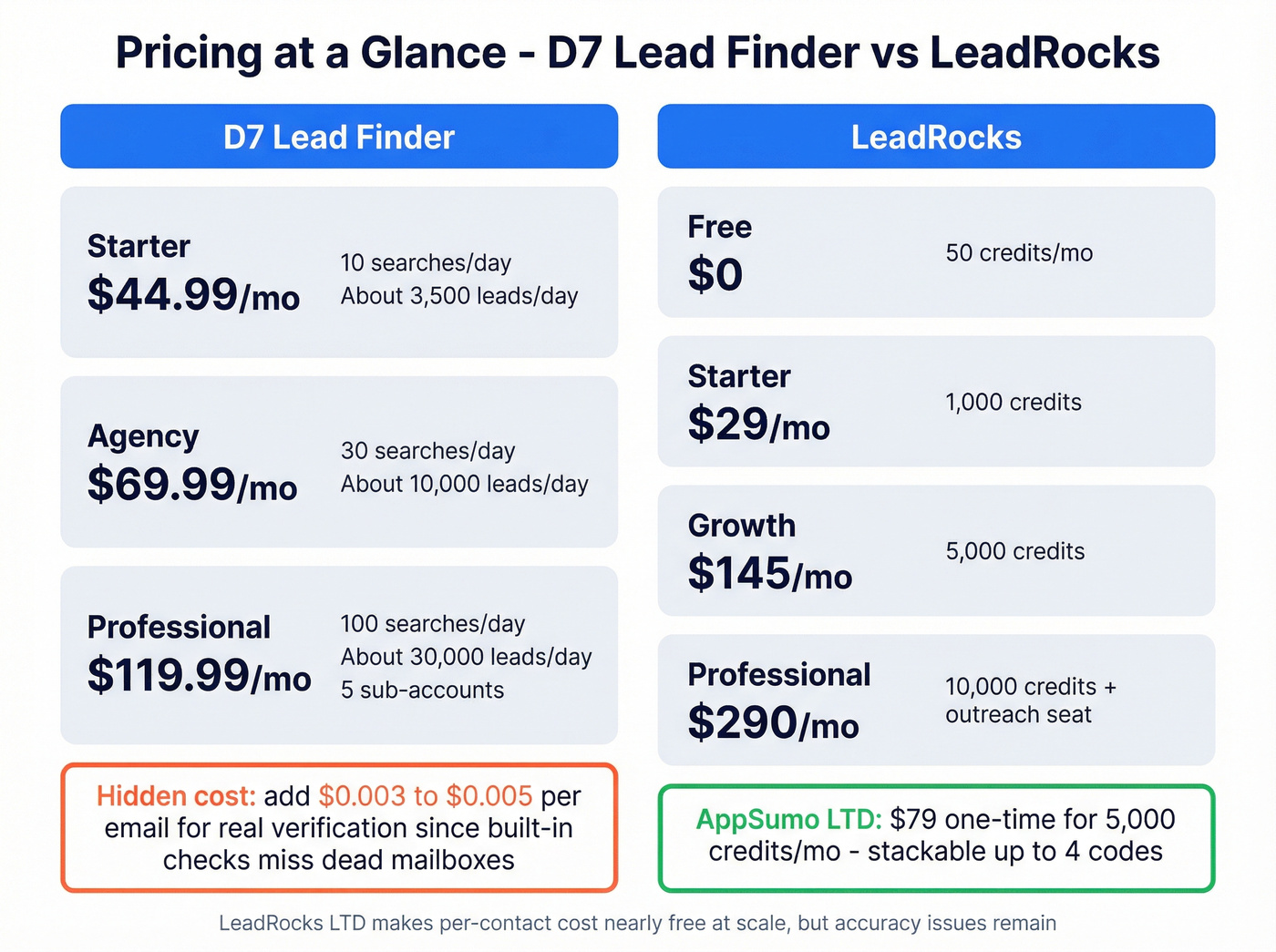
| Plan | Price | Daily Searches | Daily Leads |
|---|---|---|---|
| Starter | $44.99/mo | 10 | ~3,500 |
| Agency | $69.99/mo | 30 | ~10,000 |
| Professional | $119.99/mo | 100 | ~30,000 (5 sub-accounts) |
LeadRocks:
| Plan | Price | Monthly Credits |
|---|---|---|
| Free | $0 | 50 |
| Starter | $29/mo | 1,000 |
| Growth | $145/mo | 5,000 |
| Professional | $290/mo | 10,000 + outreach seat + 10K verification credits |
| Enterprise | $580/mo | 20,000 + 2 seats + 20K verification credits |
The AppSumo lifetime deal changes the math entirely: $79 one-time for 5,000 credits/month, stackable up to 4 codes. That LTD is why most people even consider LeadRocks - it makes the Starter plan's $0.029/contact look expensive by comparison.
Hidden cost with D7: since its built-in checks don't catch dead mailboxes, budget an additional $0.003-$0.005 per email for real verification. On 10,000 leads, that's $30-$50 extra per batch. (If you're trying to keep deliverability stable, it's worth tracking email bounce rate and tightening your list hygiene.)
Data Quality Reality Check
Let's be honest - both tools show their budget roots when you look at actual user feedback.
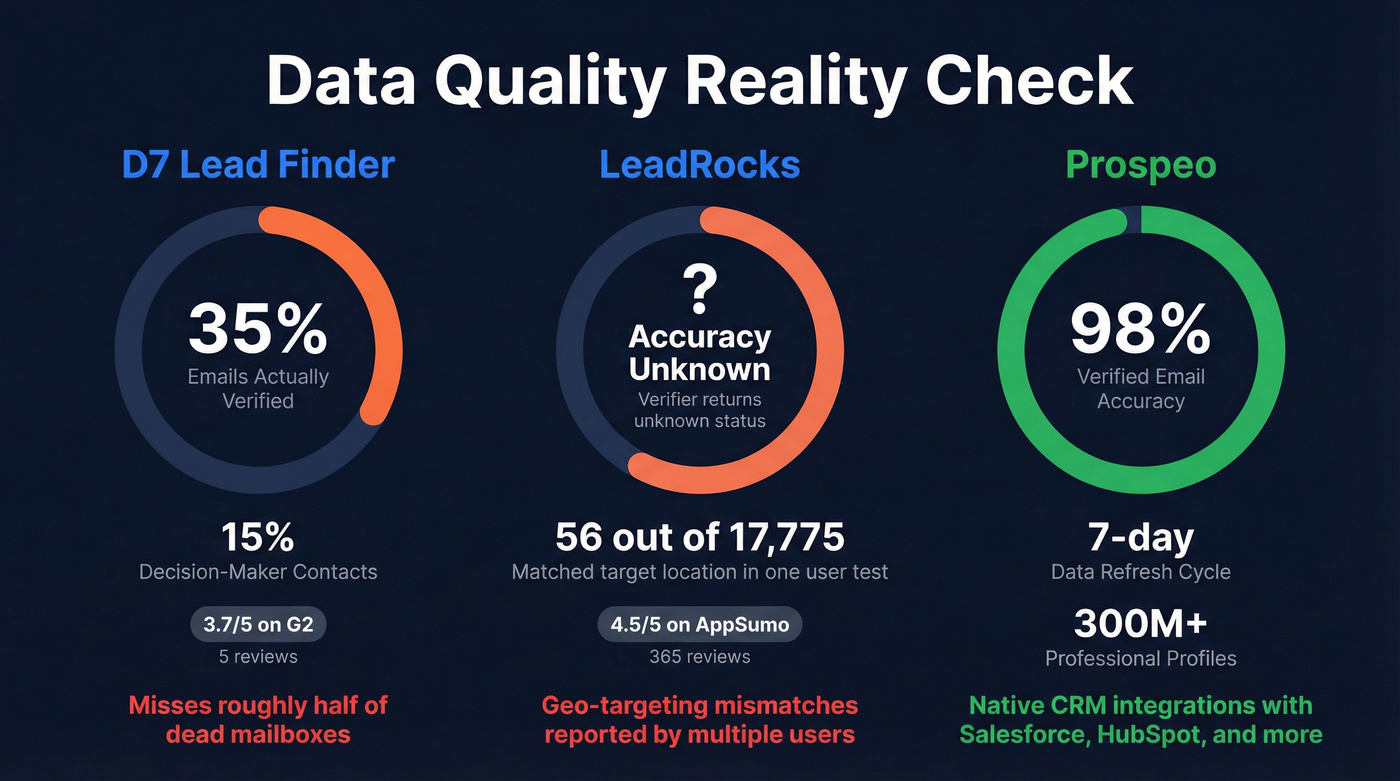
D7 carries a 3.7/5 on G2 from just 5 reviews. Users praise it as "simple, easy prospecting," but one reviewer gave it 0.5/5 citing "zero customer support." We've seen reports of infrequent database updates and inconsistent accuracy. In our testing, D7's syntax check caught formatting errors but missed roughly half the dead mailboxes.
LeadRocks fares better on volume of feedback - 4.5/5 from 365 AppSumo reviews - and users appreciate the extensive database and user-friendly UI. But the complaints are specific and damning: one user exported 17,775 contacts targeting a specific US state and found only 56 actually matched that location. Others report the email verifier returning "unknown" status across the board. Reddit threads about LeadRocks are mostly skeptical buyers asking "is this legit?" - which tells you something about the LTD's reputation in the community. (If you're comparing providers, a broader view of sales prospecting databases can help.)
Here's what frustrates us about both tools: if your average deal size is under a few thousand dollars, a cheap scraper with a verification layer bolted on might be fine. But the moment you're sending 1,000+ emails a week, bad data doesn't just waste time - it torches your sender reputation. We've watched teams burn through three domains before realizing the "free" data was the most expensive part of their stack. If you're already in that situation, start with an email deliverability guide and fix the root causes.
Which Tool Fits Your Workflow?
D7 works for agencies pulling lists of plumbers, restaurants, or dentists by city. It does that one job well. (If you're doing this at scale, the tactics in web scraping lead generation can help you avoid common pitfalls.)
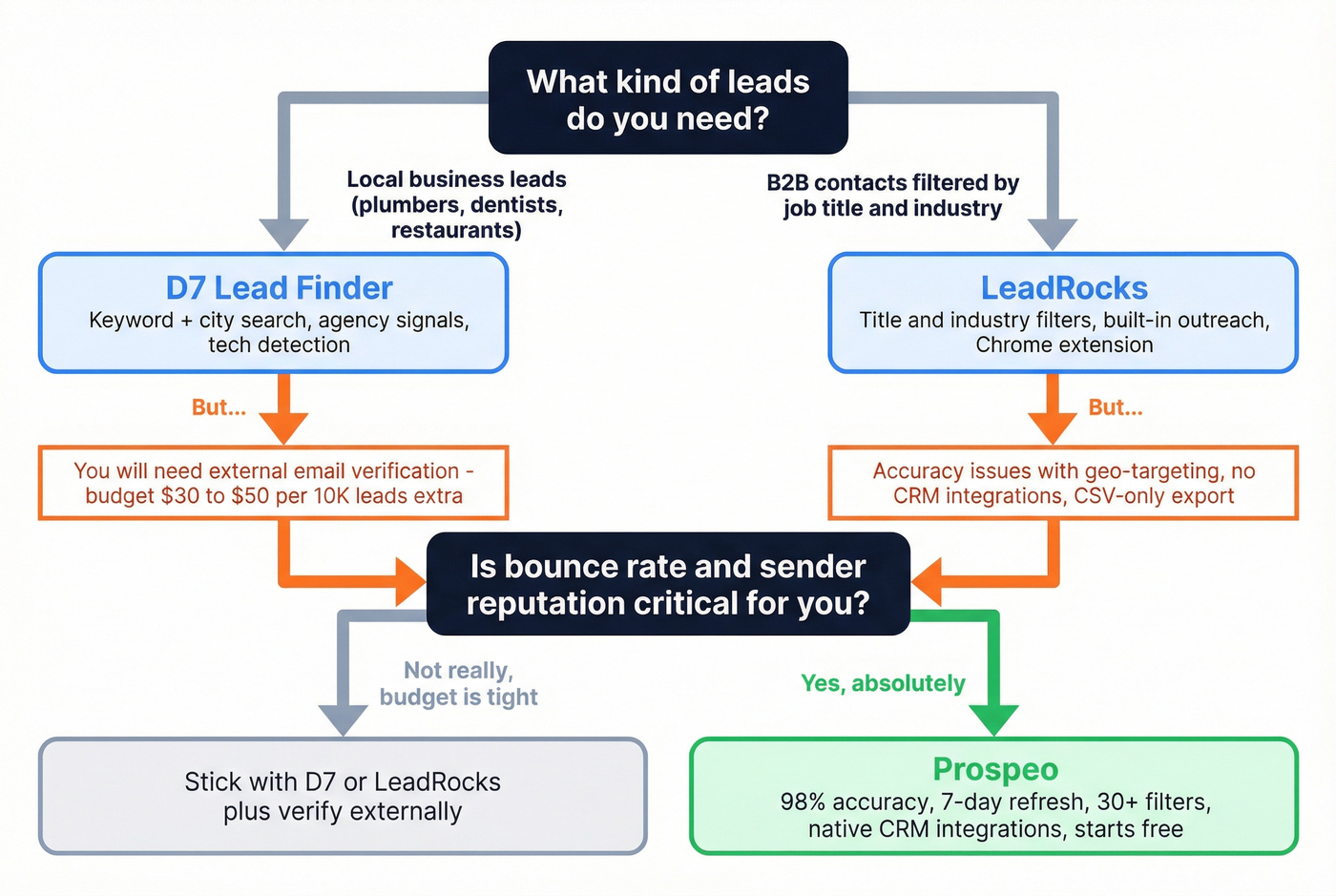
LeadRocks works for cheap B2B contact data where you can tolerate accuracy issues. The AppSumo LTD makes it nearly free at scale. (For a deeper breakdown of the tool itself, see our LeadRocks pros and cons.)
For teams where bounce rate is the reason you're comparing tools in the first place, you need a different tier of data entirely.
A Stronger Option for Verified B2B Emails
Prospeo covers 300M+ professional profiles with 143M+ verified emails at 98% accuracy. Data refreshes every 7 days - not on a quarterly or ad-hoc schedule. You get 30+ search filters including buyer intent and technographics, native integrations with Salesforce, HubSpot, Smartlead, Instantly, and Lemlist, and self-serve pricing with no contracts. (If you're evaluating vendors, this is where data enrichment services and verification standards start to matter.)

The free tier gives you 75 emails and 100 Chrome extension credits per month. Paid plans run about $0.01 per email. When your sender reputation is on the line, the cost difference between $0.01/email and free-but-bouncing is obvious. If you want to go deeper on keeping domains healthy, use this guide on how to improve sender reputation.
At $0.01/email with 98% accuracy, Prospeo costs less than D7 + a third-party verifier and delivers cleaner data than LeadRocks' lifetime deal. Plus you get 30+ filters, intent data, and native CRM integrations - not CSV-only exports.
75 free emails/month. No credit card. See the accuracy difference yourself.
FAQ
Is D7 Lead Finder or LeadRocks better for local businesses?
D7 is built for local business scraping - search by keyword and location, exactly how agencies prospect for service businesses. LeadRocks filters by job title and industry, making it a B2B database, not a local scraper. If you're targeting SMBs by geography, D7 is the right pick.
Is the LeadRocks AppSumo lifetime deal worth it?
At $79 for 5,000 credits/month, the math is compelling - if you can tolerate accuracy issues. Multiple AppSumo reviewers report outdated contacts and geo-targeting mismatches. Verify every email externally before sending.
What's a more accurate alternative to both tools?
Prospeo offers 300M+ profiles with 98% verified email accuracy and a 7-day data refresh cycle. It starts free with 75 emails/month and integrates natively with major CRMs and sequencers - a significant step up from both D7 and LeadRocks on deliverability.