

Data Cleansing Services: What They Cost, How They Work, and How to Choose
You send an 8,000-contact campaign on Monday morning. By Tuesday, 1,400 emails have bounced, your domain reputation is tanking, and the SDR team is asking why half their phone numbers ring disconnected. That's not a campaign problem - it's a data problem. Choosing the right data cleansing service before your next send can prevent thousands in wasted spend.
CRM duplication rates hit up to 20%. Business partner databases see 43,000 address changes per day. The question isn't whether your data needs cleansing - it's what kind, and whether you need a managed provider, a self-serve tool, or both.
What You Actually Need
Before you spend two weeks in a vendor sales cycle, figure out which problem you're solving:
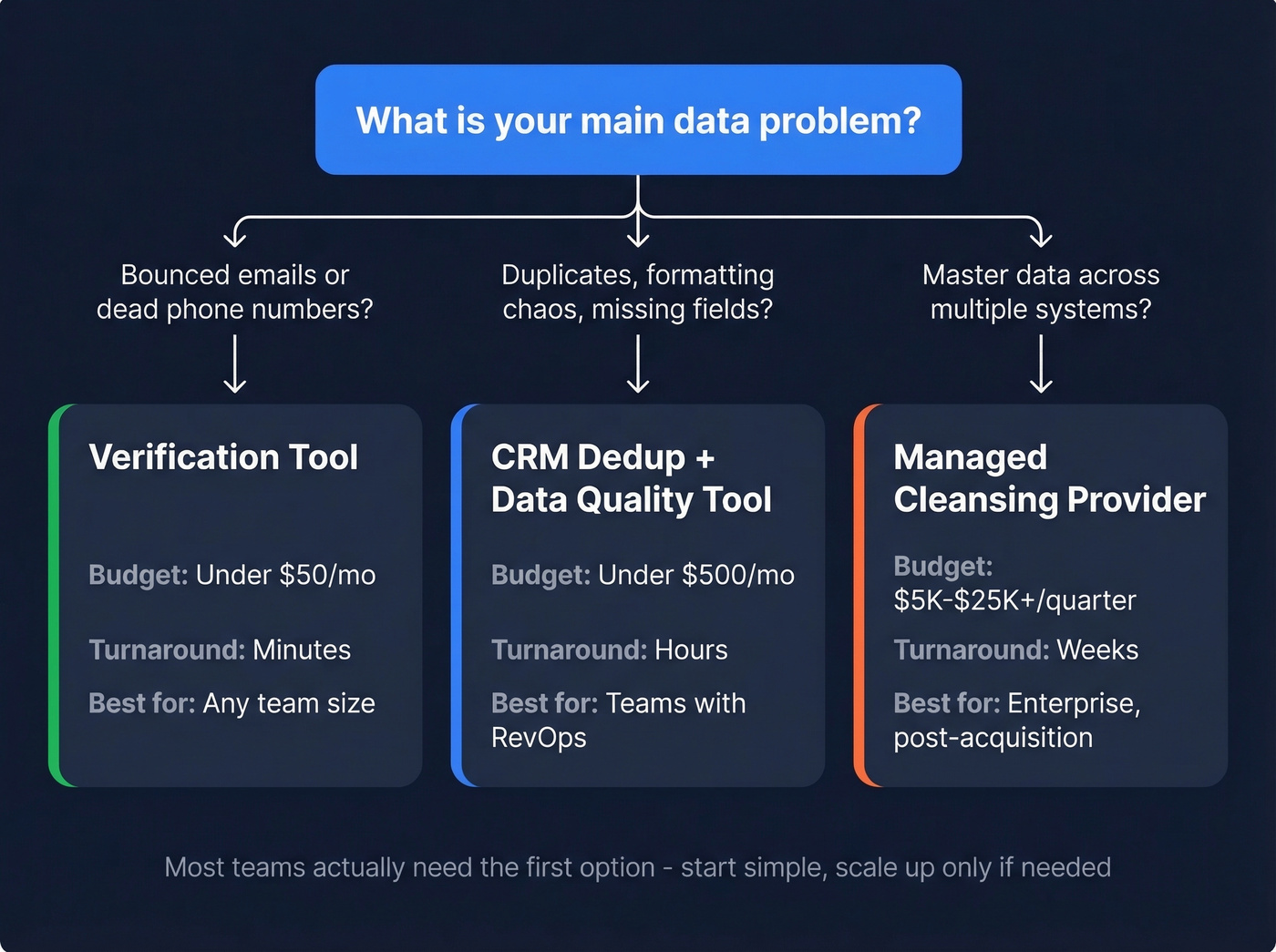
- Stale contact data - bounced emails, dead phone numbers? Start with a verification tool. Free tier, no contract, results in minutes. Budget: under $50/month. (If you're diagnosing deliverability issues, start with a quick domain reputation check.)
- Messy CRM - duplicates, formatting chaos, missing fields? Use your CRM's native dedup plus a data quality tool. Budget: under $500/month. If you're also streamlining workflows, consider CRM automation to reduce bad data at the source.
- Enterprise master data across multiple systems? Hire a managed cleansing provider or look into outsourced data cleansing services. Budget: $5,000-$25,000+/quarter.
Most teams actually need the first option. Let's make sure you pick the right path.
What Data Cleansing Means

Cleansing vs. Validation vs. Enrichment
Data cleansing corrects what you already have: removing duplicates, standardizing formats, fixing typos, deleting obsolete records. Data validation confirms accuracy - does this email deliver? Is this phone number active? Data enrichment adds what's missing: job titles, company size, technographics, direct dials. (If enrichment is part of your plan, compare data enrichment tools before you buy.)
Always clean before you enrich. Enriching dirty data just gives you more fields attached to the wrong records. IBM pegs the annual cost of poor data quality at $3.1 trillion across the US economy, and much of that waste comes from enriching records that should have been deleted in the first place.
A thread on r/BusinessIntelligence captures a common trap: a buyer with 30,000 records realized that tools like Informatica and Melissa Data validated whether a phone number worked, but couldn't tell them whether it still belonged to the right person. Validation and updating are different problems.
One-Time vs. Continuous Cleansing
One-time cleanup makes sense when you're migrating CRMs, merging post-acquisition databases, or inheriting a neglected dataset. The tradeoff: your data starts decaying immediately. CDQ tracks roughly one business address change every two seconds. Within a year, 21% of your records will be outdated again.
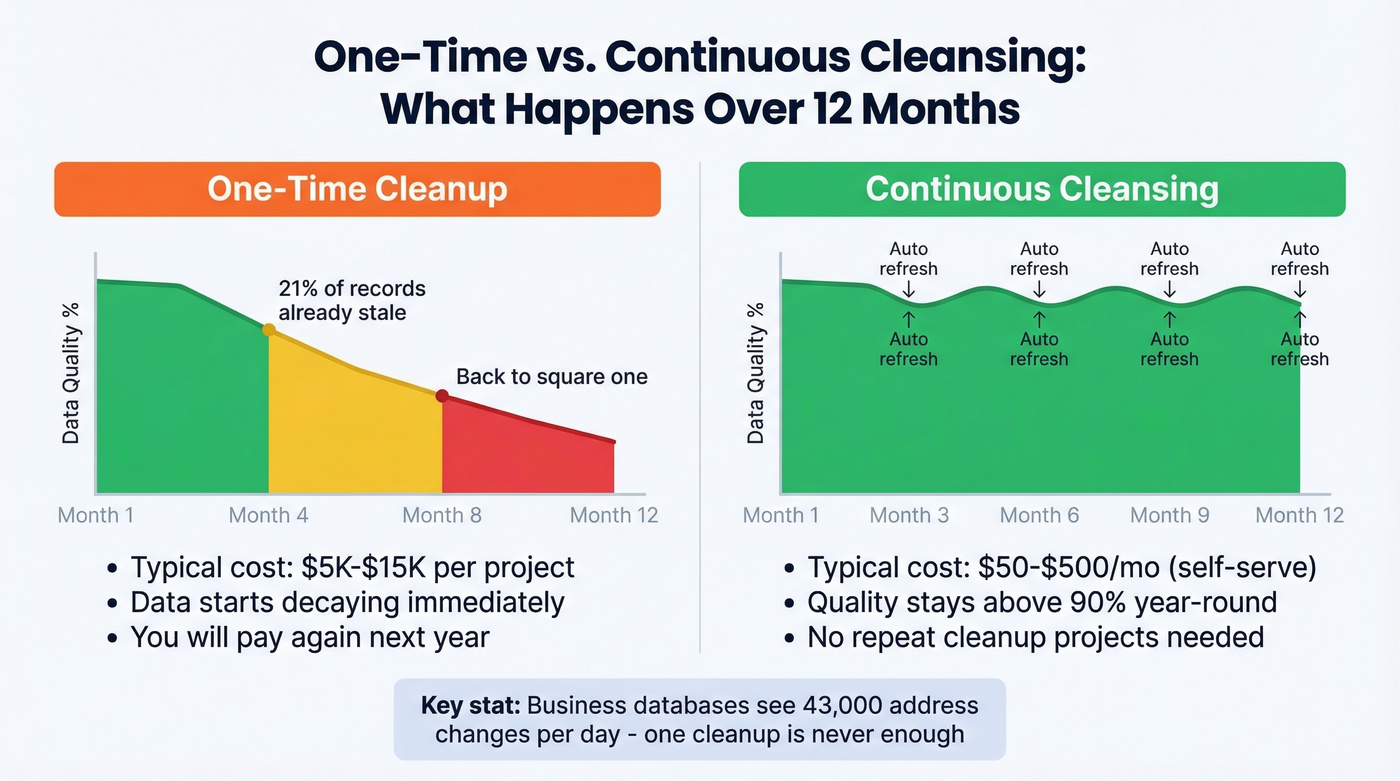
Continuous cleansing treats data quality as a process, not a project. It costs more per year, but you avoid the "dirty again in three months" cycle.
Here's the thing: the data cleansing industry profits from your data staying dirty. A one-time cleanup without addressing root causes guarantees you'll be back next year paying for the same thing. We've watched companies spend $15K on a managed cleanup only to hit 20% bounce rates again within six months because nobody owned the ongoing cadence.
DIY Tools vs. Managed Providers
65% of companies still rely on Excel to scrub their data. That's not a strategy - it's a coping mechanism.
| Criteria | DIY Tool | Managed Provider |
|---|---|---|
| Best for | <100K records, ongoing | 500K+ records, complex merges |
| Typical cost | $50-$500/mo | $5K-$25K+/quarter |
| Turnaround | Minutes to hours | Weeks |
| Control | Full | Limited |
| Key limitation | Requires internal expertise | Slow, expensive, vendor lock-in |
When evaluating DIY tools, look for profiling, matching/deduplication, standardization, automation scheduling, and CRM integrations. If you're missing three or more of those, you're back to Excel - and a business analyst at $130/hour spending 15+ hours on brute-force cleanup costs nearly $2,000 before you've fixed the root cause.
Enterprise platforms like Informatica, Experian Data Quality, and Talend handle complex multi-source cleansing but often run $50K-$250K+/year depending on modules and scale. Providers like Melissa Data and LexisNexis commonly sell usage-based or list-based services priced per record or per lookup, which can fit smaller datasets better than big-platform contracts. Many data scrubbing companies in this tier also offer industry-specific rule sets for healthcare, finance, or real estate verticals.
Despite the hype, only 10% of data teams use AI often in quality workflows. Most cleansing is still rules-based. (If you're evaluating sources, start with accuracy-first roundups like the best B2B database lists.)

Most "data cleansing" problems are really stale data problems. Prospeo's 7-day refresh cycle keeps 300M+ profiles current - so you're not paying to clean records that were already outdated when you bought them. 98% email accuracy, verified mobiles, and 50+ enrichment fields per contact.
Clean data once. Keep it fresh automatically at $0.01 per email.
What a Data Cleansing Service Costs
Most vendors gate pricing behind quotes. Here are the benchmarks we've gathered so you can skip the two-week sales cycle.
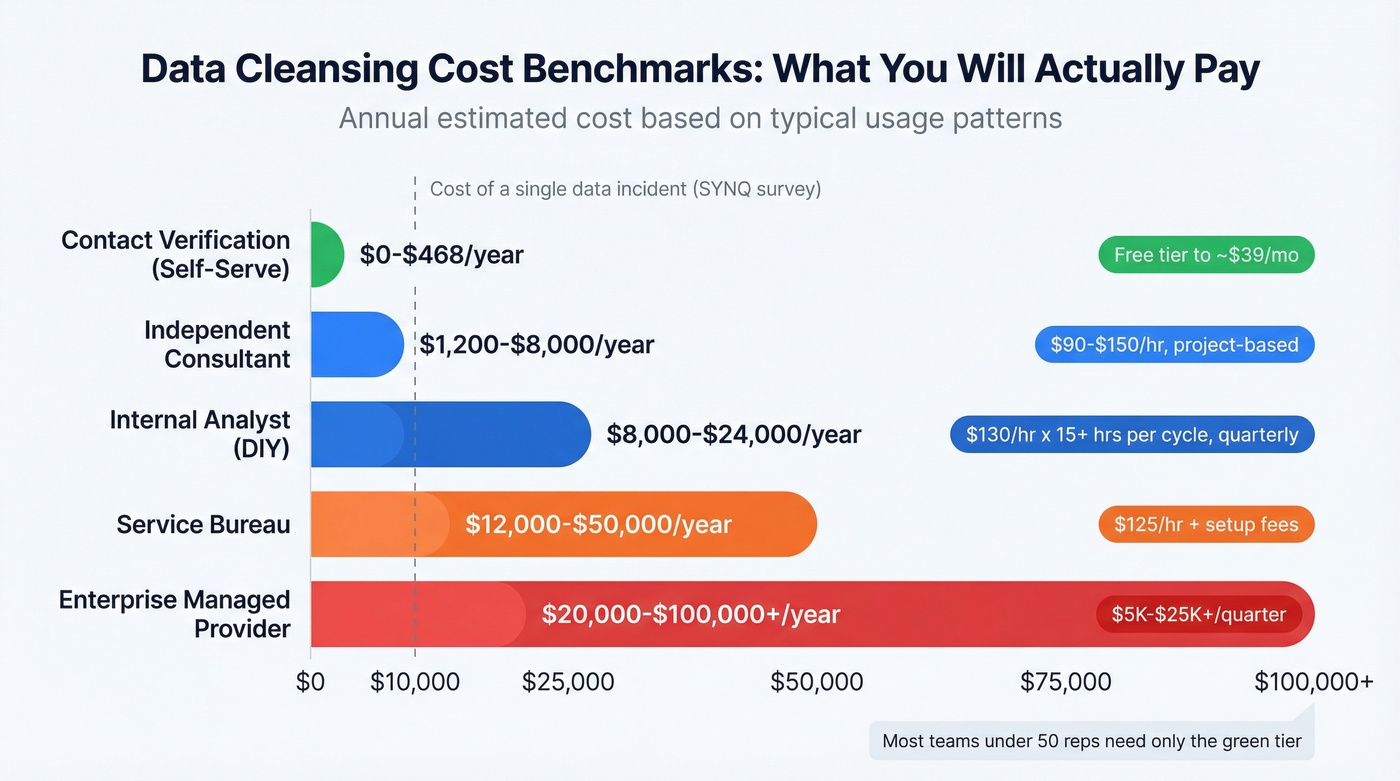
| Service Type | Typical Cost | Notes |
|---|---|---|
| Independent consultant | $90-$150/hr | $300-$2K+ per project |
| Service bureau | $125/hr + $200 setup | Per-list pricing |
| Enterprise managed | $5K-$25K+/quarter | Continuous monitoring |
| Internal analyst (DIY) | $130/hr x 15+ hrs | ~$2K per cleanup cycle |
| Contact verification | Free tier; paid from ~$39/mo | Self-serve, no contract |
What drives the price: record count, data messiness, number of source systems, whether you need identity-linked updates (not just formatting fixes), and turnaround time. Rush work is usually priced at a premium, especially for sub-two-week turnarounds.
The cost of not cleaning is worse. A SYNQ survey found nearly 20% of data teams report a single data incident costing over $10,000. (If email is your main channel, it’s worth tracking inbox placement alongside bounce rates.)
How to Evaluate a Provider
If you're going the managed route, demand these six things before signing:
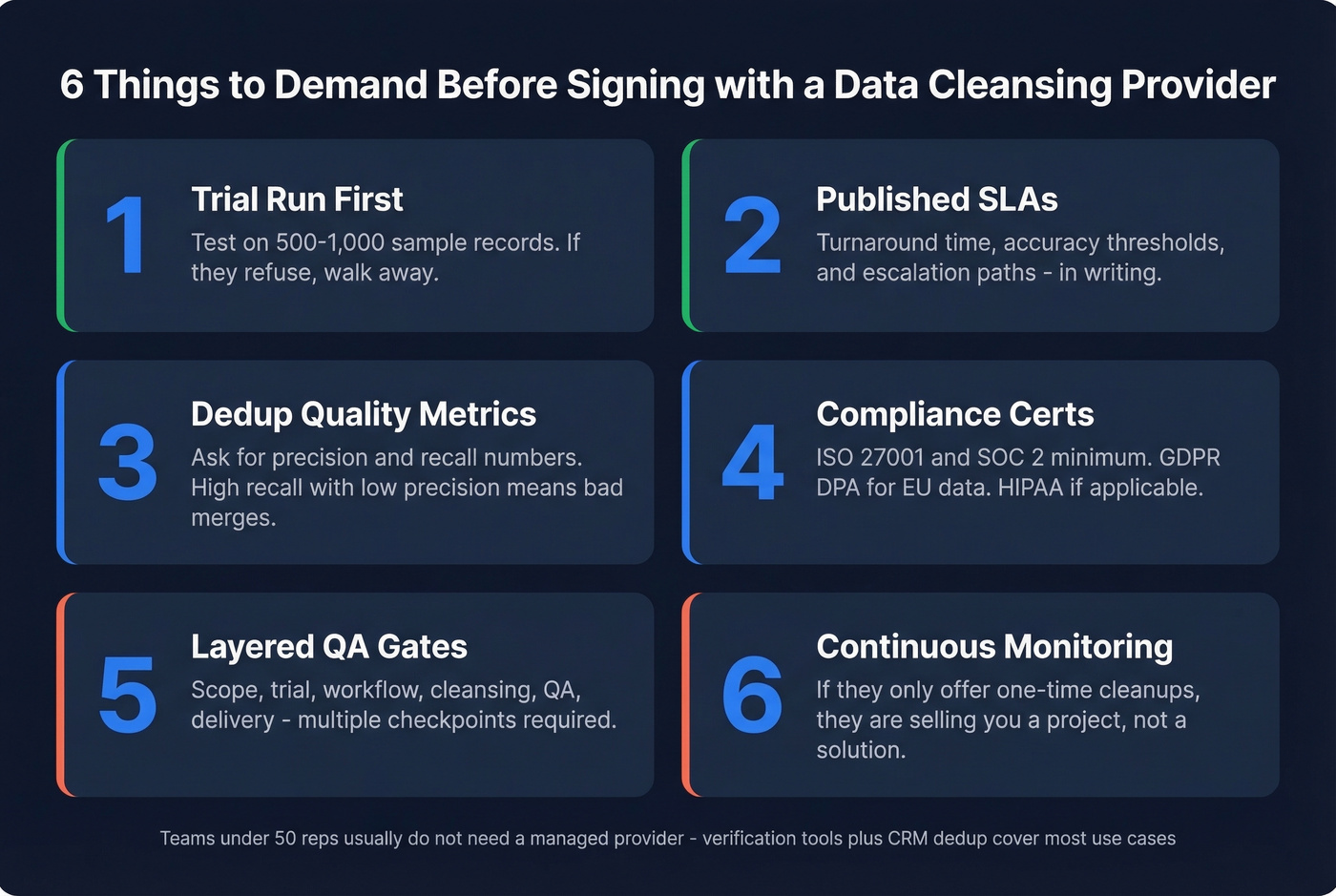
- Trial run first. Ask for a trial on 500-1,000 sample records before you commit. If they won't do it, walk away.
- Published SLAs. Turnaround time, accuracy thresholds, and escalation paths - in writing.
- Dedup quality metrics. Ask for precision and recall numbers. Two-stage entity resolution pipelines (semantic retrieval plus fuzzy verification) can maintain retrieval recall around 0.97 - ask your vendor how their engine compares. High recall with low precision means they're merging records that shouldn't be merged.
- Compliance certifications. ISO 27001 and SOC 2 at minimum. For EU data, require a GDPR DPA. GDPR fines reach 4% of global annual revenue; HIPAA penalties hit $1.5M per violation category per year. For data disposal, confirm alignment with NIST SP 800-88 sanitization standards. (If you need a deeper checklist, use a GDPR compliant database audit lens.)
- Layered QA gates. Look for a structured engagement model: scope definition, trial, workflow finalization, cleansing, QA, and final delivery with multiple checkpoints.
- Continuous monitoring option. If they only offer one-time cleanups, they're selling you a project, not a solution.
Our take: Most teams under 50 reps don't need a managed data cleansing service at all. The money is better spent on a verification tool you run monthly plus a CRM dedup plugin. Save the five-figure contracts for genuine multi-system master data problems.
Managed vs. Self-Serve: A Decision Framework
The decision comes down to internal capacity. If you have a RevOps team that can own a monthly verification cadence, self-serve data cleanup tools will save you tens of thousands per year. If your data lives across five systems with no single owner, outsourced providers with dedicated project managers earn their fee by handling the coordination you can't staff for internally. (This is also where a clean RevOps tech stack matters more than another one-off project.)
A useful litmus test: if the cleanup requires reconciling records across more than two source systems, lean toward a managed provider. If the core issue is contact accuracy in a single CRM, a verification tool handles it faster and cheaper. We've seen this play out dozens of times - teams overspend on managed services when the real problem is a 90-day-old contact list that just needs re-verification.
For Contact Data: Start Here
Traditional cleansing providers fix formatting and remove duplicates. They don't tell you whether an email still reaches the right person or whether a phone number still belongs to the VP you're targeting. That's contact data decay, and it's the most common reason sales teams start searching for help. (If you're specifically shopping for verification, start with a benchmarked list of the best email verifier options.)
Prospeo solves this specific problem. Its database covers 300M+ professional profiles with 143M+ verified emails at 98% accuracy and 125M+ verified mobile numbers, all refreshed on a 7-day cycle. The 5-step verification process handles catch-all domains, removes spam traps, and filters honeypots - the stuff that quietly destroys your sender reputation. (If you’re building a broader sourcing stack, compare B2B list providers and verification together.) Real results back this up: Meritt cut bounce rates from 35% to under 4%, and Snyk's AE-sourced pipeline jumped 180%.
Use this if: bounce rates are above 5%, phone connect rates are dropping, or you're running outbound on data more than 30 days old.
Skip this if: your core problem is CRM schema standardization or multi-system master data governance - pair a CRM dedup tool with contact verification for the full stack.
Before you spend $15K on a managed cleansing provider, try what 15,000+ companies already use. Prospeo's 5-step verification catches bounces, spam traps, and honeypots - the same issues that tank your domain reputation. Free tier included, no contract, results in minutes.
Skip the two-week sales cycle. Verify 75 emails free right now.
FAQ
What's the difference between data cleansing and data scrubbing?
Same thing. "Scrubbing" is informal shorthand used by many data scrubbing companies and in-house teams alike. Both refer to correcting, deduplicating, standardizing, and validating records - the process is identical regardless of what a vendor calls it.
How often should I clean my CRM data?
Continuously if possible. Business partner databases see 43,000 address changes per day, and 21% of records go stale within a year. At minimum, run a full cleanse quarterly and validate contact data monthly before any major outbound push.
Can I clean contact data without hiring a service?
Yes. For email and phone verification, self-serve tools let you upload a CSV and get verified results in minutes - no managed engagement needed. Prospeo's free tier covers 75 emails per month, enough to test accuracy before scaling up.