

The Data-Driven Marketing Approach That Actually Works in 2026
Your CMO asks why the $15k/month paid social budget can't prove ROI. Meta reports 200 conversions, Google says 180, and the CRM shows 120. Everyone's "data-driven," but nobody agrees on the numbers.
Here's a data-driven marketing approach built around measurement that reflects reality, a stack you can afford, and the discipline to act on what the data tells you - even when it's uncomfortable.
The Short Version
- Shift from "data-driven" to "data-informed." Data is an input, not a decision-maker. Leave room for judgment and creativity.
- Fix your data quality before adding tools. Eighteen data sources feeding dirty data into dashboards doesn't make you data-driven. It makes you data-chaotic.
- Use the AIM Stack for measurement. Attribution for directional signals, Incrementality testing for causal proof, and Marketing mix modeling for the big picture. No single method works alone in 2026.
- Start with a three-tool stack. Web analytics (GA4), a CRM (HubSpot free tier works), and a data quality layer to keep your contact data clean. Build from there.
What Data-Driven Marketing Actually Means
The textbook definition is straightforward: using quantitative and qualitative data to guide marketing decisions instead of relying on gut instinct. That's table stakes.
Here's the more useful distinction. The best practitioners don't call themselves "data-driven." They call themselves "data-informed." The difference matters. Data-driven implies the data makes the decision - that if the numbers say X, you do X, full stop. Data-informed means data is one input alongside experience, creativity, and market intuition.
This isn't semantics. When everything is A/B tested and incrementally optimized, marketing becomes a race to the local maximum. You'll find the best-performing subject line, the highest-converting landing page layout, the optimal send time - and you'll plateau there. The breakthroughs come from creative leaps that data can't predict but can validate after the fact.
The r/marketing community has been vocal about this tension: over-reliance on data stifles creativity and slows decision-making. Teams wait for data to validate every move and miss windows that intuition would've caught. Data tells you what already happened, not what's about to happen.
So when we talk about a data-informed approach throughout this piece, we mean data challenges your assumptions. It doesn't replace your judgment.
Why Most Marketing Data Strategies Fail
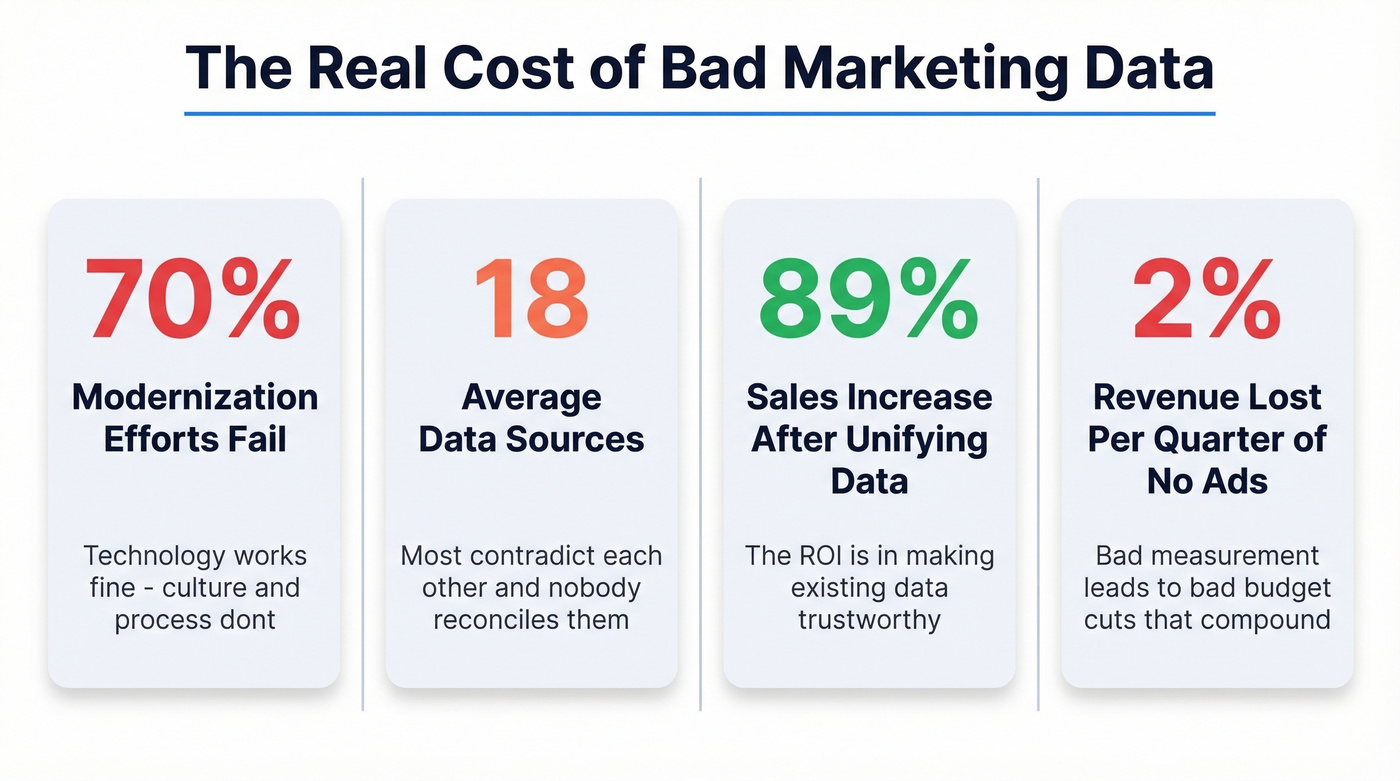
70% of business modernization efforts fail, according to a widely cited IDC study. The technology works fine. Teams invest in tools without building the culture and processes to use them.
Analysis paralysis. Teams wait for perfect data before making any decision. By the time the dashboard is "ready," the campaign window closed two weeks ago. Speed of learning beats perfection of analysis every time.
Too many sources, not enough signal. Marketers use an average of 18 data sources for reporting. That's not a data strategy - it's data chaos. Most of those sources contradict each other, and nobody has time to reconcile them.
Obvious insights. Analysts on r/BusinessIntelligence describe getting stuck producing surface-level findings - "paid search converts better than display" or "email open rates drop on weekends." If your analytics team is telling you things you already know, the problem isn't the data. It's the questions you're asking.
Bad data quality. High email bounce rates aren't a campaign problem - they're a data problem. Your CRM segmentation, lead scoring, and pipeline forecasts all break when the underlying contact data is stale or wrong. We've seen teams burn through sender reputation for months before realizing the root cause was a contact list that hadn't been verified in six months.

No analytics ownership. When responsibility for data is fragmented across marketing ops, IT, and individual channel managers, you get inconsistency, duplicated effort, and nobody accountable for accuracy.
Measurement theater. Teams build elaborate dashboards that look impressive in QBRs but don't actually change decisions. If a dashboard doesn't lead to a different action than you'd take without it, it's decoration.
A Framework That Compounds
Let's break this into five steps that build on each other. Skip one, and the rest wobble.
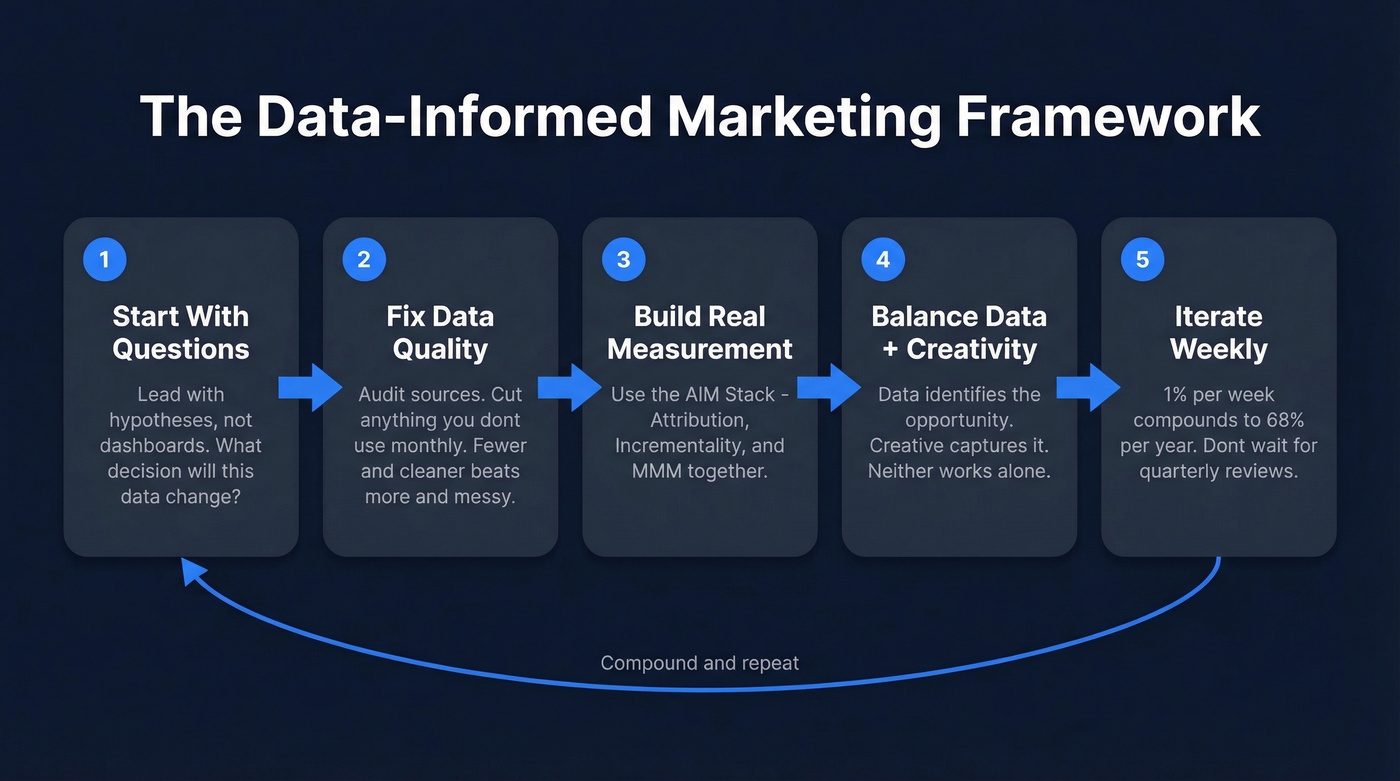
Start With Questions, Not Dashboards
Most teams start with tools. They buy a BI platform, connect their data sources, and build dashboards. Then they stare at the dashboards wondering what to do with them.
Flip it. Start with hypotheses. "We believe our enterprise segment converts 3x better from webinars than from paid search - but we're spending 5x more on paid search." Now you have something to test, a clear action if the hypothesis holds, and a reason to look at the data. Hypothesis-driven analysis produces insights that change behavior. Dashboard-gazing produces slide decks.
Fix Your Data Quality First
You don't need 18 data sources. You need three to five clean ones. 89% of businesses report increased sales after unifying their data. The ROI isn't in adding more data - it's in making the data you have trustworthy.
Audit what you've got. If a data source doesn't directly inform a decision you make at least monthly, cut it. Fewer, cleaner inputs beat a sprawling data ecosystem that nobody trusts.
Build Measurement That Reflects Reality
This is important enough to get its own section below. The short version: multi-touch attribution is breaking. You need the AIM Stack - a combination of Attribution, Incrementality testing, and Marketing mix modeling. We'll dig into the specifics.
Balance Data With Creative Judgment
Here's the hot take most guides won't give you: for many businesses with smaller deal sizes, sophisticated attribution is rarely the bottleneck. Better creative and faster iteration usually matter more. Creative quality can increase profitability by up to 12x - and teams that ignore creative in favor of spreadsheet-perfect measurement leave money on the table.
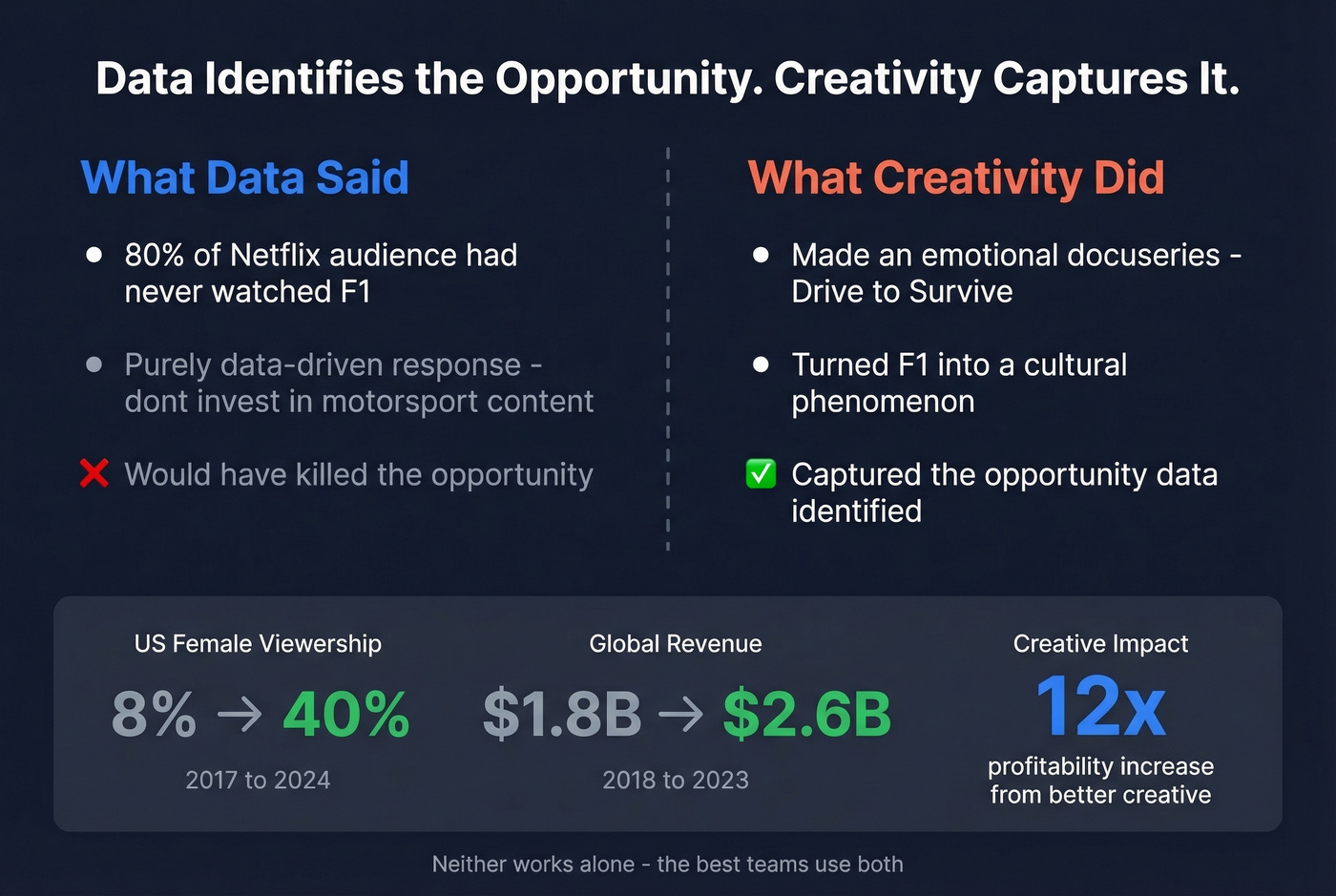
The F1 case proves this at scale. Data showed that 80% of Netflix's audience had never watched an F1 race. A purely data-driven response would've been "don't invest in motorsport content." Instead, the creative decision was to make an emotional docuseries - Drive to Survive - that turned F1 into a cultural phenomenon. U.S. female viewership went from 8% in 2017 to 40% in 2024. F1's global revenue jumped from $1.8B to $2.6B between 2018 and 2023.
Data identified the opportunity. Creativity captured it. Neither works alone.
Iterate Weekly, Not Quarterly
CRO is the second-most-used optimization technique among marketers at 50% adoption, and 56% of marketers say it's much easier to improve conversion rates now than a decade ago. The teams getting the most from it aren't running one big test per quarter - they're running small experiments weekly, documenting results, and compounding learnings. A 1% improvement per week compounds to about a 68% improvement over a year. Quarterly testing leaves that on the table.

You just read that bad data quality kills marketing strategies before they start. Prospeo refreshes 300M+ profiles every 7 days - not every 6 weeks like competitors. 98% email accuracy, 5-step verification, spam-trap removal. Your segmentation, scoring, and attribution all improve when the foundation is clean.
Stop building dashboards on dirty data. Fix the source.
Measuring Marketing Performance in 2026
Multi-Touch Attribution Is Breaking
Practitioner confidence in multi-touch attribution is cratering. The reasons are structural, not fixable with better tooling. Consent loss means you're missing chunks of the journey. Cross-device behavior fragments the path. And platform double-counting makes every channel look like the hero - Meta's "1-day view / 28-day click" attribution window means it takes credit for conversions that had five other touches.
The result: Meta says 200 conversions, Google says 180, and your CRM shows 120. Sound familiar?
The AIM Stack: Three Methods, One Answer
No single measurement method works in 2026. You need three - what we call the AIM Stack - each answering a different question.
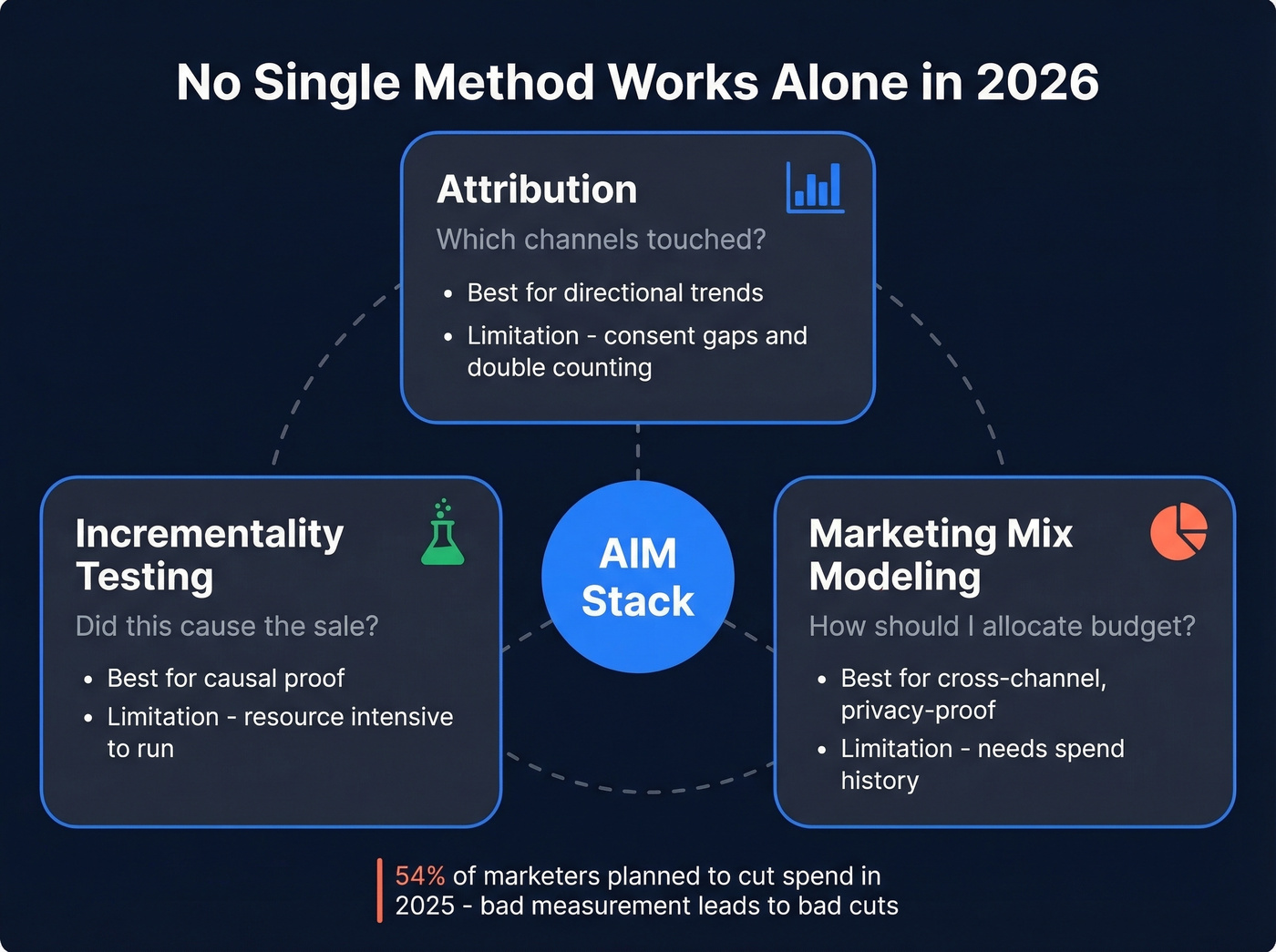
| Method | What It Answers | Best For | Limitation |
|---|---|---|---|
| Attribution | Which channels touched? | Directional trends | Consent gaps, double-counting |
| Incrementality | Did this cause the sale? | Causal proof | Resource-intensive |
| MMM | How should I allocate? | Cross-channel, privacy-proof | Needs enough spend + history |
Attribution is still useful as a directional signal. Use it for channel-level trends and relative comparisons - not as the basis for budget decisions.
Incrementality testing is the gold standard for causal proof. Run geo or audience splits, use platform lift tests, or exploit natural experiments where spending varied. It answers the question attribution can't: "If I turn this channel off, how much do sales actually fall?"
Marketing mix modeling is privacy-proof because it doesn't require user-level tracking. It uses aggregate time-series and geographic data to model channel contributions. It's the best option once you have meaningful multi-channel spend and enough historical data to model.
The stakes are real. 54% of global marketers planned to reduce spending in 2025, and Nielsen reports that a brand loses an average of 2% of future revenue for every quarter it stops advertising. When budgets are being cut, proving ROI isn't optional. Bad measurement leads to bad cuts, and bad cuts compound fast.
Where different channels deliver: B2B teams see the highest ROI from website/blog/SEO, paid social, and social shopping tools. B2C teams get the most from email (2.8% average conversion rate), paid social, and content marketing. Your AIM Stack should reflect where the returns tend to be - don't measure everything equally when the upside isn't equal.
Building Your Marketing Stack
You don't need 15 tools. You need the right ones in the right categories, connected cleanly.
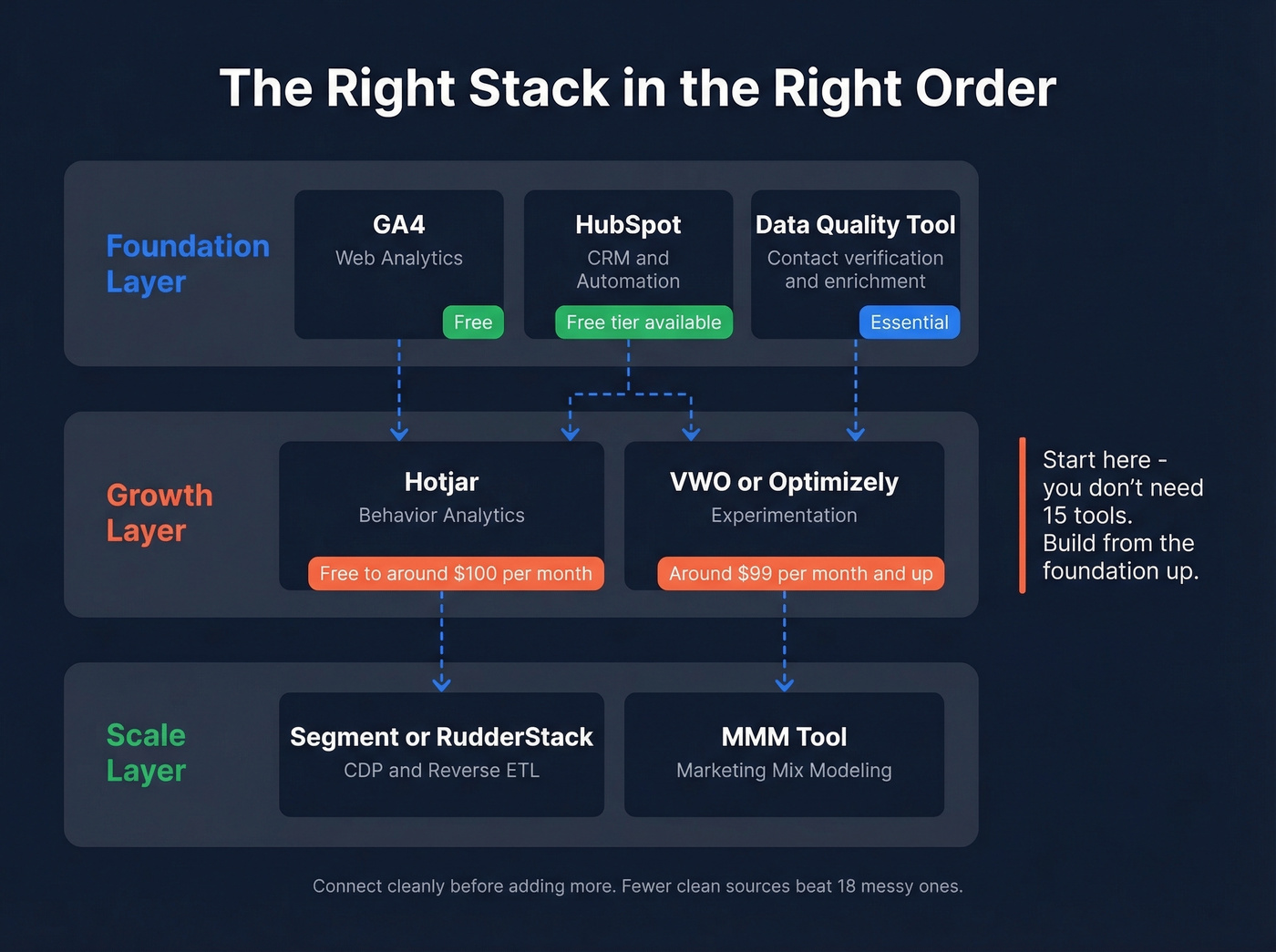
| Category | Tools | Price Range |
|---|---|---|
| Web Analytics | GA4 | Free |
| CRM / Automation | HubSpot, Salesforce | Free-$10k+/mo |
| Behavior Analytics | Hotjar | Free-~$100/mo |
| Experimentation | VWO, Optimizely | ~$99/mo-$50k+/yr |
| CDP / Reverse ETL | Segment, RudderStack, Hightouch | Free-$100k+/yr |
| BI / Visualization | Power BI, Tableau | Free-$75/user/mo |
| Data Quality / Enrichment | Prospeo, Bombora | Free-$25k+/yr |
| Marketing Automation | Klaviyo, Braze, Customer.io | Free-$50k+/yr |
The data quality layer is the one most teams skip - and it's the one that breaks everything else when it's missing. Your CRM segmentation, outbound sequences, and pipeline forecasts are only as good as the contact data feeding them. In our experience, teams that verify and refresh contact data on a weekly cycle see dramatically lower bounce rates and higher deliverability across every outbound channel. If you need a deeper playbook, start with CRM hygiene and a proper data quality audit.

CDPs are essential for mid-market and above - they unify customer data across touchpoints so you can segment and trigger campaigns based on actual behavior. For SMBs, though, a clean CRM plus an enrichment tool is enough. Don't buy a $50k CDP when you have 5,000 contacts. If you're evaluating options, compare data enrichment tools and data quality tools before you commit.
The article says fewer, cleaner data sources beat a sprawling ecosystem nobody trusts. Prospeo replaces fragmented contact data with one verified layer - 143M+ emails, 125M+ mobiles, 92% API match rate, 50+ data points per enrichment. Plug it into HubSpot or Salesforce and your CRM finally tells the truth.
One clean data source beats eighteen contradicting ones. Start free.
For experimentation, VWO at around $99/month is a strong starting point. Optimizely is powerful but enterprise-priced at $50k+/year - overkill unless you're running dozens of concurrent tests across multiple properties.
The Privacy Shift
Google rolled back its plan to fully remove third-party cookies in Chrome in July 2024, opting for user-level controls instead. Safari has blocked third-party cookies by default since 2020. The direction is clear regardless of what Chrome does next.
On the regulatory side, 14 of 50 U.S. states have data privacy regulations in place, and 40 have legislation tabled. This isn't slowing down. If you're building a measurement strategy that depends on user-level cross-site tracking, you're building on sand.
The practical response is first-party data. Focus on value exchange - give people a reason to share their information. Start simple with consented CRM and transactional data. Segment by lifetime value, not by cookie-based behavioral profiles that degrade every quarter.
This is also why marketing mix modeling is gaining traction. It doesn't need user-level tracking at all. It works with aggregate data - spend by channel, revenue by geography, time-series trends. Privacy-proof by design.
Look, the teams that invested in first-party data infrastructure two years ago aren't scrambling now. The ones that kept relying on third-party audiences are. If you haven't started, the 30-day plan below is your on-ramp.
Real Examples With Numbers
Theory is nice. Numbers are better. (If you want more case studies, see our data-driven marketing examples.)
SMB Examples
An HVAC company saw a 150% surge in Google Maps calls in June 2025 compared to the prior year, with 250+ tracked SEO calls in a single month. The approach was straightforward: data-informed local SEO targeting the service categories and geographies where search demand was highest, measured weekly, and adjusted based on what converted to actual booked appointments - not just clicks.
A tourism DMO generated 20,000+ Instagram account views in April 2025 - 44% higher than April 2024 - with zero ad spend. Their content strategy was driven by engagement data from prior months, doubling down on formats and topics that drove profile visits, not just likes.
Enterprise Examples
The F1 case we covered earlier remains the best data-meets-creativity example of the decade. But it's not alone.
Duolingo's Shorts content generated 300M impressions in Q1 2025 with a 430% viewership surge. Their content team uses engagement data to iterate on formats weekly - exactly the "iterate weekly, not quarterly" principle in action. They don't wait for quarterly reviews to kill underperforming formats or double down on winners.
Philips ran a data-informed UX optimization program across its digital properties, using behavioral analytics and A/B testing to systematically improve conversion paths. The result was a measurable uplift in both engagement and revenue per visitor - proof that even mature enterprises find gains when they let data guide incremental creative decisions.
For context, average e-commerce conversion sits under 2%. Even small, data-informed improvements - a 0.3% lift in conversion rate, a 15% reduction in bounce rate - compound into meaningful revenue over a quarter. You don't need Netflix's budget to benefit from this approach.
30-Day Kickoff Plan
Week 1: Audit your data sources. List every tool feeding your reports. For each one, ask: "Did we make a different decision because of this data in the last 90 days?" If the answer is no, cut it. Aim for three to five clean sources, not eighteen noisy ones.
Week 2: Define three hypotheses. No dashboards yet. Write down three things you believe about your marketing that you haven't proven. "We think webinar attendees convert 2x faster than whitepaper downloaders." "We think our EMEA campaigns underperform because of targeting, not creative." Specific, testable, actionable.
Week 3: Set up measurement. Configure GA4 events for the actions that matter. Make sure CRM tracking captures lead source accurately. Pick one attribution method to start - even last-click is fine as a baseline. Verify your contact data quality before building anything on top of it. If your bounce rate is above 5%, that's your first problem to solve, not your attribution model. (If you're cleaning lists, use an email list cleaning service or a dedicated B2B data cleansing workflow.)
Week 4: Run your first experiment. Pick the hypothesis with the clearest test design and run it. Document the result - win or lose. The goal isn't to be right. It's to build the muscle of testing, learning, and iterating. That muscle is what separates data-informed teams from dashboard-decorating teams.
FAQ
What's the difference between data-driven and data-informed marketing?
Data-informed means data is one input alongside experience, creativity, and market intuition - not the sole decision-maker. Most successful teams operate this way, using analytics to challenge assumptions rather than replace judgment. Pure data-driven thinking optimizes to local maxima and misses creative breakthroughs.
How much does a marketing data stack cost?
An SMB can start for free: GA4 plus HubSpot's free CRM plus a data quality tool with a free tier. Mid-market teams typically spend $500-$2,000/month across analytics, CRM, experimentation, and enrichment. Enterprise stacks with CDPs and marketing mix modeling run $50k-$200k+ per year.
Is multi-touch attribution still relevant in 2026?
As a directional signal, yes - it shows which channels are touching prospects. As the sole basis for budget decisions, no. Consent loss, cross-device gaps, and platform double-counting make MTA unreliable as a source of truth. Combine it with incrementality testing and marketing mix modeling for a complete picture.
How long does it take to see results?
You can run a meaningful first experiment within 30 days using the kickoff plan above. Building mature measurement infrastructure - clean data, validated attribution, and a testing cadence - typically takes two to six months. Start with hypotheses and verified data, not perfect dashboards.