

The 10 Best Deal Management Software Tools in 2026
Your VP just asked why the Q2 forecast was off by 40%. The answer isn't that reps sandbagged their numbers - it's that half the deals in your pipeline were sitting in the wrong stage, with stale contacts and no next steps logged. Sales reps spend roughly 30% of their time actually selling. The other 70% disappears into admin, data entry, and chasing updates.
Deal management software exists to fix that ratio, but picking the wrong tool wastes more time than it saves. And here's the uncomfortable truth most comparison articles skip: the best pipeline platform in the world can't rescue a deal attached to a bounced email address.
Here are the 10 tools worth evaluating, with real pricing and honest tradeoffs.
Our Picks
If you're short on time, start here.
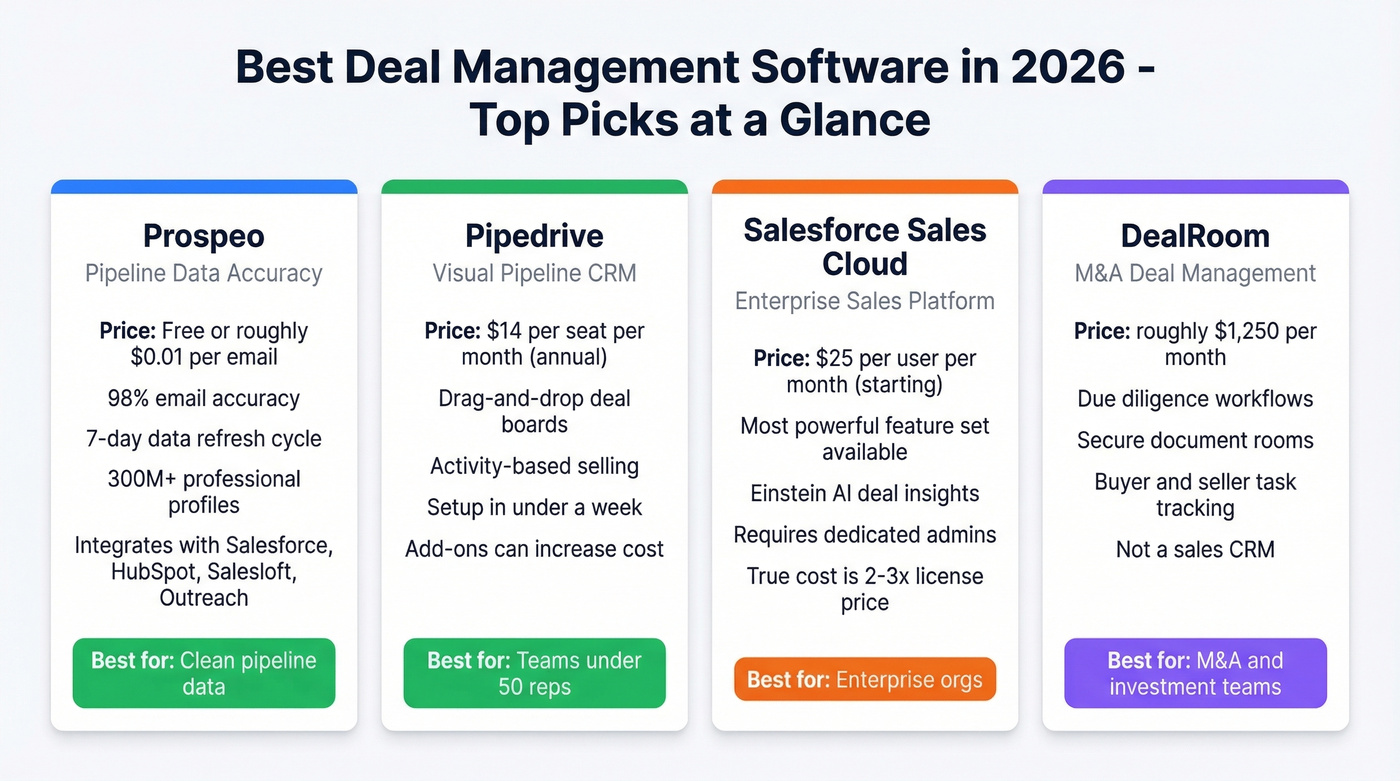
| Pick | Best For | Starting Price |
|---|---|---|
| Prospeo | Pipeline data accuracy | Free / ~$0.01/email |
| Pipedrive | Sales teams under 50 reps | $14/seat/mo (annual) |
| Salesforce | Enterprise sales orgs | $25/user/mo (read the fine print) |
| DealRoom | M&A and investment teams | ~$1,250/mo |
Prospeo ensures the contacts feeding your pipeline are actually reachable - 98% email accuracy on a 7-day refresh cycle. Pipedrive gets reps moving fast with minimal setup. Salesforce does everything, but "everything" comes with a price tag that'll make your CFO flinch. DealRoom is purpose-built for due diligence, not sales.
Sales vs. Investment Deal Management
These two worlds use the same vocabulary - "pipeline," "deal flow," "stages" - but they're solving fundamentally different problems.
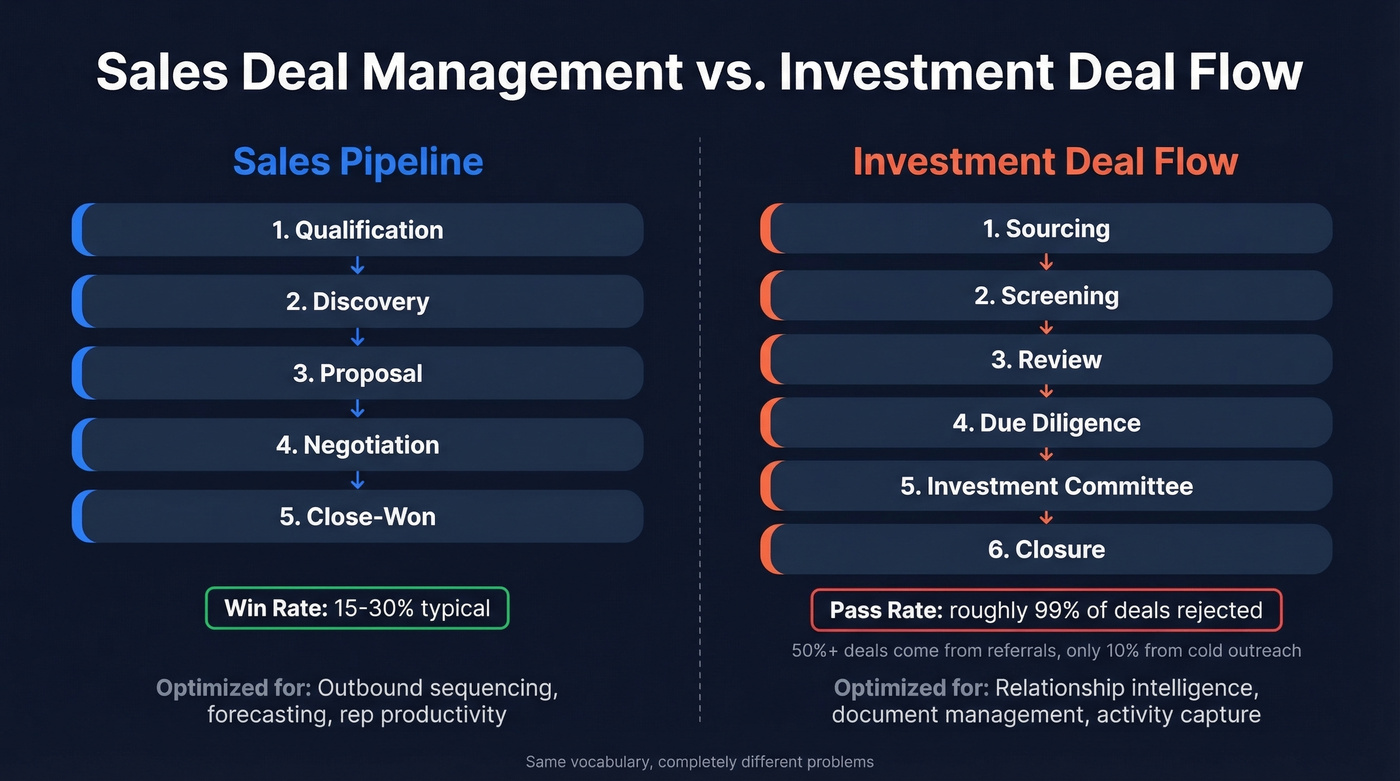
A sales deal tracking system follows opportunities from first touch to closed-won. The stages are familiar: qualification, discovery, proposal, negotiation, close. The tools are CRMs with visual boards, automation, and forecasting.
Investment deal flow works nothing like a sales pipeline. The process runs sourcing, screening, review, due diligence, investment committee decision, then closure. Investment pipelines are mostly rejection - firms pass on roughly 99% of deals they evaluate. More than half of VC deals come from referrals, and only about 10% originate from cold outreach. The tooling needs to emphasize relationship intelligence and automated activity capture, not outbound sequencing.
The virtual data rooms market is projected to hit $3.2B by 2026, growing at a 14.5% CAGR - driven by M&A, PE, and CRE teams that need secure document management alongside deal tracking. For PE and VC firms specifically, platforms like Intralinks and Dynamo handle fund-level deal flow and investor reporting that sales CRMs were never designed for.
If you're running a sales team, tools 1-6 on this list are your universe. Managing M&A or real estate deal flow? Skip to DealRoom and Dealpath.
How to Choose the Right Tool
Not every deal management tool deserves a trial. Here's what separates the useful ones from the noise.
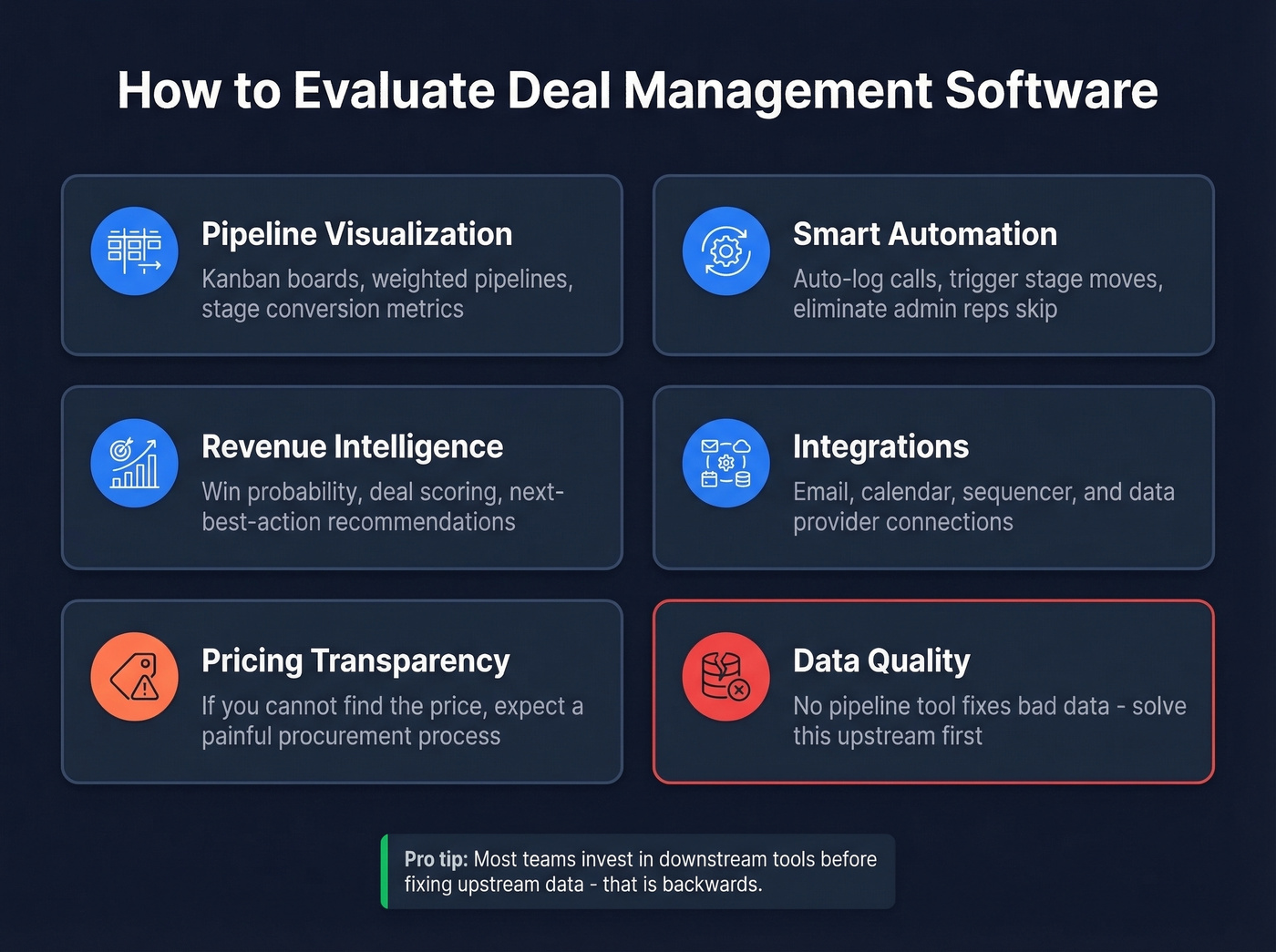
Pipeline visualization. Kanban boards, weighted pipelines, stage-by-stage conversion metrics. If you can't see where deals are stuck at a glance, the tool isn't doing its job.
Automation that saves real time. Auto-logging calls, scheduling follow-ups, moving deals between stages based on triggers. The best platforms eliminate the admin work reps skip anyway.
Revenue intelligence and deal scoring. Win probability, next-best-action recommendations, deal desk workflows. These range from genuinely useful to glorified dashboards - test before you trust.
Integrations. Your deal management platform needs to talk to your email, calendar, sequencer, and data providers. No tool is an island.
Pricing transparency. If you can't find the price on the website, expect a painful procurement process and a contract designed to lock you in.
Data quality. No pipeline tool fixes bad data. If half your contacts bounce, your pipeline metrics are fiction. Solve this upstream before you invest in downstream tooling - starting with data enrichment.

Bad data is the silent pipeline killer. Snyk's 50 AEs had 35-40% bounce rates - their forecast was fiction. After switching to Prospeo's 98% accurate emails with a 7-day refresh cycle, bounce rates dropped under 5% and AE-sourced pipeline jumped 180%.
Stop managing deals attached to dead email addresses.
The 10 Best Deal Management Tools
1. Prospeo
Verdict: The data accuracy layer that makes every other tool on this list actually work.
Prospeo isn't a CRM - it's the platform that ensures the contacts inside your CRM are real, reachable humans. We're talking 300M+ professional profiles, 143M+ verified emails at 98% accuracy, and 125M+ verified mobile numbers. The data refreshes every 7 days, compared to the 6-week industry average.

The proof point that matters: Snyk's 50 AEs were dealing with 35-40% bounce rates before switching. After? Under 5%. That translated to 200+ new AE-sourced opportunities per month and a 180% increase in pipeline.
Prospeo integrates directly with Salesforce, HubSpot, Salesloft, and Outreach - so verified contacts flow straight into whatever deal management system you're running. Pricing starts free (75 emails/month + 100 Chrome extension credits/month), scales at roughly $0.01 per email, with no contracts and no sales calls required. If you're building lists from scratch, pair it with sales prospecting techniques that keep your pipeline full.
2. Pipedrive
Verdict: The fastest path from "we need a CRM" to "reps are actually using it."
Pipedrive's visual pipeline is the product. Drag-and-drop deal boards, customizable stages, and activity-based selling that nudges reps to take the next step. We've seen teams go from spreadsheet chaos to a functioning pipeline in under a week - that's rare for any software category. Small sales teams consistently rank Pipedrive as the easiest CRM to adopt, and the onboarding experience backs that up.

Pricing is straightforward: $14/seat/mo (annual) (Lite), $39 (Growth), $59 (Premium), $79 (Ultimate), all billed annually. Where it gets tricky is add-ons. LeadBooster runs $32.50/month, Web Visitors starts at $41/month and scales to $299/month for higher volumes, and Campaigns ranges from $16 to $417/month depending on contact count.
Use this if you're a sales team under 50 reps that wants visual pipeline management without a three-month implementation.
Skip this if you need enterprise-grade reporting, complex approval workflows, or M&A deal tracking.
3. Salesforce Sales Cloud
Verdict: The most powerful deal management platform on the market - and the most expensive to get right.
Out of 26,270 products reviewed on G2 in Fall 2025, only 3% earned a Leader badge. Salesforce Sales Cloud is one of them. Opportunity management, forecasting, Einstein AI deal insights, approval workflows, CPQ integration - if a feature exists, Salesforce has it or can build it.

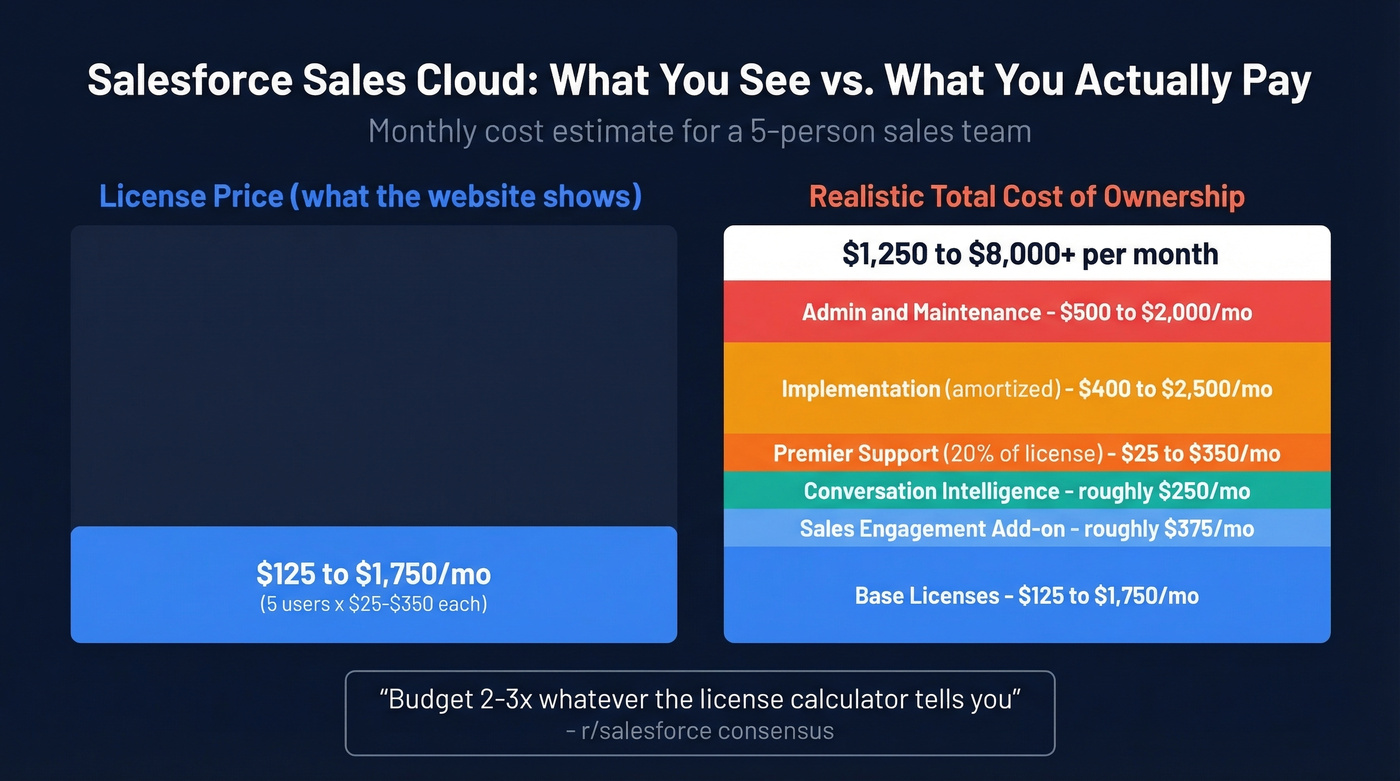
The pricing page looks reasonable: Starter ($25/user/mo), Pro ($100), Enterprise ($175), Unlimited ($350), Agentforce 1 Sales ($550). There's also a Free Suite at $0/user/month for up to 2 users. But the license price is the tip of the iceberg.
A realistic TCO for a 5-person team runs $1,250-$8,000+/month once you factor in Sales Engagement (~$75/user/month), Conversation Intelligence (~$50/user/month), and Premier Support (~20% of license cost). Implementation ranges from $5k-$15k for basic setups to $75k-$300k+ for enterprise deployments. The consensus on r/salesforce is blunt: budget 2-3x whatever the license calculator tells you. If you're comparing options, it helps to review a few examples of a CRM side-by-side.
Use this if you're an enterprise org with dedicated Salesforce admins and a budget that accounts for the full ecosystem.
Skip this if you're a 10-person team that just needs to track deals - you'll spend more time configuring than selling.
4. HubSpot Sales Hub
Verdict: The best free starting point for deal tracking - until you need enterprise features.
HubSpot's free CRM is the best entry point in the category. Period. You get contact management, deal tracking, a visual pipeline, and basic reporting without spending a dollar. For inbound-led teams that need a solution without the overhead of Salesforce, it's the obvious first move.
Paid tiers start around ~$15/user/month and scale through Professional and Enterprise levels. The catch: enterprise tiers climb past $150/user/month, and feature gating between tiers is aggressive. You'll hit walls on reporting, automation limits, and custom objects faster than you'd expect. If you outgrow it, consider dedicated sales forecasting tools to tighten projections.
Best for: Inbound-led teams and startups that want to grow into a platform rather than rip-and-replace later.
Watch out: The jump from free to enterprise pricing is steep, and HubSpot's deal inspection features lag behind dedicated tools like Outreach.
5. Outreach
Here's what you need to know about Outreach before anything else: pricing is opaque and add-on sprawl is real. That's the #1 complaint across review sites. The core sequencing product is excellent. The Deal module - pipeline inspection, deal health scoring, forecasting - runs as an add-on at roughly $30-$50/user/month on top of the base Engage tier ($100-$140/user/month). Annual contracts required, implementation runs $5,000-$25,000. If you're implementing a stack like this, follow a structured sales engagement platform rollout to avoid adoption issues.
Best for: Teams already running Outreach for sequencing who want revenue intelligence in the same platform.
Skip this if you're buying deal tracking as a standalone capability. You'll overpay.
6. SalesLoft
Let's be honest: never pay list price for Salesloft. Their deal management lives inside the revenue workflow platform - Deals is included in both the Advanced and Premier packages, not a separate add-on. That's a meaningful advantage over Outreach's modular approach. List pricing runs ~$150-$180/user/month, but 35-45% off list is typical after negotiation, landing around ~$125/user/month for 50+ seats. The calling add-on costs $7,500/year for 25 users. To keep reps consistent, standardize sales activities across stages.
Best for: Revenue teams that want sequencing + pipeline visibility in one contract without add-on surprises.
7. DealRoom
Verdict: The M&A deal management tool that corporate development teams actually use - not a CRM pretending to handle due diligence.
DealRoom is purpose-built for M&A: due diligence workflows, secure document rooms, task tracking across buyer and seller teams. M&A and finance teams choose it when deals get complex enough that a repurposed sales pipeline would be dangerous. We've talked to corp dev leads who tried running diligence in Salesforce. It didn't end well.
Pricing starts from around ~$1,250/month. That's steep for a sales team, but reasonable for an M&A practice managing multi-million-dollar transactions where a missed diligence item can kill a deal.
Best for: Corporate development, PE, and M&A advisory teams.
Skip this if you're managing a standard B2B sales pipeline.
8. Freshsales
Worth flagging for budget-conscious teams, though we haven't tested it as deeply as the others on this list. Free tier available, paid plans from ~$9/user/month, AI-powered deal scoring via Freddy AI, and a clean interface that doesn't overwhelm small teams. For organizations exploring pipeline tools at a lower price point, Freshsales deserves a look. If your bigger issue is messy records, start with contact management software fundamentals.
Use this if you need a functional deal pipeline for under $20/user/month.
Skip this if you're running complex enterprise sales cycles with multi-threaded deals.
9. Dealpath
Purpose-built for commercial real estate deal flow and portfolio management. Pricing is enterprise-only - expect $500-$1,000+/user/month based on team size and deal volume. If you're managing CRE investments, Dealpath's feature set is specifically designed for your workflow. Everyone else can skip it.
10. folk CRM
Lightweight relationship-tracking CRM starting at $20/user/month. Good for small teams graduating from spreadsheets who need flexible deal tracking without the weight of Salesforce or HubSpot. The tagging and custom field system is more flexible than most CRMs at this price point. Not built for scale.
Pricing Comparison
| Tool | Starting Price | Free Tier | Contract Req'd | Hidden Costs |
|---|---|---|---|---|
| Prospeo | Free / ~$0.01/email | Yes (75 emails/mo + 100 extension credits/mo) | No | None |
| Pipedrive | $14/seat/mo (annual) | No (14-day trial) | No | Add-ons: $32-$299/mo |
| Salesforce | $25/user/mo | Yes (max 2 users) | Annual | Implementation: $5k-$300k+ |
| HubSpot | Free / ~$15/user/mo | Yes | No | Enterprise: $150+/user/mo |
| Outreach | ~$100/user/mo | No | Annual | Modules: $30-$50/user each |
| Salesloft | ~$125/user/mo (negotiated) | No | Annual | Calling: $7,500/yr (25 users) |
| DealRoom | ~$1,250/mo | No | Contact sales | Scales with deal volume |
| Freshsales | $9/user/mo | Yes | No | Limited at lower tiers |
| Dealpath | ~$500-$1,000+/user/mo | No | Yes | Implementation varies |
| folk CRM | $20/user/mo | No | No | Minimal |
The Salesforce row deserves a footnote the size of this table. A 5-person team on Enterprise with Sales Engagement and Premier Support realistically pays $1,250-$8,000+/month. The $25 starting price is technically true and practically misleading.
The Prerequisite Nobody Talks About
Every tool on this list assumes your contact data is accurate. None of them verify it.
B2B contact data decays roughly 30% annually. If you loaded 10,000 contacts into your pipeline in January, 3,000 of them are unreliable by December. Even the best deal management software can't generate accurate forecasts when the underlying contact data is rotten - and we've watched teams burn entire quarters chasing phantom pipeline before realizing the problem was upstream, not in their CRM configuration. If you're seeing deliverability issues, start by tracking your email bounce rate.

Every deal management tool on this list depends on one thing: reachable contacts. Prospeo feeds your CRM with 300M+ verified profiles at ~$0.01 per email - 90% cheaper than ZoomInfo. Native integrations with Salesforce, HubSpot, Salesloft, and Outreach mean verified data flows directly into your pipeline stages.
Fix the data upstream so your pipeline metrics stop lying to you.
How to Calculate ROI
Before you sign a contract, run the math.
Costs: Licenses + implementation + integrations + data migration + training + ongoing admin. For Salesforce, that last bucket alone can justify a full-time admin hire at $80-$120k/year.
Revenue outputs: Pipeline velocity improvement, forecasting accuracy, rep productivity, and reduced churn from better deal handoffs. The framework from Method's CRM ROI analysis breaks this down well - map every cost input against measurable revenue outputs, then calculate payback period. Most mid-market teams should expect 3-6 months to break even on a well-implemented deal management tool, though in our experience the teams that fix data quality first see returns faster than those who don't. To diagnose issues faster, use a simple pipeline health scorecard.
FAQ
What is deal management software?
Software that tracks and automates sales or investment opportunities from first contact to close - replacing spreadsheets and gut-feel forecasting with structured pipeline workflows, stage progression metrics, and deal health visibility.
What's the difference between a CRM and a deal management platform?
A CRM stores contacts and interaction history. A deal management platform focuses on pipeline momentum - stage progression, deal velocity, win probability, and deal desk collaboration on active opportunities. Many CRMs include deal tracking, but purpose-built tools go deeper on forecasting and revenue intelligence.
Do I need separate software for M&A deal management?
Yes, in most cases. Sales CRMs aren't built for due diligence workflows or secure document rooms. DealRoom and Dealpath handle these far better than a repurposed sales pipeline.
How much does deal management software cost?
From free (HubSpot, Salesforce for up to 2 users) to $550/user/month for enterprise Salesforce. Most mid-market teams spend $25-$175/user/month on licenses, plus 30-50% more for implementation and add-ons.
How do I keep my deal pipeline data accurate?
Validate emails and phone numbers before loading contacts into your pipeline. B2B contact data decays ~30% annually - a 7-day refresh cycle catches job changes and bounced addresses before they corrupt your forecasting. Native integrations with major CRMs and sequencers make this automatic rather than manual.