

The 10 Best Deal Tracking Software Tools for 2026
It's Monday morning. You're staring at a pipeline that says $1.2M in open deals. Your gut says half of that is dead - stale contacts, ghosted follow-ups, deals that haven't moved in six weeks. Only 30% of a sales rep's time is spent actually selling, and a big chunk of the rest goes to wrangling a CRM that's supposed to make pipeline management effortless. The right deal tracking software fixes this. The wrong one becomes another tab your reps ignore.
Most "best deal tracking" lists rank 15 tools alphabetically and call it a day. We've tested these, watched teams implement them, and seen which ones stick after 90 days.
Our Picks (TL;DR)
Best pure deal tracker for SMBs: Pipedrive - clean kanban pipeline, transparent pricing ($14-$79/seat/mo), gets out of your way.
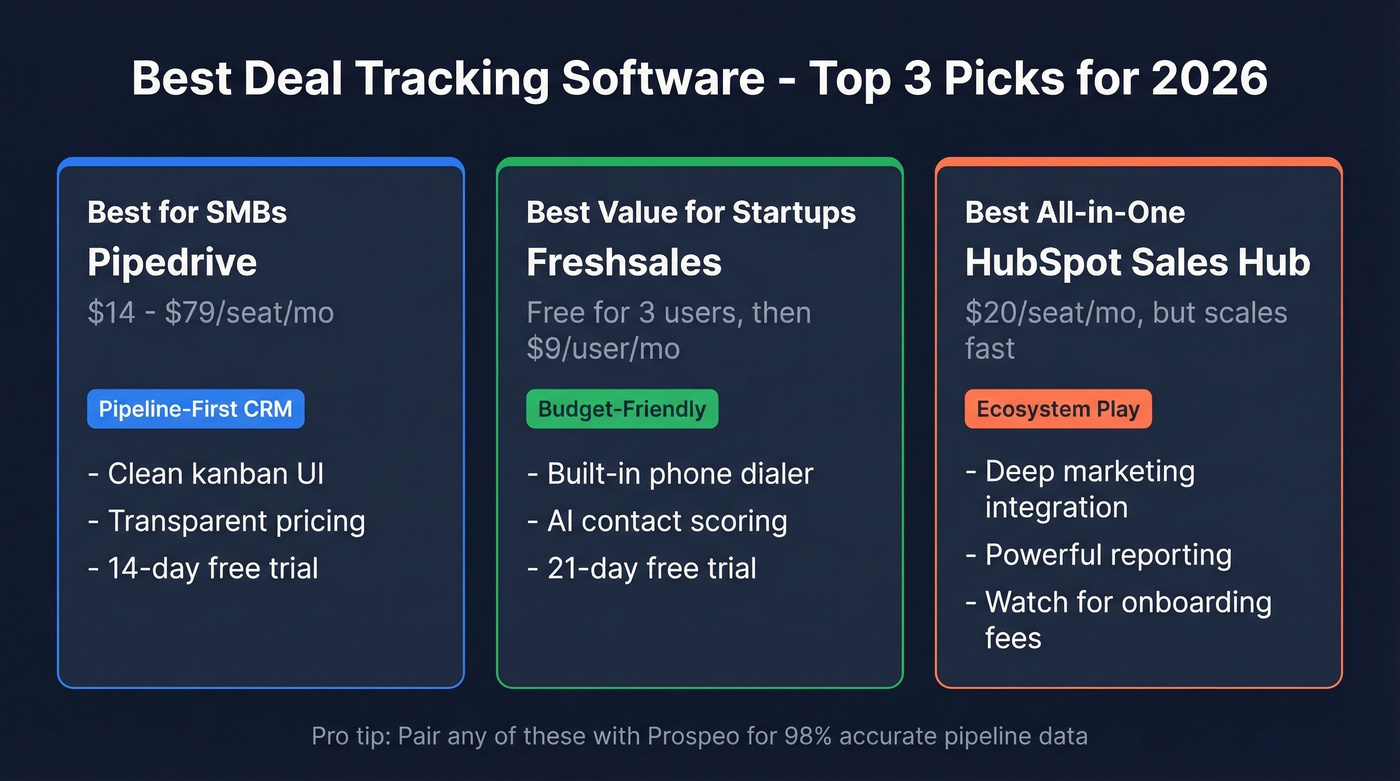
Best value for startups: Freshsales - free for up to 3 users, paid plans from $9/user/mo.
Best all-in-one for marketing-heavy orgs: HubSpot Sales Hub - but only if you're already in the HubSpot ecosystem. Otherwise, you're overpaying.
Here's the thing: most teams under 20 reps don't need an all-in-one CRM. A focused deal tracker like Pipedrive paired with a data accuracy layer like Prospeo will outperform a bloated platform your reps half-use.
What Is Deal Tracking Software?
Deal tracking software gives sales teams a structured way to manage every open opportunity from first touch to closed-won (or closed-lost). It's a core CRM function, though some tools specialize in pipeline management while full CRMs bundle marketing, support, and more.
The CRM market hit $112 billion in 2025 and is projected to reach $262 billion by 2032. 91% of companies with 11+ employees already use a CRM platform. This is table stakes - the question is which one fits your workflow.
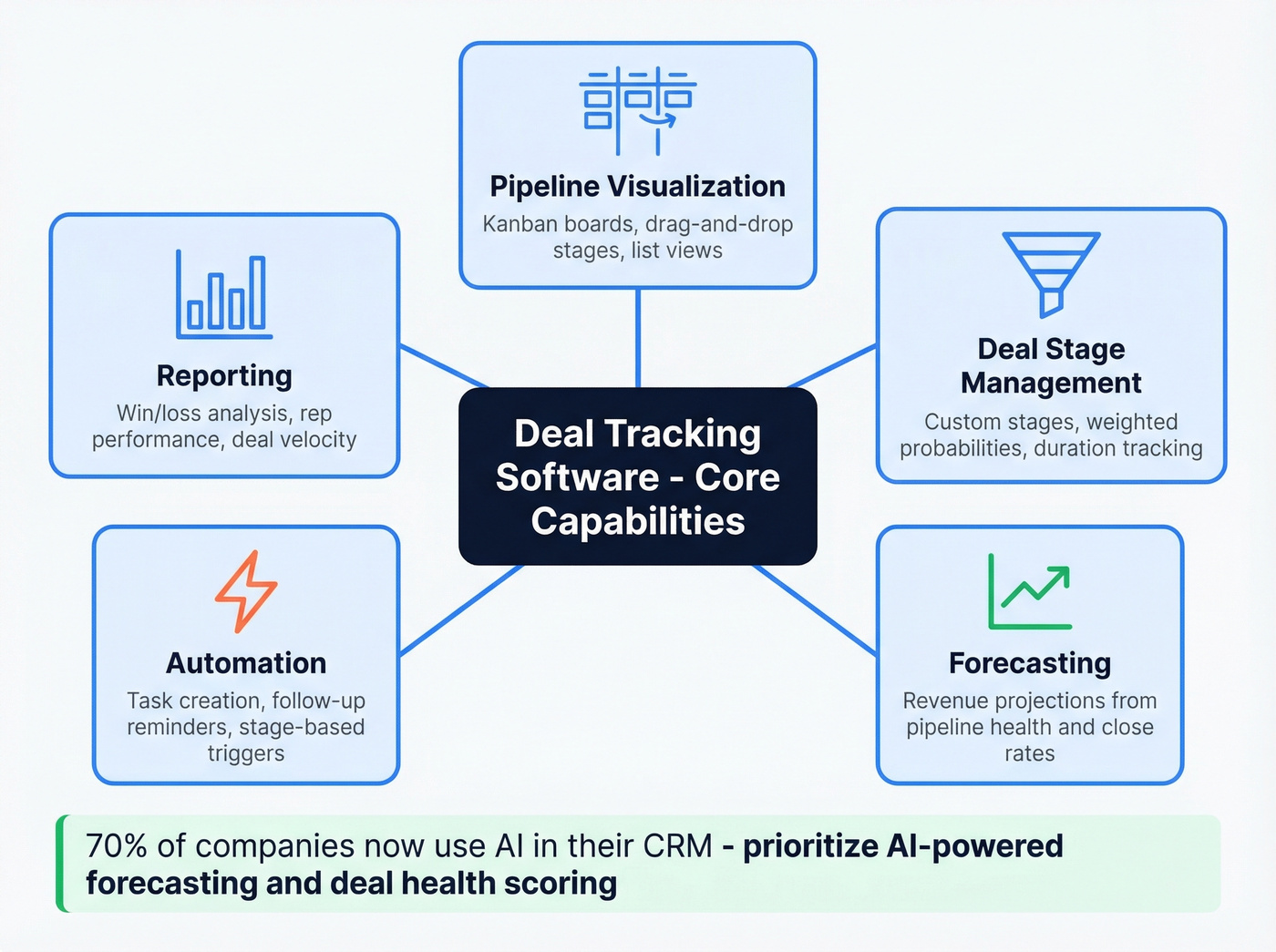
Five capabilities to look for:
- Pipeline visualization - drag-and-drop deal stages, kanban boards, list views
- Deal stage management - custom stages, weighted probabilities, stage duration tracking
- Forecasting - revenue projections based on pipeline health and historical close rates (see sales forecasting)
- Automation - task creation, follow-up reminders, stage-based triggers
- Reporting - win/loss analysis, rep performance, deal velocity metrics
70% of companies now use AI in their CRM, so prioritize tools with AI-powered forecasting and deal health scoring. They're no longer premium features.
A Simple Deal Tracking Process
If you're moving off spreadsheets, follow these five steps: define your deal stages to match your actual sales cycle, set entry and exit criteria for each stage so deals don't stagnate, assign weighted probabilities to generate realistic forecasts, automate follow-up reminders so nothing slips, and review pipeline health weekly with your team. Every tool below supports this workflow - the difference is how much friction each one adds.
For teams in commercial real estate or M&A, specialized tools like Dealpath or DealRoom handle industry-specific workflows that general CRMs can't. The tools below are built for B2B sales teams (and B2B sales is a different beast than transactional).
The 10 Best Tools for Managing Deals
1. Prospeo - Best for Pipeline Data Accuracy
Your pipeline is only as good as your contact data. This is the part most CRM lists skip entirely, and it's the reason deal boards lie to you.
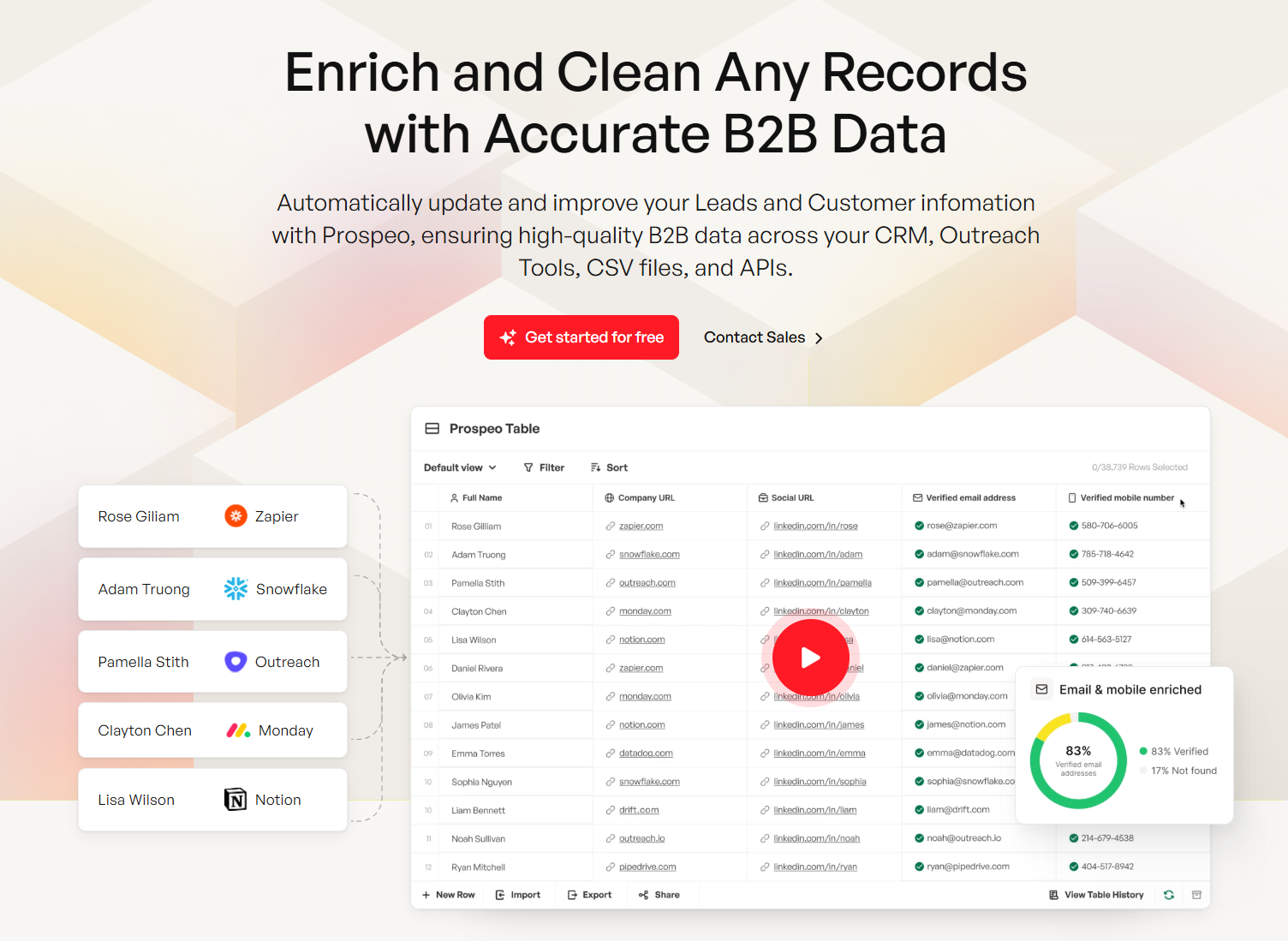
Prospeo isn't a CRM - it's the data engine that makes your CRM useful. The platform covers 300M+ professional profiles with 143M+ verified emails at 98% accuracy and 125M+ verified mobile numbers. Every record refreshes on a 7-day cycle; the industry average is six weeks, which means most CRM databases are already stale by the time reps work them.
If you're comparing vendors, start with the broader landscape of data enrichment services and how they impact deliverability and reply rates.
Teams using Prospeo book 26% more meetings than those on ZoomInfo and 35% more than Apollo, because verified data means fewer bounces and more live conversations. It integrates natively with Salesforce and HubSpot for CRM enrichment, returning 50+ data points per contact. One customer - Meritt - went from a 35% bounce rate to under 4% after layering Prospeo into their workflow, and their pipeline tripled from $100K to $300K per week.
Pricing: Free tier gives you 75 emails/month. Paid plans run roughly $0.01 per email with no contracts and no annual commitment - 90% cheaper than ZoomInfo on a per-lead basis.
Use this if: Your bounce rates are above 5%, your reps waste time on dead contacts, or you need a data layer underneath any CRM on this list. (If you're diagnosing bounces, use this email bounce rate guide.)
2. Pipedrive - Best CRM for Closing Deals
Pipedrive is the deal tracker that actually gets used. That's not a small thing - CRM adoption is where most sales tools die, and Pipedrive's clean kanban interface is the main reason teams stick with it.

Use this if: You're an SMB sales team (3-50 reps) that wants a pipeline-first CRM without the bloat. The 14-day free trial doesn't require a credit card.
Skip this if: You need deep marketing automation, customer support ticketing, or complex multi-object data models. Pipedrive is a sales tool, not a platform.
Pricing is refreshingly transparent. Lite runs $14/seat/mo, Growth is $39, Premium is $59, and Ultimate tops out at $79 - all billed annually. Watch the add-ons: LeadBooster (from $32.50/mo) and Web Visitors (from $41/mo) are per-company charges, and other add-ons start at $6.67/mo and can stack up fast on small teams.
Reddit users consistently praise Pipedrive's UI as "clean" and affordable, but the Stripe integration gets called out as weak, and activity tracking feels basic compared to HubSpot Pro. For pure pipeline management, it's the best in class at this price.
3. Freshsales
Freshsales is the budget play that doesn't feel like a budget play. The free tier covers up to 3 users with contact management, deal tracking, and a built-in phone dialer - genuinely useful for a two-person startup, not just a lead-gen gimmick.

The Growth plan at $9/user/mo unlocks AI-powered contact scoring, workflows, and a visual sales pipeline. Advanced forecasting and custom reporting live in the Pro ($39/user/mo) and Enterprise ($59/user/mo) tiers, where Freshsales starts competing with tools that have more mature ecosystems.
The 21-day free trial is generous. We've seen teams run an entire sales cycle inside the trial period and make a confident decision - that's how you evaluate a CRM, not from a demo video.
4. HubSpot Sales Hub
HubSpot is the CRM everyone evaluates and half of them regret. Not because it's bad - it's genuinely powerful - but because the pricing model punishes you for growing.
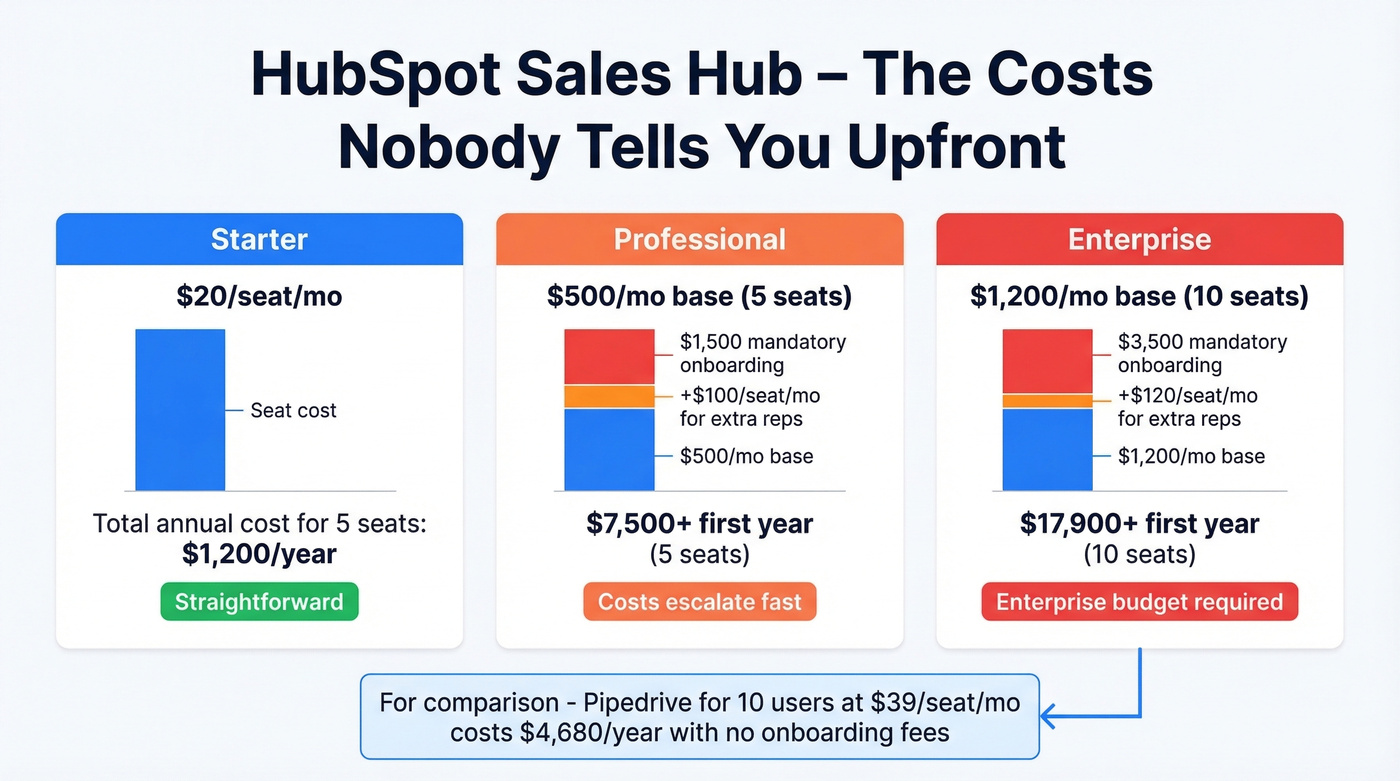
HubSpot's free CRM includes one deal pipeline. Sales Hub paid plans start at $20/seat/mo. The problem starts when you need sequences, custom reports, or forecasting - those live in Professional at $500/mo for 5 seats, plus $100/seat/mo for each additional rep. Enterprise jumps to $1,200/mo for 10 seats.
Nobody tells you upfront: Professional has a $1,500 mandatory onboarding fee. Enterprise requires $3,500.
The Reddit sentiment on HubSpot is consistent - "useful features locked behind $100+/month" and "over-engineered" for teams that just want deal management. If you're already in the HubSpot ecosystem for marketing, Sales Hub makes sense. If you're evaluating it standalone, Pipedrive does 80% of what you need at a quarter of the cost.
5. Salesforce Sales Cloud
Salesforce is the enterprise default. It's also overkill for 90% of sales teams under 50 reps.
The Free Suite (2 users max) is surprisingly capable for a solo founder. Starter Suite at $25/user/mo is competitive with Pipedrive. But the real Salesforce experience starts at Pro Suite ($100/user/mo) or Enterprise ($175/user/mo), where you get the customization, automation, and reporting that justify the platform.
The catch: implementation costs. Budget $5K-$50K+ depending on complexity, plus ongoing admin overhead. For mid-market and enterprise teams with dedicated RevOps, it's the right choice. For a 5-person sales team, it's a money pit.
6. Close
Close is built for inside sales teams that live on the phone. The built-in dialer, SMS, and email sequencing mean reps never leave the CRM to prospect. The pipeline view is clean but secondary to the communication workflow.
Pricing starts at ~$49/user/mo, with higher tiers around ~$99/user/mo and ~$139/user/mo. No free tier, but there's a trial. If your team makes 50+ calls a day, Close is the obvious pick over Pipedrive. If you're mostly email-driven, it's overbuilt.
7. Zoho CRM
Zoho is the budget enterprise alternative that tries to do everything - and does most of it reasonably well. The free tier covers 3 users, Standard starts at $14/user/mo, Professional at $23/user/mo, and Enterprise at $40/user/mo.
The feature set at Enterprise rivals Salesforce Pro Suite at less than a quarter of the price. The tradeoff is UX: Zoho's interface feels dated compared to Pipedrive or HubSpot, and the learning curve is steeper. In our experience, teams take 2-3 months to fully configure Zoho versus days for Pipedrive. If you need CRM + project management + invoicing + helpdesk in one ecosystem and you're price-sensitive, Zoho is hard to beat on paper.
8. Outreach
Outreach is primarily a sales engagement platform, and deal management is a secondary layer. The pipeline views and Deal Health Scores are genuinely good. But you're buying a sequencing engine first and a deal tracker second.
Outreach doesn't publish pricing. Expect ~$100/user/mo as a starting point with mandatory annual contracts. Typical annual spend runs $20,000-$50,000, and implementation fees range from $1,000 to $8,000. If you're already running Outreach for sequences, the deal management layer is a natural add. For pipeline management specifically, you're overpaying.
If you're building a sequencing motion, it helps to understand sequence management before you commit to a platform.
9. Copper
Google Workspace native CRM. If your team lives in Gmail and Google Calendar, Copper auto-logs emails and creates contacts without manual entry. Basic runs $23/user/mo, Business at $49/user/mo, and Premium at $134/user/mo. Niche pick for Google-first teams under 20 reps - everyone else should look elsewhere.
10. Pipeline CRM
Simple, no-frills sales tracking for small teams that don't want to think about their CRM. It offers a 14-day free trial with no credit card required. Paid plans start at ~$25/user/mo, with mid-tier around ~$33/user/mo and top tier around ~$49/user/mo. Limited integrations and basic reporting, but the pipeline view is clean and onboarding takes hours, not weeks. If you've outgrown a spreadsheet but don't need Pipedrive's depth, it works.
If you're still relying on spreadsheets, it's worth standardizing your sales activities so the pipeline stays current.

Half the deals in your pipeline are dead because the contacts behind them are wrong. Prospeo enriches your CRM with 98% accurate emails and 125M+ verified mobiles - refreshed every 7 days, not every 6 weeks. Meritt cut their bounce rate from 35% to under 4% and tripled weekly pipeline to $300K.
Stop tracking deals against dead data. Start with contacts that connect.
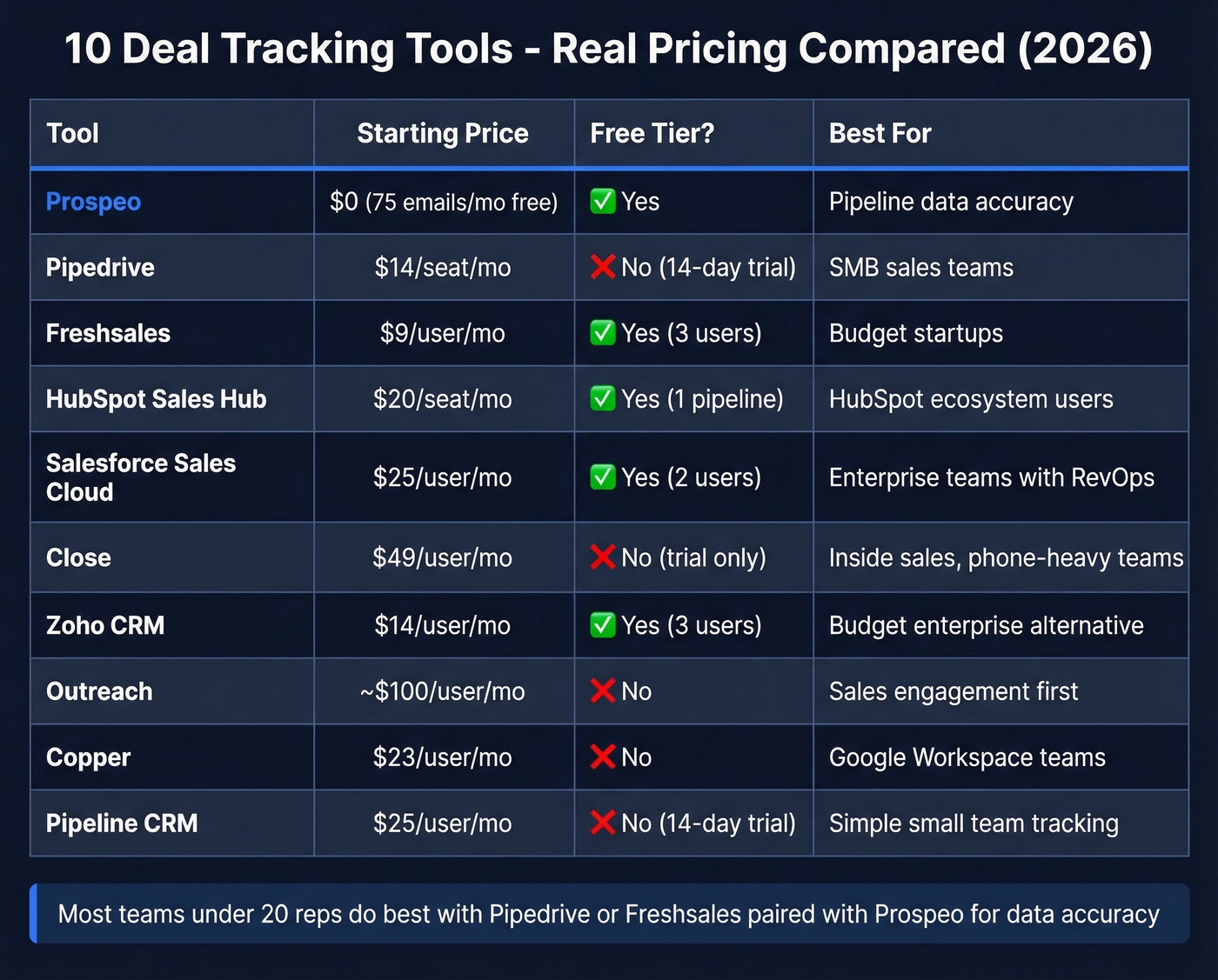
Pricing Comparison
| Tool | Free Tier | Starting Price | Paid Range | Hidden Costs | Annual Contract? | Best For |
|---|---|---|---|---|---|---|
| Prospeo | 75 emails/mo | ~$0.01/email | Credit-based | $0 | No | Pipeline data accuracy |
| Pipedrive | 14-day trial | $14/seat/mo | $39-$79/seat/mo | Add-ons from $6.67/mo | No | SMB deal tracking |
| Freshsales | 3 users free | $9/user/mo | $39-$59/user/mo | CPQ add-ons at higher tiers | No | Bootstrapped startups |
| HubSpot | Free CRM (1 pipeline) | $20/seat/mo | $500-$1,200/mo | Onboarding: $1,500-$3,500 | Yes | Marketing-first orgs |
| Salesforce | Free Suite (2 users) | $25/user/mo | $100-$550/user/mo | Implementation: $5K-$50K+ | Yes | Enterprise with RevOps |
| Close | Trial | ~$49/user/mo | ~$99-$139/user/mo | $0 | Yes | Phone-heavy inside sales |
| Zoho CRM | 3 users free | $14/user/mo | $23-$40/user/mo | $0 | No | Budget all-in-one |
| Outreach | None | ~$100/user/mo | Custom | Implementation: $1K-$8K | Yes | Sequencing + deal mgmt |
| Copper | Trial | $23/user/mo | $49-$134/user/mo | $0 | No | Google Workspace teams |
| Pipeline CRM | 14-day trial | ~$25/user/mo | ~$33-$49/user/mo | $0 | No | Spreadsheet graduates |
The biggest gotcha in this table: HubSpot's onboarding fees and Outreach's implementation costs. A "free" HubSpot plan that grows into Professional will cost you $1,500 before you've customized a single workflow.
How to Choose the Right Tool
One Reddit user building a $240K ARR coaching business wanted 80% automation and a CRM under $100/mo - and still couldn't find one that stuck. That's the reality for most buyers.
Budget first. If you're spending under $100/mo total, your realistic options are Freshsales (free), Pipedrive Lite ($14/seat), or Zoho Standard ($14/user). Don't let a sales rep talk you into a "Pro" tier you'll resent in three months.
Team size matters. Solo founders and teams under 5 can get away with simpler tools. Once you're past 10 reps, you need forecasting, role-based permissions, and reporting that Pipedrive Lite and Freshsales Free don't offer - that's where HubSpot Professional or Salesforce Starter earn their price.
Integration ecosystem. If you're already running HubSpot Marketing, Sales Hub is the path of least resistance. Google Workspace shop? Copper eliminates data entry. Don't underestimate the cost of stitching together tools that don't talk to each other natively.
Adoption risk. The CRM graveyard is real. Pick the simplest tool that covers your requirements. Complexity kills adoption. If reps aren't logging activities after 30 days, the CRM has failed - track login frequency and deal update rates weekly for the first quarter. (Use a simple 30-60-90 day plan to enforce habits early.)
Data quality. Before you commit to a CRM, audit your contact data. If bounce rates are above 5%, fix the data layer first. No point tracking deals against contacts who'll never receive your emails.
The Data Problem Nobody Talks About
Look, here's the uncomfortable truth about deal tracking: 76% of CRM users say less than half their data is accurate or complete. And 37% report actual revenue loss from bad data quality.
Think about what that means for your pipeline. You've got 200 contacts from a trade show loaded into Salesforce. Sixty percent have wrong emails. Your reps build sequences, hit send, and watch bounce rates climb past 30%. Deliverability tanks. Deals that looked real on the pipeline board were dead before the first touchpoint.
If you're trying to fix this systematically, start with an email deliverability guide and then add enrichment.
This is where a data accuracy layer changes the math entirely. The best deal tracking software in the world can't fix bad contact data. Your CRM is a pipeline management layer. Data accuracy is the layer underneath it. You need both.
No deal tracking software can save a pipeline built on stale contacts. Prospeo layers 50+ verified data points into Salesforce and HubSpot at $0.01/email - 90% cheaper than ZoomInfo. Teams book 26% more meetings because reps reach real buyers, not bounced inboxes.
Your CRM is only as good as the data inside it. Fix that first.
Mistakes That Kill Your ROI
Choosing an overly complex CRM. Monday.com gets called out on Reddit as "too flexible" - tons of custom setup, breaks easily, overkill for simple deal flows. If your team needs more than a week to configure the tool, it's the wrong tool.
Skipping training. Even Pipedrive, the simplest CRM on this list, has features most reps never discover. Budget 2-3 hours of structured onboarding per rep. The ROI on that time is enormous.
Ignoring data quality. A beautiful pipeline view means nothing if 40% of the contacts are unreachable. Automated enrichment on a recurring cycle catches job changes and invalid emails before your reps waste time on dead contacts.
Underestimating total cost. That $20/seat HubSpot Starter plan becomes $500/mo + $1,500 onboarding the moment you need sequences. Map out your 12-month cost before signing anything.
Not measuring adoption. Track login frequency and deal update rates weekly for the first quarter. The tool that gets used beats the tool with the best feature list every time.
FAQ
What's the difference between deal tracking software and a CRM?
Deal tracking is a core function within most CRMs - the pipeline view, stage management, and forecasting layer. A full CRM bundles that with marketing automation, support ticketing, and contact management. Pipedrive specializes in deal tracking; Salesforce and HubSpot cover the entire customer lifecycle.
Is there free deal tracking software?
Yes. Freshsales offers a free plan for 3 users with pipeline management and a built-in dialer. Salesforce has a Free Suite for 2 users. HubSpot's free CRM includes one deal pipeline. For data accuracy, Prospeo's free tier provides 75 verified emails per month - useful for keeping your pipeline contacts clean without paying upfront.
Which is the best CRM for sales tracking?
For SMBs that prioritize pipeline visibility, Pipedrive delivers the cleanest experience at the lowest cost ($14-$79/seat/mo). Freshsales is the best free option. For enterprise teams needing granular forecasting and custom reporting, Salesforce Sales Cloud remains the standard - just budget $5K-$50K+ for implementation.
How do I keep my deal pipeline data accurate?
Use a data enrichment tool to verify emails and phone numbers on a recurring basis. 76% of CRM users say less than half their data is accurate or complete, and manual updates don't scale. Automated enrichment with a weekly refresh cycle catches job changes and invalid numbers before reps waste time on dead contacts.
What's the average ROI of deal tracking software?
CRM systems return an average of $8.71 per $1 invested, with up to 27% improvement in customer retention. The ROI compounds when you layer in automation - less manual data entry means more time selling.