

How to Deanonymize Website Traffic in 2026
Your site got 5,000 visitors last month. Maybe 150 filled out a form. The other 4,850 looked at your pricing page, read a case study, and vanished - that's not a traffic problem. It's an identification problem. Learning to deanonymize website traffic is how you close that gap, and most teams get it wrong by stopping at the company name instead of getting to a verified contact.
The Quick Version
Company-level identification matches 30-65% of traffic depending on your visitor mix. Person-level identification gets hyped hard, but realistic rates sit at 5-20%. The real gap isn't figuring out which company visited - it's turning anonymous visits into a verified email you can actually send to (and that starts with the right B2B database).
What Website Deanonymization Actually Is
Website deanonymization identifies the companies or individuals behind anonymous site visits. It's now a $1B industry, and the category breaks into three layers.
Company-level identification matches visitor IP addresses to known business entities. This is the most reliable method. Person-level identification uses identity graphs and first-party data to resolve individual visitors - much harder, much lower match rates. Intent-based enrichment layers behavioral signals like pages viewed and return visits onto identified accounts so you can prioritize outreach (and build a tighter buyer journey view).
Most tools do the first. A few claim the second. Almost none solve the actual problem: giving you a way to contact the person who visited.
How Visitor Identification Works Under the Hood
IP-to-company matching is the workhorse. Your visitor's IP gets matched against databases of corporate IP ranges via reverse DNS lookup. When someone browses from a Salesforce office, the IP resolves to Salesforce. Simple, reliable for office traffic, and increasingly unreliable as remote work grows and more employees sit behind residential ISPs that don't map to any company.
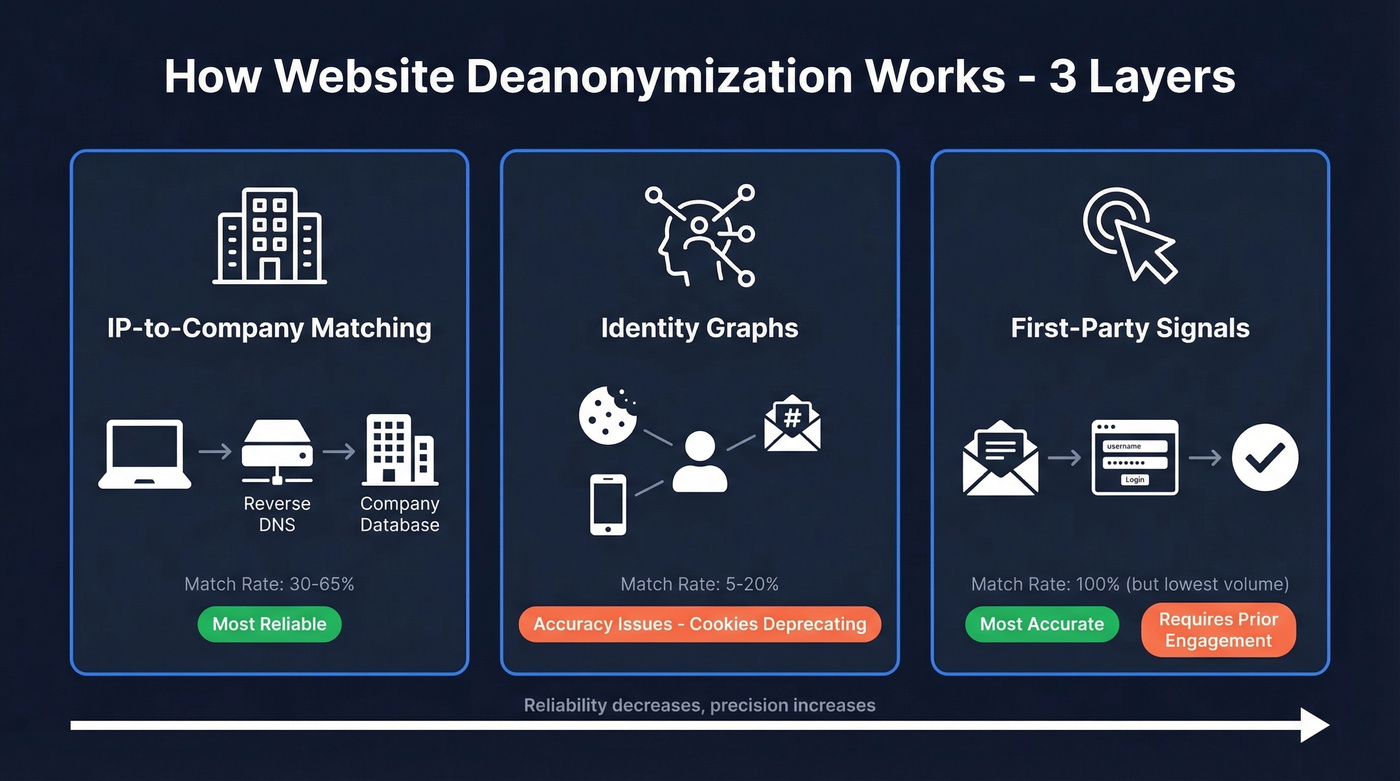
Identity graphs cluster pseudonymized identifiers - cookies, mobile ad IDs, hashed emails, authenticated IDs like UID2 - at the household or individual level. They're powerful in theory but depend on deterministic data that's getting harder to collect as cookies deprecate and privacy regulations tighten. The Trade Desk has a solid explainer on how these graphs work if you want the technical deep-dive.
First-party signals are the most accurate but lowest volume. When someone clicks an email link or logs into your app, you know exactly who they are. No guessing. But you only identify people who've already engaged directly (which is why customer profiling still matters).

Visitor identification gets you the company name. Prospeo closes the gap with 143M+ verified emails at 98% accuracy. Stop Googling for contacts after every site visit - search by company, filter by job title, and export verified emails for $0.01 each.
Turn identified visitors into contacted prospects in 30 seconds, not 30 minutes.
What Match Rates to Actually Expect
Here's the thing: every vendor quotes match rates that assume ideal conditions. Your actual numbers depend almost entirely on where your visitors are browsing from.
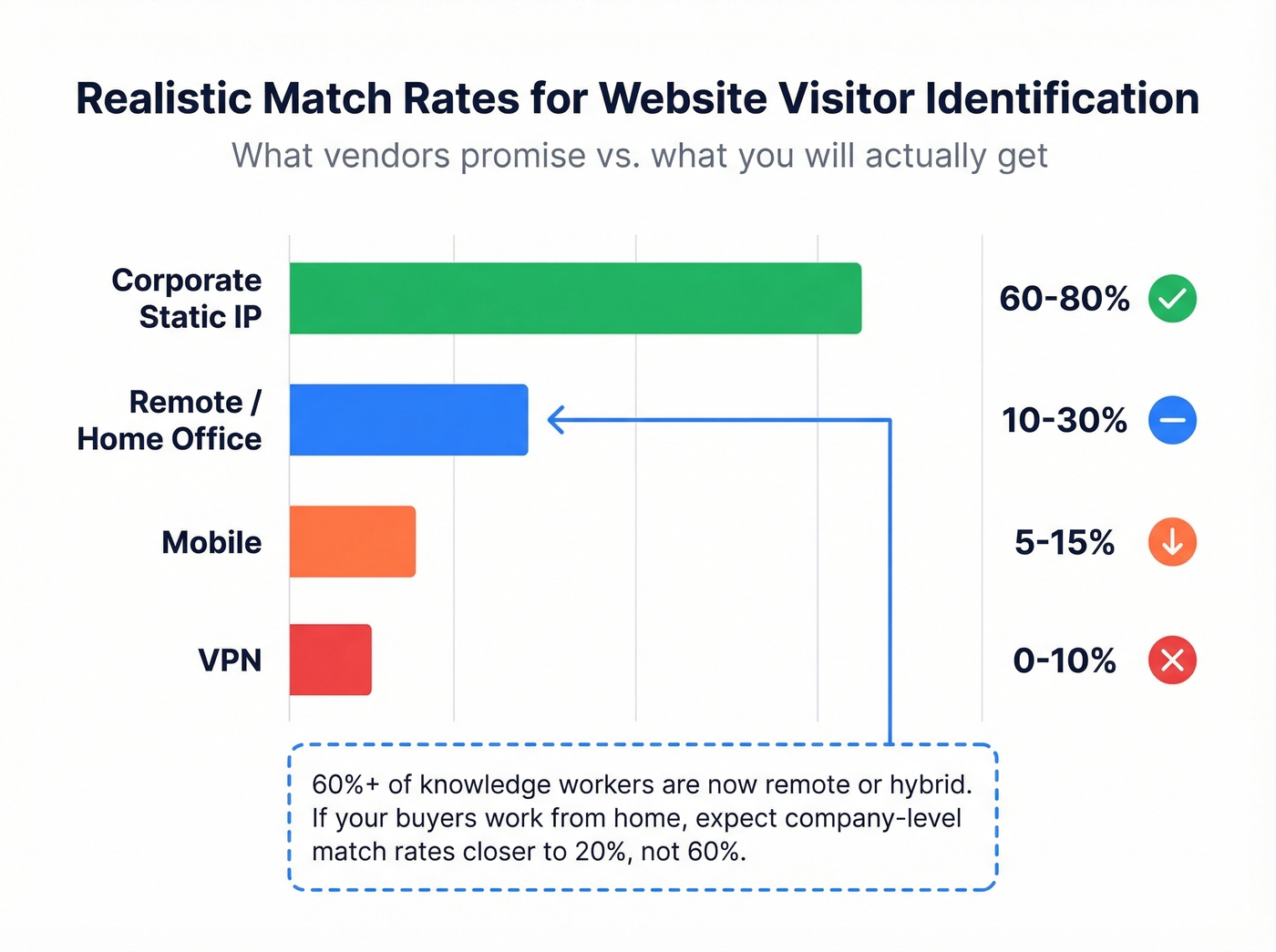
| Network Type | Match Rate |
|---|---|
| Corporate static IP | 60-80% |
| Remote / home office | 10-30% |
| Mobile | 5-15% |
| VPN | 0-10% |
With 60%+ of knowledge workers now remote or hybrid, that corporate IP sweet spot covers a shrinking slice of your traffic. If your buyers are engineering leaders working from home, your company-level match rate will land closer to 20% than 60%.
Person-level claims deserve extra scrutiny. A Customers.ai study found 2 of 3 providers tested were 70-95% inaccurate. We've seen similar results in our own testing - person-level tools consistently underperform their stated rates. On r/b2bmarketing, users visited their own sites and found the tool identified their employer via IP but not them as an individual. The "person-level" results were "likely contacts" - people matching the company and a job title pattern, not the actual visitor. That distinction matters enormously for outbound (especially if you're doing AI email personalization).
Even Lead Forensics, with 1,048 G2 reviews and a 4.4/5 rating, gets recurring complaints about outdated contacts and incorrect information.
Let's be honest: most teams don't need person-level visitor identification. They need company-level identification paired with a reliable contact database (see the tradeoffs in verified contact databases). The obsession with identifying the exact visitor is a distraction when you can identify the company and reach the right decision-maker in 30 seconds.
Tool Comparison for 2026
| Tool | Type | Starting Price | Best For |
|---|---|---|---|
| RB2B | Visitor ID | Free (150/mo); $79/mo+ | Contact-level profiles on a budget (US-focused) |
| Vector | Visitor ID | $399/mo (2,500 visitors) | Mid-market teams wanting named contacts |
| Factors.ai | Visitor ID | $99/mo | Budget company-level identification |
| Snitcher | Visitor ID | ~EUR39/mo | Cheapest company-level entry point |
| Leadfeeder | Visitor ID | ~$99/mo (free: 7 days) | European traffic |
| Warmly | Visitor ID + Orchestration | Free (500 IDs/mo); ~$700/mo | Teams wanting built-in chat + routing |
| 6sense | Enterprise ABM | Free (50 credits); $30k-$100k+/yr | Enterprise ABM with intent data |
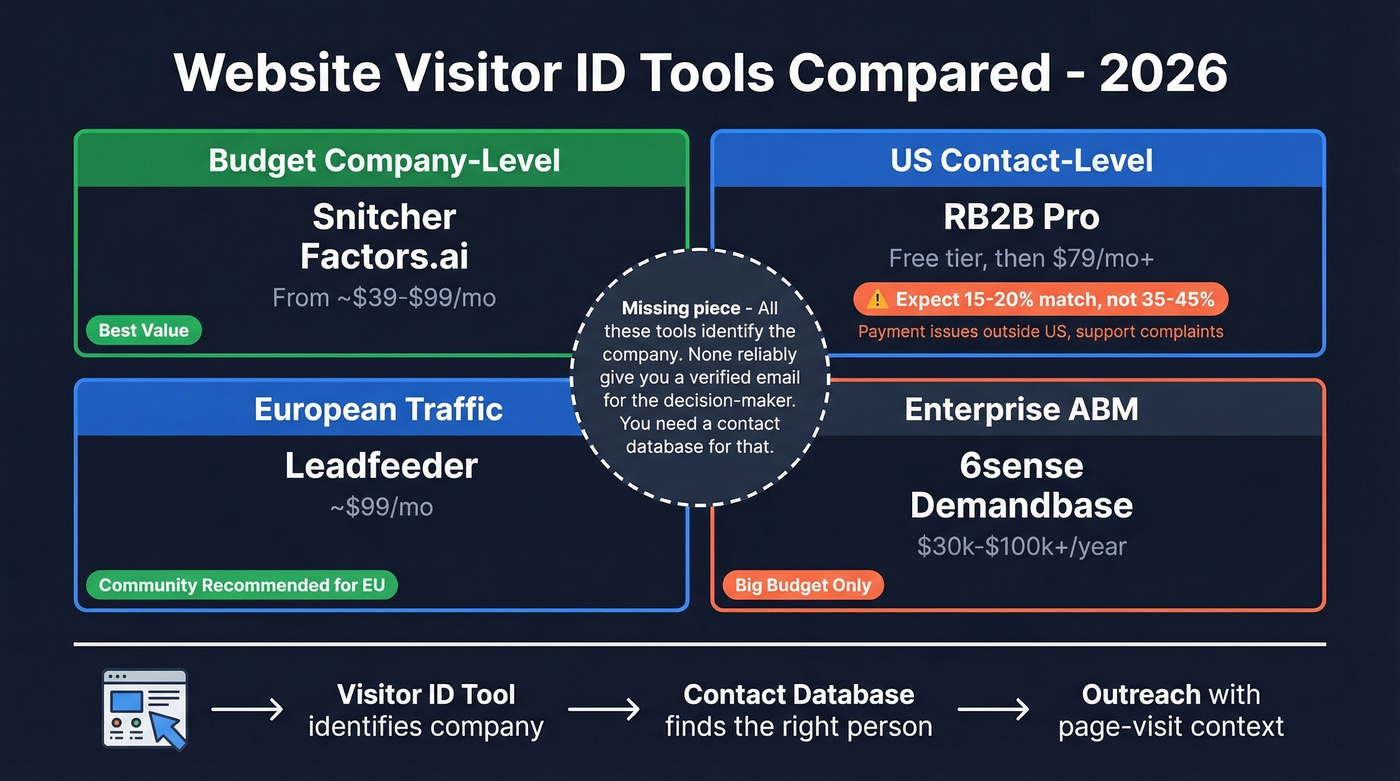
Budget pick: Snitcher or Factors.ai for company-level. US contact-level: RB2B Pro, but set expectations at 15-20% contact-level coverage, not the 35-45% their Pro+ tier claims. European traffic: Leadfeeder - the community consistently recommends it over US-focused tools. Enterprise ABM: 6sense or Demandbase at $30k-$100k+/year (and if you're building a stack, compare account based marketing tools).
A warning on RB2B: Reddit threads flag payment friction for non-US cards, and support is a common complaint. The community has also complained about free-tier changes, which frustrated the indie hacker crowd that initially championed it. If you're outside the US or need reliable support, skip it.
Compliance When You Deanonymize Web Traffic
Privacy isn't optional, and the rules shifted in January.
CCPA risk-assessment duties went live Jan 1, 2026. Automated decision-making technology requirements follow Jan 1, 2027. GDPR treats IP addresses as personal data. Any visitor identification on EU traffic requires consent or a legitimate interest basis - and "legitimate interest" is a higher bar than most vendors admit. RB2B handles this by ringfencing to US-only IP resolution, explicitly avoiding EU/UK traffic (but you still need a broader B2B compliance plan).
Geographic exclusion buys time, but it doesn't scale. If you're selling internationally, you need workflows that handle consent properly - not tools that sidestep the problem. The IAPP's tracker is worth bookmarking as more US states adopt their own frameworks.
Turning Identified Visitors Into Pipeline
I've watched this play out dozens of times: teams pay $400/month for visitor ID, then their reps spend 20 minutes per company Googling for contact info and guessing email formats. The identification was the easy part.
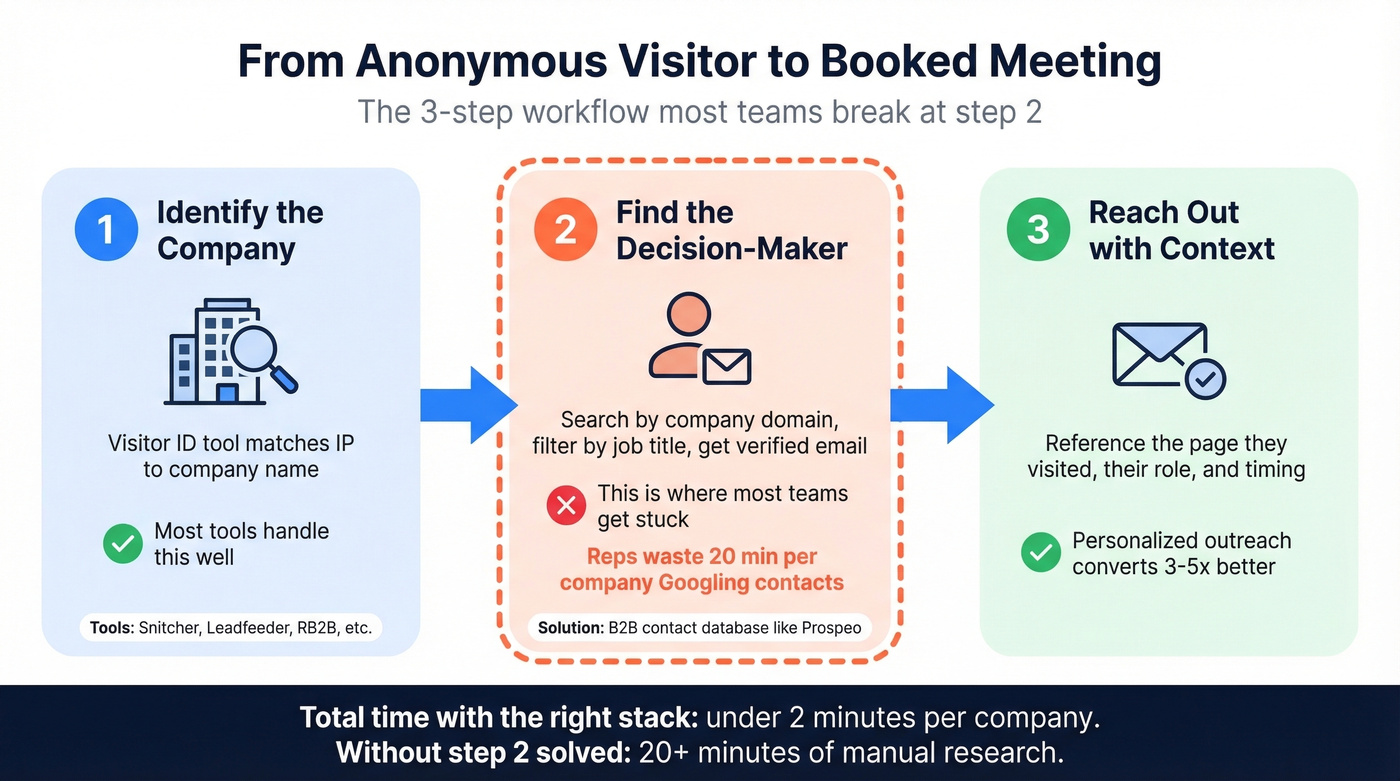
The goal is to convert anonymous visitors into booked meetings, and that takes three steps: identify the company, find the right decision-maker's verified contact, then reach out with page-visit context. Most visitor ID tools handle step one. They leave you stranded on step two (which is where data enrichment tools and company data enrichment workflows pay off).
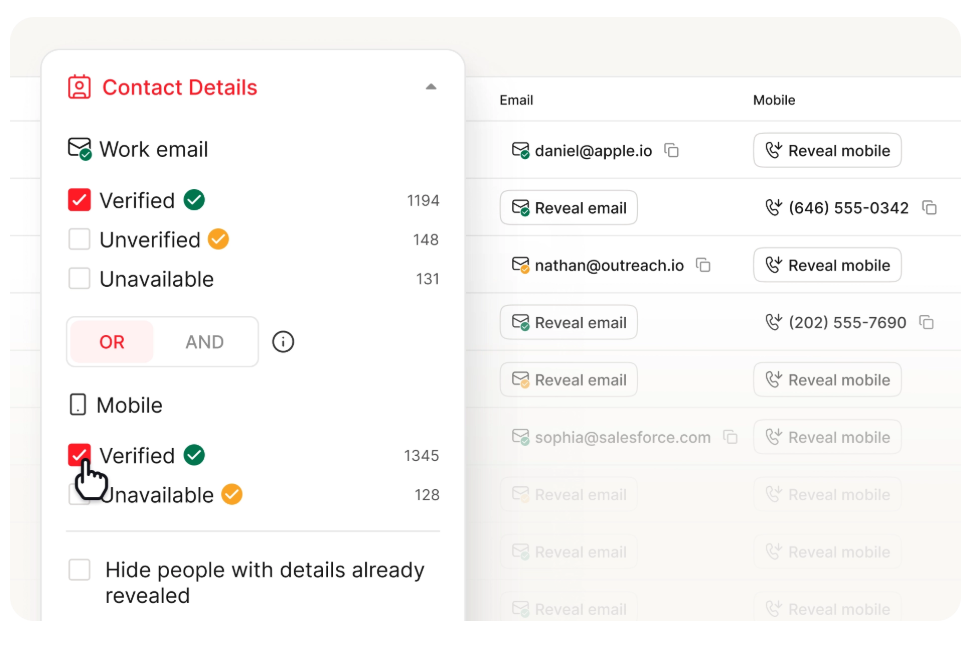
For teams running this workflow at scale, the enrichment API returns 50+ data points per contact at a 92% match rate, plugging directly into Salesforce, HubSpot, Clay, or Zapier. Pair that with intent data tracking 15,000 topics via Bombora, and you're not just reaching out to companies that visited - you're reaching the right person at the right moment (and you can automate sales signals end-to-end).
Most teams waste their visitor ID investment because they can't reach the decision-maker fast enough. Prospeo's 300M+ database with 30+ filters - including intent data and job changes - lets you go from company name to verified contact instantly. Data refreshes every 7 days, not 6 weeks.
Your visitor ID tool found the company. Now find the person who signs the check.
FAQ
Is it legal to deanonymize web traffic?
Company-level IP matching is broadly legal in the US and most jurisdictions. Person-level identification requires CCPA opt-out mechanisms and risk assessments as of 2026; under GDPR, IP addresses are personal data requiring consent. Always consult legal counsel before resolving traffic that includes EU visitors.
What's a realistic match rate for visitor identification?
Company-level tools match 30-65% of traffic; person-level tools realistically hit 5-20%. Your actual rate depends on traffic mix - remote workers and VPN users drop rates significantly. Plan outreach workflows around the expectation that identified visitors will always be a fraction of total sessions.
How do I contact someone after identifying their company?
Use a B2B data tool like Prospeo to find verified emails for decision-makers at the identified company. Paste the domain, filter by job title, and get 98%-accurate contacts in seconds. Visitor ID tells you who visited - contact data gets you to the right person.
Can I identify anonymous visitors on mobile or VPN?
Mobile match rates sit at 5-15%, and VPN traffic drops to 0-10%. Most tools claiming resolution from these sources rely on probabilistic matching, which introduces significant accuracy risk. For these segments, retargeting ads or gated content often outperform direct identification.