

Dedicated Sales Team: When to Build One, Who to Hire First, and What It Actually Costs
You're the founder, and sales is eating 15 hours of your week. Calls between product meetings, follow-ups at midnight, proposals squeezed into Sunday mornings. Building a dedicated sales team is the right move - but only if the timing is right.
The real question isn't "do I need help?" It's whether you have a capacity problem or a conversion problem. That distinction changes everything.
Document how your last five deals closed, confirm you're closing above 20%, then hire your first rep with enough pipeline coverage (3-4x) to justify the seat. If you can't explain how deals close today, a new hire won't fix that - they'll burn runway faster.
What "Dedicated Sales Team" Actually Means
A dedicated sales team means people whose only job is revenue. Not the founder squeezing discovery calls between sprint planning. Not marketing "helping with leads" when they have time.
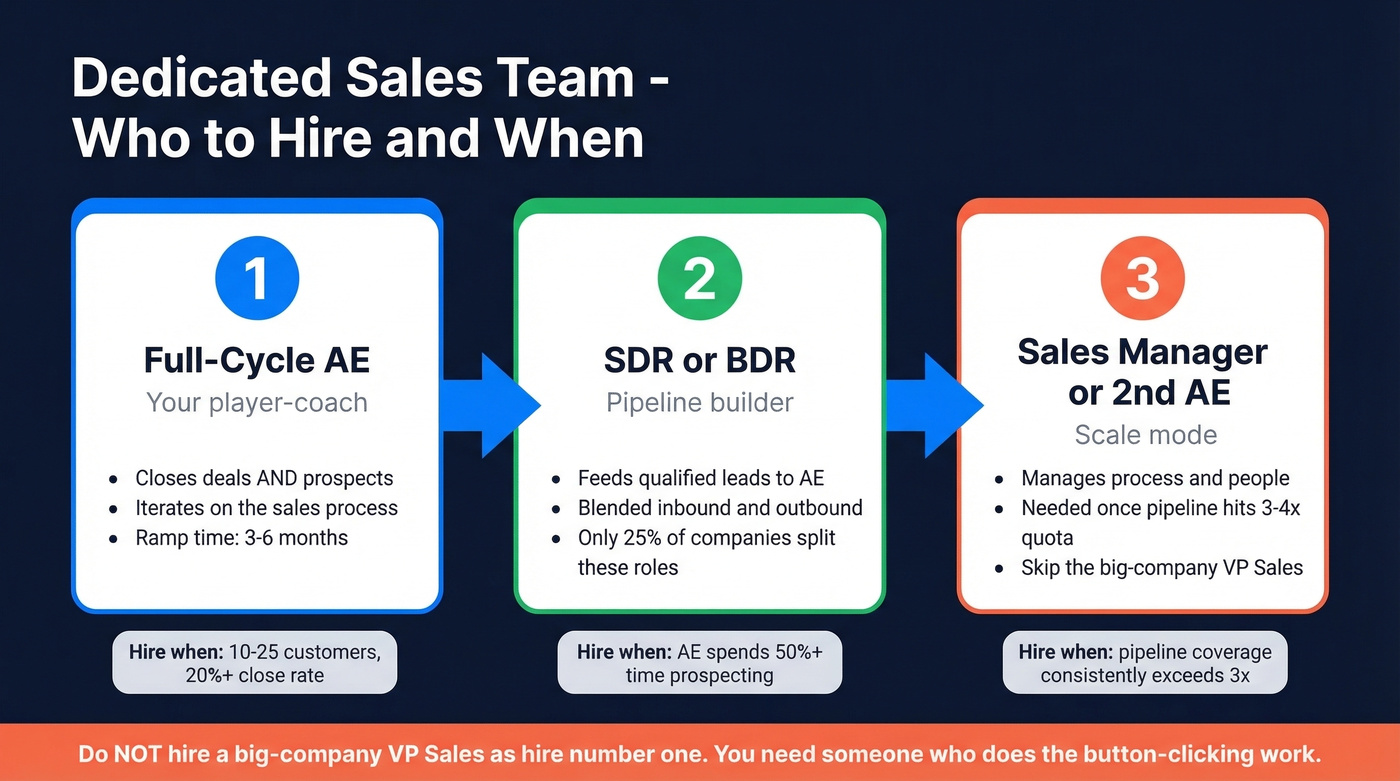
Think of it as a relay race. Eventually you'll have SDRs handing qualified leads to AEs, who hand closed deals to Account Managers. But most companies don't need a department on day one. They need one person - a dedicated revenue owner - before they need a team.
The Readiness Test
Most founders hire because they're tired, not because the business is ready. Here's a pass/fail framework we've used to pressure-test that decision:
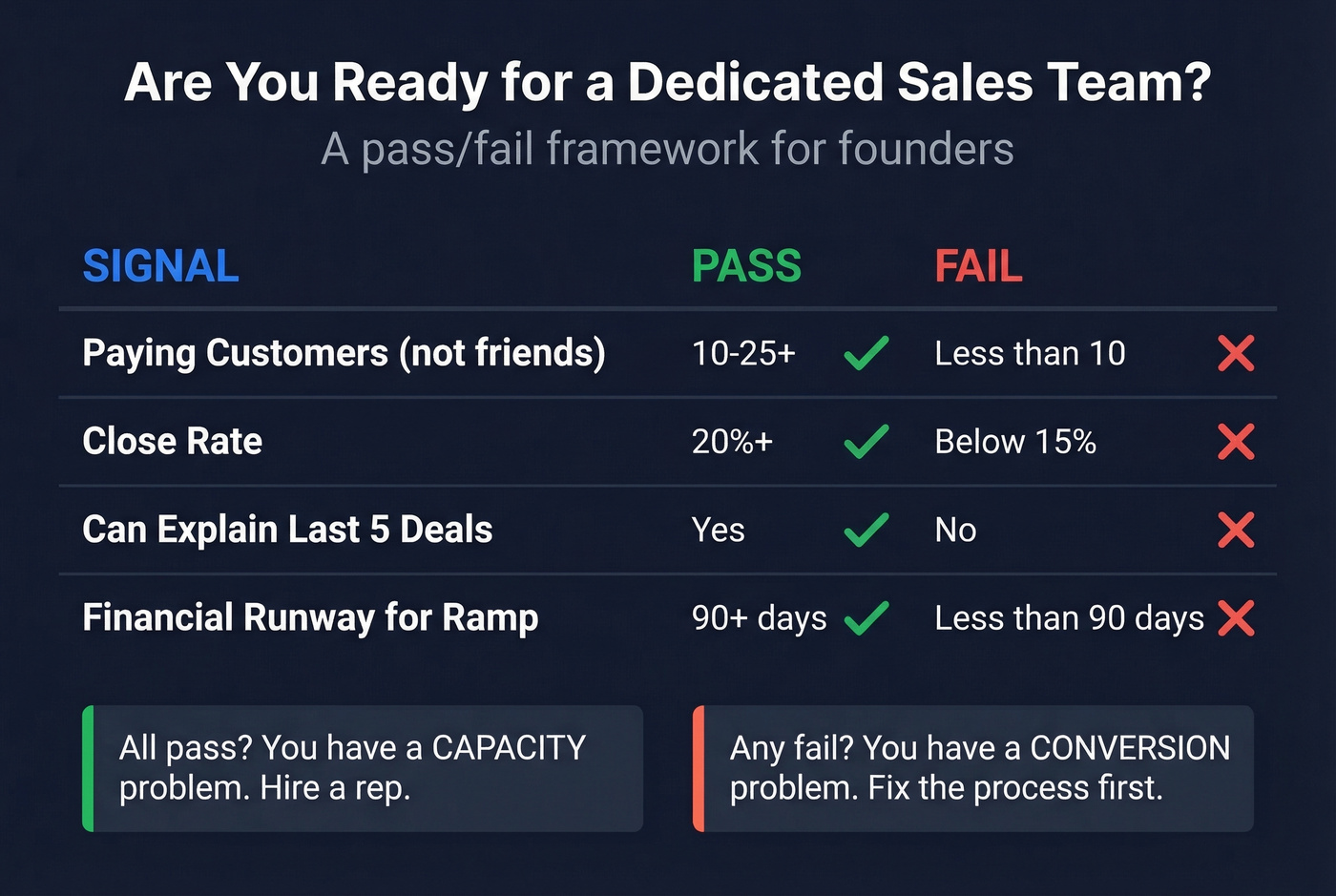
| Signal | Pass | Fail |
|---|---|---|
| Paying customers (not friends) | 10-25+ | <10 |
| Close rate | 20%+ | <15% |
| Can explain last 5 deals | Yes | No |
| Financial runway for ramp | 90+ days | <90 days |
A close rate above 20% means you have a capacity problem - you've proven the motion works, and you just need more hands. Below 15%? That's a conversion problem. Hiring a rep to run a broken process is the most expensive mistake in early-stage sales.
The 10-25 customer threshold matters because it proves demand exists outside your personal network. As dbt Labs' Becca Lindquist puts it, "10 customers who are all your best friends doesn't count." Figma didn't make their first sales hire until $2M in ARR. That's not a rule, but it's a signal: wait until the process is real before you ask someone else to run it.
Hiring simultaneously tests the rep, the process, and the market. If all three are unproven, you'll never know which one failed.
Who to Hire First
The hire order matters more than most founders realize:
- Full-cycle AE who can also prospect. This is your player-coach - someone close enough to the work to iterate on the process while closing deals.
- SDR/BDR to feed the closer pipeline. Only ~25% of companies actually split inbound and outbound into separate roles. Most early teams use a blended SDR.
- Sales manager or second AE once pipeline coverage consistently hits 3-4x quota.
Don't hire a big-company VP Sales for role number one. As Dock founder Alex Kracov puts it, you need someone close enough to the "button-clicking work" - not someone who built their career managing teams and running QBRs. Plan for 3+ months of ramp and an average SDR tenure of about 1.5 years. Build onboarding that accounts for both realities - use a simple 30-60-90 day plan so expectations are explicit.
Qualification frameworks like BANT or MEDDIC help, but keep them lightweight until you've got enough deal volume to justify the overhead.

Your new rep's ramp time depends on data quality. GreyScout cut ramp from 8-10 weeks to 4 and dropped bounce rates from 38% to under 4% with Prospeo's 98% verified emails. Don't burn your first hire's runway on bad contact data.
Give your dedicated sales team data that actually connects.
KPIs That Prove It's Working
Track these six numbers once your first rep is ramped. They'll tell you whether the hire is working or burning cash:
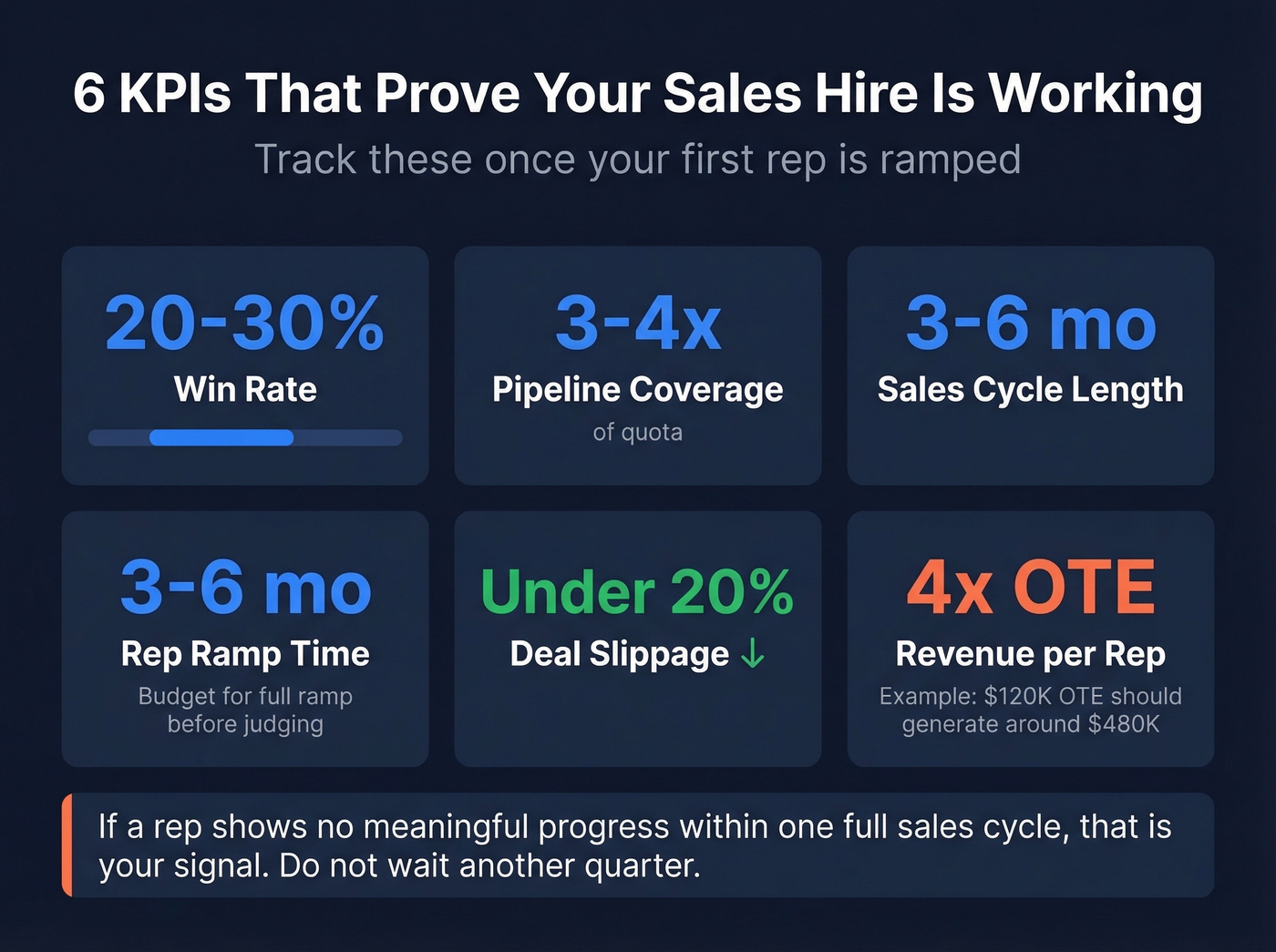
| KPI | Benchmark |
|---|---|
| Win rate | 20-30% |
| Pipeline coverage | 3-4x quota |
| Sales cycle | 3-6 months |
| Rep ramp time | 3-6 months |
| Deal slippage | <20% |
| Revenue per rep | ~4x OTE |
That last line comes from SaaStr: once ramped, a rep should close roughly 4x their OTE. A $120K OTE rep should eventually generate ~$480K. If a rep isn't showing meaningful progress within one full sales cycle, that's your signal. Don't wait another quarter hoping things turn around.
Compensation Basics
Comp plans should be boring. Complexity is a tax on execution.
The SaaS default is a 10% commission rate with a 50/50 base-variable split. A $120K OTE means $60K base and $60K variable, typically against a $600K annual quota using a 5x quota-to-OTE ratio. That math is clean and easy for reps to understand - which is the point.
One number to keep in mind: ~35% average turnover across sales roles. If your comp plan is confusing, below market, or both, you'll hit that number fast. If you need to sanity-check the math, start with a clear definition of OTE.
What It Actually Costs
Here's the honest math for building versus buying a sales function.
| Factor | In-House (2-3 people) | Outsourced |
|---|---|---|
| Annual cost | EUR 150K-300K | EUR 3K-15K/month |
| Time to productivity | 3-6 months | 2-3 weeks |
| Control | Full | Partial |
| Year-1 attrition risk | 20-30% | Provider's problem |
In-house costs stack up fast: salaries plus 25-30% for benefits, EUR 10K-20K per hire in recruiting fees, EUR 5K-15K in training, and EUR 3K-8K/year in tools. Core tool categories include CRM like HubSpot or Salesforce, outreach automation, and lead intelligence - prioritize data quality over feature count. (If you're still deciding, here are examples of a CRM and a deeper breakdown of Salesforce pricing.)
We've seen founders burn through two hires before realizing the tools budget was the problem, not the rep. Here's the thing: the highest-leverage line item is data quality. A rep with bad contact data is an expensive way to learn your list is wrong. GreyScout saw this play out firsthand - after switching to Prospeo for verified emails, their bounce rate dropped from 38% to under 4%, and they cut rep ramp time from 8-10 weeks down to 4. If you're building lists at scale, pair verification with data enrichment so reps aren't selling blind.
Modern outsourcing spans pipeline operations like qualification and nurture, full-funnel sales pods handling outreach through demo prep, and RevOps/data outsourcing covering CRM governance and reporting. 80% of executives plan to maintain or increase outsourcing investment in 2026. If you're formalizing this function, it helps to understand what a RevOps Manager actually owns.
If your average deal size is under $10K, you probably don't need a full in-house team in year one. An outsourced pod plus clean data will get you further, faster, and cheaper than a premature hire.
Mistakes That Kill Early Teams
Hiring to fix a broken process. If your close rate is below 15%, the problem isn't headcount. Fix the motion first - start by tightening your sales process.
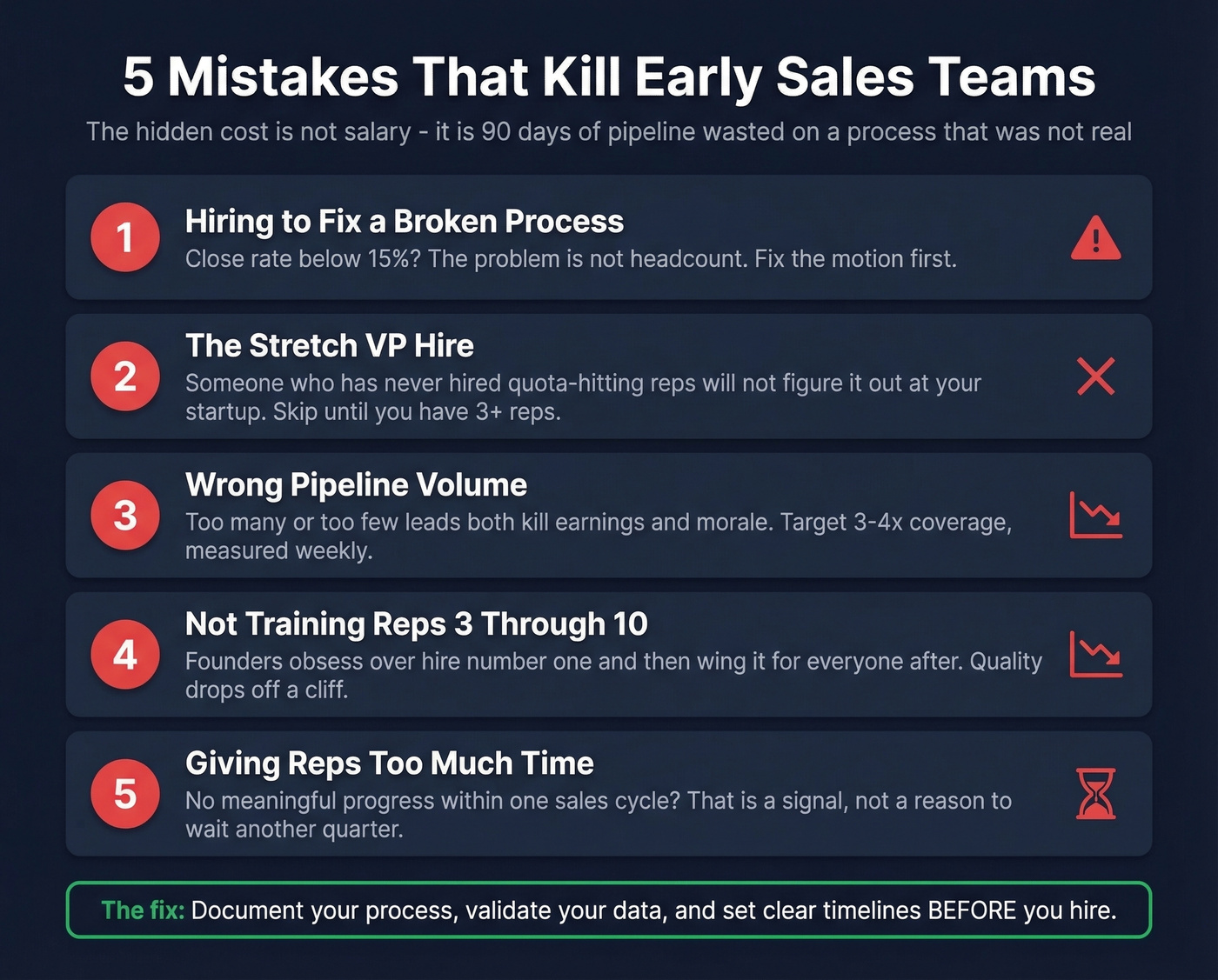
The stretch VP. Someone who's never hired quota-hitting reps won't magically figure it out at your startup. As Branch co-founder Mike Molinet warns, you're testing too many variables at once. Skip this hire until you've got 3+ reps who need managing.
Wrong pipeline volume. Too many or too few leads per rep both kill earnings and morale. Pipeline coverage of 3-4x is the target - measure it weekly, not monthly.
Not training reps 3-10. Founders obsess over the first hire's onboarding and then wing it for everyone after. That's when quality drops off a cliff. Build a repeatable system with lightweight sales training tips before headcount grows.
Giving reps too much time. In our experience, if there's no meaningful progress within one sales cycle, that's a signal - not a reason to wait another quarter.
The hidden cost isn't salary. It's 90 days of pipeline wasted because the process wasn't real.
Building a dedicated sales team at $0.01/email instead of $1/lead means your tool budget stops competing with headcount. 300M+ profiles, 125M+ verified mobiles, and a 7-day refresh cycle so your reps never prospect with stale data.
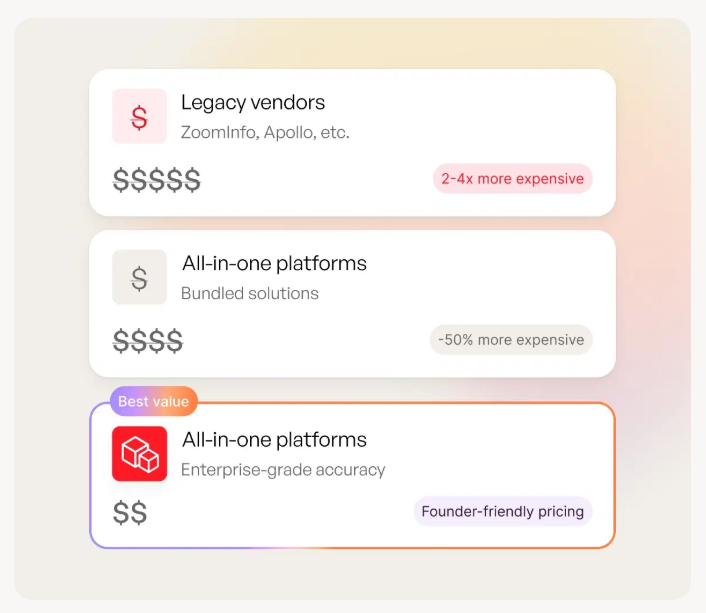
Stop paying enterprise prices before you have an enterprise team.
FAQ
Does a dedicated sales team mean more than one person?
No. You're a "team" the moment sales has a dedicated owner - even a single full-cycle AE. The department comes later, once pipeline coverage consistently exceeds 3x quota and your closer spends more time prospecting than selling.
When should I add an SDR?
Add an SDR when your AE spends over 50% of their time prospecting instead of closing. If pipeline coverage drops below 3x quota, that's the clearest signal - a dedicated SDR feeding the top of funnel typically restores coverage within 60-90 days.
What's the most common reason a first sales hire fails?
Bad inputs - either an unproven sales process or unreliable contact data. Fix both before expecting results. We've found that eliminating the data variable first makes it much easier to isolate whether the real issue is process, messaging, or market fit.
Should I outsource sales instead of hiring?
Consider outsourcing if you need pipeline in under a month or lack budget for EUR 150K+/year in-house. Outsourced pods can launch in 2-3 weeks versus 3-6 months for an internal hire - ideal for companies with deal sizes under $15K testing new markets. Let's be honest though: you lose control of the narrative. If brand voice matters to your buyers, keep at least one rep in-house from the start.