

Demand Creation: The 2026 Playbook for B2B Pipeline Growth
Your pipeline is down 30% this quarter, and the knee-jerk reaction is to crank up Google Ads spend. That's not a strategy - it's a confession that you don't have one. The real problem for most B2B teams isn't capturing demand. It's that there isn't enough demand to capture.
Demand creation solves that upstream problem.
The Short Version
If your response to shrinking pipeline is more ad spend, you've got a creation problem, not a capture problem. Building new interest among the 95% of your market that isn't buying today is the work that makes downstream conversion possible. Capturing the 5% already shopping matters - but most teams pour budget into capture and wonder why the well runs dry.
Three things to start with: a content engine that establishes a genuine point of view, an intent data layer to spot accounts entering the buying window, and a verified prospect database so your outbound team doesn't waste the moment with bounced emails and dead phone numbers.
What Is Demand Creation?
The definition is straightforward: it's the practice of building new interest in a problem, a category, or a solution among people who aren't actively looking to buy.
The confusion starts because "demand generation" gets used as a catch-all. SevenAtoms breaks it down cleanly: demand generation is the umbrella, with two components underneath - creation, which sparks new interest, and capture, which converts existing interest into pipeline and revenue.
Think about HubSpot coining the term "inbound marketing." Before that phrase existed, nobody was searching for it. HubSpot didn't capture existing interest in inbound - they created an entirely new category, then built the dominant product to serve it. Drift did the same with "conversational marketing." That's the concept at its most powerful: reframing how an entire market thinks about a problem so your solution becomes the obvious answer.
This motion targets the vast majority of your total addressable market - the people who don't know they have a problem, or know they have one but aren't shopping for a fix yet. It's the difference between running a Google Ads campaign for "best CRM software" and publishing a research report that reframes how mid-market CFOs think about revenue leakage.
Here's the thing: creation and capture aren't always sequential. You can capture interest you didn't generate - a competitor's marketing does the awareness work for you. And interest you spark today won't convert for 12 months. The two motions run in parallel, not in a neat handoff.
Creation vs. Capture vs. Generation
Let's put the three concepts side by side so the distinctions stick.
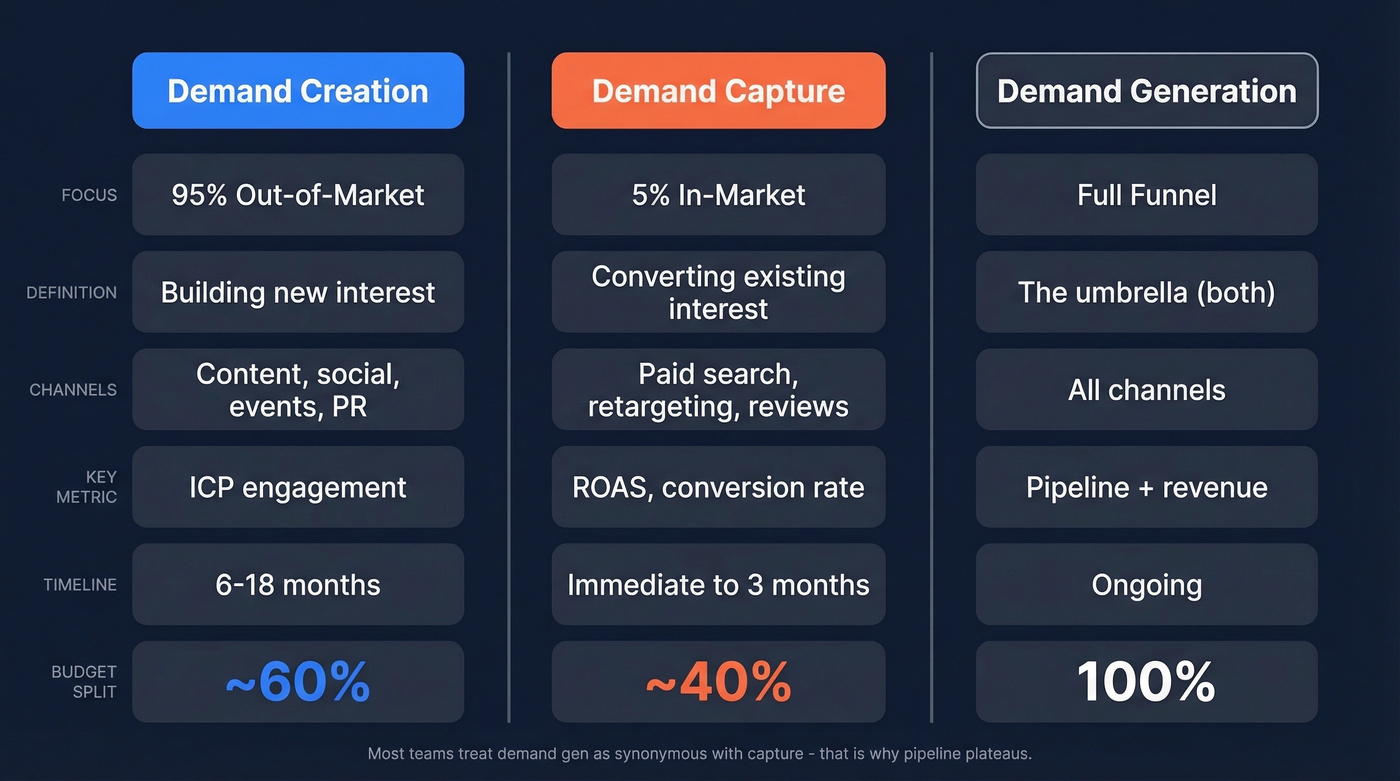
| Dimension | Demand Creation | Demand Capture | Demand Generation |
|---|---|---|---|
| Definition | Building new interest | Converting existing interest | The umbrella (both) |
| Focus | 95% out-of-market | 5% in-market | Full funnel |
| Channels | Content, social, events, PR | Paid search, retargeting, reviews | All |
| Primary metric | ICP engagement | ROAS, conversion rate | Pipeline + revenue |
| Timeline | 6-18 months | Immediate-3 months | Ongoing |
| Budget split | ~60% | ~40% | 100% |
The mistake most teams make is treating demand generation as synonymous with capture. They run paid search, retarget website visitors, sponsor G2 comparison pages - all capture tactics - and call it "demand gen." Then they're surprised when the pipeline plateaus because they've exhausted the small pool of active buyers.
Why It Matters More Than Ever
The math is brutal. Professor John Dawes at the Ehrenberg-Bass Institute introduced the 95/5 rule, and the LinkedIn B2B Institute later popularized it: roughly 95% of B2B buyers are out-of-market at any given time. Only about 5% are actively looking to buy.
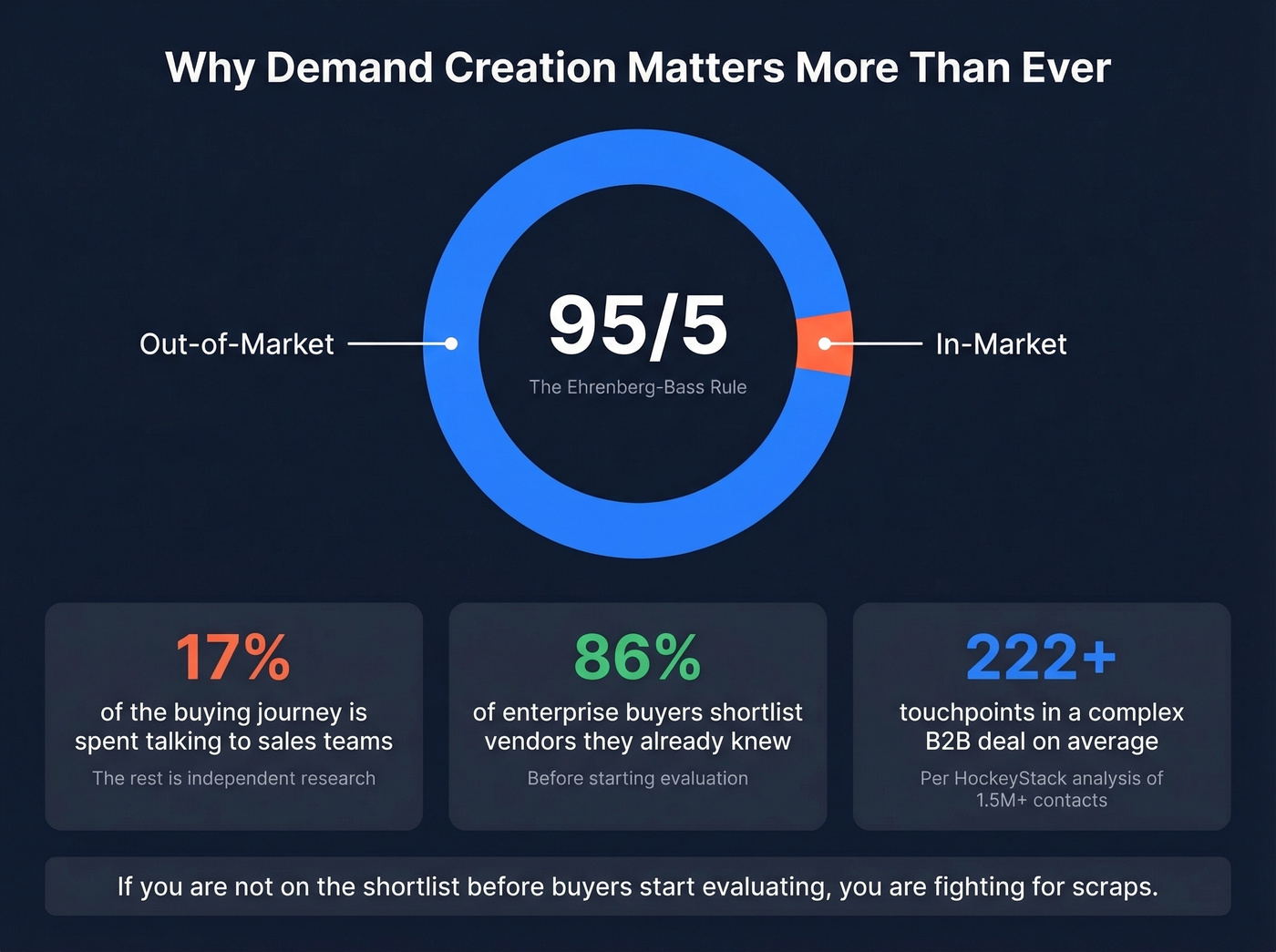
Here's how to calculate your own in-market percentage: divide your average decision window by the inter-purchase period, then multiply by 100. A product with a 48-month replacement cycle and a 3-month decision window? That's 6.25% in-market at any moment. The other 93.75% genuinely don't need what you sell right now.
Three more data points make the case for capture-only strategies even worse:
- B2B buyers spend only 17% of the buying journey interacting with supplier sales teams. The rest is independent research.
- 86% of enterprise buyers shortlist vendors they'd already heard of before starting their evaluation.
- Complex B2B deals now involve 222+ touchpoints on average, per HockeyStack's analysis of 1.5M+ contacts.
The results speak for themselves when teams commit. One B2B company saw a 150% increase in lead generation year-over-year after shifting to a creation-first strategy, with 1,500% ROI on their SEO investment. Another reported 300% ROI on events designed around thought leadership rather than product demos. These aren't outliers - they're what happens when you stop fighting over the 5% and start building relationships with the 95%.
If you're not in the buyer's mental shortlist before they start evaluating, you're fighting for scraps.
Diagnose Your Problem First
Before you build a program, figure out which problem you actually have. Rand Fishkin frames the diagnostic well:
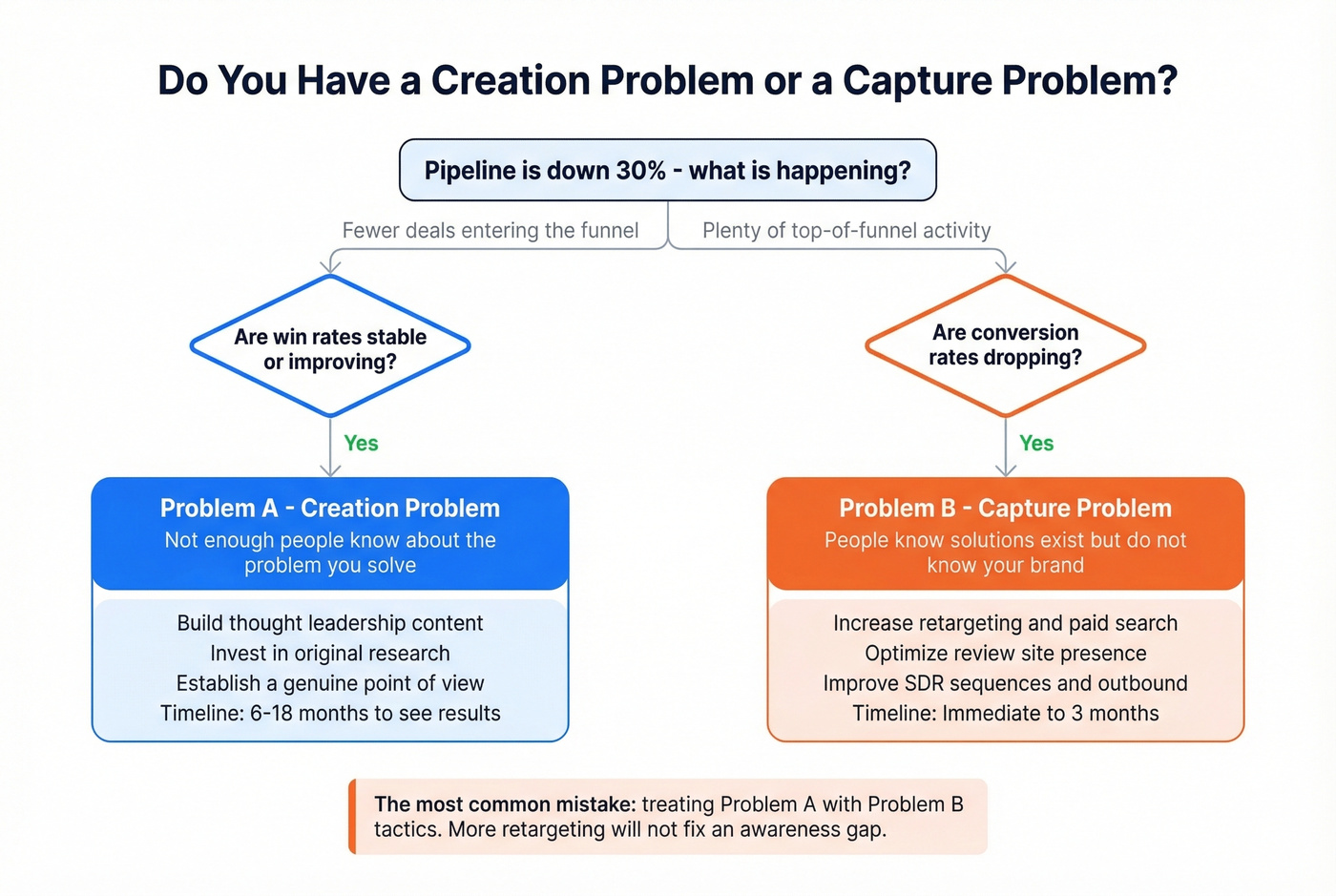
Problem A: Not enough people know about the problem your product solves. They're not searching, not comparing, not evaluating - because they don't realize there's a better way. This is a creation problem.
Problem B: People know the problem exists and solutions are available, but they don't know about your brand specifically. They're buying from competitors because you're invisible during the evaluation window. This is a conversion problem.
In our experience, teams that skip this diagnostic step waste 3-6 months running the wrong playbook. Picture the scenario: your CEO asks why pipeline is down 30%. If your team's instinct is to increase retargeting spend and add more SDR sequences, you're treating it as Problem B. But if your win rates are fine and the issue is that fewer deals are entering the funnel, you almost certainly have Problem A. The fix isn't more ads - it's more awareness.

You just diagnosed whether you have a creation or capture problem. Either way, when those 95% of out-of-market buyers finally enter the window, your outbound team needs verified contact data - not stale records that bounce. Prospeo's 7-day refresh cycle and 98% email accuracy mean you convert awareness into pipeline, not spam folders.
Stop building demand you can't convert. Get the data layer right.
How to Budget for It
A reasonable starting point: allocate 8-12% of ARR to total demand generation, then split that roughly 60/40 favoring creation over capture. Pre-product-market-fit companies should lean harder - 80/20 toward creation - because nobody knows who you are yet. Enterprise companies with established brands can run closer to 50/50.
If you need a quick way to size the market before you set targets, start with your TAM, SAM, SOM and work backward from there.
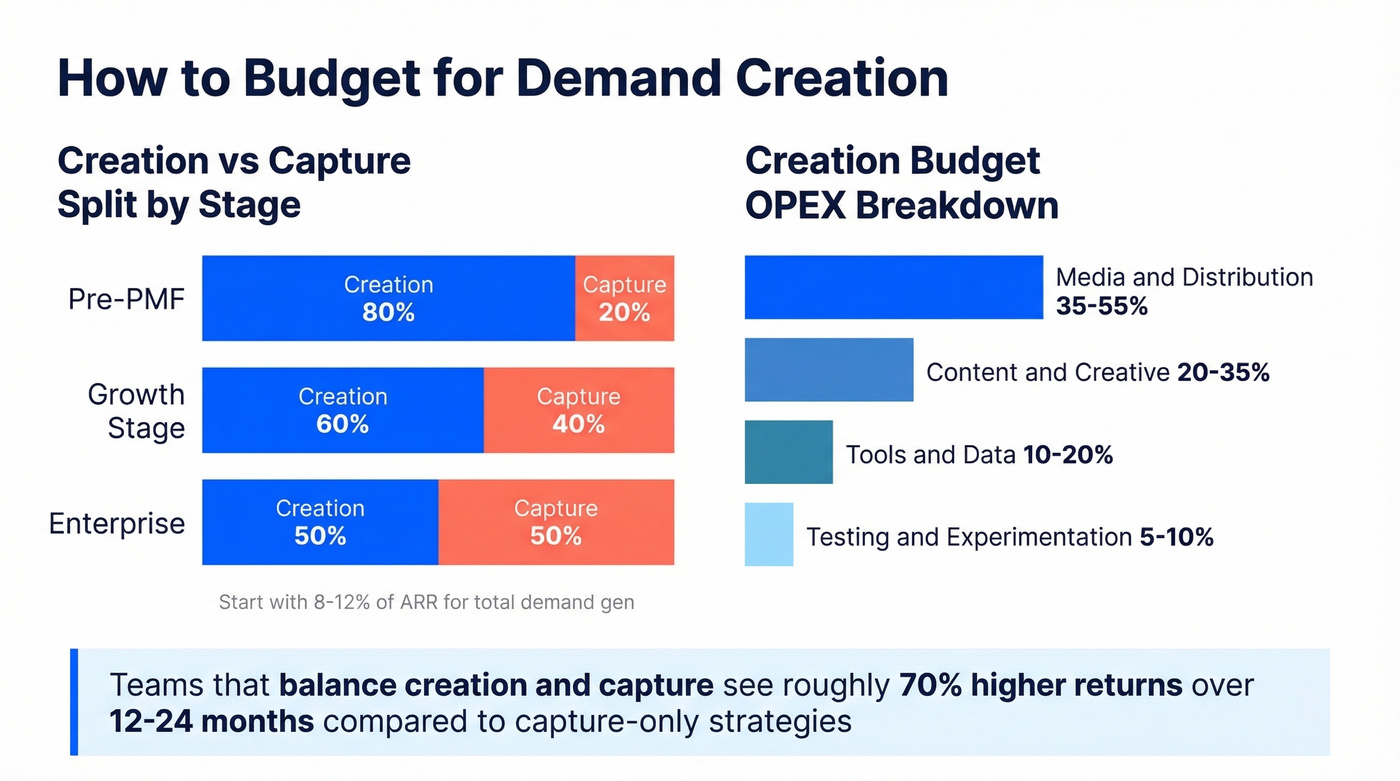
Within the creation budget, here's a practical OPEX breakdown:
- Media and distribution: 35-55%
- Content and creative: 20-35%
- Tools and data: 10-20%
- Testing and experimentation: 5-10%
The budgeting model that actually works is revenue-back, not top-down. Start with your revenue target, calculate the pipeline needed based on your win rate, determine marketing's sourced share, then work backward through conversion rates to arrive at the budget. This gives you a defensible number for the CFO instead of "we need more brand spend."
Per UnboundB2B's analysis, companies that balance creation and capture see roughly 70% higher returns over a 12-24 month period compared to teams that go all-in on capture. The payoff isn't immediate - that's the whole point. You're investing in future pipeline, not this quarter's pipeline.
Hot take: If your average deal size is under $10K, you probably don't need a sophisticated creation program at all. A strong SEO play and a decent product-led growth motion will capture enough existing interest to grow. Building new category awareness becomes essential when you're selling complex, high-ACV deals where buyers form shortlists long before they talk to sales.
The Strategy Funnel
This isn't about creating content. It's about creating a point of view that reframes how your market thinks about a problem. If your content doesn't challenge assumptions, it's not sparking new interest - it's filling a blog.
If you're still defining who you're building for, use an ideal customer profile scoring rubric before you scale distribution.
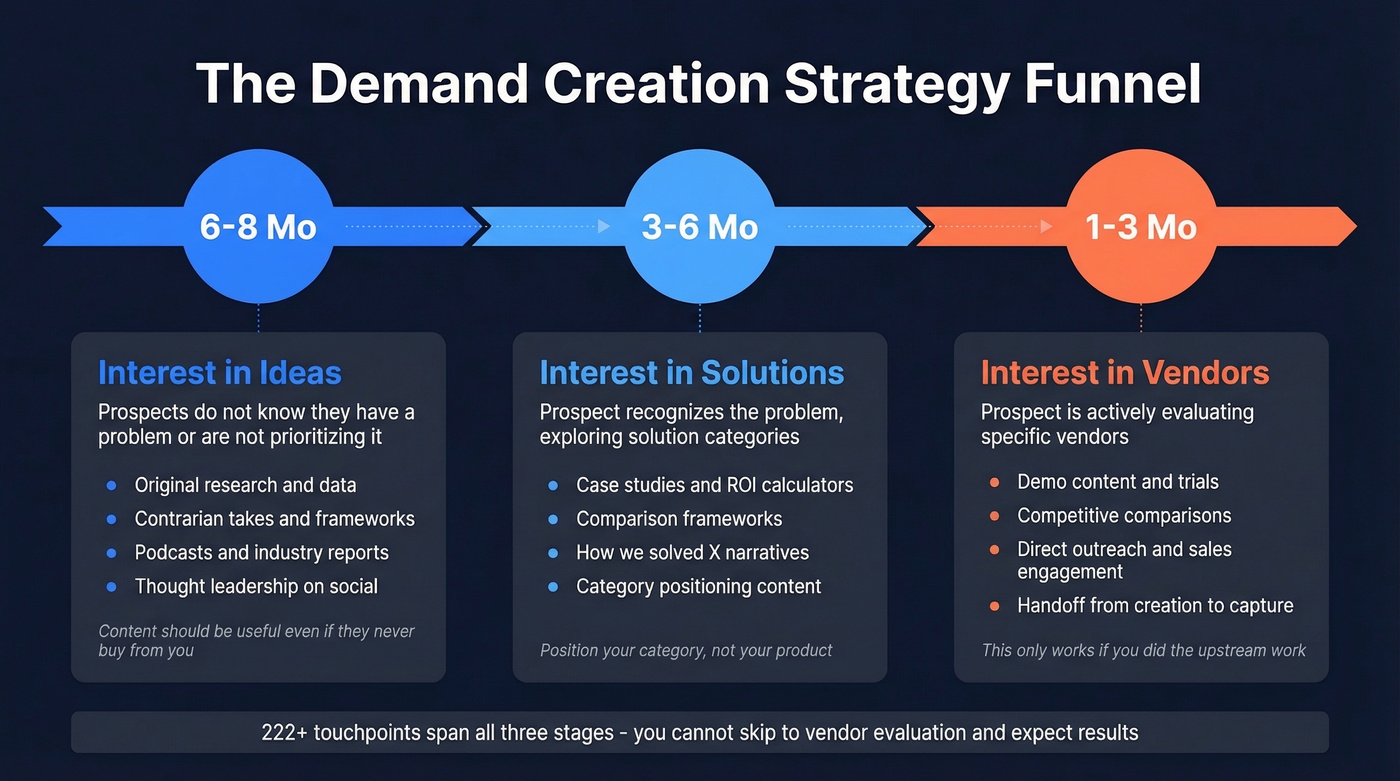
A complete demand creation strategy maps execution to three stages of buyer readiness.
6-8 Months Out: Interest in Ideas
Prospects don't know they have a problem - or they know but aren't prioritizing it. Your job is to create intellectual curiosity through original research, contrarian takes, and frameworks that make people rethink their current approach. Podcasts, industry reports, and thought leadership on social all live here. The content should be genuinely useful even if the reader never buys from you.
3-6 Months Out: Interest in Solutions
The prospect recognizes the problem and is exploring categories of solutions - not evaluating vendors yet. Case studies, comparison frameworks, ROI calculators, and "how we solved X" narratives work here. You're positioning your category, not your product.
1-3 Months Out: Interest in Vendors
Now the prospect is actively evaluating. This is where creation hands off to capture - but only if you did the upstream work. Demo content, competitive comparisons, and direct outreach belong here. The 222+ touchpoints HockeyStack measured span all three stages. You can't skip to vendor evaluation and expect results.
Channels and the Data Quality Gap
The channel mix for demand creation marketing is broad: content and SEO, organic social, events, community participation, PR, podcasts, and strategic outbound. No single channel carries the load. The compounding effect comes from showing up consistently across multiple surfaces until you've built enough mental availability that prospects remember you when the buying window opens.
If you're building outbound into the mix, treat it like a system: sales prospecting techniques matter less than consistency and targeting.
Here's where most programs break down in practice. Your SDR team sends 500 cold emails a day with a 0.3% reply rate. The instinct is to blame the copy, the subject lines, the send times. But the real problem is that nobody on the receiving end has ever heard of you. Cold outbound without upstream awareness is what one Reddit practitioner called "boiling the ocean to catch a few fish." A smarter play from that same thread: identify companies already spending on paid ads in your category, then position your outbound around improving their conversion rates. That's awareness-building informing outbound targeting - not replacing it.
If your reply rates are low, fix the basics first: your cold email sequence, your list quality, and your deliverability.
Even when your awareness efforts work - when accounts start showing intent signals and entering the buying window - execution falls apart if your data is bad. We've seen teams invest heavily in upstream campaigns, generate real intent signals, then watch their outbound sequences bounce at 30%+ because the contact data was stale. Snyk's team saw their bounce rate drop from 35-40% to under 5% after switching to Prospeo, with AE-sourced pipeline up 180%. The awareness work only pays off if you can actually reach the people it warmed up.
If you're seeing bounces, benchmark against a normal email bounce rate and audit your verification workflow.
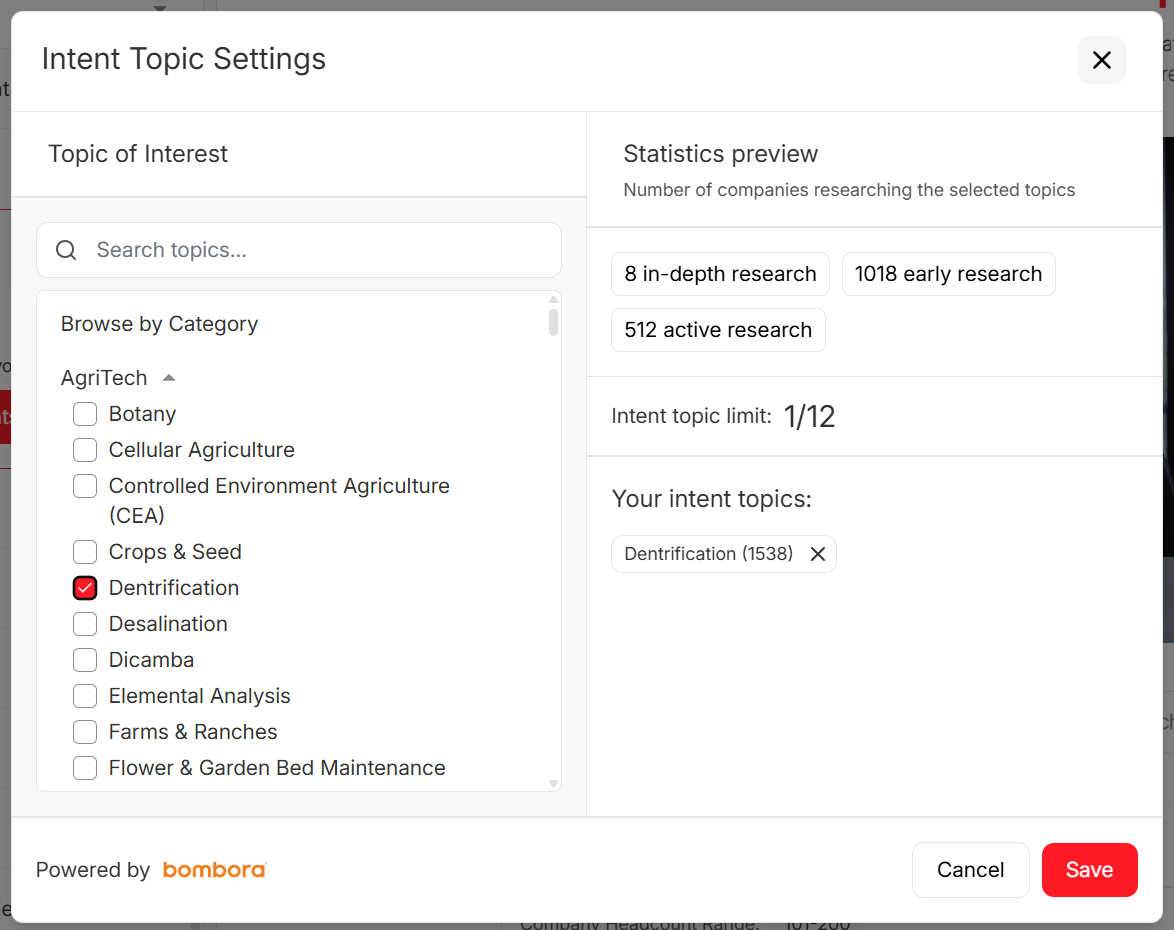
Intent data tells you which accounts are entering the buying window. Prospeo tracks 15,000 Bombora topics and layers those signals with 30+ filters - job changes, headcount growth, technographics, funding - so your team reaches the right buyer the moment they shift from the 95% to the 5%.
Spot in-market accounts before your competitors do. 75 free emails to start.
How to Measure Results
Every quarter, your CFO asks what marketing generated, and you scramble to attribute pipeline to awareness campaigns that influenced deals 9 months ago. I've watched marketing teams get their programs killed because they tried to show ROI after one quarter. Don't make that mistake.
Use a tiered measurement system that matches your program's maturity.
Tier 3 - Early Traction (Months 1-3)
Look for leading indicators: ICP engagement rates, follower growth among target accounts, ICP-specific website traffic, and qualitative signals like DMs, comments, and mentions. These aren't vanity metrics if you're tracking them against your ideal customer profile rather than total audience.
Tier 2 - Pipeline Indicators (After One Sales Cycle)
Measure pipeline quality, not just volume. The metric that matters is what some practitioners call HIRO Pipeline - deals in stages that historically close at 25%+ rates. Raw pipeline volume is misleading if it's stuffed with unqualified opportunities.
If you want a cleaner view of whether you're actually improving, track pipeline health alongside stage conversion.
Tier 1 - Revenue Attribution (1.5-2x Sales Cycle)
For a 6-month cycle, that's 9-12 months before you can credibly tie spend to revenue. Trying to measure ROI before that point will make the program look like a failure and get it killed.
Attribution is structurally incomplete. A prospect watches your video on social, later does a branded search, clicks an organic result, and SEO gets the credit. The first touch is invisible to your attribution model. One frustrated marketer on r/marketing put it well: "We're measuring demand creation with demand capture metrics and then wondering why it looks like it doesn't work." Aligning your GTM metrics around sales velocity components - ACV, win rate, cycle length, pipeline generated - gives you a more honest picture than last-touch attribution ever will.
7 Mistakes That Kill Your Program
1. No unified strategy. Random campaigns don't compound. Build a roadmap with quarterly themes tied to your ICP's pain points. The fix: one strategy doc that marketing and sales both sign off on.
2. Wrong audience targeting. Awareness efforts aimed at the wrong ICP is expensive noise. Validate your ICP with closed-won data before scaling content production.
3. Over-reliance on paid ads. Paid gets you reach, but it doesn't build trust. B2B CPL can exceed $100 in competitive categories, with diminishing returns. Cap paid at 40% of your creation budget and invest the rest in owned channels.
4. Brand-centric content. Nobody cares about your product's features at the awareness stage. Lead with the buyer's problem, not your solution. If your blog reads like a product brochure, it's not sparking new interest.
5. Sales and marketing misalignment. Marketing generates intent signals, sales ignores them or follows up three weeks late. Shared SLAs on handoff timing and follow-up cadence fix this.
If your handoff is messy, document a simple lead status model so both teams use the same definitions.
6. Vanity metrics. Impressions and total website traffic feel good but tell you nothing about ICP engagement. Segment every metric by ICP fit. 500 ICP visits beat 50,000 random ones.
7. Poor nurturing in long cycles. Upstream awareness generates interest that won't convert for 12+ months. If you don't nurture, you lose. Build always-on nurture sequences triggered by engagement signals, not just form fills.
Skip the creation playbook entirely if your ACV is under $10K and your category already has strong search volume. You'll get more from a solid SEO and PLG motion than from trying to reshape market perception.
FAQ
What's the difference between demand creation and demand generation?
Demand generation is the umbrella covering the full funnel. Demand creation builds new interest among out-of-market buyers; demand capture converts existing interest into pipeline. Most B2B teams over-invest in capture and starve creation, which is why pipeline eventually plateaus.
How long before demand creation shows ROI?
Expect early traction signals - ICP engagement, qualified traffic - within 2-3 months. Pipeline indicators appear after one full sales cycle. Revenue attribution becomes valid at 1.5-2x your average cycle length, meaning 9-12 months for a typical 6-month B2B deal.
How much should I budget for it?
Allocate 8-12% of ARR to total demand generation, split roughly 60/40 favoring creation over capture. Pre-product-market-fit companies should push to 80/20. Adjust quarterly based on pipeline data and stage-by-stage conversion rates.
What tools support a demand creation marketing program?
Three essentials: a content engine with distribution, an intent data layer to identify in-market accounts, and a verified prospect database like Prospeo to act on those signals with accurate contact data. Marketing automation platforms round out the stack for nurturing and measurement.