

The Demand Creation Process: What to Actually Do Each Week
You're selling a $7k-$10k product, the sales cycle swings from 1 to 12 months, and there's basically zero search intent for what you do. No obvious category to bid on, no competitor keywords to borrow, and cold outreach gets dismissed in two lines.
That's the zero-intent problem - and it's exactly why you need a demand creation process. Roughly 95% of B2B buyers aren't in-market at any given time, so fighting over the 5% with ads and gated content is a knife fight you'll usually lose.
The whole game is three things: a pain-point narrative that makes the problem feel urgent before buyers are shopping, a weekly content cadence you can sustain for 12+ weeks, and a verified prospect list so distribution actually lands. Message, rhythm, reach.
Demand Creation vs. Demand Capture
Demand generation is the umbrella. It has two jobs: demand creation (make future buyers care) and demand capture (convert buyers already shopping). ZoomInfo's framework splits it the same way.
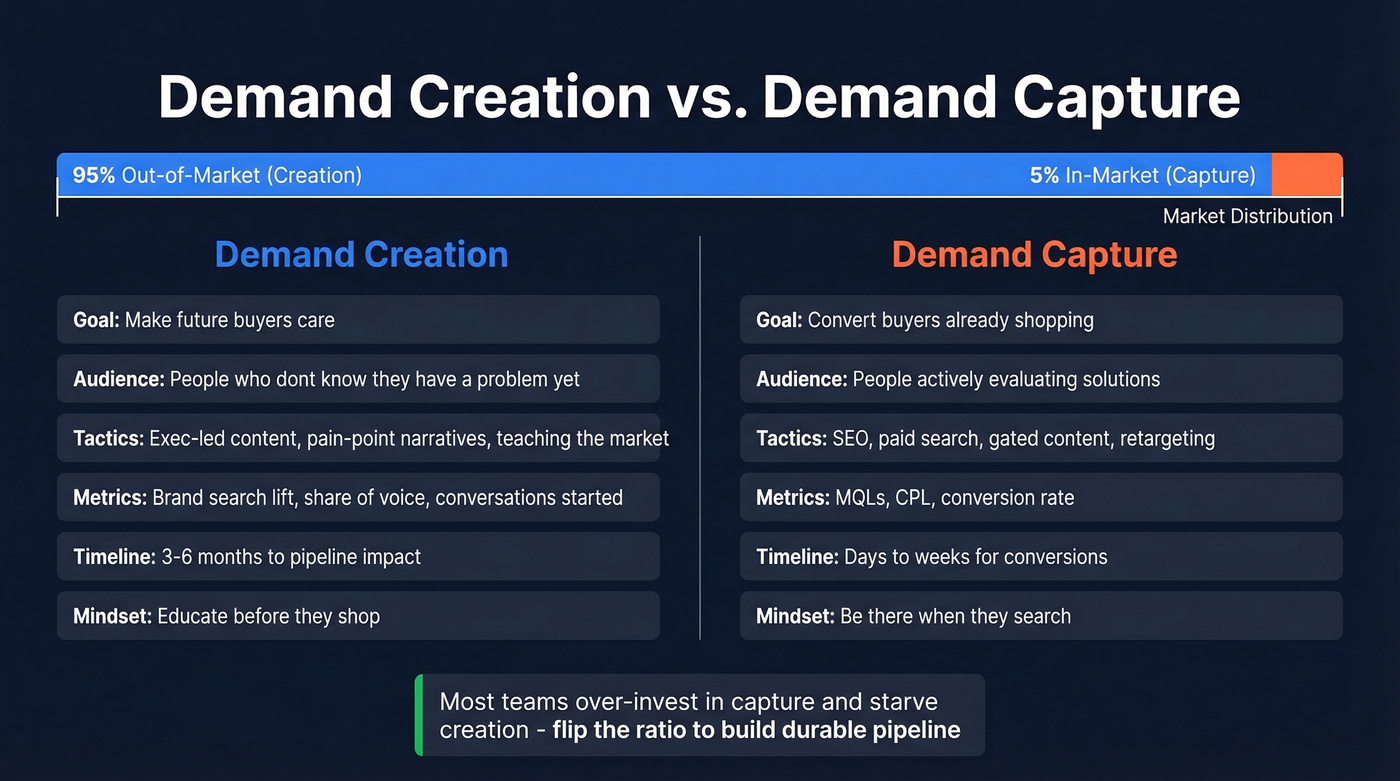
The 95/5 rule makes the stakes obvious. About 95% of your market is out-of-market right now, and Gartner's research shows buyers spend only 17% of the purchase journey with supplier sales teams. Most of the decision gets shaped when you're not in the room. That's a hard pill, but it reframes everything about where your marketing hours should go.
If your "demand gen" is just SEO plus paid plus gated content, you've built a capture process, not a creation process. Apple didn't capture iPhone demand with retargeting - they created it by teaching the market what a smartphone should be.
Five Steps to Build Your Demand Engine
Identify the Pain (Not the Solution)
You're marketing to problems buyers don't fully recognize yet, not pitching features they didn't ask for. For new categories, the "old way vs. new way" framing works best: name what people do today, why it's breaking, and what the new approach unlocks.
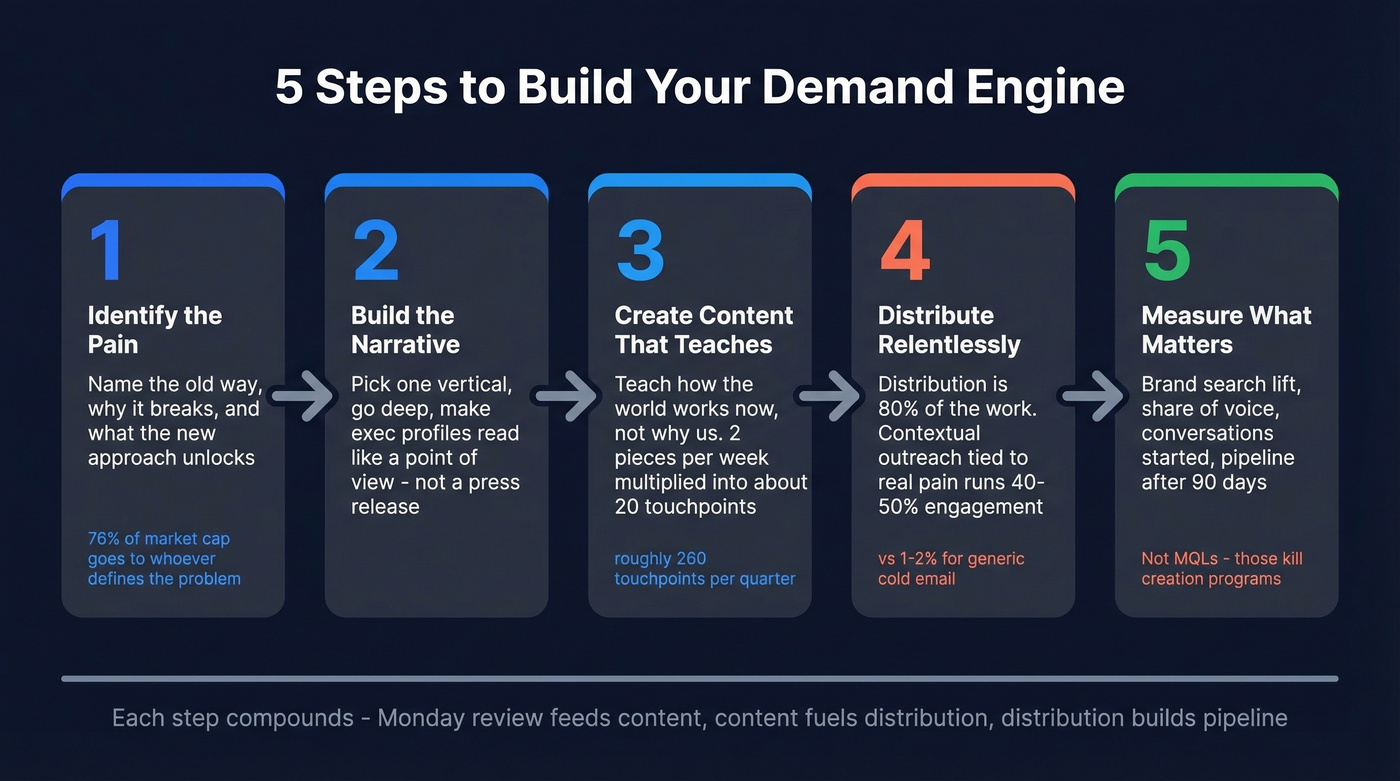
In SaaS category creation, the category-defining company often captures 76% of the space's total market capitalization. Whoever defines the problem usually defines the shortlist.
Build the Narrative
Narrow positioning beats broad messaging every time. Pick a vertical where the pain is already expensive and frequent, then build a narrative that sounds like you've lived in that world for years.
Treat exec profiles as landing pages - consistent, specific, and useful. Most narratives fail because they're written like product marketing, not like a point of view. If your CEO's profile reads like a press release, you've already lost.
Create Content That Teaches
Teach the market how to think. Not "why us," but "how the world works now." If you need a baseline for what "teaching" content looks like in B2B, start with B2B content marketing.
The format matters less than the frequency. Two strategic pieces per week, each multiplied into roughly 10 touchpoints - clips, posts, emails, slides - gives you about 20 touchpoints per week, or ~260 per quarter when you stay consistent. We've watched teams obsess over one perfect flagship asset, then go dark for three weeks. Consistency beats greatness almost every time.
Distribute Relentlessly
Here's the thing: distribution is 80% of the work. The consensus on r/demandgeneration echoes this constantly - "content distribution = 80% of success." Most companies get the ratio backwards, pouring budget into creation and then tweeting the link once.
Contextual outreach tied to a real pain or account trigger runs 40-50% engagement versus 1-2% for generic cold email, and enterprise buying committees average 6-10 stakeholders - so you're multi-threading a decision, not "reaching a lead." If you want a tighter playbook for this, use personalized outreach as the default.
Your distribution list is only as good as the data behind it. If half your emails bounce, your weekly cadence is just noise. We've seen teams lose weeks of momentum because a bad contact list torched their sender reputation. Prospeo's 98% email accuracy and 7-day data refresh cycle keep outreach landing on real inboxes, and its intent data across 15,000 Bombora topics helps you spot accounts showing early signals before they hit anyone else's radar.
Measure What Matters (Not MQLs)
Stop measuring demand creation with lead gen metrics. It's the fastest way to kill the program before it builds momentum.
The KPIs that actually matter: brand search lift, share of voice, conversations started, and pipeline sourced after 90+ days. MQLs and CPL are fine for capture motions - they're just the wrong yardstick for teaching a market that isn't shopping yet. If you need a clean measurement stack, start with funnel metrics.

Your weekly distribution push only works when contacts are real. Prospeo's 98% email accuracy and 7-day data refresh keep your demand creation cadence hitting real inboxes - not bouncing into oblivion. Layer in intent data across 15,000 Bombora topics to find accounts showing early pain signals before competitors even notice.
Stop torching your sender reputation with stale data every Thursday.
Weekly Execution Cadence
Every guide gives you four stages and stops. Nobody tells you what to do on Tuesday.
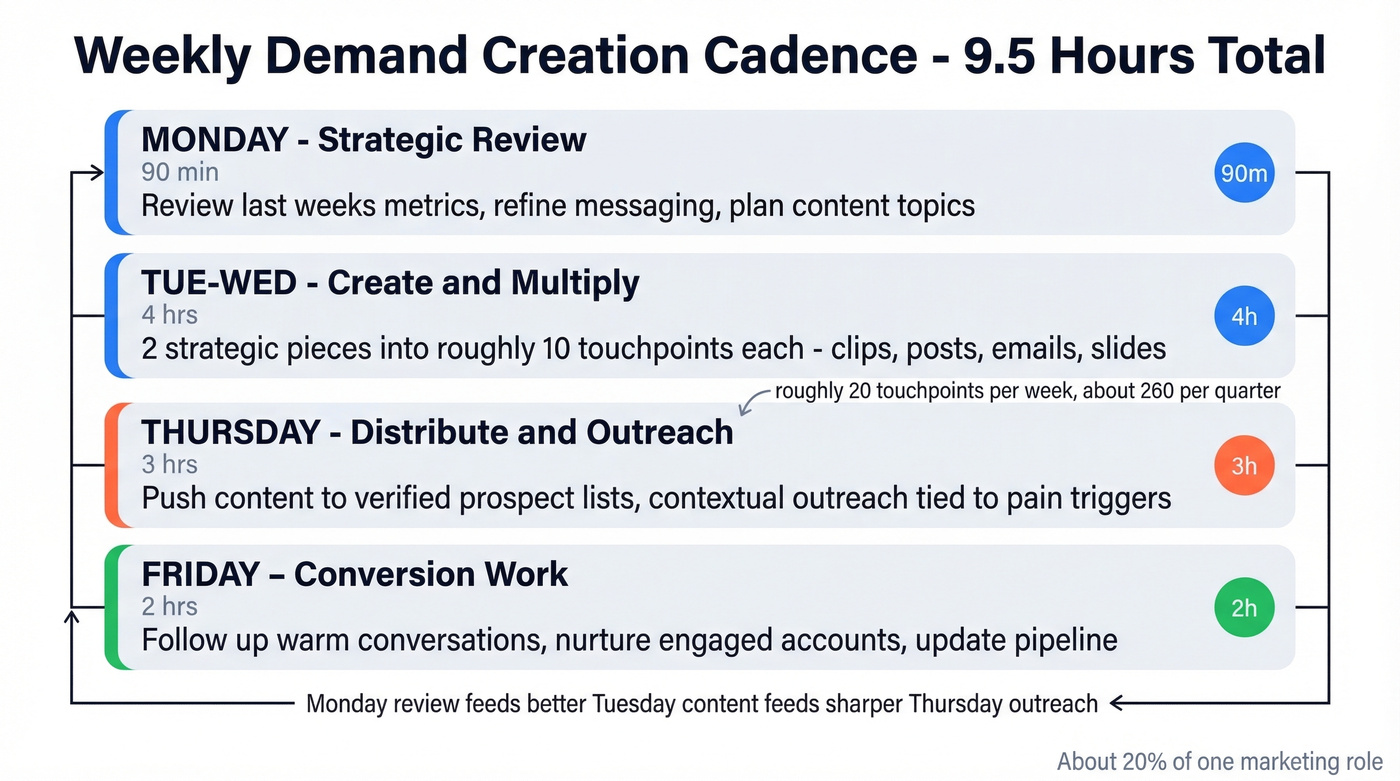
This cadence works because it's small enough to survive real life - about 9.5 hours per week, roughly 20% of one marketing role. It forces the creation/distribution split to stay honest.
| Day | Block | Time |
|---|---|---|
| Monday | Strategic review | 90 min |
| Tue-Wed | Create + multiply | 4 hrs |
| Thursday | Distribute + outreach | 3 hrs |
| Friday | Conversion work | 2 hrs |
You don't need a "campaign." You need a weekly operating system: one review loop, two creation blocks, one distribution push, one conversion block. Each of these demand creation activities compounds over time - the Monday review feeds better Tuesday content, which fuels sharper Thursday outreach. Skip this if you're running a team of 10+ marketers with dedicated channel owners; at that scale, you'll want parallel workstreams instead of a single sequential cadence. If you're building the outbound side alongside this cadence, borrow from proven sales prospecting techniques.
When to Expect Results
Demand creation feels slow - until it doesn't. The accumulation curve is real, and attribution anxiety is what kills most programs before they stack.
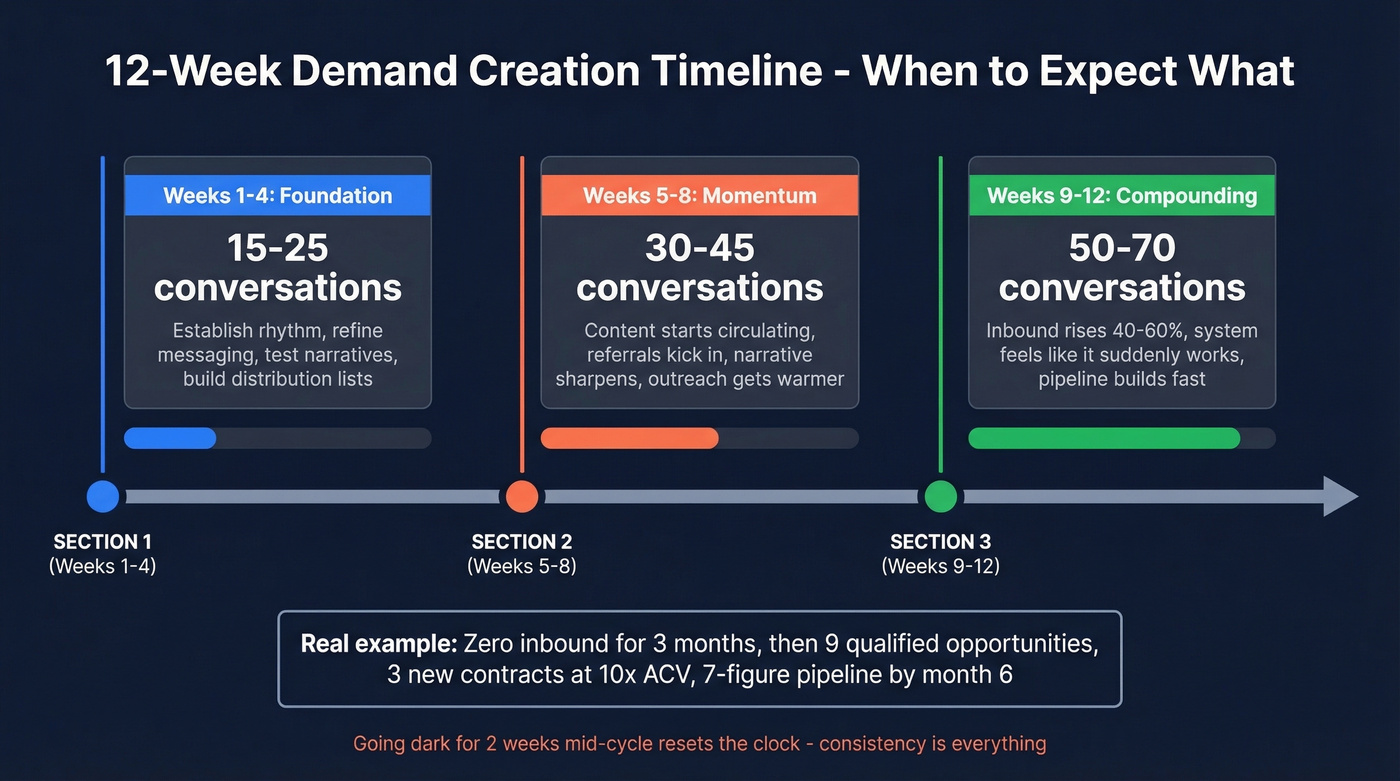
A practical 12-week expectation: in weeks 1-4, expect 15-25 conversations as you establish rhythm and refine messaging. Weeks 5-8 typically double that to 30-45 conversations as content starts circulating and referrals kick in. By weeks 9-12, inbound rises 40-60% and you're looking at 50-70 conversations - the point where the system feels like it "suddenly" works.
The Reddit case studies rhyme with this pattern. One marketer reported zero inbound opportunities in the first 3 months, then 9 qualified opportunities, 3 new contracts at 10x ACV, and a 7-figure pipeline by month 6 after tightening positioning and distribution.
MarketingSherpa case study roundups include results like a 150% increase in lead generation and a 13.4% conversion rate to scheduled meetings in specific B2B campaigns.
Let's be honest: if your leadership can't stomach 90 days of "nothing happening," you don't have a strategy problem. You have a patience problem. No amount of MQL dashboards will fix it.
Channel ROI Benchmarks
Budget pressure is real - marketing budgets average about 7.7% of revenue right now. So you need a bias toward channels that accumulate value, not just quick hits. Early-stage teams should focus on repeatable pipeline from two or three channels; enterprise teams can optimize for segmented contribution across more.
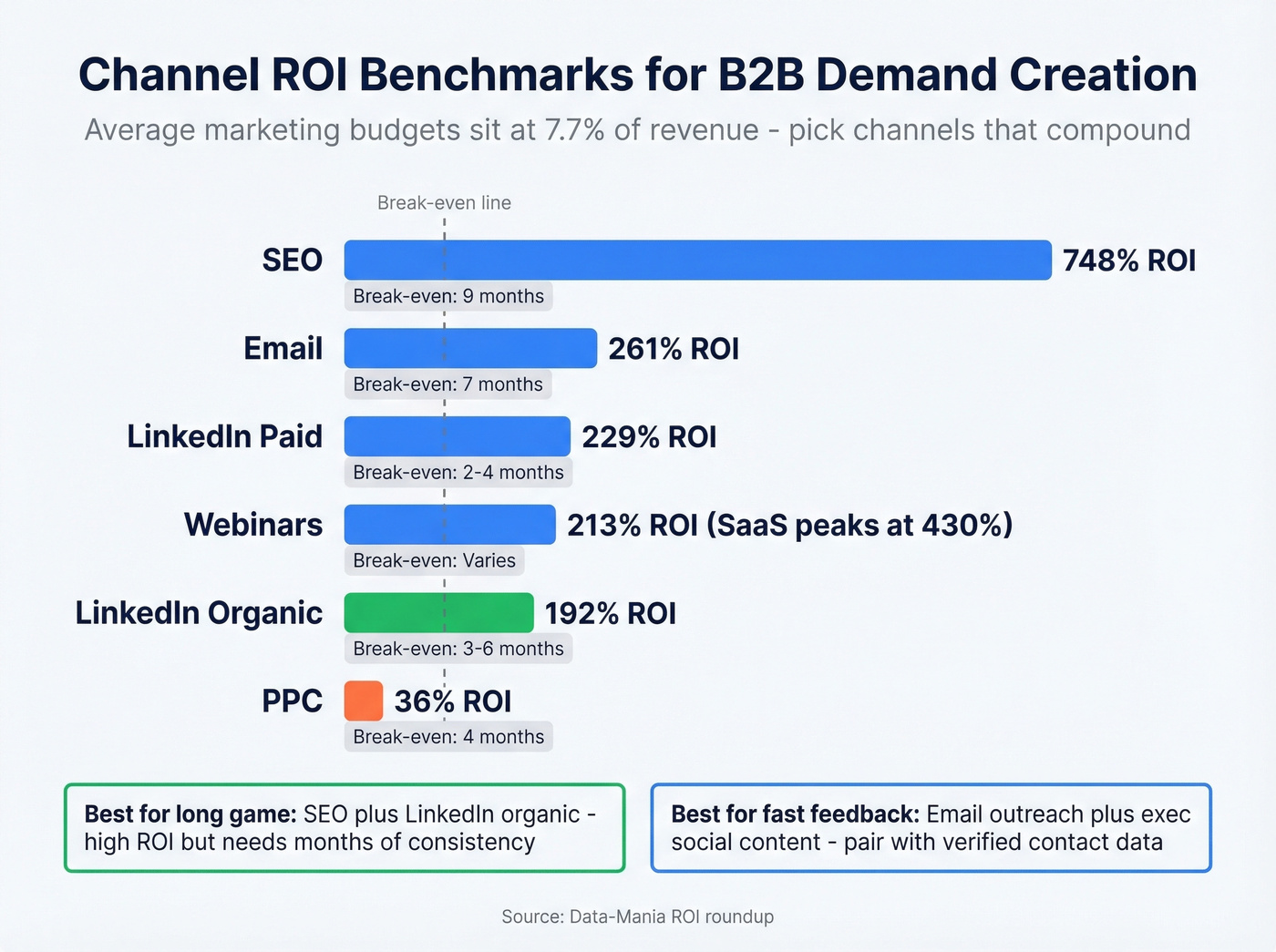
Benchmarks from Data-Mania's ROI roundup:
| Channel | ROI | Break-even |
|---|---|---|
| SEO | 748% | 9 mo |
| 261% | 7 mo | |
| Webinars | 213% (SaaS peaks 430%) | Varies |
| LinkedIn organic | 192% | 3-6 mo |
| LinkedIn paid | 229% | 2-4 mo |
| PPC | 36% | 4 mo |
SEO's 748% ROI is eye-popping, but the 9-month break-even means it's a demand creation channel, not a demand capture one. For teams that need pipeline in 90 days, pair LinkedIn organic with email outreach and layer SEO underneath for the long game. PPC's 36% return looks grim on its own, but it can accelerate brand search lift when you're already running a creation motion - think of it as a catalyst, not a standalone play.
One scenario we see often: a 5-person B2B team splits budget 60/40 between LinkedIn organic content and verified email outreach for the first 8 weeks, then adds SEO and webinars once they've nailed their narrative. That sequencing matters more than the channel mix itself, because you can't distribute content you haven't figured out how to write yet. If you're tightening the email side, use an email deliverability guide to keep the channel stable.
The 95/5 rule means you need to reach future buyers before they're shopping. Prospeo's 30+ search filters - buyer intent, job changes, headcount growth, technographics - let you build the exact prospect lists your demand creation narrative deserves, at $0.01 per email.
Build distribution lists that actually match your pain-point narrative.
FAQ
What's the difference between demand creation and demand generation?
Demand generation is the umbrella term covering both creation and capture. Demand creation targets the 95% of buyers who are out-of-market, building awareness and urgency before they shop. Demand capture converts the 5% already evaluating solutions. Most companies over-invest in capture and under-invest in creation - which is why their pipeline feels feast-or-famine.
How long does the demand creation process take to show results?
Expect 15-25 new conversations in weeks 1-4, with inbound increasing 40-60% by week 12. Full pipeline impact typically appears at 3-6 months of consistent execution. One practitioner reported a 7-figure pipeline by month 6 after starting from zero inbound. The key word there is "consistent" - teams that go dark for two weeks mid-cycle reset the clock.
How do you measure demand creation if not by MQLs?
Track brand search lift, share of voice, conversations started, and pipeline sourced after 90+ days. Intent data platforms tracking thousands of topics can surface early engagement signals before they appear in traditional pipeline metrics. MQLs and CPL are demand capture metrics - applying them to creation programs kills them prematurely. Gartner's B2B buying research backs this up: the buying journey is nonlinear, so linear metrics miss the picture.
What channels work best for B2B demand creation?
SEO (748% ROI) and LinkedIn organic (192% ROI) deliver the highest long-term returns, but both require months of consistency. For faster feedback loops, combine verified email outreach with exec-led social content. The key is picking two or three channels and going deep rather than spreading thin across six. HubSpot's State of Marketing report consistently shows that channel depth outperforms channel breadth for mid-market teams.