

Demand Generation: What It Actually Takes in 2026
Your CMO just handed you the mandate: "Build a demand gen engine." You nod, open a browser, and find 200 articles that all say the same thing - create content, nurture leads, align with sales. None of them tell you what demand generation actually costs, how long it takes, or what to do when the CEO asks why there's no pipeline after 60 days.
We've been in those rooms. This piece is built on real buyer data, practitioner timelines, and the pricing numbers nobody wants to publish.
What You Need (Quick Version)
If you're building or fixing a demand generation program in 2026, three things matter more than everything else combined.
Get on the buyer's Day One shortlist. 95% of deals go to vendors already on the shortlist before formal evaluation starts. If you're not there, your pipeline is someone else's.
Fix your data before your strategy. Bounced emails mean invisible campaigns. If your bounce rate sits above 5%, you don't have a strategy problem - you have a data problem. Verified email tools now run around $0.01/email, making data cleanup the cheapest fix available. (If you need benchmarks and fixes, start with bounce rate.)
Give it 3-6 months before judging results. Demand gen compounds. The first 90 days often show almost nothing. Then it accelerates. If your CEO expects pipeline in 30 days, you have an expectations problem, not a strategy problem.
What Is Demand Generation?
So what is it, exactly?
Demand generation is the full-cycle process of creating awareness, building trust, and driving interest in your product before a buyer ever fills out a form. It's not a campaign. It's not a channel. It's the system that makes your market want what you sell - and it doesn't stop at acquisition. Expansion revenue from existing customers is part of the system too, because a customer who upgrades went through the same awareness-to-trust arc internally.
The simplest definition: everything your company does to make your market aware of, interested in, and ready to buy your product before they ever talk to sales.
Here's the distinction that trips most teams up: demand gen isn't the same thing as lead generation, and neither is the same as demand capture. Confusing them leads to one of the most expensive mistakes in B2B marketing - burning through a solid TAM with sloppy messaging and mass outreach that catches nobody at the right moment.
Demand Gen vs. Lead Gen vs. Demand Capture
| Demand Generation | Lead Generation | Demand Capture | |
|---|---|---|---|
| Definition | Create awareness + desire | Capture contact info | Convert existing intent |
| Goal | Build the shortlist | Fill the database | Close the deal |
| Example tactic | Podcast, ungated guide | Gated whitepaper, webinar reg | Google Ads, demo page |
| Key metric | Pipeline velocity | MQLs, cost per lead | Conversion rate, CAC |
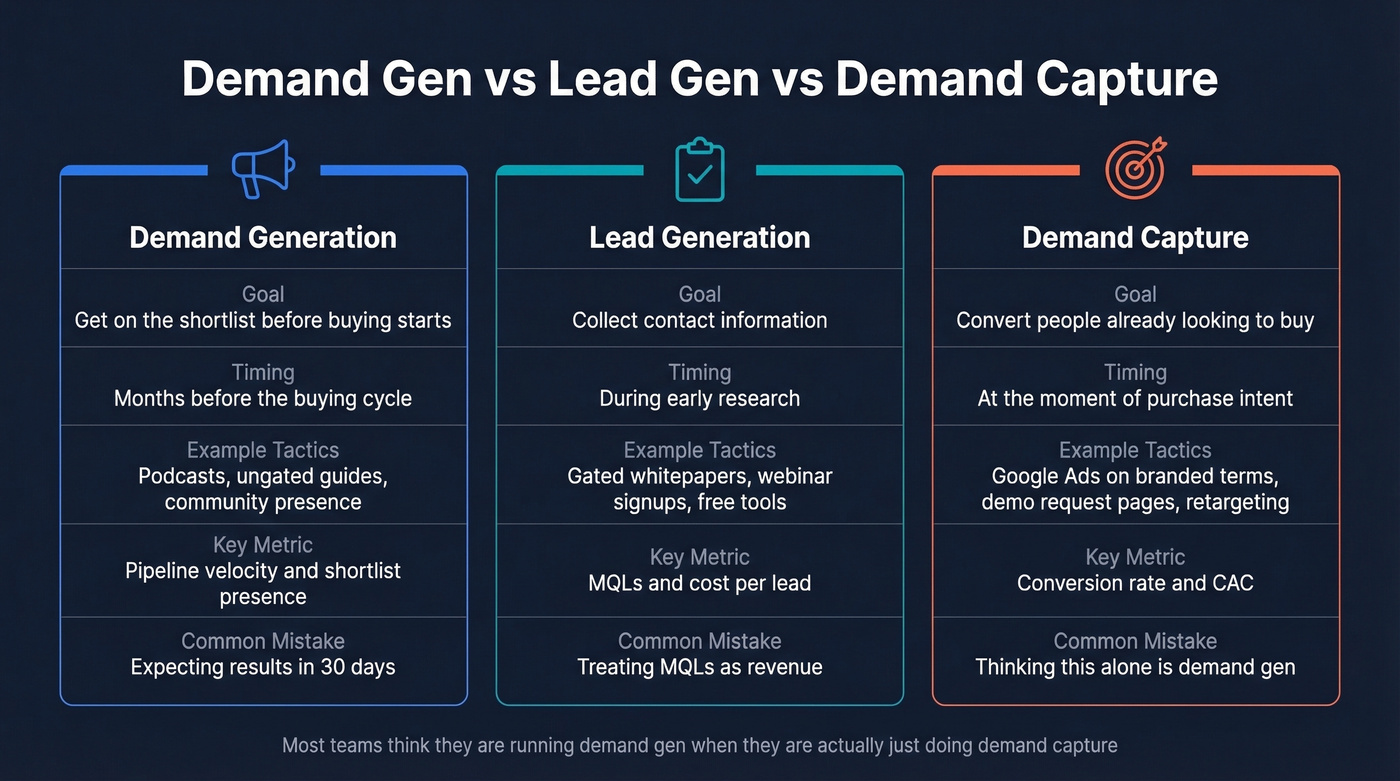
Most teams think they're running demand gen when they're actually doing demand capture - blasting cold lists and hoping timing works out. That's not generating demand. That's playing the lottery with your TAM. Real demand gen means a prospect already knows your name and trusts your perspective before they ever hit your pricing page.
Why It Matters More Than Ever
The B2B buying process has changed so fundamentally that this discipline isn't optional anymore. It's existential.
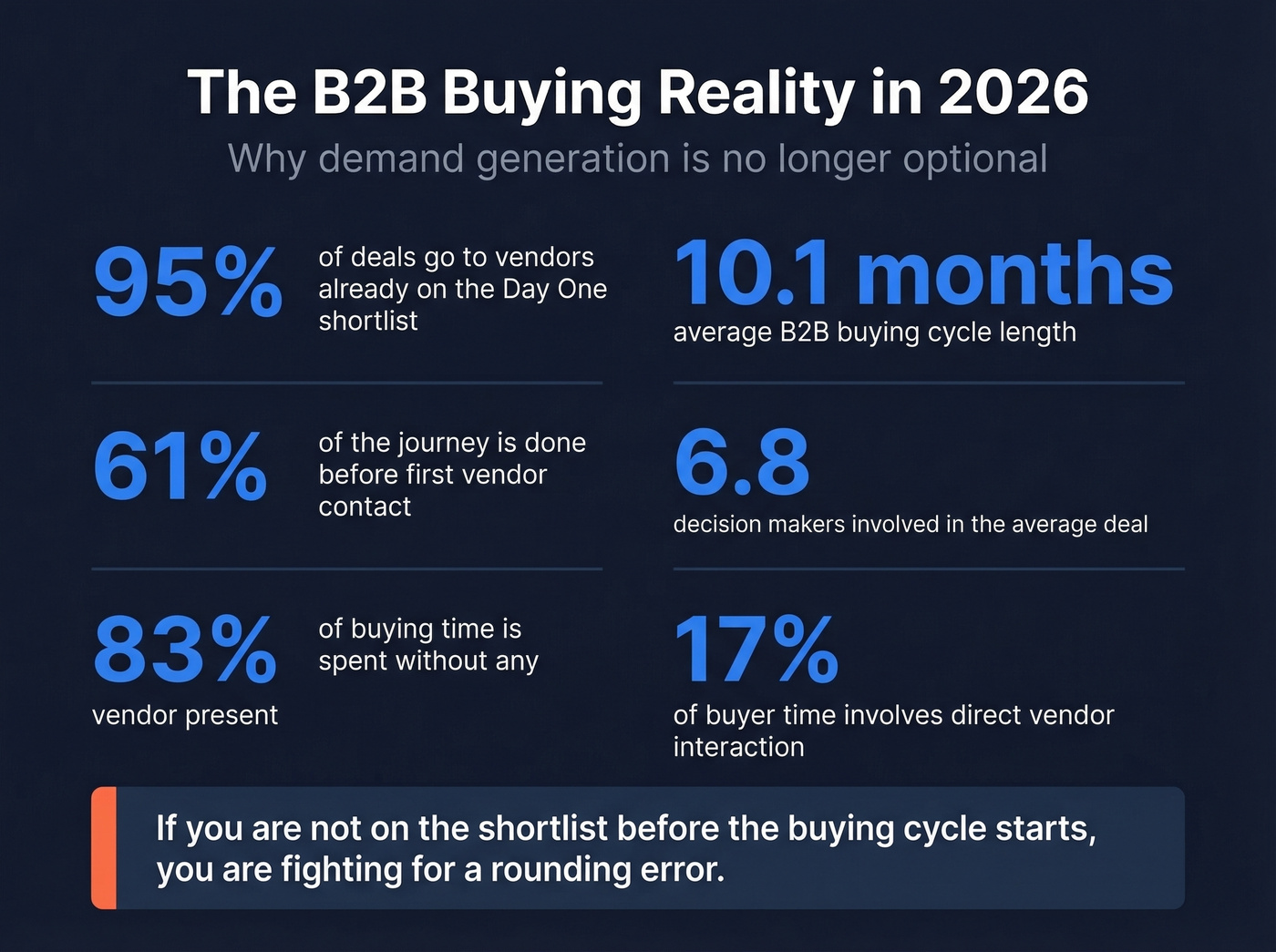
92% of buyers start their research with at least one vendor already in mind. 41% have a preferred vendor before formal evaluation even begins. And the winning vendor sits on the buyer's "Day One shortlist" 95% of the time. If you're not on the shortlist before the buying cycle starts, you're fighting for the remaining 5% of deals. That's not a strategy - that's a rounding error.
The average B2B buying cycle now runs 10.1 months, and first contact with a vendor doesn't happen until roughly 61% of the way through that journey. Buyers interact with vendors directly only 17% of the time - the other 83% is independent research, peer conversations, and internal discussions you'll never see. With 6.8 decision makers involved in the average deal, you're not persuading one person. You're building consensus across a buying committee where the CFO, CTO, head of ops, and procurement each need different proof points.
This is why "run more ads" isn't a strategy. By the time someone clicks your ad, the shortlist is already set. Demand generation is how you get on that list months before the buying cycle starts.
Strategies That Actually Work
Most demand gen advice sounds reasonable in a slide deck and falls apart in execution. These five strategies have the strongest evidence behind them - and the clearest performance deltas.
Content + Distribution
Great content is only 20% of success. The other 80% is distribution. We've seen teams pour months into a beautifully designed ebook that gets 200 downloads because nobody planned how to get it in front of the right people.
The Rule of 7 still holds - prospects need repeated exposure before your brand registers. Consistency beats brilliance. A weekly newsletter that actually ships outperforms a quarterly masterpiece sitting in a Google Drive folder. Just under 80% of B2B marketers say email is their most effective distribution channel, while 73% say webinars generate their highest-quality leads. Both only work if you're reaching real inboxes with verified addresses (and strong email deliverability).
Every piece of content needs a distribution plan before it's created. No exceptions.
Intent-Signal Outreach
Generic cold email gets 1-2% engagement. Signal-triggered outreach - reaching companies actively researching your category - drives 40-50% engagement rates. That's not a marginal improvement. That's a different sport.
The key is identifying which accounts are surging on relevant topics before they hit your website, then layering buying signals with job role and company growth data to build outreach lists that actually convert (see identifying buying signals).
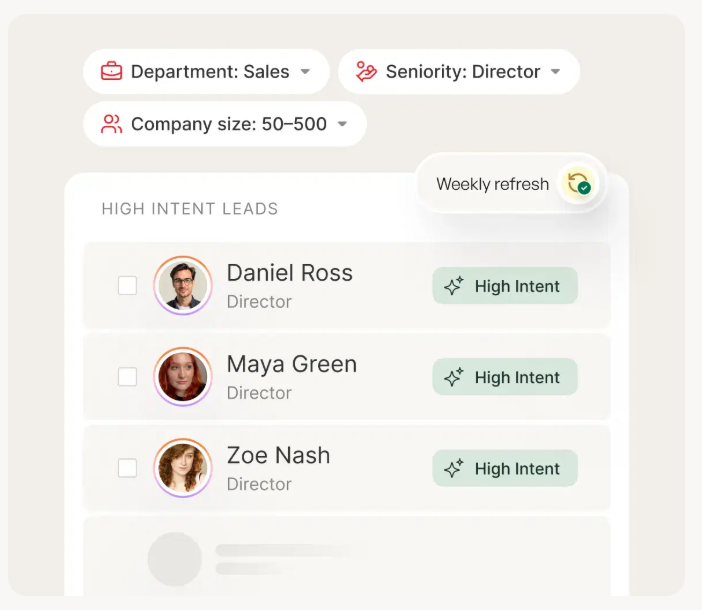
Teams using BANT qualification before demos report 35%+ close rates versus 5-8% from standard inbound requests. When you combine intent signals with verified contact data, you're not cold-calling - you're arriving at the right moment with the right message. This is the single biggest lever most teams aren't pulling.
ABM for Named Accounts
Account-based marketing and demand gen aren't opposites - ABM is demand gen focused on a finite list. The difference is precision.
| ABM | Broad Demand Gen | |
|---|---|---|
| Targeting | Named account list | Market/segment |
| Content | Personalized by account | Persona-level |
| Metrics | Engagement score, pipeline | Leads, CPL, cycle length |
| Best for | Enterprise, high ACV | Mid-market, volume |
The buying committee reality makes ABM essential for enterprise deals. A CFO needs ROI projections. A CTO needs architecture diagrams. An ops leader needs implementation timelines. Procurement needs compliance documentation. One generic nurture sequence won't move all four.
Paid Demand Capture
Paid search and retargeting aren't demand gen - they're demand capture. But they're a critical part of the system.
Retargeting keeps your brand visible during the 83% of the buying journey that happens without you. Chatbots on landing pages can qualify visitors in real time, routing high-intent prospects to sales before they bounce. Not glamorous, but it compounds.
Community and Dark Social
Podcasts, newsletters, Slack communities, private peer groups - this is where opinions form and shortlists get built. None of it shows up in your attribution model.
You can't track it, but you can participate in it. Guest on industry podcasts. Sponsor niche newsletters. Show up in the Slack groups where your buyers hang out. Skip this if your ICP doesn't congregate in communities - but for most B2B segments, they do, and this is where the real influence happens.

The article says it clearly: if your bounce rate is above 5%, you have a data problem, not a strategy problem. Prospeo delivers 98% email accuracy at $0.01/email with a 7-day refresh cycle - so your demand gen campaigns actually reach real inboxes.
Fix your data foundation before you spend another dollar on demand gen.
The 6-Month Reality Check
Let's be honest about timelines, because this is where most programs die - not from bad strategy, but from impatient leadership.
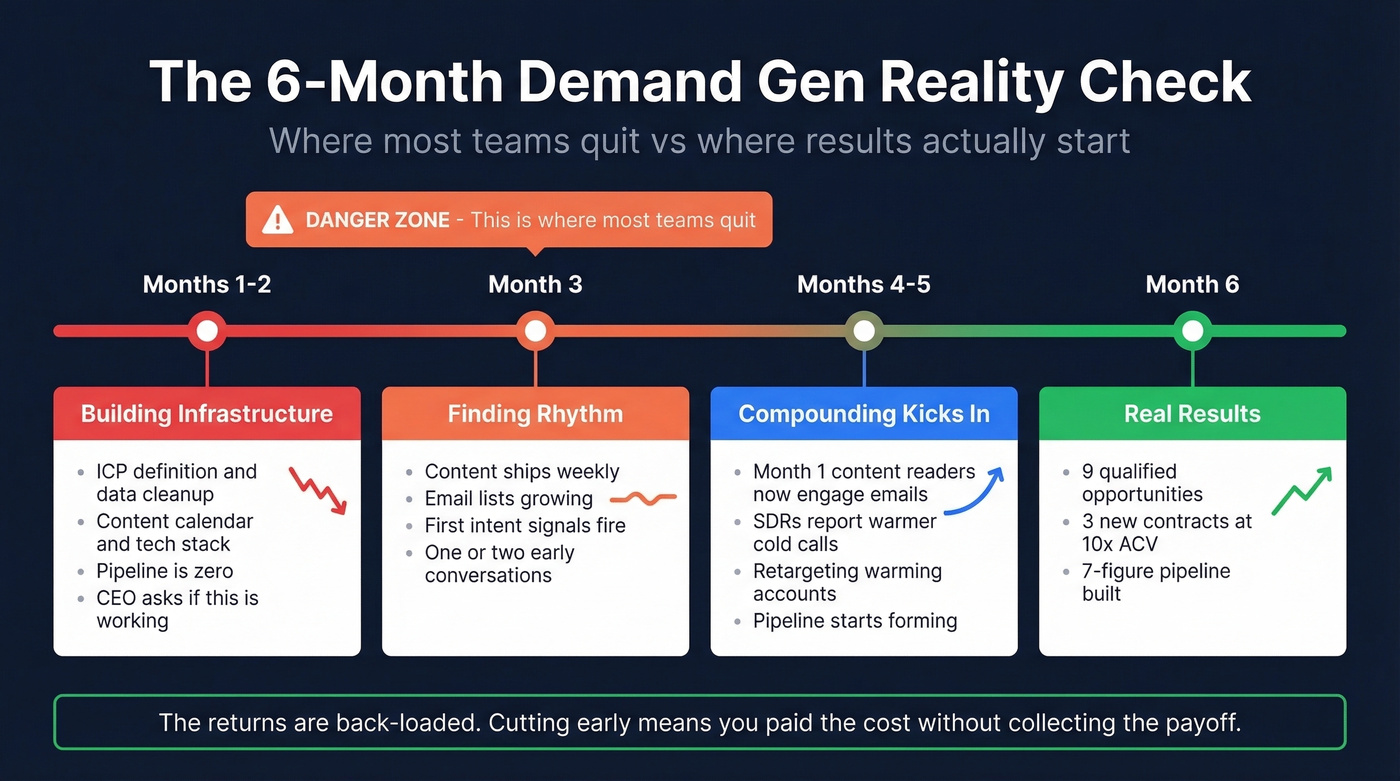
Months 1-2: You're building infrastructure. ICP definition, content calendar, tech stack integration, data cleanup. You publish your first few pieces. Traffic is flat. Pipeline is zero. Your CEO asks if this is working.
Month 3: You've got a rhythm. Content ships weekly. Email lists are growing. A few intent signals fire. You might have one or two early-stage conversations. It doesn't feel like enough.
Months 4-5: Compounding kicks in. Prospects who saw your content in month 1 are now engaging with your emails. Retargeting is warming accounts. Your SDRs report that cold calls are getting warmer - "Oh yeah, I've seen your stuff." Pipeline starts forming.
Month 6: One practitioner shared results after six months of consistent execution: 9 qualified opportunities, 3 new contracts at 10x ACV, and a 7-figure pipeline. That's not guaranteed, but it's realistic for a team that stayed disciplined.
Here's the thing: if your CEO expects pipeline in 30 days, you don't have a strategy problem. You have an expectations problem. The returns are back-loaded, and cutting early means you paid the cost without collecting the payoff.
Mistakes That Kill Pipeline
Optimizing for MQLs Over Revenue
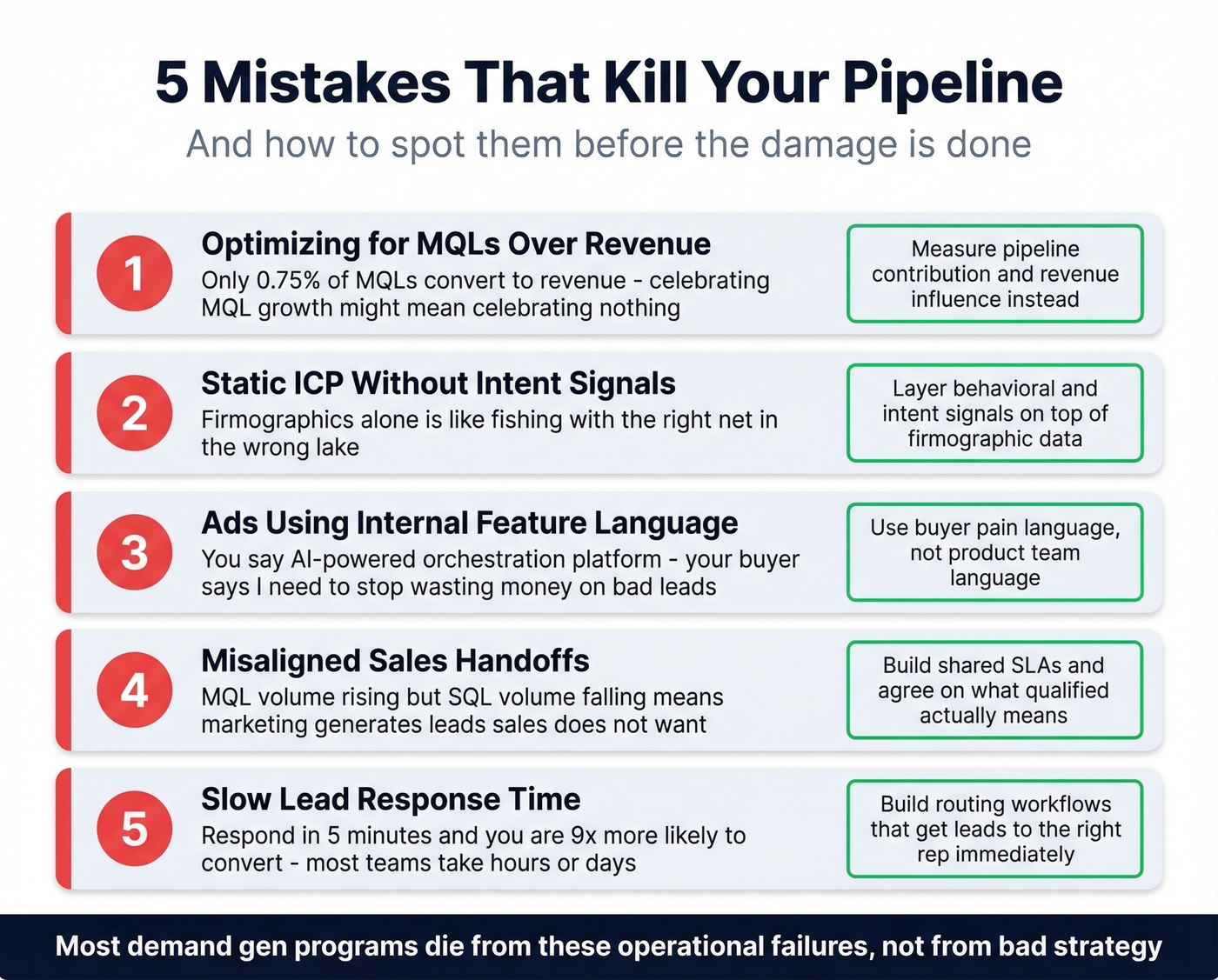
MQLs are a vanity metric unless they're tied directly to pipeline and revenue. Only 0.75% of MQLs convert to revenue. If you're celebrating a 3x increase in MQLs, you might be celebrating a 3x increase in nothing. Measure pipeline contribution and revenue influence instead (use a simple pipeline health view to keep it honest).
Static ICP Without Intent Signals
Building your ICP on firmographics alone - industry, company size, geography - is like fishing with a net that's the right shape but dropped in the wrong lake. Layer behavioral and intent signals on top. Companies actively researching your category are 10x more likely to engage than companies that merely fit your firmographic profile.
Ads Without Buyer Research
Launching paid campaigns using internal feature language instead of buyer pain language is a fast way to burn budget. Your product team says "AI-powered orchestration platform." Your buyer says "I need to stop wasting money on leads that don't close." Use their words, not yours.
Misaligned Handoffs and Slow Activation
Two operational failures that quietly destroy pipeline, often at the same time.
The warning sign for the first: MQL volume is rising but SQL volume is falling. That means marketing is generating leads that sales doesn't want. Fix the definitions, build shared SLAs, and agree on what "qualified" actually means - use a simple BANT framework as a starting point - before you spend another dollar on campaigns.
The second failure is speed. Respond to a web lead within 5 minutes and you're 9x more likely to convert them. Most teams take hours or days. Build routing workflows that get leads to the right rep immediately - not after a weekly lead review meeting.
Attribution Paralysis
Teams that spend more time debating attribution models than running campaigns are optimizing for the wrong thing. The consensus on r/marketing is blunt: the attribution mindset kills B2B marketing programs. Directional is good enough. Move on.
Bad Contact Data
This is the mistake that quietly undermines everything else. You can have the best strategy, the best content, and the best targeting - and none of it matters if 35-40% of your emails bounce. Snyk's sales team was running bounce rates in that range before switching to verified data. After the switch, bounces dropped to under 5%, and AE-sourced pipeline jumped 180%. At around $0.01 per verified email, cleaning your data is the cheapest improvement you can make.
Measuring What Matters
KPIs Worth Tracking
Stop leading with MQLs in your board deck. These are the metrics that actually tell you whether your program is working.
Pipeline velocity - how fast qualified opportunities move through your funnel. This is the single most important metric because it captures both volume and quality.
CAC and CLV - what it costs to acquire a customer and what they're worth over time. If your program drops CAC by 20% while maintaining CLV, that's a win regardless of what MQL volume does (see cost to acquire a customer).
Sales cycle length - demand gen should shorten this. If buyers arrive already educated and trusting your brand, they move faster. Track whether your average cycle is compressing quarter over quarter.
Attribution Models
A typical B2B lead interacts with your company 5 to 50 times before purchasing, across 6.8 stakeholders, over 10 months. No attribution model captures this perfectly. Here's what each one does:
| Model | How It Works | Best For |
|---|---|---|
| First-touch | 100% credit to first interaction | Understanding discovery |
| Last-touch | 100% credit to final interaction | Short sales cycles |
| Linear | Equal credit across all touches | Simple multi-touch |
| Time-decay | More credit to recent touches | Long cycles, late-stage focus |
| Position-based (U) | 40% first / 20% middle / 40% last | Balanced B2B attribution |
| Data-driven | Algorithmic weighting | Large datasets, enterprise |
In our experience, position-based (U-shaped, 40/20/40) is the best starting point for most B2B teams. It credits both the channel that created awareness and the one that closed the deal, without ignoring the middle. But don't let attribution debates paralyze your program. Directional measurement that helps you make better decisions is infinitely more valuable than a perfect model you spend six months building.
Building Your Tech Stack
A typical mid-sized company runs more than 150 different software tools. That's not a tech stack - that's a junk drawer.
You need 4-5 tools that genuinely integrate, not 15 that each have a Salesforce connector that technically works. Be skeptical of "integrates with Salesforce" claims - there's a wide gap between a connector that syncs fields and a true workflow integration that triggers actions and populates reports.

The core layers: a CRM as your system of record, a data and enrichment platform to fuel targeting, an engagement layer for sequences and campaigns, and analytics to close the loop. Everything else is optional until you've nailed those four.
For the data and enrichment layer, Prospeo covers 300M+ professional profiles with 98% email accuracy on a 7-day refresh cycle - the industry average is six weeks, which means most databases are serving you stale contacts. The 30+ search filters let you build lists by buyer intent, technographics, job changes, headcount growth, funding, and revenue. Intent data tracks 15,000 topics via Bombora. It integrates with HubSpot, Salesforce, Clay, Lemlist, Instantly, Smartlead, Zapier, and Make. And it starts free, with paid plans running about $0.01 per email. (If you're comparing vendors, see data enrichment services.)
Here's the full stack with starting price ranges:
| Category | Tool | Starting Price | Best For |
|---|---|---|---|
| CRM | HubSpot | $890-$3,600/mo Marketing Hub | All-in-one |
| CRM | Salesforce | $1,250-$4,200/mo | Enterprise |
| Data/Enrichment | Prospeo | Free-$0.01/email | Verified contacts + intent |
| Data/Enrichment | ZoomInfo | $15K-$40K+/yr | Large sales teams |
| Data/Enrichment | Cognism | ~$1K-$3K/mo | EMEA focus |
| Intent Data | 6sense | $60K-$150K+/yr | Enterprise intent + ABM |
| Intent Data | Demandbase | $30K-$100K+/yr | ABM orchestration |
The pricing gap is stark. A 10-seat ZoomInfo contract with intent data can run $40-100K/year. 6sense commonly lands in the $60K-$150K+ range for mid-market teams and $200K+ for enterprise.
For teams building a stack from scratch, self-serve tools with transparent pricing are the difference between launching this quarter and waiting for budget approval.
Hot take: If your average contract value is under $15K, you almost certainly don't need a $60K intent data platform. Start with verified contact data and basic intent signals, prove the model works, then upgrade your stack as deal sizes justify the spend.
Intent-signal outreach drives 40-50% engagement vs 1-2% for generic cold email. Prospeo tracks 15,000 intent topics via Bombora, then layers in verified emails and direct dials so you reach in-market buyers at the exact right moment.
Stop playing the lottery with your TAM - reach buyers already researching your category.
How AI Search Changes the Game in 2026
AI Overviews are creating a new layer of zero-click discovery. Buyers get answers synthesized from multiple sources without visiting any of them. For demand generation, this means awareness is shifting from "did they visit our site" to "did the AI cite our content."
This creates a practical split in your content strategy. You need two types of content now.
Content LLMs will parse - structured, authoritative, data-backed pages that AI models can cite in summaries. Think definitive guides, comparison pages with clear data, FAQ-style content with concise answers. This is how you show up in AI Overviews and become part of the buyer's research even if they never click through.
Content humans will engage with - podcasts, video, community posts, newsletters. Things that build trust and preference in ways AI can't replicate. The 83% of buyer activity that happens without direct vendor interaction? It's increasingly happening through these human-first channels.
The 56% of buyers who say there's too much content aren't wrong. The solution isn't less content - it's more intentional content. Every piece should serve one of those two purposes. If it doesn't clearly feed AI discoverability or human engagement, it's noise.
FAQ
How does demand generation differ from lead generation?
Demand generation creates awareness and desire before someone raises their hand - it's how you get on the buyer's shortlist. Lead gen captures contact information from people already interested. Without demand gen feeding the top, lead gen efforts are limited to the small percentage of your market actively looking right now.
How long does it take to show results?
Expect 3-6 months for meaningful pipeline impact. The first 90 days typically show little visible progress while content publishes and lists build. Results compound as awareness grows and buyers enter buying cycles. Cutting a program at 60 days means you paid the cost without collecting the return.
What's a realistic budget?
B2B organizations allocate roughly 31% of their marketing budget to demand gen. For mid-market companies, that typically means $5K-$50K/month across tools, content production, and paid channels. The tech stack alone ranges from under $500/month with self-serve tools to $30K+/month with enterprise platforms like 6sense and Demandbase.
Do I need intent data?
Not strictly, but it dramatically improves efficiency. Signal-triggered outreach drives 40-50% engagement rates versus 1-2% for generic cold email. Intent platforms now track thousands of topics starting on free tiers, making this accessible even without enterprise budgets.
What's the most important metric to track?
Pipeline velocity - how fast qualified opportunities move through your funnel. MQLs alone are misleading since only 0.75% convert to revenue. Track pipeline contribution, sales cycle length, and CAC alongside velocity. If those four metrics trend in the right direction, your program is working regardless of MQL count.