

Demand Generation for Professional Services: A Data-Backed Playbook
Referrals built your firm. They're also quietly failing you. A Hinge Research Institute study surveyed 822 buyers and 533 providers of professional services and found that 71% of buyers still discover firms through personal referrals. But referral usage as a search method has dropped 15% over the past five years. Almost three quarters of the time, companies don't refer because nobody asked them.
Online discovery is rising at the same pace. Hinge's buyer study found 11% of buyers find firms by searching online, and their broader trend data shows nearly one in five professional services buyers now use online search as a primary discovery method - adoption that keeps climbing year over year.
If your pipeline depends on referrals and referrals are declining, you need a system that creates trust at scale. That system is demand generation for professional services, and this playbook shows you exactly how to build it.
The Playbook in Three Bullets
- Referrals are declining; online discovery is growing. Your demand gen strategy must build trust at scale, not just collect leads.
- Pick three tactics max - thought leadership, ABM, outbound with verified data - and execute relentlessly for 12 months.
- Spend 80% of your budget on distribution, 20% on content creation. Most firms do the opposite, then wonder why nobody sees their brilliant whitepaper.
Why Services Firm Demand Gen Is Different
You're not selling software someone can trial for 14 days. You're selling expertise, judgment, and trust - things that take months to evaluate and can't be demonstrated in a demo.
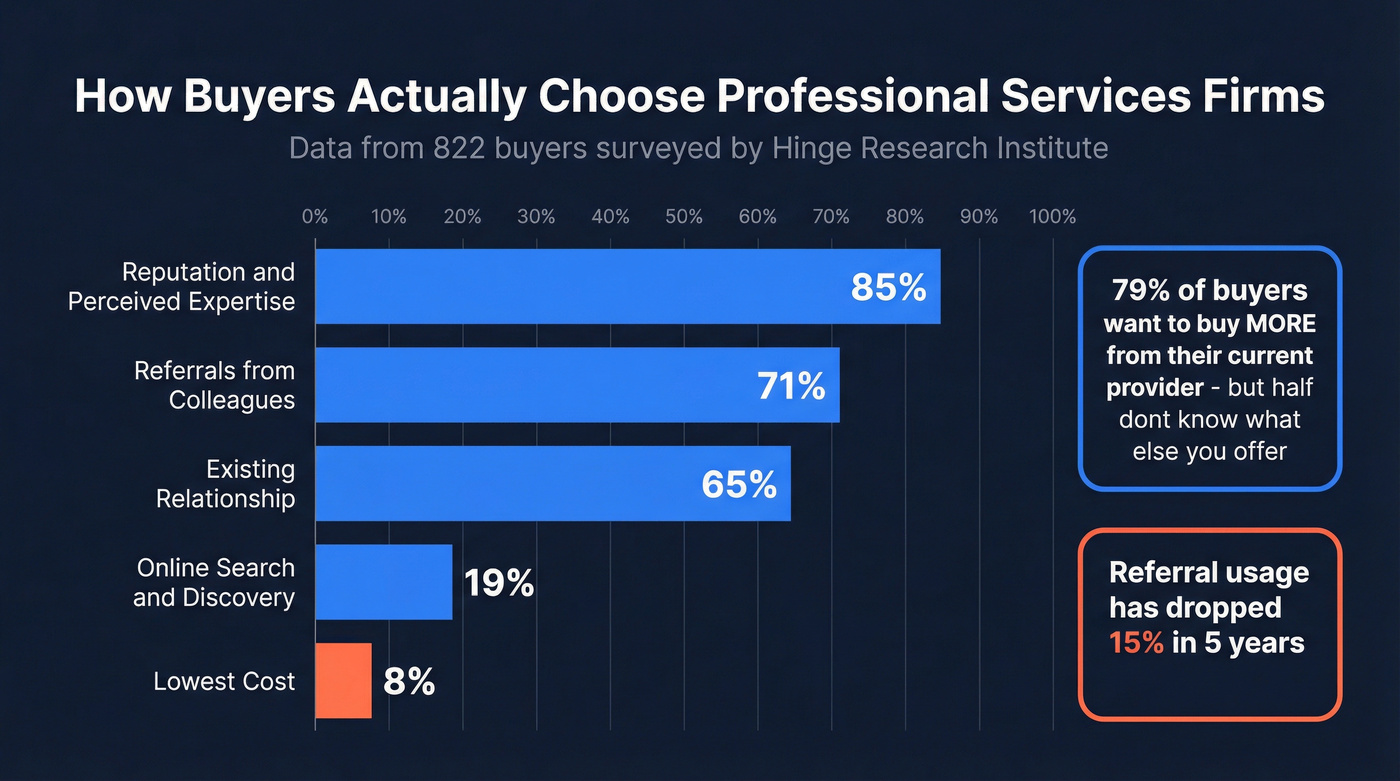
The Hinge data makes this concrete. Reputation is the single most important factor in how buyers select a firm. Cost tipped the scales only 8% of the time. Most services firms compete on price when buyers are actually choosing on perceived expertise.
Here's a stat that should reshape your entire strategy: 79% of buyers would like to buy more from their current provider, but almost half don't know what other services that provider offers. Demand gen isn't just for new clients - it's for the ones already paying you.
Consulting and professional services sites average just 2,180 sessions per month per Databox benchmarks, well below the median across industries. Buying committees involve multiple stakeholders. Law firms lean heavily on local SEO because law is fundamentally a local business. Consulting firms need partner-level thought leadership. Generic B2B playbooks can't solve this, which is precisely why the approach requires two modes working in tandem: demand creation (educating buyers who don't yet know they need you) and demand capture (reaching buyers actively searching).

You just read that 79% of buyers want to buy more from their current provider but don't know what else you offer. Outbound fixes that - but only if your data connects you to real people. Prospeo's 143M+ verified emails and 7-day refresh cycle mean your demand gen hits inboxes, not spam folders.
Stop creating demand you can't capture because of bad contact data.
Three Tactics That Actually Work
Thought Leadership
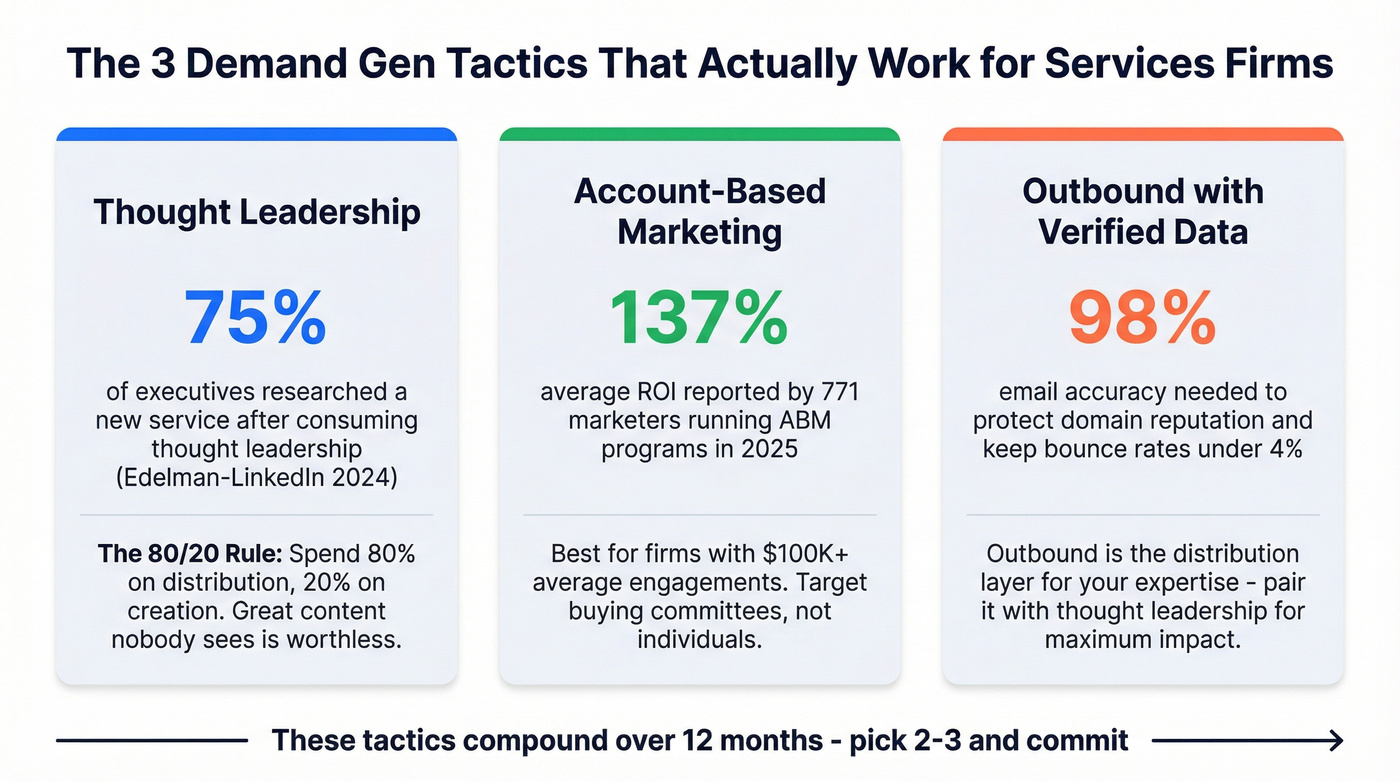
Thought leadership isn't a nice-to-have for services firms - it's the primary demand creation mechanism. The 2024 Edelman-LinkedIn B2B Thought Leadership Impact Report found that 75% of 3,000+ management-level professionals researched a new product or service they weren't previously considering after consuming thought leadership. And 60% said it made them feel they were missing a significant business opportunity. That's demand creation in action.
The catch: you can't just publish and pray. The consensus on r/marketing is that great content is only 20% of the equation. The other 80% is distribution - syndication, executive social presence, co-marketing with industry associations, and paid amplification. We've seen firms produce genuinely excellent research reports that get 200 downloads because nobody planned the distribution before hitting publish.
If you want a simple framework for what to publish (and why it works), start with B2B content marketing basics and then build your distribution plan around it.
ABM for High-Value Accounts
If your average engagement runs $100K+, account-based marketing isn't optional. A 2025 survey of 771 marketers found 71.2% of organizations now run ABM strategies, with an estimated average ROI of 137%.
To operationalize ABM, align your targeting and messaging with account-based selling best practices so sales and marketing run the same play.
Outbound with Verified Data
Use outbound if: you've got a defined ICP, a strong value proposition, and verified contact data. Outbound accelerates pipeline when paired with thought leadership - it's the distribution mechanism for your expertise. If you need a starting point, use an Ideal Customer Profile template and score accounts before you ever send an email.
Skip outbound if: your contact data is stale or your messaging is generic. We've seen firms torch their domain reputation by running sequences on unverified lists. High bounce rates don't just waste budget - they hurt deliverability for every email your firm sends, including client communications. (If you’re diagnosing issues, start with email bounce rate benchmarks and fixes.)

Here's the thing: most of your outbound budget should go toward reaching the right people with the right message, not building lists from scratch. Prospeo delivers 98% email accuracy across 143M+ verified addresses with a 7-day data refresh cycle at roughly $0.01 per lead. Upload a CSV of target accounts, get verified contacts back in minutes, and push them to your sequencer via native integrations with HubSpot, Salesforce, Instantly, or Lemlist.
If you’re building lists internally, a repeatable lead generation workflow prevents the “random acts of prospecting” problem.
Services firms torch domain reputation with stale lists - and that kills deliverability for client emails too. Prospeo's 5-step verification and catch-all handling keep bounce rates under 4%, exactly what firms like Meritt and Snyk achieved before tripling their pipeline.
Protect your domain and fill your pipeline at $0.01 per verified email.
Timelines and Budget Reality
A practitioner on r/marketing documented their demand gen journey: zero inbound opportunities in the first three months, nine qualified sales opportunities by month six, three new contracts with 10x ACV, and a seven-figure pipeline. In our experience, the firms that succeed commit to 12 months before evaluating ROI. The ones that pull the plug at month three waste the entire investment.
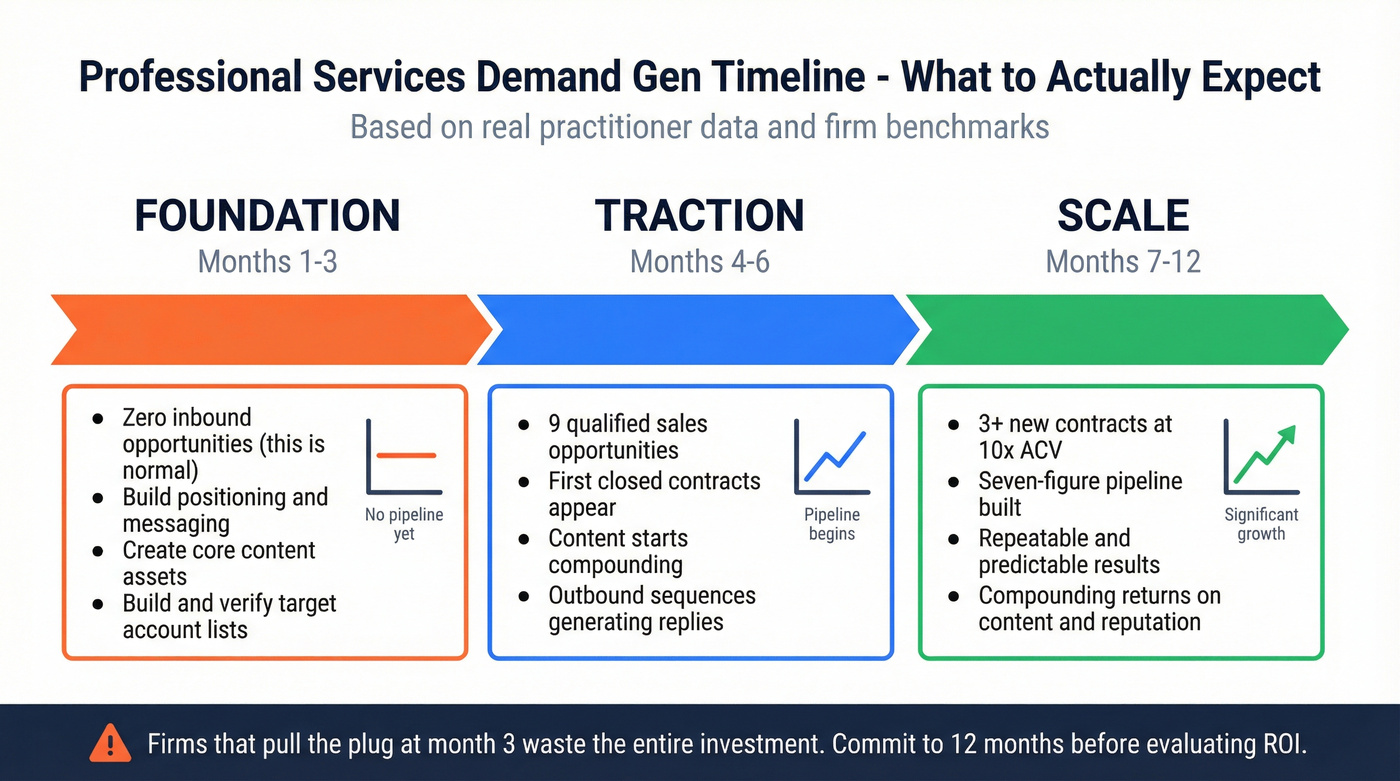
| Stage | Timeline | What to Expect |
|---|---|---|
| Foundation | Months 1-3 | Positioning, content, list building |
| Traction | Months 4-6 | First qualified opportunities |
| Scale | Months 7-12 | Repeatable pipeline, compounding returns |
On the agency side, engagements often start around $10K for foundational positioning and planning, with full implementation commonly landing in the $30K-$100K/year range depending on scope and channels. Mid-market firms often invest $50K-$150K/year for multi-channel programs, and enterprise programs can exceed $200K/year. Blend's case study with Datel showed a 35% revenue increase and 800% marketing ROI from a positioning and demand gen program - proof that the spend compounds. The 2025 Demand Gen Benchmark Survey found 57% of marketers ranked case studies as their top-performing content format.
If you want to sanity-check whether your pipeline expectations are realistic, compare against sales pipeline benchmarks and adjust your targets accordingly.
Let's be honest about one thing: if your firm's average deal size is under $50K and your partners won't put their names on content, demand gen won't work for you. Hire another salesperson instead. This kind of marketing requires visible experts - partners and senior leaders willing to show up. Without them, you're just another marketing team publishing blog posts nobody reads.
Mistakes That Kill Your Pipeline
Treating demand gen like lead gen. Gating every asset and measuring MQLs builds a list of people who wanted your PDF, not your services. Ungate your best content. The trust you build is worth more than the email address you capture.
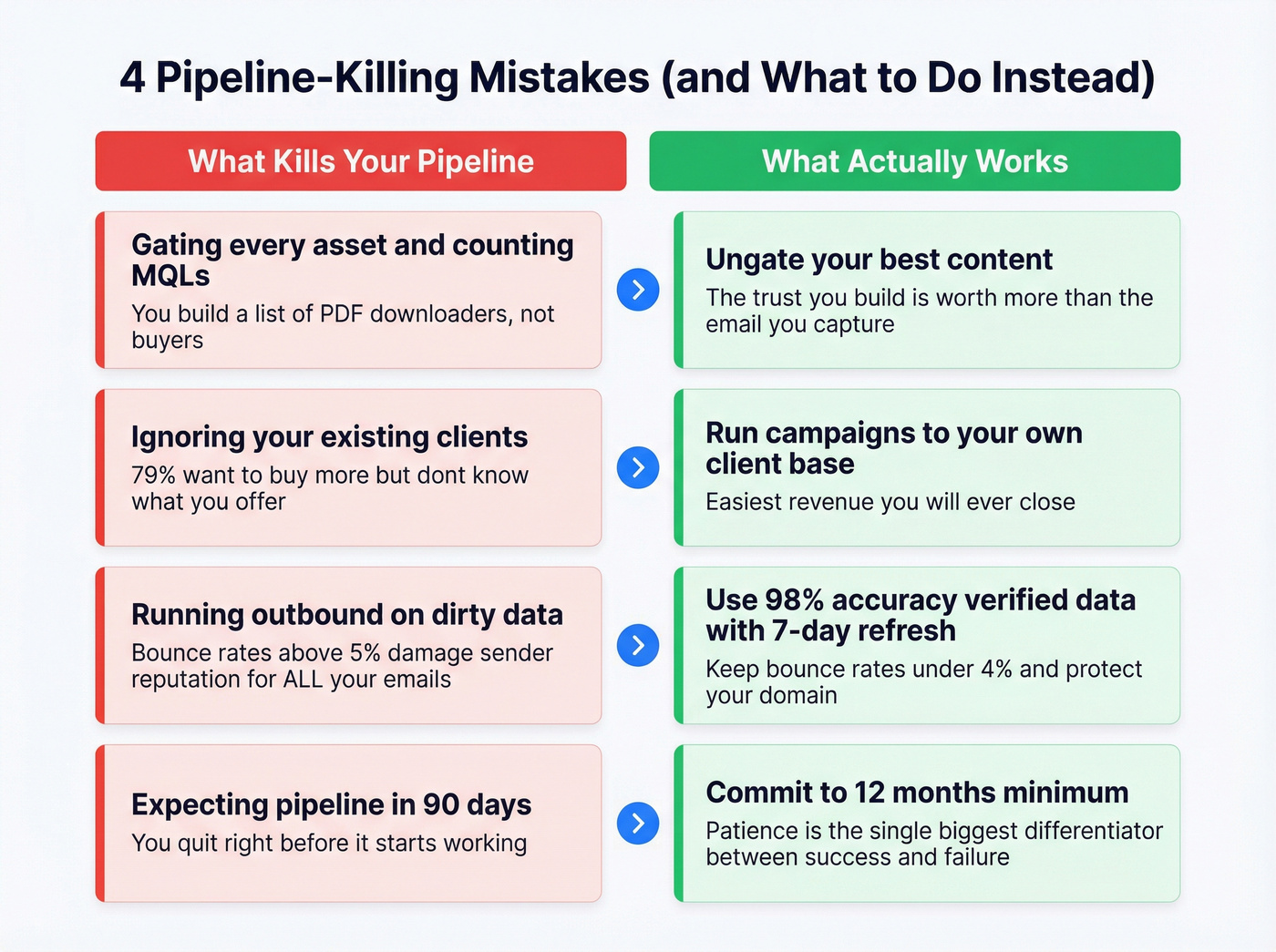
Ignoring existing clients. Remember: 79% of buyers want to buy more from their current provider. If you're not running campaigns toward your own client base, you're leaving revenue on the table - and it's the easiest revenue you'll ever close.
Running outbound on dirty data. Bounce rates above 5% damage your sender reputation. Every bounced email makes your next campaign less effective, and the damage compounds fast. I've talked to firms that spent six months rebuilding domain reputation after a single bad campaign on an unverified list. (If you’re actively repairing deliverability, follow a step-by-step plan to improve sender reputation.)
Expecting pipeline in 90 days. Services demand gen compounds. Patience is the single biggest differentiator between firms that succeed and those that abandon the effort right before it starts working.
FAQ
How long does demand gen take for professional services?
Expect three months of groundwork before qualified opportunities appear. Most firms see meaningful pipeline by month six and predictable, repeatable results by 12-18 months. Pulling the plug before month six wastes the entire investment.
What's the best content format for services firm demand gen?
Case studies - 57% of marketers rank them as the top-performing format. Pair them with executive thought leadership pieces for maximum trust-building across the buying committee.
How do you run outbound without damaging your domain?
Start with verified contact data - 98% accuracy minimum. Warm your sending domain gradually, cap daily volume at 30-50 emails per mailbox, and never blast an unverified list. A 7-day data refresh cycle and multi-step verification keep bounce rates under 4%, protecting deliverability across every campaign.
Can small firms afford demand generation?
Yes, but scope matters. A two-partner consulting firm won't run enterprise ABM. Focus on one channel: thought leadership via executive posts, or targeted outbound with verified data at roughly $0.01 per lead. Budget $2K-$5K/month and commit for 12 months. The firms that fail aren't the ones that spend too little - they're the ones that quit too early.