

Demo Coaching: How to Turn Every Sales Demo Into a Closed Deal
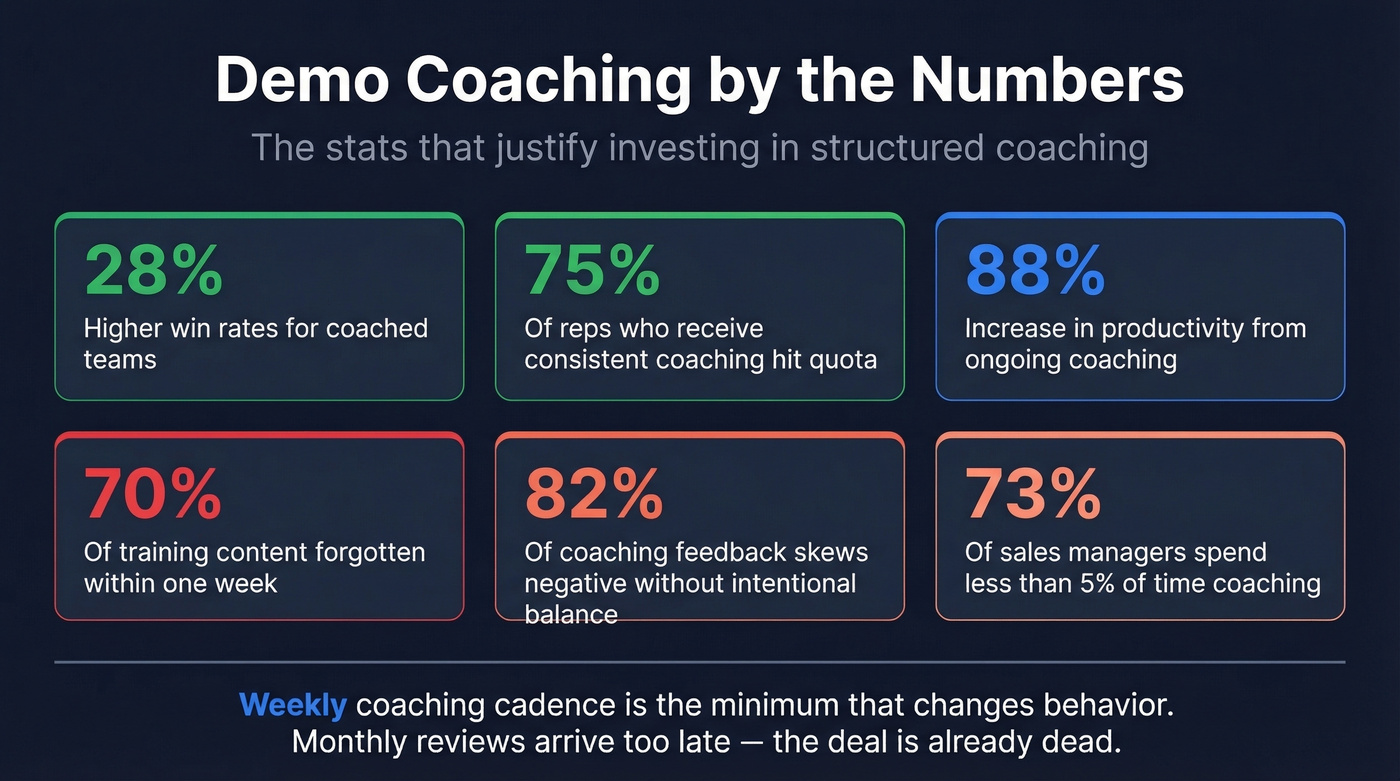
Seventy-three percent of sales managers spend less than 5% of their time coaching. Meanwhile, teams with effective coaching programs see 28% higher win rates, and 75% of reps who receive consistent coaching hit quota. The math is obvious. The execution isn't - especially when it comes to demo coaching, the single moment where buyers pay the most attention to your team.
If you're looking for ICF credentialing demo recordings, wrong article. This is about coaching sales reps to run demos that close deals.
The Quick Version
The process breaks into three phases. Get each one right and you're looking at 16.7% higher revenue growth:
- Pre-demo: Confirm your prospect is real, still employed, and has buying authority.
- During the demo: Monitor talk ratio, objection handling, and discovery depth.
- Post-demo: Review recordings, categorize feedback, role-play improvements.
Coaching vs. Training: Why It Matters
Coaching isn't training. Training is a quarterly workshop where someone reads slides about "best practices." Coaching is a manager watching Tuesday's demo recording and saying, "You lost the CFO at minute 12 when you switched to the technical deep-dive - let's work on reading the room."
Reps forget 70% of training content within a week. Coaching reinforces behaviors in context, which is why coached teams see an 88% increase in productivity. It's ongoing, individualized, and tied to specific moments that actually happened on a call - not hypothetical scenarios from a workbook.
Three Phases of Effective Demo Coaching
Pre-Demo Preparation
This is the most overlooked phase. Before reps even open the slide deck, they should answer three questions: Who's in the room? What do they care about? Have we done real discovery?
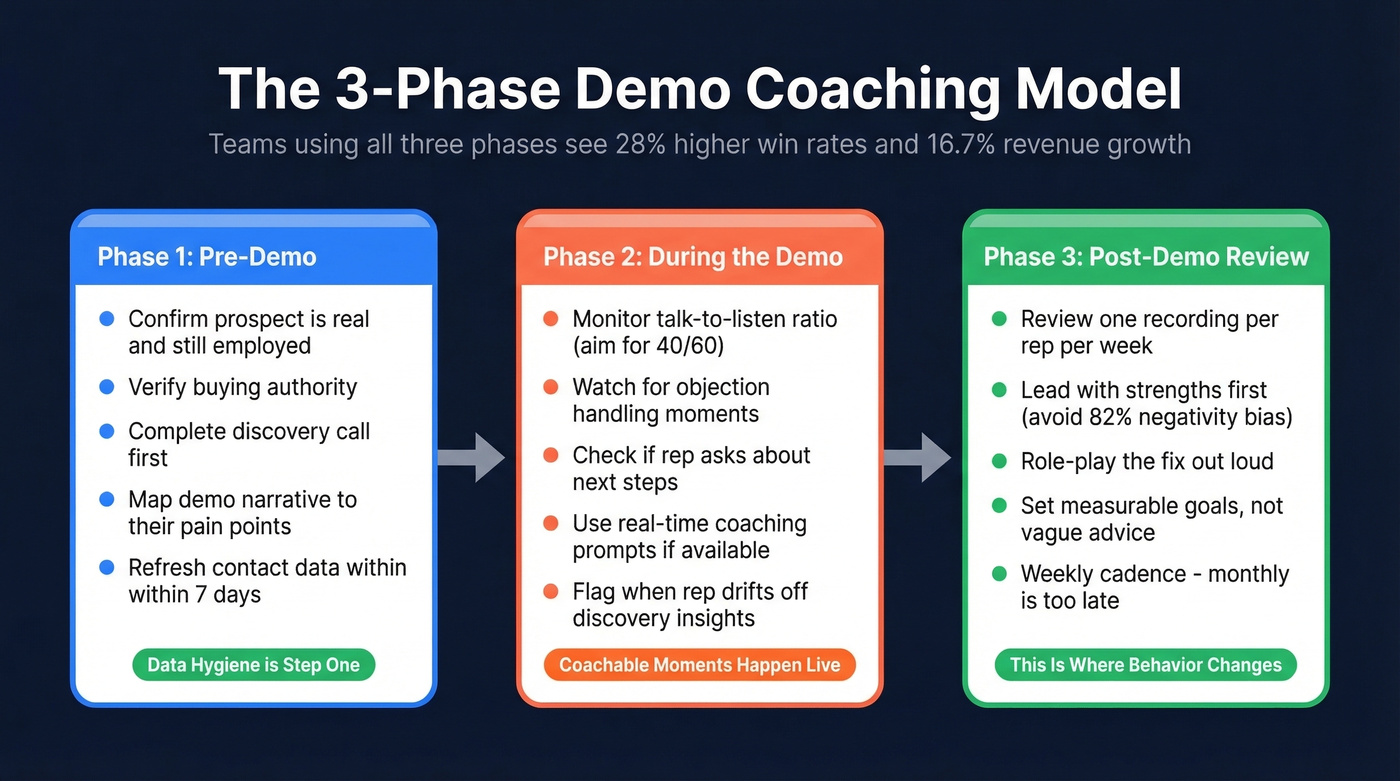
Here's the thing - coaching a great demo is pointless if the rep is presenting to someone who left the company six months ago. We've watched teams waste entire pipeline weeks demoing to bounced contacts, and it's genuinely painful. Prospeo's 7-day refresh cycle and 98% email accuracy eliminate that problem, so reps always reach the right person before they invest 30 minutes in a live walkthrough.
Your pre-demo coaching checklist:
- Discovery call completed (not just scheduled)
- Prospect's role and buying authority confirmed
- Contact data verified within the last 7 days
- Custom demo narrative mapped to prospect's stated pain points
- Competitive landscape researched (use battle cards to keep it tight)

During the Demo
There's a meaningful difference between reviewing a demo after the fact and guiding a rep during the call. Async review is where most teams start, and it works. But real-time coaching tools have gotten genuinely useful in the last year or so.
Balto delivers live prompts when reps hit objections or drift off-script. Revenue.io triggers Salesforce-based cues during conversations. Both focus on the coachable moments: talk-to-listen ratio (aim for 40/60 or better), objection handling, and whether the rep actually asked about next steps. If your reps consistently talk more than 50% of the demo, that's the first behavior to coach (and it’s one of the most predictive sales productivity metrics to track).
Post-Demo Review
This is where most coaching actually happens. A solid post-demo workflow looks like this:
- Review the recording - one demo per rep per week minimum (pair with structured call shadowing for newer reps)
- Categorize feedback - lead with strengths, because 82% of feedback skews negative when managers aren't intentional about balance
- Role-play the fix - don't just tell reps what went wrong, practice the alternative out loud
- Set measurable goals - "Improve discovery question count from 3 to 6 per demo" beats "do better discovery" every time (use SMART Goals to keep it measurable)
Weekly cadence is non-negotiable. Monthly coaching sessions become post-mortems. The deal is already dead by then.

The best demo coaching in the world won't save a rep presenting to a bounced contact. Prospeo's 7-day data refresh and 98% email accuracy ensure every prospect is real, still employed, and reachable - before your rep invests 30 minutes in a live walkthrough.
Fix your pre-demo data before you fix your demo skills.
Ten Demo Mistakes Worth Coaching Out
These anti-patterns kill deals. Each one is coachable if you name it explicitly and show the rep what "good" looks like:
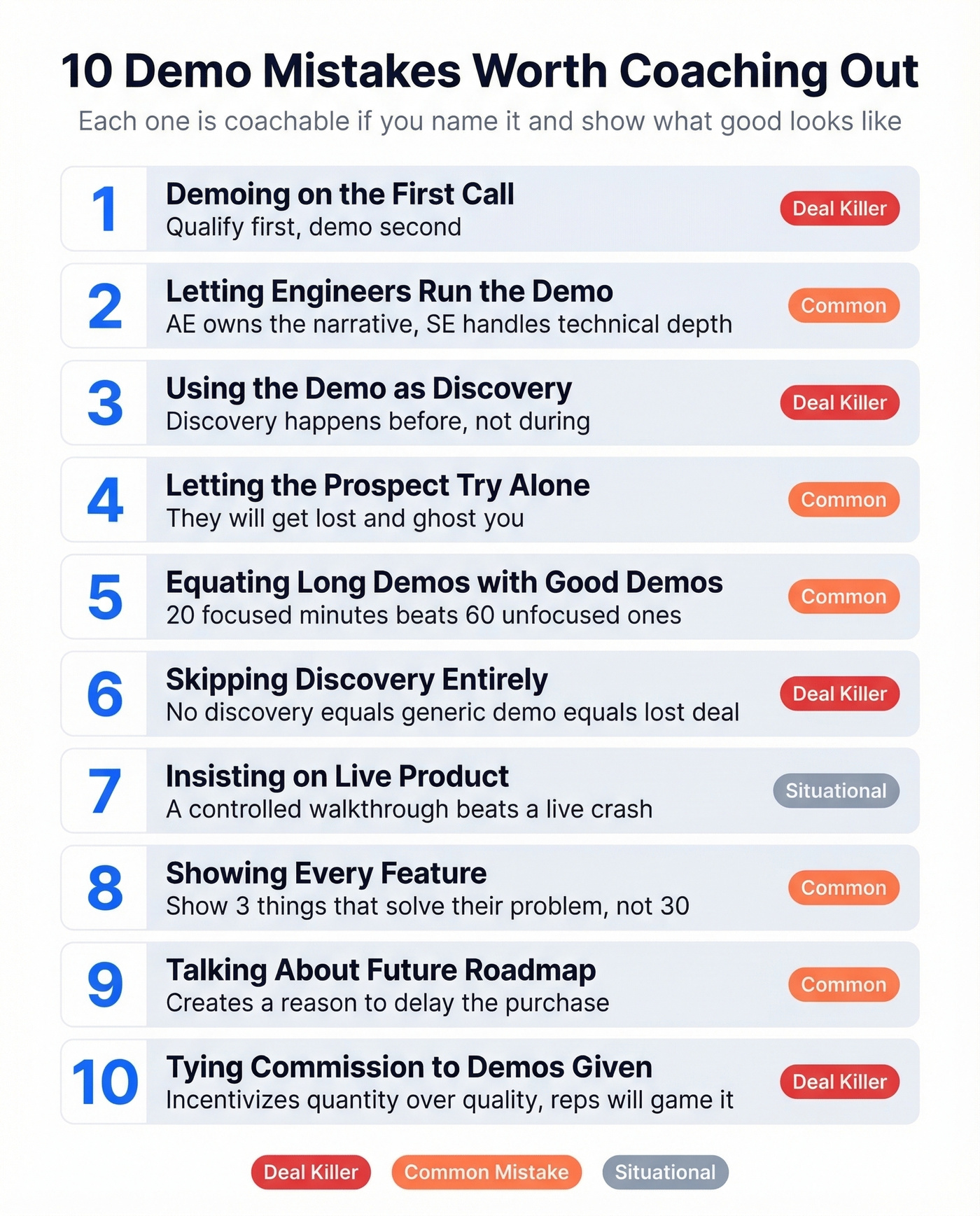
- Demoing on the first call - qualify first, demo second (build a bank of good discovery questions so reps don’t wing it)
- Letting engineers run the demo - the AE owns the narrative; the SE handles technical depth (see what a sales engineer should own vs. the AE)
- Using the demo as discovery - discovery happens before the demo, not during it
- Letting the prospect try alone - they'll get lost and ghost you
- Equating long demos with good demos - 20 focused minutes beats 60 unfocused ones
- Skipping discovery entirely - no discovery = generic demo = lost deal
- Insisting on live product - sometimes a controlled walkthrough beats a live environment that crashes mid-sentence
- Showing every feature - show three things that solve their problem, not thirty things that might (reps who nail features vs benefits win more)
- Talking about future roadmap - creates a reason to delay the purchase decision
- Tying commission to demos given - incentivizes quantity over quality, and reps will game it immediately
The GROW Framework for Demos
The GROW model adapts well to structuring coaching conversations around demos:
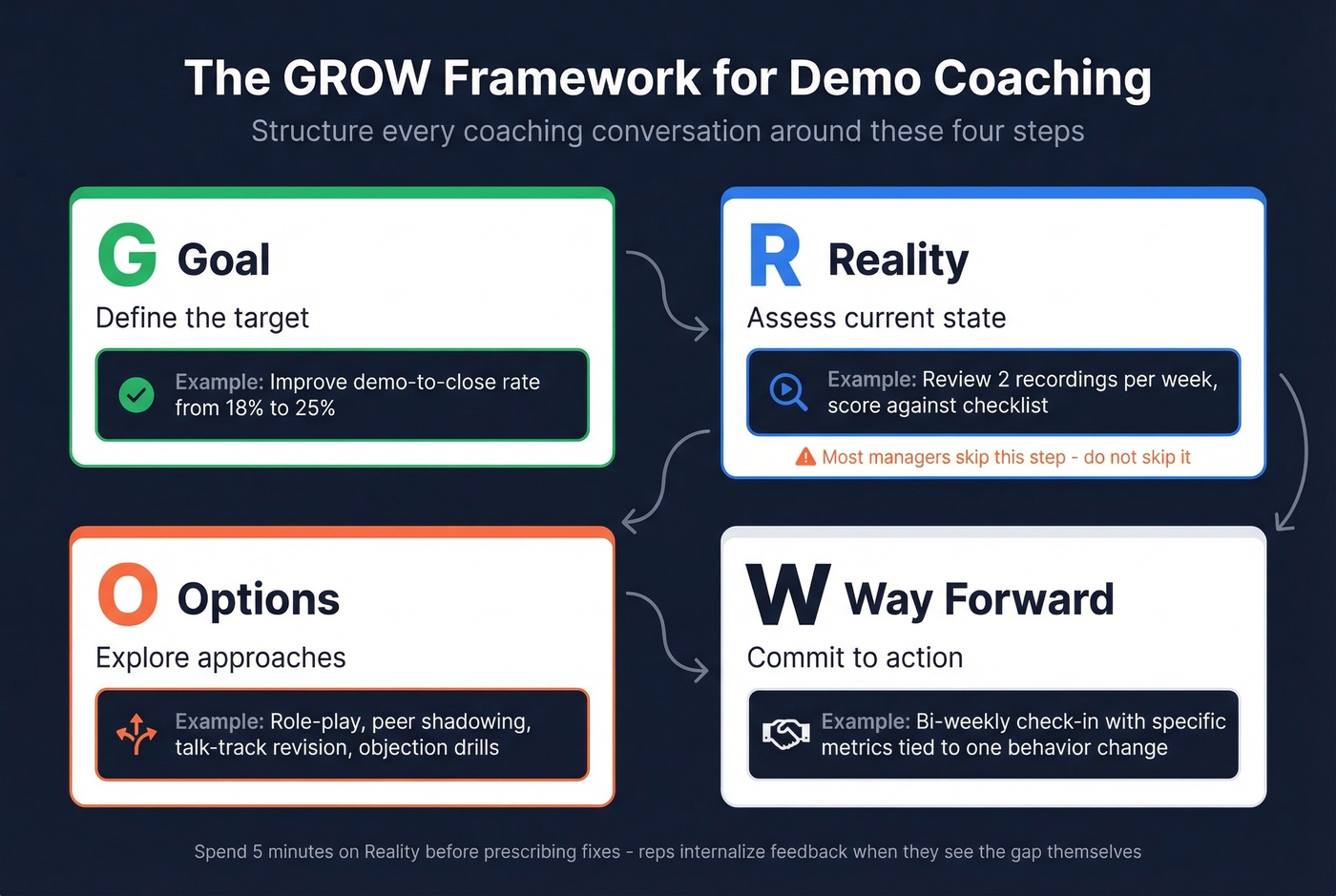
| Step | What It Means | Example |
|---|---|---|
| Goal | Define the target | "Improve demo-to-close from 18% to 25%" |
| Reality | Assess current state | Review 2 recordings/week, score against checklist |
| Options | Explore approaches | Role-play, peer shadowing, talk-track revision |
| Way Forward | Commit to action | Bi-weekly check-in with specific metrics |
Let's be honest - most managers skip the "Reality" step and jump straight to telling reps what to do differently. That's not coaching. Spend five minutes on the current state before prescribing fixes, and the rep will actually internalize the feedback instead of nodding along.
Tools and Pricing (2026)
You don't need a $50k platform. But the right tool at the right phase makes coaching scalable.
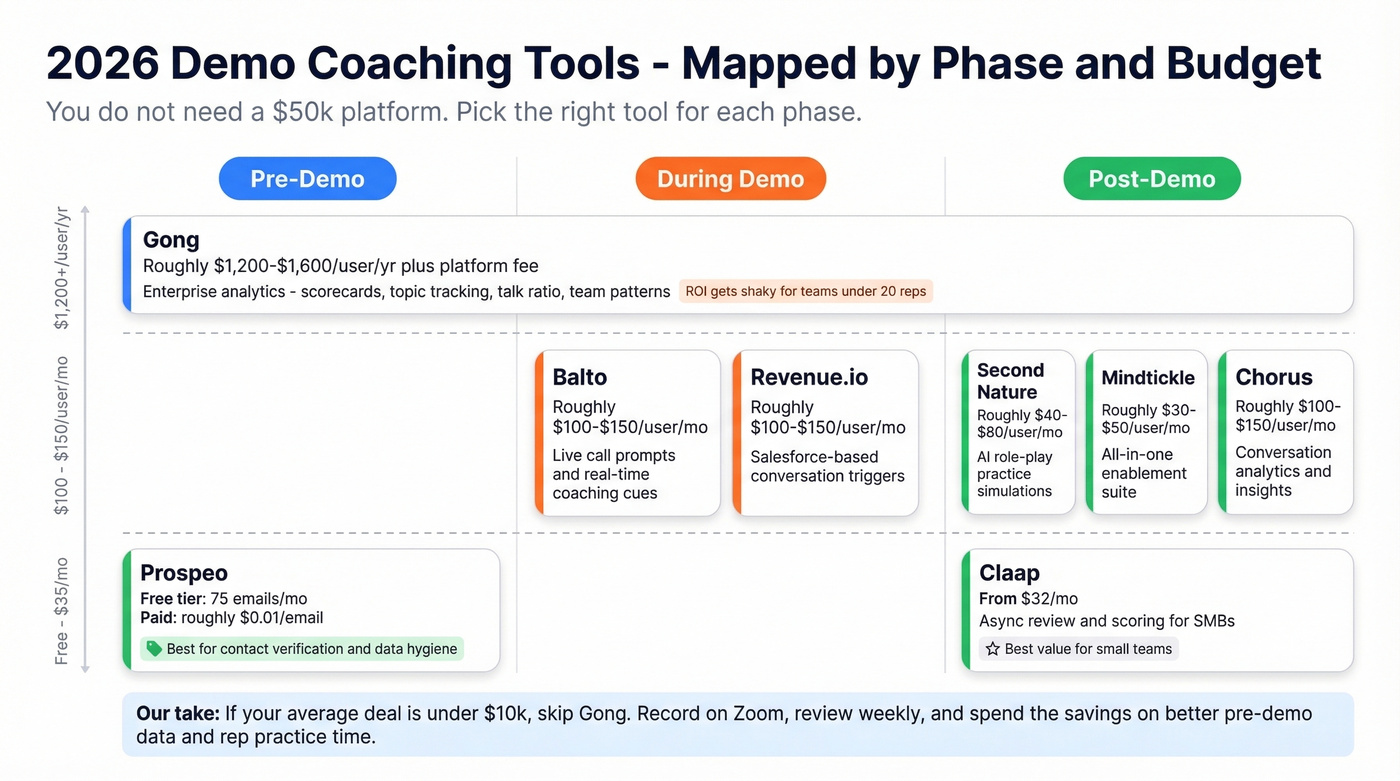
| Tool | Category | Starting Price | Best For |
|---|---|---|---|
| Gong | Conversation intel | ~$1,200-$1,600/user/yr + platform fee | Enterprise analytics |
| Prospeo | Pre-demo data | Free (75 emails/mo), ~$0.01/email paid | Contact verification |
| Chorus | Conversation intel | ~$100-$150/user/mo | Conversation analytics |
| Claap | Async review | From $32/mo | SMBs, scoring |
| Balto | Real-time coaching | ~$100-$150/user/mo | Live call prompts |
| Second Nature | AI role-play | ~$40-$80/user/mo | Rep practice sims |
| Mindtickle | Enablement suite | ~$30-$50/user/mo | All-in-one enablement |
Gong is the default for a reason - scorecards, topic tracking, talk ratio analysis, and team-wide pattern identification. It's also expensive once you add seats and platform fees, and for teams under 20 reps, the ROI math gets shaky fast.
For teams that just need recording review and basic scoring, Claap Pro at $32/mo does the job at a fraction of the cost.
Our take: If your average deal is a sub-$10k contract, you don't need Gong. Record on Zoom, review one demo per rep per week, and spend the savings on better pre-demo data and rep practice time. We've watched small teams outperform enterprise squads with this exact approach - the bottleneck is almost never the software (if you want a broader stack view, start with sales enablement tools).
Your pre-demo checklist says 'confirm buying authority' - but how? Prospeo gives reps 30+ filters including job changes, department headcount, and org-level signals so they walk into every demo knowing exactly who holds the budget. At $0.01 per verified email, it costs less than the coffee your rep drinks during the call.
Arm every rep with verified decision-maker data before they demo.
How Demo Coaching Fails
Skip this if you're already doing weekly reviews: Coaching once a month isn't coaching. It's a post-mortem. Weekly is the minimum cadence that changes behavior.
Skip this too: Coaching results instead of behaviors. "You need to close more demos" isn't coaching. "You're spending 8 minutes on pricing before establishing value - let's flip that sequence" is.
And the subtlest failure: one-size-fits-all feedback. Your top rep and your newest hire need completely different coaching. The veteran needs micro-adjustments on specific objection patterns; the new hire needs help structuring the first five minutes so they don't lose the room before they've said anything useful (this is where coachability becomes a real hiring and development lever).
Sales teams on r/sales regularly ask about structured demo coaching programs - the demand is real, but most advice stays generic. The fix isn't complicated: one recording per rep per week, structured strengths-first feedback, and a manager who actually watches the demos. Everything else is optimization.
FAQ
What's a good demo-to-close rate?
Most SaaS teams land between 15-30%. Consistent coaching pushes teams toward the higher end - coached organizations report 28% higher win rates. If you're below 15%, start by auditing whether reps are running real discovery before the demo.
How often should managers review demos?
Weekly at minimum. Review at least one recording per rep per week with structured, strengths-first feedback. Monthly reviews arrive too late - the deal and the behavior are already locked in.
Can you coach demos without expensive software?
Yes. Record on Zoom, review weekly, and use the GROW framework. Claap Pro starts at $32/mo for async review if you want scoring capabilities. Pair that with a free-tier contact verification tool for pre-demo data hygiene and your total cost stays under $35/month.
What's the biggest demo coaching mistake managers make?
Focusing on what went wrong instead of reinforcing what worked. Research shows 82% of coaching feedback skews negative when managers aren't intentional about it. Lead with one specific strength, then address one behavior to change - never more than two fixes per session, or the rep walks away overwhelmed and changes nothing.