

The Difference Between B2B and B2C: What the Numbers Actually Say
B2B ecommerce runs 3-5x larger than B2C globally - roughly $28-32T+ in 2026 estimates vs $5-7T by 2027 - and the difference between B2B and B2C touches everything from your sales cycle to your tech stack to how much it costs to acquire a single customer. Yet every explainer gives you the same two paragraphs of definitions and a vague table full of words like "longer" and "more complex."
That's not useful. The benchmarks below come from real datasets, and they'll tell you more about the B2B/B2C divide than any Venn diagram ever could.
B2B vs B2C at a Glance
Every row uses real numbers, not hand-wavy descriptors.
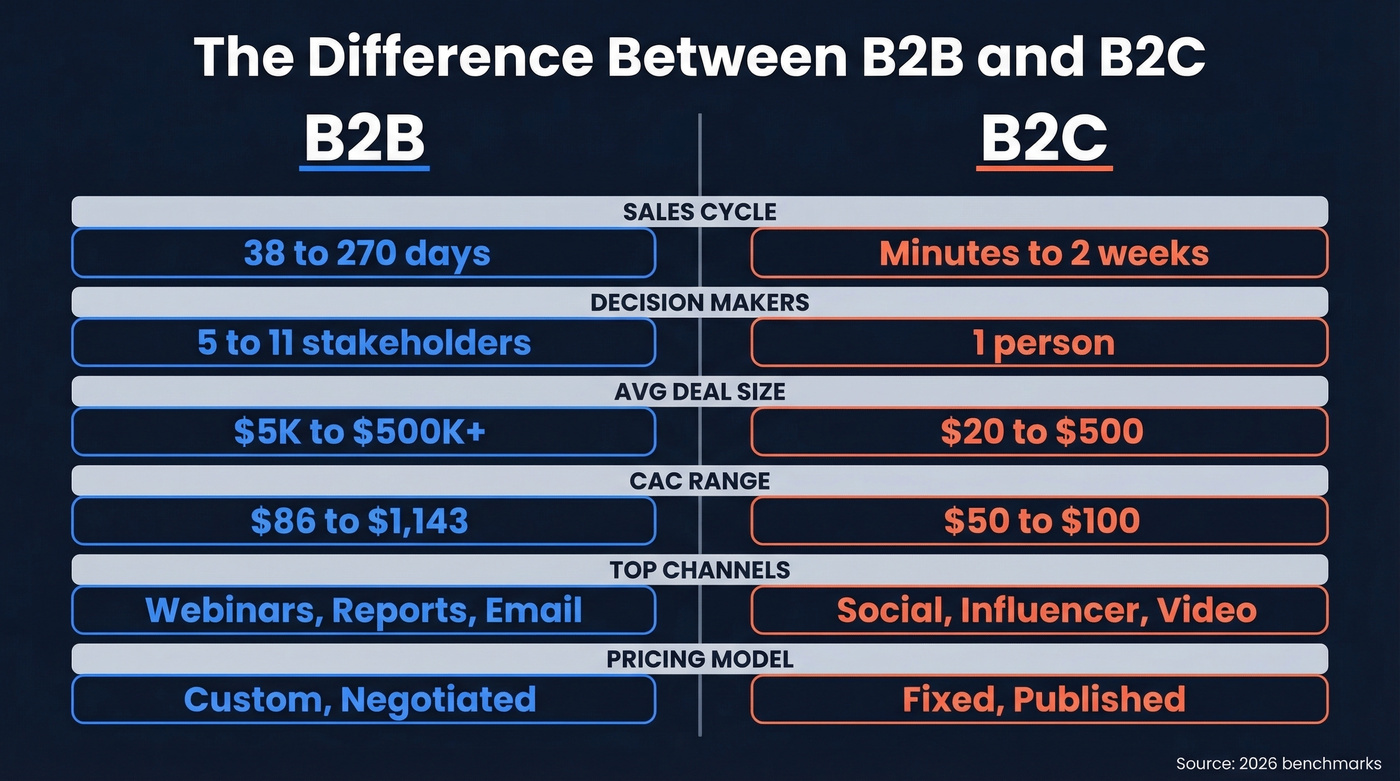
| Dimension | B2B | B2C |
|---|---|---|
| Audience | Companies (2,000-50,000 TAM) | Consumers (millions+) |
| Sales cycle | 38-270 days | Minutes to 2 weeks |
| Decision-makers | 5-11 stakeholders | 1 person |
| Avg deal size | $5K-$500K+ | $20-$500 |
| CAC range | $86-$1,143 | $50-$100 |
| Marketing channels | Webinars, reports, ebooks | Social, influencer, video |
| Relationship type | Long-term, account-based | Transactional, loyalty-based |
| Pricing model | Custom, negotiated | Fixed, published |
| Data infrastructure | CRM + enrichment + intent | Ad tech + personalization |
Now let's unpack the rows that actually matter for how you build your go-to-market.
Sales Cycles: The Biggest Gap
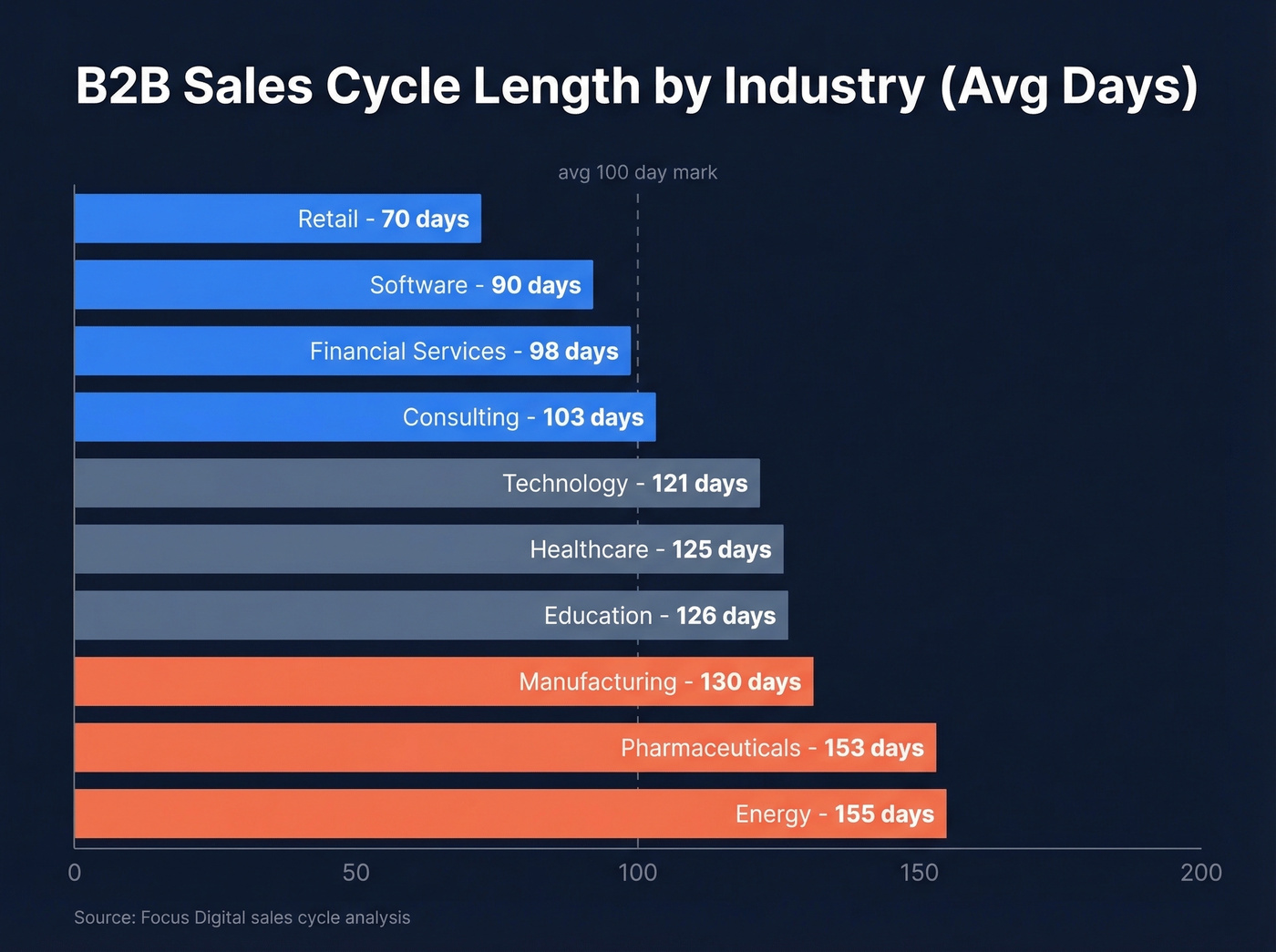
The sales cycle is where these two models split most dramatically. A consumer buys running shoes in 10 minutes. A manufacturing procurement team takes 130 days to sign a vendor contract. Here's the breakdown by industry, based on Focus Digital's sales cycle analysis:
| Industry | Avg Days |
|---|---|
| Retail | 70 |
| Software | 90 |
| Financial Services | 98 |
| Consulting | 103 |
| Technology | 121 |
| Healthcare | 125 |
| Education | 126 |
| Manufacturing | 130 |
| Pharmaceuticals | 153 |
| Energy | 155 |
Company size matters just as much as industry. A 10-person startup closes in about 38 days. A 10,001+ employee enterprise? 185 days. And deal size compounds the effect: sub-$1K deals average 25 days, while deals over $500K stretch to 270 days.
The channel you use to source the deal changes things too. Inbound leads from SEO close in roughly 28 days for low-complexity deals. Cold calling the same prospect? 60 days. Referrals are fastest at around 20 days. We've seen this pattern hold across dozens of pipeline reviews - the source of the lead predicts the cycle length almost as reliably as the deal size does. And with 80% of B2B sales interactions now conducted virtually, the entire cycle plays out through screens, not handshakes.
Who Makes the Decision
Here's the thing most B2C marketers don't appreciate about B2B: you're not selling to a person. You're selling to a committee.
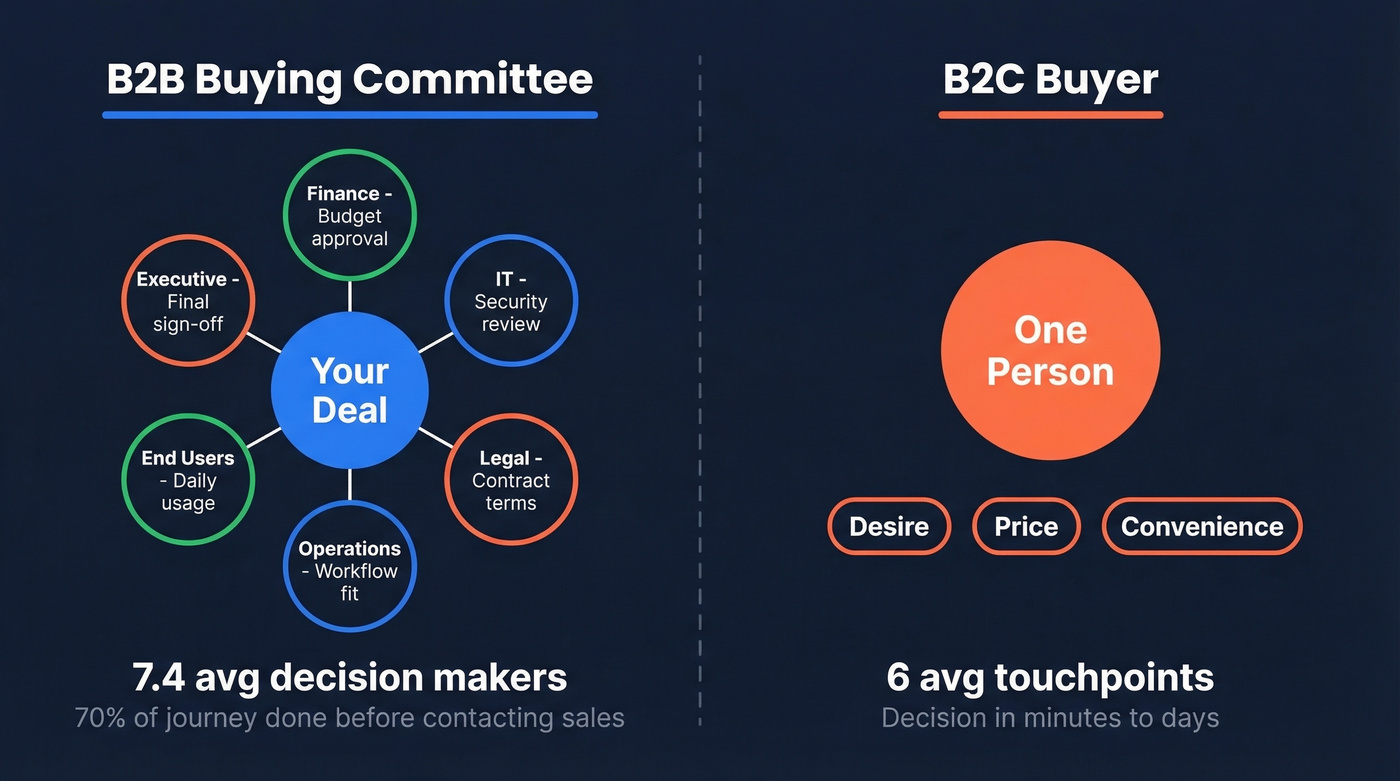
The average B2B purchase involves 7.4 decision-makers. At the enterprise level, buying groups typically include 5-11 stakeholders across roughly 5 distinct business functions - finance, IT, operations, legal, and the end-user team. Each stakeholder has different concerns, different evaluation criteria, and different political incentives. Meanwhile, 70% of the buyer's journey is complete before anyone contacts your sales team, and 61% of B2B buyers say they'd prefer a completely rep-free buying experience. That's not a trend. It's the new default.
B2C is simpler on the surface: typically one person, roughly six touchpoints on average, and a decision driven by desire, price, and convenience.
But the old "B2B is rational, B2C is emotional" framing is misleading. B2B buyers are humans. They have emotional responses to your brand, your demo, your sales rep's energy. Ask any seller who's crossed over from B2C and they'll tell you the same thing in r/sales threads: the hardest adjustment isn't the longer cycle - it's learning to navigate internal politics you never see. The real distinction isn't that B2B buyers lack emotion. It's that they must translate their gut feeling into ROI language that survives a committee review.
Unit Economics: CAC and LTV
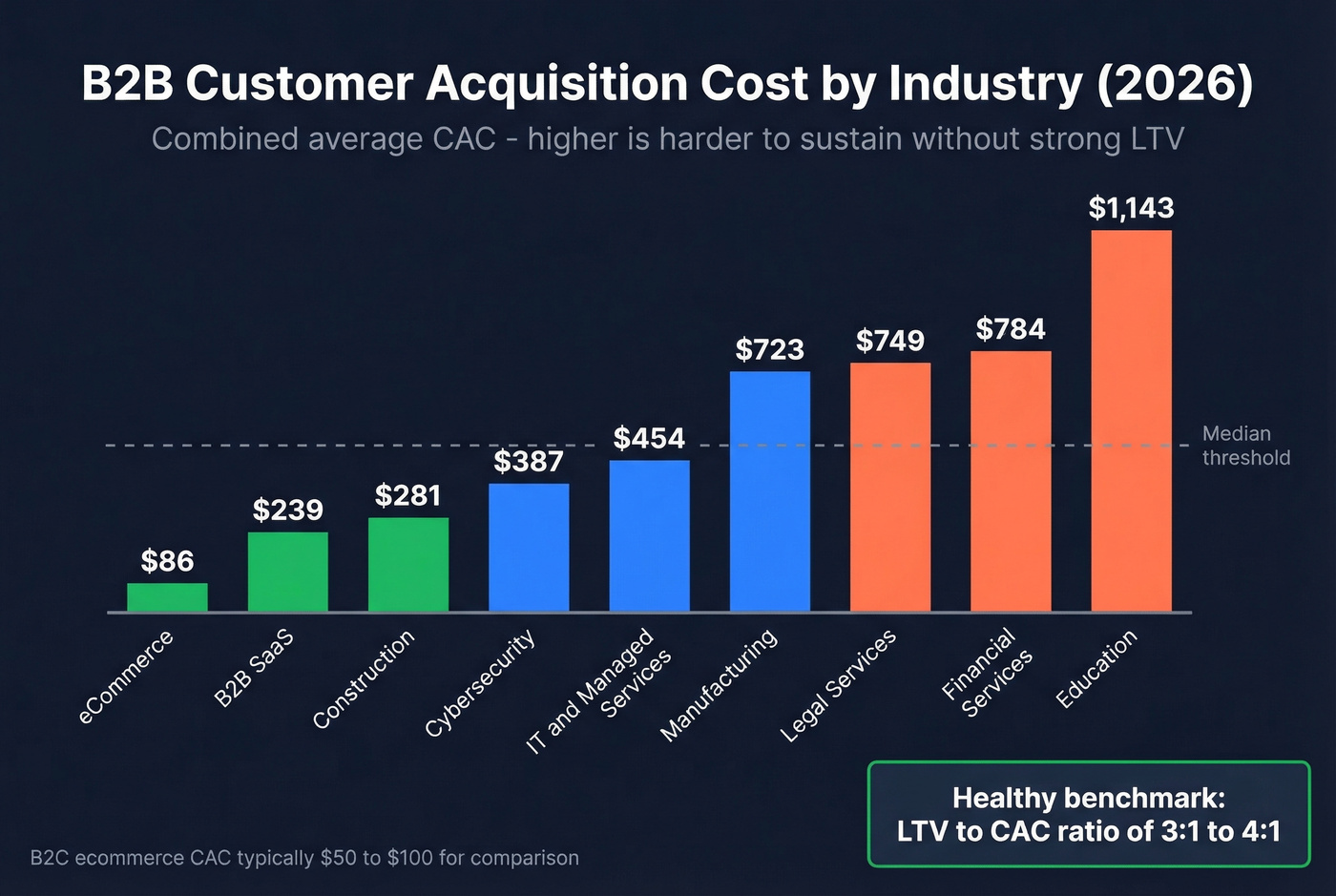
Customer acquisition cost is where the economic models diverge sharply. Here are B2B CAC benchmarks by industry:
| Industry | Combined Avg CAC |
|---|---|
| eCommerce | $86 |
| B2B SaaS | $239 |
| Construction | $281 |
| Cybersecurity | $387 |
| IT & Managed Services | $454 |
| Manufacturing | $723 |
| Legal Services | $749 |
| Financial Services | $784 |
| Education | $1,143 |
B2C ecommerce CAC typically runs $50-$100. The numbers look lower, but B2C margins are thinner and churn is higher. The healthy benchmark for both models is a LTV:CAC ratio of 3:1 to 4:1 - if you're spending $1 to acquire a customer, that customer should generate $3-$4 in lifetime value.
What inflates B2B CAC faster than anything? Bad data. When your outbound sequences bounce 20-35% of emails, you're burning budget on messages that never arrive. Fixing your data foundation - through verification tools like Prospeo that cut bounce rates from 35% to under 4% - directly reduces cost per meeting and pulls your CAC back toward healthy territory. If you want the full breakdown, start with cost to acquire a customer and work backward from your funnel math.

The article above shows B2B CAC ranges from $86 to $1,143. Bad data inflates those numbers fast - bounced emails, wrong contacts, wasted sequences. Prospeo cuts bounce rates from 35% to under 4% with 98% verified emails across 300M+ profiles, so every dollar of your B2B acquisition spend actually reaches a real buyer.
Stop paying enterprise CAC on data that bounces. Fix the foundation.
Marketing and Content Strategy
B2B and B2C marketing look nothing alike in practice, even when they share the same channels.
B2B buyers consume content like researchers. 71% review multiple content assets before making a decision, and the most valued formats early in the journey are webinars (57%), research reports (53%), blog posts (52%), and ebooks (48%). Here's what surprised us: 84% of B2B marketers say brand awareness is their top content marketing goal - not lead gen, not demand capture. Awareness. That's a meaningful shift from even two years ago.
67% of B2B buyers choose vendors who demonstrate stronger knowledge of their company and needs, and 61% cite higher-quality content as a deciding factor. You win by being the most informed voice in the room, not the loudest. If you're building this motion, it helps to map it against what is B2B content marketing.
B2C marketing runs on a different engine entirely. Emotional storytelling, influencer partnerships, social proof, and loyalty programs drive consumer behavior. B2B lives on email, webinars, and trade shows, while B2C dominates Instagram, TikTok, and YouTube. A B2C brand can go viral on a 15-second video. A B2B brand goes viral on a benchmark report that gets shared in Slack channels. Different games, different rules.
Our hot take: if your average contract value sits below $15K, you probably don't need a sophisticated ABM program or a 6-person content team. A sharp outbound motion with clean data will outperform a bloated content operation every time. Save the thought-leadership machine for when your deal sizes justify the investment.
Data and Tech Infrastructure
This is the section that matters most if you're actually building a sales operation, and it's the one most B2B vs B2C guides skip entirely.
The B2B tech stack revolves around data quality: CRM, enrichment tools, prospecting databases, intent data, and email verification. The B2C stack centers on scale: ecommerce platforms, personalization engines, ad tech, and attribution tools. Both are complex, but the failure modes are different. If you're auditing your stack, start with data enrichment and work outward.
In B2C, a 5% bounce rate on a 100,000-person email blast is noise. You lose some deliverability, you adjust, you move on. In B2B, where your total addressable list might be 2,000 accounts, every bad email is a missed deal. Every wrong phone number is a conversation that never happens. Data quality isn't a nice-to-have - it's existential.

We've watched this play out firsthand. Teams running outbound with unverified lists see 20-35% bounce rates, tanked sender reputation, and a pipeline that flatlines. Teams that invest in verification infrastructure - weekly data refreshes, catch-all handling, spam-trap removal - see the opposite: bounce rates under 4%, reply rates that climb, and meetings that actually book. The difference isn't marginal. It's a different business.
Pricing Models
| Dimension | B2B | B2C |
|---|---|---|
| Structure | Custom, negotiated | Fixed, published |
| Payment terms | Net 30/60/90 | Immediate |
| Transparency | "Talk to sales" | Price on page |
| Trend (2026) | Moving to self-serve | Growing subscriptions |
B2B pricing has historically been opaque by design - custom quotes, annual contracts, and procurement negotiations that drag for weeks. B2C pricing is the opposite: transparent, immediate, and optimized for conversion.
The interesting trend in 2026 is convergence. B2B buyers increasingly expect B2C-style transparency. They want to see pricing before talking to a rep. The "talk to sales" model isn't dead, but it's losing ground fast, especially with SMB and mid-market buyers who've grown up buying software the way they buy everything else - self-serve onboarding, transparent per-unit pricing, and cancel-anytime terms are becoming table stakes for any B2B tool targeting teams under 200 people.
Skip this section if you're already running transparent pricing. But if your sales page still says "contact us for a quote" and your ACV is under $25K, you're leaving money on the table. Buyers under that threshold don't want to schedule a call. They want to swipe a card.
Hybrid Models: B2B2C and D2C
Not everything fits neatly into B2B or B2C, and the fastest-growing models often don't.
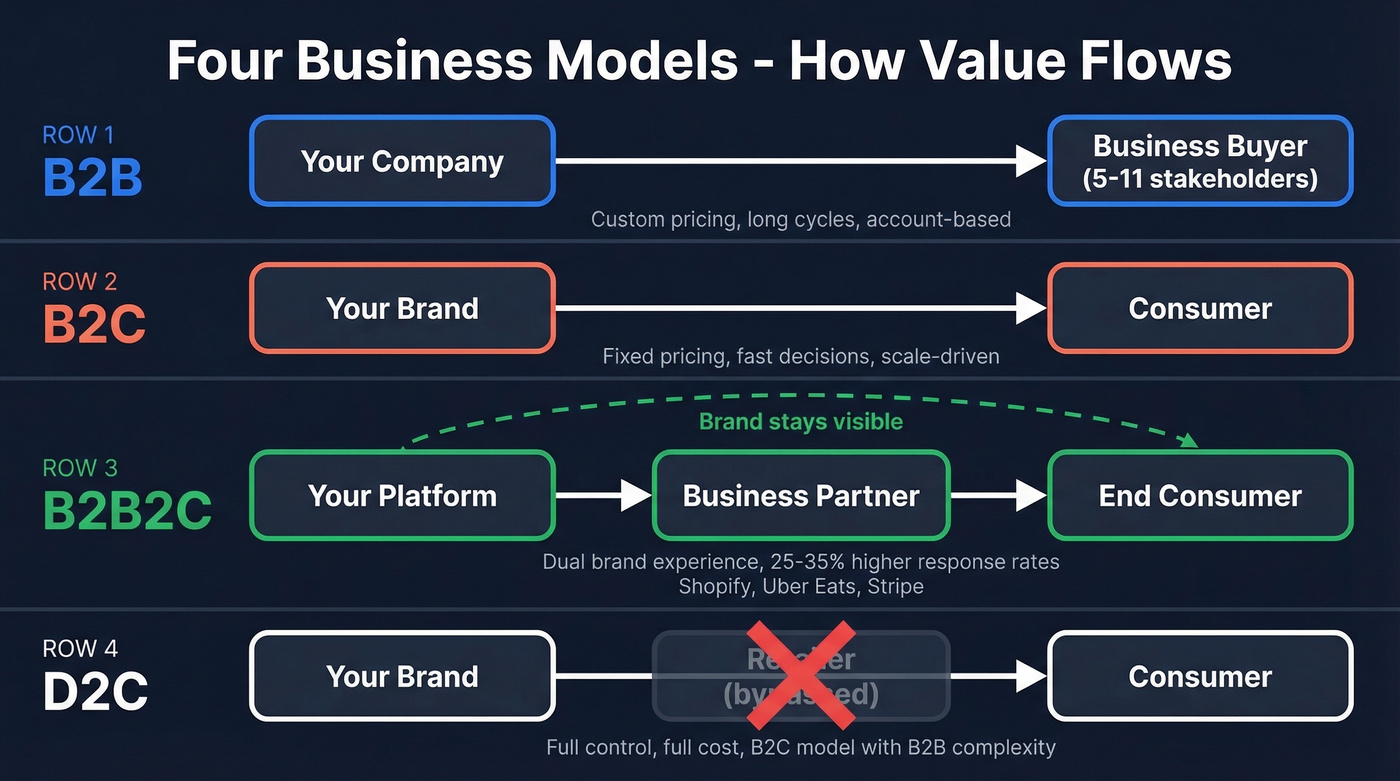
B2B2C - business-to-business-to-consumer - is a model where a company sells through a business partner while maintaining brand visibility and a direct connection with the end customer. Unlike white-label arrangements where the original brand disappears, B2B2C keeps both brands visible. Think restaurants on Uber Eats, merchants on Amazon Marketplace, or payment processors like PayPal and Stripe embedded in checkout flows. Shopify is the textbook example: it sells a platform to businesses (B2B) that then sell to consumers, creating a dual-brand experience where Shopify's infrastructure powers the merchant's storefront. The model works because it aligns incentives - the platform grows when its partners grow, and co-branding in B2B2C generates 25-35% higher response rates compared to single-brand promotion.
D2C (direct-to-consumer) is the inverse play. Brands like Warby Parker and Casper bypass retailers entirely, selling straight to the end customer. D2C gives you full control over pricing, customer experience, and data - but you absorb all the acquisition costs that a retail partner would normally share. It's a B2C model with B2B-level operational complexity, and the brands that win at it treat their data and logistics infrastructure with the same rigor a B2B company brings to its CRM.
The risks in both models are real. Partner dependency in B2B2C means a platform change can disrupt your entire distribution. D2C brands face rising CAC as paid social gets more expensive. Diversifying distribution channels is the standard hedge, but it adds operational complexity you need to plan for.
Which Model Fits Your Business?
The difference between B2B and B2C isn't academic - it determines your tech stack, your hiring plan, your content strategy, and your unit economics. Get the model wrong and you'll burn budget for months before figuring out why.
If you're selling a high-ACV product to a defined set of companies, you're B2B. Invest in data infrastructure, build for long cycles, and staff for account-based selling. If you're selling a low-price product to millions of individuals, you're B2C. Invest in brand, optimize for speed, and build a conversion machine. And if you're somewhere in between, study the hybrid models above and pick the one that matches your distribution reality, not your aspiration.
B2B deals involve 5-11 stakeholders across multiple departments. You need verified contact data for every person on that buying committee - not just the one who filled out your form. Prospeo gives you direct emails and mobile numbers for entire decision-making groups, with 30+ filters to target by role, department, and company size.
Reach the full buying committee, not just one gatekeeper.
FAQ
What is B2B and B2C sales?
B2B sales means selling products or services from one business to another - software platforms, consulting, industrial equipment - while B2C sales targets individual consumers, like retail or streaming subscriptions. B2B relies on multi-stakeholder alignment and longer negotiation cycles; B2C prioritizes speed, convenience, and emotional appeal.
What's a real-world example of B2B vs B2C?
Salesforce selling CRM software to enterprises is B2B. Nike selling sneakers to consumers on nike.com is B2C. Shopify is both - it sells a platform to businesses (B2B) that then sell to consumers, making it a B2B2C hybrid.
Can a company be both B2B and B2C?
Yes, and it's increasingly common. Apple sells iPhones to consumers (B2C) and enterprise device management to IT departments (B2B). Amazon runs a consumer marketplace (B2C) and AWS cloud infrastructure (B2B). The go-to-market motions are completely different even within the same company.
Which is more profitable - B2B or B2C?
B2B typically delivers higher margins and customer lifetime value but with longer sales cycles and higher acquisition costs - CAC ranges from $86 to $1,143 by industry. B2C generates faster revenue but thinner margins. Profitability depends on your LTV:CAC ratio and operational efficiency, not the model itself.
What tools do B2B teams need that B2C teams don't?
B2B teams need prospecting and data infrastructure - CRMs, email finders, enrichment platforms, and verification tools - because they target a finite number of accounts and decision-makers. B2C teams invest more in ad tech, personalization engines, and ecommerce platforms built for high-volume, low-touch transactions.