

Digital Marketing Demand Generation: What Actually Works in 2026
Here's a pattern we see constantly: a team runs digital marketing demand generation across 14 channels. Content output doubles. Ad spend climbs 30%. Pipeline stays flat. Cold emails pull a 2% reply rate. Marketing contributes nearly 50% of pipeline across most B2B companies - but only when the effort is focused.
The short version:
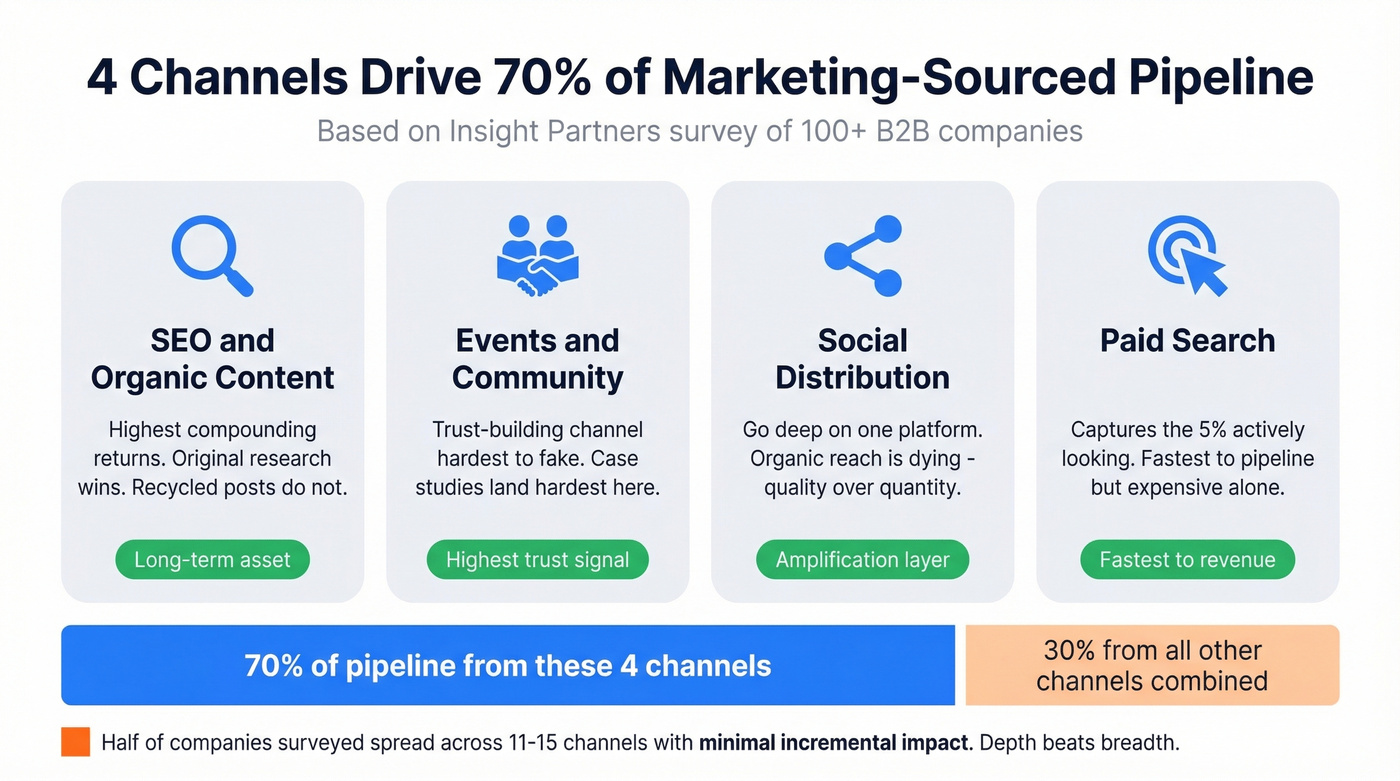
- Focus on 4 channels, not 15. SEO, events, social, and paid search drive 70% of marketing-sourced pipeline across 100+ companies surveyed by Insight Partners.
- Measure pipeline, not MQLs. 25% of companies are still evaluated on marketing qualified leads. That's a vanity metric dressed up as accountability.
- Fix your data before scaling anything. 60% of brands don't even measure the cost of bad data. If your contact list bounces 15%+, no channel strategy saves you. (If you're diagnosing deliverability, start with bounce rate benchmarks and fixes.)
What Is Demand Generation?
Demand generation isn't a synonym for lead generation, and it's not just "top of funnel." It's the full system that makes your target market aware you exist, trust you're credible, and remember you when they're ready to buy.
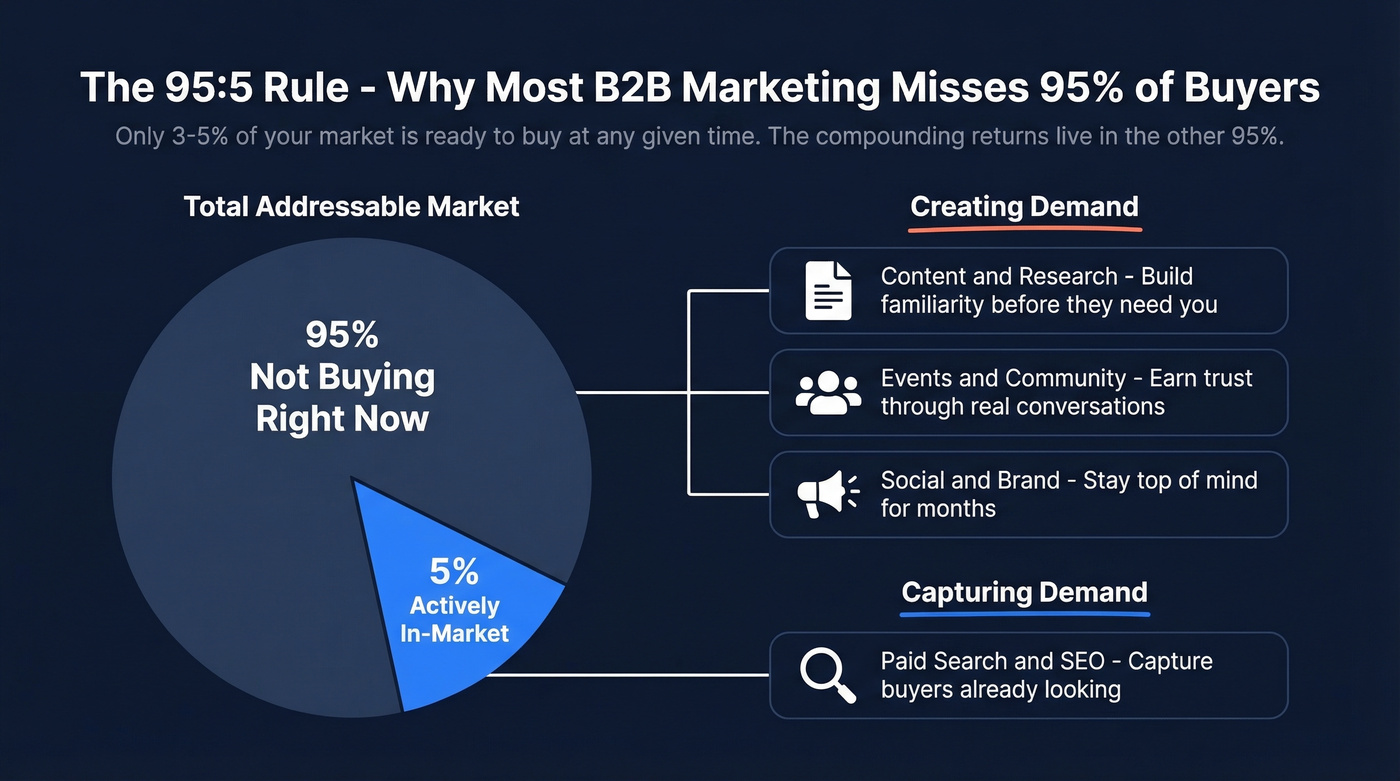
The math is brutal: only 3-5% of your market is actively buying at any given time. That's the 95:5 rule. If your brand only shows up when buyers are in-market, you've already lost - they'll default to whoever built familiarity during the other 95% of the buyer journey.
Creating demand engages that 95% through content, events, social presence, and brand-building. Capturing demand targets the 5% already searching. Most teams over-invest in capture because it feels immediate. The compounding returns live in creation.
Demand Gen vs. Lead Gen
| Demand Gen | Lead Gen | |
|---|---|---|
| Goal | Build awareness + trust | Convert interest into contacts |
| Audience | 95% of TAM not yet buying | Small in-market segment |
| Metrics | Brand search, share of voice | Form fills, CPL |
| Time horizon | Months to years | Short-term pipeline |
Most teams over-invest in lead gen because it feels concrete. Gating every piece of content and counting form fills gives you a number for a slide - but it doesn't give you pipeline. Companies that shift from lead-first to demand-first consistently see order-of-magnitude gains: win rates go up, sales cycles shorten, and inbound pipeline grows without constant paid spend to sustain it. One B2B firm documented in Kurt Uhlir's research saw inbound pipeline grow several times over after ungating their best research and launching a podcast - classic demand-first moves.
Let's be honest: if your marketing team's biggest achievement last quarter was "we generated 4,000 MQLs" and sales closed twelve of them, you don't have a demand gen engine. You have a form-fill factory. (If you need a clean way to define stages, use a simple lead status model.)
The 4 Channels Behind 70% of Pipeline
Insight Partners surveyed 100+ portfolio companies and found that 70% of marketing-sourced pipeline comes from just four channels - regardless of company size or deal value. Half of those companies spread across 11-15 channels with minimal incremental impact.
SEO and Organic Content
This remains the highest-leverage channel for compounding returns. Search-optimized articles, original research, and ungated guides build an asset that grows month over month - unlike paid campaigns that stop the moment budget runs out. The catch: 87% of companies now use AI in their demand gen workflows, and 65% report positive impact. But AI has made content cheap to produce and expensive to differentiate. Original research and first-party data win. Recycled blog posts don't. (If you want a tighter system for turning SEO into revenue, see SEO sales leads.)
In our experience, the teams that publish one deeply researched piece per month outperform teams publishing four thin posts per week. Every time.
Events and Community
Events are the trust-building channel hardest to fake. Buyers want proof, case studies, and real conversations - yet 72% of marketers say they don't have enough case studies to fuel their programs effectively. If you have them, events are where they land hardest. If you don't, that's your bottleneck, not your channel mix.
Social Distribution
Social still works as a distribution layer for genuinely useful content, even though organic reach on most platforms is functionally dead. The consensus on r/b2b_sales is pretty clear: go deep on one platform instead of posting everywhere. Pick where your buyers actually spend time and commit. (For positioning that actually sticks on social, build a clear B2B brand positioning narrative.)
Paid Search
Paid search captures the 5% actively looking. It's the fastest channel to pipeline but the most expensive to sustain alone. One emerging channel worth watching: ChatGPT ads are gaining traction in 2026 as search behavior splinters across AI interfaces. Not a core channel yet, but keep an eye on it.
Here's the thing: if your average deal size is under $15K, you probably don't need 12 channels or a $60K intent platform. Pick two of these four, execute relentlessly, and you'll outperform the team running everything at half-effort.

You read it above: if your contact list bounces 15%+, no channel strategy saves you. Prospeo's 5-step verification delivers 98% email accuracy on 300M+ profiles - refreshed every 7 days, not 6 weeks. That's how teams like Snyk cut bounce rates from 35% to under 5% and grew AE-sourced pipeline 180%.
Stop feeding bad data into your demand gen stack.
Mistakes That Kill Online Demand Generation
Gating everything. Excessive gating creates barriers when buyers expect free access. Ungate your best content to build trust first. Gate the stuff that's genuinely high-value and specific - not a recycled ebook that restates your blog.
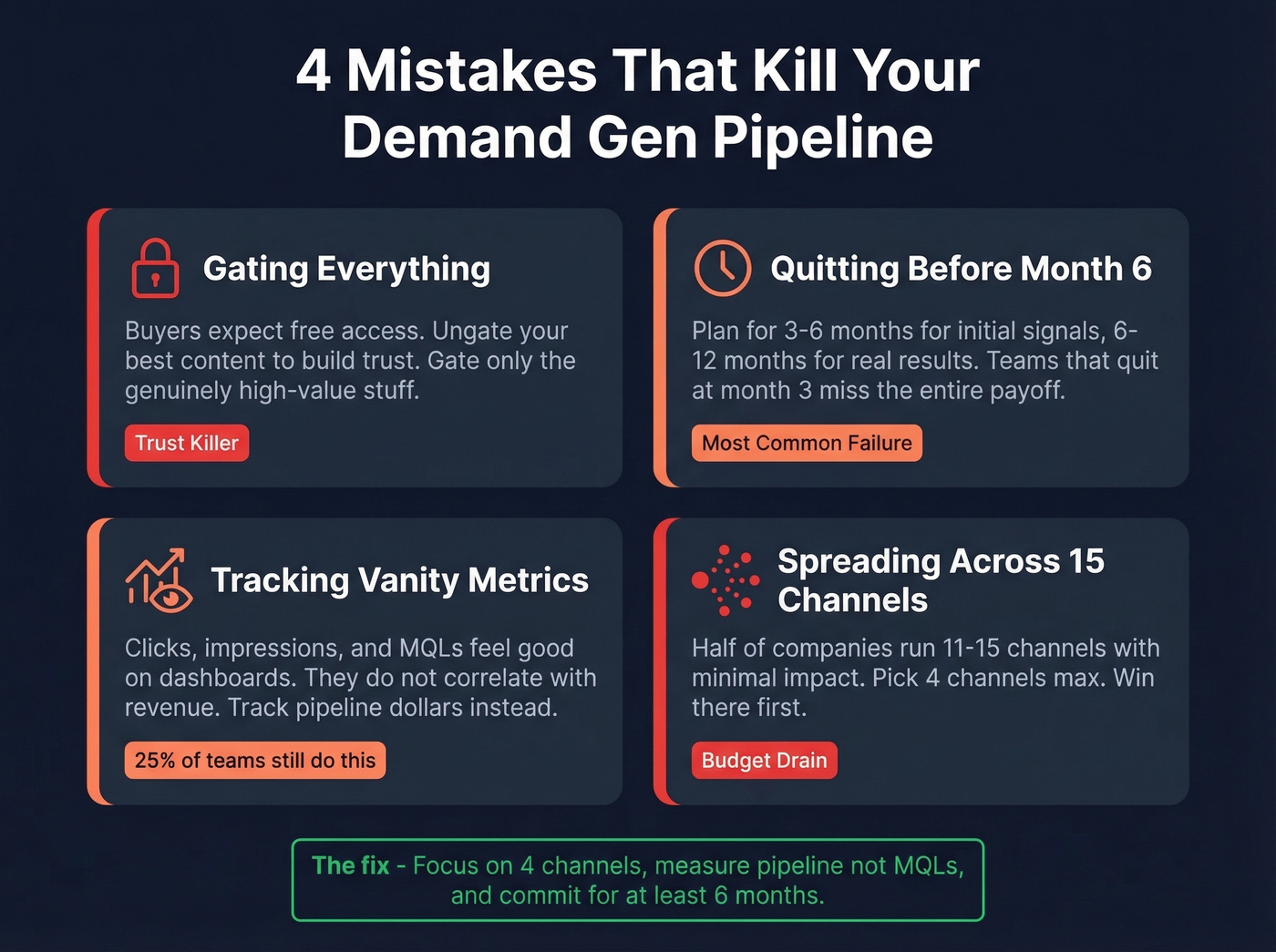
Quitting before compounding kicks in. Plan for 3-6 months for initial pipeline signals and 6-12 months for meaningful results. Teams that quit at month 3 miss the entire payoff. This is the single most common failure mode we see.
Tracking vanity metrics. Clicks, impressions, and MQLs feel good on a dashboard. They don't correlate with revenue. Track pipeline creation and SQL conversion instead. (If you need a clean measurement framework, use funnel metrics that map to revenue.)
Spreading too thin. Depth beats breadth every time. Pick four channels. Win there first.
The Demand Gen Tech Stack
B2B companies using marketing automation generate 50% more sales-ready leads at 33% lower cost per lead, according to Forrester. Companies with well-integrated tool stacks see a 43% increase in qualified opportunities and a 38% reduction in sales cycle length. But the stack only works if the data feeding it is clean. (If you're evaluating vendors, start with data enrichment services and work backward from your CRM fields.)
| Tool | Category | Starting Price |
|---|---|---|
| HubSpot | Marketing automation | $890/mo (Pro) |
| ActiveCampaign | Email automation | $49/mo |
| Marketo | Enterprise automation | ~$1,500/mo |
| 6sense | Intent + ABM | Not public (enterprise) |

Skip enterprise intent platforms like 6sense until you've validated your ICP and proven your messaging converts. For most teams under $5M ARR, a verified contact database and a solid automation tool are enough. (If you need a starting point, compare a few free lead generation tools before you buy anything.)
You don't need a $60K intent platform to capture the 5% actively buying. Prospeo tracks 15,000 intent topics via Bombora, layered with 30+ filters like technographics, job changes, and headcount growth - starting at $0.01 per email. No contracts, no sales calls.
Reach in-market buyers before your competitors do.
Benchmarks That Actually Matter
| Metric | Good | Needs Work |
|---|---|---|
| Lead conversion rate | 10-15% | Below 5% |
| Landing page conversion | 2-5% | Below 2% |
| MQL-to-SQL | 13-20% | Below 10% |
| Time to pipeline signal | 3-6 months | Expecting results in 4 weeks |
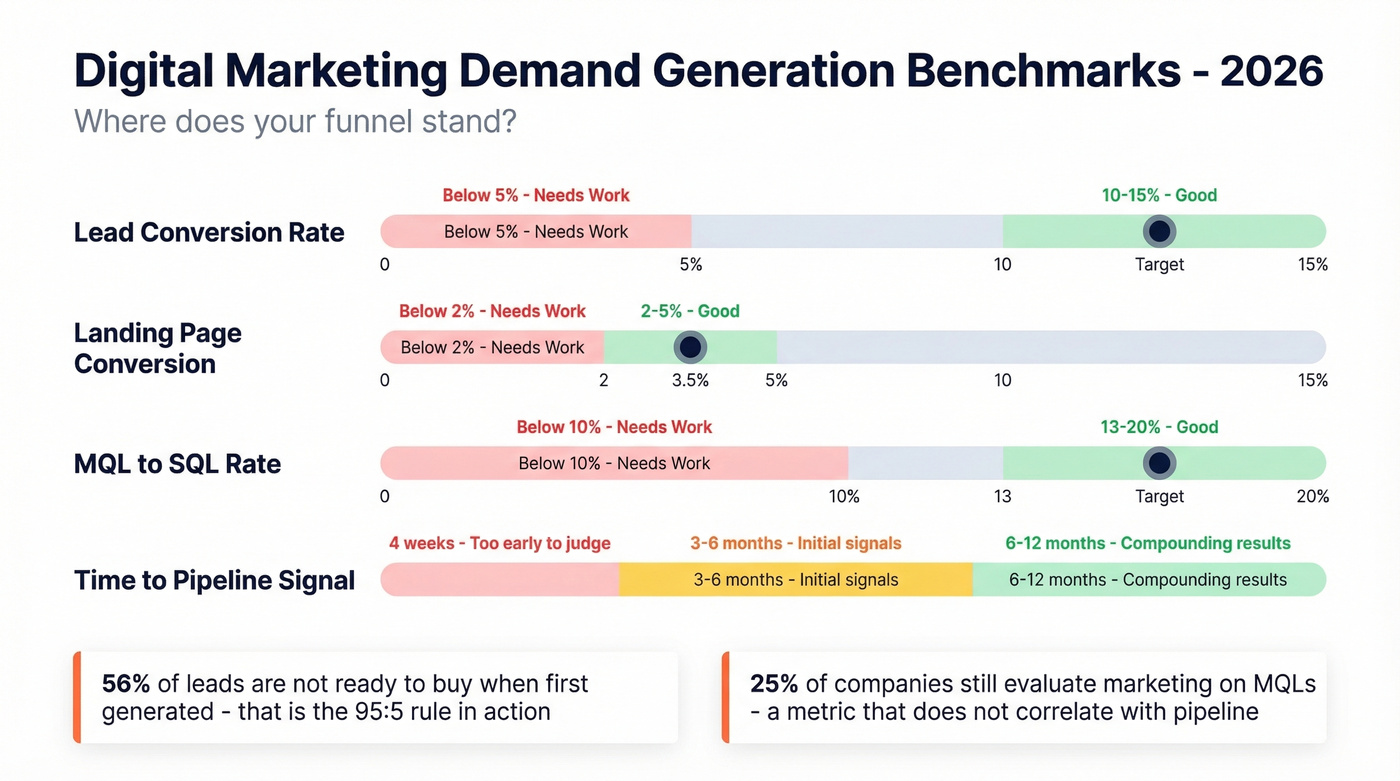
56% of leads aren't ready to buy when initially generated. That's not a failure - it's the 95:5 rule in action. The question isn't whether leads convert immediately; it's whether your system nurtures them until they do. (If you want a reality check on conversion, compare against the average B2B lead conversion rate.)
And 25% of companies are still evaluated on MQLs - a metric that doesn't correlate with pipeline outcomes. If that's your org, fix the measurement before fixing the funnel. (For a practical teardown of what breaks revenue, see sales pipeline challenges.)
FAQ
How long does demand generation take to show results?
Three to six months for initial pipeline signals, six to twelve months for compounding results. SEO and ungated content need time to index and build authority. Set executive expectations early and budget for at least two full quarters before evaluating ROI.
What's the difference between demand gen and inbound marketing?
Inbound is one tactic within a broader demand generation strategy. Demand gen also includes outbound, paid media, events, account-based marketing, and brand-building - anything that creates awareness with the 95% of your market not yet buying.
What tools do I need to start?
A CRM (HubSpot's free tier works), a data quality tool like Prospeo for verified contacts at $0.01 per email, and one content distribution channel you'll commit to deeply. That's it. Skip enterprise intent platforms until you've validated your ICP and proven your messaging converts.
How do I measure demand gen without relying on MQLs?
Track pipeline creation, SQL conversion rate, and brand search volume instead. Pipeline sourced by marketing - measured in dollars, not lead count - is the metric that correlates with revenue. Supplement with share-of-voice tracking and direct-traffic growth as leading indicators.