

How to Build a Digital Sales Strategy That Actually Moves Pipeline
It's Monday morning. You're staring at a pipeline review that looks thinner than it did last quarter, and the reps who are "doing everything right" still can't hit number. 84% of reps missed quota last year. That's not a coaching problem - it's a structural one. With 80% of B2B sales interactions now happening in digital channels, the fix isn't another training workshop. It's building a digital sales strategy from the ground up - an operating system that matches how buyers actually buy in 2026.
The Short Version
Before we go deep, here's the compressed playbook:
- Audit your funnel against real benchmarks. If you don't know your MQL-to-SQL conversion rate off the top of your head, start there.
- Build a 4-5 tool stack. CRM + engagement platform + data provider + conversation intelligence. That's the core.
- Fix your contact data before anything else. Sequences, DSRs, AI coaching - none of it works if 20% of your emails bounce.
- Set up a digital sales room for enterprise deals. Buying committees need a single place to align. Give it to them.
- Measure weekly, not quarterly. By the time you catch a quarterly miss, three months of pipeline are already gone.
Now let's build the thing.
What Digital Selling Actually Means
Stop building a "strategy." Build a digital sales operating system.
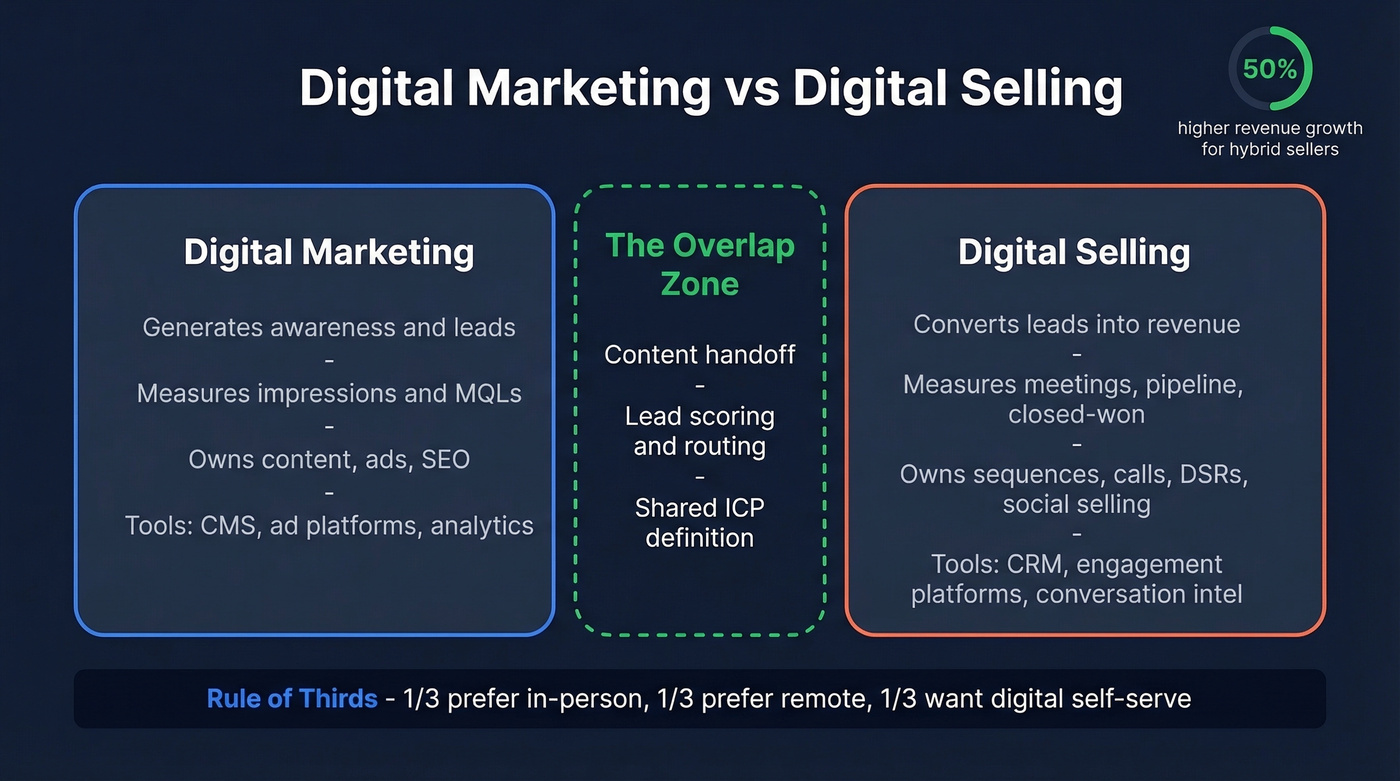
This isn't your marketing team's demand gen plan with a sales label slapped on it. Digital marketing generates awareness and leads. Digital selling converts them - through email sequences, video calls, chat, digital sales rooms, and social selling. The overlap between the two is where most organizations break.
The distinction matters because the two functions require different tools, different metrics, and different ownership. Marketing measures impressions and MQLs. Sales measures meetings booked, pipeline created, and revenue closed. When you blur the line, you get a team that's great at generating content and terrible at converting it.
At any given stage of the buying process, the modern reality looks like a rule of thirds: roughly a third of buyers prefer in-person interaction, a third prefer remote, and a third want digital self-serve. Companies that embrace this hybrid model see 50% higher revenue growth than those stuck in a single channel. The operating system you build needs to serve all three modes - not just the one your reps are comfortable with.
Why It Matters Now
The numbers have shifted faster than most sales orgs have adapted. Gartner projected that 80% of B2B sales interactions would happen in digital channels by 2025. That shift arrived on schedule, and the percentage is still climbing. The global B2B market sits at roughly $32 trillion, with 86.6% of US ecommerce flowing through B2B channels. This isn't a niche - it's the economy.
Buyers today use roughly 10 interaction channels on average, double what they used in 2016. They spend just 17% of their buying time actually meeting with potential suppliers. A third of all buyers prefer a completely seller-free experience, and among millennial buyers - now the majority of B2B decision-makers - that number hits 44%.
Here's the efficiency argument that should end every internal debate about going digital: inside and remote reps cover 4x as many prospects at roughly 50% of the cost compared to field reps. If your average deal size sits below $25K and you're still running a field-heavy model, you're lighting money on fire.
The average B2B purchase journey now runs about 192 days, involves 62 touchpoints, and requires alignment from 6.3 stakeholders. And 89% of B2B buyers had a deal stall in the past year. That's not a pipeline problem - it's a buying-process problem.
The 7-Phase Framework
The operating system that drives results has seven phases. High-growth companies spend 1.4x more on sales operations than low-growth peers and achieve 200-300 basis points above market growth. Here's where that investment goes.
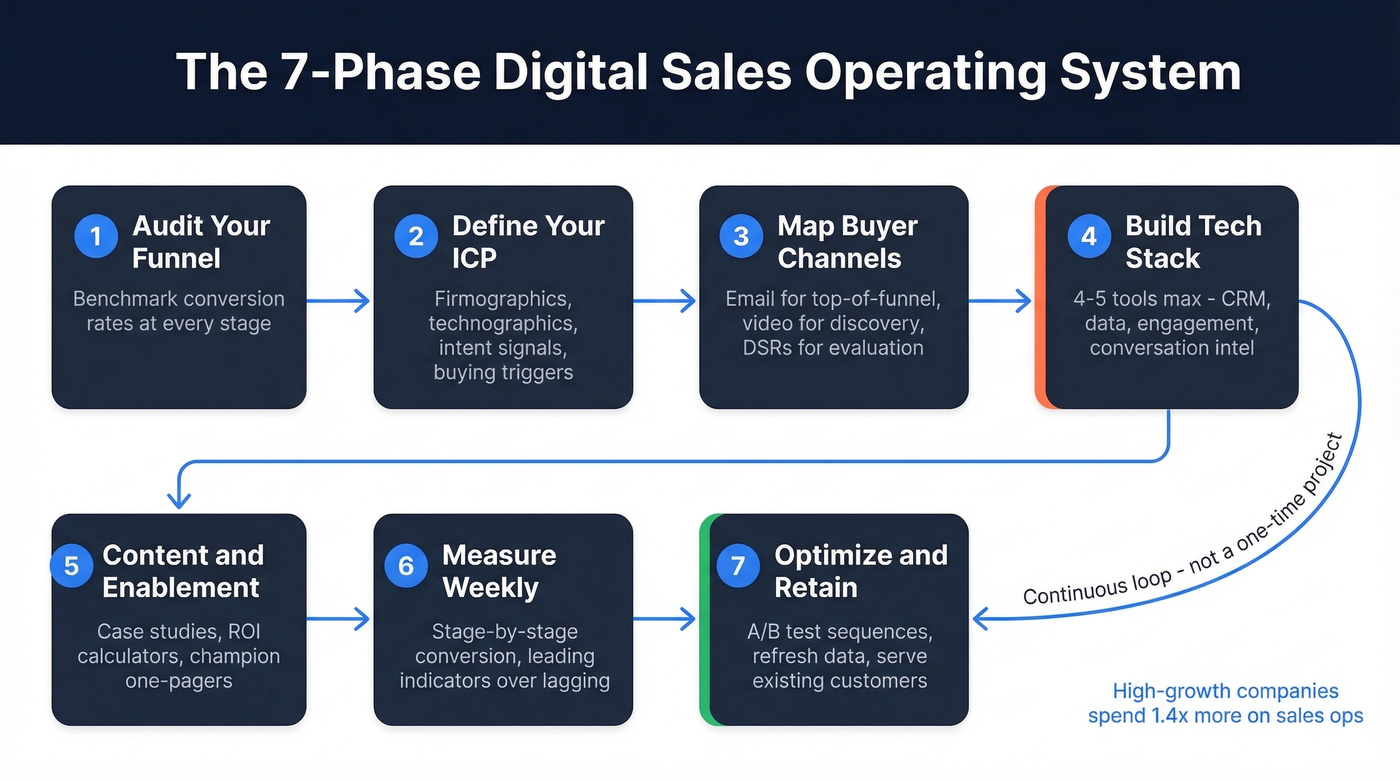
Phases 1-3: Diagnose Before You Build
Start with an audit. Benchmark your current funnel against the numbers in the next section. You can't fix what you haven't measured, and most teams skip this step entirely to jump straight to buying tools.
From there, define your ideal customer profile with enough specificity that a new rep could identify a qualified account in under 60 seconds - firmographics, technographics, intent signals, and buying triggers. Then map your buyer's preferred channels at each funnel stage. Email for top-of-funnel outreach. Video calls for discovery. Digital sales rooms for multi-stakeholder evaluation. Don't force buyers into your preferred channel.
Phase 4: Tech Stack
Four to five tools, not fifteen. We'll break this down in detail below.
Phase 5: Content & Enablement
Arm reps with content that maps to buying stages, not marketing campaigns. Case studies for evaluation. ROI calculators for procurement. One-pagers for champions selling internally.
Phase 6: Measurement
Weekly pipeline reviews. Stage-by-stage conversion tracking. Leading indicators like meetings booked and DSR engagement over lagging ones like closed-won.
Phase 7: Optimize and Retain
Run the loop again. A/B test sequences. Swap underperforming channels. Refresh stale data. This isn't a project - it's a continuous operating rhythm.
Here's the thing most teams get wrong: they pour all their energy into acquisition and ignore the customers they already have. McKinsey's data shows that retaining existing customers costs less than a third of acquiring new ones, and existing customers generate roughly 10% more revenue per deal. One company achieved a 10x increase in cross-sell revenue in just 8 weeks by applying digital selling tactics - personalized sequences, intent monitoring, automated outreach - to their existing customer base. Your operating system should serve both sides of the revenue equation.

You just read it: fix your contact data before anything else. Sequences, DSRs, AI coaching - none of it works on bad emails. Prospeo's 5-step verification delivers 98% email accuracy on 300M+ profiles, refreshed every 7 days. That's how Snyk cut bounce rates from 35% to under 5% and added 200+ opportunities per month.
Your digital sales operating system starts with data that actually connects.
Benchmarks You Should Be Hitting
Two tables. Print them. Tape them to your monitor.
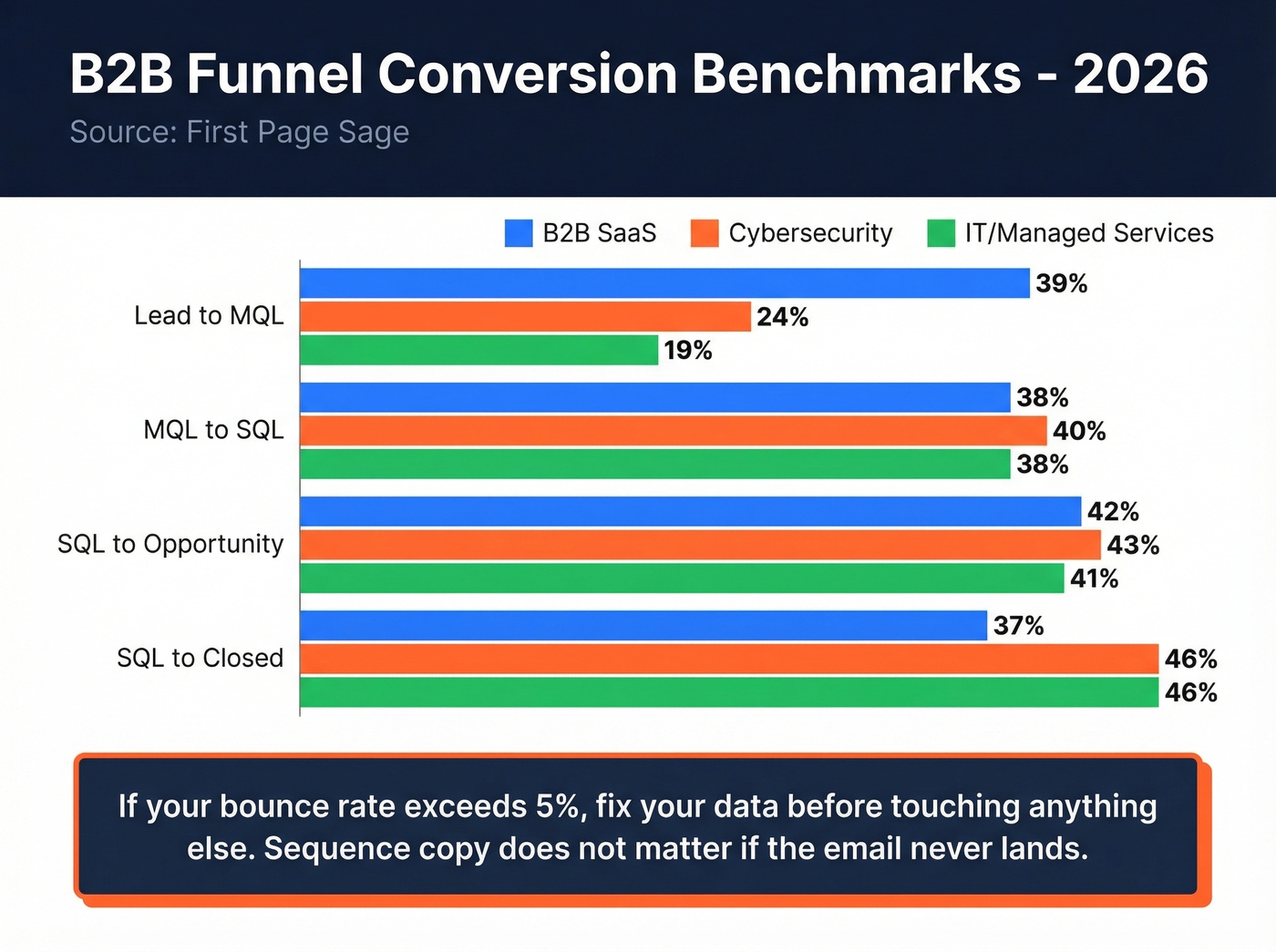
Funnel Conversion Rates by Industry
| Stage | B2B SaaS | Cybersecurity | IT/Managed Svcs |
|---|---|---|---|
| Lead to MQL | 39% | 24% | 19% |
| MQL to SQL | 38% | 40% | 38% |
| SQL to Opp | 42% | 43% | 41% |
| SQL to Closed | 37% | 46% | 46% |
Source: First Page Sage 2026 benchmarks.
Outbound Channel Baselines
| Metric | Baseline |
|---|---|
| Cold email open rate | ~27-28% |
| Cold email reply rate | ~5% |
| Meetings booked (% of sends) | ~1% |
| Average close rate | 29% |
| Average win rate | ~21% |
| Website visitor to lead | ~1.8% |
If you're below these numbers at any stage, you've found your bottleneck. A 2% reply rate on cold email usually points to one of two problems: bad targeting or bad data. Those benchmarks assume verified contact data - if your bounce rate exceeds 5%, fix your data before touching anything else. Sequence copy doesn't matter if the email never lands. (If you want to go deeper on diagnosing this, start with email bounce rate benchmarks and fixes.)
Your Sales Tech Stack for 2026
Reps spend 72% of their time on non-selling activities. The right stack claws that time back. The wrong stack adds more admin.
CRM
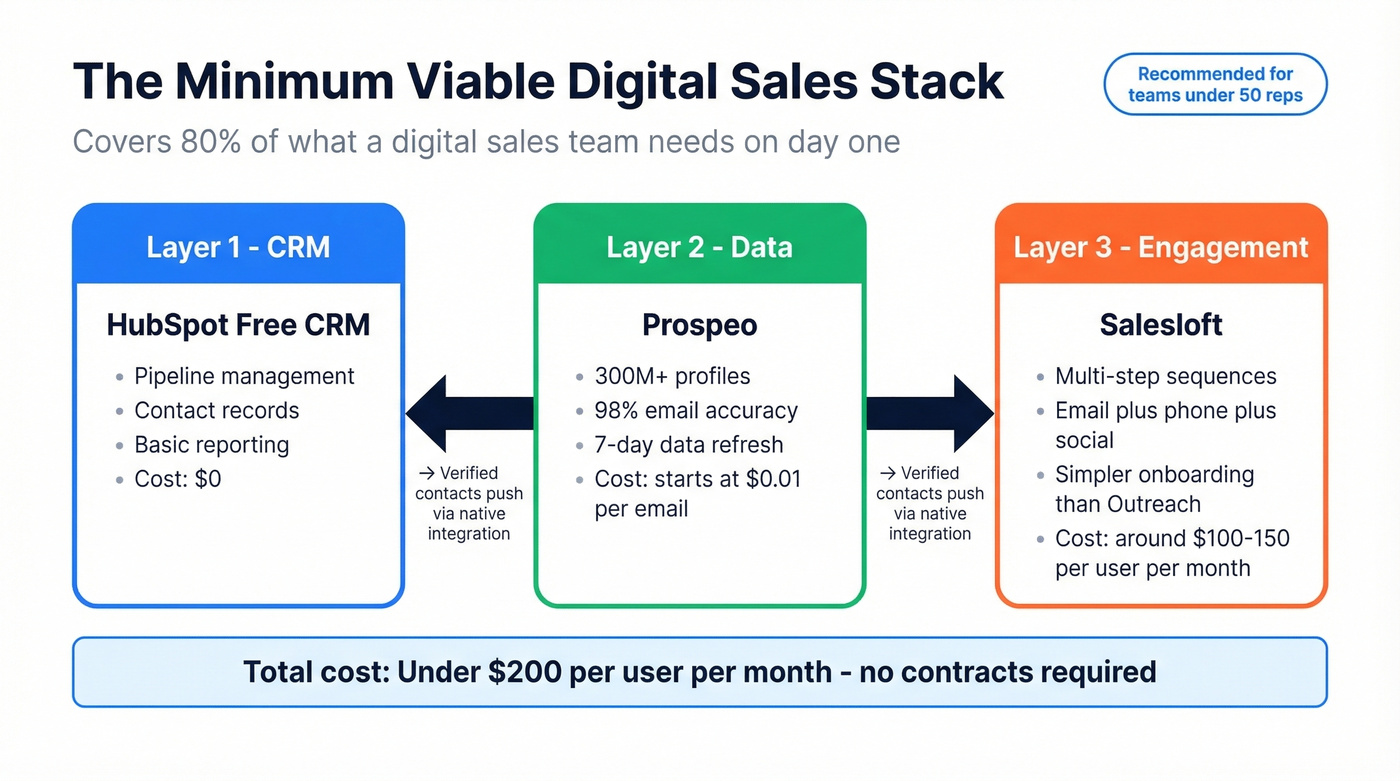
HubSpot's free CRM is the obvious starting point for SMB and mid-market teams. Sales Hub paid tiers typically run ~$20-$150/user/month when you need sequences and automation. Salesforce runs ~$25-$330/user/month depending on edition - deeper ecosystem, steeper learning curve, and a longer implementation timeline. If your team is under 50 reps, start with HubSpot. You can always migrate later, and the free tier removes one budget objection from the stack conversation. (If you're comparing options, see examples of a CRM and Salesforce pricing.)
Data & Prospecting
Your engagement platform is only as good as the data feeding it. We've seen this over and over in our own outbound work: teams invest $150/user/month in Outreach or Salesloft, then feed it unverified contact lists and wonder why reply rates sit at 1%.
Prospeo covers 300M+ professional profiles with 143M+ verified emails at 98% accuracy and 125M+ verified mobile numbers that hit a 30% pickup rate. The 7-day data refresh cycle is the real differentiator - the industry average sits at six weeks, which means most providers are serving stale data by default. With 30+ search filters including buyer intent across 15,000 Bombora topics, technographics, job changes, and headcount growth signals, you can build hyper-targeted lists without stitching together three different tools. Pricing runs ~$0.01/email with a free tier of 75 emails/month, no contracts, and self-serve onboarding. Native integrations push directly into Salesforce, HubSpot, Outreach, Salesloft, Smartlead, Instantly, and Lemlist.

Engagement Platforms
Outreach vs. Salesloft - pick based on team size. Outreach (~$100-150/user/month) is the enterprise standard with 4.3/5 on G2 across 3,488 reviews. The learning curve is steep, and user reviews consistently flag onboarding complexity. Salesloft (~$100-150/user/month) offers simpler onboarding and works well for mid-market teams that don't need Outreach's full feature depth. If you have a dedicated RevOps team to manage the platform, go Outreach. If you don't, go Salesloft. (For a broader shortlist, use this SDR tools roundup.)
Conversation Intelligence
Gong (~$1,200-1,600/user/year plus a platform fee) is the category leader at 4.7/5 on G2. It's expensive, but teams using AI coaching ramp new hires 30-40% faster. Chorus by ZoomInfo (~$100-150/user/month) delivers about 80% of Gong's functionality at roughly half the cost - worth considering if you're budget-constrained but still want call recording, deal intelligence, and basic coaching scorecards.
If You Can Only Buy Three
HubSpot free CRM + Prospeo for verified data + Salesloft for sequences. That stack covers 80% of what a digital sales team needs on day one, and the total cost stays under $200/user/month.
Digital Sales Rooms: A Setup Playbook
Use DSRs if: deal size exceeds ~$25K, buying committees involve 3+ stakeholders, and your sales cycle runs longer than 60 days.
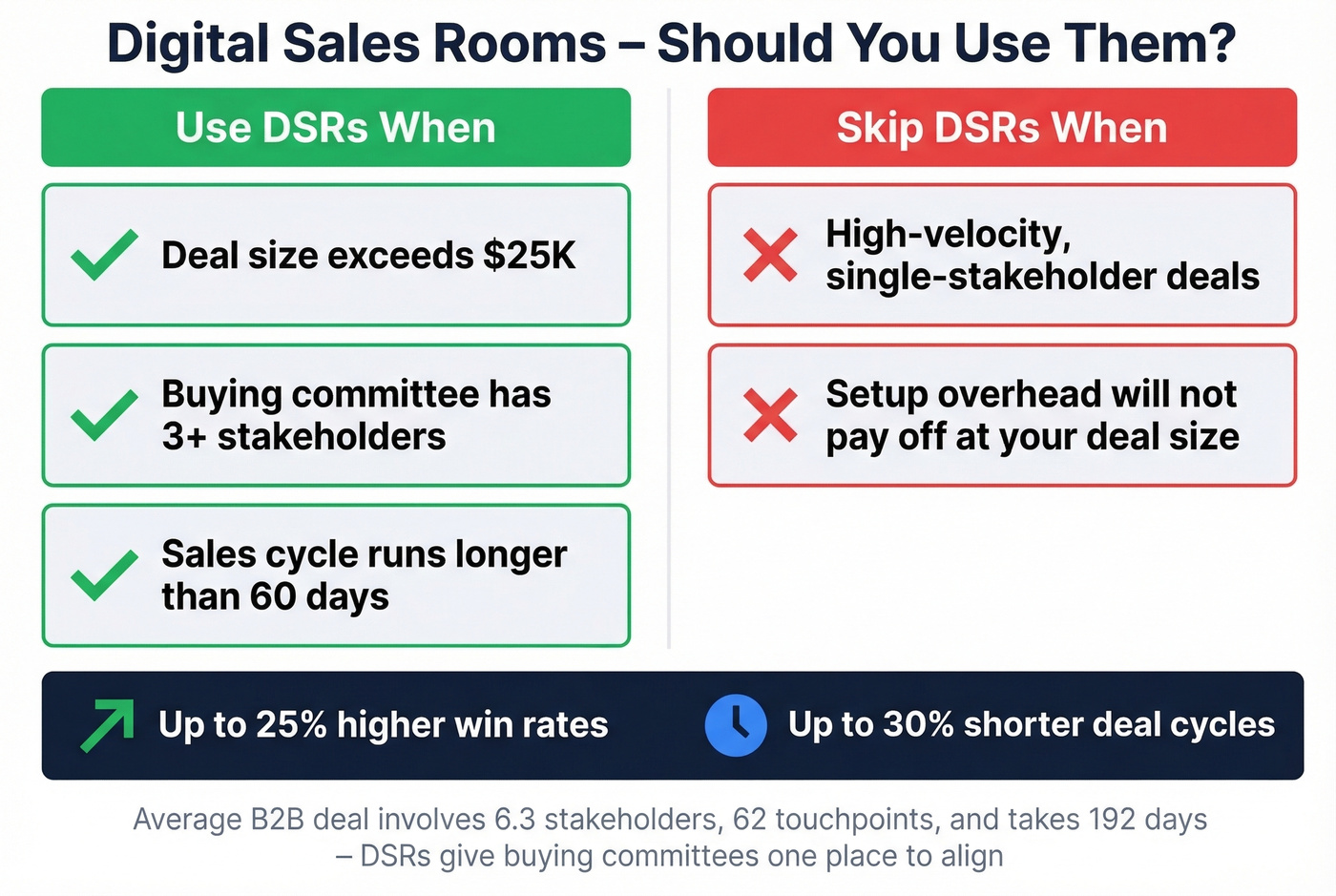
Skip DSRs if: you're running high-velocity, single-stakeholder deals. The setup overhead won't pay off.
DSRs can increase win rates by up to 25% and reduce deal cycles by up to 30%. Traditional processes without them lead to 24% longer sales cycles and 17% lower win rates. Here's how to set one up properly: (If you want the failure modes and templates, read our guide to a digital sales room.)
Step 1: Don't call it a "DSR" to buyers. Frame it as "a dedicated space for your team to collaborate on this evaluation." The acronym means nothing to a VP of Finance.
Step 2: Present the room on a live call first. Walk through the layout, show where key documents live, and fix confusion in real time. Then send the invite link.
Step 3: Personalize for each buying committee role. Your champion needs the ROI calculator and competitive battle card. The IT stakeholder needs the security whitepaper and integration docs. Don't dump everything in one folder.
Step 4: Track engagement religiously. Downloads, time spent on each page, likes, and shares within the room. When the CFO opens the pricing page three times in one afternoon, that's your signal to call your champion.
Platforms like Aligned, GetAccept, and Trumpet typically run $30-80/user/month, with enterprise configurations running higher.
AI Tactics for 2026
Gartner identifies three priorities for CSOs heading into 2026: build a sales-centric AI portfolio roadmap, transform GTM motions to match buyer preferences, and maximize sales manager impact. AI isn't replacing your reps. It's replacing the 72% of their time spent not selling. And with 87% of executives expecting AI to drive revenue growth, the question isn't whether to invest - it's where to start.
Three concrete applications worth investing in right now:
AI-personalized sequences. Buyers actively avoid irrelevant and too-frequent messages. AI that personalizes based on intent signals, recent company news, and role-specific pain points turns generic outreach into relevant outreach. The volume-to-relevance shift is the single biggest improvement for outbound in 2026. (If you need a starting point, use these sales follow-up templates and then layer personalization.)
Predictive forecasting. McKinsey found that companies fusing mature digital capabilities with AI-driven operating models grow EBITDA 5x faster than laggards. Predictive deal scoring and pipeline forecasting are the most immediate ROI plays - they turn your CRM from a reporting tool into a decision-making engine. (Tooling options: sales forecasting solutions.)
Conversation coaching. Real-time feedback during calls, automated scorecards after them. Gartner projects that by 2028, 15% of routine work decisions will be handled by AI agents. Coaching is the first sales function where that's already happening.
Mistakes That Kill Execution
The "tech magpie" problem. Buying tools without a clear problem to solve. We've seen teams running 12+ tools in their stack where five would do the job better. Every new tool adds integration complexity, training overhead, and another login reps ignore. Audit before you buy.
Treating B2B like B2C. 78% of B2B transactions still flow through EDI, email, and fax - even after companies invest in slick websites. B2B buyers need multi-user accounts, approval workflows, saved quotes, and long-cycle support. A beautiful landing page doesn't replace operational buying infrastructure.
Bad data destroying outbound. Look, if your bounce rate is above 10%, your sequences aren't underperforming - they're never arriving. Meritt, a Prospeo customer, went from a 35% bounce rate to under 4% after switching providers and tripled their weekly pipeline from $100K to $300K. That's the difference between 3 meetings a week and 12. Fix data first, optimize copy second. (If you're rebuilding your outbound motion, start with these sales prospecting techniques and then lock deliverability.)
Sales-marketing misalignment. The classic tension: marketing's MQL definition and what sales actually considers qualified are two different things. Shared pipeline metrics and a joint SLA on lead definitions fix this. Weekly alignment meetings - not quarterly business reviews - keep it fixed.
Ignoring existing customers. Most teams focus exclusively on net-new pipeline. Meanwhile, your existing customers cost a third as much to retain as new ones cost to acquire, and they buy more per deal. If your operating system doesn't include expansion sequences, renewal triggers, and cross-sell plays, you're leaving the easiest revenue on the table.
Phase 4 says build a 4-5 tool stack with a data provider at the core. Prospeo gives you 30+ search filters - buyer intent, technographics, job changes, headcount growth - plus 125M+ verified mobiles and CRM enrichment returning 50+ data points per contact. All self-serve, no contracts, at roughly 90% less than ZoomInfo.
Teams using Prospeo book 26% more meetings than ZoomInfo users.
FAQ
What is a digital sales strategy?
A digital sales strategy is an operating system for selling through digital channels - email, social, web, chat, and video - supported by data, automation, and weekly measurement. It's how your sales team reaches, engages, and closes buyers who spend only 17% of their buying time meeting with potential suppliers. The framework typically spans seven phases from funnel audit through continuous optimization.
How does digital sales differ from digital marketing?
Digital marketing generates awareness and leads through content, ads, and SEO. Digital sales converts those leads through sequences, calls, digital sales rooms, and proposals. Alignment on shared pipeline metrics and lead definitions bridges the gap - without it, you get high MQL counts and empty pipeline.
What tools do you need to execute?
At minimum: a CRM like HubSpot's free tier, a verified data provider for accurate contact data, and an engagement platform like Salesloft. Add conversation intelligence for coaching and a DSR platform for enterprise deals. Most teams need 4-5 tools total - more than that usually means redundancy and wasted budget.
How much does a B2B digital sales tech stack cost?
A functional stack starts under $200/user/month: HubSpot free CRM ($0), Prospeo for verified data (~$0.01/email with a free tier), and Salesloft for sequences (~$100-150/user/month). Enterprise stacks with Salesforce, Outreach, Gong, and a DSR platform can run $500-800/user/month. Start lean, add tools only when you've identified a specific bottleneck.