

DiscoverOrg vs The Data City: Contact Database vs Classification Engine
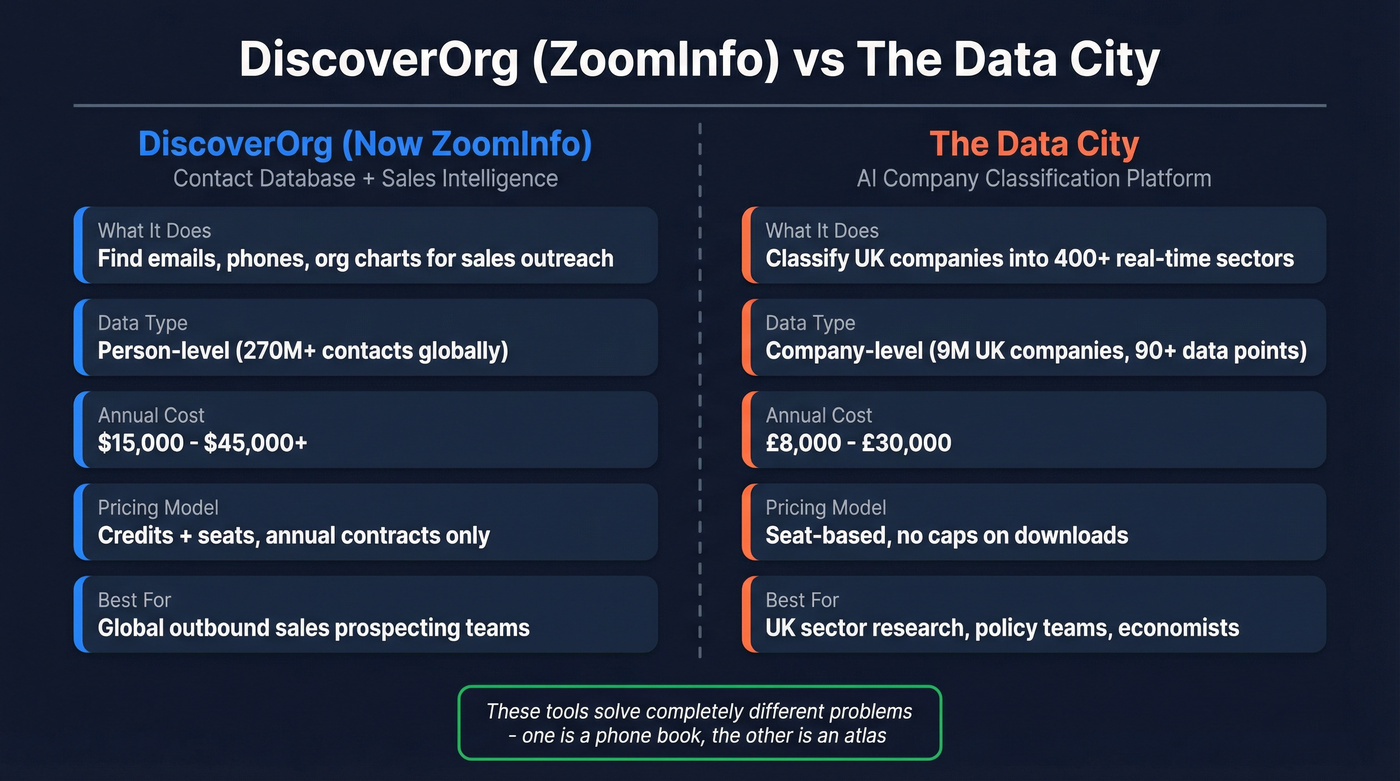
These two tools get compared because they both involve "B2B data." That's where the similarity ends. Comparing DiscoverOrg to The Data City is like comparing a phone book to an atlas - both contain information, but they're built for completely different jobs. DiscoverOrg acquired ZoomInfo in 2019 and was later rebranded under the ZoomInfo name, so it no longer exists as a standalone product. It was a contact database for finding emails and phone numbers. The Data City is an AI-powered company classification platform that tells you what UK businesses actually do.
What Is DiscoverOrg (Now ZoomInfo)?
DiscoverOrg was a B2B sales intelligence platform known for human-verified org charts and direct dials. In 2019, it acquired ZoomInfo under CEO Henry Schuck, and the DiscoverOrg brand was retired as the combined company rebranded around ZoomInfo. Everything DiscoverOrg offered now lives inside ZoomInfo's platform.
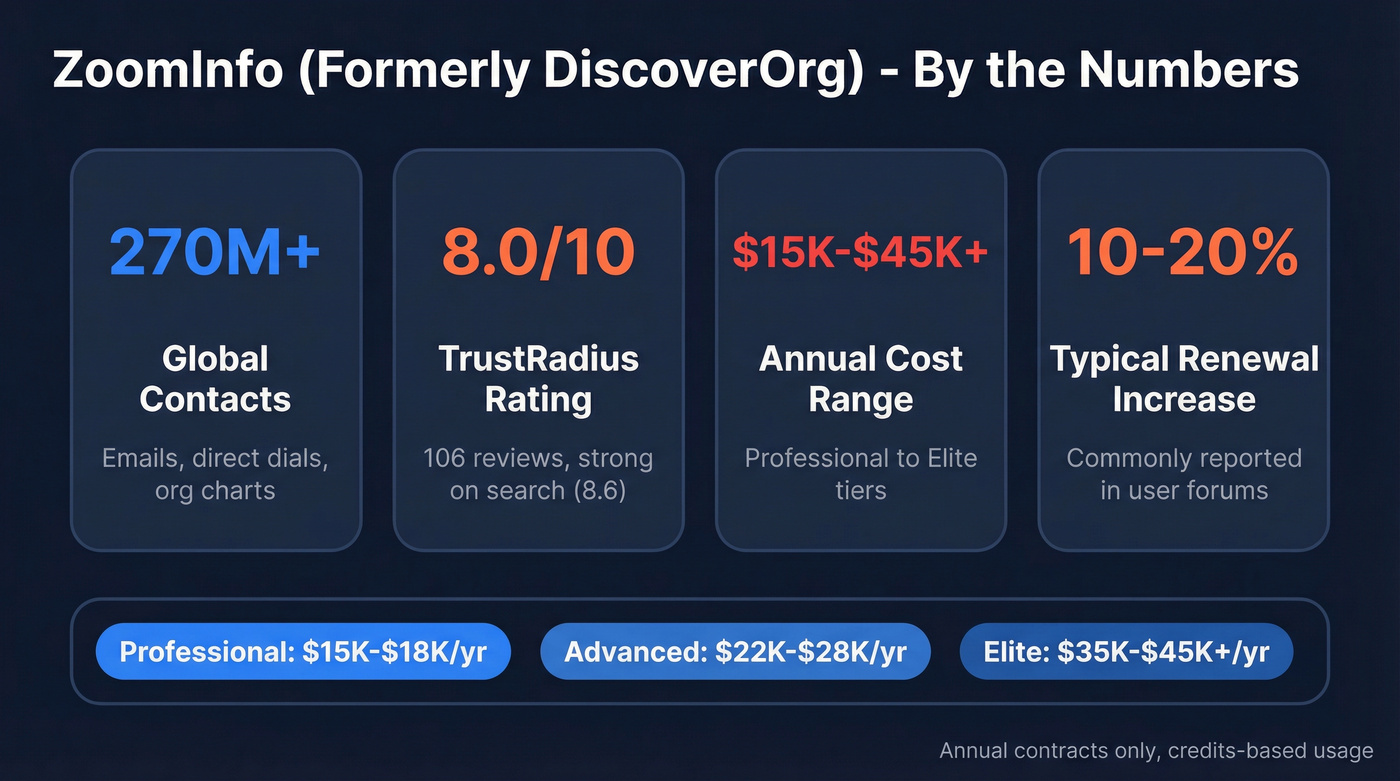
On TrustRadius, the legacy DiscoverOrg product holds an 8.0/10 rating across 106 reviews - with strong scores for advanced search (8.6) and lead identification (8.4). The product was well-liked. The pricing, less so.
Here's what you're looking at with ZoomInfo today:
- Database: 270M+ contacts globally, with exports governed by credits (see more options in our guide to sales prospecting databases)
- Pricing: ~$15,000-$18,000/year for Professional (1-3 seats), $22,000-$28,000 for Advanced, $35,000-$45,000+ for Elite
- Contracts: Annual only, with 10-20% renewal increases being standard
- Add-ons: Intent data and other premium features can push total cost significantly higher (related: intent based segmentation)
We've heard from teams who signed a ZoomInfo contract expecting one price, then got hit with a renewal quote 15-20% above what they budgeted. It's a common frustration in r/sales threads, and it's worth factoring into any ROI calculation (especially if you're tracking cost to acquire customer).
What Is The Data City?
The Data City isn't a contact database. It's an AI-powered industry classification platform covering 9 million UK companies with 400+ Real-Time Industrial Classifications (RTICs) and 90+ data points per company. Think of it as a replacement for outdated SIC codes, not a replacement for ZoomInfo. Its real competitors are company intelligence platforms like Beauhurst and Bureau van Dijk - tools built around sector research, not person-level prospecting.
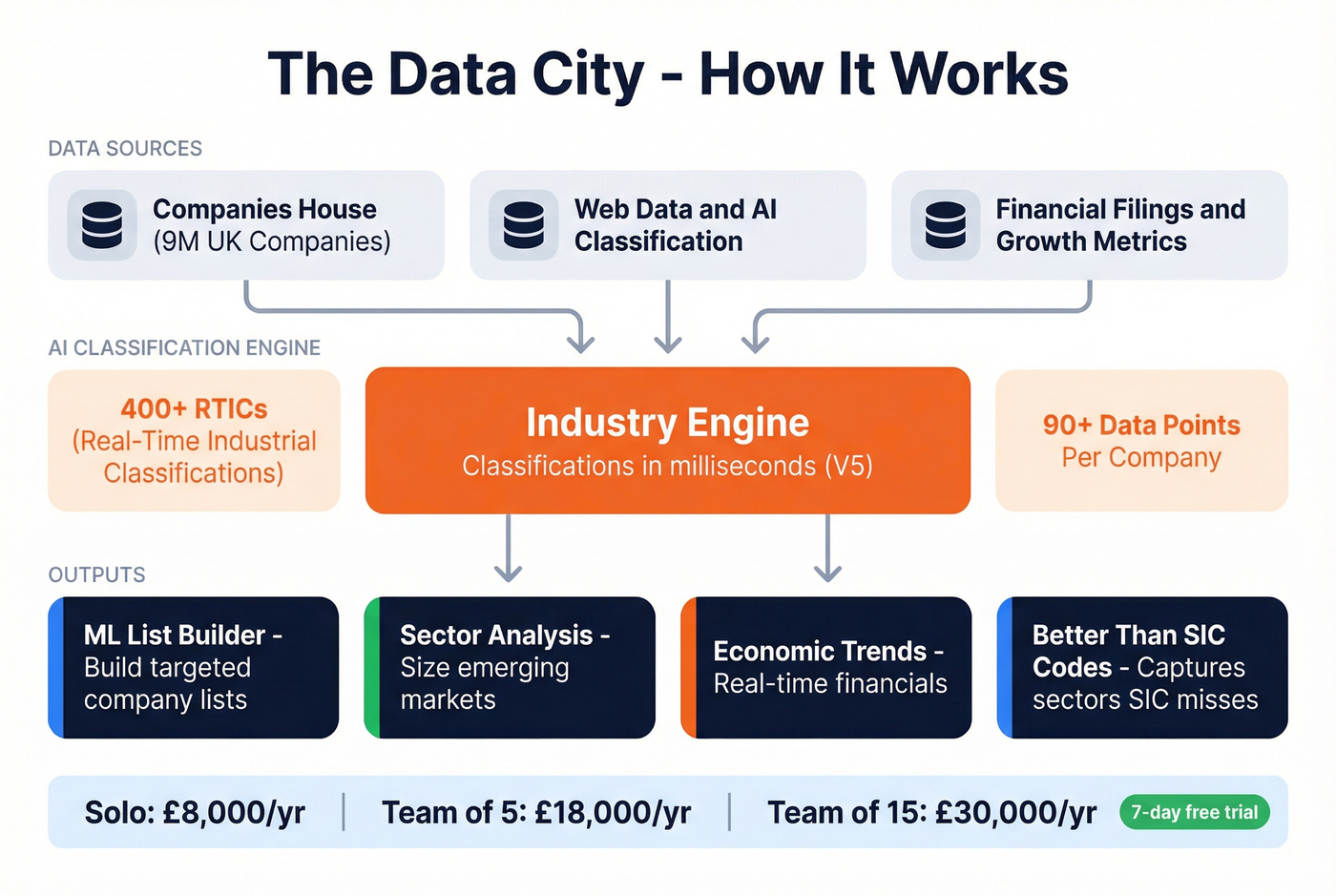
The core product - the Industry Engine - lets you explore sectors, build targeted company lists using an ML List Builder, and analyse economic trends with real-time financials and growth metrics. Oxford Economics validated the approach with a £2 million investment at a £19 million valuation, and V5 launched in early 2025 with faster classification speeds, including classifications in milliseconds. Pricing is public: £8,000/year for a solo seat, £18,000/year for a team of five, £30,000/year for fifteen seats. No credits, no caps on company downloads, and a 10% discount for multi-year licenses. Add-ons like Lightcast Jobs & Skills and Real-Time SIC Codes run £2,000-£8,000 extra depending on plan tier. A 7-day free trial gives you full platform access to test the ML List Builder and RTICs before committing.
Let's be honest - if you're a sales rep looking for direct dials, The Data City isn't what you need. But if you're a policy researcher or a B2B marketer trying to size an emerging UK sector that SIC codes completely miss, it's one of the few tools that actually solves that problem (and it pairs well with strong firmographic filters in your stack).

DiscoverOrg is gone and The Data City doesn't do contact data. If you need verified emails and direct dials without a $15K+ annual contract, Prospeo gives you 300M+ profiles with 98% email accuracy and 125M+ verified mobiles - refreshed every 7 days, not every 6 weeks.
Get enterprise-grade B2B data at $0.01 per lead, no contract required.
Feature and Pricing Comparison
| ZoomInfo (DiscoverOrg) | The Data City | |
|---|---|---|
| Primary function | Contact database + sales intel | Company classification + sector mapping |
| Data type | Person-level (emails, phones) | Company-level (financials, sectors) |
| Coverage | Global (270M+ contacts) | UK-focused (9M companies) |
| Annual cost | $15K-$45K+ | £8K-£30K |
| Pricing model | Credits + seats | Seat-based, no caps |
| Best for | Global outbound prospecting | UK sector mapping & classification |
Here's the thing: putting these two in a head-to-head table almost misrepresents the decision. You wouldn't compare a CRM to an analytics platform just because both touch customer data. These tools operate at different layers of the data stack entirely (if you're evaluating systems, see examples of a CRM).
When to Use Each (or Both)
Use ZoomInfo if you need person-level contact data at scale - emails, direct dials, org charts - for global outbound prospecting. It's the default enterprise contact database for a reason, and for large sales orgs with the budget, the depth of data is hard to match (more tactics: sales prospecting techniques).
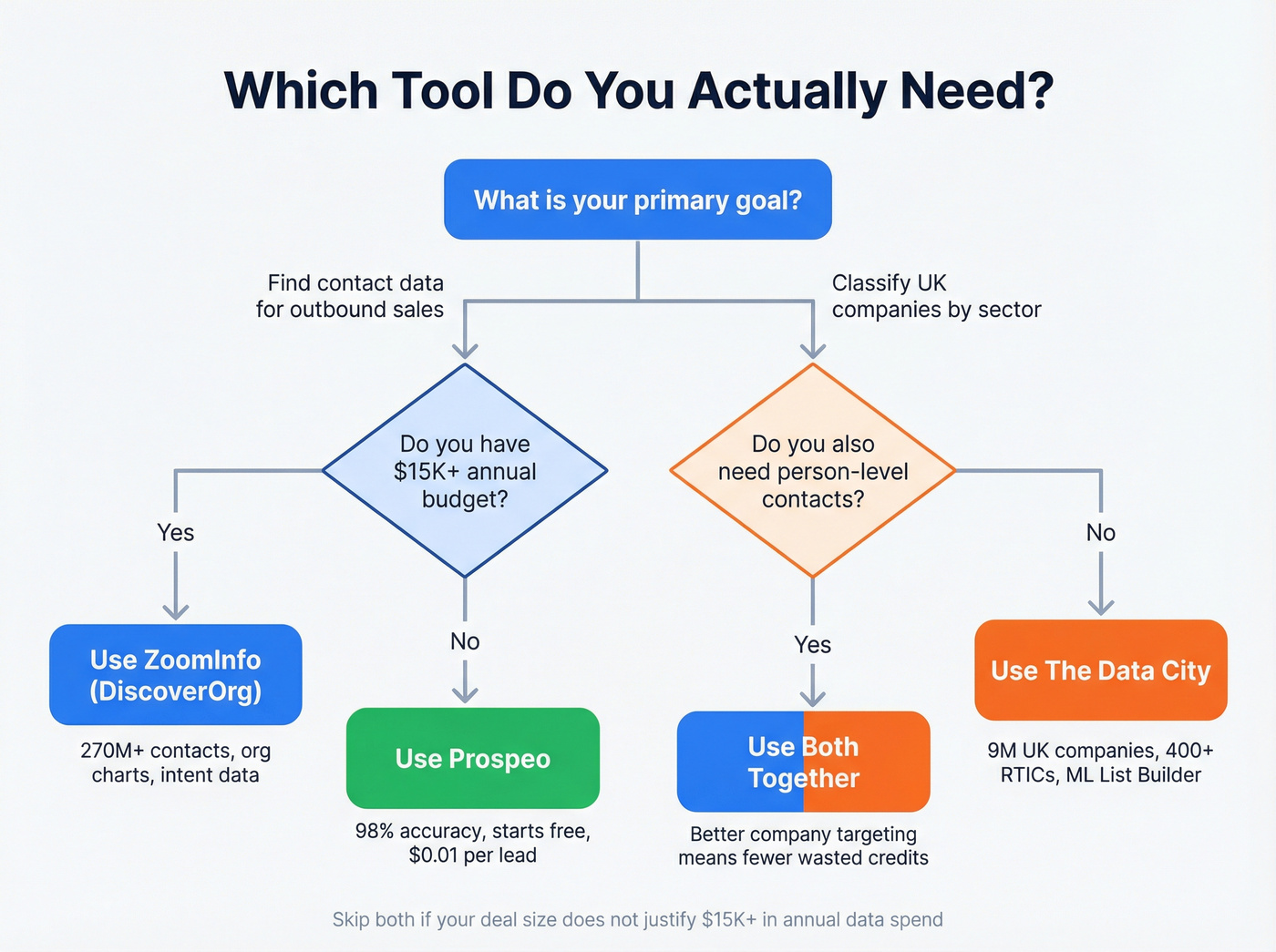
Use The Data City if you need to identify and classify UK companies in emerging sectors that SIC codes miss entirely. Policy teams, economists, and B2B marketers targeting niche verticals get the most value here. In our experience, the ML List Builder produces surprisingly granular sector lists - but the platform comes with a steeper learning curve than simpler tools, so budget time for onboarding.
Use both if you want The Data City's precision targeting to improve ZoomInfo's efficiency. The Data City positions itself as complementary to contact tools - better company selection means fewer wasted credits and more relevant outreach (related: lead scoring).
Skip both if your average deal size doesn't justify $15K+ in annual data spend. ZoomInfo's ROI math breaks down fast for smaller teams, and The Data City solves a different problem entirely. Most teams we talk to who search this comparison actually need something simpler.
Verified Contact Data Without the Price Tag
One of our customers, Snyk, cut their bounce rate from 35-40% down to under 5% across 50 AEs - and saw AE-sourced pipeline jump 180%. That's the kind of result that's hard to argue with (if you're diagnosing list quality, start with email bounce rate).
Snyk's 50 AEs dropped their bounce rate from 35-40% to under 5% and grew AE-sourced pipeline 180% after switching. ZoomInfo charges $15K+ for 87% accuracy. Prospeo delivers 98% accuracy with a free tier to prove it.
Stop overpaying for data that bounces - test 75 verified emails free.
FAQ
Is DiscoverOrg the same as ZoomInfo?
Yes. DiscoverOrg acquired ZoomInfo in 2019 and rebranded the combined company under the ZoomInfo name. DiscoverOrg no longer exists as a standalone product - all its capabilities now live inside ZoomInfo's platform.
Does The Data City provide contact emails or phone numbers?
The Data City is primarily a company classification platform, but company records can include people fields like directors, shareholders, and PSCs, along with contact fields such as email, social profiles, and telephone numbers. It's not a prospecting tool in the traditional sense.
What's the cheapest way to get verified B2B contact data?
Prospeo offers a free tier with 75 verified emails per month and paid plans at roughly $0.01 per lead - 90% cheaper than ZoomInfo's $15,000+ annual minimum, with 98% email accuracy and 125M+ verified mobile numbers.