

5 Discovery Call Email Templates That Actually Get Replies
Your prospect gets 15 cold emails a week and takes 2.7 seconds to decide whether yours gets read or deleted. Most discovery call email template collections floating around are bracket-filled Mad Libs written by someone who's never booked a meeting. These five are different - filled-in examples from a realistic scenario, not placeholder soup.
Formatting Rules That Earn Replies
Before you touch a template, internalize these. They're backed by data, not vibes.
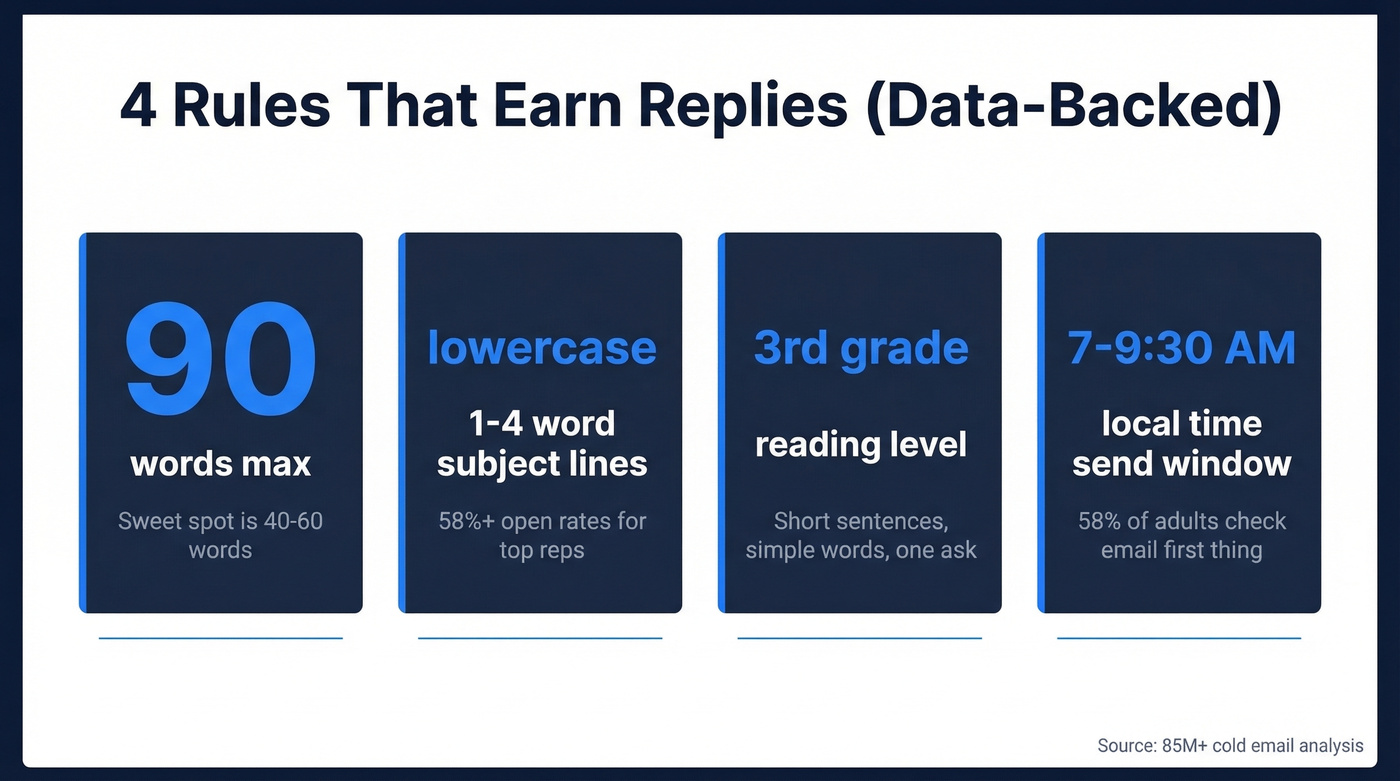
Keep it under 90 words. The sweet spot is 40-60 words. Long emails lose the 2.7-second race every time.
Subject lines: 1-4 words, all lowercase. An analysis of 85M+ cold emails found short, lowercase subject lines produce the highest open rates - top reps hit 58%+ opens, 2.1x the average. Salesy tricks like ALL CAPS, exclamation marks, and "limited time" reduce opens by 17.9%. Skip the empty-subject-line gimmick too: it boosts opens by 30% but tanks replies by 12%.
Write at a 3rd-grade reading level. Short sentences. Simple words. One clear ask. One link max - some email systems flag outside links as spam.
Send between 7-9:30 AM local time. 58% of adults check email first thing in the morning. Land at the top of the inbox, not buried under the afternoon pile.
5 Templates You Can Send Today
Every template below uses the same scenario: you're an SDR at a marketing analytics company reaching out to Jordan Chen, VP of Marketing at a mid-market SaaS company called Relay.
The Cold Outreach Email
Your first touch. No fluff, no life story. One tailored line proving you did homework, one sentence about what you do, one soft ask.
Filled-in example:
Subject: relay's pipeline
Hey Jordan - you're running demand gen at Relay, so I'd guess attribution across paid and organic is eating your team's time.
We help marketing teams like Lattice cut reporting time by 60%.
Worth a conversation?
- Alex
Blank template:
Subject: {company lowercase}
Hey {first name} - you handle {responsibility} at {company}, so I'd bet {specific challenge} is on your radar.
We help teams like {reference customer} {specific result}.
Worth a conversation?
That's around 40-50 words. The tailored one-liner does the heavy lifting - it shows you understand their world without writing a thesis.
The Value-First Email
This is the template we'd send first in 2026. Instead of asking for 30 minutes, you offer something useful. The consensus on r/copywriting is clear: low-friction offers crush calendar asks in cold outreach. If you want more structure, build this into a simple B2B cold email sequence instead of one-off sends.
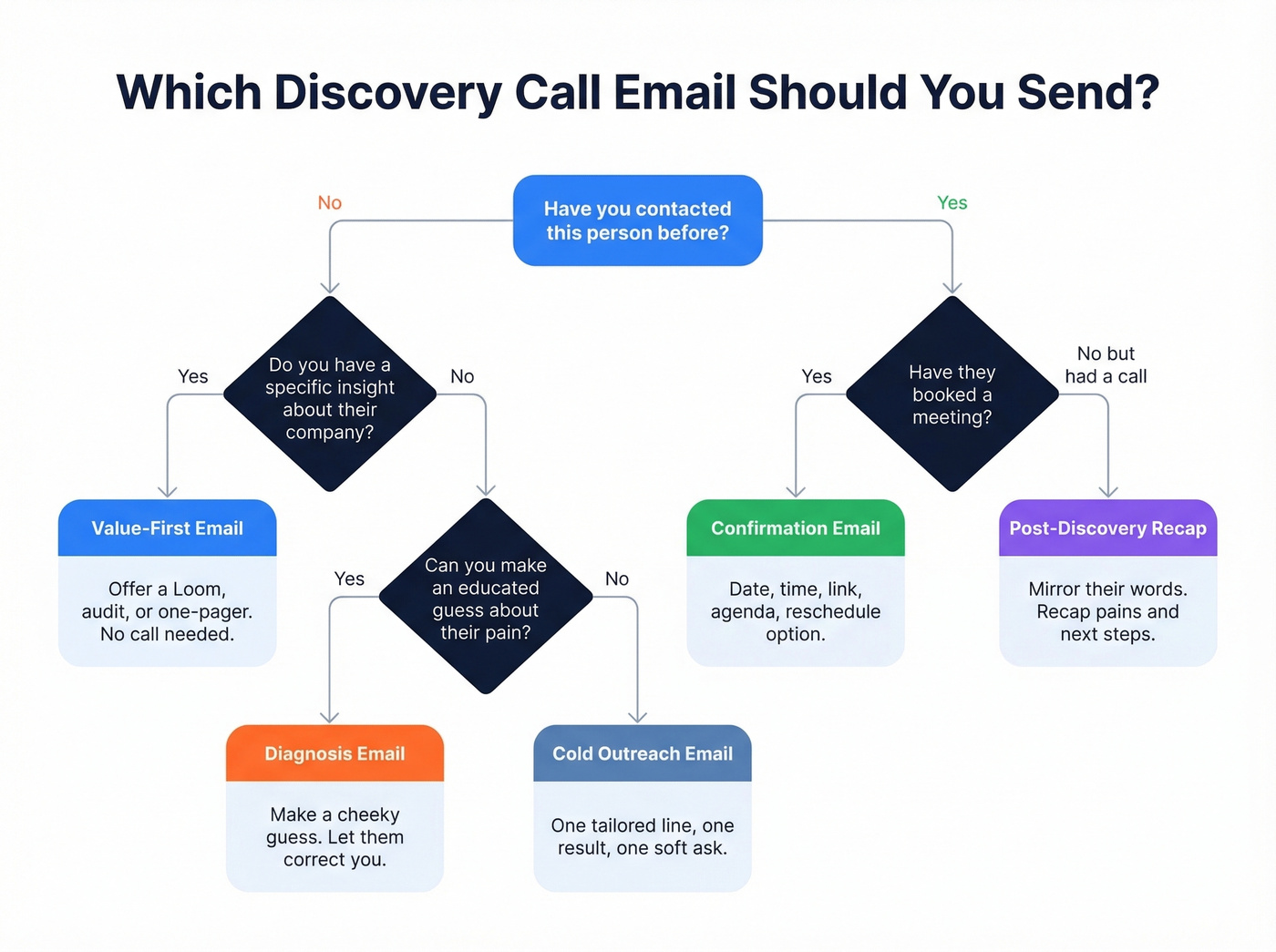
Filled-in example:
Subject: quick idea
Jordan - I looked at Relay's attribution setup and spotted two gaps that are probably inflating your CAC numbers.
Happy to record a 3-minute Loom walking through what I found. No call needed.
Want me to send it over?
Blank template:
Subject: quick idea
{First name} - I looked at {company}'s {visible asset} and noticed {specific observation}.
Happy to {low-friction deliverable - Loom, audit, one-pager}. No call needed.
Want me to send it over?
"Want me to send it over?" is a yes/no question, not a calendar commitment. You earn the meeting by proving value first. (More examples: emails that get responses.)
The Diagnosis Email
This one uses a problem-agitation-solution structure that feels like a cheeky guess rather than a pitch. It works because it forces the prospect to react - even if you're wrong, they'll correct you, and now you're in a conversation.
Filled-in example:
Subject: hunch
Jordan - my guess: Relay's marketing team is spending 5+ hours a week stitching together reports from HubSpot, Google Ads, and Salesforce. You've looked at BI tools but they'd take months to implement.
How'd I do?
Blank template:
Subject: hunch
{First name} - my guess: {company} is dealing with {problem}. You've considered {typical solution} but {reason they haven't done it}.
How'd I do?
We've seen this format spark more back-and-forth than any other cold template. People can't resist correcting a wrong guess - and a right one gets you instant credibility. If you need the call itself to run tighter, pair this with a discovery questions framework.
The Confirmation + Reminder Email
Once they book, your job is to make sure they show up. Send this pre-call email immediately after booking, then reminders at 24 hours and 1 hour before.
Filled-in example:
Subject: confirmed: thursday 2pm
Jordan - looking forward to Thursday.
When: Thursday, March 13 at 2:00 PM ET Where: [Zoom link] Agenda: Walk through Relay's current attribution workflow and see if there's a fit.
Need to reschedule? [Click here]
- Alex
Date, time, meeting link, one-sentence agenda, rescheduling link. That's it. No-shows are expensive - one estimate puts missed appointments at $200+ each across industries. A simple confirmation email is the cheapest insurance you'll buy.
The Post-Discovery Recap Email
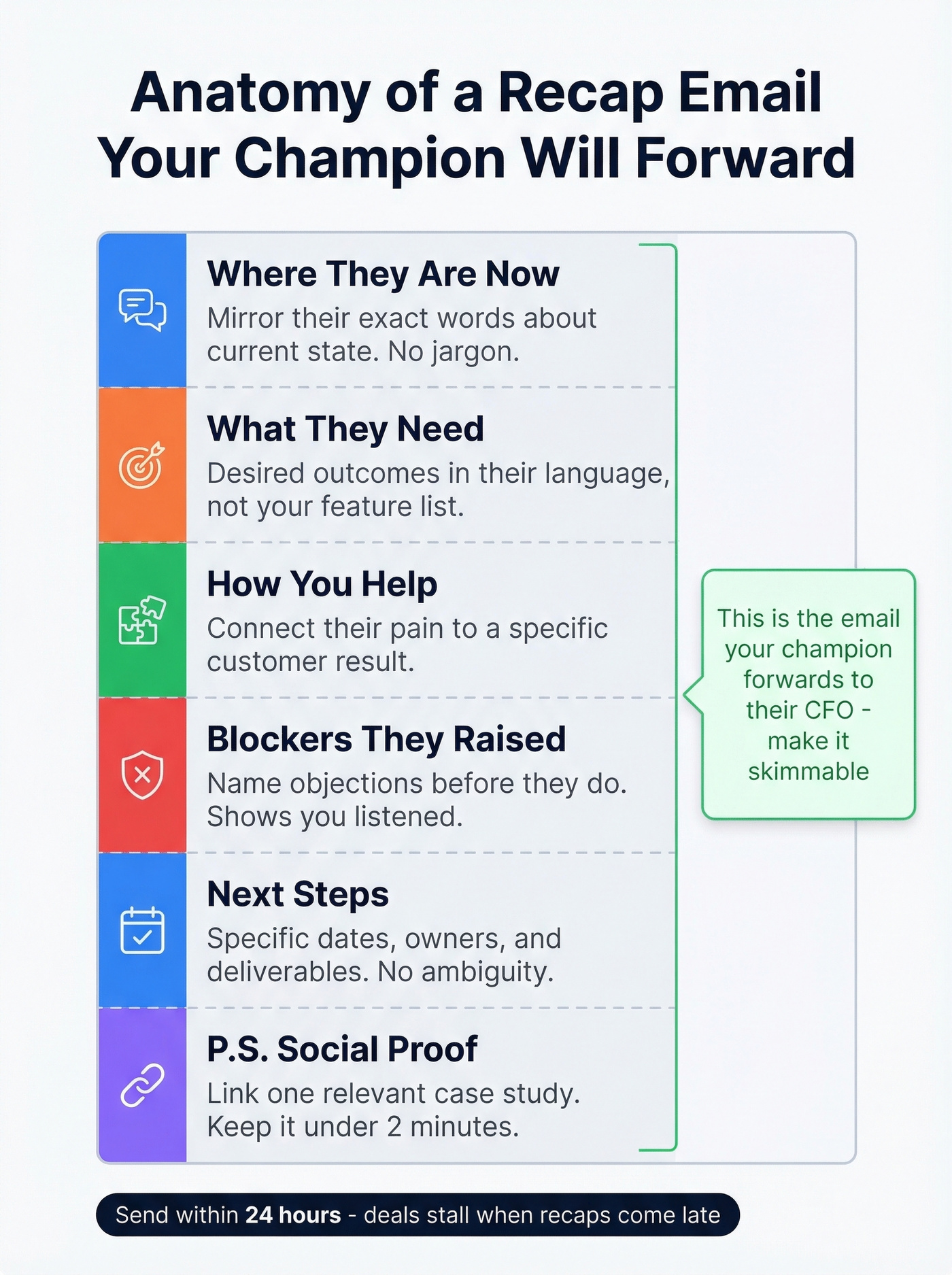
Send this within 24 hours. Deals stall when recaps come days late and the champion forgets half the conversation. Here's a 6-section structure that works:
Filled-in example:
Subject: relay recap + next steps
Jordan - great conversation today. Quick recap:
Where you are now: Your team manually stitches attribution data from 4 platforms, burning ~20 hours/month. CAC reporting lags by two weeks.
What you need: Real-time attribution across paid and organic, with Salesforce as the source of truth.
How we help: We unify marketing data for teams like Lattice and Ramp, cutting reporting time by 60% and giving finance same-day CAC numbers.
Potential blockers you raised: Salesforce integration timeline and getting your CFO's buy-in on budget.
Next steps: I'll send the Salesforce integration spec by Friday. Demo with your CFO scheduled for March 20 at 10 AM ET.
P.S. - Here's a 2-minute case study from Ramp's marketing team. Similar setup to yours.
Mirror their language, not your product docs. No feature dumps - recap status quo, pains, desired outcomes, then handle blockers proactively. This is the email your champion forwards to their CFO, so make it easy to skim. If you want a plug-and-play version, use a sales meeting follow-up email format.

Your discovery call templates are dialed in - but they only work if they land in real inboxes. Prospeo's 98% email accuracy and 7-day data refresh mean your perfectly crafted outreach actually reaches Jordan Chen, not a dead mailbox. Teams using Prospeo book 35% more meetings than Apollo users.
Stop sending great emails to bad addresses.
Follow-Up Cadence That Works
Most reps send one email and quit. It takes an average of 5 touches to engage a prospect - roughly 4 for junior contacts, about 9 for executives. If you need copy for those touches, steal from these sales follow-up templates.
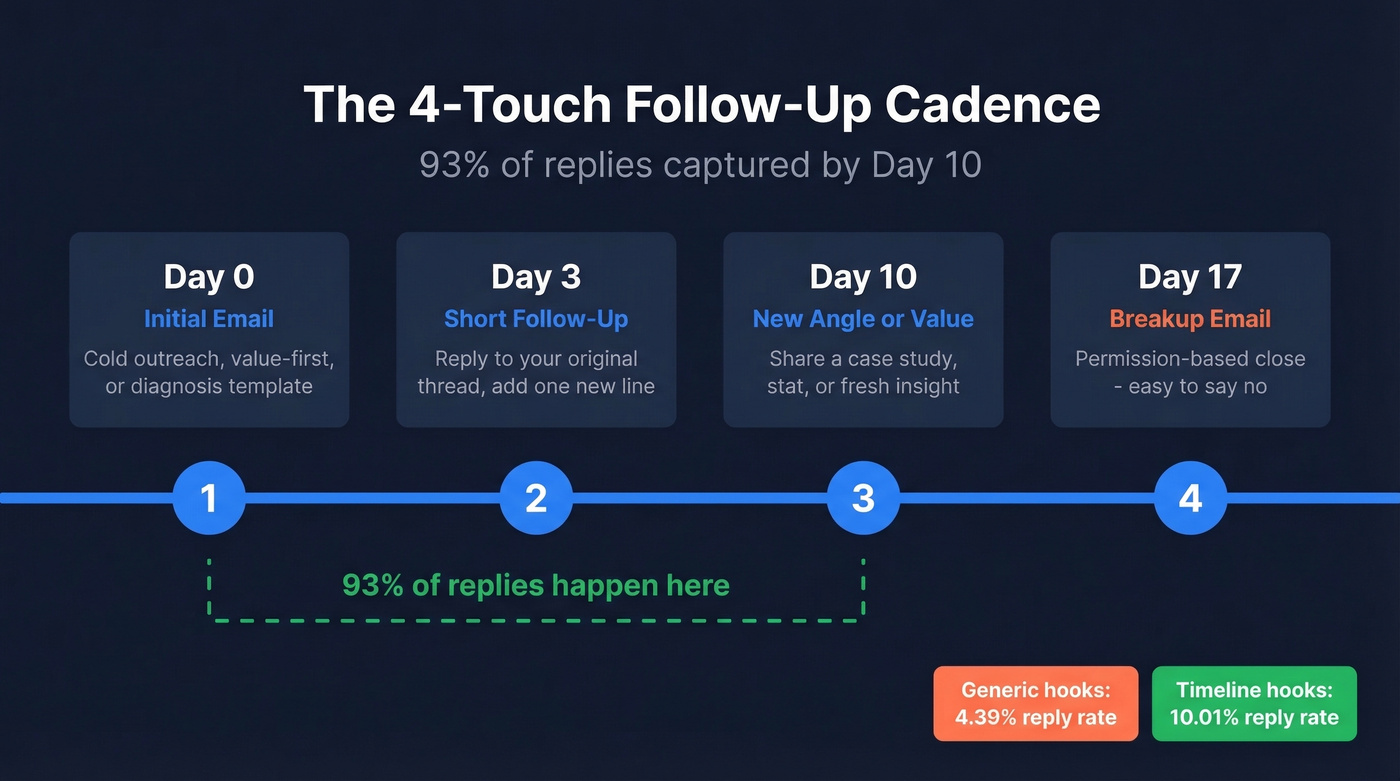
| Touch | Day | What to Send |
|---|---|---|
| 1 | Day 0 | Initial email |
| 2 | Day 3 | Short follow-up |
| 3 | Day 10 | New angle or value |
| 4 | Day 17 | Breakup or final |
The 3-7-7 cadence captures 93% of replies by Day 10. Two things that move the needle further: timeline hooks like "before Q3 planning kicks off" pull a 10.01% reply rate versus 4.39% for generic problem hooks. And segment your list into cohorts of 50 or fewer contacts - that alone lifts reply rates by 2.76x. (More on timing: best time to send cold emails.)
Here's the thing: if your average deal size is under $10k, you don't need a 12-touch, multi-channel sequence. Four well-timed emails with tight personalization will outperform a bloated cadence every time. We've watched teams burn weeks building elaborate sequences when a shorter, sharper approach would've booked more meetings in half the time.
Before You Hit Send
None of these templates matter if you're emailing the wrong person or bouncing off dead addresses. 71% of prospects ignore cold emails that lack relevance, and 43% ignore them for poor personalization - but the silent killer is bad data. If you're building lists at scale, sales prospecting techniques matter as much as the copy.
Meritt, an outbound agency, was running a 35% bounce rate before switching to Prospeo's email finder. They got it under 4%, and their pipeline tripled from $100K to $300K per week. That's the difference between a sequence that books meetings and one that torches your domain reputation. The free tier gives you 75 verified emails per month - enough to test every discovery call email template above before you spend a dollar. If you're troubleshooting deliverability, start with email bounce rate benchmarks and fixes.

A 5-touch follow-up cadence falls apart when half your contacts bounce. Prospeo verifies every email through a 5-step process - spam-trap removal, catch-all handling, honeypot filtering - so your sequence hits real decision-makers. One agency cut bounce rates from 35% to under 3%.
Build your prospect list in minutes, not hours.
Discovery Call Email Template FAQ
How long should a discovery call email be?
Under 90 words - ideally 40-60. Cold email benchmarks consistently show shorter messages earn higher reply rates. Write at a 3rd-grade reading level with one clear ask and zero filler.
How many follow-ups should I send?
Plan for at least five touches. The 3-7-7 cadence captures 93% of replies by Day 10. For VP-level and above, budget for 9 touches across email and other channels.
What's the best subject line for booking a discovery call?
Use 1-4 words, all lowercase. An analysis of 85M+ emails found short, non-salesy subject lines produce the highest open rates - 58%+ for top performers. Try "quick question" or the company name. Skip "Exclusive Opportunity Inside!!!"
How do I make sure my outreach emails actually get delivered?
Verify every address before sending. Bounce rates above 5% damage your sender reputation fast. Tools like Prospeo run a 5-step verification process that delivers 98% email accuracy, and the free plan at 75 credits per month lets you clean a list before committing to anything paid.