

DNS Reputation: How to Check, Understand, and Fix It
A SOC analyst blocks a suspicious domain on the WAF, then pauses - should they also check the hosting IP? What about the DNS infrastructure behind it? That moment of confusion plays out in security teams and marketing ops departments every day. DNS reputation is one of the most misunderstood layers in the email deliverability and security stack, and most guides skip the part that actually matters: how to fix it when things go wrong.
The Quick Version
- DNS reputation, domain reputation, and IP reputation aren't the same thing. Conflating them leads to misdiagnosis.
- Cross-reference at least three sources - Spamhaus, MxToolbox, and Google Postmaster Tools is a solid baseline.
- The major silent killer of domain reputation is bad contact data - bounces, spam traps, honeypots - not weak subject lines.
- Domain reputation typically takes 6-12 weeks to recover. Prevention is always cheaper.
DNS vs. Domain vs. IP vs. Sender Reputation
These terms get swapped constantly, and that's where teams get burned. They measure different things, recover on different timelines, and get evaluated by different systems.
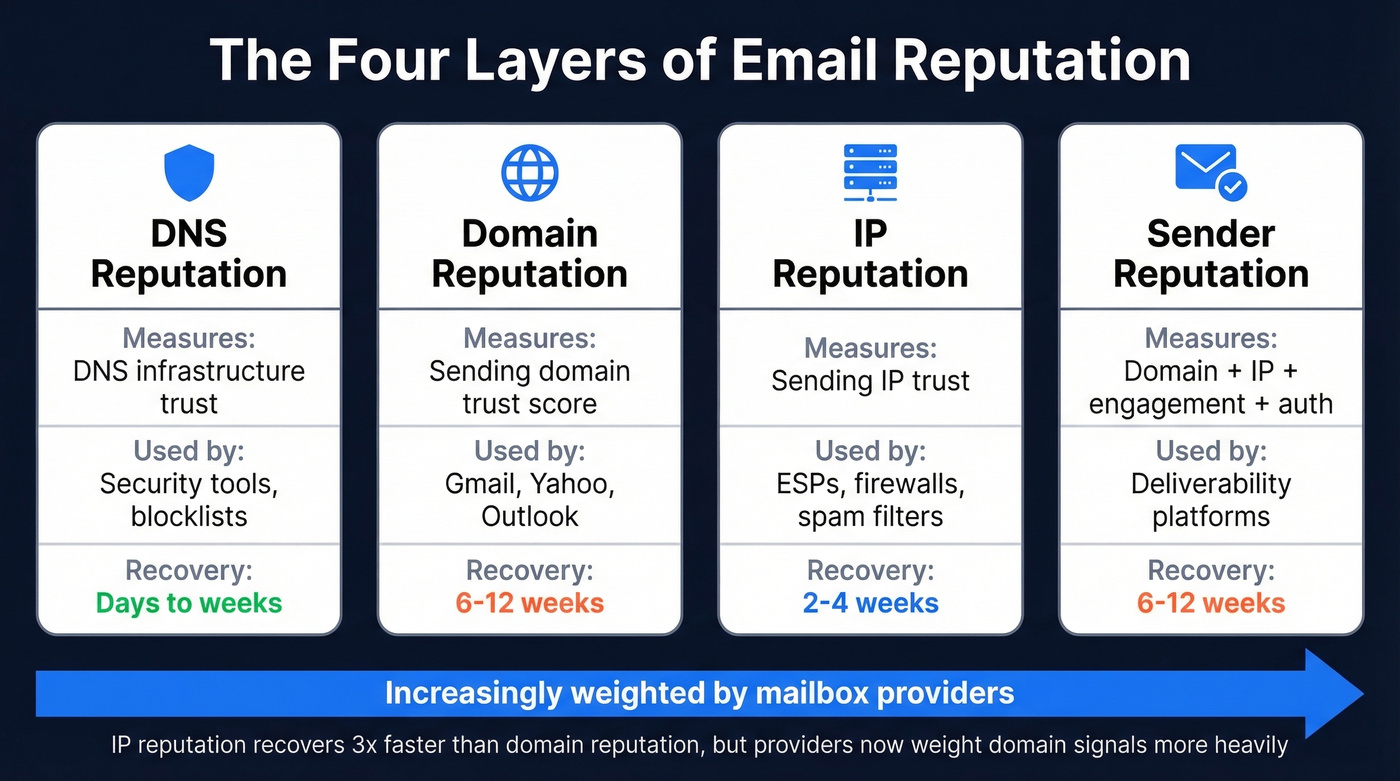
| Layer | What It Measures | Who Uses It | Recovery Time |
|---|---|---|---|
| DNS Reputation | DNS infrastructure trust | Security tools, blocklists | Days to weeks |
| Domain Reputation | Sending domain trust score | Gmail, Yahoo, Outlook | 6-12 weeks |
| IP Reputation | Sending IP trust (>80 good, <70 problem) | ESPs, firewalls, spam filters | 2-4 weeks |
| Sender Reputation | Domain + IP + engagement + auth | Deliverability platforms | 6-12 weeks (bottlenecked by domain) |
Here's the critical distinction: IP reputation recovers roughly 3x faster than domain reputation. Mailbox providers increasingly weight domain-level signals over IP signals - a shift Twilio has documented well. Swapping IPs won't save you if your domain is burned.
If you're trying to improve outcomes end-to-end, treat this as part of how to improve sender reputation, not a one-off lookup.
How Reputation Scoring Works
There's no universal score for DNS reputation. One of the most influential ecosystems is Spamhaus, which calculates domain-level trust using SIGINT, OSINT, machine learning, heuristics, and manual investigations - weighing domain ownership, registration location, registration time, associated infrastructure, and observed behavior.
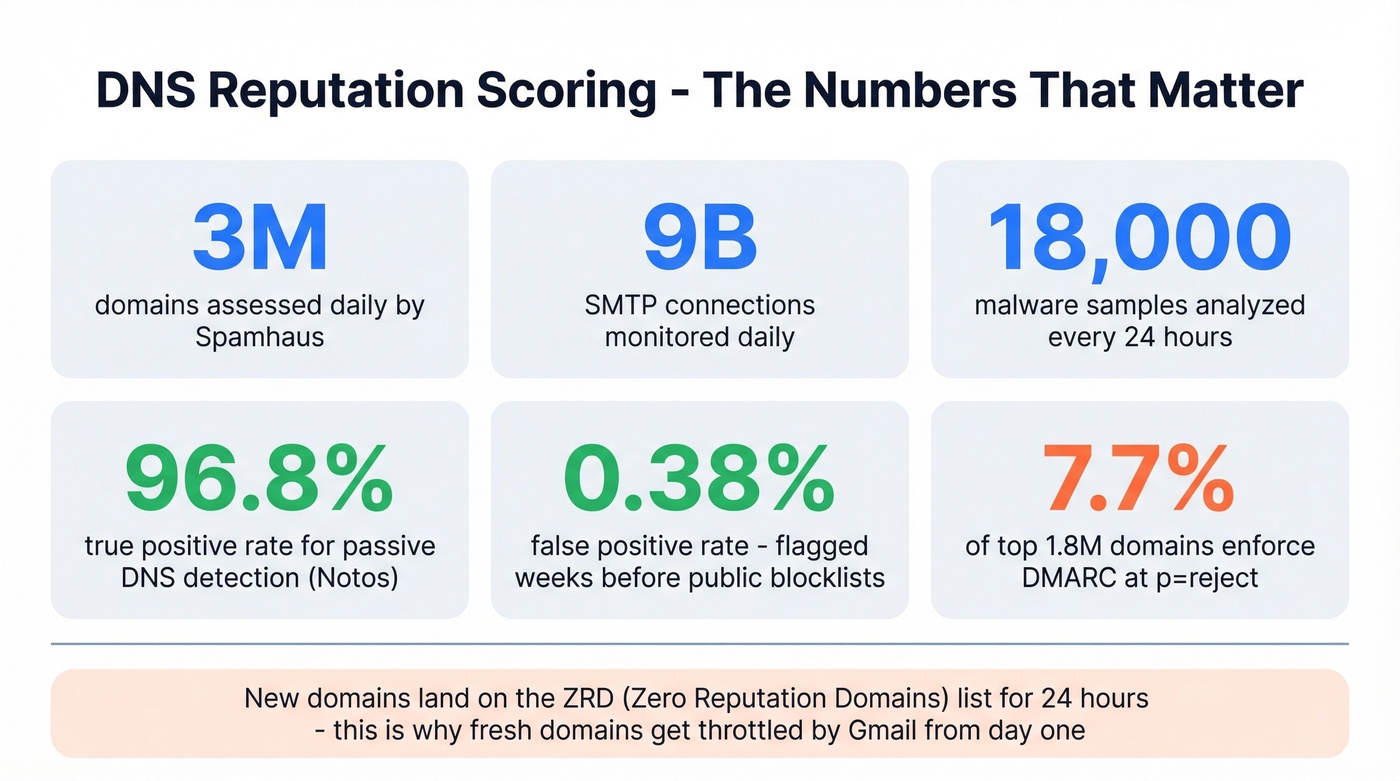
Spamhaus assesses 3M domains per day, monitors 9B SMTP connections daily, and analyzes 18,000 malware samples every 24 hours. Its ZRD (Zero Reputation Domains) list covers domains registered in the past 24 hours, which is why brand-new domains often get treated as suspicious by default. If you've ever warmed up a fresh domain and wondered why Gmail was throttling you from day one, ZRD is probably why.
On the research side, passive DNS systems like Notos have demonstrated 96.8% true positive rates with just 0.38% false positives, detecting malicious domains weeks or even months before they hit public blocklists. That's impressive, but it also means your domain can be flagged by downstream security tools before you even know there's a problem.
Meanwhile, the authentication layer remains wide open: only 7.7% of the top 1.8M email domains enforce DMARC at p=reject. That gap is both a massive attack surface and a massive deliverability risk. (If you’re implementing policy changes, it helps to understand DMARC alignment and validate your setup with a DKIM check.)

Spam traps and honeypots are the fastest path to a blocklisted domain. Prospeo's 5-step verification catches these reputation killers before they touch your sending queue - with 98% email accuracy on a 7-day refresh cycle, not the 6-week industry average.
Stop diagnosing reputation damage. Start preventing it with verified data.
How to Run a DNS Reputation Check
A common SOC triage pattern is to cross-check multiple tools rather than trusting a single score. We've found three sources is the minimum to catch listings any single tool misses.
| Tool | Use Case | Price | Notes |
|---|---|---|---|
| Spamhaus | Security + deliverability | Free lookup / DQS commercial | Gold standard for blocklists |
| MxToolbox | Deliverability | Free-$399/mo | Checks 100+ blacklists at once |
| Google Postmaster Tools | Deliverability | Free | Non-negotiable for Gmail senders |
| Cisco Talos | Security | Free lookup | Good IP/domain threat intel |
| VirusTotal | Security | Free / Enterprise plans available | VirusTotal (Aggregates 70+ scanners) |
| AbuseIPDB | Security | Free / paid API plans | Community-reported IP abuse |
| Validity Sender Score | Deliverability | Free basic / Everest paid tier | Industry-standard sender scoring |
| IPVoid | Security | Free | Quick DNS-resolver block checks |
For most teams sending at scale, Google Postmaster Tools and MxToolbox are the minimum baseline. Add Spamhaus if you want the security layer too. Running a lookup through all three gives you coverage across deliverability and threat intelligence in a single pass.
Skip AbuseIPDB and IPVoid unless you're doing security-focused analysis - they're overkill for a marketing team trying to diagnose inbox placement issues.
Why Reputation Tanks
Most teams blame content - subject lines, spam words, formatting. That's almost never the real problem. (If you’re still testing copy, use a structured library of email subject line examples so you don’t confuse content wins with reputation recovery.)
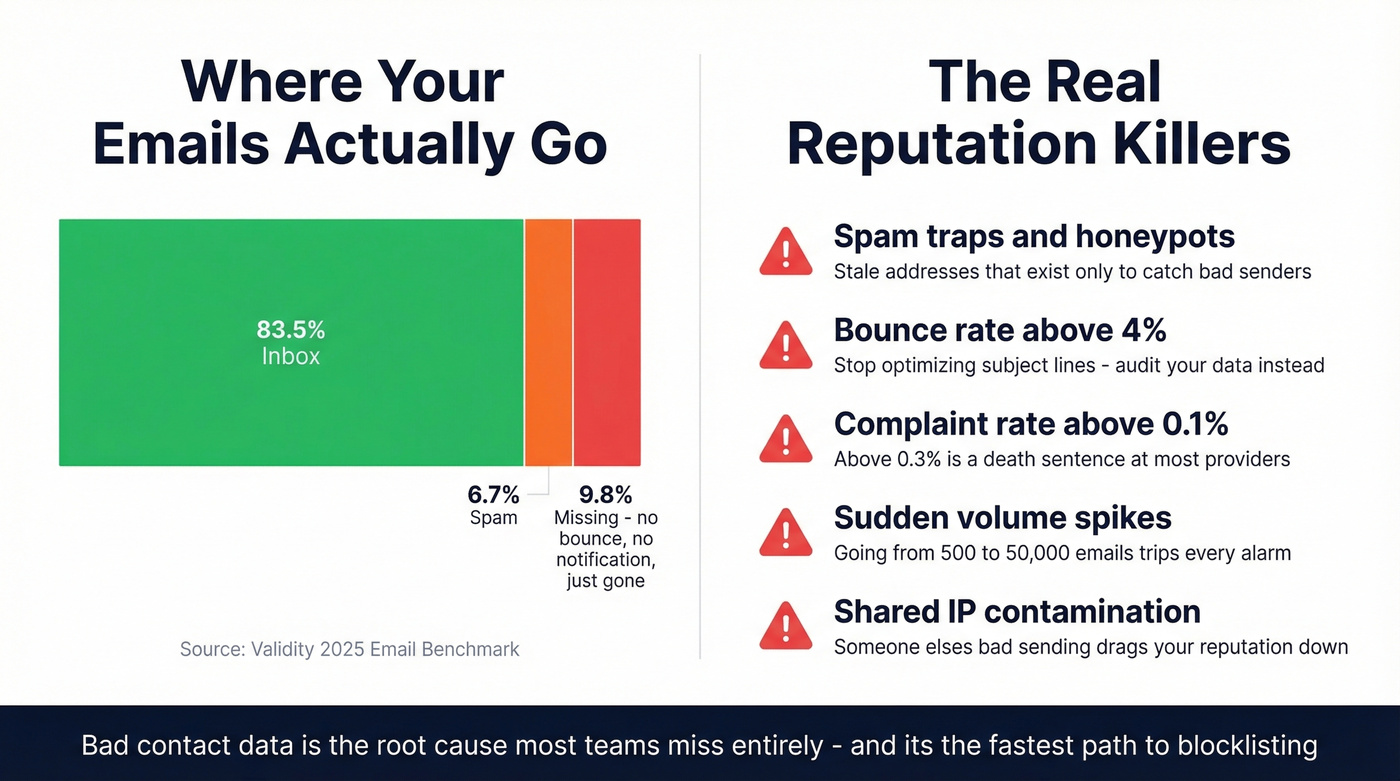
The actual causes are more mundane and more damaging. Compromised systems or accounts send spam without your knowledge. Poor list hygiene means you're mailing addresses that haven't been verified in months, and those stale addresses turn into recycled spam traps that exist solely to catch senders with bad data. High complaint rates above 0.1% start triggering filters, and crossing 0.3% is a death sentence at most providers. Sudden volume spikes - going from 500 emails a day to 50,000 - trip every alarm. And if you're on a shared IP, someone else's garbage sending drags your reputation down with it.
Validity's 2025 benchmark paints a sobering picture: only 83.5% of emails reach the inbox, 6.7% land in spam, and 9.8% simply vanish - no bounce, no notification, just gone.
Let's be honest: if your bounce rate is above 4%, stop optimizing subject lines and start auditing your data. We've seen teams spend weeks A/B testing copy when the real problem was a spam trap hit from a purchased list. Bad contact data is the root cause most teams miss entirely - and it's the fastest path to blocklisting. Prospeo's 5-step verification with spam-trap removal and honeypot filtering catches these reputation-killing addresses before they enter a sending queue, maintaining 98% email accuracy on a 7-day refresh cycle. (For benchmarks and remediation, see email bounce rate and spam trap removal.)

How to Fix Damaged DNS Reputation
If your reputation is already damaged, expect 6-12 weeks for domain reputation to stabilize. There aren't shortcuts here - just a disciplined process. Here's the recovery workflow we recommend:
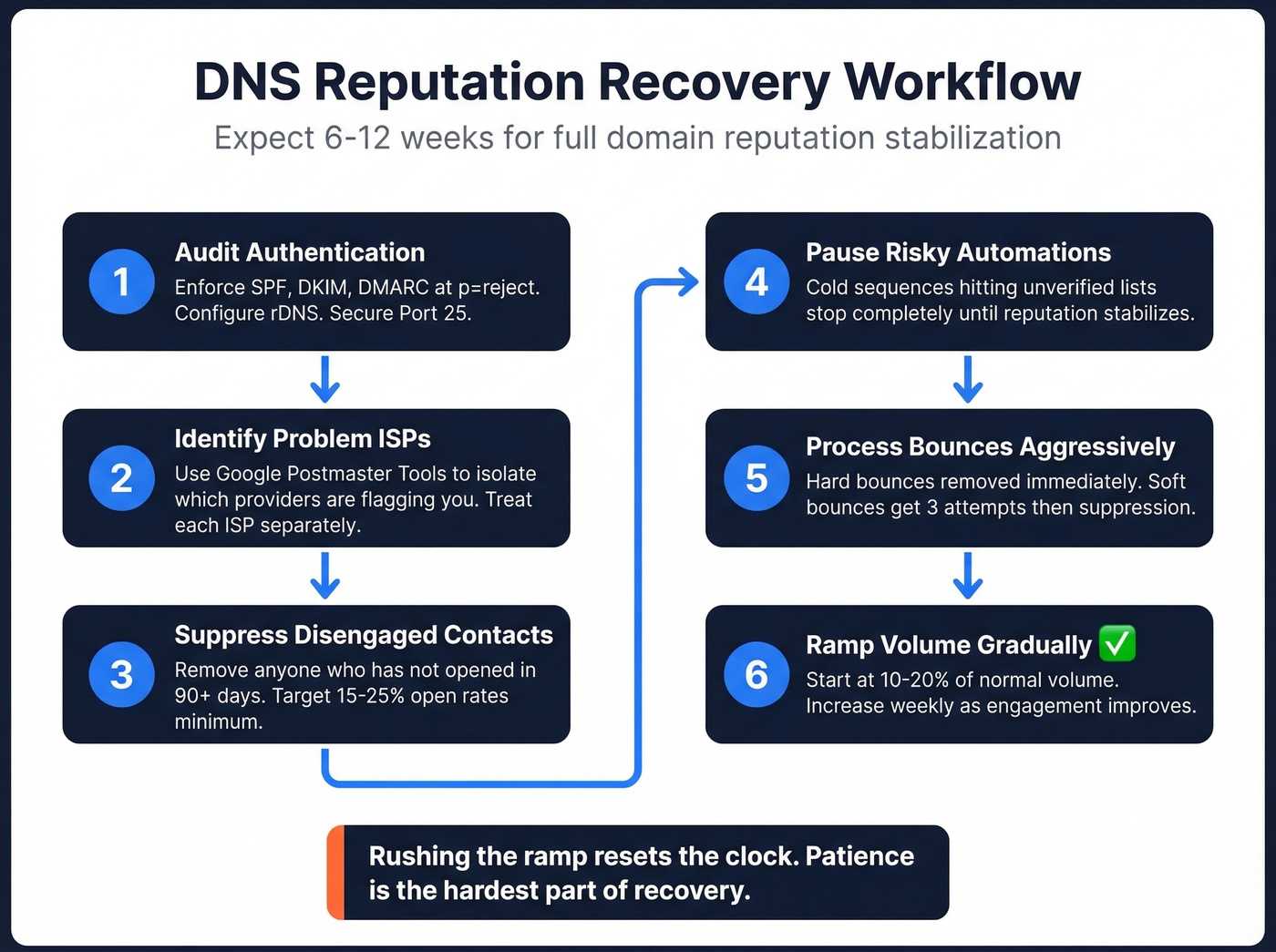
1. Audit authentication. Enforce SPF, DKIM, and DMARC at p=reject. Configure rDNS properly, secure Port 25, and prevent open proxies. This is table stakes, but the consensus on r/sysadmin is that a shocking number of teams still haven't done it. (If you need syntax help, start with an SPF record example.)
2. Identify the problem ISP. Use Google Postmaster Tools to isolate which providers are flagging you. Don't treat all ISPs as one problem - Gmail and Outlook weigh signals differently.
3. Suppress disengaged audiences. Anyone who hasn't opened in 90+ days gets removed. Aim for 15-25%+ open rates on the remaining list.
4. Pause risky automations. Cold sequences hitting unverified lists stop until reputation stabilizes. Full stop.
5. Process bounces aggressively. Hard bounces removed immediately. Soft bounces get three attempts, then suppression.
6. Ramp volume gradually. Start at 10-20% of normal volume and increase weekly as engagement improves. This is the part that tests everyone's patience, but rushing it just resets the clock.
One scenario we've watched play out multiple times: an outbound agency onboards a new client, imports a stale list of 50,000 contacts from a CRM that hasn't been cleaned in two years, and fires off a campaign the same week. Bounce rate hits 12%, three spam trap hits land them on Spamhaus SBL, and now they're spending the next quarter in recovery mode instead of booking meetings. The fix was always upstream - verify before you send. (If you’re already listed, follow a dedicated Spamhaus blacklist removal process.)
If your bounce rate is above 4%, your DNS and domain reputation are already taking hits. Prospeo removes spam traps, honeypots, and stale addresses at $0.01 per email - so the 6-12 week recovery process never starts.
Clean data is cheaper than reputation recovery. Always.
FAQ
What's the difference between DNS reputation and domain reputation?
DNS reputation measures how security tools and blocklists evaluate your DNS infrastructure at the network level - resolver behavior, nameserver associations, and zone configurations. Domain reputation is the trust score mailbox providers like Gmail assign to your sending domain based on authentication, engagement, and complaint rates. A DNS reputation check focuses on infrastructure health; domain reputation reflects sending behavior over time. They're related but not interchangeable.
How long does recovery take?
IP reputation recovers in 2-4 weeks. Domain reputation takes 6-12 weeks because providers weight historical sending behavior more heavily. Gradual volume ramps paired with strong engagement metrics are the only reliable recovery path. Anyone selling you a faster fix is selling you a relisting, not a reputation.
Can bad email data hurt my reputation?
It's one of the fastest ways to destroy it. Sending to invalid addresses, spam traps, and honeypots generates bounces and complaints that trigger blocklist additions. Verifying emails before sending prevents the damage entirely - tools like Prospeo, NeverBounce, and ZeroBounce all handle this, though verification depth and refresh frequency vary significantly between them.
How do I perform a DNS reputation lookup?
Cross-reference at least three tools: Spamhaus for blocklist coverage, MxToolbox for a broad blacklist sweep across 100+ lists, and Google Postmaster Tools for Gmail-specific domain signals. No single source gives you the full picture, so a multi-tool approach is standard for both security and deliverability teams.