

How to Write Effective Sales Messages That Actually Get Replies
Writing effective sales messages isn't about finding the perfect template. It's about understanding why 94.2% of your cold emails get ignored - and fixing the real reasons behind it. A study of 16.5 million cold emails found reply rates dropped 15% year-over-year to just 5.8%. Most teams are trending the wrong direction because they're optimizing copy when the problem is upstream: bad data, wrong contacts, no framework.
Here's the thing - your message probably isn't the problem. Your data is. We've watched teams rewrite emails for months while sending to addresses that bounce 30% of the time. Fix the foundation first, then worry about your subject line.
Quick Version
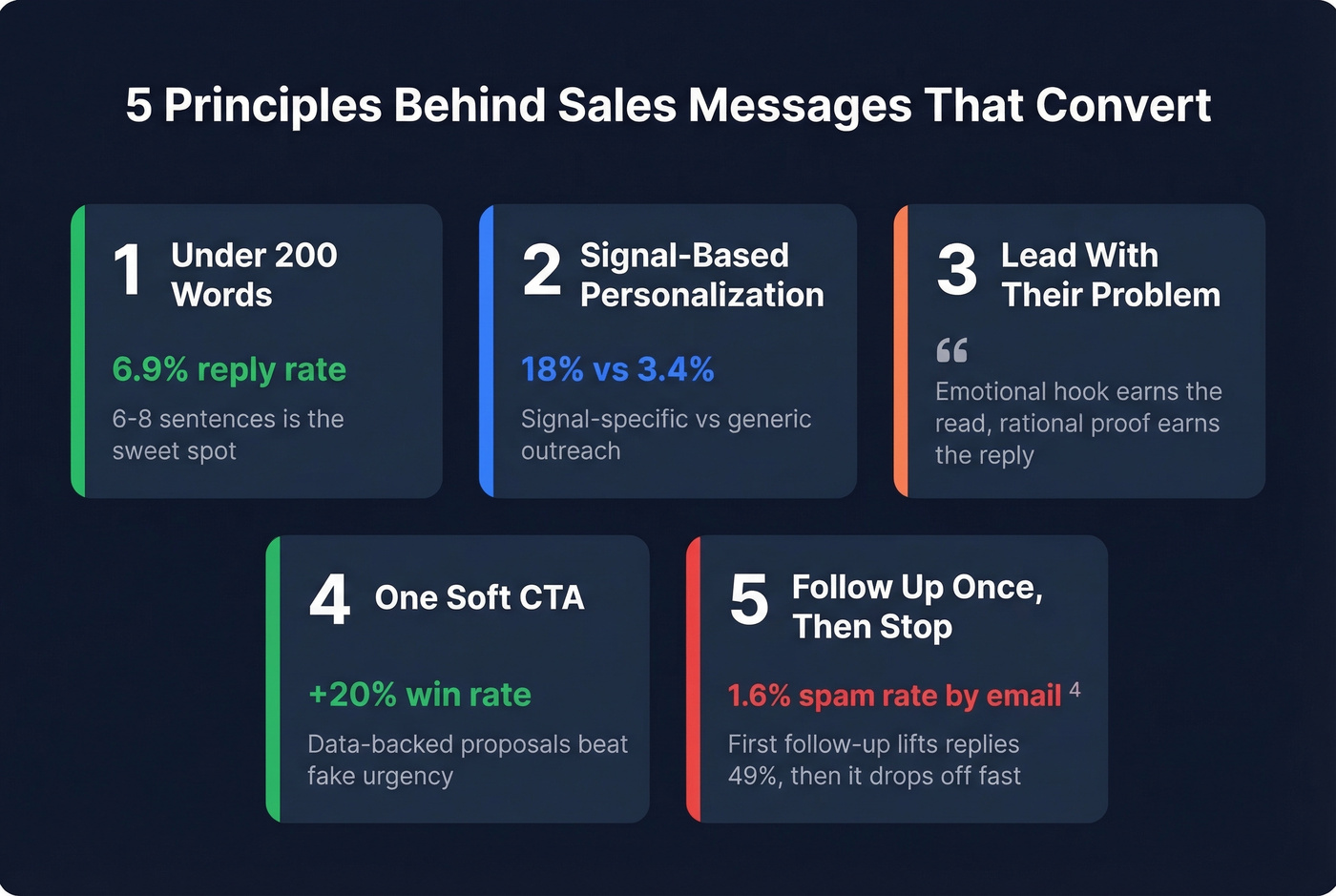
- Keep messages under 200 words. Six to eight sentences hit the highest reply rates at 6.9%.
- Contact 1-2 people per company, not 10+. Narrow targeting doubles your reply rate (7.8% vs 3.8%).
- Verify contact data before sending. Prospeo's free tier lets you verify 75 emails/month before you hit send.
2026 Benchmarks
Belkins analyzed 16.5 million cold emails across 93 business domains, and the results reshape how you should think about outreach performance:
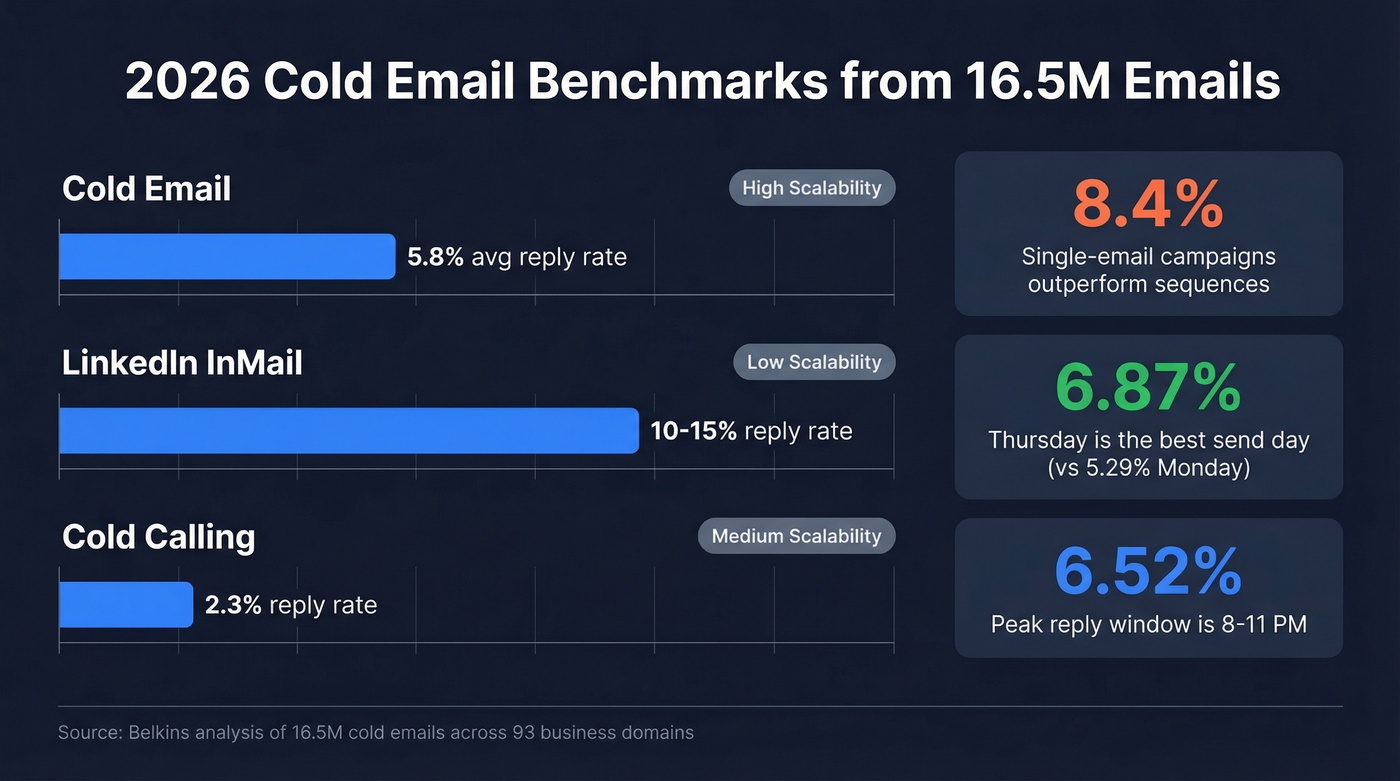
| Channel | Avg Response Rate | Scalability | Best For |
|---|---|---|---|
| Cold email | 5.8% | High | First touch at scale |
| LinkedIn InMail | 10-15% | Low (platform caps) | Warm/targeted outreach |
| Cold calling | ~2.3% | Medium | High-value accounts |
Thursday emails pulled a 6.87% reply rate versus Monday's 5.29%. The 8-11 PM send window peaked at 6.52%. And single-email campaigns - no sequence, just one shot - hit 8.4%, which surprised us too. More emails in a sequence doesn't mean more replies.
Build a Messaging Framework First
B2B buyers typically run around 12 online searches before engaging with a vendor. By the time they read your email, they've already formed opinions. Your outbound messaging needs to be consistent across every touchpoint, which means you need a framework, not a template.
If you're still building your outbound motion, start with a clear ideal customer profile so your messaging framework has a real target.
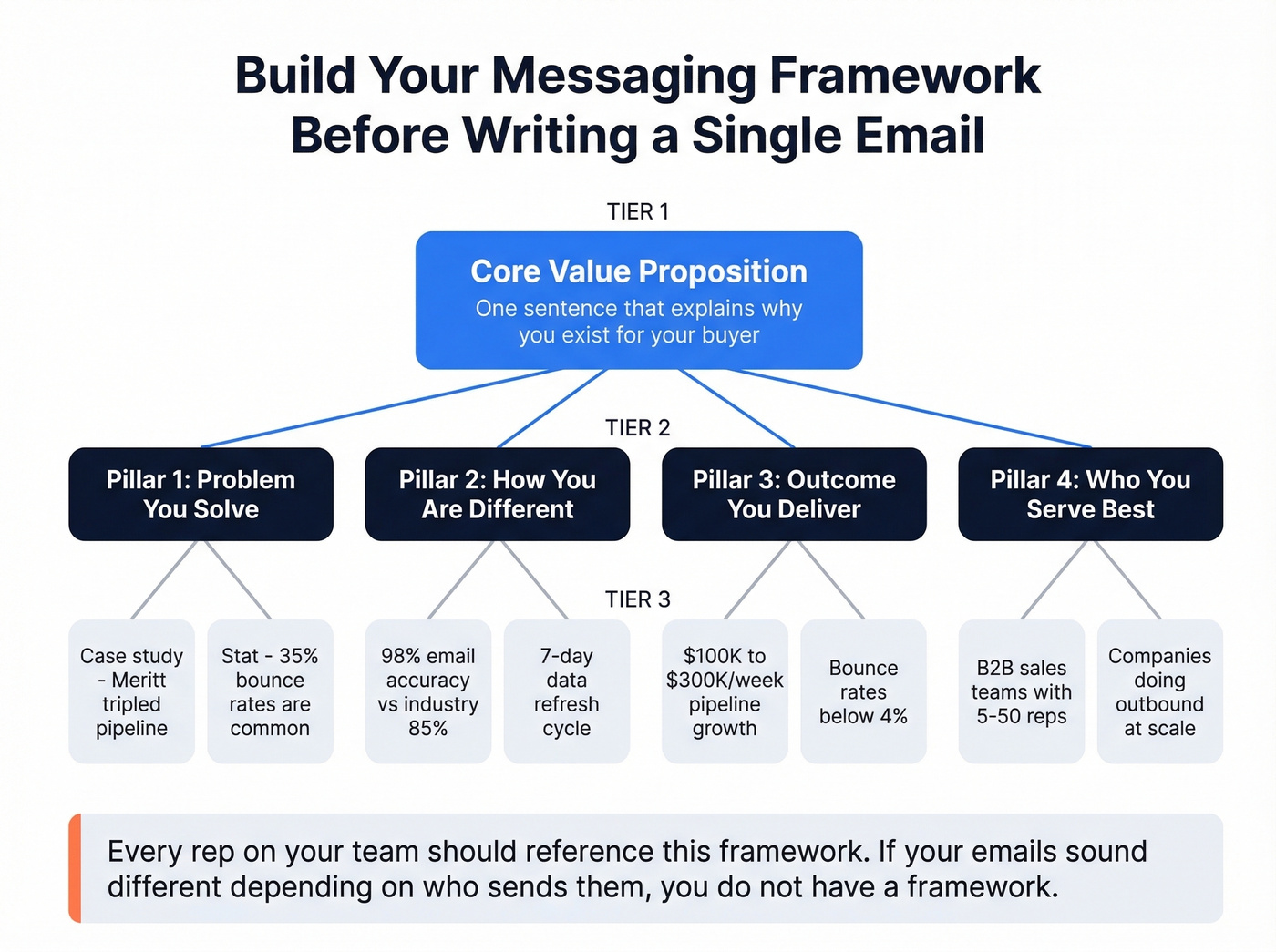
Start with one core value proposition, support it with three to four messaging pillars, and back each pillar with proof points. WordPress leads with "powers 43% of the web" because that single proof point does the selling on its own. Most sales teams skip this step and jump straight to writing emails, which is why their messaging sounds different depending on which rep sends it. If you don't have a messaging framework documented somewhere your whole team can reference, stop reading this article and go build one. Everything else is downstream.

Your messaging framework means nothing if 35% of your emails bounce. Prospeo's 98% email accuracy and 7-day data refresh cycle ensure every carefully crafted message actually reaches an inbox. Meritt tripled their pipeline from $100K to $300K/week after dropping bounce rates below 4%.
Fix your data before you rewrite another subject line.
Five Principles Behind Messages That Convert
Keep It Under 200 Words
The 16.5M-email dataset found messages with 6-8 sentences produced a 6.9% reply rate. On r/salestechniques, new reps commonly overexplain because they're afraid of leaving something out. Cut the product paragraph. Your prospect needs a reason to respond, not your feature list.
If you need a starting point, use proven email copywriting patterns and then tailor them to the account.
Personalize Beyond First Name
71% of buyers expect personalized interactions, and 76% get frustrated when they don't get them. First-name tokens don't count. Signal-specific personalization - referencing a job change, a funding round, or a tech stack shift - drives an 18% response rate versus 3.4% for generic outreach, per Instantly's 2026 benchmark data.
To operationalize this, build a repeatable personalized outreach process your whole team can follow.
Let's look at what that difference actually looks like:
Before: "Hi Sarah, I wanted to reach out about our platform that helps companies improve their outbound sales efficiency and pipeline generation..."
After: "Saw Acme just closed Series B - congrats. Most teams at your stage lose 15% of pipeline to bad contact data. Worth a quick look at how Meritt fixed that?"
The second version takes 10 seconds longer to write and gets 5x the replies. Specific, concise, rooted in a real signal. That's what a high-converting prospecting message looks like.
Lead With Their Problem
Dan Kennedy's principle holds: write with emotion, edit with logic. Your opening line should name a problem your prospect actually has. The emotional hook earns the read; the rational proof earns the reply. Nobody cares what your product does until they believe you understand what they're dealing with.
This is also why strong sales communication beats clever copy: clarity wins.
One Soft CTA Per Message
"Worth a 15-minute call?" outperforms "Book a demo here" in almost every test we've run. Bryan Vasquez at LinkBuilder.io replaced urgency-based CTAs with data-backed proposals and saw a 20% win rate increase over two quarters. Fake urgency backfires. Your prospects can smell it.
If you want more examples, use these email call to action rules to keep CTAs low-friction.
Follow Up Once, Then Stop
Here's the math that should change your follow-up strategy: a first follow-up can lift replies up to 49%. But the third email produces ~20% fewer responses, and spam complaint rates climb from 0.5% on the first email to 1.6% by the fourth.
One follow-up is valuable. Two is marginal. Three is actively harmful.
If you need a system, start with these cold email follow-up templates and adapt them to your signals.
We've seen this pattern across dozens of campaigns - the reps who send fewer emails book more meetings, which is counterintuitive until you look at the deliverability data.
Mistakes That Kill Your Outreach
Do this: Contact 1-2 decision-makers per account with a tailored message. The data shows 7.8% reply rates for narrow targeting.
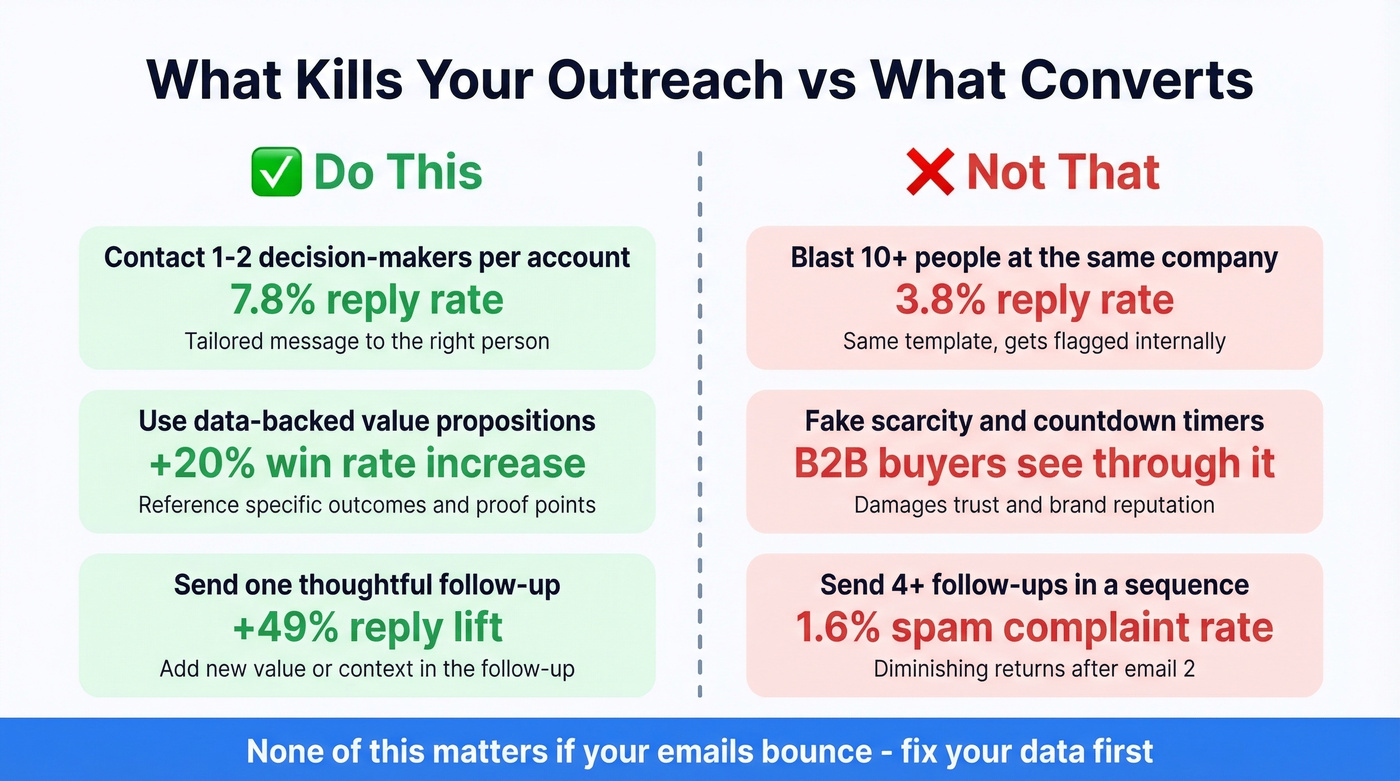
Not that: Blast 10+ people at the same company with the same template. Reply rates drop to 3.8%, and you'll get flagged internally.
Do this: Replace urgency tactics with specific, data-backed value propositions. Vasquez's team proved this - 20% higher win rates.
Not that: Use fake scarcity or aggressive countdown timers. B2B buyers see through it.
None of this matters if your message bounces. Meritt was running a 35% bounce rate before switching to Prospeo - their pipeline tripled from $100K to $300K per week once bounce rates dropped below 4%. That's the difference 98% email accuracy and a 7-day data refresh cycle make: your messages actually reach inboxes.
If you're seeing high bounces, start by diagnosing your email bounce rate and fixing the root cause.
AI-Assisted Messaging in 2026
56% of sales reps now use AI daily, up from 24% in 2023. Gartner found that sellers who effectively partner with AI are 3.7x more likely to meet quota. The numbers are hard to argue with.
But AI doesn't fix bad inputs. Sales reps spend 72% of their time on non-selling activities - AI reclaims some of that, but only when you feed it real signals like buyer intent and job changes instead of asking it to generate generic templates. The biggest obstacle is data fragmentation: AI can't personalize when your contact records are stale or scattered across five tools. Skip the AI writing assistant if you haven't cleaned up your CRM data first. You're just generating prettier garbage.
If you're experimenting here, use an AI for sales emails workflow that starts with data quality, not prompts.
What to Measure (and What to Ignore)
Stop tracking open rates. Apple Mail accounts for 46% of email clients, and Mail Privacy Protection inflated open rates by 18 points across 80,000+ accounts. Your "45% open rate" is fiction.
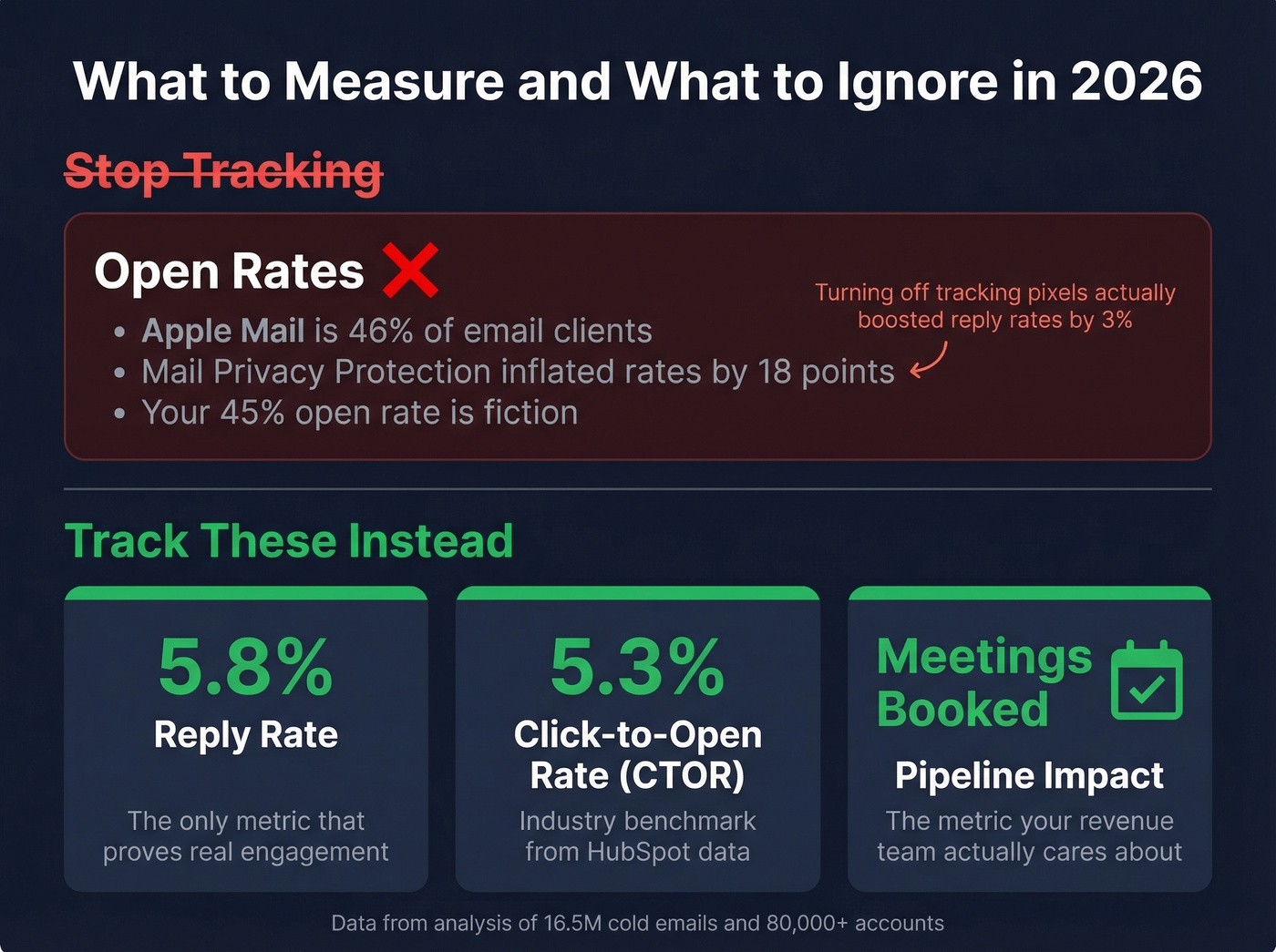
Track reply rate, click-to-open rate (benchmark: 5.3% CTOR), and meetings booked. These measure actual engagement. One surprising finding from the 16.5M-email study: turning off open-tracking pixels produced 3% higher response rates. The pixels themselves were hurting deliverability. We turned ours off six months ago and haven't looked back.
If you want to go deeper, this email tracking pixel breakdown explains what’s really happening behind the scenes.
Signal-specific personalization drives 18% reply rates - but only when you have real signals to work with. Prospeo tracks 15,000 intent topics, job changes, funding rounds, and tech stack shifts across 300M+ profiles so your sales messages reference something your prospect actually cares about.
Stop guessing. Prospect with real buyer signals at $0.01 per lead.
FAQ
What's a good reply rate for cold emails?
The 16.5M-email study found 5.8% average across all industries. Above 7% is strong performance. Single-email campaigns hit 8.4% - more emails in a sequence doesn't automatically mean more replies.
How long should a sales message be?
Under 200 words. Messages with 6-8 sentences produced the highest reply rates at 6.9%. If you're writing more than a short paragraph, you're overexplaining and losing attention.
How do you personalize outreach at scale?
Use signal-based triggers - job changes, funding rounds, intent data - instead of manual research. Reference something specific to the prospect's situation rather than leading with your product. Tools that pull buyer intent and contact data in one place cut personalization time from minutes to seconds per prospect.
Does follow-up frequency affect deliverability?
Yes. Spam complaint rates climb from 0.5% on the first email to 1.6% by the fourth. One follow-up lifts replies by up to 49%, but each additional message after that produces diminishing returns and risks your sender reputation.