

The Best Email Address Finder Software in 2026
Your last campaign had a 6% bounce rate. Your ESP sent a warning. You don't have a messaging problem - you have a data problem. Most email address finder software claims 90-95%+ accuracy, but published benchmark tests often tell a different story. Database size is a vanity metric. What actually matters is accuracy, data freshness, and cost per verified email.
Our Picks (TL;DR)
- Best for accuracy and data freshness: Prospeo - 98% email accuracy, 7-day data refresh, free tier with 75 emails/month.
- Biggest self-serve database: Apollo.io - 210M-250M+ contacts, but watch bounce rates on older records.
- Best budget option: Snov.io - affordable credits, solid international coverage, built-in automation.
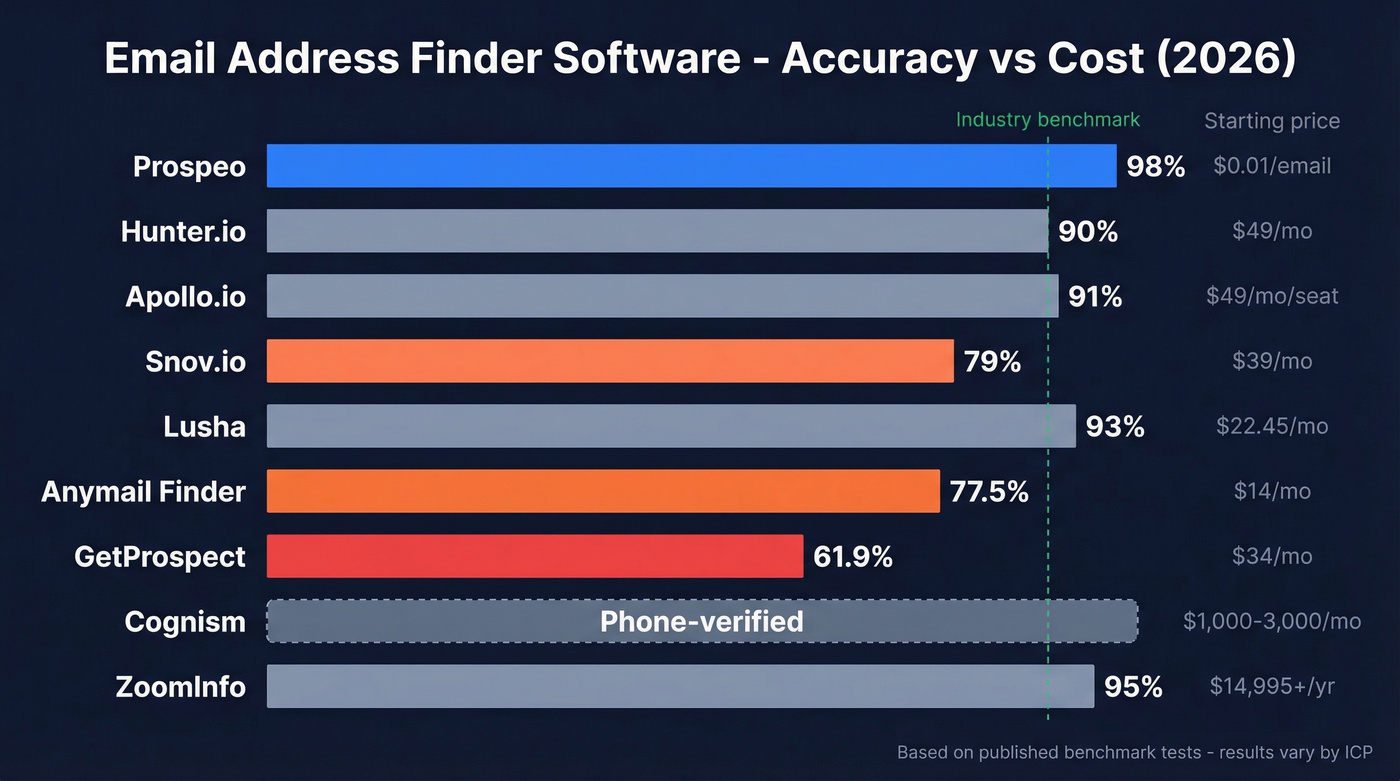
| Tool | Best For | Accuracy | Starting Price | Free Tier |
|---|---|---|---|---|
| Prospeo | Accuracy + freshness | 98% | ~$0.01/email | 75 emails/mo |
| Hunter.io | Email verification | ~90% | $49/mo (or $34/mo yearly) | 50 credits/mo |
| Apollo.io | Database size | ~91% | $49/mo per seat | Yes (limited) |
| Snov.io | Budget + intl. | ~79% | $39/mo | 50 credits/mo |
| Lusha | Quick lookups | ~93% | $22.45/mo annual | 40 credits/mo |
| Anymail Finder | Pay-for-valid only | ~77.5% | $14/mo | 100 credits |
| GetProspect | Small teams | ~61.9% | $34/mo annual | 50 emails/mo |
| Cognism | EU/UK enterprise | Phone-verified | ~$1,000-3,000/mo | No |
| ZoomInfo | Enterprise anchor | ~95% | $14,995-$35,995/yr | No |
Accuracy figures reflect published benchmark tests and vendor data. Results vary by methodology and ICP - always validate against your own list.
Top Email Finder Tools Compared
Prospeo - Best for Accuracy and Freshness
Prospeo's database covers 300M+ professional profiles with 143M+ verified emails. The 98% email accuracy comes from a proprietary 5-step verification process that includes catch-all handling, spam-trap removal, and honeypot filtering - not just pinging an MX record and calling it verified.

The 7-day data refresh cycle is the real differentiator here. Industry average sits around six weeks, which means a lot of tools serve contacts who changed jobs weeks ago. Using fresher data, Snyk's team dropped their bounce rate from 35-40% to under 5%, with AE-sourced pipeline up 180%. That's what fresh data does at scale.
The Chrome extension - used by 40K+ people - works across company websites, professional profiles, and CRMs for one-off lookups, while the API hits a 92% match rate for bulk enrichment. You can filter by buyer intent signals to prioritize contacts actively in-market, so you're not just finding emails but finding the right ones at the right time. Pricing starts free: 75 emails per month, no credit card required. At scale, roughly $0.01 per email.
If you're building a full outbound stack, pair your finder with data enrichment so your CRM stays clean as you scale.
Hunter.io - Best for Verification
Use this if: You already have a list and need to clean it before sending. Hunter's verification engine is genuinely solid, and the unlimited-users model means your whole team shares one plan without per-seat creep.
Skip this if: You need a primary prospecting database. The consensus on r/sales is that Hunter's database is "pretty small" - practitioners use it as a verification layer, not a lead source.

The credit system needs decoding. One credit gets you one email find, but verification costs 0.5 credits. So Hunter's Starter plan at $49/mo with 2,000 credits gets you roughly 1,300 finds and 1,300 verifications - not 2,000 of each. Credits expire three months after purchase, which catches people off guard.
One detail competitors don't mention: Hunter offers two plan types - All-in-One Outreach with unified credits and Data Platform with separate search and verification pools. Confirm which you're signing up for, because the credit math changes significantly.
If you're comparing options in this category, see our breakdown of Hunter alternatives.
Apollo.io - Biggest Self-Serve Database
Apollo's 210M-250M+ contact database is one of the largest self-serve options on the market. For US-based prospecting - especially mid-market and enterprise titles - the coverage is hard to beat. The platform bundles sequencing, dialing, and basic intent signals alongside the data, making it attractive as an all-in-one outreach suite.
Here's the thing: biggest doesn't mean best. The top complaint across Reddit threads about Apollo is data freshness - "data feels bad sometimes" and "lots of bounces on older contacts." We've seen this firsthand when comparing Apollo pulls against fresher sources on the same target list.
Pricing runs on a hybrid per-seat plus credit model. Basic starts at $49/mo, Professional at $79/mo, and Organization at $119/mo with a minimum of three seats. Credits don't roll over, which punishes inconsistent usage months.
If you're evaluating database-first tools, compare against other sales prospecting databases before committing.
Snov.io - Best Budget Option
Most agencies and startups don't need enterprise data - they need decent international coverage at a price that doesn't require board approval. That's Snov.io.
The credit system is straightforward, the built-in drip campaign automation saves you a separate sequencer subscription, and coverage outside the US is stronger than Apollo's, which skews heavily domestic. Reddit users consistently praise the affordability. Where it falls short: deep US enterprise data and high-volume mobile numbers. Free tier gives you 50 credits per month. Starter runs $39/mo with enough credits for a small team's weekly prospecting.
If you're running cold outreach, make sure your B2B cold email sequence matches your list quality.
Lusha - Quick Lookups, Not Bulk
Lusha isn't for the team pulling 500+ contacts per week. It's for the rep who needs three direct dials before a meeting block. The browser extension is fast, the UI is dead simple, and the free tier of 40 credits per month is generous for individual contributors who prospect lightly.
Pro runs $22.45/mo on an annual plan, Premium $52.45/mo. G2 reviewers rate it highly for ease of use but consistently flag the credit math as expensive at scale. If you're doing serious volume, look elsewhere.
For teams that need a broader stack, start with a shortlist of SDR tools that fit your workflow.
Anymail Finder - Pay Only for Valid Emails
Here's a pricing model more tools should copy: you're only charged for emails that verify as valid. That eliminates the "I burned 200 credits on catch-all addresses" frustration that plagues every other tool on this list. Plans start at $14/mo with 100 free credits to test. The database is smaller than Apollo's, so discovery is limited - but for verification-first workflows, the economics are compelling.
If you're doing verification-heavy workflows, it helps to understand email bounce rate benchmarks and what the codes actually mean.
GetProspect - The $34/mo Starting Point
Don't expect advanced filtering or intent data. GetProspect offers 50 free emails per month and a Starter plan at $34/mo annually for 1,000 credits. It's straightforward, no-frills, and fine for a two-person team doing light prospecting. If you outgrow it in three months, that's actually the right outcome - it means your outbound is working.
If you're still building your pipeline motion, these sales prospecting techniques will help you get more value from any list.
Cognism - EU/UK Enterprise Data
For teams selling into the UK and EU who need GDPR-compliant, phone-verified data, Cognism is purpose-built. The intent data layer is strong. Think of it as ZoomInfo for regulated European markets - similar depth, similar price tag of $1,000-3,000/mo for small teams, no self-serve option. Overkill for SMBs.
ZoomInfo - The Enterprise Anchor
Hot take: ZoomInfo is still the most comprehensive all-in-one sales intelligence platform. But most teams don't need all-in-one - and they definitely don't need the price tag.
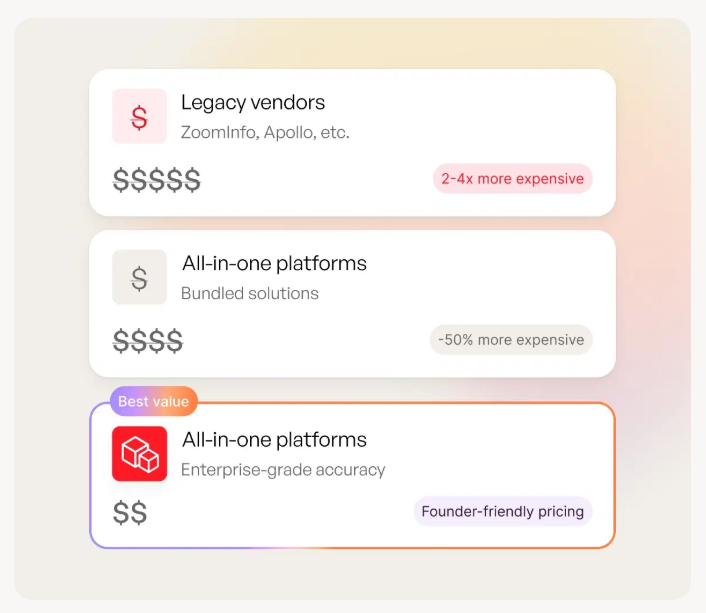
List prices run $14,995-$35,995/year, though most teams negotiate 30-65% off. If your average deal size is under $25K, you're probably paying more for the data than you're closing per deal. We've watched mid-market teams get equivalent results from lighter tools at a tenth of the cost, which is why the r/sales subreddit is full of threads about ZoomInfo alternatives.

Most email address finder software serves you contacts who changed jobs six weeks ago. Prospeo refreshes every 7 days, delivers 98% email accuracy, and costs roughly $0.01 per verified email. That's why teams like Snyk dropped bounce rates from 35% to under 5%.
Stop paying for stale emails. Start with 75 free lookups today.
How Credits Actually Work
Credit systems are designed to look generous on the pricing page and feel expensive in practice. Let's break down what you're actually getting.
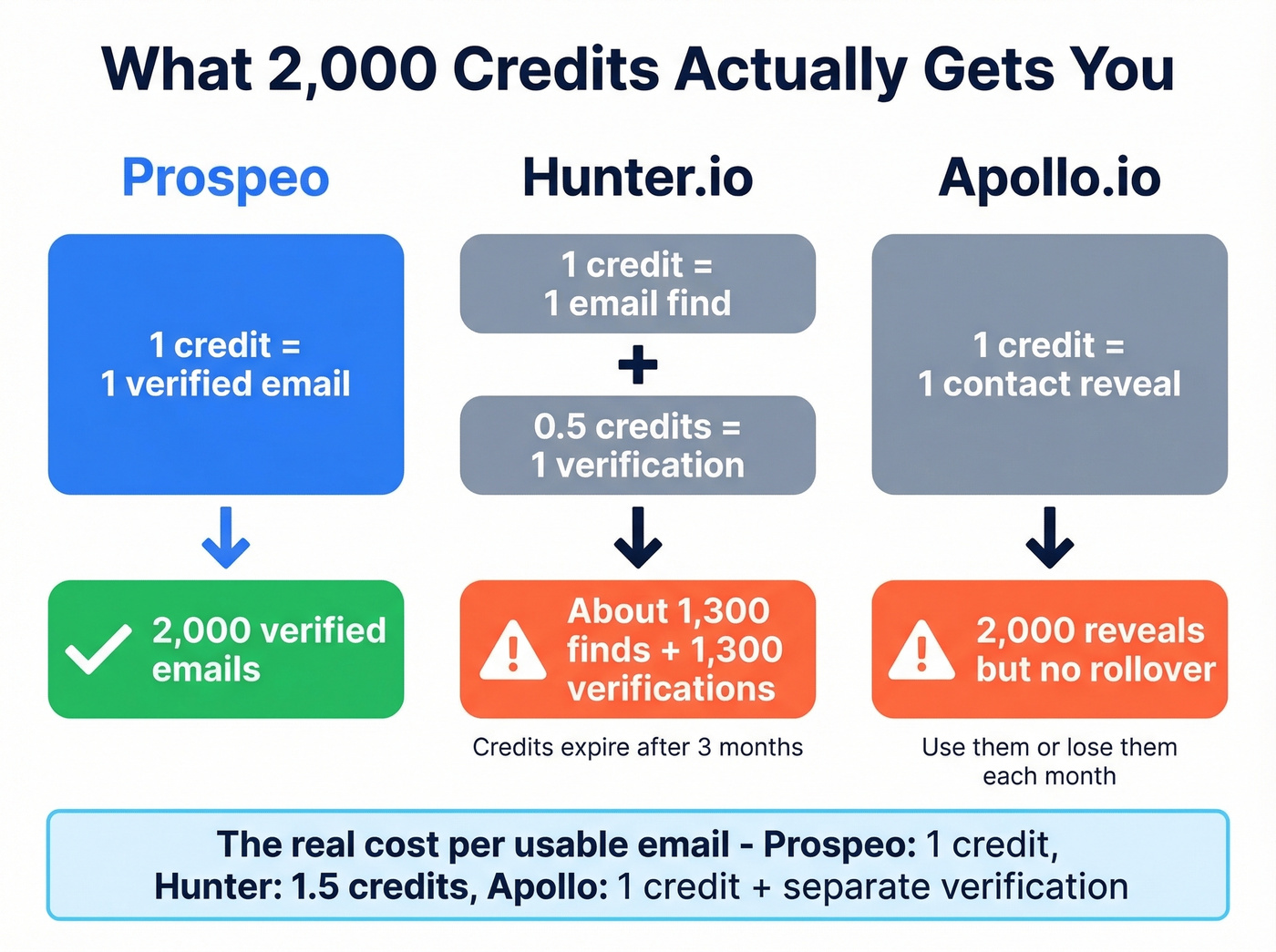
| Tool | 1 Credit Buys | Credits Roll Over? | Verification Cost |
|---|---|---|---|
| Prospeo | 1 verified email | No (monthly) | Included |
| Hunter.io | 1 email find | No (expire in 3 mo) | 0.5 credits |
| Apollo.io | 1 contact reveal | No | Varies by workflow |
| Snov.io | 1 email find | No | Varies by plan |
| Lusha | 1 contact reveal | No | Varies by plan |
The critical difference: Hunter's 2,000 Starter credits get you roughly 1,300 finds plus 1,300 verifications - not 2,000 of each. If you're finding and verifying, which you should be, you're burning 1.5 credits per usable email. Apollo's credits don't roll over between billing cycles, so you either use them or lose them. Teams with inconsistent prospecting cadences end up overpaying for months they don't fully utilize.
Prospeo bundles verification into the credit cost, which makes the math simpler: one credit, one verified email, done.
If you're sending at scale, align your list-building with safe email velocity so deliverability doesn't collapse.
Mistakes That Kill Deliverability
Five errors that turn a good email finder into a domain reputation problem.
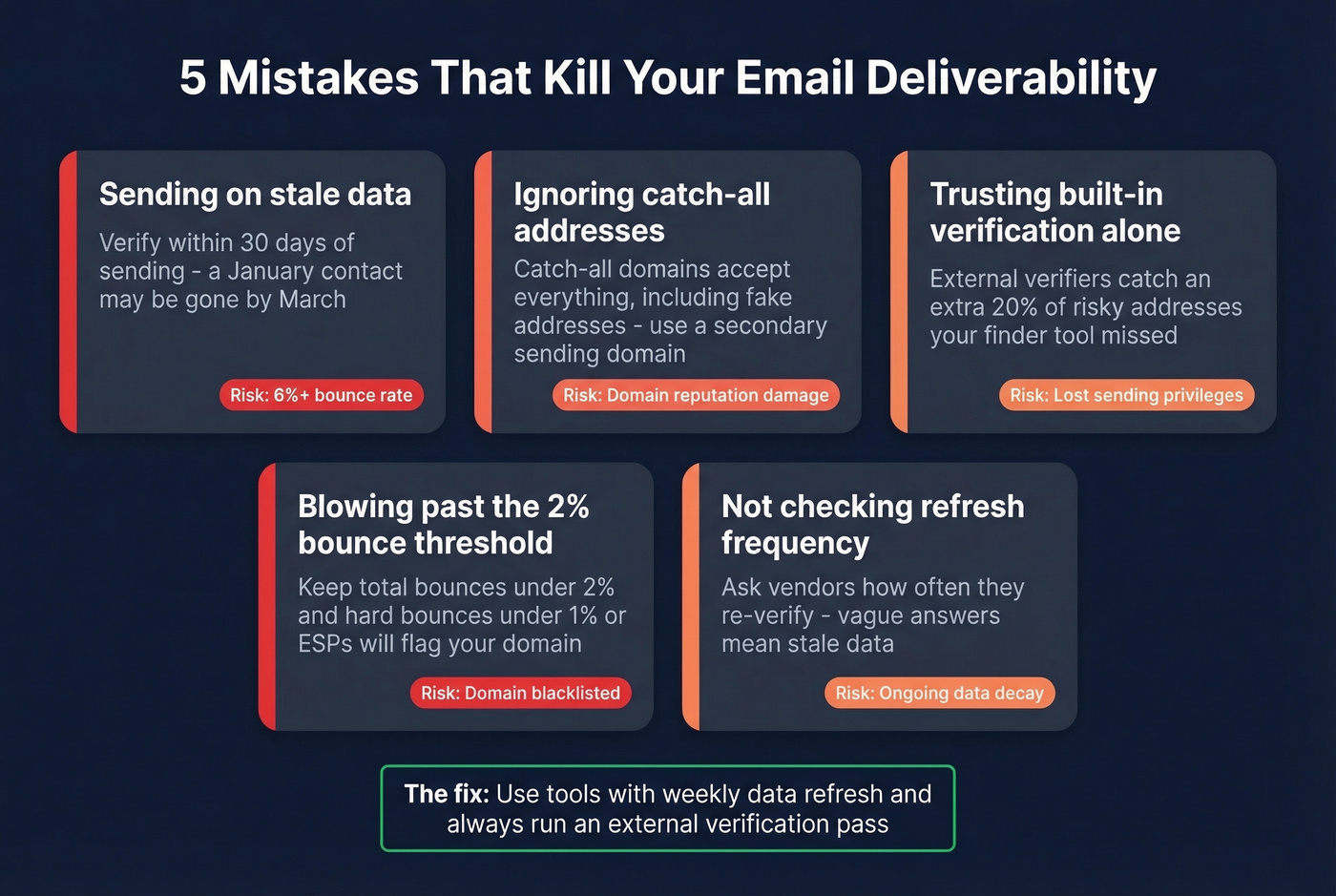
Sending on stale data. Verify emails within 30 days of sending. A contact who was valid in January may have changed jobs by March. Tools with weekly data refresh reduce this risk dramatically compared to the six-week industry average.
Ignoring catch-all addresses. Catch-all domains accept everything - including fake addresses. Separate these onto secondary sending domains so a bad batch doesn't torch your primary domain's reputation.
Trusting built-in verification alone. Running your list through an external verifier after your finder tool can flag an additional ~20% of addresses as risky. We've watched teams lose sending privileges after a single campaign on unverified data - that's the difference between a 2% bounce rate and a 6% bounce rate, and it happens faster than you'd think.
Blowing past the 2% threshold. Industry consensus is clear: keep total bounces below 2%, with hard bounces under 1%. One bad campaign can get your domain flagged by major ESPs.
Not checking refresh frequency before buying. Ask every vendor how often they re-verify their database. If the answer is vague, the data is probably stale. Validity's State of Email report consistently shows data decay as the top driver of deliverability problems.
If you need a deeper playbook, use our email deliverability guide to diagnose issues end-to-end.
You just read the accuracy benchmarks. 79%, 91%, 93% - none of them touch 98%. Prospeo's proprietary 5-step verification catches spam traps, honeypots, and catch-all domains before they torch your sender reputation.
Find emails that actually land in inboxes, not bounce logs.
Quick Compliance Note
GDPR fines can reach EUR 20M or 4% of global annual turnover - whichever is higher. Before signing with any email finder service, confirm they offer a Data Processing Agreement and honor opt-out requests. DSARs must be fulfilled within 30 days, and that obligation falls on you, not just your vendor. If a tool can't produce a DPA on request, walk away.
For the legal side of list sourcing, read our guide on buying email lists.
FAQ
What's the best free email address finder?
Prospeo gives you 75 free emails per month with verification included - enough to test real prospecting workflows. Hunter offers 50 free credits per month, but verification costs 0.5 credits each, so you get fewer usable contacts. Both have genuine free tiers, making them the easiest way to trial a tool before committing budget.
How accurate are email finder tools really?
Published benchmarks using 100 to 5,000 contacts produce wildly different rankings depending on methodology. Some tests rank ZoomInfo, Apollo, Hunter, and Lusha near the top; others produce very different results depending on whether you're doing domain-based or company-name searches. The real answer: test any tool against your own ICP list. Pull 50 contacts, send a test campaign, and measure your actual bounce rate. That one test is worth more than every benchmark article combined.
Do I need more than one email finder?
Most teams do best with one primary tool that has strong accuracy and fresh data, plus one verification layer as backup - two tools, not twelve. Over-stacking finders wastes budget, complicates workflows, and creates duplicate-management headaches in your CRM. Pick the best primary source and add a verifier if your bounce rate creeps above 2%.